A resilience framework for critical
infrastructure
Thayaparan, M, Ingirige, MJB, Pathirage, C, Kulatunga, U and Fernando, TP
Title
A resilience framework for critical infrastructure
Authors
Thayaparan, M, Ingirige, MJB, Pathirage, C, Kulatunga, U and Fernando,
TP
Type
Conference or Workshop Item
URL
This version is available at: http://usir.salford.ac.uk/id/eprint/41003/
Published Date
2016
USIR is a digital collection of the research output of the University of Salford. Where copyright
permits, full text material held in the repository is made freely available online and can be read,
downloaded and copied for noncommercial private study or research purposes. Please check the
manuscript for any further copyright restrictions.
For more information, including our policy and submission procedure, please
A Resilience Framework for Critical Infrastructure
M.Thayaparan
1, B.I.Ingirige
2*, C.P.Pathirage
1, U.Kulatunga
1and T. Fernando
11
Centre for Disaster Resilience, University of Salford, Salford, UK
2
Global Disaster Resilience Centre, University of Huddersfield, Huddersfield, UK
Abstract: Infrastructures facilitate economic growth, protect human health and the environment and promote
welfare and prosperity. Modern societies, therefore, rely heavily on continuous and reliable services provided critical infrastructure. Destructions to the infrastructure can lead to severe economic and social impacts and can also lead to loss of lives. To further complicate matters, modern infrastructures operate as a ‘system of systems’ with many interactions and interdependencies among these systems. Thus damage in one infrastructure system can cascade and result in failures and cascading effects onto all related and dependent infrastructures. To minimise such damages and impacts, it is vital to improve the resilience of critical infrastructure. This paper intends to present a resilience framework for critical infrastructure. Firstly a resilience definition has been established by reviewing the existing definitions. Then existing resilience frameworks were analysed to identity the suitable components for the proposed framework for critical infrastructure. Finally a layered approach framework has been developed to improve the resilience of critical infrastructure. The framework was developed based on comprehensive literature review. It was further validated with stakeholder feedback sessions. The framework consists of 4 layers that are independent and interdependent. Climatic hazards including current and future climate change, infrastructure, their networks and interdependencies, risks and impacts and capacities are the main layers. Each layer will have its unique features and its relationships with other layers. Climatic hazards will contribute to increased risks and impacts. Critical infrastructure is more vulnerable when exposed to climate hazard and uncertainty of climate change and will lead to risks and impacts. The capacities will help to determine the resilience level and will help to recue the risks and impact. The framework serves as a diagnostic model to determine the existing resilience level of critical infrastructure and to improve the resilience by making necessary changes to the layers.
Keywords: Capacities, Critical Infrastructure, EU-CIRCLE, Resilience
1. Introduction
Infrastructure systems, commonly referred to as the energy production & distribution systems, the chemical industry, water system, transportation, ICT Networks and public sectors, are one of the defining features of modern societies as they rely heavily upon them and their smooth operation to carry out our day-to-day activities. For example, water networks transport water for drinking, cooking, cleaning, cooling, for the production of raw materials and goods, for irrigation, whilst wastewater systems eliminate personal and manufacturing waste [1]. Infrastructures thus facilitate economic growth, protect human health and the environment and promote welfare and prosperity.
When infrastructure systems are damaged or fail, the smooth functioning of society is disrupted, with negative impacts on our ability to continue in our daily activities; well-being; and security. Damage or failure may result in severe economic losses and interruption of many services that we rely on [2]. Critical Infrastructure systems do not act alone as they are interdependent on many other systems at multiple levels and are deeply embedded within social systems in cities. Therefore, a disruption in
one system will create cascading impacts and consequences to the networked infrastructure system. For example, loss of an electricity substation may stop a water treatment plant from functioning; which may stop a hospital from functioning. This is a failure cascade chain that spans energy, water and healthcare systems [3]. Such failures are made worse because of the nature of our modern societies, which are characterised by high-density urban centres, high levels of material wealth, and rapid, immediate and interconnected lifestyles [4]. The societal disruption caused by infrastructure failures can frequently be disproportionately higher in relation to the actual physical damage [5]. It is for these reasons that the ability of systems to cope and bounce back from shocks, their resilience, is so important [4]. This nature of interdependency of infrastructure, therefore, demands a focus on the resilience of critical infrastructure and its networks.
need for resilience – for example, ICE’s state of the nation report: ‘Defending critical infrastructure’ [7]; the European Commission’s policy on the prevention of natural and man-made disasters [8], and the national response framework (NRF) prepared by the USA’s Federal Emergency Management Agency [9].
In this context, this paper presents a resilience framework developed for critical infrastructure. The paper first defines the term resilience for critical infrastructure, then it reviews some existing resilience frameworks in order to identify the necessary components for the proposed resilience framework and finally it presents the framework that has been developed and validated.
This paper is developed as part of an ongoing collaborative project titled pan-European framework for strengthening Critical Infrastructure resilience to climate change (EU-CIRCLE), which is funded European Union’s Horizon 2020 research and innovation programme. The paper was based on comprehensive literature review and synthesis. Several definitions for resilience have been analysed to define our own definition for resilience of critical infrastructure. Also 16 existing resilience frameworks were reviewed and analysed to understand their features and to identify the components for the proposed resilience framework.
Then the factors influencing critical infrastructure were identified. Both the resilience framework analysis together with the factors influencing critical infrastructure helped to develop the necessary components for the proposed resilience framework. The framework was presented to the potential stakeholders for validation purposes and the feedback received has been incorporated.
2. Resilience of Critical Infrastructure
Resilience has multiple meanings and is a term increasingly employed throughout a number of sciences: psychology, ecology, disaster planning, urban planning, political science, business administration and international development. It is a term that originally emerged from the field of ecology in the 1970s to describe the capacity of a system to function in the face of disturbance [10]. ‘Resilience’ has been defined in a number of different ways by various authors and organisations.
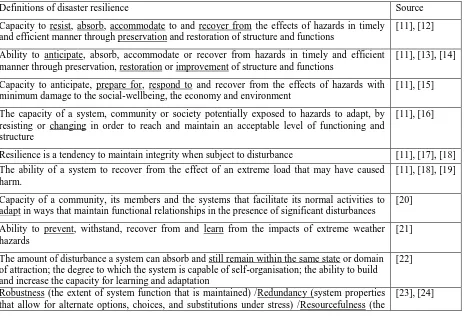
[image:3.595.64.532.468.787.2]This section reviews the definitions provided for the term resilience within the EU-CIRCLE Taxonomy [11] and other scientific literature in order to arrive at a comprehensive definition for use in the development of the resilience framework. Table 1 provides an overview of the definitions analysed.
Table 1: Resilience Definitions
Definitions of disaster resilience Source
Capacity to resist, absorb, accommodate to and recover from the effects of hazards in timely and efficient manner through preservation and restoration of structure and functions
[11], [12]
Ability to anticipate, absorb, accommodate or recover from hazards in timely and efficient manner through preservation, restoration or improvement of structure and functions
[11], [13], [14]
Capacity to anticipate, prepare for, respond to and recover from the effects of hazards with minimum damage to the social-wellbeing, the economy and environment
[11], [15]
The capacity of a system, community or society potentially exposed to hazards to adapt, by resisting or changing in order to reach and maintain an acceptable level of functioning and structure
[11], [16]
Resilience is a tendency to maintain integrity when subject to disturbance [11], [17], [18] The ability of a system to recover from the effect of an extreme load that may have caused
harm.
[11], [18], [19]
Capacity of a community, its members and the systems that facilitate its normal activities to adapt in ways that maintain functional relationships in the presence of significant disturbances
[20]
Ability to prevent, withstand, recover from and learn from the impacts of extreme weather hazards
[21]
The amount of disturbance a system can absorb and still remain within the same state or domain of attraction; the degree to which the system is capable of self-organisation; the ability to build and increase the capacity for learning and adaptation
[22]
Robustness (the extent of system function that is maintained) /Redundancy (system properties that allow for alternate options, choices, and substitutions under stress) /Resourcefulness (the
capacity to mobilize needed resources and services in emergencies)/ Rapidity (the time required to return to full system operations and productivity)
Ability of an asset, or system of assets, to continue to provide essential services when threatened by an unusual event and its speed of recovery and ability to return to normal operation after the threat has receded.
[11], [25]
A close look at the above definitions indicates the interpretation of resilience implies four concepts, though the boundaries between them are blurred.
- PREVENT - ability to predict and resist the impact – prepare for / anticipate / resist / prevent / preservation
- WITHSTAND - ability to sustain the damage – absorb / withstand / accommodate / robustness
- RECOVER - damage can occur but the system will be able to recover – respond to / recover / rapidity
- ADAPT - modifications to system – change / adapt / restoration / improvement / learn
Based on the above analysis, the definition of resilience in the context of critical infrastructure is the ability of the critical infrastructure system to
1. Prevent the impacts from climatic hazards by minimising the exposure of critical infrastructure to hazards and climate change;
2. Withstand the impacts from climatic hazards and climate change by reducing the magnitude and number of impacts;
3. Recover from the effects of climate hazards and climate change; and
4. Adapt through modification and improvements to the CI system
3. Analysis on existing resilience framework
The authors analysed 16 existing resilience frameworks, from which the main features were considered to incorporate within the proposed resilience framework. Few of such frameworks are presented in detail in this paper.
3.1 National Infrastructure System Model family (NISMOD)
The UK Infrastructure Transitions Research Consortium (ITRC) [26] is delivering research, models and decision support tools to enable analysis and planning of national infrastructure systems. As part of this, ITRC has tackled four major challenges as detailed below [26, p.3]
- Balancing infrastructure capacity and demand in an uncertain future
- Making the infrastructure more resilient by identifying the risks of failure
- Enabling the infrastructure system evolve and interact with society and the economy - A long term UK strategy be for integrated
provision of national infrastructure
[image:4.595.318.539.358.509.2]The National Infrastructure System Model (NISMOD) family contains four components such as a model for long-term performance, a model of risk and vulnerability, a model for regional development and a national database of infrastructure networks. The long-term performance model presented in Figure 1, is the focus, as it constitutes infrastructure resilience.
Figure 1: National Infrastructure System Model - Long-term Performance - NISMOD-LP [26]
The factors that influence demand for infrastructure services in future are combined with the alternative strategies for infrastructure provision. Combinations of scenarios and strategies are input into the modules that compute demand for various infrastructure system models such as energy, transport, digital communications, water, wastewater and solid waste, now and in the future. The model then outputs sets of metrics for future infrastructure performance.
INTERDEPENDENT LAYERS − three-layered grid of the Baltic Sea LAYER OF DYNAMIC THREATS
coming from/to: − shipping, − port operations.
coming from/to: − pipelines, − electric cables, − oil rigs, − wind farms.
LAYER OF CLIMATIC HAZARDS (NATURAL) HAZARDS
coming from/to: − winds, − waves, − sea water, − air, − precipitation, − ice conditions, − fog.
THREE-LAYERED GRID OF THE BALTIC SEA THREATS scale depending on the number
of vulnerable critical infrastructures
− none,
− one, − two,
− three,
− four, − five or more. LAYER OF STATIC THREATS
C O N S E Q U E N C E S TO/FROM CRITICAL INFRASTRUCTURES
port infrastructure energy infrastructure
transport infrastructure
[image:5.595.62.260.112.331.2]A layered approach has been proposed concerning the critical infrastructures and their networks at the Baltic Sea Region as illustrated in Figure 2.
Figure 2: The model of area-picture of potential threats from/to critical infrastructures in the Baltic
Sea Region [27]
The elements of those critical infrastructures and their networks, on the one hand, may be vulnerable to damage caused by external factors and on the other hand, may pose actual or potential threats to other critical infrastructures and networks. The expected threats associated with the critical infrastructures located in the Baltic Sea area have been divided into 3 layers of dynamic threats; static threats and natural hazards associated with weather and climate change.
As critical infrastructures are often interconnected and interdependent, the combination of these three layers can help to indicate critical infrastructures, which can be affected and can affect other critical infrastructures in fixed area of the Baltic Sea Region. This in turn will help to determine the critical infrastructures based on their level of vulnerability.
3.3 UNISDR Disaster Resilience Scorecard for Cities
The Disaster Resilience Scorecard has been prepared by UNISDR and provides a set of assessments that allow cities to gauge how resilient they are to natural disasters. The aim of the scorecard is to aid cities to establish a baseline measurement of their current level of disaster resilience, to identify priorities for investment and action, and to track their progress in increasing
their disaster resilience over time. It is made up of 85 disaster resilience evaluation criteria which focus on the research, organisation, infrastructure, response capability, environment and recovery. The scorecard is based on the UN’s ten essentials and of particular relevance to this paper is essential four which is invest in and maintain critical infrastructure that reduces risk, such as flood drainage, adjusted where needed to cope with climate change. The scorecard treats the topic of resilient infrastructure by subdividing it into issues, and offering measurement indicators and measurement scales.
3.4 The Climate Resilience Framework
The Climate Resilience Framework (CRF) provides a conceptual framework for assessing vulnerabilities and risks, identifying resilience strategies and creating an open, inclusive learning process to identify specific measures and processes that can address the uncertainties of climate change through action and implementation [28, p.9].
The CRF that has been developed by the Institute for Social and Environmental Transition-International (ISET-International) has a combination of two loops as indicated in Figure 3.
Figure 3 Climate Resilience Framework [29]
[image:5.595.317.536.425.567.2]Defining Disaster Resilience: A DFID Approach Paper 7
2.2 How resilient is a country, community or household?
Determining levels of resilience is an important part of understanding the concept. And most definitions of resilience share four common elements which can be used to do this: context; disturbance; capacity; and reaction. Together these elements form a resilience framework (see below) which can be used to examine different kinds of resilience (for example, of growth or of governance systems) and help determine the level of resilience that exists.
The four elements of a resilience framework
Exposure
Stresses Shocks
Adaptive capacity 2. Disturbance
e.g. natural hazard, conflict, insecurity, food shortage, high fuel
prices.
3. Capacity to deal with disturbance
4. Reaction to disturbance e.g. Survive, cope,
recover, learn, transform.
Bounce back better
Collapse Bounce back
1. Context e.g. social group, region, institution.
Sensitivity System
or
Process Recover
but worse than before
Resilience of what?
Resilience to what?
The framework above is a simplified representation of the elements to be considered when examining resilience. In practice the picture is more complex: the response curve could be slow and uneven due to, for example, the political context, secondary shocks or lack of information. Stresses can be cumulative, building slowly to become a shock, and both shocks and stresses may result in a number of different reactions.
Each element of the resilience framework is explored below with specific reference to disaster resilience.
WHAT IS DISASTER RESILIENCE?
has three core components: systems, agents and institutions. The framework further identifies the factors and characteristics of each of these components that are important to enhance and to identify the indicators to measure the success.
3.5 DFID’s resilience framework
[image:6.595.59.276.298.460.2]The Department for International Development [30, p.6] defines resilience as the ability of countries, communities and households to manage change, by maintaining or transforming living standards in the face of shocks or stresses without compromising their long-term prospects. The resilience framework built upon this definition has used four elements such as context; disturbance; capacity to deal with disturbance; and reaction to disturbance as shown in Figure 4.
Figure 4: DFID’s Resilience Framework [30]
The framework emphasises that resilience should always be contextualized in order to answer the question of ‘resilience of what’, as the significance of resilience differs across a range of different contexts. The next stage is to understand the disturbance to address the question ‘resilience to what’ where they have considered the immediate shocks and the long-term stresses as the main forms of disturbances. The third step is about the ability of the system or process to deal with the shock or stress based on the levels of exposure, the levels of sensitivity and adaptive capacities. The final step is the reaction to disturbance, which might be ‘bounce back better’ for the system or process concerned in the best case [30].
3.6 The PEOPLES Resilience Framework
PEOPLES resilience framework has been established for defining and measuring disaster resilience for a community at various scales.
Seven dimensions characterizing community functionality have been identified and are represented by the acronym PEOPLES: Population and Demographics, Environmental/ Ecosystem, Organized Governmental Services, Physical Infrastructure, Lifestyle and Community Competence, Economic Development, and Social-Cultural Capital as depicted in Figure 5. The proposed PEOPLES Resilience Framework provides the basis for development of quantitative and qualitative models that measure continuously the functionality and resilience of communities against extreme events or disasters in any or a combination of the above-mentioned dimensions [31].
Figure 5: PEOPLES Resilience Framework [31]
The framework has seven layers, where interdependencies between and among these layers are key to determine the resilience of communities. The disaster resilience of communities is measured at different scales ranging from individual to groups, local, regional, state, national and global levels. Further the framework has established a comprehensive list of components and subcomponents of each dimension of the framework (refer Renschler [31] for the complete list). A software (Personal BrainTM) platform is used which is capable of linking and dynamically visualizing all seven PEOPLES dimensions in multiple layers of components and properties of functionality and resilience as well as pointing to information about quantitative and qualitative concepts, algorithms or models in various databases. This model also provides the flexibility to overlay the layers or even to add layers depending on the context.
3.8 Synthesis
Change Adaptation and Resiliency Framework, Vulnerability to Resilience (V2R) framework, the city resilience framework, city strength diagnostic: resilient cities programme, Singapore’s adaptation approach, various conceptual models on organisational resilience. The review of several existing resilience frameworks indicates noticeably that hazards, risks and vulnerability should essentially be part of the resilience framework. The other component is the capacity of the system to deal with the disaster in order to improve the resilience. As illustrated in Figure 5 framework it is important to focus on the ‘resilience of what’ and ‘resilience for what’ questions, as we intend to develop the resilience framework for a particular system. As such the focus on proposed framework should be specifically given for the resilience of critical infrastructure for climate hazards. Another observation noted within some of the frameworks is the multi-dimensional approaches. The critical infrastructure system could involve more than one resilience parameters and therefore the framework would possibly take a multi-dimensional form. Considering the nature and incorporation of multidimensional components within the resilience framework a layered approach would be preferable as it has the flexibility to modify each layer (each component) independently and yet the collective output will be based on the interconnection between the layers. Further, the interdependency nature of critical infrastructure and the current and future climate change are the main factors influencing critical infrastructure, thereby incorporated within the framework appropriately. In summary the resilience framework will potentially have multi-dimensional components, incorporating risks and capacities with the focus on critical infrastructure, their networks and interdependencies and climate hazard including the current and future climate change. The next section illustrates the resilience framework developed for critical infrastructure.
3. Resilience Framework of Critical Infrastructure
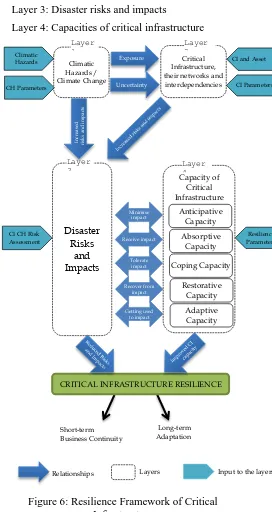
The EU-CIRCLE resilience framework will help to determine what constitutes resilience. The framework consists of 4 layers as listed below and illustrated in Figure 6.
Layer 1: Critical Infrastructure (CI), their networks and interdependencies (the context)
Layer 2: Climatic Hazard (CH), including current and future climate change (the disturbance)
Layer 3: Disaster risks and impacts
[image:7.595.304.576.62.574.2]Layer 4: Capacities of critical infrastructure
Figure 6: Resilience Framework of Critical Infrastructure
In addition to these 4 layers the framework adopts several other components that influences these layers. Some of the key components are the parameters associated with climate change such as frequency of the event, magnitude of the event, anticipated level of impact on CI, future climate change projections, nature of uncertainties etc.; parameters associated with critical infrastructure such as lifecycle, age of infrastructure, location of infrastructure, state of maintenance, level of exposure to climatic hazards, level of interdependencies etc.; parameters associated with capacities such as resistance, reliability, redundancy, response, recovery, adaptation; and
Anticipative Capacity
Adaptive Capacity Restorative
Capacity Absorptive
Capacity
Coping Capacity Capacity of
Critical Infrastructure
Short-term Business Continuity
Long-term Adaptation
CI CH Risk Assessment
CRITICAL INFRASTRUCTURE RESILIENCE
Input to the layers
Resilience Parameters Disaster
Risks and Impacts
Layer
3 Layer 4
Layers Climatic
Hazards / Climate Change
Critical Infrastructure, their networks and interdependencies Exposure
Uncertainty Layer
1
Layer 2
CI and Asset Climatic
Hazards
CH Parameters CI Parameters
Relationships
In
cr
ease
d
ri
sk
s
an
d
imp
ac
ts
Minimise impact
Receive impact
Tolerate impact
Recover from impact
parameters associated with risks such as tolerance level, network strengths, susceptibility of critical infrastructure etc.
Climatic hazard contributes to disaster risks. Critical infrastructure, when exposed to climate hazard and uncertainty nature of climate change, will also lead to increased disaster risks and impacts. Improving the capacity of critical infrastructure can reduce the level of risks and impacts. Different types of capacities are identified within the framework, which helps to deal with the disaster risks and impacts. Improved capacity and reduced risks and impacts would lead to critical infrastructure resilience. Further the CI resilience has two main time frameworks, the Short term, linked to business continuity and
long term, linked to adaptation.
5. Conclusions
The term resilience carries a number of different definitions. One of the purposes of this paper is to define the term resilience that can be used in the context of critical infrastructure. A comprehensive definition for resilience has been established having analysed most of the existing definitions for the term resilience. Hence, the definition of resilience in the context of critical infrastructure (CI) is the ability of a CI system to prevent, withstand, recover and adapt from the effects of climate hazards and climate change. The paper also presented the resilience framework developed for critical infrastructure. 16 existing resilience frameworks have been analysed and this analysis provided a sound basis to identify the necessary components for the EU-CIRCLE resilience framework. Few of the key frameworks analysed are presented in this paper. In addition to existing framework the factors influencing critical infrastructure have also been studied, as they need to be essential part of the framework of resilience. The resilience framework has been developed as a layered approach which has 4 layers designated such as climatic hazard, climate change; critical infrastructure, their networks and interdependencies; disaster risks and impacts; and capacity of critical infrastructure. Each layer will be fed with different data and parameters to determine the resilience of critical infrastructure and to further improve the level of resilience. The framework presented in this paper has been partly validated with the feedback received from the potential stakeholders of the framework.
Acknowledgements
The paper is written based on an on-going collaborative research project titled EU-CIRCLE (A pan-European framework for strengthening critical infrastructure resilience to climate change). EU-CIRCLE is a project that has received funding from the European Union’s Horizon 2020 research and innovation programme. This publication reflects the views only of the authors and the EU-CIRCLE consortium members and the Commission cannot be held responsible for any use, which may be made of the information contained therein. The authors would like to acknowledge the consortium members who provided their contribution to the development of resilience framework especially Gdynia Maritime University, Poland; University of Applied Sciences Velika Gorica, Croatia; Fraunhofer-Gesellschaft Zur Foerderung Der Angewandten Forschung E.V, Germany; European University of Cyprus, Cyprus; National Protection and Rescue Directorate of the Republic of Croatia, Croatia; University of Exeter, UK; ARTELIA Eau et Environnement SAS, France; and National Center for Scientific Research - Demokritos, Greece. Please see http://www.EU-CIRCLE.eu/ for more information.
References
[1]. National Institute of Standards and Technology (2015) NIST Special Publication 1190: Community Resilience Planning Guide for Buildings and Infrastructure Systems Volume 2. [2]. National Institute of Standards and Technology (2015) NIST Special Publication 1190: Community Resilience Planning Guide for Buildings and Infrastructure Systems Volume 1. [3]. IBM and AECOM, 2015, UNISDR Disaster Resilience Scorecard for Cities, http://www.unisdr.org/campaign/resilientcities/h ome/toolkitblkitem/?id=4 [accessed 15 May 2015]
[4]. Rogers, C.D., Bouch, C.J., Williams, S., Barber, A.R., Baker, C.J., Bryson, J.R., Chapman, D.N., Chapman, L., Coaffee, J., Jefferson, I. and Quinn, A.D., 2012, June. Resistance and resilience–paradigms for critical local infrastructure. In Proceedings of the Institution of Civil Engineers-Municipal Engineer (Vol. 165, No. 2, pp. 73-83). Thomas Telford Ltd. [5]. Chang, S.E. 2014, "Infrastructure resilience to
disasters", The Bridge, vol. 44, no. 3.
[6] Sandia National Laboratories, 2014 Annual report, Laboratory Directed Research and Development.
[7]. Institution of Civil Engineers (2009) State of the Nation Defending Critical Infrastructure [8]. European Commission, 2009, A Community
man-made disasters [online], http://eur-lex.europa.eu/ [accessed 24 July 2015]
[9]. Federal Emergency Management Agency, 2016, National Response Framework, 3rd ed. [online],
http://www.fema.gov/national-response-framework [accessed 18 June 2016]
[10]. Holling, C.S. 1973, "Resilience and stability of ecological systems", Annual Review of Ecology and Systematics, pp. 1-23.
[11]. EU-CIRCLE , 2015, EU-CIRCLE Taxonomy [online],http://www.eu-circle.eu/research/ deliverables/ [accessed 10 December 2015] [12] EU-ADAPT, EC Climate-ADAPT compilation
of terms from the IPCC's 4th assessment reports of the different working groups (Working Group I, II and III) and the UNISIDR, http://climate-adapt.eea.europa.eu/glossary [13] IPCC, 2012, Summary for Policymakers. In:
Managing the Risks of Extreme Events and Disasters to Advance Climate Change Adaptation [Field, C.B., V. Barros, T.F. Stocker, D. Qin, D.J. Dokken, K.L. Ebi, M.D. Mastrandrea, K.J. Mach, G.-K. Plattner, S.K. Allen, M. Tignor, and P.M. Midgley (eds.)]. A Special Report of Working Groups I and II of the Intergovernmental Panel on Climate Change. Cambridge University Press, Cambridge, UK, and New York, USA, p. 1-19. [14] UNISDR, 2009, Terminology [Online],
http://www.unisdr.org/we/inform/terminology [accessed 8 November 2005]
[15] US Environment Protection Agency (EPA), 2015, Glossary of Climate Change Terms [online], http://www.epa.gov/climatechange/ glossary.html#C [accessed 8 November 2015] [16] UNISDR, 2004, Terminology: Basic terms of
disaster risk reduction [online], available from
http://www.unisdr.org/2004/wcdr-dialogue/ terminology.htm [accessed 8 Nov 2015] [17]. Burton, I., & Development Programme United
Nations. (2005). Adaptation policy frameworks for climate change: developing strategies, policies and measures (p. 258). B. Lim (Ed.). Cambridge: Cambridge University Press. [18] Levina E. and Tirpak D., 2006 Adaptation to
climate change: key terms. Organisation for Economic Co-operation and Development (OECD), International Energy Agency
[19] UK CIP (2003). Climate Adaptation: Risk, Uncertainty and Decision-making. UKCIP Technical Report, Oxford, Willows, R. I. and R. K. Cornell (eds.)
[20] Paton D. (2007) Measuring and monitoring resilience in Auckland. GNS Science Report 2007/18. Institute of Geological and Nuclear Sciences Limited.
[21] Hallet S. (2013) Community Resilience to Extreme Weather – the CREW Project: Final Report. 110.
[22] Carpenter, S.R., B.H. Walker, J.M. Anderies and N. Abel. 2001. From metaphor to
measurement: resilience of what to what? Ecosystems 4, pp.765–781.
[23] McDaniels T, Chang S, Cole D, Mikawoz J and Longstaff H. (2008) Fostering resilience to extreme events within infrastructure systems: Characterizing decision contexts for mitigation and adaptation. Global Environmental Change, 18(2), 310-318.
[24] Bruneau, M., S. Chang, R. Eguchi, G. Lee, T. O’Rourke, A. Reinhorn, M. Shinozuka, K. Tierney, W. Wallace, and D. von Winterfelt. 2003. A framework to quantitatively assess and enhance the seismic resilience of communities. Earthquake Spectra 19(4): 733–752.
[25] McBain W., Wilkes D., Retter M. Flood resilience and resistance for critical infrastructure, CIRIA, London, ISBN: 978-086017-688-6, 2010
[26] UK Infrastructure Transitions Research Consortium (ITRC, 2015), Providing the concepts, models and evidence to inform the analysis, planning and design of national infrastructure systems [Online],
http://www.itrc.org.uk/wp-content/ITRC-booklet-final.pdf [accessed 5 January 2016]. [27] GMU, Identification of existing critical
infrastructures at the Baltic Sea area and its seaside, their scopes, parameters and accidents in terms of climate change impacts, 2016 (unpublished)
[28] Friend, R and MacClune, K. (2013), Climate Resilience Framework: Putting Resilience Into Practice, [Online] Available from:
http://i2ud.org/wp- content/uploads/2011/06/CCA-concept-paper1.pdf [Accessed 20 December 2015] [29] Institute for Social and Environmental
Transition-International (ISET-International), Boulder, CO USA [Online], http://i-s-e- t.org/resources/working-papers/resilience-into-practice.html [accessed 20 December 2015] [30] Department for International Development,
2011, Defining Disaster Resilience: A DFID Approach, DFID, UK.
![Figure 1: National Infrastructure System Model - Long-term Performance - NISMOD-LP [26]](https://thumb-us.123doks.com/thumbv2/123dok_us/8701128.879548/4.595.318.539.358.509/figure-national-infrastructure-system-model-long-performance-nismod.webp)
![Figure 3 Climate Resilience Framework [29]](https://thumb-us.123doks.com/thumbv2/123dok_us/8701128.879548/5.595.62.260.112.331/figure-climate-resilience-framework.webp)
![Figure 5: PEOPLES Resilience Framework [31]](https://thumb-us.123doks.com/thumbv2/123dok_us/8701128.879548/6.595.59.276.298.460/figure-peoples-resilience-framework.webp)