Developing a project management case
study from history
Procter, CT and KozakHolland, MP
Title Developing a project management case study from history Authors Procter, CT and KozakHolland, MP
Type Conference or Workshop Item
URL This version is available at: http://usir.salford.ac.uk/45167/ Published Date 2015
USIR is a digital collection of the research output of the University of Salford. Where copyright permits, full text material held in the repository is made freely available online and can be read, downloaded and copied for noncommercial private study or research purposes. Please check the manuscript for any further copyright restrictions.
1
Paper presented to BAM conference Portsmouth 2015 Track 13
‘Management and Business History’
Title: Developing a Project Management Case Study from History
Abstract
Peter Morris argues that the depth of understanding of one’s history is a measure of the maturity of a discipline (Morris, 2013). By this measure Project Management is an immature discipline. The consequence of this is a significant gap between theory and practice, where research has little impact, and where project failures are repeated in a cycle of tragedy and farce. As Geraldi and Soderlund (2012) eloquently suggest, by revisiting our past we can create the future.
Historical case studies empower us to expand our knowledge base beyond prescriptive bodies of knowledge, potentially breaking cycles of project failure.
This paper outlines known historical case studies, showing their relevance to contemporary project management. Research into these projects is not unique but the application of a project management lens is new. The paper provides a description of the methods and techniques of research used, which can be adapted by students of project management to develop their own case studies of direct relevance to their own contexts and societies.
2
1 Introduction
The paper summarises four case studies with key project management lessons from each. Following these examples it discusses the value of interpretive research (and case studies in particular) to develop our understanding of historical project management. Then it outlines the method that was deployed in these case studies in a step by step process.
The research approach is to gather and integrate existing documentation from different disciplines about well known case studies and, from this evidence, reinterpret existing
knowledge. The reinterpretation is conducted using a project management lens so that historical case studies can be understood by contemporary project managers, and be of significant value to contemporary business practice.
2 The case studies
The four case studies that are discussed are as follows:
1. The Florence Duomo (cathedral) 2. The Titanic
3. The Great Escape 4. The Giza pyramid
In each case the information provided about the project is fairly brief since this is published elsewhere. The paper concentrates on the contemporary lessons in project management that can be drawn from these cases.
2.1 Florence Duomo project
The dome of the Florence Duomo was designed and project managed by Filippo Brunelleschi in the fifteenth century. It was the most significant dome project in Europe in 1300 years, and possibly the most significant, innovative and complex project of the Renaissance era (Colombo and Lanzavecchia, 1997). Whilst the body of the cathedral in Florence had been completed in 1367, for the next 50 years it had a 42 metre hole in the centre of the chancel. The Catholic church wanted the most magnificent dome in Europe as a great symbol of their international prestige but it appeared to be technically impossible to build a dome on such a scale. In order to design the dome, Brunelleschi researched and adapted the construction and project management of the Pantheon in Rome in the second century securing the contract in 1417. The dome was completed in 1436 and still stands as the largest brick dome ever built. The project required substantial innovation in construction and adoption of project management best practice. Brunelleschi sought to not only adopt, where relevant, the product innovations of the Pantheon project, but also to incorporate process learning as well.
2.1.1 Lessons Learned for Project Management
3
key drivers of project management success, and illustrates the substantial potential for learning, and therefore knowledge transfer, from previous historical projects and experiences.
The project demonstrates the value in rediscovering, interpreting, transferring, and transforming best practices (knowledge) between historical projects. Without the Pantheon Brunelleschi could not have delivered the Duomo. In turn the lessons from the Duomo project are directly relevant to contemporary management of large projects that are politically and technically complex. The examination of the Duomo project shows how both product and process innovations can in turn develop “our organisational creativity and collaborative management” (Hartley, 2006), which are essential elements of effective project management.
2.2 The Titanic
An examination of this case study shows how the decisions made during the design,
construction, and sea trials (testing) compromised the ship’s integrity and left it vulnerable to disaster. It challenges conventional wisdom that the situation was outside of the control of the captain and officers who have been depicted as mere bystanders incapable of changing the course of events. The 1912 disaster was not down to bad luck, an accident, or unforeseen forces of nature. The seeds of disaster were sown as Titanic was designed, and there was a long chain of mistakes in the project.
The 1908 White Star project for the three Olympic-class luxury mega ships (Olympic, Titanic, and Britannic) started off well with its initiation and planning phases, but as it progressed aesthetics were prioritised above design. The project sponsor overstepped his role and in an obsessive way controlled the project to meet his agenda. Poor project management allowed major compromises to be made in every project stage from design to construction to testing, and right into implementation and operation. Those in the design stage were most significant, such as the shortened height of the bulkheads, or the reduced number of lifeboats. In today's terms these are known as compromises to the non-functional requirements.
Olympic went into service first, nine months ahead of Titanic. In this period Olympic had a number of incidents that had a direct impact on Titanic’s project. Early in its life the Olympic collided with H.M.S. Hawke. This played a significant part in Titanic's project schedule as major repairs had to be carried out and resources were diverted from the building of the Titanic. As the project ran into trouble the sponsor took greater risks to meet pre-set deadlines. The scope of Titanic's sea trials (testing) was dramatically reduced so the maiden voyage could still be realized as Titanic was rushed into service to meet commercial pressures.
4
overloaded with commercial traffic, and the lookout’s missing binoculars) resulted in grounding the ship onto an ice shelf.
2.2.1 Lessons Learned for Project Management
The scenarios in this case study provide salutary lessons for today’s complex projects and highlight how project managers need to bring a balance to the requirements management
process, and avoid compromises to the design in order to meet aesthetic factors. The de-scoping of a project’s non-functional requirements should be avoided as this is very dissimilar to
reducing functional requirements, and can be very costly in the longer term. This is a problem not well understood by business stakeholders and typically outside of their comfort zone. Project managers need to ensure that the project steering committee/ board and sponsor are fully
engaged in the project and understand their role, and decisions being made. For example, with granular decisions made by the project team the associated risks need to be aggregated and summarised back to the committee. Otherwise a well meaning sponsor or committee member can unwittingly compromise the project even with well defined governance.
2.3 The Great Escape
The Great Escape from the prison camp Stalag Luft III in March 1944 is widely regarded as one of the most audacious and daring escape attempts of the 20th century. It also had all the
hallmarks of a great project, with complex timelines, limited resources, dire situation, and a hostile environment.
Everything in Stalag Luft III was set up to prevent escape. The project was confronted by a myriad of obstacles; for example, an intimidating scope, no budget, intolerable time constraints, new problems appearing every day, hostile groups trying to close the project down, a
continuously changing environment, and a stringent penalty system (2 weeks solitary). The project team had to stave off hunger and psychological pressures. It required a lot of planning, preparation, and team work.
Everything had to be thought through and assessed, including continuous risk analysis. The project team had to adapt to changing and unexpected daily situations.
Basic resources were scarce so every possible resource was used. Bed boards were plundered to make braces for the tunnels. Red Cross packages were pooled to use as rewards or bribes. Rubber boot heels were carved to make "official" stamps for forged documents required on the outside.
5
2.3.1 Lessons Learned for Project Management
The case study allows us to learn about the organisational aspects of the project like unifying an organisation (i.e., the prisoners of the camp) to work on one priority project. Slender resources were focused on critical tasks and the work effort was maximized by matching skill sets against project activities. The camp was a gold mine of human talent with artists, engineers, tailors and tradesmen whose skills could be applied. The team had to be resourceful, and reuse and recycle everything.
The case study also demonstrates the need to create contingencies around core activities, so that if these are interrupted the project can continue. This required considering all the intangibles that could affect the scope, calendar and the seasons, and the dynamic nature of the project. The project manager had to be tactically astute and continuously assess the risks.
2.4 The Giza Pyramid Project
This is an iconic structure and the only surviving wonder of the ancient world (one of seven). It was built in a timeframe of 20 years and dwarfed anything in its heyday. It has survived intact for 4,500 years despite being hit by earthquakes. The project pushed the limits of technologies, materials, and resources with the heights and stability of the structure, and the complexity and integrity required for the internal chambers. The technical challenges still baffle experts today, considering the primitive tools and equipment (no wheel or pack animals) available to the project. For example, the pyramid needed to be precisely centred and aligned to a true north-south axis. Throughout the construction the builders had to deliver the limestone blocks
weighing 1.5 tons each, up to a height of 148 metres and a precise position in the structure. They measured and calculated the position of the corners to the centre, the angle of inclination of the ridges and lateral surfaces. If the centre shifted then the overall pyramid shape would be
distorted. The internal chambers required relief from the full weight of the pyramid above.
The height is the equivalent to a modern 48-story building, with 203 layers to its summit the structure is made up of 2.3 million limestone blocks, two-thirds of the size of Hoover Dam. Analysis of the project demonstrates that project management is not a new discipline. It suggests that the core knowledge areas of Project Management, as defined today, were used extensively in great historical projects.
2.4.1 Lessons Learned for Project Management
The project delivered levels of quality that would be difficult to match today. For example, the Pyramid’s base has incredible accuracy. Each side is 230 meters (767 ft) in length and almost perfectly level to within 15 millimetres. The site was levelled within a fraction of a centimetre over the entire 13.1-acre (5.3 hectares) base. A perfectly level base was required since
inaccuracies of centimetres at the bottom would translate into meters at the top.
6
delivering an extravagant royal tomb. It was very much a “public works” project which required massive institutional intervention in the agricultural economy (Kemp, 1989, pp.319). It was a catalyst to sparking an import and export economic boom through the extensive supply chain created by the project. It maintained the economic wellbeing of Egypt and kept the fledgling nation unified.
The project dealt with comparable issues and had many similar characteristics to contemporary projects like the multiple competing constraints of scope (reduced by building in and near limestone quarries), schedule (delivery within 20 years), budget (offset by an economic boom), quality (perfectly level base), resources (availability of and their organization), and risk
(quarrying of 2 million 1 ton limestone blocks, and delivering to site).
3. Overall Approach
Selecting a research methodology for project management depends on a research philosophy and its dimensions namely the ontology (essence of the subject), and the epistemology that is the reliability of our knowledge about the subject (Morris 2010, pp. 141).
3.1 Philosophy
There is a developing recognition (Gauthier and Ika, 2013, pp. 5) that there needs to be a closer relationship between research theory and practice in Project Management, and that the
philosophy of this research needs to be made explicit (Biedenbach and Muller, 2011, pp. 98). The predominant philosophical perspective is positivist offering a simplistic view of projects. Smyth & Morris argue that positivism is simply unsuitable for addressing many project issues, except in the few cases where a simple closed system is in evidence ( 2007, pp. 427). Geraldi and Soderlund argue that these limitations are inadequate for researching historical projects.
Historical case studies require a move towards interpretivism, examining projects broadly and diversely where project complexity, actuality and contextualisation are all important
considerations (2012, pp. 570). Maylor and Soderland support this view suggesting that interpretive research allows us to uncover the human factors involved in projects:
...hard skills [Positivism] are focused on the administrative tasks, in particular the use of the toolsets within project management, and associated with a hard systems worldview. Soft skills [Interprevitism] enable working through and with people and groups, and with that, handling the associated human factors. (Maylor and Söderlund, 2012, pp. 689)
3.1.1 Ontology
7
existence, an object to study, a being or reality. The ontology of today’s project management did not exist in any given historical period. Gauthier and Ika (2013, pp. 12) argue that the meanings and conceptions of project and project management will vary according to the historical periods of the social world—pre-modern, modern, postmodern, and hypermodern (late modern).
3.1.1.1 Historical Context and Contextualisation
Historical context needs to be carefully considered when researching and examining past projects. This refers to the attitudes, conditions, and views in a historical period. It is the setting for an event that occurs, and has impact on the relevance of the event. Grattan (2008, pp. 182) warns that:
The contextual environment of these [historical] studies, however, is so complex and diverse that acceptable generalisations are difficult to derive.
For historical research, contextualisation is the act of placing events into a proper context that is to appreciate the particular policies, institutions, worldviews, and circumstances that shape a given moment in time.
3.1.2 Epistemology
Morris (2010, pp. 141) defines the reliability of our knowledge about the subject as its
epistemology which depends on the research methodology but most importantly on the kind of knowledge available. For historical projects this knowledge is predominantly based on a world of social science drawn from historical records, eyewitness accounts of events, narratives, biographies, personal diaries, and oral histories. Interpretivism evaluates the truth of the historical evidence of the past and analyses it in a depersonalized but empathetic manner to create knowledge or learning (Grattan, 2008, pp. 276).
3.2 Research Methodology
Morris points out that (2010, pp. 143) crafting a sound approach to framing the research issue and collecting reliable and appropriate data lies at the heart of good research. Its interpretation should be scrupulous, and the argumentation rigorous. Kaplan (1964, pp. 18) defined
methodology as:
...the study—the description, the explanation, and the justification — of methods, and not the methods themselves.
There has been much criticism (Smyth and Morris, 2007, pp. 424) that researchers into
contemporary project management pay little attention to the selection of a research methodology. This section examines research methodologies for both contemporary and historical project management. A combination of these was used and evolved in the case studies discussed above.
3.2.1 Qualitative Research Framework
8
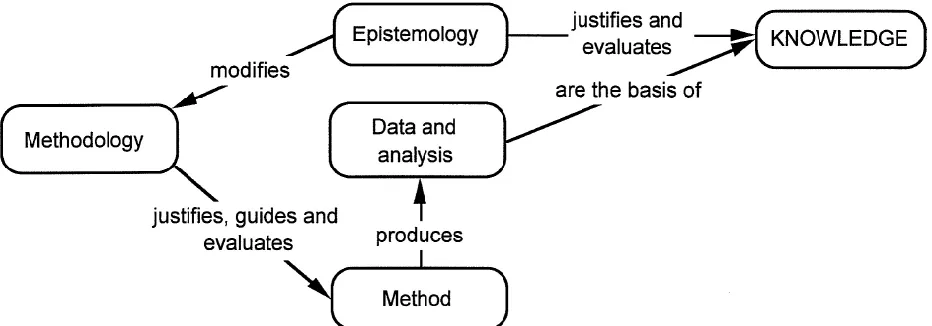
Epistemology guides methodological choices and is axiological. Methodology shapes and is shaped by research objectives, questions, and study design. Methodologies can
prescribe choices of method, resonate with particular academic disciplines, and
[image:9.612.78.544.154.317.2]encourage or discourage the use and/or development of theory. Method is constrained by and makes visible methodological and epistemic choices.
Figure 1: The simple relationship between epistemology, methodology, and method (Carter and Little, 2007, pp. 1317)
According to Petty et al (2012, pp.269):
...qualitative research helps to understand human experience and meaning within a given context using text rather than numbers, interpreting experience and meaning to generate understanding, and recognizing the role of the researcher in the construction of knowledge.
3.3 Selecting a Research Methodology for Historical Project Management
There are two primary qualitative methodologies; case study research and historiography advocated for researching historical project management. Both were used extensively. A third supportive methodology, interdisciplinarity, is also of great relevance.
3.3.1 Case Study Research
3.3.1.1 Significance
Case study research is important to project management. By definition it consists of a detailed investigation that attempts to provide an analysis of the context and processes involved in the phenomenon under study (Yin, 1994). This includes both single and multiple case studies. According to Smyth and Morris (2007, pp. 427) case study research is used extensively in management and:
9
The case study approach can include ‘‘war stories’’, which can introduce perception and interpretation in method and link to hermeneutical or interpretative methodologies. There is a link here to the grounded theory method, which also begins to introduce other methodologies by implication.
Willis (2007,pp. 239-240) suggested case studies are:
about real people and real situations … [they commonly] rely on inductive reasoning … [and] illuminate the reader’s understanding of the phenomenon under study.
Further he outlined three specific attributes of case study research that make it increasingly attractive:
1. It allows you to collect rich, detailed data in an authentic setting.
2. It is holistic and thus supports the idea that much of what we can know about human behaviour is best understood as lived experience in the social context.
3. Unlike experimental research, it can be done without predetermined hypotheses and goals.
3.3.1.2 Process
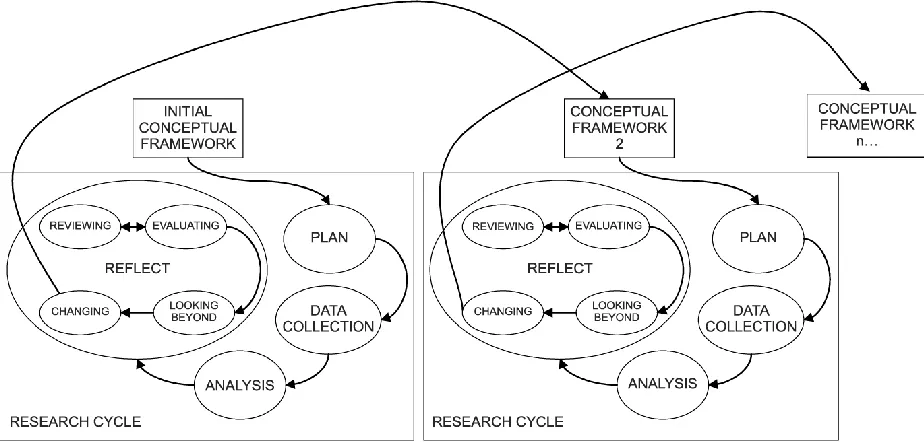
Cepeda and Martin (2005, pp. 857) identified three main elements in a sound case study (figure 2):
First, the conceptual framework, which identifies research topics and gaps in the literature, and clarifies the researcher’s starting interpretation of the key issues that are going to be developed.
Second, the research cycle which includes:
Research planning that guides rather than prescribes the research activities to be conducted.
Data collection, where the researcher examines the data, looking for new openings for exploration, unexpected outcomes and emergent topics.
Data analysis involves the ongoing iterative processing of transcripts in order to establish patterns within the data.
Critical analysis of these patterns and reviewing the whole process and structures, evaluating the outcomes, and identifying opportunities to build new theory.
10
Figure 2: Multiple iterations of these research cycles enact an iterative spiral towards understanding (Cepeda and Martin, 2005, pp. 857)
3.3.2 Historiography
Historiography is the study of writing of history, of historical perspectives over time, the changing research interests of historians and a methodology of historical research and
presentation. For example, the views on Ancient Egypt changed between 1900 and 2000, as the research interests of Egyptologists changed from finding treasures, to discovering habitats and skeletal remains.
Traditionally historians have taken a narrative based approach. Stone (1979) defined a narrative as being organised chronologically, focused on a single coherent story, descriptive rather than analytical, concerned with people not abstract circumstances, and dealing with the particular and specific, rather than the collective and statistical. He reported that:
More and more of the 'new historians' are now trying to discover what was going on inside people's heads in the past, and what it was like to live in the past, questions which inevitably lead back to the use of narrative. (Stone, 1979, pp. 13)
The past is increasingly seen as a narrative which is constructed through historical writing. Historical facts only become useful when assembled with other historical evidence, and the process of assembling this evidence is understood as a particular historiographical approach.
The Journal of Management History has cultivated the use of historiography in management research. In a special edition in 2008 (Grattan, 2008) it gathered general advice from eminent historians and suggested a particular approach for the management historian:
11
Historians need to be empathetic to a period and handle the facts in-line with the society and ideas that existed at the time. Grattan (2008, pp. 176) discusses the use of general historiography and its particular application to management history stating that historiography is essentially an art or a craft:
This brief consideration of the nature of history is consistent with the idea that the events of the past can be crafted into a meaningful account, rather than attempting to treat the evidence scientifically. The raw material, the clay, of history is evidence and empathy with this material is essential in the writing of history.
This advice can be equally applied to project management and was used in all the case studies.
For example, the availability of knowledge and research increased greatly up to the centenary of the sinking of the Titanic (2012), and different historical perspectives were shaped by new and evolving theories like Brown’s (2000, pp. 9) Grounding Theory, i.e., that Titanic was grounded onto an ice-shelf.
3.3.3 Interdisciplinary Research
The use of this supportive research methodology evolved from a knowledge gap identified in research on the Giza Pyramid.There was little primary evidence for the project. Other disciplines were examined as to how they overcame similar knowledge gaps to create a more accurate picture of the past.
12
Figure 3a: The 1940s view of dinosaurs, big, slow-moving, stupid, cold-blooded clunkers (Zallinger, 1947)
Figure 3b: The contemporary view sees dinosaurs as sleek, fast-moving, intelligent, warm-blooded (Fellman, 2008)
As a result, contemporary scholars view dinosaurs as agile, warm blooded creatures, closer to birds than reptiles (figure 3b) that lived in the extremes of hot and cold climates, like the polar dinosaurs of the Mesozoic poles (Buffetaut, 2004, pp. 225).
Interdisciplinary research is widely used in scientific research (Wagner et al., 2011, pp. 15). It addresses complex problems by approaching these simultaneously with deep knowledge from different perspectives. According to Popper (1963, pp. 88):
[image:13.612.139.474.307.509.2]13
3.4 How these Research Methodologies were used
The methodology combined elements from both case study and historiographical research. In some cases interdisciplinary research guided the research to other disciplines like archaeology to overcome the knowledge gap. The four stages of the process are described in this section.
3.4.1 Idea or Concept for a Publication
The first step is to define what you are researching, and to be very specific. What is the research about? How important is it to you? It is important to develop a core idea or concept, for example, a paper with a related business/management/project theme that is based on historical case
studies. This is a juggling act where it is too easy to fall into the trap of writing just a historical paper.
3.4.2 Select the Required Case Studies
Case study research consists of a detailed investigation that attempts to provide an analysis of the context and processes involved in the concept under study. The research allows collection of rich, detailed data in an authentic setting. It is also holistic and thus supports the idea that much of what we can know about human behaviour is best understood as lived experience in the social context. The approach consists of two sets of criteria. The first guides the research to find case studies that:
1. are recognisable today and not too obscure, and are definitive examples of notable projects (both successes and failures),
2. have identifiable actors who are part of a team, 3. have good ethno-history,
4. have on-going research (archaeological or other) that brings new evidence forward.
The second establishes specific criteria related to the central idea or concept for example. As discussed in the previous section, each case study brings to life different issues relevant to contemporary project management, e.g., resource constraints/ risk/ scheduling/ estimation etc.
3.4.3 Create Theoretical Framework and Lens for Research
This provides a particular perspective, or theoretical lens, through which to investigate the historical case study, and guides the research as to the issues that are important to examine. Qualitative researchers use theoretical lenses or perspectives (for example gender, class, and race) to shape what is looked at. Figure 2 shows how this may need to be done iteratively.
Historians use lenses from disciplines like economics and social sciences to bring new
14
3.4.4 Determine the Research Questions
These provide a clear, concise focus for the research which builds on the use of a lens. For example, with some of the aforementioned author’s publications:
• How was Brunelleschi able to complete the Duomo project deemed technically impossible by his peers?
• Did poor project management contribute to Titanic’s disaster?
• In the Great Escape did Roger Bushell create an “agile project” resilient to change and hostility?
• How was the Giza Pyramid built in 20 years with all the known constraints and limitations?
3.4.5 Using historiography
In the discipline of management history, Carson (1998, pp. 30) put forward an approach to help potential authors with their submissions to the Journal of Management History. First explained by Ranke, a 19th century German historian, the process of historiography comprises of three steps (Gottschalk, 1956, pp. 28):
1. Investigation involves the discovery of historical facts – those that relate in a
chronologically consistent manner and can be used collectively to develop causal
explanations. Facts should be subject to both internal and external criticism, and
triangulated.
2. Synthesis involves the integration of authentic credible evidence into a logical, causally
explanative narrative.
3. Interpretation and explanation of the narratives, untangling the complexity of causes
that move human events, and examining their antecedents:
(a) deep structural causes, which often have origins far removed in time and space
from the event in question;
(b) contextual causes, which stand in a more proximate temporal relationship to an
event being studied; and
(c) triggering causes, which are closest in time to a focal event.
3.5 Selecting Research Methods
Methods refer to the tools and techniques used, and differ from methodologies (figure 1). Sometimes the two are confused.
15
The methodology justifies, guides, and evaluates (figure 1) the research methods. In historical research they comprise the techniques and guidelines by which historians use primary sources and other evidence, such as secondary and tertiary sources, to research and then to write history. Historians must be aware not to confuse the retelling of historical events and inclusion of
anachronism, with too much conceptualising of a subject. Historians use their own language in research, a unique linguistic style (Carson, 1998, pp. 31).
The writing of history is based on the critical examination of sources, the selection of particulars from the authentic materials, and the synthesis of particulars into a narrative that will stand the test of critical methods.
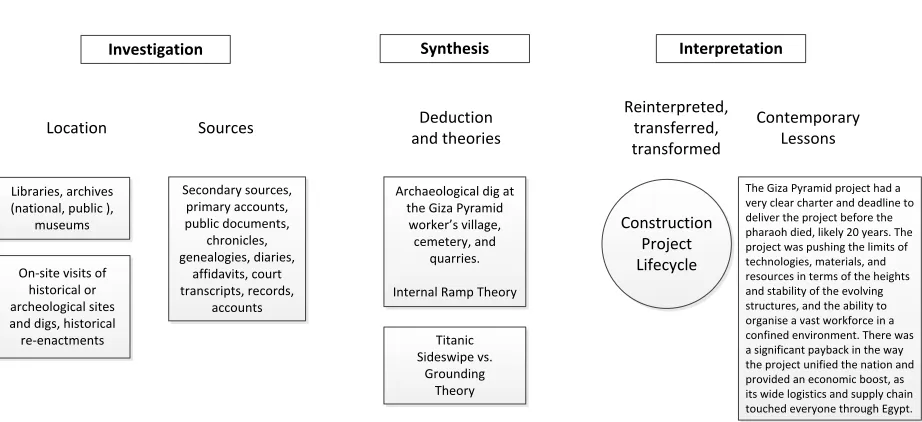
The research methods used in this research had to collect the data, synthesise the evidence, and interpret it where lessons were taken from historical projects and then transformed for use in contemporary business and projects. All the research methods listed below (figure 4) are qualitative and are guided by historiography.
Location Sources
Reinterpreted, transferred, transformed
Contemporary Lessons
Investigation Synthesis Interpretation
Research Methods
Deduction and theories
Figure 4: Research methods used
3.5.1 Investigation
3.5.1.1 Qualitative Review of Known Literature
A wide variety of sources (books, white papers, journals, research reports) are relevant to the contemporary management concepts highlighted by the case study. These include modern re-interpretations of the case study, and often change as new evidence is uncovered, or ideas are developed. For example, there is current debate concerning how the blocks of stone were pushed to the top of the Giza Pyramid.
Although there may be a rich data set of publications around a particular case study, close attention has to be paid to the author’s world view. For example, when examining the
publications around the Giza Pyramid project, all had either a rich engineering or architectural perspective but lacked a project management perspective. Further, according to Durepos et al (2008):
there is a need to reflect critically on the socio-politics embedded in the interpretations of the past (Gunn, 2006).
16
Jenkins (1994) notes that the “past” refers to all that has gone on before the present whereas “history” is better understood as a socially constructed categorisation in which “inter-textual” (Jenkins, 1994, p. 7) knowledge of the past is created.
Researchers are encouraged to seek out multiple secondary resources on a topic to corroborate the facts.
Once the basic story-line is identified, uncovered and grasped the next step is to follow the trail from secondary sources to any primary sources cited which may be found for example in national archives and museums.
Primary sources are first-hand accounts of information and include personal diaries, eyewitness accounts of events, interviews and oral histories. Care needs to be taken with primary sources as they can be influenced by the writer and their world view, linked to their socioeconomic status.
For example, in investigating the Great Escape a former prisoner of war, George McKiel was interviewed. He provided a rich personal interpretation of the event and very specific answers to questions around contradictions and discrepancies discovered in the narratives of three secondary source publications. This overcame the knowledge gaps to create a more complete and accurate picture which resulted in a rich and complete narrative. McKiel verified that the event could be viewed as a project and was able to interpret it so that the POW activities could be transferred, and translated into today’s project management language. From this a narrative was created specific to project management elements (scope, cost, time) which could then be readily understood.
3.5.1.2 Alternate Sources Identified through Interdisciplinary Research
The research into the Giza Pyramid project broadened out to alternate sources such as archaeologist Mark Lehner’s dig at Giza’s workers cemetery and village (Shaw, 2003). The village included houses, and industrial sized bakeries and breweries (figure 4). Lehner
discovered that excavated bones were mineralized indicating the workers ate meat which was the luxury food of the Egyptian middle classes. He corroborated this when he found an abundance of animal bones from sheep, and cows.
17
18
3 .5.1.3 Findings from Other Types of Research Methods
Based on an interdisciplinary methodology, findings from other types of research methods are incorporated, for example:
Progression of archaeological finds on-site
Deduced building techniques from surviving physical buildings/structures
Computer generated imagery of project worksites including both workshops with tools and equipment, and living quarters (workers villages with kitchens, sleeping areas),
Use of X-ray computed tomography, and head/body digital reconstruction from skulls/skeletons, for on-site worker’s cemeteries and burial chambers
Forensic science in examination of worker’s graves and tombs
Paleoclimatology reconstructing past climates by examining as ice core and tree ring records
Ethnohistory and the history of various ethnic groups.
On-site visits are particular useful and provide far greater insights into a historical project. For example, research into the Florence Duomo project not only led to the perfectly preserved Duomo, but the adjoining on-site museums containing the actual project equipment and project models:
Immersion into an historical subject – such as a visit to an historical site, a talk with a descendent of an historical figure, or careful perusal of primary documents – can
enhance a researcher’s ability to empathetically reconstruct past events. Such immersion is perceived as valuable because it: (a) facilitates a deeper understanding of the
phenomena under study by allowing subtle nuances to be detected; (b) partially defends against cultural biases and values; and (c) allows historians to proceed intuitively, though somewhat subjectively, by being able to think and feel as did real historical actors (Nevett, 1991).
This technique visualises the project and provides some context for understanding actors’ motives and actions.
Specific documentaries (National Geographic, PBS Nova, and BBC Horizon) can be very useful. For example, research into the Giza Pyramid was considerably enhanced by Pyramid (Macauley, 1988), that explored the project site and the project through an organizational lens. It provided great insight into the day-to-day workings of the project, and had some similarities to an on-site visit.
Forums and chat groups are communities of interest for discussions, questions and answers with noted researchers in a particular field. Access to posted FAQs, or discussion threads proved very useful in enriching knowledge around the Titanic case study.
19
3.5.2 Synthesis of Evidence
Methods of analysis can include: content analysis, constant comparison method, thematic analysis, and analysis of narratives. Synthesis involves the integration of this authentic, credible and analysed evidence into a logical, causally explanative narrative of the case study. Grattan (2008) calls this crafting:
An historical narrative has to make clear not only what happened but also why or how it happened: an account without interpretation is merely a story or a case study. So the historical narrative has to recount the collected facts and make clear when a deduction is being made. The process of deduction and narration can be seen as where the crafting is taking place, and where the historian is empathising with and making judgements about the assembled material.
Architect Jean-Pierre Houdin’s research into the Giza Pyramid project led him to play
architectural detective and painstakingly create a rich picture of the construction of a structure by analysing data read from the fabric of the monument. Based on all the synthesized evidence he questioned the practicality of an external ramp, in resources, materials and time, arguing that it would make the project unfeasible. The remains of the external ramp have never been found. He analysed the evidence further and went through a process of deduction based on observations on what was feasible with the project scope and a 20 year time frame. He hypothesised that an internal spiral ramp reduced the projections of the workforce size (100,000 to a more realistic 20,000). Consequently, he crafted a more plausible narrative based on judgements about the assembled evidence. Together with Egyptologist Bob Brier they demonstrated this Internal Ramp theory through computer modelling (Brier and Houdin, 2009) which was substantiated by French archaeologists who saw the computer model and provided magneto scans that had puzzled them since 1986. The theory is now seen as a breakthrough and is gaining wide acceptance in the Egyptologist community.
In another example naval engineer DavidBrown (2000) went through a similar type of detective work with Titanic’s disaster. He synthesised the evidence to create a narrative around the
timeline of the disaster, and then went through a process of deduction on Titanic’s collision. He questioned the Titanic Sideswipe Theory to hypothesize a Grounding of Titanic Theory. He then compared the two theories through a counterfactual analysis and deduced what would have happened to Titanic by comparing different outcomes. As a result, he created the Last Log of Titanic (Brown, 2000) a causally explanative narrative of the case study.
3.5.3 Interpretation
The causally explanative narrative of the case study is interpreted through the lens of a
20
3.5.3.1 Discovery Extraction and Transfer of Historical Lessons
Through the interpretation historical lessons are discovered, analysed and evaluated, then
extracted, transferred and transformed into contemporary lessons, which are not context specific. Examples are given below.
In the Giza Pyramid research, the work of Brier and Houdin (2009) was incorporated and reinterpreted. The principal lesson extracted and transferred was that project scope and schedule can be actively reduced in the design by adopting innovative approaches (like the internal ramp) and sophisticated winching technologies.
In the Titanic research Brown’s (2000) research was incorporated and reinterpreted. The principal lessons extracted related to project over confidence and stakeholder meddling.
In the Great Escape research Roger Bushell’s communication methods had to be verbal where nothing was ever written down and certain key words were avoided, for example, tunnels were replaced by the names Tom, Dick and Harry. Bushell’s communication involved daily updates with the department heads, and weekly morale boosting visits to the huts to address the rank and file POWs. The narrative was reinterpreted through a project management lens which guided the research to examine the approach, questions, and issues from a communication management perspective. It then extracted, transferred and transformed the historical lessons into
contemporary lessons for project management practitioners to follow.
In these examples, the aim is for project management practitioners to recognize both the rich historical project narrative and the project management approaches and lessons, which they can reflect on and with some transformation apply to their contemporary practice.
3.5.3.2 Comparative Analysis of Projects
Historians are very conscious of the risks and challenges in meaningfully comparing or juxtaposing historical periods, with different socio/economic environments, and the methodological issues that arise. Practitioners need to be aware of the issues of decontextualisation and generalisation of best practices.
3.5.4 The Complete Research Methods
21
Location Sources Deduction and theories Reinterpreted, transferred, transformed Contemporary Lessons
Investigation Synthesis Interpretation
Research Methods
Libraries, archives (national, public ),
museums
On-site visits of historical or archeological sites and digs, historical re-enactments
Archaeological dig at the Giza Pyramid worker’s village, cemetery, and
quarries. Internal Ramp Theory
Titanic Sideswipe vs.
Grounding Theory
The Giza Pyramid project had a very clear charter and deadline to deliver the project before the pharaoh died, likely 20 years. The project was pushing the limits of technologies, materials, and resources in terms of the heights and stability of the evolving structures, and the ability to organise a vast workforce in a confined environment. There was a significant payback in the way the project unified the nation and provided an economic boost, as its wide logistics and supply chain touched everyone through Egypt.
[image:22.612.76.537.84.295.2]Secondary sources, primary accounts, public documents, chronicles, genealogies, diaries, affidavits, court transcripts, records, accounts Construction Project Lifecycle
Figure 6: Research methods expanded with specific examples.
4. Conclusion
This paper summarises four well known case studies highlighting their relevance to contemporary project management. The paper then enunciates in detail a philosophy, methodology and methods used.
The methodology was pluralist. Using an interpretive approach, a combination of case study and historiographical research was used with an emphasis on examining narratives. A supportive methodology, interdisciplinarity, was used to guide the research.
The three steps of historiography were followed:
Investigation, including data collection methods like literature reviews, interviews and oral histories, field research and on-site visits.
Synthesis, including content analysis, constant comparison method, thematic analysis, and analysis of narratives.
Interpretation, including the theoretical framework, cross checking and testing for
coherence, extraction, transfer and transformation of historical lessons into contemporary lessons.
22
5. References
Biedenbach, T., Muller, R., (2011), Paradigms in project management research: examples from 15 years of IRNOP conferences, IJMPB, Vol. 4, No. 1, pp. 82-104
Brier, B., Houdin, J., (2009), The Secrets of the Great Pyramid, pp. 69, Harper Perennial, NYC.
Brown, D., (2000), Last Log of Titanic, International Marine Press, Camden, Maine
Buffetaut, E., (2004), Polar dinosaurs and the question of dinosaur extinction: a brief review,
Palaeogeography, Palaeoclimatology, Palaeoecology, 214, pp. 225–231
Carter, S., Little, M., (2007), Justifying Knowledge, Justifying Method, Taking Action: Epistemologies, Methodologies, and Methods in Qualitative Research, Qualitative Health Research, Vol. 17, Number 10, pp. 1316-1328
Carson, P., Carson, K. (1998), Theoretically grounding management history as a relevant and valuable form of knowledge, Journal of Management History, Vol. 4, No. 1, pp. 29-42
Cepeda, G., Martin, D., (2005), A review of case studies publishing in Management Decision 2003-2004 Guides and criteria for achieving quality in qualitative research, Management Decision, Vol. 43, No. 6, pp. 851-876
Colombo, U., Lanzavecchia, G., (1997), Science and technology in Italian industry: A unique model, Technology in Society, Vol. 19, Issues 3–4, Pages 467–491
Durepos, G., Mills, J., Mills, A., (2008),"Flights of fancy: myth, monopoly and the making of Pan American Airways", Journal of Management History, Vol. 14 Iss: 2 pp. 116 - 127
Engwall, M., (2012), PERT, Polaris, and the realities of project execution, IJMPB, Vol. 5, Iss: 4, pp. 595 – 616
Fellman, B., May/June (2008), Extreme Makeover - We bring T. rex and kin into the 21st century, Yale Alumni Magazine
Foley, D., (2001), Worker's village at Giza, Discover Magazine
Gauthier, J., Ika, L., (2013), Foundations of Project Management Research: An Explicit and Six-Facet Ontological Framework, PMJ, Vol. 43, No. 5, 5–23
Geraldi, J., Söderlund, J., (2012), Classics in project management: revisiting the past, creating the future, IJMPB, Vol. 5, Iss: 4, pp. 559–577
23
Grattan, R., (2008), Crafting management history, Journal of Management History, Vol. 14 Iss: 2 pp. 174-183
Hartley, N., (2006), Management history: an umbrella model, Journal of Management History, Vol. 12, Iss: 3, pp. 278-292
Kaplan, A., (1964), The conduct of inquiry: Methodology for behavioural science, San Francisco: Chandler
Kemp, B., (1989), An Ancient Egypt: The Anatomy of a Civilisation. London: Routledge, 1989. ISBN 0-415-01281-3.
Macauley, D., (1988), Pyramid, PBS Documentary
Maylor, H.,Söderlund, J., (2012), Project management scholarship: Relevance, impact and five integrative challenges for business and management schools, IJPM 30, 686–696
Morris, P., (2010), Research and the future of project management, IJMPB, Vol. 3 Iss: 1 pp. 139 – 146
Morris, P., (2013), Reconstructing Project Management Reprised: A Knowledge Perspective,
Project Management Journal, Vol. 44, No. 5, 6–23
Nevett, T., (1991), Historical Investigation and the Practice of Marketing, Journal of Marketing, Vol. 55, July, pp. 13-23.
Petty, N., Thomson, O., Stew, G., (2012), Ready for a paradigm shift? Part 1: Introducing the philosophy of qualitative research, Manual Therapy 17, 267-274
Petty, N., Thomson, O., Stew, G., (2012), Ready for a paradigm shift? Part 2: Introducing qualitative research methodologies and methods, Manual Therapy 17, 378-384
Popper, K. R., (1963), Conjectures and Refutations: The Growth of Scientific Knowledge, New York: Routledge and Kegan Paul
Shaw, J., (2003), Who Built the Pyramids? Not slaves. Archeaologist Mark Lehner, digging deeper, discovers a city of privileged workers. Havard Magazine, pp.45-49
Smyth, H., Morris, P., (2007), An epistemological evaluation of research into projects and their management: Methodological issues, IJPM, 25, pp. 423–436
Söderlund, J., Lenfle, S., (2011), Special issue: project history. International Journal of Project Management.
24
Wagner et al., (2011), Approaches to understanding and measuring interdisciplinary scientific research (IDR): A review of the literature, Journal of Informetrics, 165, 14–26
Willis, J.W., (2007), Foundations of qualitative research: Interpretive and critical approaches, SAGE Publications, Thousand Oaks, California
Yale Alumni Magazine (2008) Dinos, Accessed 20 September 2013,
http://www.yalealumnimagazine.com/issues/2008_05/dinos.html
Yin, R.K., (1994), Case study research. Design and methods., 2nd ed., SAGE Publications, Thousand Oaks, California