http://www.scirp.org/journal/ojs ISSN Online: 2161-7198
ISSN Print: 2161-718X
Inferences on the Difference of Two
Proportions: A Bayesian Approach
Thu Pham-Gia
1, Nguyen Van Thin
2, Phan Phuc Doan
21Department of Mathematics and Statistics, Université de Moncton, New Brunswick, Canada
2Faculty of Mathematics and Computer Science, Hochiminh University of Science, Ho Chi Minh, Vietnam
Abstract
Let π π π= 1− 2 be the difference of two independent proportions related to
two populations. We study the test H0:π ≥0 against different alternatives,
in the Bayesian context. The various Bayesian approaches use standard beta distributions, and are simple to derive and compute. But the more general test
0: ,
H π η≥ with η>0, requires more advanced mathematical tools to carry
out the computations. These tools, which include the density of the difference of two general beta variables, are presented in the article, with numerical ex-amples for illustrations to facilitate comprehension of results.
Keywords
Proportion, Convolution, Normal, Beta, Bayesian, Critical Value, Appell’s Function
1. Introduction
For two independent proportions π1 and π2, their difference is frequently
en-countered in the frequentist statistical literature, where tests, or confidence in-tervals, for π π1− 2 are well accepted notions in theory and in practice, although
most frequently, the case under study is the equality, or inequality of these pro-portions. For the Bayesian approach, Pham-Gia and Turkkan ([1] and [2]) have considered the case of independent, and dependent proportions for inferences, and also in the context of sample size determination [3].
But testing π1=π2 is only a special case of testing H0:π π1− 2≤η, with η
being a positive constant value, which is much less frequently dealt with. In Section 2 we recall the unconditional approaches to testing H0 based on the
maximum likelihood estimators of the two proportions and normal approxima-tions. A new exact approach not using normal approximation has been devel-oped by our group and will be presented elsewhere. Fisher’s exact test is also re-How to cite this paper: Pham-Gia, T.,
Thin, N.V. and Doan, P.P. (2017) Inferences on the Difference of Two Proportions: A Bayesian Approach. Open Journal of Statis-tics, 7, 1-15.
https://doi.org/10.4236/ojs.2017.71001
Received: July 13, 2016 Accepted: February 6, 2017 Published: February 9, 2017
Copyright © 2017 by authors and Scientific Research Publishing Inc. This work is licensed under the Creative Commons Attribution International License (CC BY 4.0).
called here, for comparison purpose. The Bayesian approach to testing the equality of two proportions and the computation of credible intervals are given in Sec-tion 3. The Bayesian approach using the general beta distribuSec-tions is given in Section 4. All related problems are completely solved, thanks to some closed form formulas that we have established in earlier papers.
2. Testing the Equality of Two Proportions
2.1. Test Using Normal Approximation
As stated before, taking η=0 we have a test for equality between two
propor-tions. Several well-known methods are presented in the literature. For exam-ple, the conditional test is usually called Fisher’s exact test, and is based on the hypergeometric distribution. It is used when the sample size is small. Pearson’s Chi-square test using Yates correction is usually used for intermediary sample size while Pearson’s Chi-square is used for large samples. Their appropriateness is discussed in D’Agostino et al. [4]. Normal approximation methods are based on formulas using estimated values of the mean and the variance of the two populations. For example, we have
(
)(
)
1 1(
2 2)(
)
1 1 2
1 1 1 1 1 1 2 2 1 2 2 2
X n X n
T
X n X n n X n X n n
− =
− + −
, and the pooled version
(
) (
)
(
(
(
)
)
(
)
)
(
)
1 1 2 2
2 1 2
1 2 1 2 1 1 2 1 2 1 1 1 2
X n X n T
X X n n X X n n n n
− =
+ + − + + +
, both being
approximately N
( )
0,1 under H0:π1≤π2. Cressie [5] gives conditions underwhich T2 is better than T1, in terms of power. Previously, Eberhardt and Fligner
[6] studied the same problem for a bilateral test.
Numerical Example 1
To investigate its proportions of customers in two separate geographic areas of the country, a company picks a random sample of 25 shoppers in area A, in which 17 are found to be its customers. A similar random sample of 20 shoppers in area B gives 8 customers. We wish to test the hypothesis that H0:π1≤π2
against H1:π1>π2.
We have here the observed value of T1=1.9459 and of T2=1.8783 which
lead, in both cases, to the rejection of H0 at significance level 5% (the critical
value is 1.64) for H1:π1>π2.
2.2. Fisher’s Exact Test
Under H0 the number of successes coming from population 1 has the
(
1 2 1 2 1)
Hyp n +n t, = +x x n x, , distribution. The argument is that, in the combined
sample of size n1+n2, with x1 successes from population 1 out of the total
num-ber of successes t= +x1 x2, the number of x successes coming from population
1 is a hypergeometric variable.
Numerical Example 2
We use the same data as in numerical example 1 to test H0:πA=πB vs
1: A B
H π >π i.e. the proportion of customers in area A is significantly higher
than the one in area B. We have Table 1:
the observed data
(
xB=8)
, and also cases more extreme, which means 0,1, 2, , 7B
x = . The p-value of the test is hence
8
0
25 20
25
-value 0.0542
45 25
B
B B
x
x x
p
=
−
= =
∑
.Although technically not significant at the 5% level, this result shows that the proportion of customers in area B can practically be considered as lower than the one in area A, in agreement with the frequentist test.
REMARK: The problem is often associated with a 2 × 2 table where there are three possibilities: constant column sums and row sums, one set constant the other variable and both variables. Other measures can then be introduced (e.g. Santner and Snell [7]). A Bayesian approach has been carried out by several au-thors, e.g. Howard [8] and also Pham Gia and Turkkan [2], who computed the credible intervals for several of these measures.
3. The Bayesian Approach
In the estimation of the difference of two proportions the Bayesian approach certainly plays an important role. Agresti and Coull [9] provide some interesting remarks on various approaches.
Again, let π π π= 1− 2. Using the Bayesian approach will certainly encounter
some serious computational difficulties if we do not have a closed form expres-sion for the density of the difference of two independently beta distributed ran-dom variables. Such an expression has been obtained by the first author some time ago and is recalled below.
3.1. Bayesian Test on the Equality of Two Proportions
Let us recall first the following theorem:Theorem 1: Let πi~ beta
(
α βi, i)
, for i=1, 2 be two independent betadis-tributed random variables with parameters
(
α β1, 1)
and(
α β2, 2)
, respectively.Then the difference π π π= 1− 2 has density defined on
(
−1,1)
as follows:( )
(
)
(
)
(
)
(
)
(
)
(
)
(
)( )
(
)
(
)
2 1 1 2
1 2 1 2
1 1
2 1
2
1 1 1 2 1 2 1 1 2
1 2 1 2 1 2 1 2
1 1
1 2
2
1 2 2 2 1 2 1 2 1 2
, 1
, 2,1 ; ; 1 ,1 , 0 1
1; 1 , 0, if 1, 1
, 1
,1 ,1 ; 2, ;1 ,1 , 1 0
B x x
F x x A x
p x B A x
B x x
F x x A x
α β
β β
π
β β α β
α β
β α α β β α β α
α α β β α α β β
α β
β α α α α β β α β
+ −
+ −
+ − + −
−
+ + + − − + − − ≤ <
= + − + − = + > + >
− +
− − + + + − + − + − ≤ <
(
1, 1) (
2, 2)
A B α β B α β
=
( )
1 .
F is Appell’s first hypergeometric function, which is defined as
(
)
[ ][ ] 1[ ] [ ]2 1 21 1 2 1 2
0 0
, , ; ; ,
! ! i j i j i j
i j i j
b b x x a
F a b b c x x
i j c
+ ∞ ∞
+
= =
=
∑∑
(2)where a[ ]b =a a
(
+1) (
a+ −b 1)
. This infinite series is convergent for x1 <1and x2 <1, where, as shown by Euler, it can also be expressed as a convergent
integral:
( )
( ) (
)
(
)
(
) (
1)
21
1 1
1 2
0
1 c a 1 b 1 b d
a c
u u ux ux u
a c a
− − − −
−
Γ − − −
Γ Γ −
∫
(3)which converges for c− >a 0, a>0. In fact, Pham-Gia and Turkkan [1]
es-tablished the expression of the density of the difference using (3) directly and not the series. Hence, the infinite series (5) can be extended outside the two cir-cles of convergence, by analytic continuation, where it is also denoted by F1
( )
. .Here, we denote the above density (1) by π ψ α β α β~
(
1, 1, 2, 2)
.Proof: See Pham-Gia and Turkkan [1].
The prior distribution of
π
is hence ψ α β α β(
1, 1, 2, 2)
, obtained from the twobeta priors. Various approaches in Bayesian testing are given below.
Bayesian Testing Using a Significance Level
While frequentist statistics frequently does not test H0:π η≤ vs. H1:π η> ,
for η>0 and limits itself to the case η=0, Bayesian statistics can easily do it.
a) One-sided test:
Proposition 1: To perform the above test at the 0.05 significance level, using the two independent samples
{ }
11, 1
n i i
X = and
{ }
2, 21n i i
X = , we compute
(
)
1 2 1 2 1, 1, 2 2
pπ π−
π π α β α β
− ∗ ∗ ∗ ∗ , where αi αi xi∗ = + and
i i ni xi β∗=β + − ,
1, 2
i= .
This expression of the posterior density of
π
, obtained by the conjugacy of bi-nomial sampling with the beta prior, will allow us to compute P(
π η>)
andcompare it with the significance level
α
.For example, as in the frequentist example of Section 2.1, we consider
1 25
n = , x1=17, n2 =20, x2=8 and use two non-informative beta priors,
that is, Beta 0.5, 0.5
(
)
.We note first that πˆ1=17 25=0.68, 8 20πˆ2 = =0.40, giving πˆ=0.28.
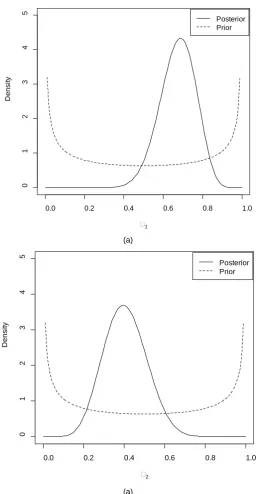
We obtain the prior and posterior distributions of π1 and π2 (Figure 1).
We wish to test:
0: 0.35 vs 1: 0.35
H π ≤ H π > (4)
We have α1 17.5, 8.5, 8.5, 12.5β1 α2 β2
∗= ∗ = ∗ = ∗ = :
1
H has posterior
proba-bility
(
)
1(
)
0.35
Pr π >0.35 =
∫
ψ x;17.5, 8.5, 8.5,12.5 dx=0.2855, and we fail to reject0
H at the 0.05% level. This means that data combined with our judgment is not
enough to make us accept that the difference of these proportions exceeds 0.35. Naturally, different informative, or non-informative, priors can be considered for π1 and π2 separately, and the test can be carried out in the same way.
b) Point-null hypothesis:
The point null hypothesis H0:π η= vs. H1:π η≠ to be tested at the
(a)
[image:5.595.244.502.66.561.2](a)
Figure 1. (a) Prior Beta 0.5,0.5
(
)
and posterior Beta 17.5,8.5(
)
of1
π and (b) Prior Beta 0.5,0.5
(
)
and posterior Beta 8.5,12.5(
)
of2
π .
in the literature. Several difficulties still remain concerning this case, especially on the prior probability assigned to the value η (see Berger [10]). We use here Lindley’s compromise (Lee [11]), which consists of computing the
(
1−α)
100%highest posterior density interval and accept or reject H0 depending on whether
η belongs or not to that interval. Here, for the same example, if η=0.35,
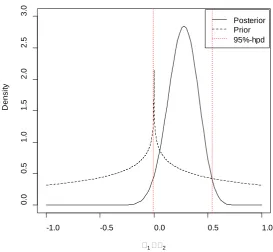
us-ing Pham-Gia and Turkkan’s algorithm [12], the 95% hpd interval for
π
is(
−0.0079; 0.5381)
, which leads us to technically accept H0 (see Figure 2),al-0.0 0.2 0.4 0.6 0.8 1.0
0
1
2
3
4
5
1
D
ens
it
y
Posterior Prior
0.0 0.2 0.4 0.6 0.8 1.0
0
1
2
3
4
5
2
D
ens
it
y
though the lower bound of the hpd interval can be considered as zero and we can practically reject H0.
We can see that the above conclusions on
π
are consistent with each other.3.2. Bayesian Testing Using the Bayes Factor
Bayesian hypothesis testing can also be carried out using the Bayes factor B, which would give the relative weight of the null hypothesis w.r.t. the alternative one, when data is taken into consideration. This factor is defined as the ratio of the posterior odds over the prior odds. With the above expression of the differ-ence of two betas given by (1) we can now accurately compute the Bayes factor associated with the difference of two proportions. We consider two cases:
a) Simple hypothesis: H0:π =a vs H1:π =b. Then
( )
( )
p a
B
p b
π
π π π
= , which
corresponds to the value of the posterior density of
π
at a, divided by theval-ue of posterior density of
π
at b. As an application, let us consider thefol-lowing hypotheses (different from the previous numerical example):
0: 0.35
H π = vs. H1:π =0.25, where we have uniform priors for both π1 and 2
π , and where we consider the sampling results from Table 1. We obtain the posterior parameters α1 18, 9, 9, 13β1 α2 β2
∗= ∗ = ∗ = ∗= . Using the density of the difference (1), we calculate the Bayes factor,
(
)
(
11 11 22 22)
0.35 , , ,
0.8416 0.25 , , ,
B
ψ α β α β
ψ α β α β
∗ ∗ ∗ ∗
∗ ∗ ∗ ∗
= = . This value indicates that the data slightly
[image:6.595.236.510.437.689.2]favor H1 over H0, which is a logical conclusion since πˆ=0.28.
Figure 2. Prior ψ
(
0.5,0.5,0.5,0.5)
and posterior ψ(
17.5,8.5,8.5,12.5)
distributions of π. The red dashed lines correspond to the bounds of the posterior 95%-hpd interval.
-1.0 -0.5 0.0 0.5 1.0
0
.0
0
.5
1
.0
1
.5
2
.0
2
.5
3
.0
1 2
D
ens
it
y
Table 1. Data on customers in area A and B. Area
A B Combined Response
Response Yes 17 8 25
No 8 12 20
Totals 25 20 45
b) Composite hypothesis: As an application, let us consider the hypotheses (4), that is, H0:π ≤0.35 vs. H1:π >0.35.
In general, H0:π ∈ Θ0 vs. H1:π ∈ Θ1, where Θ ∪ Θ =0 1 R. We have
(
)
0 Pr 0posterior
p =
π
∈ Θ and p1=Pr(
π
∈ Θ1posterior)
(or p1= −1 p0) asposterior probabilities. Consequently, we define the posterior odds on H0
against H1 as p0 p1. Similarly, we have the prior odds on H0 against H1,
which we define here as z0 z1. The Bayes factor is
0 1 1 0
p z B
p z
= . Again, we use the
sampling results from Table 1, yielding the prior and posterior distributions presented in Figure 1 with Beta 0.5, 0.5
(
)
prior separately for bothpropor-tions.
Now, using (4),
π ψ α β α β
(
1, 1, 2, 2)
∗ ∗ ∗ ∗
∼ , we can determine the required prior
and posterior probabilities. For example, 0 0.35
(
1 1 2 2)
1, , , d
p ψ α β α βt ∗ ∗ ∗ ∗ t
−
=
∫
gives0 0.7145
p = . In the same way, we obtain z0=0.745, using the prior
(
1 2 ,1 2 ,1 2 ,1 2)
ψ . Since p1= −1 p0 and z1= −1 z0, we have p1=0.2855
and z1=0.255. Finally, the Bayes factor is B=0.8566, which is a mild
argu-ment in favor of H1.
4. Prior and Posterior Densities of
π η
−
The testing above can be seen to be quite straightforward, and is limited to some numerical values of the function ψ
( )
. that can be numerically computed. Butto make an in-depth study of the Bayesian approach to the difference
(
)
1 2
π η π− = − π +η , we need to consider the analytic expressions of the prior and posterior distributions of this variable, which can be obtained only from the general beta distribution. Naturally, the related mathematical formulas become more complicated. But Pham-Gia and Turkkan [13] have also established the expression of the density of X1+X2, where both have general beta
distribu-tions.
4.1. The Difference of Two General Betas
The general beta (or GB), defined on a finite interval, say (c, d), has a density:
(
) (
) (
1)
1(
)
1(
)
; , ; , , , , 0,
gb
f xα β c d = x−cα− d−x β− d−cα β+ − B α β α β > c≤ ≤x d (5)
and is denoted by X ~GB
(
α β, ; ,c d)
. It reduces to the standard beta abovegeneral beta by addition of, or/and, multiplication with a constant. Theorem 2: Let X ~GB
(
α β, ; ,a b)
and any two scalars θ, λ. Then1) X +θ~GB
(
α β, ;a+θ,b+θ)
,2) λX ~GB
(
α β λ λ, ; a, b)
when λ >0. Otherwise, λX ~GB(
β α λ λ, ; b, a)
when λ <0.
Proof: 1) We have
( )
(
)
(
)
(
)
(
(
)
)
(
)
(
)
(
)
(
)
(
(
)
)
(
(
) (
)
)
(
)
1 1 1
1 1 1
, ,
, ,
X X
f y f y
y a b y b a B
a y b
y a b y b a B
a y b
θ
α β α β
α β α β
θ
θ θ α β
θ
θ θ θ θ α β
θ θ
+
− − + −
− − + −
= −
= − − − − −
≤ − ≤
= − + + − + − +
+ ≤ ≤ +
2) For λ >0,
( )
(
)
(
) (
)
(
)
(
)
(
) (
)
(
)
(
)
1 1 1
1 1
1
1
1
, ,
, ,
X X
f y f y
y a b y b a B a y b
y a b y b a B a y b
λ
α β α β
β α β
α λ λ
λ λ α β λ
λ
λ λ λ λ α β λ λ
− − + −
− + −
− =
= − − − ≤ ≤
= − − − ≤ ≤
When λ <0,
( )
(
)
(
) (
)
(
)
(
)
(
) (
)
(
)
(
)
1 1 1
1 1 1
1
1
, ,
, ,
X X
f y f y
y a b y b a B a y b
y b a y a b B b y a
λ
α β α β
β α α β
λ λ
λ λ α β λ
λ
λ λ λ λ α β λ λ
− − + −
− − + −
= −
= − − − − ≤ ≤
= − − − ≤ ≤
Q.E.D. Pham-Gia and Turkkan [13] gave the expression of the density of X1+X2,
where X1 and X2 are independent general beta variables. The density of
1 2
X −X , which is only mentioned there, is explicitly given below.
Proposition 2:
Let X1~GB
(
α β, ; ,c d)
and X2 ~GB(
γ δ, ; ,e f)
. For the difference1 2
X −X defined on
(
c− f d, −e)
, there are two different cases to consider,de-pending on the relative values of c−e and d− f , since X1 and X2 do not
have symmetrical roles. Case 1:
c− ≤ − ≤ − ≤ −f d f c e d e (6)
Case 2:
c− ≤ − ≤ − ≤ −f c e d f d e (7)
Theorem 3: Let X1 and X2 be two independent general betas with their
supports satisfying (6). Then Y =X1−X2 has its density defined as follows:
( )
(
(
)
)
(
)
(
)
(
)
(
) (
) (
)
(
)
(
)
(
)
1 1 1 1 , , ,,1 ,1 ; ; ,
y c f d f y B
f y
d c f e B B
c f y y c f
F
d f y f e
α δ β
α β δ
δ α δ γ α β
δ β γ α δ
+ − − + − − − − − = − − − − − − − − + − − − (8)
For d− ≤ ≤ −f y c e,
( )
(
(
)
)
(
)
(
)
(
)
(
)
1 1 1 1 ,,1 ,1 ; ; ,
y d f d e y
f y
f e B
c d d c
F
y d f d e y
δ γ
δ γ δ γ
β δ γ α β
− − + − − + − − = − − − + − − − − − − (9)
and for c− ≤ ≤ −e y d e,
( ) (
(
)
)
(
(
)
)
(
)
(
) (
)
(
) (
)
(
)
(
)
(
)
1 1 1 1 , , ,,1 ,1 ; ; ,
d e y y d f B
f y
d c f e B B
d e y y d e
F
d c y d f
β γ δ
β δ γ
β γ δ γ α β
β α δ β γ
+ − − + − − − − − = − − − − − − − − + − − − (10)
where F1
( )
. is Appell’s first hypergeometric function already discussed.Proof:
The argument uses first part 2) of Theorem 1 to obtain that
(
)
2 ~ , ; ,
X GB δ γ f e
− − − . Then, it uses the exact expression of the density of the sum of two general betas (see Theorem 2 in the article of T. Pham-Gia & N. Turkkan [14]).
Q.E.D. We denote the above density given by (8), (9) and (10) by
(
1, 1, 2, 2; , , ,c d e f)
π
ϕ α β α β
Note: The corresponding case 2, when relation (7) is satisfied, is given in Ap-pendix 1 (Theorem 3a).
To study the density of π η π− = 1−
(
π2+η)
, a particular case that will beused in our study here is the difference between X1 ~GB
(
α β1, 1; 0,1)
and(
)
2 ~ 2, 2; , 1 , 1 1
X GB α β η η+ − ≤ ≤η , with η being a positive constant.
In this case both Theorem 2 and Theorem 3 apply since c− = −e d f and
the middle definition section of ϕ α β α βπ
(
1, 1, 2, 2; , , ,c d e f)
disappears.Theorem 4: Let X1~GB
(
α β1, 1; 0,1)
and X2 ~GB(
α β η η +2, 2; , 1)
be twoindependent general beta distributed random variables. Then the density of
1 2
Y =X −X , defined on −
(
η
+1 ,1)
−η
, is:1)
for − − ≤ ≤ −η 1 y η,( )
(
(
)
)
(
(
) (
)
)
(
)
(
)
(
)
1 21 21
1 2
1 1 2 2
1 2 1 2 1 2
1 ,
, ,
1
,1 ,1 ; ; , 1
y y B
f y
B B
y
F y
y
α β α
η η α β
α β α β
η
β β α α β η
η + − − + + − − = + + − − + + + +
( ) (
(
)
)
(
(
) (
)
)
(
)
(
)
(
)
2 11 21
2 1
1 1 2 2
1 1 1 2 2 1
1 ,
, ,
1 ,1 ,1 ; ; 1 ,
y y B
f y
B B
y
F y
y
α β β
η η α β
α β α β
η
β α β α β η
η + − − − − + = − − − − + − − +
and we denote this distribution by
(
1 1 2 2)
~ , , , ;
Y ξ α β α β ηη . (11) Proof:
This is a special case of Theorem 3.
Q.E.D. An equivalent form using Theorem 4 leads to a slightly different expression, which gives however, the same numerical values for the density of π η− (see Theorem 4a in Appendix 1).
4.2. Prior and Posterior Distributions of
π η
−
Let πi, 1, 2i= be two independent beta distributed random variables, the first
being a regular beta, π1~ beta
(
α β1, 1)
, and the second being a general beta,(
)
2~GB 2, 2; ,1
π α β η +η .
Binomial sampling, with these two different beta priors, leads to the following Proposition 3: The prior distribution of π η π− = 1−
(
π2+η)
is(
1, 1, 2, 2;)
η
ξ α β α β η , given by (11), and its posterior distribution is
(
1, 1, 2, 2;)
η
ξ α β α β η
∗ ∗ ∗ ∗ withi i xi α∗ =α + and
, 1, 2. i i ni xi i β∗=β + − = Proof:
(
)
1 2
π − π +η is the difference of two random variables with respective distri-bution beta
(
α β1, 1)
and GB(
α2,β2; ,ηη+1)
, The prior distributions of π η−is hence ξ α β α β ηη
(
1, 1, 2, 2;)
, as given by (14).Binomial sampling affects these 2 distributions in different ways. For the first, the posterior is beta
(
α1+x1,β1+ −n1 x1)
while the posterior distribution of thesecond is GB
(
α2+x2,β2+n2−x2; ,ηη+1)
(see Proposition 3a in Appendix2). Figure 3 shows the prior and the posterior of π +2 0.35.
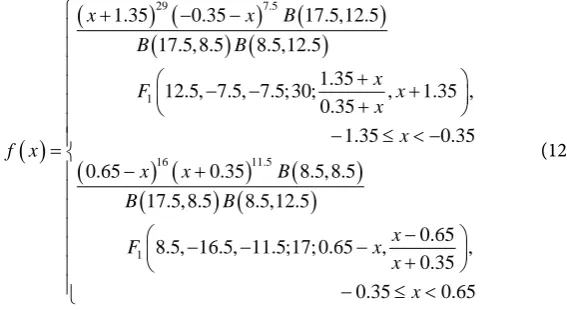
From Theorem 4, we obtain the expression of the posterior density
(
)
.35 17.5,8.5,8.5,12.5; 0.35
ξ of π η− as follows:
( )
(
) (
)
(
)
(
) (
)
(
) (
)
(
)
29 7.5 1 16 11.51.35 0.35 17.5,12.5
17.5, 8.5 8.5,12.5
1.35
12.5, 7.5, 7.5; 30; , 1.35 ,
0.35
1.35 0.35
0.65 0.35 8.5, 8.5
17.
x x B
B B x F x x x f x
x x B
B + − − + − − + +
− ≤ < − =
− +
(
) (
)
1
5, 8.5 8.5,12.5
0.65
8.5, 16.5, 11.5;17; 0.65 , ,
0.35 0.35 0.65 B x F x x x − − − − +
− ≤ <
[image:10.595.251.535.562.717.2](12)
(a)
[image:11.595.237.506.70.580.2](b)
Figure 3. (a) Prior GB
(
0.5,0.5,0.35,1.35)
distribution of π2+0.35 and(b) Posterior GB
(
8.5,12.5;0.35,1.35)
distribution of π2+0.35. The posterior of π1−(
π2+η)
is hence given by Theorem 4, as(
1, 1, 2, 2;)
η
ξ α β α β η∗ ∗ ∗ ∗ .
5. Conclusion
The Bayesian approach to testing the difference of two independent propor-tions leads to interesting results which agree with frequentist results when non-informative priors are considered. Undoubtedly, all preceding results can be
0.4 0.6 0.8 1.0 1.2
0
1
2
3
4
20.35
P
ri
or
D
ens
it
y
0.4 0.6 0.8 1.0 1.2
0
1
2
3
4
20.35
P
os
ter
ior
D
ens
it
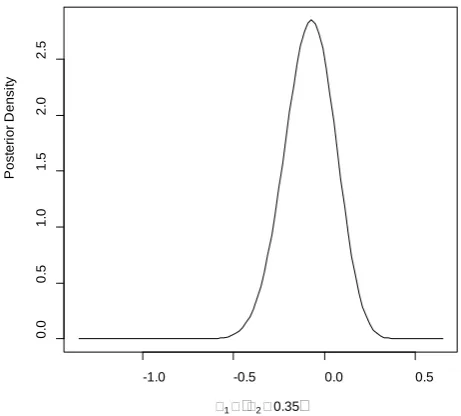
Figure 4. Posterior density ξ.35
(
17.5,8.5,8.5,12.5;0.35)
of(
)
1 2 0.35
π − π + .
generalized to other measures frequently used in a 2 × 2 table.
Acknowledgements
Research partially supported by NSERC grant 9249 (Canada). The authors wish to thank the Universite de Moncton Faculty of Graduate Studies and Research for the assistance provided while conducting this work.
References
[1] Pham-Gia, T. and Turkkan, N. (1993) Bayesian Analysis of the Difference of two Proportions. Communications in Statistics—Theory and Methods, 22, 1755-1771. https://doi.org/10.1080/03610929308831114
[2] Pham-Gia, T. and Turkkan, N. (2008) Bayesian Analysis of a 2 × 2 Contingency Ta-ble with Dependent Proportions and Exact Sample Sizes. Statistics, 42, 127-147. https://doi.org/10.1080/02331880701600380
[3] Pham-Gia, T. and Turkkan, N. (2003) Determination of the Exact Sample Sizes in the Bayesian Estimation of the Difference between Two Proportions. Journal of the Royal Statistical Society,52, 131-150. https://doi.org/10.1111/1467-9884.00347 [4] D’Agostino, R., Chase, W. and Belanger, A. (1988) The Appropriateness of Some
Common Procedures for Testing the Equality of Two Independent Binomial Popu-lations. The American Statistician, 42, 198-202.
[5] Cressie, N. (1978) Testing the Equality of Two Binomial Proportions. Annals of the Institute of Statistical Mathematics, 30, 421-427.
https://doi.org/10.1007/BF02480232
[6] Eberhardt, K.R. and Fligner, M.A. (1977) A Comparison of Two Tests for Equality of Two Proportions. The American Statistician, 21, 151-155.
https://doi.org/10.1080/00031305.1977.10479225
[7] Santner, T.J. and Snell, M.K. (1975) Small Sample Confidence Intervals for p1−p2
and p p1 2 in 2 × 2 Contingency Tables. JASA, 75, 386-394.
-1.0 -0.5 0.0 0.5
0
.0
0
.5
1
.0
1
.5
2
.0
2
.5
120.35
P
os
ter
ior
D
ens
it
[8] Howard, J.V. (1998) The 2 × 2 Table: A Discussion from a Bayesian Viewpoint. Sta-tistical Sciences, 13, 351-367. https://doi.org/10.1214/ss/1028905830
[9] Agresti, A. and Coull, B. (1998) Approximate Is Better than Exact for Interval Esti-mation of Binomial Proportions. The American Statistician, 52, 2.
[10] Berger, J. (1999) Bayes Factor. In: Kotz, S., Read, C.B. and Banks, D.L., Eds., Encyc-lopedia of Statistics, Update 3, Wiley, NY, 20-29.
[11] Lee, P.M. (2004) Bayesian Statistics.An Introduction. 3rd Edition, Hodder Arnold, London.
[12] Pham-Gia, T. and Turkkan, N. (1993) Computation of the Highest Posterior Den-sity Interval in Bayesian Analysis. Journal of Statistical Computation and Simula-tion, 44, 243-250. https://doi.org/10.1080/00949659308811461
[13] Pham-Gia, T. and Turkkan, N. (1998) Distribution of the Linear Combination of Two General Beta Variables and Applications. Communications in Statistics—Theory and Methods, 27, 1851-1869. https://doi.org/10.1080/03610929808832194
Appendix 1
Below is the expression of the density of Y =X1−X2 when (7) is satisfied,
in-stead of (6). This expression, with the one given in Theorem 3, covers all cases. Theorem 3a: Let X1 and X2 be two independent general betas with their
supports satisfying (10). Then Y =X1−X2 has its density defined as follows:
for c− ≤ ≤ −f y c e,
( )
(
(
)
)
(
)
(
)
(
)
(
) (
) (
)
(
)
(
)
(
)
1 1 1 1 , , ,,1 ,1 ; ; ,
y c f c e y B
f y
f e d c B B
c f y y c f
F
c e y d c
α δ γ
δ γ α
α δ α β δ γ
α γ β α δ
+ − − + − − − − − = − − − − − − − − + − − − (13)
For c− ≤ ≤ −e y d f,
( )
(
(
)
)
(
)
(
)
(
)
(
)
1 1
1
1 ,1 ,1 ; ; ,
,
y c e d e y e f f e
f y F
y c e d e y
d c B
α β
α β α β γ α β δ γ
− −
+ −
+ + − − − −
= − − + − − − −
− (14)
For d− ≤ ≤ −f y d e,
( ) (
(
)
)
(
(
)
)
(
)
(
) (
)
(
) (
)
(
)
(
)
1 1 1 1 , , ,,1 ,1 ; ; ,
d e y y c e B
f y
f e d c B B
d e y y d e F
f e y
β γ α
γ α β
β γ δ γ α β
γ δ α β γ
+ − − + − − − − − = − − − − − − − − + − (15) Proof:
By rewriting Y = −
(
X2) (
− −X1)
, we can apply the above Theorem 2 andTheorem 3.
Q.E.D A parallel, and equivalent, result to Theorem 4 is given below:
Theorem 4a: The density of X1−X2−η is:
For − − ≤ ≤ −η 1 y η,
( )
(
(
)
)
(
(
) (
)
)
(
)
(
)
(
)
1 21 21
1 2
1 1 2 2
1 1 2 1 1 2
1 ,
, ,
1
,1 ,1 ; ; , 1
y y B
f y
B B
y
F y
y
α β α
η η α β
α β α β
η
α α β α β η
η + − − + + − − = + + − − + + + +
For − ≤ ≤ −η y 1 η,
( ) (
(
)
(
)
) (
(
)
)
(
)
(
)
(
)
2 11 11
2 1
1 1 2 2
1 2 2 1 2 1
1 ,
, ,
1
,1 ,1 ; ; 1 ,
y y B
f y
B B
y
F y
y
α β α
µ η α β
α β α β
η
α β α α β η
η + − − − − + = − − − − + − − +
and we denote Y ~ξ α β α β ηη
(
1, 1, 2, 2;)
∗ .
Proof:
Similar to the proof of Theorem 4.
Appendix 2
Proposition 3a:Suppose that X2~ Bin
(
n2,π2)
and π2 has the prior distribution(
2 2)
beta α β, then the posterior distribution of π2+η is
(
2 x2, 2 n2 x2; , 1)
GB α + β + − ηη+ .
Proof:
The prior distribution of π2+η is GB
(
α β η η +2, 2; , 1)
(see Theorem 2) withthe pdf
(
)
(
) (
) (
2)
22
1 1 1
2 2 2, 2 2 1 2 , 12
fπ η+ π x =B α β − π −η α− + −η π β− η π≤ ≤ +η ,
The likelihood function is
(
)
(
)
2(
)
2 22 2 2 2
2
2 2 2 2 2 2
2
1 n x , 0,1, ,
x
X X
n
f x f x x n
x
π η θ π π π π
− +
= = − =
Thus the marginal distribution of X2, the number of success, with π2= −θ η,
has density:
(
)
(
)
(
) (
)
(
)
(
)
(
) (
) (
) (
)
(
)
(
)
(
)
(
)
2 2 2 2 2
2 2 2 2 2
2 2 2 2 2
2
1 1 1
2
2 2 2 2
2 2 2
1 1 1
2 2 2
2
1 1 1
2 2 2
2 2
2 2 2
2 2
2 , 2 1 1 d
,
1 1 d
, , , , 1 d , , n x x
x n x
x n x
n x B n x B n x B n x x
K x n
B B
η α β
η
η α β
η
η α β
η
α β θ η η θ π π θ
α β
θ η η θ θ η η θ θ
α β
θ η η θ θ
α β α β α β + − − − + − − − + + − + − − = = = = − + − − − + − − + − − + − + +
∫
∫
∫
(
n2−x2)
Therefore, the posterior distribution of θ given X2=x2 is
(
)
(
(
)
(
)
)
(
) (
) (
)
(
)
(
) (
)
(
)
(
)
(
)
2 2 2
2 2
2 2 2 2 2
2 2 2 2 2
2 2
2
2 2
1 1 1 2
2 2 2 2
2
2 2
2 2
2 2 2 2 2
2 2 2
1 1
2 2 2 2 2
, , 1 , , , wit 1 ,
, 1
1 , 1 h , X X n x x
x n x
f x f x
f x n B x n x K x
x n x
B x n n B B x π η π η α β π β η α θ θ θ α β
α β θ η η θ π π
α β
α β
π θ η η θ η
θ η η θ η θ η
α β + + − − − + − + − + − − = − + − − = + − = − ≤ ≤ + − + − = ≤ − + + ≤ + +
This is the p.d.f. of GB
(
α2+x2,β2+n2−x2; ,ηη+1)
.Submit or recommend next manuscript to SCIRP and we will provide best service for you:
Accepting pre-submission inquiries through Email, Facebook, LinkedIn, Twitter, etc. A wide selection of journals (inclusive of 9 subjects, more than 200 journals)
Providing 24-hour high-quality service User-friendly online submission system Fair and swift peer-review system
Efficient typesetting and proofreading procedure
Display of the result of downloads and visits, as well as the number of cited articles Maximum dissemination of your research work