2017 2nd International Conference on Computer, Network Security and Communication Engineering (CNSCE 2017) ISBN: 978-1-60595-439-4
Distributed Secret Key Management Based on ECC for Ad-hoc Network
Yi-xuan WU, Hua-wei CHEN
*and Lei WANG
School of Aeronautics and Astronautics, University of Electronic Science and Technology of China, China
*Corresponding author
Keywords: Distributed secret key, Elliptic curve cryptography, Combined RSA, Ad-hoc.
Abstract. Ad-hoc network without centralized infrastructure makes its security problem tricky. In this paper, we proposed a full distributed secret key management scheme to handle it. The main con- tribution of this paper is that we combined combined-RSA threshold scheme with elliptic curve cryptography (ECC) to construct a full distributed secret key management scheme. There are several advantages in our scheme comparing with traditional distributed secret key management key: First we transfer the secret share generation process from initiator to nodes which belong to this network so that ECC generation process and secret share generation process can be performed in parallel. Second, the establishment of secure communication between nodes is straightforward and efficient. Third the secret share generation process for new node non-interactive, furthermore secret share update process is also non-interactive. At last we also analyzed the strength of security of the scheme to show it can fulfill the security requirements of ad-hoc.
Introduction
Ad-hoc network is defined as a set of autonomous devices connecting each other through the wireless link without centralized infrastructure. That is to say some of nodes in network play the role of routers to transmit packets to destination [1]. Considering some of the characteristics such as open environment, shared wireless medium, lack of infrastructure and etc. [2], providing security service is harder for ad-hoc than network with infrastructure. At this stage, the public key cryptography is an ideal solution to solve the ad-hoc security problem. The main content of public cryptography for ad-hoc is a secure key management. Evaluating the quality of a key management scheme depends on whether it can provide some of the functions required in a particular environment, such as the distribution of keys, the reconstruction of keys, and the verification of secret share. Prior to this, many scholars have proposed the key management schemes. There are three general approaches in lite- rature contribution for solving the key management problem. 1. Key management based on ID. 2. Key management based on inter-certificate. 3. Key management based on public key cryptography. But majority of scheme can’t fulfill the whole requirement of the ad-hoc network.
Ad-hoc network exists many vulnerabilities towards key management scheme, such as middle attack [3], eavesdrop problem [3] and so on. In order to solve the problem of man-in-the-middle attacks, Hölbl et al. comes up with [4]. In this paper, He used identity-based authenticated scheme to handle it, But Nose proved Hölbl’s scheme could not hold man-in-the-middle attacks in [5]. As for eavesdrop problem, Harn et al. present a Threshold scheme in [6] which mentioned the secret share should be transmitted secretly, but he didn’t show how to transmit. In addition to security problem, there is another problem in ad-hoc. Most of key management scheme need an initiator to generate the essential system parameters. If there are lots of parameters that need to be generated, it takes a pretty long time to initialize the system. Gharib put forward [7] and its initialization phase needs to generate parameter for each node in the network. If there are n nodes in the network, initiator needs to generate
2n parameter in total. Besides, initiator needs to transmit these parameters secretly. This process will take some time. Therefore, we propose a key management scheme to solve the weakness mentioned above.
the node to generate secret share rather than initiator. 2) Construct a security communication method between nodes. 3) Simplify the join/leave process of node using combined RSA scheme. 4) Analyze the security of our scheme.
The rest of the paper would be organized as following. Preliminaries will be introduced in section 2. We present our scheme in section 3. Section 4 shows the security analysis of our scheme. We conclude our work in section 5
Preliminaries
In this section, we show the basic background used in our scheme, including ECC[10], RSA, Com- bined RSA[11]
Elliptic Curve Cryptography
The equation of the elliptic curve on a prime field Fp is Eq. (1), where 4a3+27b2≠0(mod p) ,a, b∈Fp and p is a large prime number. We have a base point B with order q. Choose a private key x. Calculate public key y, where y=x· B. Given y and B, x could not be calculated in polynomial-time.
) (mod
3 2
p b ax x
y ≡ + + (1)
RSA
RSA is a public key encryption algorithm proposed by Rivest et al. In their scheme, they choose two large prime number p, q, then compute n=p·q. Let ø(n)=lcm(p-1,q-1) Select a integer e from (1,ø(n)) as its public key. Calculate d as its private key according to Eq. (2) using Extended Euclidean algorithm. Given e and n, d couldn't be calculated in polynomial-time.
)) ( (mod
1 n
ed ≡
φ
(2)Combined RSA Threshold Scheme
This scheme was proposed by Zhang et al. Given several RSA instances, we can use RSA insta- nces to construct a (t, n) threshold [12]. Let λi=lcm(pi-1,qi-1). [N] denotes the set {1, 2… N}. If ø={l1,l2…lu}⊆ [N], So λø=lcm{λl1,λl2…λlu}. E is an integer and is relatively prime with λ[N], Given λø and e, We can calculate dø according to Eq. (2) using Extended Euclidean algorithm.
Encryption Phase. Given message m, Use Eq.(3) to encrypt m. where m ∈(0,M2k),M denotes a large prime.
∏
∈
=
] [ mod
N i i
e n
m
c (3)
Decryption Phase. Given ciphertext c, if and only if uican decrypt c as follow where i∈ø and |ø|=k.
1)Calculate dø according to Eq.(2) using Extended Euclidean algorithm. 2)Calculate m using Eq.(4)
∏
∈
=
] [
mod
φ
φ
i i d
n c
m (4)
Proposed Scheme
Assumption
open environment and nodes can join/leave network freely. The number of neighbors in the node is greater than t. All nodes have the ability to generate two large prime numbers and store theirs product. There is a system initiator in the network whose responsibility is to generate necessary system parameters. After generating the necessary system parameters, it leaves the network.
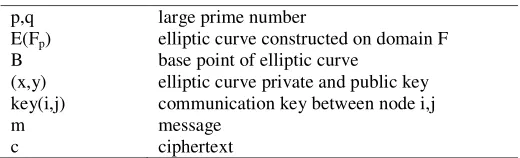
[image:3.612.176.436.177.256.2]We also assume there are always adversary nodes in the network. The adversary node can intercept any information in the network. In a certain period, we allow there are t-1 compromised nodes in our network under t>n/2 condition [13]. Table 1presents some necessary annotations.
Table 1. Necessary annotations. p,q large prime number
E(Fp) elliptic curve constructed on domain F
B base point of elliptic curve
(x,y) elliptic curve private and public key key(i,j) communication key between node i,j
m message
c ciphertext
Initialization Phase
In this part, we will introduce the initialization phase which contains four sub-phases. The details of phases are introduced as follow.
Initiator. Initiator generates a large prime number p and construct a elliptic curve E(Fp) which satisfies 4a3+27b2≠0(mod p) where a, b ∈Fp over Fp using Eq.(1). Choose a base point B with order q where q is also a prime number and q|#(E(Fp)), then Initiator generate private key x. Calculate the public key y, where y = x· B. Furthermore, initiator needs to generate a hash function h of collision free, such as SHA-3[15].At last it chooses an integer e and then it publishes y, e, B, q, h.
Node Initialization. While the initiator generates system parameters, the node also generates its secret share. Each node chooses pi, qi from (M, 2M) such that gcd(e,λi)=1, where M is a large prime number and λi=lcm- (pi-1,qi-1). Calculate ni using Eq. (5), and Then each node chooses a secret value , where ai∈Zq. Compute communication secret key and public key using Eq. (6) and Eq. (7), then
publish yi, ni. At the same time each node collects yj,j≠i and nj,j≠ithat comes from other nodes.
i i
i p q
n = ⋅ (5)
q a
xi=
λ
i+ imod (6)B x
yi = i⋅ (7)
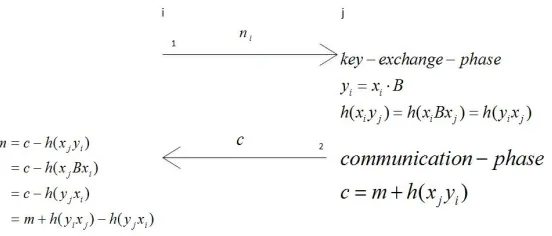
Threshold Construct. After nodes in the network finishing generating secret shares, Initiator encrypts master secret key x using Eq. (3). Hence, we can construct a (t, n) threshold scheme. One can decrypt c i.e. master secret key x using Eq. (4) if and only if he gets t or more different secret shares. Node Communication. If node i decides to communicates with node j, It sends his public number ni to node j. So node j knows which node needs to communicate with it, then node j finds the public communication key of node i and calculate communication key using Eq. (8). Eq. (9) and Eq. (10) present how to send message security. Figure.1 presents the detail and encryption and decryption.
) , ( ) ( ) ( ) ( ) ,
(j i h y x h x Bx h x y key i j
key = i j = i j = i j = (8)
) (xiyj h m
c= + (9)
Figure 1. Node communication phase Message Signature Phase
For some special message, network needs to sign it to provide a method that anyone can verify the correctness of this message. According to what we discussed above, signature collector has to gather t or more different secret shares to sign a message. Hence, signature process will have the following steps:
1) Signature collector collects t different shares (λi, ni) which are not in the newly added nodes list. 2) First, It computes dø using Extended Euclidean algorithm, then computes master secret key d using Eq.(4).
3) It chooses an integer k, where 0<k<q and compute R using Eq. (11). 4) Let r =xR, where xR denotes the coordinates of the R’s x-axis.
5) Given a message m, calculate s using Eq. (12). So the signature is (r, s). Through the above steps we completed the signature of the message. Message signature verification also has the following steps:
1) Calculate auxiliary value w using Eq. (13). 2) Calculate auxiliary value u1 using Eq. (14). 3) Calculate auxiliary value u2 using Eq. (15). 4) Compute P using Eq. (16).
5) Check the equation that if x p≡ r (mod q).
If xp and r is equal, then signature is valid, otherwise it is invalid [15]. After finishing message signature phase, signature collector drops the master secret key d and recalculates the c using Eq. (3), where [N] includes the former node and newly added node. Then Reset the newly added nodes list.
ky
R= (11)
) (mod )
) (
(h m d r k 1 q
s≡ + ⋅ − (12)
) (mod
1
q s
w≡ - (13)
) )(mod (
1 w h m q
u ≡ ⋅ (14)
) (mod
2 w r q
u ≡ ⋅ (15)
B u y u
P= 1 + 2 (16)
Node Join/Leave Phase
If A new node requests to join the network, then it needs to get p, e, B, q, ni. These parameters are stored in each node in the network. Therefore, node join phase has the following steps:
2) New node calculates nnew= pnew·qnew, xnew, ynew using Eq. (6) and Eq. (7), then publishes nnew, ynew.
3) At the same, signature collector adds nnew to its newly added nodes list. This is the whole process of joining nodes to the network.
For node that leaves the network, it just needs to broadcast leaving request and nleave, then any node receives the nleave, it drops the nleave from its node list.
Secret Share Update Phase
In our scheme, secret share update process is easy to implement.In a period of time, secret share is constant. After a period of time, secret share needs to be updated.So the update node needs to regenerate two large prime as node initialization phase discussed above. When the update process finished, it republishes its nr, yr.
Security Analysis
In this section, we will analyze the security of our proposed scheme. The security of key mamag- ement scheme can be evaluated by security of services that the scheme provides. Our scheme pro- vides majority of services including key confidentiality, backward and forward secrecy, resistance against compromising, full distributed key, node authentication.
Key confidentiality [16] means that in an open environment adversary can not learn any key info- rmation. In our scheme, the generation of new node’s secret share is non-interactive which means There is no secret key information leak during transmission. Besides, our scheme is built on ECC based on discrete logarithm problem and RSA based on a large number of decomposition. Both questions are hard problems i.e. there is no algorithm that can find the private key in polynomial time. As for backward and forward secrecy [16], they both focus on preventing adversary from deriving new key from old keys. In our scheme, nodes’ communication key is independent. Besides, new node constructs his communication key independently. Even if adversary knows one key or subset keys, adversary can’t get the other key. So our scheme provides backward and forward secrecy.
Resistance against compromising the nodes [16] is the capability of the scheme to defend against or tolerate attacks. Our scheme distributes the key among all nodes which can solve single point of failure problem. Our scheme is full security unless adversary compromises t or more nodes. Because in (t, n)-threshold, If anyone wants to get the private key or secret, he has to collect t or more different shares. Therefore, our scheme is resistance against compromising nodes under the premise of t≥n/2 +1.
If there is a trusted center, then adversary is able to corrupt it.So if trusted center is compromised, then the whole network is compromised. There is no trusted center in network in our scheme, because our scheme is fully distributed. This scheme avoids the problem we discussed above.
Another important service is security communication between nodes. In our scheme, each node publishes its public communication key and public number n. If one node receives public number n. it checks whether it is legal. If it is legal, it authenticates the sender, otherwise ignores it. Our scheme also prevents adversary from forging the communication key. Therefore, our scheme can deal with key authentication.
Summary
References
[1] Jyoti N S. Comparative Study of Adhoc Routing Protocol AODV, DSR and DSDV in Mobile Adhoc NETwork[J]. International Journal of Applied Engineering Research, 2011, 7(11): 2012.
[2] Hoebeke J, Moerman I, Dhoedt B, et al. An overview of mobile ad hoc networks: Applications and challenges[J]. Journal-Communications Network, 2004, 3(3): 60-66.
[3] Goyal P, Batra S, Singh A. A literature review of security attack in mobile ad-hoc networks[J]. International Journal of Computer Applications, 2010, 9(12): 11-15.
[4] Hölbl M, Welzer T. Two improved two-party identity-based authenticated key agreement protocols[J]. Computer Standards & Interfaces, 2009, 31(6): 1056-1060.
[5] Nose P. Security weaknesses of authenticated key agreement protocols[J]. Information Processing Letters, 2011, 111(14): 687-696.
[6] Harn L, Wang F. Threshold Signature Scheme without Using Polynomial Interpolation[J]. IJ Network Security, 2016, 18(4): 710-717.
[7] Gharib M, Moradlou Z, Doostari M A, et al. Fully Distributed ECC-based Key Management for Mobile Ad Hoc Networks[J]. Computer Networks, 2017.
[8] Rivest R L, Shamir A, Adleman L. A method for obtaining digital signatures and public-key cryptosystems[J]. Communications of the ACM, 1978, 21(2): 120-126.
[9] Diffie W, Hellman M. New directions in cryptography[J]. IEEE transactions on Information Theory, 1976, 22(6): 644-654.
[10] Koblitz N. Elliptic curve cryptosystems[J]. Mathematics of computation, 1987, 48(177): 203-209.
[11] Zhang C, Luo Y, Xue G. A new construction of threshold cryptosystems based on RSA[J]. Information Sciences, 2016, 363: 140-153.
[12] Shamir A. How to share a secret[J]. Communications of the ACM, 1979, 22(11): 612-613.
[13] Li L C, Liu R S. Securing cluster-based ad hoc networks with distributed authorities[J]. IEEE transactions on wireless communications, 2010, 9(10): 3072-3081.
[14] Site B. SHA-3 Standard: Permutation-Based Hash and Extendable-Output Functions[J]. 2014.
[15] Johnson D, Menezes A, Vanstone S. The elliptic curve digital signature algorithm (ECDSA)[J]. International Journal of Information Security, 2001, 1(1): 36-63.