2018 International Conference on Modeling, Simulation and Analysis (ICMSA 2018) ISBN: 978-1-60595-544-5
Analysis and Implementation of Intelligent Commuter Bus
System and Its Application Perspectives
Xiao-hong QIAN
*and Chun-yan LIU
College of Information Engineering, Wuhan Huaxia University of Technology, Wuhan 430223, China
*Corresponding author
Keywords: Commuter bus system, Architecture, route optimization, Cost minimization, Internet of things (IOT).
Abstract. At present, many enterprises are continuously facing the problem that commuting costs are high and some employees of small enterprises have no commuter buses to use. In this paper, we proposed the intelligent commuter bus system by integration of intelligent community and industrial park resources to utilize commuter buses more effectively and conveniently. This system was developed for intelligent commuter demand. We designed the five-layer architecture to achieve intelligent commuter platform. To effectively reduce the influence of the stochastic ant colony algorithm on the commuter bus route optimization and reduce the complexity of solving the commuter bus optimization problem, this paper designed a commuter bus route optimization algorithm based on Dijkstra and ant colony algorithm. For comparison, this paper made concurrent testing of the developed system, and evaluated its application effect, adaptability, which helps to further validate the approach and application system development and estimate its perspectives.
Introduction
With the rapid development of China’s economy, the live separation problem is increasingly serious. The separation of employment and residence makes the average commuter time and distance of the city residents growing. The traffic problem of office workers, school family and other groups from work and school is growing serious [1, 2]. In this background, commuter bus service is at the historic moment. Commuter bus is an important part of urban public transport, and also a main commuting way for employees to commute. But many unreasonable commuter bus lines were convenient for travelers but also brought some negative effects to the city traffic[3]. Current situation of commuter buses is that most enterprises use their own dedicated commuter buses, commuting costs are high, some small enterprises have no commuter buses, commuter buses cannot be effectively used, service quality and service level of passengers is very low so that passengers are hard to obtain the real-time information.
In 2014 the concept of Internet + bus was broadcasted in the north and wide. In December 2014 the position of e-bus was clarified: taking the enterprises and parks as the starting point, providing the intelligent commuter cloud platform service solution. In the future, a unified intelligent commuter operation service platform will be established to achieve green commute.
Reasonable intelligent commute bus routes and site design not only have a positive impact on employee satisfaction but also have an active and complementary role in urban transport [4]. In the current era of the Internet and the mobile Internet, how to use Internet thinking to create a "car networking" [5]. It provides mobile Internet application services and in many areas supporting enterprise vehicle management to achieve an optimized intelligent commuter bus system is imperative. Intelligent commuter bus system deploys commuter vehicles, stations and lines uniformly according to the integration of industrial park resources to provide staff commuting bus service to the various companies in the park. Bus companies can make rational use of resources to maximize the collection of individual passengers stationed in the shuttle service, thereby increasing revenue [6].
commuter shuttle system platform by combining the current hot mobile Internet technology, big data, Baidu map, B / S, O2O and IoT technology against some shortcomings of current commuter bus system.
Development Technologies
The system used big data, car networking, LBS, O2O and other technologies in the development process.
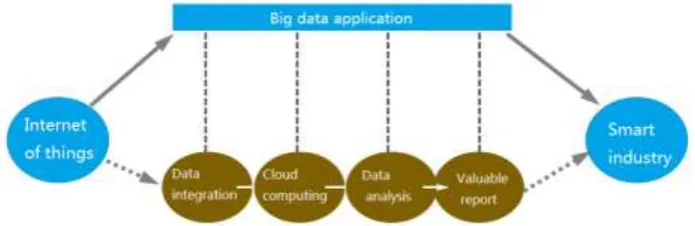
[image:2.595.126.474.294.407.2](1) Big Data and Data Mining: This technology integrates and calculates various resources such as people, vehicles and roads, realizing the interactive system of vehicles and vehicles, vehicles and roads, vehicles and people, vehicles and sensors and realizing dynamic mobile communication system between vehicles and the public. Valuable reports are formed after the analysis, providing the formation for the industrial chain optimizing services[7]. Big data with IOT as the carrier realizes a interactive system. It provides services for each industry after data integration, calculation and analysis to form a variety of valuable reports, finally forming smart industries. Integration flow chart between IOT and big data is shown in Fig.1.
Figure 1. Integration flow chart of Big Data and IOT.
(2)Application of LBS: The system realizes the location-based service, querying real-time bus location and time, reasonably grasping waiting time to improve the ride experience of employees.
(3) O2O: The system adopted online and offline service mode, payed attention to customer's needs to meet diversified travel needs of different customers.
(4) Baidu map API:Baidu map API is a set of application programming interfaces in fact, providing Baidu map-related services for its development and publishing [8]. The project uses API to show the query results displayed on the user interfaces, realizing data visualization. The system uses the Baidu map API to obtain the map service which can display the map to the user and then the system uses the GPS technology to locate the vehicle and the passengers and displays the route information.
Design of Intelligent Commuter Bus System
Function Design of Intelligent Commuter Bus System
Figture 2. Function set diagram of intelligent commuter bus system.
1) Login registration: Users and drivers etc. can register and login in the system.
2) Route management: It monitors commuter vehicles in all platforms. The administrator can create a line; add a station to a line, set a start point, set an end point, set a stop point, set a arrival time and an exit time of each station. The line information is configure including setting a line name, remarks, verification or not, supplier, vehicle number, drivers, line scheduling, costs etc. The existing lines are modified, queried, deleted and optimized. Line simulation can be run after line setting, automatically generating return lines. It can also detect the minimum time line between two sites and the shortest distance line.
3) Intelligent riding: Passengers can search the lines, query real-time location, query ulti-dimensional dynamic information timely, taking a leisurely ride.
a. Finding the bus route through intelligent line searching quickly. b. Calmly riding is run by car real-time query location.
4) Socialization: Administrators, drivers and passengers can communicate and comment. a. Administrators, drivers and passengers communicate through multi-channels. b. Passengers can comment on the line.
c. Line comment management.
5) Mobile ticketing: Ticket purchasing and checking in via smart commuter bus system app. 6) E-ticket checking: Passengers produce electronic tickets, self-inspect or produce a certificate on board.
7) Collecting needs: Passengers submit personal demands. The system automatically calculates demand distribution, collects passenger car demands, and calculates ride rates. The system automatically generates vehicle delay forecasts, site population changes, site complaint inquiries, and passenger experience acquisition, to control the operation of the shuttle at any time.
a. Submitting personal needs through mobile app. b. Background collects need distribution automatically.
8) Intelligent line planning: It calculates the line coverage of the crowd. a. Planning the route is according to the demand distribution.
b. It automatically calculates the line coverage of the crowd.
9) Report statistics: It automatically counts up attendance statistics, driving record statistics, unusual line statistics, car record statistics, street map statistics, line comments and so on.
10) Intelligent attendance:The platform can automaticly count up whether the drivers start on time and provide the statistical results.
The Solution of Intelligent Commuter Bus System
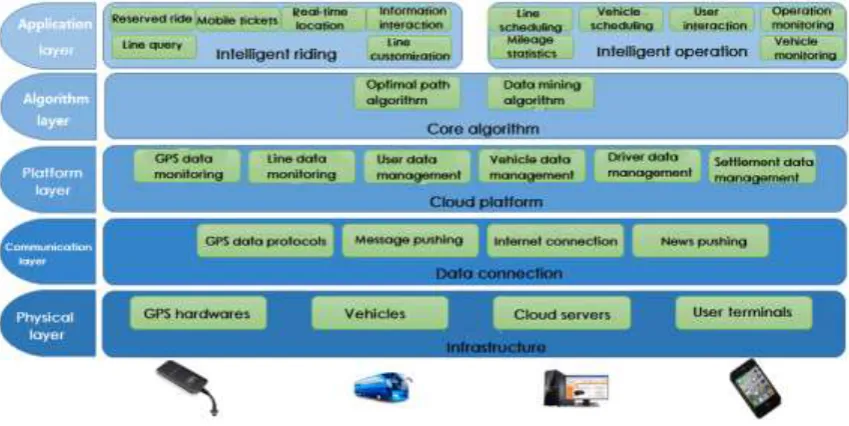
developed by the B2B model is implemented by a five-layer architecture. The overall structure of intelligent commutation is shown in Fig.3.
Figure 3. General architecture of intelligent commuter bus system.
Application layer: This layer provides access to the entrance for users booking riding, line inquiry, real-time positioning, operation monitoring, etc.
Algorithm layer: This paper focuses on the optimal path algorithm and data mining algorithm for commuter line planning and proposes a commuter bus route planning algorithm suitable for dynamic environment to ensure the utilization of resources with a minimum of sites and vehicles.
Platform layer: This layer conducts data monitoring and various data management. Communication layer: This layer provides data connection and data persistence services. Physical Layer: This layer provides infrastructure services to the system.
Route Optimization Algorithm Design
Dijkstra Algorithm
Dijkstra algorithm is the shortest path algorithm from one vertex to the remaining vertices, solving the shortest path problem in directed graph. The basic idea is to settle the set P and set T of two nodes, where P node is the node that has found the best path from the starting point to this point and set T is the set of nodes with no shortest path found. The initial state set P only includes V0 and then continuously select the node with the shortest path from the set of T nodes to join the set P. When new node is added to the set P, it needs to compare and compute the shortest path value of other nodes to V0 in the updated set T, repeating this process until you have added all the nodes in the T set to the P set [9].
Ant Colony Algorithm (ACA)
Ant colony algorithm is a new simulated evolutionary algorithm proposed by Italian scholar Dorigo in the early 1990s [10]. The main characteristics of this algorithm are the positive feedback,the distributed computation,and the use of a constructive greedy heuristic[11]. Each ant starts searching from any city and selects the next city with probability P at time t. The improved ant colony algorithm are described as expression(1).
pijk(t) = {
τijα(t) ηijβUijγ+1 ∑ (τijα
j∈Njk (t) ηij β
The Design of Route Optimization Algorithm
Ant colony algorithm has been used in many fields of research for its strong robustness. However, the shortcomings such as long convergence time of ant colony algorithm and falling into the problem of local optimal solution easily greatly affect the application of ant colony algorithm in the optimization of commuter bus routes. Dijkstra algorithm as a classic algorithm for solving the shortest path has been used by many scholars in the optimization of public transportation system. However the simple pursuit of the shortest distance is often difficult to meet the actual commuter bus routing requirements. Finding the theoretical "optimal solution" has no practical significance for the commuter bus line optimization problem. On the one hand the commuter bus optimization problem is a typical traveling route optimization problem and the optimal solution can‘t be solved. On the other hand the optimization of commuter bus routes is very complicated and a lot of constraints are difficult to consider comprehensively. At the same time the actual demand for commuter bus transportation is also changing dynamically. Only obtaining a commuter bus line that tends to be optimal in theory is of little significance to the optimization and guidance of the commuter bus transportation system. Ant colony algorithm as a classical random search method can solve a number of sub-optimal solution to meet the requirements through effective parameter control. Based on the above analysis, in order to effectively reduce the influence of the stochastic ant colony algorithm on the commuter bus line optimization and reduce the complexity of solving the commuter bus optimization problem, this paper uses a commuter bus optimization algorithm based on Dijkstra and ant colony algorithm.
Step 1: Initializing the commuter bus transportation network G where G= (V, E), V (V=1, 2, ---, n) is vertex set denoting commuter bus picking up site and E is edge set. The given weight of every edge set is the distance between the corresponding vertices.
Step 2: After selecting the starting point of the commuter bus line, the path length of the inter-site is taken as the optimization target. According to Dijkstra's expansion algorithm as shown in expression (1), candidate commuter bus sites are selected. The outermost layer is expanded from the starting point until it reaches the ending point, removing sites that do not meet the distance requirements and use the filtered candidate transit sites as a feasible site collection.
Step 3: According to the size of the wire network, it determines the number of ants m and initializes the optimization parameters of the ant colony optimization algorithm: pheromone severity factor α, heuristic function importance factor β, pheromone volatility factor p, pheromone release Q, the maximum number of iterations IterM.
Step 4: Constructing the solution space is done by placing each ant at the starting point of the optimized route and searching for the destination of the route. Each ant chooses node j to be moved in the next step according to the state transition rule and puts it into taboo list [12].
Step 5: Calculating the route length and traffic volume of each ant passing path and recording the optimal solution (the route with the shortest candidate route and the largest traffic volume) in the current iteration count.
Step 6: Judging whether to terminate. If iter <IterM, then go to Step 4, otherwise the loop ends and outputs corresponding multiple "optimal" alternatives.
Implementation and Testing
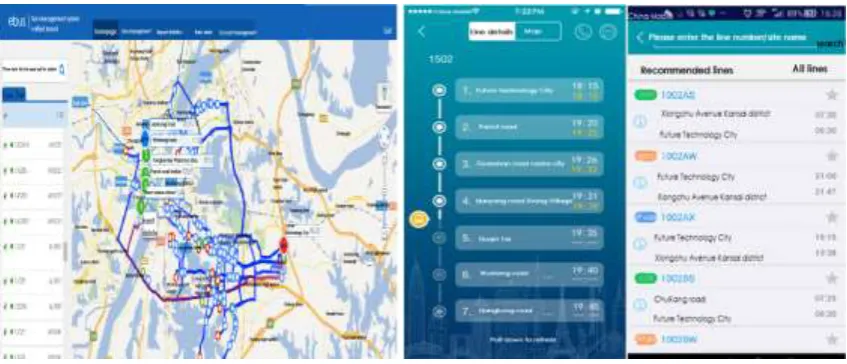
After the system administrator can manage through the intelligent commuter bus system passengers drivers can travel through the system intelligence comments and so on. Administrator and passenger interface shown in Fig.4 and Fig.5.
Figure 4. Administrator main interfaces. Figure 5. Passenger main interfaces.
Test phenomenon:
1. In 100, 200 and 300 concurrent cases, the error rate of the two architectures is almost zero, but the data in the second structure is relatively good.
2. In 500 and 1000 concurrency situation, the architecture one has a relatively good data, the error rate is low, time is controlled shorter. There are a large number of 404 errors in the second structure, so the effect is relatively poor.
Test conclusion:
In 100, 200 and 300 concurrent cases, the architecture of two maintains efficient processing power. In 500 and 1000 concurrent cases, the architecture one is relatively good.
Suggestion:
I personally suggest using architecture two. The parameters of architecture two may not be adjusted, but to meet the possibility of 200 concurrency with a machine is absolutely possible. In the current code unchanged, we can add 5 machines to ensure the amount of 1000 concurrent.
Conclusion and Future Work
This paper first introduced the background and necessity of intelligent commuter bus system and then described the development goal and development technologies. The research of designing functions, designing framework and route optimization algorithm were presented subsequently to achieve intelligent commuter platform. To effectively reduce the influence of the stochastic ant colony algorithm on the commuter bus route optimization and reduce the complexity of solving the commuter bus optimization problem, this paper designed a commuter bus route optimization algorithm based on Dijkstra and ant colony algorithm. For comparison, this paper made concurrent testing of the system, and evaluated its application effect and adaptability. The intelligent commuter bus system developed in this paper has been applied to Huawei Wuhan Research Institute, Beacon Fire Hongxin Communication Co. Ltd. and Wuhan Huaxing Optoelectronics Co. Ltd. It has accumulated over 20000 people using intelligent commuter bus system. After these companies deployed intelligent commuter bus system, they cost less on commuter cost and employees experience better than before. Later we will further study the route optimization algorithm to strive for using the least vehicles to cover the most people, improving resource efficiency and reducing staff costs.In the future, we will extend the system to more industrial parks.
Acknowledgement
References
[1] Bi Yanyan, Xiao Min, Zhou Xi-zhao, Priority development of public transport in Large and Medium-sized foreign Countries and its enlightenment, City Development Research, 213, (11):87-90.
[2] Deonie, Allen, Scott Arthur, Nicolas Wallerstien, Janice Blanc, Heather Haynes, Provision, transport and deposition of debris in urban waterways, International Journal of Sediment Research,No.2,142-149,2015.
[3] Zhong Guo, Pinghong Wei, Xiao Peng, Chengzhi Chang, Lu Tong, Study on the layout method of newly-added feeder bus lines coordinating with bus rapid transit, International Conference on Humanities and Social Science Research,475-482,2016.
[4] Shuai Song, Chao Su, Yonglong Lu, Tieyu Wang, Yueqing Zhang, Shijie Liu, Urban and rural transport of semivolatile organic compounds at regional scale: A multimedia model approach, Journal of Environ mental Sciences,No.1,228-241,2016.
[5] Wangkai, Car networking applications big data and intelligent transportation, China Public Security, 2017(04):168-172.
[6] Liu Xuejie, Zhao Zhen, An Jian, Hu Xuewen, Research on the Construction Scheme of Beijing Municipal Public Transport Rapid Commuter bus system, 2016 China City Transportation Planning Annual Proceedings, 2016(4):512-1525.
[7] Wu Weiqiang, Intelligent Transportation Decision Analysis System Based on Big Data Mining, Mechanical & Electrical Engineering Technology, 2017,(S2):526-528.
[8] Zhang Bo, Zhao Shuangming, Research on Baidu Map Development Based on Android Platform, Software Guide, 2015(7):96-99.
[9] Chen Jixiang, Optimization of Tourist Traffic Lines in Northern Anhui Based on Dijkstra Algorithm, Journal of Luoyang Institute of Science and Technology (Natural Science Edition), 2014 (2):55-57.
[10] Yang Xinshe, He Xingshi, Swarm Intelligence and Smart Optimization Algorithm, Basic Sciences Journal of Textile Universities, 2013, 26(3):287-296.
[11] Hu Xiaobing, Research on principle, theory and application of ant colony optimization, Chongqing University, 2004.