Title:
Social Identity and Consumer Preference
Formation for High Involvement Products: A
Study of Nigerians in the UK
By
EMMANUEL NDI WANKI
A thesis submitted in partial fulfilment of the requirements of the University of East London
for the degree of Doctor of Philosophy
January 2018
ii
Abstract
iii
Declaration
I declare that the work contained in this thesis has not been previously submitted for a degree or diploma at any other higher education institution. To the best of my knowledge and belief, the thesis contains no material previously published or written by another person except where due reference is made.
Sign: ____
iv
Acknowledgement
Table of contents
Title: ... i
Abstract ... ii
Declaration... iii
Acknowledgement ... iv
Table of contents ... 1
List of Tables ... 5
LIST OF FIGURES ... 6
Chapter One: The Introduction ... 7
1.1. Background of the Study ... 7
1.2 Statement of the Problem ... 10
1.3 The Research Aim, Objectives and Questions ... 12
1.4 Contributions of this Study ... 18
1.4.1 Methodology ... 19
1.5 Summary of the Chapter and The Structure of this Research ... 19
Chapter Two: UK based Nigerians as Contest for this Study ... 22
2.1 Introduction ... 22
2.2: A background Information ... 22
2.3 The Demographics of Nigerians in the UK ... 24
2.4 Summary ... 26
Chapter Three: Literature Review ... 27
3.1 Introduction to the Chapter ... 27
3.2 Social Psychology ... 31
3.2.1 Ethnocentrism Theory ... 33
3.2.2 Acculturation Theory ... 34
3.2.3 Cultural Dimensions (Individualism vs. Collectivism) Theory ... 36
3.3 Collective Identity (Social Identity) ... 39
3.3.1 Self-Categorisation Theory ... 44
2
3.3.3 Importance ... 50
3.3.4 Attachment and Sense of Interdependence... 53
3.3.5 Social Embeddedness ... 56
3.4 Social Dominance Theory and System Justification Theory ... 57
3.4.1 Social Dominance Theory ... 58
3.4.2 System Justification Theory ... 60
3.5 Consumption Preference and symbolic consumption ... 61
3.5.1 Consumption Preference ... 61
3.5.2 Symbolic Consumption ... 63
3.6 The Conceptual Model ... 65
3.7 Summary ... 69
Chapter Four: Research Methodology ... 70
4.1 Introduction ... 70
4.2 Research Paradigms ... 70
4.2.1 Introduction – Research Paradigm ... 70
4.2.2 The Paradigmatic Position of this Research and Justification ... 73
4.3 The Research Design ... 75
4.3.1 The Qualitative Nature of this Study and Justification ... 75
4.4. Data Collection Steps and Analysis ... 77
4.4.1 Data Collection Modalities in this Research ... 77
4.4.2 Data Analysis Procedures in this Research ... 84
4.4.3 Summary ... 88
Chapter Five: Data Analysis ... 90
5.1 Introduction ... 90
5.2 The Analytical Steps Explained ... 90
5.3 Making Meaning out of Data: Further Analytical Steps Taken ... 100
5.4 Comparative Coding ... 102
5.5 Examining (Coding of) Data based on Research Questions ... 105
5.6 Summary ... 109
Chapter Six: The Findings ... 110
3
6.2.2 Image attached to Membership of a Group ... 112
6.2.3 Hero Factor in a Group ... 116
6.3 The Role of Price on the Identity Behaviour and Consumer Preference Formation ... 119
6.3.1 Introduction ... 119
6.3.2 Money as a Personal Identity Factor ... 120
6.3.3 Money as a Driver of Social Identity ... 123
6.4 The Moderating Factors of the influence of Culture on the consumer preference formation ... 128
6.4.1 Introduction ... 128
6.4.2 Educational Background and Religiosity as Moderator (or not) of the Influence of Social Group ... 129
6.4.3 Acculturation and Social Group Identity ... 138
6.4.4 Sub-Cultural (Tribal/Ethnical) Factors as moderator of social group identity and influence on consumer preference for high involvement products... 151
6.5 Summary ... 162
Chapter Seven: Discussion of Findings ... 165
7.1 Introduction ... 165
7.2 Purchase Preference and use of High Involvement Products for Social Occasions: The Personal and (or) Collective Identity Features ... 167
7.3 Social Identity Influence: Sub-Cultural Groups Differences and Moderating Influence ... 177
7.3.1 Introduction ... 177
7.4 Other Factors that Moderate the influence of social group identity ... 181
7.4.1 Introduction ... 181
7.4.2 Educational background and religiosity as moderator of social group identity influence ... 182
7.4.3 Acculturation as a moderator of social group identity influence ... 187
7.5 Summary ... 196
Chapter Eight: Conclusions, Implications, Limitations, and Future Research Directions ... 198
8.1 Introduction ... 198
8.2 The Conclusions of this Study ... 199
8.3 The Implications of this Study ... 205
8.3.1 The Theoretical Implications of this Study ... 205
4
8.4 The Limitations of this Study... 216
8.5 Future Research Directions ... 220
8.6 Summary ... 222
Bibliography ... 224
Appendices ... 269
Appendix 1: Ethics Approval Letter ... 269
Appendix 2: A Sample of Letter Requesting Respondents to Participate in this Study ... 273
Appendix 3 A Sample of Interview Questions for this Study ... 275
Appendix 4: A Short Questionnaire Used to Obtain Background Information of Interviewees .... 276
Appendix 5: Focus Group Topic Guide ... 278
Appendix 6: Sample of Gatekeeper’s Consent Form ... 281
Appendix 7: Methodological Approach of Past Studies of Social Identity (Table 4.2) ... 282
Appendix 8: A First Sample of the Analytical Memos ... 284
Appendix 9: A Second Sample of the Analytical Memos ... 285
Appendix 10: Excerpts from transcripts from Interviews ... 286
Appendix 11: Excerpts from transcripts from Interviews ... 288
Appendix 12: Excerpts from transcripts from Interviews ... 289
Appendix 13: Excerpts from transcripts from Interviews ... 290
Appendix 14: Coding of an interview – data 2 ... 291
Appendix 15: Comparison of codes and categories – Deriving selective codes ... 292
Appendix 16: Comparison Observational Data ... 293
5
List of Tables
Table 2. 1: Population of Nigerians in major UK locations in 2011 ... 25
Table 3.1 Selected Past studies relating to Social Identity Theory and Empirical/Conceptual Insights ... 28
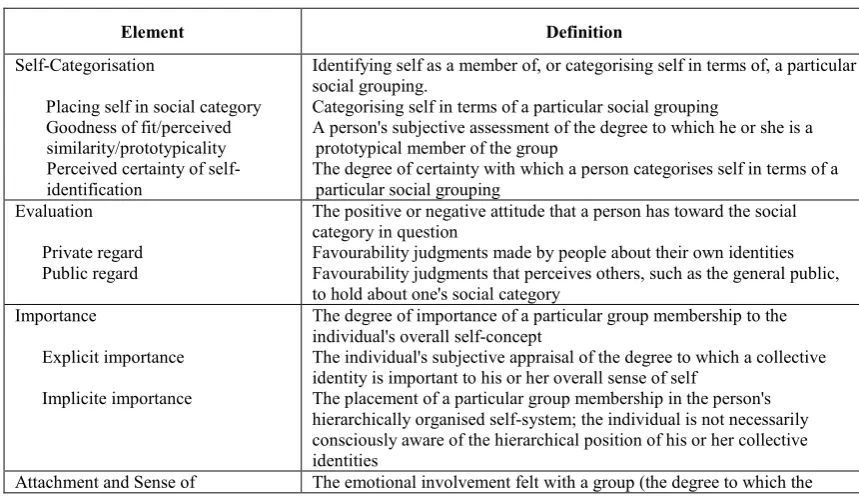
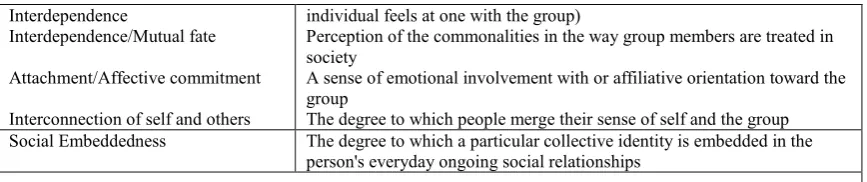
Table 3.2: Elements of Collective Identity as Individual-Level Constructs... 43
Table 3.3 Individual-level elements featured in Four Theories of Collective Identity ... 44
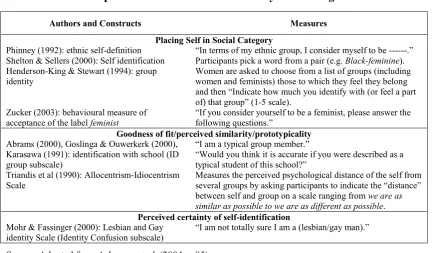
Table 3.4 Some Representative Measures of Identity: Self Categorisation ... 48
Table 3.5 Some Representative Measures of Identity: Evaluation ... 50
Table 3.6 Some Representative Measures of Identity: Importance ... 52
Table 3.7 Some Representative Measures of Identity: Attachment and Sense of Interdependence ... 54
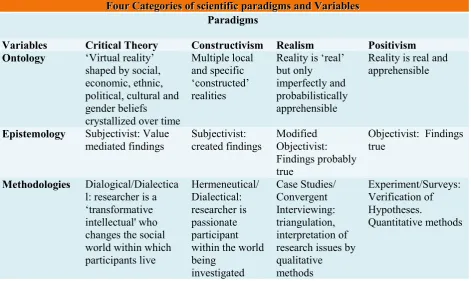
Table 4. 1: Four Categories of Scientific Paradigms and Variables ... 72
Table 4. 2: See Appendix 7 ... 83
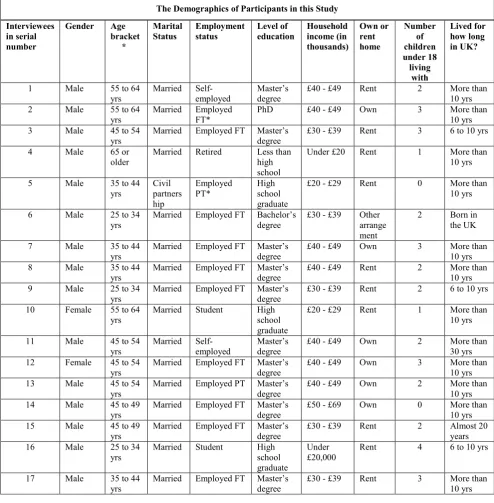
Table 4. 3: The Demographics of Participants in this Study ... 83
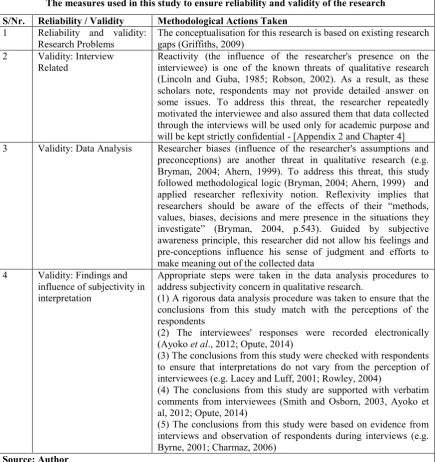
Table 4. 4: The measures used in this study to ensure reliability and validity of the research ... 87
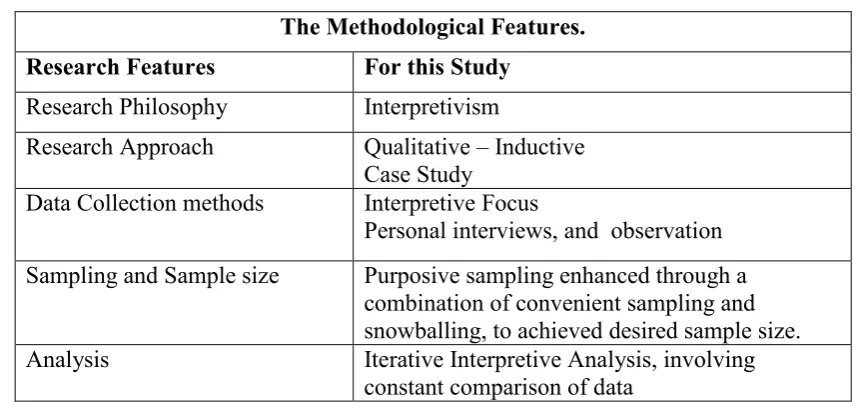
Table 4. 5: The Methodological Features ... 88
Table 5. 1: EExxcceerrppttssffrroommttrraannssccrriippttssffrroommIInntteerrvviieewwwwiitthhIInntteerrvviieewweeeeaabboouuttCCoonnssuummeerr P PrreeffeerreenncceeFFoorrmmaattiioonnTToowwaarrddssHHiigghhIInnvvoollvveemmeennttPPrroodduucctts ... 92s Table 5. 2: EExxcceerrppttssffrroommttrraannssccrriippttssffrroommIInntteerrvviieewwwwiitthhIInntteerrvviieewweeeeaabboouuttCCoonnssuummeerr P PrreeffeerreenncceeFFoorrmmaattiioonnTToowwaarrddssHHiigghhIInnvvoollvveemmeennttPPrroodduuccttss. ... 93.
Table 5. 3: AASSaammpplleeooffMMeemmoowwrriitttteenndduurriinnggtthheeIInntteerrvviieew ... 96w Table 5. 4: AAnnEExxaammpplleeoofftthheeAAnnaallyyttiiccaallMMeemmoosswwrriitttteenndduurriinnggtthheeCCooddiinnggPPrroocceesss ... 97s Table 5. 5: AAnnootthheerrEExxaammpplleeoofftthheeAAnnaallyyttiiccaallMMeemmoosswwrriitttteenndduurriinnggtthheeCCooddiinnggPPrroocceesss ... 98s Table 5. 6: AAnnootthheerrEExxaammpplleeoofftthheeAAnnaallyyttiiccaallMMeemmoosswwrriitttteenndduurriinnggtthheeCCooddiinnggPPrroocceesss ... 99s Table 5. 7: A Sample of the Analytical Memos written during the Coding Process reflecting non-verbal communication ... 101
Table 5. 8: A Sample of the Coding of an interview - data1 ... 102
Table 5. 9: A Sample of comparing and contrasting codes and sub-categories emerging from interview data1 and interview data 2... 103
Table 5. 10: See Appendix 8 ... 105
Table 5. 11: See Appendix 9 ... 105
Table 5. 12: Sample of Open codes for RQ 1 ... 105
Table 5. 13: Sample of Open codes for RQ 2 ... 107
Table 5. 14: Sample of Open codes for RQ 3 ... 108
Table 5. 15: EExxcceerrppttssffrroommttrraannssccrriippttssffrroommIInntteerrvviieewwsswwiitthhaannIInntteerrvviieewweeeeaabboouuttCCoonnssuummeerr P PrreeffeerreenncceeFFoorrmmaattiioonnTToowwaarrddssHHiigghhIInnvvoollvveemmeennttPPrroodduuccttss. ... 286.
Table 5. 16: EExxcceerrppttssffrroommttrraannssccrriippttssffrroommIInntteerrvviieewwwwiitthhiinntteerrvviieewweeeeaabboouuttCCoonnssuummeerr P PrreeffeerreenncceeFFoorrmmaattiioonnTToowwaarrddssHHiigghhIInnvvoollvveemmeennttPPrroodduuccttss. ... 288.
Table 5. 17: AAnnootthheerrEExxaammpplleeoofftthheeAAnnaallyyttiiccaallMMeemmoosswwrriitttteenndduurriinnggtthheeCCooddiinnggPPrroocceessss ... 289
Table 5. 18: A Sample of the Analytical Memos written during the Coding Process reflecting non-verbal communication ... 290
Table 5. 19: A Sample of the Coding of an interview – data 2 ... 291
6
LIST OF FIGURES
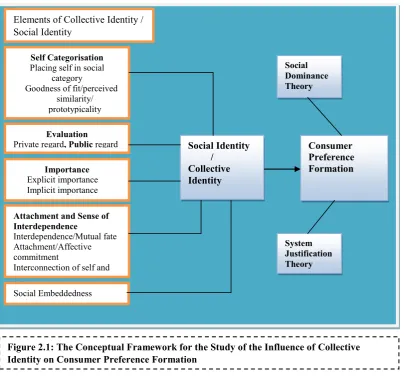
Figure 2. 1: The Conceptual Framework for the Study of the Influence of Collective Identity on Consumer Preference Formation ... 67 Figure 5. 1: A Sample of Comparing of Codes from Interviews ... 104
7
Chapter One: The Introduction
1.1. Background of the Study
Social psychology has been gaining increasing research attention since the pioneering works
of Tajfel (1978) and Tajfel and Turner (1979) on social group behaviour. The comment by
Tajfel (1981) underlines the importance of this topic - “social psychology can and must
include in its theoretical and research preoccupations a direct concern with the relationship
between human and psychological functioning and the large scale social processes and events
which shape this functioning and are shaped by it” (Tajfel, 1981, p.7). Recent literature
(Haslam et al., 2012) comments that, “groups and group behaviour lie at the heart of human society. We live, work, and interact in groups and, through this, are collaborative architects of
the social world we inhabit” (p.201). Though earlier works on groups and group behaviour
were purely sociologically premised, psychoanalytic perspectives have also featured regularly
in the literature too (Shimp and Sharma, 1987). Psychological (Pettigrew, 1998; Abrams and
Hogg, 2004; Hogg and Abrams, 1993; Haslam et al., 2012) as well as sociological (Branscombe et al, 2003; Ellemers, 1993; Turner et al., 1987; Reid and Hogg, 2003; Tajfel, 1978) perspectives do not only contribute to, but also advocate for further research, towards
enhancing the understanding of groups and group behaviour.
Oakes (2002) reinforces this research pertinence commenting that complex processes
underlie the complex outcomes about what constitutes the reality of social relations.
Commenting further (p.820), she notes that there are shortcomings and omissions, and there
has “been some major revisions in our understanding of several issues [e.g., contrast Turner
8
(1987) with Oakes et al., (1994) on the related shift to ‘perceiver readiness’ rather than ‘category accessibility’]”.
Psychological theorists argue that social psychology plays a pivotal function in the social and
behavioural sciences, and is indeed crucial for numerous levels of explanation that range
from individual cognition to interpersonal interaction and group processes to social structure
(Pettigrew, 1998; Abrams and Hogg, 2004). Abrams and Hogg (2004) note that European
social psychology literature has recognised a distinctive social or collective level of
psychological process. In other words, people may not only act as individuals but also as
members of a group with shared perceptions, goals and identity. Tajfel (1978), who pioneered
social behaviour knowledge enhancement, summarised that “the central idea is that both
behaviour and identity could shift along a continuum with extremely unique and personal
aspects at one end and extremely common and collective aspects at the other” (see Abrams
and Hogg, 2004, p.99).
In this sociological thinking, categorisations such as race, ethnicity, gender etc, have been
used as psychological significance elements for self-defining (Tajfel and Turner, 1982;
Oakes, 2002; Brown and Lunt, 2002). Thus, membership reference groups are a core identity
signalling factor in defining self (Thornton, 1996; Muniz and OʼGuinn, 2001; Whittler and
Spira, 2002). Further reference group literature (Mihalcea and Cätoiu, 2008, p.5) adds that
“membership reference groups are groups to which an individual currently belongs (a family,
a peer group, one's gender group)”, a conceptualisation that is further enhanced by Muniz and
OʼGuinn (2001) who add community and cultural groups dimensions of reference groups. In
9
reference group, the individual belongs to, identifies with, is attracted to, and feels
psychologically engaged.
Psychological theorists argue that social psychology plays a pivotal function in the social and
behavioural sciences, and is indeed crucial for numerous levels of explanation that range
from individual cognition to interpersonal interaction and group processes to social structure
(Pettigrew, 1998; Abrams and Hogg, 2004). Abrams and Hogg (2004) note that European
social psychology literature has recognised a distinctive social or collective level of
psychological process. In other words, people may not only act as individuals but also as
members of a group with shared perceptions, goals and identity. Tajfel (1978), who pioneered
social behaviour knowledge enhancement, summarised that “the central idea is that both
behaviour and identity could shift along a continuum with extremely unique and personal
aspects at one end and extremely common and collective aspects at the other” (see Abrams
and Hogg, 2004, p.99).
In this sociological thinking, categorisations such as race, ethnicity, gender etc, have been
used as psychological significance elements for self-defining (Tajfel and Turner, 1982;
Oakes, 2002; Brown and Lunt, 2002). Thus, membership reference groups are a core identity
signalling factor in defining self (Thornton, 1996; Muniz and OʼGuinn, 2001; Whittler and
Spira, 2002). Further reference group literature (Mihalcea and Cätoiu, 2008, p.5) adds that
“membership reference groups are groups to which an individual currently belongs (a family,
a peer group, one's gender group)”, a conceptualisation that is further enhanced by Muniz and
OʼGuinn (2001) who add community and cultural groups dimensions of reference groups. In
10
reference group, the individual belongs to, identifies with, is attracted to, and feels
psychologically engaged.
1.2 Statement of the Problem
According to the social identity view, when customers become aware of their
socio-demographic groups, their psychology has a significant influence in their purchase behaviour
(Brown and Lunt, 2002; Chowdhury, 2012). Thus, customers tend to be attracted to those
products and brands that are linked to their social identity (Forehand et al., 2002; Chowdhury, 2012). In other words, as Berger et al., (2011) summarised, people use their consumption behaviour to make statements about themselves to others, and observers make
inference about other people based on the consumption behaviour they display.
Within this developing knowledge about social identity theory and consumer behaviour,
scholars have also tapped into the concept of consumer ethnocentrism (Shimp and Sharma,
1987; Worchel and Cooper, 1979; Chowdhury, 2012). Reviewed literature calls for research
that (1) investigates the consumer ethnocentrism perspective of social identity theory and
consumer behaviour (Tajfel, 1981; Chowdhury, 2012), and contributes to the understanding
of the emerging debate about the applicability of the consumer ethnocentric tendencies scale
in both developed and developing nations (Chowdhury, 2012; Shimp and Sharma, 1987).
Responding to the second element of the aforementioned call, Chowdhury (2012)
investigated two issues of consumer psychology. First, the study challenged the orthodox
notion that consumer ethnocentrism is a developed nations phenomenon, and examined the
applicability of consumer ethnocentric tendencies scale (CETSCALE) in a developing
country context (Bangladesh). Subsequently, the study investigated the applicability of the
social identity theory in gauging ethnocentric tendencies in different socio-demographic
11
while the CETSCALE used in examining developed nations context in past studies is
applicable to the developing nation context (Bangladesh), the evidence for the scale differs
when the consumers are segregated into smaller social identities. The emergent deviation,
Chowdhury (2012) explained further, is due to in-group interests, which supports the
applicability of social identity theory.
Reviewed literature shows a trend of increasing call for knowledge enhancement in the area
of consumer ethnocentrism. Scholars contend that although the applicability of ethnocentrism
to consumer behaviour study has gained recognition (Berkman and Gilson 1978; Markin
1974), there is hardly any study that specifically aligned ethnocentrism to the study of
marketing and consumer behaviour (Shimp and Sharma, 1987; Chowdhury, 2012;
Witkowski, 1998). Motivated by this and other aforementioned calls, this study is focused on
enhancing understanding of the influence of social identity theory on consumer behaviour. In
other words, this study is designed to contribute to the understanding of how culturally
induced behaviour regulates buying attitude within a social group. While this study taps from
the consumer ethnocentrism concept, it is important to emphasise that this study only draws
from the theoretical substance of “universal proclivity for people to view their own as the
centre of the universe, to interpret other social units from the perspective of their own group,
and blindly accepting those who are culturally like themselves” (Shimp and Sharma, 1987,
p.280). Thus, this study does not draw from the consumer ethnocentrism substance that
purchasing foreign products is wrong, since it causes loss of jobs, and hurts the home
economy (Shimp and Sharma, 1987). Specifically, this study draws from what Shimp and
Sharma (1987) call the functional terms of consumer ethnocentrism where the interest is on
how the individual has a sense of identity, feelings of belongingness, and an understanding of
12
1972). Buying attitude is conceptualised to include what the customer buys as well as the
decision process involved with regards to when or when not to use the product.
Thus, from the analytics undertaken so far, this study is grounded on ‘social psychology,
which as scholars note, “occupies a pivotal position in the social and behavioural science”
(Abrams and Hogg, 2004, p.98), and significantly influences the purchasing behaviour of
consumers (Chowdhury, 2012). For this purpose of contributing to the knowledge about the
social identity theory, and other related theories, and influence on consumer preference
formation, this study explores the Nigerian social group in the United Kingdom. The study
explores the social identity in consumer preference formation of high involvement products.
1.3 The Research Aim, Objectives and Questions
Sociological phenomena have received insufficient empirical attention from marketing and
consumer behaviour scholars (Nicosia and Mayer 1976; Sheth 1977; Shimp and Sharma,
1987; Chowdhury, 2012). This research is, therefore, grounded on this need to enhance
sociological understanding. Section 1.1 explained the importance of and the need to explore
social identity behaviour (SIB). Inspired by this importance, this study aims to contribute to
the understanding of social group behaviour and especially with regards to consumer
behaviour. Towards achieving that goal, the study adopts a framework (see Chapter Three)
that is motivated by evident gaps in the literature.
Drawing from the social psychology foundation “that a person's conduct oscillates between a
personal and a collective frame of reference” (Brown and Lunt, 2002, p.2; Tajfel, 1981), the
framework for this research is aimed at using data from the Nigerian social group in the UK
to contribute to the social psychology (e.g. Abrams and Hogg, 2004; Jacoby, 1978), social
13
and Rodica, 2012) consumer psychology (Chowdhury, 2012; Worchel and Cooper, 1979;
Witkowski, 1998) and other interconnected theories that are essential to this understanding.
In their study “metatheory: lessons from social identity research”, Abrams and Hogg (2004)
summarise that the discussions with reference to European and North American perspectives
focus on groups; theorising about intergroup behaviour, motivation, and self-categorisation.
Towards enhancing the understanding of social behaviour with regards to group processes,
intergroup relations, and social identity, they recommend that researchers must be armed with
a ‘good travel guideʼ or ‘metatheoryʼ that tells “where to go and where not to go, what is
worthwhile and what is not” (p.98). Additional to providing structure and direction, such
theoretical approach informs the sort of questions one asks. Motivated by evident research
gaps, the theoretical foundations that, on the one hand, provide the guide for this study, and
which this study aims to contribute to, on the other, are pinpointed in Section 1.1.
To summarise, the central aim of this study is:
To enhance the understanding of the influence of social identity on consumer
preference formation of UK based Nigerians.
Sociologists argue that what we consume conveys meaning (Boudieu, 1986; Levy, 1959).
Specifically, this study aims to investigate the saliency of social identity on consumer
preference formation of UK based Nigerian consumers towards high involvement products. A
core theoretical notion within the social identity literature suggests that individual's desire to
possess a product can be driven by the need to satisfy psychological needs, such as actively
creating one's self concept, reinforcing and expressing self-identity, and asserting one's
individuality as well as differentiating oneself from others (Ball and Tasaki, 1992; Belk,
14
2002) and possession is motivated primarily by the desire to reflect reference group
membership (Muniz and OʼGuinn, 2001; Whittler and Spira, 2002). Tapping from this
theoretical foundation, this study explores a major social group (Nigerians) in the UK. The
focus here is to enhance the knowledge about how UK based Nigerians use their consumption
decisions to infer identity, as well as how their consumption patterns are driven by the
identity inferences made by others.
Consumer behaviour scholars that have explored the social identity perspective have also
underlined the need to study symbolic consumption (Berger et al., 2011; Stigler and Becker, 1977). Past literature identifies clothing styles, car models, music genes, and hair styles as
core products that fit the symbolic consumption description (Berger et al., 2011; Bearden and Etzel, 1982; Escalas and Bettman, 2005; Mihalcea and Cätoiu, 2008). In their study “identity
signalling with social capital: a model of symbolic consumption”, Berger et al. (2011) stress the need for consumer behaviour research perspectives that go beyond existing models of
fads, fashions, herds and conspicuous consumption. Tapping from this view, this study
combines the aforementioned dual foundations (high involvement products and symbolic
consumption), and considers the product type, e.g., clothing and cars.
Social and Cultural values have long been recognized as a powerful force shaping consumers'
motivation, lifestyle, and product choices (Berger et al., 2011; Berger and Heath, 2008; Berger and Rand, 2008; White and Dahl, 2006, 2007). The value system is thought to include
sets of beliefs, attitudes, and activities to which a culture or subculture subscribes, and is
reinforced by rewards and punishments to those who follow or deviate from these guidelines
(Rokeach, 1973). This value system has been expanded in subsequent literature to include the
"tool kit" of habits, skills, and styles from which people construct strategies of action
15
high involvement products like those for occasions that form cultural and social value
systems.
A prior study on Nigerian consumers in the UK (Kihlstrom, 1992) comments that although an
average Nigerian consumer in the UK can potentially self-identify with every possible social
category, it is most unlikely that the same social categories would receive significant
attention from the consumers. According to related literature, the Black African consumer is
likely to attend to those social categories that are specifically self-relevant to their social
categories and social identity (Wiedmann and Hennigs, 2013). As Forehand et al. (2002) and Stayman & Deshpande (1989) suggest, the fundamental premise that bridges marketing and
psychology is that consumers are often attracted to products and brands that are linked to
their social identity, a linkage, which as Aaker (1997) argues may come about because the
brand or product symbolizes the consumer’s own personality traits, or in the case of Nigerian
consumers in the UK, it embodies being the “type” of person that the consumer aspires to
become (Belk et al., 1982; cf. Levy 1959). Thus, the Nigerian consumer’s social identity may motivate him/her to form, hold, and express social identity-oriented beliefs (Shavitt, 1990;
Katz, 1960; Smith, Bruner and White 1956).
The focus of this study is to enhance the understanding of how social and cultural values
motivate social identity of UK based Nigerians, and how social identity oriented beliefs
influence the consumer preferences of UK based Nigerians for high involvement products.
For example, consumer behaviour literature identifies fashion and cars as typical conspicuous
consumption items (Escalas, 2013; Ireland, 1992; Rafferty, 2014). According to Escalas
(2013), it can be questioned why would some Nigerian consumers in the UK drive a specific
car to work but choose to drive a different car say for example a BMW to a blind date or to a
16
management”, “Value expression” or “Need for affiliation”? An example of high
involvement product can be highlighted by the style in clothing, which is a combination of
personal expression and social rules (Rahman et al., 2014). Dressing is influenced by dominant values, social attitudes, socioeconomic status, life status, and some of the
circumstances through which people want to assure their self-introduction (Haley, 2013).
Based on the Veblen's Theory of the Leisure Class (1912), scholars suggest that a paramount role of fashion is to signal wealth (Ireland, 1992; Pesendorfer, 1995; Bagwell and Bernheim,
1996). High involvement product communicates symbolically the social identity, namely how
a person wants and seeks to appear in society (Davis, 1985; Rafferty, 2014; Crane and
Bovone, 2006; Auty and Elliot, 1998). For example, why would Nigerians prefer specific
clothing for a blind date or prestigious occasion? Thus, this study also aims to enhance the
understanding of how social and cultural values influence the self and collective identity of
UK based Nigerian consumers in their clothing preference for a blind date or a prestigious
occasion.
Drawing from the aforementioned aim, the research objectives are as follows:
1. To contribute to that understanding, a core objective of this study is to shed light on
the extent to which consumer preference formation of UK based Nigerians for high
involvement products is social group/collective identity or personal identity driven.
2. Another core objective of this study is to understand the extent to which the
sub-cultural features in the Nigerian community influence the preference formation of UK
based Nigerians. Noting that there are three major sub-cultural groups in the Nigerian
nation (the Ibos, the Yorubas, and the Hausas), this study seeks to understand how
differences along these sub-cultural levels would impact preference formation of UK
17
3. Drawing from aforementioned theoretical foundations, this study seeks to understand
how the sub-cultural groups identities motivate adoption (or non-adoption) of social
congruence induced preference formation for high involvement products.
4. In their study, White et al. (2012) conceptualised university as an element of consumer social identity. Borrowing from and enhancing that viewpoint, this study
seeks to understand what role education and other factors such as cross-cultural
marriage and country of abode culture play in the social identity behaviour and
preference formation of UK based Nigerians for high involvement products.
Within the aforementioned aim and objectives for this study, the research questions are as
follows:
1. What features of the consumer preference of explored Nigerians in the UK are driven
by personal or collective frame of preference or both? Improving the knowledge about
social identity theory and self-categorisation theory is central component in enhancing
general understanding of social psychology (e.g. Tajfel, 1978; Tajfel and Turner,
1979; Huddy, 2001; Haslam et al., 2012; Abrams and Hogg, 2004; Oakes, 2002; Berger et al., 2011; Ashmore et al., 2004).
2. What are the sub-groups differences in the social identity influence on high
involvement products purchase (and use) preferences of UK based Nigerians?
Intergroup relationship literature (e.g. Opute, 2014; Kanter and Corn, 1994; Opute,
2015) contends that cultural diversity shapes the psychological mindset and behaviour
of people. Transporting that foundation to the context of this study, bearing in mind
the evidence that despite belonging to the Nigerian nation, the Ibo, Yoruba and Hausa
cultural enclaves do not entirely share homogeneous features (e.g. Ifeyinwa, 2002;
18
Yoruba and Hausa enclaves) features may differentiate the social identity behaviour
of these groups and preference formation influence. Prior study of identity signalling
with social capital (Berger et al, 2011) suggests that “signals depend on the identities that are associated with, and may be valuable in motivating adoption as well as
dis-adoption behaviour” (p.3).
3. What factors (e.g. education, cross cultural marriage, country of abode culture)
moderate the influence of social group identity on the consumer preference of UK
based Nigerians for high involvement products.
1.4 Contributions of this Study
In addressing the aforementioned research questions, this study also aims to contribute to a
foundation that has been mentioned repeatedly in political behaviour perspectives of social
identity research (Huddy, 2001; Oakes, 2002; Huddy, 2004; Duckitt, 1989). Hence, this study
responds to a research advocacy for insights on the role individual differences play in the
process of social identity acquisition and development of out-group antipathy (Huddy, 2001;
Huddy, 2004). Within that target, this study also seeks to contribute to symbolic consumption
literature (Berger et al., 2011; Berger and Heath, 2008; Berger and Rand, 2008; White and Dahl, 2007) by exploring the in-group versus out-group influence on such consumption of
high involvement products.
The logic behind the expectation of symbolic consumption differences based on the in-group
and out-group is founded on the psychological notion that, though collective unto itself, the
collectiveness in an individual can only achieve a temporary kind of wholeness, as it passes
through different social identities or states (Brown and Lunt, 2002). Thus, the contribution
made by this study has shown that UK based Nigerians may not only show a high tendency to
19
also embrace and utilise such in transforming their views of the world and approach to life,
paving the way for their preference formation for high involvement products to also be
governed by less social identity motives. In addition, this study has contributed and asserted
that the consumer preference formation of UK based Nigerians for high involvement products
is a factor of the social identity and personal identity features that form the composite identity
of individuals – composed of several components – socio-cultural process, lived experiences
of individuals, and interpersonal and intergroup interaction experiences of individuals.
1.4.1 Methodology
The first methodological step taken is to position this study in the realm of research
paradigm. The paradigmatic position of this study is described as interpretivism (Crotty,
1998), and its suitability has been justified in Section 4.2.2. In line with the aforementioned
interpretivism nature, this research is qualitative. Also, the relevant information about the
participants in this study and their demographics have been explained in the Methodology
Chapter in which the last part has explained the steps taken to ensure the reliability and
validity of this research (see Section 4.4.3.2), and the core methodological steps summarised
in Table 4.5. Furthermore, in the aforementioned section, the steps taken to ensure ethical
conformity have been pinpointed.
1.5 Summary of the Chapter and The Structure of this Research
Chapter One identified and justified the context of the study. In doing that, the theoretical and
practical importance of this study was also underlined. Towards ensuring that this study is
clearly positioned, the aims and objectives of the study have also been specified.
In addressing the specified research questions, Chapter Two introduced and explained the UK
based Nigerian community as the focus of this study. Within that target, this Chapter
20
in the UK, and critical cultural features of the Nigerian nation that justified its fit for the
exploration of social identity influence on consumer preference formation.
Following that, Chapter Three introduced the theoretical foundations that guide this study by
reviewing several and interrelated streams of literature. Firstly, the researcher undertook a
literature review of social psychology. Subsequently, literature was reviewed on social
identity theory and interrelated theories, such as self-categorisation theory, social dominance
theory, group membership theory, symbolic consumption theory, amongst others. Chapter
Three has been concluded with a theoretical framework that guided this research.
In Chapter Four, the methodological approach for this study was presented and explained. To
commence, the researcher specified and justified the paradigmatic position of this study.
Following that, the research design was explained and the methodological fit to the research
focus clearly stated. In addition to detailing out the demographics of participants, and
justification for their selection, this study also explained the methodological steps taken to
ensure reliability and validity in this study. The data analysis was the focus of Chapter Five.
In this chapter the analytical protocol was explained and the analytical steps taken to draw
meaning from interview reports are also pinpointed.
Following that, Chapter Six presented the findings. To ensure a better organising and
understanding of the results from this study, the findings are presented based on the emergent
themes. Chapter Seven presented the discussion of the findings and showed how the research
questions that underpin this study have been answered and also in relation to relevant
literature that connects to the domains covered in these questions. In the final Chapter of this
thesis (Chapter Eight), conclusions drawn from this study are pinpointed. Also, in Chapter
21
findings from the study reinforced and/or enhanced the body of literature, on the one hand,
and how the findings are relevant to practitioners, on the other. This Chapter was
concluded with an explanation of the limitations of the study and specification of directions
22
Chapter Two: UK based Nigerians as
Contest for this Study
2.1 Introduction
Founded on the social identity theory (SIT), this study proposes that consumer preference
formation is conditioned by their social group features. To contribute to theoretical
development in this domain, this study is located in a context that is characterised by multiple
social cultural features, namely Nigeria. Nigeria is a multi-ethnic, multilingual, multi-cultural
and multi-religious state. Chapter Two is presented in the following order: (1) a background
information of Nigeria as a nation is presented in Section 2.2, and (2) presents the
demographic information about Nigerians in the UK.
2.2: A background Information
With an estimated population of 173 million people, Nigeria is the most populous country in
Africa (UK Trade and Investment, 2016). In a paper “an exploration into social identity and
post-colonialism in the work setting of a developing nation”, presented at the Brunel Business
School doctoral symposium, Konya (2011) embraces a post-colonialism conceptualisation to
explore social identity behaviour in the Nigerian society. By that conceptualisation, that study
seems to suggest that colonialism experience might influence the behavioural tendencies of
people and their social identity propensities. Prior literature relating to Nigeria offers a view
that lends support to that colonialism logic (Ebijuwa, 1999). Commenting on British
colonialism in Nigeria, Ebijuwa (1999) argued that premeditated policies of British colonisers
23
Hausas and Yorubas, who till that time seemed to be coherently united, but also dispossessed
them of the values and practices that had served as facilitators of social identity and cohesion.
The suitability of the Nigerian context, and Nigerian citizens, to the investigation of identity
and social behaviour has also been underlined in further studies. One central argument
offered in that regard is the fact that Nigeria is multi-ethnic, multilingual, multi-cultural and
multi-religious state (Ebijuwa, 1999; Osaghae and Suberu, 2005; Odetola, 1978; Ifeyinwa,
2005). For example, Osaghae and Suberu (2005) comment that Nigeria as a nation presents a
context of complex individuals and features that suits the exploration of identity and group
behaviour.
Nigerian has a huge ethnic diversity (Edewor et al., 2014; Ifeyinwa, 2002; Mustapha, 2003). According to Mustapha (2003), it is estimated that Nigeria has 250 ethnic groups, while Otite
(1990) suggests a tentative list of 374 ethnic groups. Mustapha (2003) suggests that most of
the ethnic classifications about Nigeria have been based on the linguistic criteria, an argument
which also underlines the multiple language feature of Nigeria as a nation. Agheyisi (1984)
argues that there are about 400 language groups in Nigeria. Mustapha (2003) concludes that
though the current state of knowledge does not permit a greater precision, the figure of 250
ethnic groups may not be far off the mark. The major ethnic groups in Nigeria are Ibos,
Yorubas, and the Hausas, and the major languages spoken in Nigeria are Hausa, Igbo,
Yoruba, Edo, Ibibioid (Efik, Ibibio and Annang language), French, Adamawa Fulfulde,
Idoma, Abiriba language, and Central Kanuri (Konya, 2011).
Given the aforementioned multi-ethnic feature of the Nigerian nation, heterogeneity in the
cultural setting would seem logical. The multi-cultural feature of the Nigerian nation has been
severally mentioned in the literature (e.g. Ifeyinwa, 2002; Osaghae and Suberu, 2005;
24
in Nigeria, Ifeyinwa (2002) stressed the importance of culture to identity and inter-group
behaviour thus:
The way one relates to somebody has to do with culture. What is very
important is to make an attempt to understand the dynamics of social
relationships in the environment.... since culture is integrated in society and
social development, it must be made manageable. Culture is heterogeneous,
dynamic and holistic (p.118).
It has also been emphasised in the literature that the multiple religious’ dynamics in the
Nigerian nation influences the individuality and group propensities of Nigerian citizens (e.g.
Ifeyinwa, 2002; Mustapha, 2003).
2.3 The Demographics of Nigerians in the UK
As pinpointed in Section 2.1 above, the Nigerian social group is the domain explored in this
study, given the multiple social cultural features of Nigeria as a nation, a core characteristic
which would aid a detailed understanding of socio-cultural influence on identity patterns and
consumer preference formation of high involvement products. The Nigerian social group
forms an important proportion of the Black African community in the UK (Office of National
Statistics, 2015). According to Change Institute (April, 2009), Nigerians have for a long time
established communities in London, Liverpool and many other industrial cities.
The migration of Nigerians to the UK commenced before Nigeria's independence from
Britain in 1960 when many Nigerians studied in the UK as well as in other Western countries
like France and United States, with the majority returning back to Nigeria upon completing
their studies (Change Institute, 2009; Migration Policy Institute, 2010). However, due to civil
and political unrest, there was a huge influx of Nigerian refugees (including also skilled
25
petroleum boom, a much higher number of Nigerians migrated to the UK in the 1980s
(Change Institute, 2009), a migration wave that has become more permanent than in the
pre-independence period.
According to UK Census (2001) data, 88,378 Nigerian-born people were resident in the UK
in 2001, while the Office for National Statistics puts the figure at 181,000 in 2013 (Office for
National Statistics, 2014). The 2011 Census reports that England and Wales have become
more ethnically diverse, with minority ethnic groups increasingly rising since 1991. That
census reports that 13% (992,000) of the foreign-born population were of
Black/African/Caribbean/Black British identity. The 2011 Census reported a combined figure
for England and Wales at 191,183 Nigerians (Office for National Statistics, 2012). Further
2011 Census data put the figure of Nigerians in Scotland and Northern Ireland at 9,458
(National Records of Scotland, 2012) and 543 (Northern Ireland Statistics and Research
Agency, 2012) respectively. The population of Nigerians in 2011 in the core locations of UK
[image:29.595.63.500.488.721.2]is presented in Table 2.1 below.
Table 2. 1: Population of Nigerians in major UK locations in 2011
Population of Nigerians in major UK locations in 2011
Location Nigerian-born Population
East Midlands 6,601
East of England 15,557
London 114,718
North East England 2,768
North West England 13,903
South East England 16,273
South West England 3,941
West Midlands 8,628
Yorkshire and the Humber 6,301
Northern Ireland 543
Scotland 9,458
Wales 2,493
26
2.4 Summary
The Nigerian social group is the domain explored in this study, given the multiple social
cultural features of Nigeria as a nation, a core characteristic which would aid a detailed
understanding of socio-cultural influence on identity patterns and consumer preference
formation of high involvement products. The Nigerian social group forms an important
proportion of the Black African community in the UK. Founded on the social identity theory
(SIT), this study proposes that consumer preference formation is conditioned by their social
group features. To contribute to theoretical development in this domain, this study is located
in a context that is characterised by multiple social cultural features, namely Nigeria. Nigeria
is a multi-ethnic, multilingual, multi-cultural and multi-religious state. This Chapter also
looked into the background information of Nigeria as a nation and it is presented in Section
2.2, and (2) presents the demographic information about Nigerians in the UK.
With an estimated population of 173 million people, Nigeria is the most populous country in
Africa. This chapter also embraces a post-colonialism conceptualisation to explore social
identity behaviour in the Nigerian society. This study suggest that colonialism experience
27
Chapter Three: Literature Review
3.1 Introduction to the Chapter
In Chapter one, the importance of this study was explained in section 1.1, and the aim and
objectives of this study specified in Section 1.2. Following that, Chapter two explained the
location of this study which is the United Kingdom. While the UK is the geographical
location of this study, the Nigerian social group based in the UK is the focus. Consequently,
Chapter two shows demographics about the UK and the Nigerian social group. Chapter two
also elaborates further on why the Nigerian social group is the focus of this study.
Guided by the research questions that this study aims to answer (see Section 1.2), the relevant
literature that provides the theoretical foundation for this study is reviewed in this present
chapter (3). In doing this, this study heeds the research call and recommendation for a
metatheory based approach towards improving the understanding of social psychology driven
consumer behaviour (Abrams and Hogg, 2004). This study therefore combines unique but
interrelated theories to contribute to the understanding about interactionist social identity and
consumer behaviour.
Two core steps are taken in the literature process for this study. First, a summary of the
central ideas upon which this study is founded is presented in Table 3.1, pinpointing the
theoretical or conceptual focus, and the critical insights from selected studies. Following that,
the core streams of literature and theoretical foundations are presented, pinpointing the
28
theoretical foundations, the researcher also engages in a critical analysis of existing literature.
The theoretical foundations for this study, inspired by the aim of contributing to the
understanding of the influence of social identity on consumer preference formation of UK
based Nigerians, are explained in the following order:
1. Social Psychology (Section 3.2);
2. Collective Identity (Social Identity) Theory (Section 3.3);
3. Social Dominance Theory and Systems Justification Theory. (Section 3.4);
4. Consumption Preference and Symbolic Consumption (Section 3.5); and
5. Conclusion to Chapter Three and Summary of the Framework for this Study (Section
3.6).
In Section 3.6, the conclusion to this current Chapter (3) is presented, underlining the core
theoretical ideas from existing literature. The conceptual framework for this study is also
presented and justified in this section.
Before undertaking the aforementioned thematic based literature review, Table 3.1 below
highlights some selected past studies relating to the social psychology and consumer
[image:32.595.65.497.591.761.2]behaviour and summarises core emergent insights.
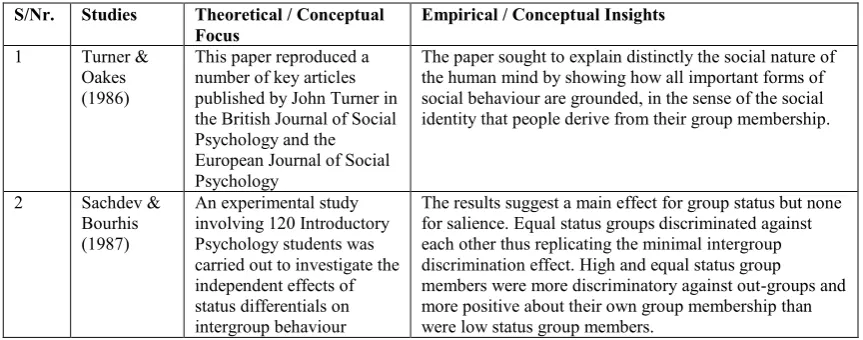
Table 3.1 Selected Past studies relating to Social Identity Theory and Empirical/Conceptual Insights
S/Nr. Studies Theoretical / Conceptual
Focus Empirical / Conceptual Insights 1 Turner &
Oakes (1986)
This paper reproduced a number of key articles published by John Turner in the British Journal of Social Psychology and the European Journal of Social Psychology
The paper sought to explain distinctly the social nature of the human mind by showing how all important forms of social behaviour are grounded, in the sense of the social identity that people derive from their group membership.
2 Sachdev & Bourhis (1987)
An experimental study involving 120 Introductory Psychology students was carried out to investigate the independent effects of status differentials on intergroup behaviour
29 3 Shimp &
Sharma (1987)
Consumer ethnocentrism Consumer ethnocentrism concept and the CETSCALE are useful tools for examining sociological phenomena in the marketing and consumer behaviour domains
4 Brown &
Lunt (2002) This conceptual study offers a genealogical analysis of the social identity tradition (SIT).Also, drawing from the work of Deleuze and Guattari, this study shows how a range of SIT concepts can be reformulated.
This study suggests that the social identity tradition (SIT) is in trouble. It has more or less “evolved into a mostly experimental study of categorisation as cognitive process and not the mid-range theory of the relationship between individuals and the social order promised by Tajfel (1981)” (p.18). As a consequence, SIT is becoming more highly disputed. The status of the social cannot be taken for granted. Society is engineered and produced through social practices, through the organisation of bodies and materials along with the ordering of categories and identities.
5 Oakes
(2002) Conceptual: This paper provides a conceptual response to Leonie Huddy's (2001) critique of the social identity approach developed by Tajfel, Turner and their collaborators.
This paper challenged Huddy's (2001) critique of the social identity approach developed by Tajfel and collaborators. this study supports the subjective aspect of group membership, as well as the interpretation of the minimal group paradigm, including as well issues of identity choice, salience and the variations in identity strength. This study gives particular emphasis to the treatment of groups as process in social identity theory and self-categorisation theory.
6 Abrams & Hogg (2004)
Conceptual: A
metatheoretical approach is used to develop group theorising about intergroup behaviour, motivation and self-categorisation
“A valuable way to test the limits of theory is to pitch it into the real world. ... The principle of functional antagonism between levels of self-categorisation, proposed by self-categorisation theory, did not seem able to capture the complexities and nature of many intergroup
encounters” (p.103). Meta theory should be used to consider whether social identity would shape processes among different members within groups (e.g. Abrams, 1990; Hogg, 1996).
7 Ashmore et
al (2004) The study offers a framework for conceptualising collective identity and distinguished several identity dimensions.
The study offers a framework involves several identity elements and pinpoints critical research directions. The study comments on the process of differentiating and labelling elements and discusses measurement issues involved in measuring identity elements: Also, the study discusses the individual differences in the variability versus stability of the experience and expression of collective identity elements. The study also considers the development of collective identity.
8 Huddy
(2004) This study explored the approaches that account for variations in the
development of in-group cohesion and out-group antipathy among individual group members, across groups, and in different societies.
Social dominance theory is the most ambitious theory in understanding identity acquisition and development of out-group antipathy.
Social identity theory provides the greatest nuance in understanding how group membership is likely to translate into group bias and intergroup conflict.
System justification theory, the least well-developed of the three theories, helps to explain the existence of quiescence among members of low-status societal groups.
9 Aries & Seider (2007)
Using data from public and elite private colleges, this study explored the association between social class and identity formation, both as an independent variable that shapes identity (e.g. class position may shape choices, self-conceptions and ideologies) and as a domain of importance and personal relevance to identity.
Social class plays an important role both as an independent variable that shapes the formation of identity and as a domain of identity exploration. This study elaborated the influence of five domains of identity - occupational goals, political beliefs, religious beliefs, sex role attitudes and social class.
10 Berger et al.
(2011) Identity signalling and symbolic consumption. The study examines how identity signalling explains
This paper presents a model of how people use
30 and predicts aggregate
changes in consumption. model demonstrates how the structure of a social network can give consumption meaning. 11 Sechrist &
Young (2011)
This study (involving two separate studies) examined the role of ingroup identification in the influence of social consensus information (information about others' beliefs) on intergroup attitudes
Both studies demonstrated that in-group identification moderated consensus effects, such that high identifiers were more susceptible to others' beliefs than individuals in the low identification and control conditions. This study demonstrates that identifying with the person or group providing the consensus information is important to changing intergroup attitudes.
12 Chowdhury
(2012) His study assesses the utility of social identity theory in addressing the ethnocentric tendencies of different socio-economic-demographic groups of consumers.
(1) The CETSCALE is applicable to developing countries (Bangladesh, in this study). (2) Consumer ethnocentric tendencies of different social identities (male and female, consumers of border and non-border districts, students, job holders and businessmen) are highly influenced by their ‘in-group’ interests that make them act diversely (less or more ethnocentric) from others or ‘out-groups’. Thus, social identity theory explains consumer ethnocentrism. 13 Constanţa &
Rodica (2012)
Person perception and
social illusions Core conclusions in this study include: (1) a person's status distorts perception, (2) depending on the context, (2) a person's perception is determined by the stereotypes guiding interpersonal evaluation, and (3) one's view of another depends on past experience.
14 Haslam et al
(2012) This conceptual paper examined the significant role played by John Turner in contributing to the development of social psychology
This study highlighted the foundations and ideas
underpinning the instrumental contribution of John Turner to the development of social psychology knowledge. This study pinpointed the key role that John Turner played in communicating the importance of social psychology to human society and galvanising research interest. 15 White et al
(2012) This study examined the conditions under which consumers demonstrate associative vs dissociative responses to identity-linked products as a consequence of a social identity threat.
This study reports that people with independent self-construals tend to avoid identity-linked products when that identity is threatened versus not threatened. Those with more interdependent self-construals, in contrast, demonstrate more positive preferences for identity-linked products when that aspect of social identity is threatened.
16 Fellmann
(2017) This conceptual paper examined the relation between personality and society regarding contrast between Eastern and Western cultures.
Personality in the perspective of cultural psychology remains problematic. There are significant cultural and personality contrasts globally.
17 Islam
(2014) This book chapter conceptually examined social identity theory
The chapter highlights critical debates in the discourse of social identity theory. The chapter argues that SIT offers critical insights about social identity bases of
discrimination, prejudice and intergroup conflict by positioning the phenomena as a consequence of group-based categorisation and self-enhancement motives. 18 McKinley et
al (2014) Based on experimental design, this study examined the influence of exposure to positive Latino media exemplars on ingroup (Latino) and outgroup (white) consumers.
Study 1 and Study 2 suggest that although exposure to positive media depictions of Latinos can prompt more favourable evaluations of ingroup and self among Latinos, the same cannot be said of the effects of exposure to affirmative messages on judgements about Latinos among outgroup members (i.e. whites).
31
3.2 Social Psychology
In their Special Issue Editorial “Identity, influence, and change: Rediscovering John Turner's
vision of social psychology”, published in the British Journal of Social Psychology, Haslam
et al (2012) note that “groups and group behaviour lie at the heart of human society” (p.201). Since humans live, work and interact in groups, they become collaborative architects of the
social world we inhabit, they commented further. Within this process, social psychology
plays a fundamental role (e.g. Turner and Giles, 1981; Haslam et al., 2012; Turner, 1975, 1985; Fellmann, 2017). As summarised by Haslam et al., (2012), the core questions that define the field of social psychology, which John Turner devoted himself to addressing in the
37-year period between commencing his PhD at Bristol in 1971 and his retirement in 2008
are: what is the relationship between individual minds, groups and society?
“Social psychology is a crucible for numerous levels of explanations ranging from individual
cognition to interpersonal interaction and group processes to social structure” (Abrams and
Hogg, 2004, p.98). According to further literature (e.g. Turner, and Giles, 1981; Haslam et al., 2012) social psychology tries to clearly explain the social nature of the human mind by showing how all important forms of social behaviour, especially the propensity for social
influence and social change are grounded in the sense of social identity that people derive
from their group membership (e.g. McKinley et al, 2014; Islam, 2014; Opute, 2017).
To conclude the aforementioned Special Issue Editorial, Haslam et al., (2012) underlined the immense contribution of John Turner to the development of social psychology knowledge.
The third and most important of several contributions, they noted, is Turner's commitment
and drive to convey the importance of social psychology to human society. As they
32
pursuit, rather1 it addresses processes of the most profound importance” (p.215). These processes are of critical importance to human society because they enable people to
determine whether people divide or unite, whether they fail or flourish, and whether they
suffer or succeed (Haslam et al., 2012).
For John Turner, getting social psychology right was the most important of all pursuits, and
does not afford space for complacency or compromise (Haslam et al., 2012). Responding to John Turner's call for research, and those of other scholars (e.g. Haslam et al., 2012; Turner and Oakes, 1986; Oakes, 2002), this study aims to contribute to the understanding of
“distinctly social nature of the human mind by showing how the important forms of social
behaviour are grounded” (Haslam et al., 2012, p.201).
Given the aforementioned aim of this study of contributing to the understanding of “distinctly
social nature of the human mind by showing how the important forms of social behaviour are
grounded” (Haslam et al., 2012, p.201), it is important to gain some understanding of collective identity or social identity theory (see section 3.3). Prior to doing that, it is also to
gain some understanding of critical factors to the understanding of social behaviour and
collective or social identity dynamics. Hence, literature is reviewed on:
1. Ethnocentrism Theory (section 3.2.1),
2. Acculturation Theory (section 3.2.2), and
3. Cultural Dimensions (Individualism vs. Collectivism) theory (section 3.2.3).
Engaging with these streams of literature is essential to gaining a better understanding of the
role that culture plays in social behaviour grounding of individuals (e.g. Opute, 2015;
Houston, 2014; Schwartz et al., 2010; Hofstede, 2011).
33 3.2.1 Ethnocentrism Theory
The global market is increasingly becoming homogeneous. Nevertheless, ethnicity and
nationalism remain strong motivational tools that condition modern markets (Akin, 2016).
According to Vida et al. (2008), ethnicity serves as a balancing force for individuals‟ sense of identity as well as for the behaviour of individuals who may seem to have lost their sense
of identity as a result of globalisation influence.
An ethnicity-based theory that has been utilised in the understanding the socio-psychological
perspective of consumers' behaviour is ethnocentrism theory (Bizumic, 2015; Akin, 2016;
Sharma et al., 1995; Shimp and Sharma, 1987; Liang and Kong, 2010; Neuliep et al., 2005). The term ethnocentrism emerged out of the combination of Greek terms ethnos (meaning race or nation) and kentron (meaning centred) (Usunier and Lee, 2005). Ethnocentrism is a slippery concept that has famously featured across a variety of disciplines, such as
anthropology, sociology, psychology, political science, philosophy, education, and the
academic study of religion (Bizumic, 2015). The term ethnocentrism was first introduced to
the social sciences literature over a century ago (Sumner, 1906). Neuliep et al. noted in 2005 that over the past 50 years, considerable research effort has been made in the social science
domain regarding the nature and prevalence of ethnocentrism. Over a decade after Neuliep et al.'s observation, the pertinence for better understanding of the ethnocentrism theory is no less recognised (e.g. Liang and Kong, 2010; Bizumic, 2015; Akin, 2016, inter alia).
In the pioneering engagement with ethnocentrism in the social science field, Sumner (1906)
defined ethnocentrism as “the technical name for this view of things in which one's own
group is the centre of everything, and all others are scaled and rated with reference to it” (p.
13). According to Bizumic (2015, p.2), “ethnocentrism is usually defined as a kind of ethnic
or cultural group egocentrism, which involves a belief in the superiority of one’s own group,
34
outside the group.” Thus, conceptually, individuals who are ethnocentric exhibit attitude and
behaviours that favour ingroup members at the expense of the outgroup (e.g. Neuliep et al., 2005; Islam and Hewstone, 1993). As elaborated further in the literature, individuals who are
ethnocentric foster cooperative relations with ingroup members but compete with (or even
battle with) outgroup members (Neuliep et al., 2005).
Within the consumer behaviour domain, consumer ethnocentrism relates to the opinions and
evaluations of consumers concerning the morality of purchasing foreign-made products
(Sharma et al., 1995; Shimp and Sharma, 1987). This consumer logic is grounded on the notion that patronising foreign products is detrimental to the domestic economy and leads to
unemployment and also contravenes patriotic behaviour (e.g. Auruskeviciene et al., 2012; Asil and Kaya, 2013). Thus, as Shimp and Sharma (1987) argue, ethnocentrism is grounded
on the notion that people should take pride in their own norms and virtues, and therefore
perceive their own groups (in-groups) as the centre of the universe. Although ethnocentrism
is viewed as a negative trait, Sharma and Shin (1995) contend that ethnocentrism lubricates
in-group survival, solidarity, conformity, cooperation, loyalty, and effectiveness.
Typical socio-psychological factors that affect ethnocentrism include patriotism, collectivism
and cultural openness (Liang and Kong, 2010; Akin, 2016)
3.2.2 Acculturation Theory
According to social interaction theorists, social psychology focuses on understanding how
our actions, thoughts, and feelings are influenced by the social environments that we live in
(Baron et al., 2008). Thus, the focus is on understanding how we act and who we are in various situations (Baron et al., 2000). A pivotal lens for understanding what propels
individual behaviour is culture (e.g. Hofstede, 2011; Opute, 2015; Kanter and Corn, 1994). In
35
terms are integrally intertwined with each other (Kim, 2007). According to domain literature,
culture, which includes norms, values, beliefs, principles, and ways of doing things (Opute,
2017; Hofstede, 1980), is "the collective programming of the mind which distinguishes the
members of one group or category of people from another." (Hofstede, 1991, p.5). In other
words, an individual's behaviour is conditioned by the values, norms and principles that are
defined by his/her cultural lineage. As a matter of fact, Triandis (1994) adds that culture
implies a social group's shared values, traditions, norms, behaviours and rituals.
With this stream of literature is however the notion that culture is not stagnant (e.g. Opute,
2012; Chan and Prendagast, 2007). Thus, cultural transformation can take place, in which
case, the mindset and the induced behaviour trend may change. The processes of change with
regards to the functioning of the norms, values, traditions, etc. have been represented by two
terms: acculturation and enculturation (Kim, 2007).
Acculturation, which is the embraced construct in this study, was first defined by Redfield,
Linton and Herskovits (1936) as reflecting those phenomena which exist when groups of
individuals sharing diverse cultures come into regular first-hand contact, leading to
subsequent changes in the original culture patterns of either or both groups. This conceptual
lens is reinforced by Newman and Sahak (2012) who view acculturation as a learning
process, practices and customs of a new culture which acquires the capability to function
within a main culture but preserving the original culture. Thus, it means when there is a
meeting of two cultures, one culture adopts the beliefs and behaviours of another culture
(Ishak et al., 2013). Further literature simply refers to acculturation as