2017 2nd International Conference on Information Technology and Industrial Automation (ICITIA 2017) ISBN: 978-1-60595-469-1
Level Control Study of Two-link Tank on
Double Baroceptors
Hong-Xia Niu and Tao Hou
ABSTRACT
The level of two-link tank was controlled for THKGK-1 advanced process control device based on double baroceptors. The method of PID control and fuzzy control were used respectively to control liquid level on the existing experiment equipment and software environment. During the experiment, firstly, PID control experiment was done on single baroceptor. Then the experiment was repeated on double baroceptors, and observation and analysis control effect was done according to the actual control results. Secondly, fuzzy control method was put forward and a fuzzy controller was designed by analysis experimental results to find the shortages, and then experimental verification work was done. Finally, the real-time curve of level control and real-time data were displayed in the MCGS configuration software. The two experimental results show that PID Control can control the level of two-link tank, but the effect is a bit poor. It can be improved the performance using PID control based on double baroceptors. The fuzzy control improves the dynamic performance and steady-state performance and obtains better control effect.
________________________
Hong-xia Niu. Automatic Control Research Institute, Lanzhou Jiaotong University, Lanzhou China, 730070. e-mail: [email protected]
INTRODUCTION
The THKGK-1 Advanced Process Control Experiment Device is an experimental plat consisting of a controlled object and a control computer. The device can finish the experimental project such as liquid level, temperature, pressure and flow control. These experimental projects can be used to simulate the measurement and control such as petroleum, chemical and sewage treatment and other areas. As a typical experiment representative of process control, level control study of two-link tank which is studied by numerous process control specialists is one of the hotspots. Because of the features of its own lag, nonlinear characteristics and complex control system status, system parameters and control algorithm directly affect the control precision.
Most of current process control systems use pressure transducer to detect the tank level with the traditional PID control methods, improved PID control and fuzzy control & neural network control [1-4]. The experimental project can make the experimenter understand the experimental principle, know well the process, verify different control methods, thus strengthen the understanding of the control algorithm and applied it. So the research of the process control system has very important theoretical significance and practical application value.
EXPERIMENTAL SYSTEM
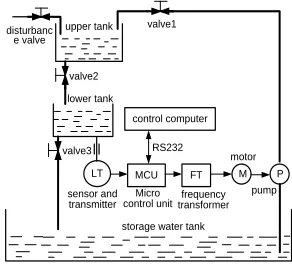
Experimental device principle and diagram. Level control principle and diagram of two-link tank on the experimental device is shown in Figure 1.
M P LT MCU
control computer
FT RS232
pump motor
Micro control unit sensor and transmitter
frequency transformer upper tank
lower tank valve1
valve3 valve2
storage water tank disturbanc
[image:3.612.233.379.87.219.2]e valve
Figure 1. Two-link tank control principle and diagram.
Tank
Baroceptor 2 Baroceptor 1
Plastic hoses Output
[image:3.612.229.368.253.375.2]Level height
Figure 2. Principle diagram of double baroceptors detection.
Data Processing of double baroceptors detection. According to the principle of the experimental device, the output information of two baroceptors is transmitted and processed by A/D conversion in order to obtain the digital information. Then the digital information is transmitted to the host computer through RS-232. The host computer determines whether the sensor data is normal by reference to the setting value of the computer software (configuration software) and the upper and lower bounds of the liquid level control. If both of them are normal, the average of the two data is regarded as the final detection value. If one of them is failed, another data is regarded as the final detection value. If both of them are failed, the operation is stopped and an alarm is given.
CONTROL ALGORITHM DESIGN
P d 0 i 0
( ) ( 1)
( ) [ ( ) ( ) ]
k
j
T e k e k
u k k e k e j T u
T T
(1)Incremental control algorithm:
d
P P P
i
( ) [ ( ) ( 1)] T ( ) T [ ( ) 2 ( 1) ( 2)]
u k k e k e k k e k k e k e k e k
T T
(2)
Design of fuzzy controller for water tank level. Generally, PID control requires the establishment of the precise mathematical model or empirical parameters of the controlled object. Fuzzy control [6-8] is a kind of intelligent control which reflects the human thinking, which has good robustness, good construction and is easy to be accepted and no need to know the exact mathematical model of the controlled object. The fuzzy controller works according to certain language rules which are based on summarizing the experience of operator, and most fuzzy logic inference methods adopt max-min inference method. Therefore, in order to design a fuzzy controller, the input and output variables of the fuzzy controller must be fuzzed.
Ensure the input and output variables of the fuzzy controller. The fuzzy controller selects error e of the system level and change rate of the error ec as the input language variable, and output u as the output language variable. So, a two-dimension fuzzy controller is constituted.
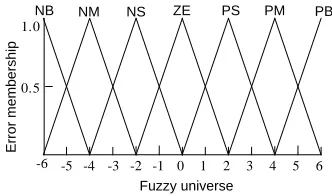
Determine the range of input and output variables. According to the characteristics and the actual parameters of the experimental device, the domain of discourse of the error e is set as [-6 6], the domain of discourse of error change rate ec is set as [-12 12], the domain of discourse of control output u is set as [-6 6]. And the fuzzy quantities of the error e can be set as "NB", "NM", "NS", "ZE", "PS", "PM", "PB". The fuzzy quantities of error change rate ec and control output u can be set as "NB", "NM", "NS", "ZE", "PS", "PM", "PB". Input and output are used triangular membership function to proceed fuzzy inference to get the membership function of the error e as shown in Figure 3. The membership function of the error change rate ec is similar to the membership function of the output u, of course, the domain of discourse of error change rate ec has been set as [-12 12].According to the fuzzy quantities above-mentioned, the fuzzy control rules can be obtained as shown in TABLEⅠ. Anti-fuzzy method adopts the method of the centroid method, and finally calculates the input value after the quantitative calculation. Then the controlled quantity is gained.
EXPERIMENTAL STUDY AND RESULTS
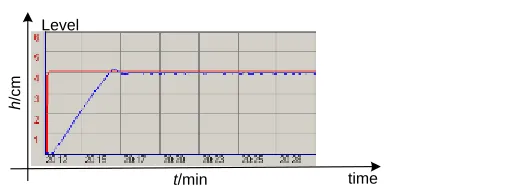
proceed three times. And then the PID control parameters are setted for experiment in order to complete the level control. The result of the liquid level control with a target water level of 4.0 cm and an initial water level of 0 cm under a single baroceptor is shown in Figure 4. From Figure 4, the dynamic time of the system is about 25min, and the overshoot is close to 50%. It shows that the dynamic performance is not very good. After the system is stabilized, the water level is about 4cm. There is static error in comparison with the target water level. So the error is large, and the control accuracy is not high.
Note: The system initialization phase "delay" is due to the hysteresis characteristics of the control system.
[image:5.612.222.388.201.299.2]In order to compare with PID experiment based on the single baroceptor, PID control experiment based on the double baroceptors was done under parameters and procedures are the same, but the effect is not. The result is shown in Figure 5.
TABLE 1. u TABLE OF FUZZY CONTROL RULES.
e ec
NB NM NS ZO PS PM PB
NB PB PB PM PM PS ZO ZO
NM PB PB PM PS PS ZO NS
NS PM PM PM PS ZO NS NM
ZO PM PM PS ZO NS NM NM
PS PS PS ZO NS NS NM NM
PM PS ZO NS NM NM NM NB
PB ZO ZO NM NM NM NB NB
-6 1.0
0.5
-2 -3 -4
-5 -1 0
Fuzzy universe
NB NM NS
4 3 2
1 5 6
ZE PS PM PB
E
rr
o
r
m
e
m
b
e
rs
h
ip
It can be seen from Figure 5 that the water level of the stabilization system is very close to 4cm. The error is close to 0 in comparison with the target water level. The dynamic time of the system is about 19min and the overshoot is about 30%, so the dynamic performance is improved. Therefore, PID control based on the double baroceptors, not only improves the dynamic performance of the system, but also improves the system's steady-state performance, especially the accuracy was clearly improved in the late period of the stabilization.
Fuzzy control experiment and result. According to the designed fuzzy control method, the experiment was carried out under the same parameter setup (a target water level of 4.0 cm and an initial water level of 0 cm) and the same experimental conditions (double sensors, zero calibration, gain calibration and valve opening). The result is shown in Figure 6.
It can be seen from Figure 6 that the water level of the stabilization system is very close to 4cm. The error is close to 0 in comparison with the target water level, the dynamic time of the system is about 5min and the overshoot is about 3%, so the dynamic performance is improved obviously. Therefore, the fuzzy control based on the double baroceptors, not only improves the dynamic performance of the system, but also improves the system's steady-state performance, especially the dynamic process is significantly accelerated.
h
/c
m
t/min time Level
Figure 6. The real-time water level curve of the tank by fuzzy control.
h
/c
m
t/min
[image:6.612.111.491.91.205.2]time Level
Figure 4. The real-time water level curve of the tank on the single baroceptor PID control.
h
/c
m
t/min
time Level
[image:6.612.199.453.519.612.2]CONCLUSIONS
On the basis of the THKGK-1 advanced process control device, two methods of PID control and fuzzy control were used to study the liquid level control of the Two-link Tank. From the results, both experimental methods can achieve the level control for the same device and set value, and achieve better control effect. But the comparison shows that the effect of single baroceptor PID control is somewhat poor, the double baroceptors PID control is better than single baroceptor PID control, and the fuzzy control can greatly correct deficiency of the PID control and can further improve the control effect for the tank level.
ACKNOWLEDGEMENTS
This work was financially supported by the Gansu Natural Science Foundation (Grant No. 1606RJZA002).
REFERENCES
1. Hou Tao, Dong Haiying. 2005, Design and Experimental Study of 2-Container Water Tank Fuzzy Controller Based on THJ-3. Journal of Lanzhou Jiaotong University, 24(6):107-109. 2. Hou Tao. 2009, Experimental Research on Neural Network PID Control Based on Hydraulic
Pressure of 2-Container Water Tank. Journal of Lanzhou Jiaotong University, 28(3): 41-43. 3. Niu Hong-xia, Hou Tao. 2010, Research of Fuzzy Adaptive PID Control on 2-Container Water
Tank. Techniques of Automation & Applications, 29(12): 9-11.
4. Hou Tao, Niu Hong-xia, Fan Duo-wang. 2013. Simulation and Experiment Study of Optimizational PID Control with Changing Integration Rate.TELKOMNIKA, 11(1):550-558. 5. Li Hua, Fan Duowang. 2007. Computer control system. China Machine Press, Beijing In
Chinese.
6. Lou Shuntian. 2001, Fuzzy System-Analysis and Design Based on MATLAB, Xidian University Press, Xi’an In Chinese.
7. Sun Zengqi, Zhang Zaixing, Deng Zhidong. 1997. Intelligent control theory and technology. Tsinghua University Press, Beijing In Chinese.