Optimization of Network Lifetime with Extreme Lifetime Control
Proficient Steering Algorithm and Remote Power Transfer
Manish BHARDWAJ
1,*and Anil AHLAWAT
21SRM University, NCR Campus, Modinagar, Ghaziabad, India
2KIET Muradnagar, Ghaziabad, India
*Corresponding author
Abstract. A versatile Ad-hoc Network for which every hub is free to all hub of the system. In MANETs hub are not having legitimate framework. The power wellspring of the Mobile Ad hoc arrange is battery control. As we as a whole know battery control have a specific point of confinement and reasons. This paper executes the idea of remote power exchange between the hubs of Ad hoc system to exchange the ability to these hubs remotely and utilize the most extreme lifetime control proficient steering Algorithm (ELPSA) to diminish the utilization of energy utilized by the hubs. The remote power exchange can be accomplished with the assistance of one kind of near field methods called magnetic resonance. This system is non radiative in nature. This paper decreases the issue of energy of the specially appointed system hubs about 70 to 80 % from the customary idea utilized for lifetime improvement of these hubs. Execution streamlining can be investigations with the assistance of some vitality productive conventions.
Introduction
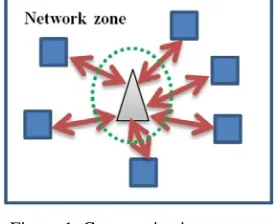
[image:1.612.237.374.561.673.2]Grid computing is a group of distinguish systems from many areas to get the same target for all the connected system. It works on the partition method this method divides the area in grid form in equal or unequal subareas. A sample area is divided with some certain length that is pre-specified in the network designed. Through this technique routing protocols will perform well within the communication network. Higher accuracy is obtained by using this technology. Wireless communication and networking are becoming very predominant due to their flexibility and ease of deployment. The NSA algorithm discusses a zone-based scheme that groups nodes into zones and allowing the zones to route packets. Zoning requires nodes to be GPS-enabled. In wireless networking, routing protocols have been designed especially for data centric, finding path or locations of node. Grid computing is a type of distributed computing. Distributed computing explores that the systems in same network may share the multiple resources. This technology coordinates the systems on large scale with many number of network connections. Mobile grid computing is the improved version of the traditional way of computing. Fig 1 represents the traditional way of communications.
Figure 1. Communication system.
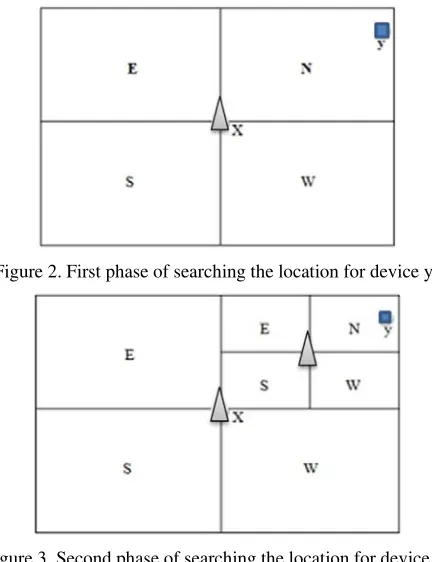
the power station and y device that wants to connect with the network. Divide the area into four grids as zone north south east and west. The entire figure explains the procedure of searching the target device. After searching the device connection will establish between the appropriate power station and the device. Then communication is in process.
Figure 2. First phase of searching the location for device y.
[image:2.612.198.414.122.403.2]Figure 3. Second phase of searching the location for device y.
Figure 4. Third phase of searching the location for device y.
Figure 5. Third phase of searching the location for device y.
[image:2.612.213.398.412.534.2] [image:2.612.216.404.555.685.2]some interval. The approach of DSR is spread the path request message packets dynamically throughout network and carries the route-traversed packet in its header.
Related Work
Rajesh and sudhir explores[1]Vehicular ad hoc network (VANET) as it is an important application of
communication and networking. Because of its nature, routing in VANET is difficult. The nature explores as high mobility and different network topologies. Many topologies are developed for VANET, where they exhibit high beginning to end delay; throughput, delay jitter and also have low routing energy and load. Parameters considered like movement of the vehicle, vehicular density; velocity and also considering its fading conditions to create a hybrid by implementing the Ant Colony Technique on reactive path finding protocol Dynamic source routing and improve the performance of it.
Ikram designed[2] an approach to protect the location privacy of vehicle driver, but there are
limitations, which hamper to fully utilize and provides an efficient privacy protection in VANET. This paper, explain two things that are : first is analyze existing location privacy techniques proposed in the scenario of VANET and highlight their limitations and second is a new Velocity Based Pseudonym Changing (VBPC) strategy for preserving location privacy of vehicles in VANET. It is an efficient strategy to protect location information of vehicle drivers in terms of average privacy strength and pseudonym changing when compared with VLPZ and PCS strategy.
Md Raqibull Hasan investigates [3]the malicious detection and avoidance of black hole attack for
smart meter network. In terms of routing protocol, the reactive routing protocol Ad hoc On-Demand Distance Vector (AODV) is commonly adopted for smart meter network and is considered in our paper. However, the default AODV is vulnerable to black hole attacks. A new routing protocol is designed, termed Enhanced Ad hoc On-Demand Distance Vector (E-AODV) by modifying the Route Reply (RREP) system based on AODV. The RREP in E-AODV updates the destination sequence number corresponding to a fresh route request. By comparing sequence numbers from multiple replies, it detects the existence of black hole behavior because the attacker usually sends a much higher sequence number, compared to the actual one generated from the destination. After detection, the receiving meter sends a deny reply to the destination. Upon receipt of the deny reply, the destination regenerates RREP with an updated sequence number, which is kept to itself. Since attackers only respond when a new request is initiated, this time the attacker will not act because no request is initiated. Therefore, it is able to avoid the effects of malicious meter.
G S Prasanna Lakshmi improves [4] the intrusion detection system by using a signature method
based on security for MANETs. These mobile Ad hoc networks modify their topology dynamically; intrusion detection in these networks is a most challenging task. Signature based detection is the mainly used for detection technique for Intrusion Detection Systems (IDS). By focusing on Zone based AODV routing protocol, implementation is done for intrusion detection system using MATLAB with true-time.
Jair Jose Ferronato done[5] comparison of three routing protocols for behavioral and performance
analysis in the urban environment. The proactive, reactive and hybrid protocols were applied in the simulator NS2 (Network Simulator), and made a study with TCP and UDP transport protocols applied with varying cars density.
Praneeth Paranavithana presents[6] a modified AODV algorithm, where a node calculates its
Remote Power Generation
[image:4.612.249.372.288.346.2]Family unit gadgets create generally little magnetic fields. Therefore, chargers hold gadgets at the separation important to initiate a present, which can just happen if the curls are near one another. Since an attractive field spreads every way, making a bigger one would squander a considerable measure of vitality. An effective approach to exchange control between loops isolated by a couple of meters is that we could expand the separation between the curls by adding resonance to the condition. A decent approach to comprehend resonance is to consider it as far as sound. A question's physical structure - like the size and state of a trumpet - decides the recurrence at which it normally vibrates [7]. This is its resonant recurrence. It's anything but difficult to motivate articles to vibrate at their full recurrence and hard to inspire them to vibrate at different frequencies. This is the reason playing a trumpet can make an adjacent trumpet start to vibrate. The two trumpets have the same resounding recurrence. Enlistment can occur little distinctively if the electromagnetic fields around the loops resound at a similar recurrence. The hypothesis utilizes a bended curl of wire as an inductor. A capacitance plate, which can hold a charge, joins to each finish of the loop as appeared in Fig 6. As power goes through this curl, the loop starts to reverberate [8]. Its thunderous recurrence is a result of the inductance of the curl and the capacitance of the plates.
Figure 6. Curl contain Charge.
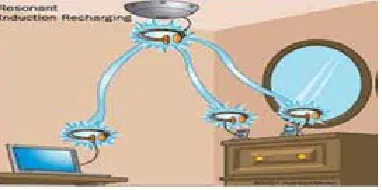
Power, going along an electromagnetic wave, can burrow from one loop to alternate as long as they both have the same resonant recurrence. In a short hypothetical investigation they exhibit that by sending electromagnetic waves around in an exceedingly precise waveguide, transitory waves are created which convey no vitality. A transient wave is close field standing wave showing exponential rot with separate. On the off chance that a legitimate full waveguide is brought close to the transmitter, the evanescent waves can enable the vitality to burrow (particularly transient wave coupling, what might as well be called burrowing to the power drawing waveguide, where they can be corrected into DC control [9]. Since the electromagnetic waves would burrow, they would not proliferate through the air to be ingested or scattered, and would not disturb electronic gadgets. For whatever length of time that the two loops are out of scope of each other, nothing will happen, since the fields around the curls aren't sufficiently solid to influence much around them. So also, if the two curls reverberate at various frequencies, nothing will happen. Be that as it may, if two resounding loops with a similar recurrence get inside a couple of meters of each other, surges of vitality move from the transmitting curl to the accepting loop. As per the hypothesis, one loop can even send power to a few getting curls, as long as they all resound at an indistinguishable recurrence from appeared in Fig 7. The specialists have named this non-radiative vitality exchange since it includes stationary fields around the curls as opposed to fields that spread every way [10].
Figure 7. Power transmission with Curl.
[image:4.612.213.404.597.692.2]As indicated by the hypothesis, one loop can energize any gadget that is in go, as long as the curls have the same full recurrence. "Full inductive coupling" has enter suggestions in taking care of the two principle issues related with non-resonant inductive coupling and electromagnetic radiation, one of which is caused by the other; separation and productivity. Electromagnetic enlistment chips away at the rule of an essential curl producing a transcendently attractive field and an optional loop being inside that field so a current is actuated inside its loops. This causes the moderately short range because of the measure of energy required to create an electromagnetic field. Over more noteworthy separations the non-resonant enlistment strategy is wasteful and squanders a great part of the transmitted vitality just to expand. This is the place the resonance comes in and helps productivity significantly by "burrowing" the magnetic field to a collector loop that resounds at a similar recurrence. Not at all like the different layer optional of a non-resonant transformer, such accepting loops are single layer solenoids with firmly divided capacitor plates on each end, which in mix enable the curl to be tuned to the transmitter recurrence in this manner dispensing with the wide vitality squandering "wave issue" and permitting the vitality used to concentrate in on a particular recurrence expanding the range.
Extreme Lifetime Control Proficient Steering Algorithm (ELPSA)
a) For correspondence Source hub (S) sends the message RREQ to all hubs which are in the transmission scope of it.
b) Fixed the upper edge farthest point and lower edge restrict. When flooding happens, select the hubs which are having vitality equivalent or upper the upper edge cutoff and name them "Head hubs".
c) Nodes which are having vitality level underneath the upper edge cutoff would not partake in the correspondence first and it's smarter to go into rest mode.
d) Out of these chose Head hubs pick the one hub called goal hub and afterward send the affirmation (ACK) message to a source hub. This message contains all the data with respect to goal hub. On the off chance that this progression does not happen then go to step (a).
e) After each transmission, the vitality level of each head hub is recalculated.
f) If the rest of the vitality of any head hub is lower than the lower edge restrain then it is called dead hub. Locate the close-by hubs which likewise have a lower vitality level, a hub having in rest mode and those entire the correspondence procedure.
g) Club all the vitality of these hub to one hub which having vitality level close to upper edge constrain. When it reaches to upper edge level at that point exchange that vitality to next hub which having vitality level close to upper edge restricts.
h) Continue that procedure up to the last joule of vitality remains and afterward begin from the underlying after energize every one of the hubs again with the assistance of remote power exchange.
Results Analysis
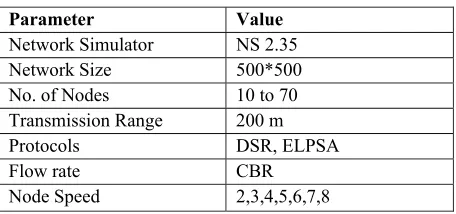
[image:5.612.193.421.624.731.2]In this manuscript the initial Power of the network is 0.5J. Table 1 represents the Parameter metrics. Table 1. Parameter Metrics.
Parameter Value
Network Simulator NS 2.35 Network Size 500*500 No. of Nodes 10 to 70 Transmission Range 200 m Protocols DSR, ELPSA
Flow rate CBR
In this manuscript Figure 8 Represent the line graphs between the DSR and ELPSA protocols. This graph shows in between packet delivered to no. of nodes. As per the graph, nodes in the network increases packet delivering ratio is get reduce but graph shows that ELPSA give better result than DSR.
Figure 8. Packet Delivered vs No. of nodes.
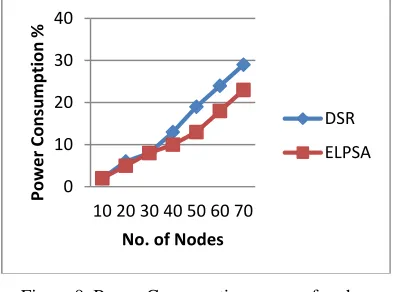
[image:6.612.208.405.358.504.2]In this manuscript Figure 9 Represent the line graphs between the DSR and ELPSA protocols. This graph shows in between power consumption in percentage and the no. of nodes. The x axis is varies from 10 to 70 and for every value of x axis there is one value of power consumption at y axis. The DSR protocol shows the linear graph but ELPSA gives some different graph. In middle the ELPSA not shown the linear graph and just due to this ELPSA shows the overall advancement than DSR protocol.
Figure 9. Power Consumption vs no. of nodes.
In this manuscript Figure 10 Represent the line graphs between the DSR and ELPSA protocols. This manuscript uses varying number of nodes like 10 to 70. In this graph both protocols shows the similar curve each at every point of the network lifetime. ELPSA shows little better results than DSR.
Figure 10. Network Lifetime vs No. of nodes.
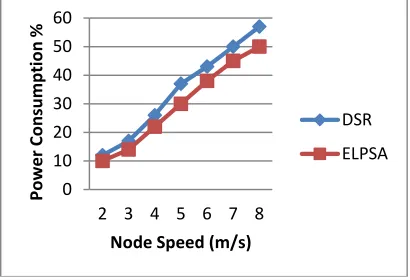
In this manuscript Figure 11 Represent the line graphs between the DSR and ELPSA protocols. In this graph the horizontal axis is represented by node speed which is measured in meter per
0.8 0.85 0.9 0.95 1 1.05
10 20 30 40 50 60 70
Packet D elivery % No. of Nodes DSR ELPSA 0 10 20 30 40
10 20 30 40 50 60 70
Po wer C o nsu m pti o n % No. of Nodes DSR ELPSA 0 5 10 15
10 20 30 40 50 60 70
[image:6.612.205.408.561.697.2]second. The vertical axis in this graph is represented as Power consumption in percentage. As the node is moved to the network with some speed then the calculation of data for this node in communication is get difficult. This is because position coordinates and distance is varied at every movement. The Graph shows that as the node speed of the nodes get increased the power consumption of the nodes in the network get increased. The Graph shows that ELPSA has lesser consumption of energy than DSR protocol. When the node speed is 1m/s energy consumption is 12 for both protocols and when node speed is 6m/s there is the difference between energy consumption 38 and 47 respectively.
Figure 11. Power Consumption vs Node speed.
Conclusion
This manuscript focuses on to resolve the power problem of the network’s nodes. In every portable device one major problem is its limited power system. The power of the node is directly propositional to lifetime of the node. To resolve the above problem this manuscript uses the two separate techniques in first technique the network’s node are recharge with continuous wireless power transfer technique and in second technique use a proposed algorithm for reduce the power consumption. The above graph shows the comparison between the proposed algorithm ELPSA and DSR protocol. DSR and ELPSA compare with respect to various parameter metrics and at every point proposed algorithm shown better results than DSR protocol.
References
[1] S. Kumar, K. Kumar, M.K. Singh, and R.M. Hegde, “A range-free tracking algorithm in
vehicular ad-hoc networks” IEEE Twentieth National Conference on Communications, ISBN: 978-1-4799-2361-8, 2014.
[2] I. Ullah, A. Wahid, M.A. Shah and A. Waheed, “VBPC: Velocity based pseudonym changing
strategy to protect location privacy of vehicles in VANET”, International Conference on Communication Technologies, pp-132-137, 2017.
[3] M.R. Hasan, Y. Zhao, G. Wang, Y. Luo and Robb M., “Winter Enhanced AODV: Detection
and Avoidance of Black Hole Attack in Smart Meter Network”, International Conference on Computer Communication and Networks, 2017.
[4] G.S.P. Lakshmi and S.K.B. Patil, “Signature intrusion detection using a zone based AODV
routing protocol for MANETs”, International Conference on Advanced Computing and Communication Systems, 2017.
[5] J.J. Ferronato and M.A.S. Trentin, “Analysis of Routing Protocols OLSR, AODV and ZRP in
Real Urban Vehicular Scenario with Density Variation”, IEEE Latin America Transactions, vol 15, issue 9, 2017.
0 10 20 30 40 50 60
2 3 4 5 6 7 8
Po
wer
C
o
n
sumpt
ion
%
Node Speed (m/s)
DSR
[6] P. Paranavithana and A. Jayakody, “Compromising AODV for better performance: Improve energy efficiency in AODV”, National Conference on Technology and Management, pp. 201-204, 2017.
[7] M. Bhardwaj, Enhance life Time of Mobile Ad hoc Network using WiTriCity and
Backpressure Technique, 1877-0509 © 2015 The Authors. Published by Elsevier B.V. This is an open access article under the CC BY-NC-ND license, doi: 10.1016/j.procs.2015.07.447.
[8] M. Bhardwaj, A. Ahlawat, Reduce Energy Consumption in Ad Hoc Network with Wireless
Power Transfer Concept. Inter J of Cont Theor and App 2017; 10: 125-13.
[9] M. Bhardwaj, Selection of Efficient Relay for Energy-Efficient Cooperative Ad Hoc Networks.
American J of Netw and Comm 2015; 4(3), 5-11.
[10]J. Kim, J. Jang, AODV based Energy Efficient Routing Protocol for Maximum Lifespan in
MANET. In:IEEE 2006, Conference on Telecommunications; 19-25 Feb 2006;Guadelope, French Caribbean: IEEE. pp. 1-212.
[11]L. Guo, Y. Liu, T. HuizhuMa, Jiang, Energy Efficient on–demand Multipath Routing Protocol
for Multi-hop AdHoc Networks. In: IEEE 2008, Symposium on Spread Spectrum Techniques and Applications; 25-28 Aug 2008;Bologna, Italy: IEEE. pp. 1-820.
[12]V. Kanakaris, D. Ndzi and D. Azzi, Ad-hoc networks energy consumption: A review of the ad
hoc routing protocols. J of Engg and Techn 2010; 3, 162-167.
[13]M. Tamilarasi, T.G. Palanivelu, IntegratedEnergy-Aware Mechanism for MANETs using on
demand Routing. Intern J of Compand Inform Engg 2008; 2(2), 253-257..
[14]G. Ferrari, S.A. Malvassori, M. Bragalini and O.K. Tonguz, Physical Layer-Constrained
Routing in Ad-hoc Wireless Networks: A Modified AODV Protocol with Power Control. In: IEEE 2005 International Workshop on Wireless Ad hoc Networks; 23-26 may 2005; King’s College London, London: IEEE.
[15]R.C. Shah, J.M. Rabaey, Energy aware routing for low energy ad hoc sensor networks. In:
IEEE 2002 Wireless Communications and Networking; 17-21 March 2002; Orlando, FL, USA: IEEE. pp. 1-931.
[16]B. K. Saraswat, M. Bhardwaj, A. Pathak, Optimum Experimental Results of AODV, DSDV &
DSR Routing Protocol in Grid Environment. In: Elsevier 2015 Procedia computer science, Conference on Recent Trends in Computing; 12-13 March 2015; Ghaziabad, India: Elsevier. pp. 1342-1350.
[17]M. Bhardwaj, Enhance Life Time of Mobile Ad-hoc Network Using WiTriCity and
Backpressure Technique. In: Elsevier 2015, Procedia computer science, Conference on Recent Trends in Computing; 12-13 March 2015; Ghaziabad, India: Elsevier. pp. 1342-1350.
[18]M. Bhardwaj, A. Singh, Power Management of Ad Hoc Routing Protocols Using Mobility
Impact and Magnetic Resonance. Advan in Networks 2015; 3(3), 27-33.
[19]M. Bhardwaj, A. Bansal, Energy Conservation in Mobile Ad Hoc Network Using Energy
Efficient Scheme and Magnetic Resonance. Advan in Networks 2015; 3(3), 34-39.
[20]M. Veerayya, V. Sharma, A. Karandikar, SQ-AODV: A novel energy aware stability based
[21]K.T. Sikamani, P.K. Kumaresan, M. Kannan, R. Madhusudhanan, Simple Packet Forwarding and Loss Reduction for Improving Energy Efficient Routing Protocols in Mobile Ad-Hoc Networks. Euro J of Sci Resea 2009.
[22]H. Huang, G. Hu, F. Yu, A Routing Algorithm Based on Cross-layer Power Control in
Wireless Ad Hoc Networks. In: IEEE2010 Communications and Networking in China (CHINACOM); 25-27 Aug 2010; Beijing, China: IEEE.
[23]M. Bhardwaj. Selection of Efficient Relay for Energy-Efficient Cooperative Ad Hoc Networks.