University of Huddersfield Repository
McCamley, Claire, Gilmore, Audrey and McCartanQuinn, Danielle
Developing the Heritage Destination: An investigation of the implementation of strategic plans Original Citation
McCamley, Claire, Gilmore, Audrey and McCartanQuinn, Danielle (2013) Developing the
Heritage Destination: An investigation of the implementation of strategic plans. In: Proceedings of Academy of Marketing 2013. Academy of Marketing.
This version is available at http://eprints.hud.ac.uk/id/eprint/21116/
The University Repository is a digital collection of the research output of the University, available on Open Access. Copyright and Moral Rights for the items on this site are retained by the individual author and/or other copyright owners. Users may access full items free of charge; copies of full text items generally can be reproduced, displayed or performed and given to third parties in any format or medium for personal research or study, educational or notforprofit purposes without prior permission or charge, provided:
• The authors, title and full bibliographic details is credited in any copy; • A hyperlink and/or URL is included for the original metadata page; and • The content is not changed in any way.
For more information, including our policy and submission procedure, please contact the Repository Team at: [email protected].
Developing the Heritage Destination: An investigation of the
implementation of strategic plans
INTRODUCTION
This paper attempts to investigate the factors which are influential in the effective implementation of strategic planning in a heritage tourism setting. In particular, the paper looks at the respective roles of the public and private sectors in relation to creating an economically viable, augmented tourist experience from a core heritage resource, and the role of strategic planning in this process. This study is set within the context of a wider research programme which focuses on the strategic marketing planning of tourism at two heritage regions in Northern Ireland, which are made up of both publicly and privately owned resources. A conceptual model is presented, which serves to outline the marketing tasks of heritage tourism, making a distinction between strategic and operational dimensions and assigning each between public and private sectors. Findings are presented from in-depth interviews carried out with private sector tourism providers operating in the region.
LITERATUREREVIEW
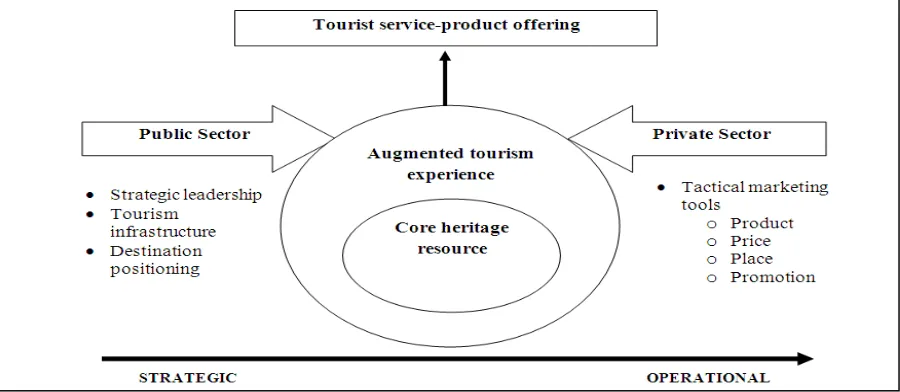
A heritage resource can be developed to become a lucrative tourism resource, providing a desirable experience for the tourist (Waitt 2000; Alvarez and Korzay 2011). This process can be carried out through strategic marketing planning, in particular, through the provision of sound strategic leadership, development of tourism infrastructure and destination positioning (as illustrated in figure 1), all of which should be reflective of the region in question (Hardy and Beeton 2001; Hankinson 2009). However, this can be a difficult and complex process due to several characteristics. In particular, the presence of both public and private sectors adds a level of complexity to the process (Hall C. M. 1999; Alvarez and Korzay 2011), particularly given the public good aspect of the heritage resource (Jamal and Getz 1995). The public sector has key responsibility in the strategic planning process (Nuryanti 1996; Panyik et al 2011 ) including strategic level tasks required in developing a destination, while the private sector is required to work within the strategic framework set out by the public sector (Bramwell 1999; Hall 1999).
A destination is based on a number of attributes including a range of product and service offerings (Bornhorst et al 2010), such as accommodation, visitor attractions and transportation facilities provided by the private sector (Gilmore et al 2007; Greenly and Matcham 2007) and public sector provision of vital infrastructure necessary for tourism delivery in a given region, such as public amenities and the development of transport networks and roads (Bornhorst et al 2010). As such, marketing planning of individual tourism providers becomes of limited value, particularly if it is carried out in isolation (Palmer and Bejou 1995) therefore there is a requirement for a joined up approach to marketing planning. Indeed, a key issue in considering tourism marketing planning is that planning is not confined to one business or organisation and there are many external factors which can impact upon tourism delivery (Okazaki 2008). In this respect, the responsibility for marketing planning for tourism lies not only with individual businesses but there is also a public sector responsibility, particularly in relation to providing strategic leadership (Nuryanti 1996; Hall 1999), and ensuring effective tourism infrastructure is in place.
facilitated through an integrated approach where all relevant parties, including public, private and local community organisations can meet and agree on a destination management approach (Gilmore 2007; Saxena and Ilbery 2008; Leask and Rihova 2009).
Figure 1 (source: developed for this research )
METHODOLOGY
This study focused on gaining in-depth insights into the nature and scope of strategic marketing planning and implementation at heritage regions. The two regions in question are the Mournes (Region 1) and Causeway Coast and Glens (Region 2) both situated in Northern Ireland. An exploratory research methodology was employed with a qualitative, semi-structured interview approach. The in-depth interview was used as it is useful for gathering rich and meaningful data and led to a significant depth of understanding (Carson et al 2001). In order to fulfil the requirements of the research, SME tourism providers were chosen as research subjects as the regions in question are largely made up of SMEs. In total, 12 SMEs were selected, six from each of the two regions identified, providing a cross section of Tourism Product Service Providers (TPSP), including accommodation providers, visitor attractions and community associations with a focus on tourism. The research objective which is the focus of this paper is
• To investigate the nature and scope of the implementation of tourism marketing plans in the context of heritage regions.
Data was analysed using a coding method, with key themes emerging from an earlier stage of the research process which focused on key informants from the tourism industry and using a conceptual model developed from literature as outlined in the figure 1.
INITIAL FINDINGS: Strategic Leadership - Findings indicate weaknesses in strategic leadership resulting in the emergence of smaller, independent bodies operating within the regions. For example, community-based TPSP organisations, made up of private sector tourism providers, have developed as a result of failures in public sector strategic leadership. “It’s just a collective organisation of people who are interested in the Mournes and we are just trying to get together to do something about it,” TPSP 1 Region 1
“There has always been a feeling that this area doesn’t get the promotion that it deserves” TPSP 1 Region 2
[image:3.595.75.525.125.321.2]Tourism Infrastructure –TPSPs in these two regions have different experiences in relation to tourism infrastructure. TPSPs in region 1 feel disadvantaged and limited in their marketing efforts due to a lack of tourism infrastructure. They recognise that weaknesses in product development can restrict the potential of tourist businesses, regardless of marketing efforts,
“There’s nothing to bring you here...there’s nothing to draw you to this direction and that’s down to…all of the government bodies who…should be doing their jobs,” TPSP 2 Region 1
In contrast, the benefits of infrastructural developments to tourism businesses have been felt in region 2, “We’ve now got signage for the Causeway Coastal Route, out of Belfast and out of Derry, so all that is covered and people are talking about the Causeway Coast Route,” TPSP 2 Region 2
This highlights the necessity for tourism planning to take a holistic approach; individual business can only operate within the context of the broader strategic framework; if the outputs of strategic planning (such as development of tourism infrastructure) are not implemented, then the individual tourism business is at a disadvantage.
Destination positioning – In these two regions Destination Marketing Organisations (who have a coordinating role between Government Bodies and TPSP) are assigned responsibilities by government in terms of marketing specific heritage regions. Some private sector businesses operating in the regions feel that there is little benefit in supporting (financially) these organisations,
“There are so many membership organisations that you could pay into that it’s just pointless paying into any one of them...but there’s no one place where you could go and get everything you want, like a one stop shop.” TPSP 3 Region 1
“If our group didn’t exist then that brochure wouldn’t exist because no individual [business] would really have the capability, time or skills to draw down funding in order to do this.” TPSP 3 Region 2
These points highlight flaws in tourism strategic planning, TPSPs are working together and are ‘doing their own thing’ rather than participating in an integrated, holistic tourism marketing planning system. As such, there appears to be a disjointed approach to the marketing of heritage sites. Private sector businesses are operating independently as a result of the disjointed and limited approach of the public sector organisations who control strategic marketing planning for tourism. This has lead to the formation of smaller business associations, with tangible outputs and the development of micro-scale promotional schemes which do not necessarily align with the broader strategic framework. Overall this points to a disintegrated tourism management approach and ultimately failure in effective implementation of strategic planning.
CONCLUSION
REFERENCES
Aas, C., Ladkin, A., Fletcher, J. 2005, “Stakeholder collaboration and heritage management”,
Annals of Tourism Research, vol. 32, no. 1 pp. 28 – 48.
Alvarez M. D. and Korzay, M. 2011, “Turkey as a heritage tourism destination: the role of knowledge”, Journal of Hospitality Marketing and Management, vol. 20, pp.425-440.
Bornhorst, T., Ritchie, J.R.B. and Sheehan, L. 2010, “Determinants of tourism success for DMOs and destinations: An empirical examination of stakeholders’ perspectives”, Tourism Management vol. 31, pp.572-589.
Bramwell, B. and Sharman, A., 1999. Collaboration in local tourism policymaking. Annals of Tourism Research, vol.26, no.2, pp. 392-415.
Carson, D., Gilmore, A., Perry, C. And Kjell, G. 2001, Qualitative Marketing Research, Sage, London.
Fyall, A., and Garrod, B. 2004, Tourism marketing: A collaborative approach, Cleaveland, OH: Channel View Publications.
Gilmore, A. and Simmons, G. 2007, "Integrating sustainable tourism and marketing management: can National Parks provide the framework for strategic change?", Strategic Change, vol. 16, no. 5, pp. 191.
Greenley, G.E. and Matcham, A.S. 1990, “Marketing orientation in the service of incoming
tourism” Marketing Intelligence and Planning, vol. 8, no. 2, pp35 – 39.
Hall, M.C. 1999, “Rethinking collaboration and partnership: a public policy perspective”,
Journal of Sustainable Tourism, vol. 7, No.3-4, pp. 274-289.
Hankinson, G., 2009, “Managing destination brands: establishing a theoretical foundation”, Journal of Marketing Management, vol. 25, no. 1, pp. 97.
Hanna, S. and Rowley, J. 2011, “Towards a strategic place brand-management model”, Journal of Marketing Management, vol. 27, No.5, pp 458.
Hardy, A. L. and Beeton, R. J. S. 2001, “Sustainable Tourism or Maintainable Tourism: Managing resources for more than average outcomes”, Journal of Sustainable Tourism, vol. 9, no. 3, pp. 168.
Jamal, T.B. and Getz, D. 1995, "Collaboration theory and community tourism planning", Annals of Tourism Research, vol. 22, no. 1, pp. 186.
Leask, A. And Rihova, I. 2009, “The role of heritage tourism in the Shetland Islands”, International Journal of Culture, Heritage and Hospitality Research, vol. 4, no. 2, pp. 118 – 129.
Okazaki, E. 2008, “A community based tourism model: Its conception and use”, Journal of Sustainable Tourism, Vol. 16, No. 5, pp. 511-529.
Panyik, E., Costa, C. Ad Ratz, T. 2011, “Implementing integrated rural tourism: An event-based approach”, Tourism Management vol. 32 pp. 1352 – 1363.
Saxena, G. and Ilbery, B. 2008, “Integrated rural tourism, A border case study”, Annals of Tourism Research, vol. 35, no.1, pp. 233-254.