Journal of Chemical and Pharmaceutical Research
__________________________________________________
ISSN No: 0975-7384 CODEN(USA): JCPRC5
J. Chem. Pharm. Res., 2011, 3(2):747-752
747
Formulation and process optimization of Etodolac extended release tablet
Tarak J. Mehta*, Mukesh R. Patel, Kanu R. Patel, Natvarlal M. Patel and Alpesh D. Patel
Department of Pharmaceutical Technology, Shri B. M. Shah College of Pharmaceutical Education & Research, College Campus, Modasa, Gujarat, India
______________________________________________________________________________
ABSTRACT
The aim of the present study was to optimize Etodolac extended release(ER) tablets meet the international regulatory requirements and prove with assurance, that the product meets predetermined specifications and quality attributes. In present research work, the optimization of compression process and granulation has been carried out using rapid mixer granulator and cadmach 16 station single rotary machine. Granulation process variables like impeller speed, chopper speed, binder addition time, ampere reading were selected Drying process variables as Initial air-drying time, Total Hot air drying Time, Inlet Temperature (°C) Outlet Temperature (°C) were selected and their impact on bulk density, true density, compressibility index hausner ratio and loss on drying. Compression process variable was carried out at by using BOX AND BEHNKEN experimental design and evaluated for weight variation, Hardness, Thickness, Friability and dissolution studies. Results indicated that uniform granules formation was observed at fast impeller speed , slow chopper speed ampere reading of 3.7-4.1, dry mixing for 7 minutes, relative standard deviation was less, which indicates that the homogecity of drug distribution in the dry mixture. At 20 rpm Machine speed, Tablet thickness was found between - 6.2-6.6 mm, Hardness of Tablet NLT 6 kg/c, Optimized tablet coating was carried out in perforated Coating pan and drug release was found to be 92.6 % at 16hrs. It can be concluded that granulation and compression process optimization of Etodolac extended release tablet can be successfully prepared and evaluated.
______________________________________________________________________________
INTRODUCTION
______________________________________________________________________________
748
cadmach 16 station single rotary machine. Granulation process variables like impeller speed, chopper speed, binder addition time, ampere reading were selected Drying process variables as Initial air-drying time, Total Hot air drying Time, Inlet Temperature (°C) Outlet Temperature (°C) were selected and their impact on bulk density, true density, compressibility index hausner ratio and loss on drying. Compression process variable was carried out at different compression speed i.e. 15 rpm, 20 rpm and 25 rpm and evaluated for weight variation, Hardness, Thickness, Friability and dissolution studies Etodolac Extended Releases Tablets [through process validation] as per the U.S. F.D.A Specification / Guide lines for the Domestic and Export market.
EXPERIMENTAL SECTION
Materials:
Etodolac was received by Ariane Org Chem. Ltd. (Hyderabad, India). Heavy magnesium carbonate and Gelatin was procured from Taurus chemicals (London, U.K.). Sodium Lauryl sulphate and maize starch were received from Cognis (Mumbai, India). Magnesium stearate was gift sample from Febro Ltd (London, U.K.). All chemicals used for this study were of analytical reagent grade. Freshly distilled water was used through out the work
Manufacturing of Tablets
Etodolac heavy magnesium carbonate, maize starch and sodium lauryl sulphate (60-80 mesh, 250-177 µm) were mixed in Rapid Mixer Granulator (Sainath boilers and pneumatics, India) for 10 mins at different impeller and chopper speed. Purified water (50%) was heat and add gelatin in heated water with constant stirring until dissolve. 3.57 % w/w maize starch paste (granulating agent) was prepared with boiling purified water. Add the gelatin solution to starch paste and mixed properly. Add the granulating agent to the material over a period of 2 min at different impeller and chopper speed followed by kneading for about 2 min to get a good granular mass. Wet granular mass was dried in fluidized bed dryer (Bectochem, India, 20kg) at an internal temperature of 60 ± 5°C, outlet temperature 40±5°C till a loss on drying of 1.5–3.3 % was achieved on IR moisture balance in auto mode at 105°C. Dried granules were sifted through 18 mesh on vibratory sifter (Bectochem, India) and mill the retentions of granules through 1 mm screen of multimill (bectochem, India) with knives forward direction at slow speed. The dried granules were blended with 1% magnesium stearate in Octagonal blender (Bectochem, India) for 20 min. Tablets (390 mg) were compressed on a 16 station rotary tablet compression machine (Rimek, India) using a 9 mm standard flat-face punch. The prepared tablets were round and flat with an average diameter of 9.0 ± 0.1 mm and a thickness of 6.2 ± 0.2 mm.
Evaluation of Tablets Hardness
The hardness of the tablets was tested for 10 tablets by pharma hardness tester (Pharma Test, Germany) and average hardness (N) was being taken and compared with that of standard one.
Friability
______________________________________________________________________________
749
Disintegration time
The disintegration of the tablets was tested in a disintegration tester (Pharma Test, Germany), six tablets were put in to a basket that was raised and lowered in a beaker containing preheated water at 37۫°C. The disintegration test was calculated as the mean value and as the range.
Statistical analysis
Statistical analysis of the Box-Behnken design batches was performed by multiple regression analysis using Microsoft Excel. To evaluate the contribution of each factor with different levels to the response, the two-way analysis of variance (ANOVA) was performed using the DESIGN EXPERT 6.0.11 (STAT-EASE) demo version software. To graphically demonstrate the influence of each factor on the response, the response surface plots were generated using
DESIGN EXPERT 6.0.11 (STAT-EASE) demo version software.::
RESULT AND DISCUSSION
The above compilation data shows that uniform granules formation was observed at Impeller amperage reading of 3.7-4.1 Amps. The drying process was carried initially at ambient temperature followed by inlet temperature of 50-60°C. At the end of the drying process the LOD of the dried granules was found between 1.55 to 2.45%.
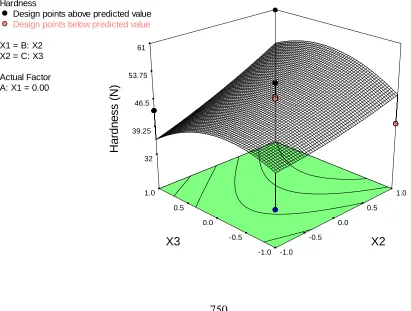
The distribution of Etodolac is well acceptable at 25 minutes (Pre lubrication) and 30 minutes (Final blending) time as shown by the sample analyzed, which indicates the homogeneciity of drug distribution in the blending For tablet compression process by selecting three independent variables viz.pre compression force,compression force,compression speed by box – behnken experimental design and their effect on hardness,friability and thickness. the best design(BB 10) was compared with innovator drug release study and they were analysed statistically.
Table : 1 variables for granulation
Batch No.
Speed of Impeller
Binder addition
time
Impeller mixing time After binder
addition
Impeller mixing time After
Racking
Amp. reading
Speed of Chopper
Batch-1 Slow 1 minute 1 minute 12 minutes 3.7 Slow
Batch -2 Fast 2 minutes 1 minute 8 minutes 3.9 Slow
Batch -3 Fast 2 minutes 1 minute 6 minutes 3.9 Fast
Table : 2 , results of variables granulation
Lot no Bulk density (gm/ml)
True density (gm/ml)
Cars index %
Hausner’s ratio %
Lod %
Lot-1 0.501 0.757 21.052 1.267 1.5
Lot-2 0.627 0.836 23.504 1.305 1.8
[image:3.595.82.516.481.552.2]______________________________________________________________________________
[image:4.595.156.441.120.282.2]750
[image:4.595.79.490.442.753.2]Table 3, variables for compression process with results
Figure 1: counter and surface plot of Hardness,friability and Disintegration time by using design-Expert Software
Design-Expert® Software
Hardness
Design points above predicted value
Design points below predicted value
X1 = B: X2 X2 = C: X3
Actual Factor A: X1 = 0.00
-1.0 -0.5 0.0 0.5 1.0 -1.0 -0.5 0.0 0.5 1.0 32 39.25 46.5 53.75 61 H a rd n e s s ( N ) X2 X3
LEVELS AVERAGE VARIABLES
X1 X2 X3 Hardness Friability Thickness -1.00 -1.00 1.00 1.00 -1.00 -1.00 0.00 1.00 0.00 0.00 0.00 1.00 -1.00 1.00 -1.00 1.00 0.00 0.00 -1.00 0.00 -1.00 1.00 1.00 0.00 0.00 0.00 0.00 0.00 -1.00 1.00 1.00 -1.00 -1.00 -1.00 1.00 1.00 32.28 37.39 52.32 78.25 48.36 20.9 41.8 55.09 35.08 40.3 62.8 45.,3 2.5 0.8 0.7 0.089 0.28 1.8 0.55 0.37 0.58 0.15 0.102 0.32 7.2 6.9 5.3 4.4 6.3 7.4 6.4 6.4 4.1 7.3 4.7 6.2
CODE ACTUALS X1 HIGH X1 LOW
X 1 Precompression force 2 0
X2 Compression force 6 2
______________________________________________________________________________
751 Design-Expert® Software
D.T.
Design Points
830
96
X1 = A: X1 X2 = B: X2
Actual Factor C: X3 = 0.00
-1.0 -0.5 0.0 0.5 1.0
-1.0 -0.5 0.0 0.5
1.0 Disintegration Time (Sec)
X1
X
2
45.1 96.7
148.3 199.9
251.5
251.5
275.5
3
Design-Expert® Software
Friability
Design points above predicted value
Design points below predicted value
X1 = A: X1 X2 = B: X2
Actual Factor C: X3 = 0.00
-1.00
-0.50
0.00
0.50
1.00 -1.00
-0.50
0.00
0.50
1.00 0.0
0.5 0.9 1.4 1.8
F
ri
a
b
ili
ty
(
%
)
______________________________________________________________________________
752
Design-Expert® Software
D.T.
Design points above predicted value
Design points below predicted value
X1 = A: X1 X2 = B: X2
Actual Factor C: X3 = 0.00
-1.0 -0.5
0.0 0.5
1.0
-1.0 -0.5 0.0 0.5 1.0 -10
85 180 275 370
D
is
in
te
g
ra
ti
o
n
T
im
e
(
S
e
c
)
X1 X2
REFERENCES
[1] Rabia bushra et al. journal of pharmaceutical sciences (21)P. No 113-117(2008)
[2] Robert Forget et al. Journal of pharmaceutical and bio medical analysis
P.no1052-1056(2006)
[3] Goutam Dutta et al. International journal of pharmaceutics P.No.92-96(2006)
[4] Peter Wiesch et al. International journal of pharmaceutics(2006)
[5] Agraval S.S. et al. International journal of pharmaceutics(2006)
[6] Shruti Chopra et al. International journal of pharmaceutics(2006)
[7] M.kinel et.al International journal of pharmaceutics P. No 39-44(2004)
[8] Sandra furlanetto et al. International journal of pharmaceutics P. No 107-118(2002)
[9] Adnan Sabir et al. International journal of pharmaceutics P. No 123-135(2001)
[10]Nilay shah Pharmaceutical supply chain-key for optimization Computer and Chemical
Engineering(28)P.no.929-941(2000)
[11]R Bergman et al Chemotherapeutics and Intelligent laboratory
system(44)P.No271-286(1998)
[12]P. Soyeux et al. European journal of pharmaceutics and bio pharmaceutics. (46).P. No