Journal of Chemical and Pharmaceutical Research, 2012, 4(5):2501-2506
Research Article
ISSN : 0975-7384
CODEN(USA) : JCPRC5
“An efficient synthesis of Benzimidazole by cyclization–oxidation processes
using Fe/MgO as a heterogeneous recyclable catalyst”
Ashok V. Borhade
*, Dipak R. Tope and Dattaprasad R. Patil
Department of Chemistry, Research Centre, HPT Arts and RYK Science College, Nasik, India
______________________________________________________________________________
ABSTRACT
A convenient and straightforward method has been developed for the synthesis of benzimidazole using aryl aldehydes and o-phenylene diamine in the presence of Fe containing Magnesium oxide (Fe/MgO), at room temperature. The salient feature of this method includes mild condition, short reaction time, high yield, easy purification, recyclable catalyst, large scale synthesis and simple procedure. The catalyst can be reused for several cycles without decrease in activity.
Keywords Benzimidazole, Fe/MgO, Recyclable catalyst, Room temperature.
______________________________________________________________________________
INTRODUCTION
Recently, many metal oxides based catalytic systems are widely used in variety of organic reactions like cyclization oxidation reaction [20,21]. Though, those based catalyst are used in number of reactions, these reactions takes place over a longer period, gives low yield and forms byproducts [22]. These limitations can be overcome by using metal containing metal oxide, X-Meng et.al [23] have reported catalytic oxidation by molecular oxygen catalyzed Ni-TiO2, the similar catalyst like SO4/ZrO2,[24] Li/MgO,[25] CeO/CoO [26] etc. now used for a variety of enantioselective reaction such as Knovendgel reaction and oxidation reaction.
With this in mind, in the present study, we report the synthesis of benzimidazoles from aldehydes and o-phenylene diamines using Fe/MgO nanocrystalline catalyst (Scheme 1). They have been successfully utilized in several organic transformations to minimize undesirable waste causing environmental pollution [27]. It has been received more attention due to its high thermal stability, large specific surface area, easy recovery and good ability to perform organic reactions at lower temperatures.
EXPERIMENTAL SECTION
All Chemicals were employed are commercial products (Aldrich Chemical Co) and were used without purification. All yields refer to isolated products after purification. 1H (300 MHz) NMR and 13C(75 MHz) NMR spectra were recorded on Varian mercury XL-300 and Bruker spectrometer instruments using TMS as internal standard. The solvent used for NMR spectra was CDCl3 and DMSO-d6. Infra red spectra were taken on Shimadzu FTIR–408 in
KBr. The mass spectra were recorded on Shimadzu GC-MS QP 2010A mass spectrometer with an ionization potential of 70 eV. Column chromatography was performed on silica gel (230–400 mesh) supplied by Acme Chemical Co.
General Procedure
In a typical run, o-phenylene diamines (1.1 mol), aryl aldehydes (1.3 mol) and Fe/MgO (0.8 mol) nanoparticles were allowed to react in methanol at room temperature for 25 min. The reaction mixture was directly filtered and washed with methanol. The recovered catalyst was dried and reused further in successive reactions. Filtrate was collected and evaporated under reduced pressure to afford the product. The products obtained were confirmed by IR, NMR and Mass spectrometry.
Spectral data of selected compounds
2-Phenyl-1H-benzimidazole (1): FT-IR (KBr): 3500, 1718, 1600, 948, 740 cm-1; 1H NMR (300 MHz, DMSO-d6): δ 7.20 - 8.20 (m, 4H), 7.46-7.62 (m, 5H), 12.02 (s, 1H, NH); 13C NMR (75 MHz, DMSO-d6) : δ 115.16, 139.17,
129.97, 129.06, 128.88, 126.50, 122.16, 151.03 ; Mass m/z: 195 (M+1).
2-(4-chlorophenyl)-1H-benzimidazole (10): FT-IR (KBr): 3548, 1722, 1600, 1450, 1550, 748 cm-1; 1H NMR (300 MHz, DMSO-d6): δ 7.21-8.18 (m, 4H), 7.53 (d, J = 8.4 Hz, 2H), 7.66 (d, J = 8.4, 2H), 12.94 (s, 1H, NH); 13C NMR
(75 MHz, DMSO-d6) : δ 115.53, 119.06, 121.90, 122.67, 126.74, 127.81, 129.86, 135.30, 139.90, 144.82, 152.73;
Mass m/z: 229 (M+1).
2-(4-methoxyphenyl)-1H-benzimidazole (7): FT-IR (KBr): 3544, 1724, 1610, 1450, 1100, 1200, 950 cm-1; 1H NMR (300 MHz, DMSO-d6) : δ 3.83 (s, 3H, CH3), 7.09 (d, J = 8.4 Hz, 2H), 7.15 (d, J = 8.4 Hz, 2H), 7.20 - 8.12 (m, 4H), 11.65 (s, 1H); 13C NMR (75 MHz, DMSO-d6): δ 55.12, 110.39, 114.28, 118.42, 121.35, 121.97, 122.67,
127.93, 134.92, 143.84, 151.28, 160.54; Mass m/z: 225 (M+1).
2-Styril-1H-benzimidazole (13): FT-IR (KBr): 3545, 1710, 1640, 1550, 948, 750 cm-1; 1H NMR (300 MHz, DMSO-d6) : δ 7.09 (d, J = 16 Hz, 1H), 7.24-7.30 (m, 2H), 7.33 (m, 2H), 7.38 (m, 2H), 7.57 (m, 2H), 7.70 (m, 1H),
7.76 (d, J = 16 Hz, 1H), 12.92 (s, 1H); 13C NMR (75 MHz, DMSO-d6): δ 110.28, 113.97, 119.86, 124.47, 128.16,
127.53, 128.93, 129.72, 135.17, 139.43, 142.21, 150.43, 162.77; Mass m/z: 221 (M+1).
RESULTS AND DISCUSSION
benzaldehyde as a model substrate. The reaction was monitored by TLC technique using ethyl acetate-hexane (3:7 v/v) as a solvent system.
NH
2NH
2+
R
N
H
N
R
R.T.
MeOH
H
O
Fe/MgO
1 2 3
Scheme 1 Synthesis of benzimidazoles
[image:3.595.104.472.145.237.2]To evaluate and optimize the effectiveness of Fe/MgO with different catalyst, we tried MgO, Co/MgO and Cu/MgO for the cyclization reaction of o-phenylene diamine and p-chloro benzaldehyde. MgO gave poor yield while Cu and Co/MgO gave good yield but required more time as compared to Fe/MgO (Table 1).
Table 1. Effect of different metal on reaction time and yield
Sr.no. Catalyst Time (min) Yield* 1. 2. 3. 4. 5. 6. MgO 3% Fe/MgO 7% Fe/MgO 10% Fe/MgO Cu/MgO Co/MgO 90 67 26 30 50 40 34 79 94 89 91 79
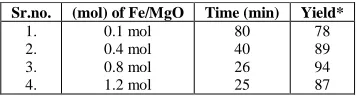
[image:3.595.209.389.514.563.2]With increasing Fe loading from 0 to 10%, cyclization substantially increases and it reaches a maximum (94%) at the Fe content of 7%. Further, increasing Fe content, however, lowers the cyclization rate. As evidenced by XRD, Fe species loading lower than 10%, whereas high Fe contents (>10%) results in microcrystalline phase, Fe located outside the internal channels, resulting in a remarkably poor catalytic activity. Therefore, it shows that a moderate incorporation of Fe results in higher catalytic activity. Thus, it is obvious from our studies that 7% Fe/MgO was superior in the cyclization reaction with good yield in short time. To optimize the amount of catalyst required for the cyclization we tried various mol equivalents of the catalyst compared to the quantity of the phenylene diamine (Table 2). It was found that when reaction was carried out with 0.8 mol equivalents cyclization was 94%.
Table 2. Effect of mole percentage of Fe/MgO
Sr.no. (mol) of Fe/MgO Time (min) Yield* 1. 2. 3. 4. 0.1 mol 0.4 mol 0.8 mol 1.2 mol 80 40 26 25 78 89 94 87
[image:3.595.233.362.622.680.2]When the cyclization reaction was carried out in different solvents such as DMF, methanol, ethanol, acetonitrile, dichloromethane and the result clearly showed that methanol was found to be the best choice (Table 3).
Table 3. Effect of Solvent for benzimidazoles using Fe/MgO
Sr. no. Solvent Time Yield* 1. 2. 3. 4. 5. MeOH EtOH DMF
CH3CN
CH2Cl2
25 25 45 40 60 94 91 86 89 69
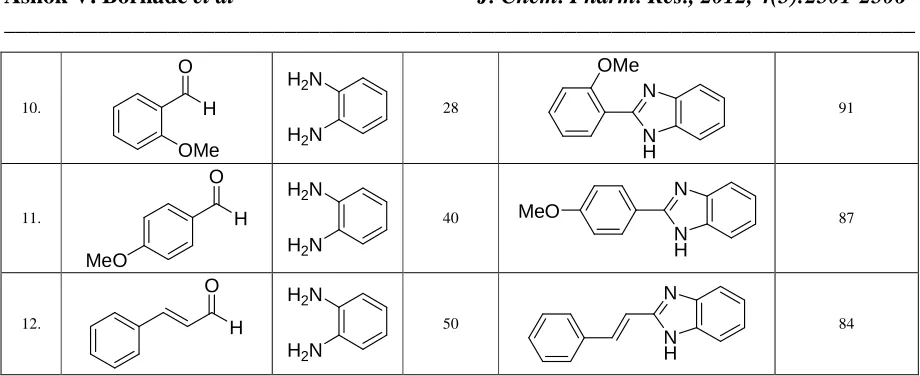
reaction of aromatic aldehydes with electron donating groups reacted very well at faster rate compared to electron withdrawing groups. Treatment of substituted aldehydes with o-phenylene diamine in methanol with 7% Fe incorporated MgO (0.8 mol) at room temperature afforded benzimidazole with excellent yield. The results obtained are illustrated in table 4. All the products obtained were characterized by IR, 1H NMR, 13C NMR and Mass spectroscopy.
Table 4. Synthesis of benzimidazoles in the presence of Fe/MgO nanoparticle
Entry Aldehyde 1,2-Diamine Time (min) Product Isolated Yield (%)
1. H
O H
2N
H2N
25
N
N H
92
2. H
O
NO2
H2N
H2N
50
N
N H O2N
96
3. H
O
OH
H2N
H2N
40 N N H OH 89
4. H
O
Br
H2N
H2N
26
N
N H
Br 92
5. H
O
F
H2N
H2N
24
N
N H
F 87
6. H
O
Cl
H2N
H2N
30
N
N H
Cl 94
7. H
O
HO
H2N
H2N
30
N
N H
HO 86
8. H
O
N H3C
CH3
H2N
H2N
20
N
N H N
H3C
H3C
90
9. H
O
Cl
H2N
H2N
The reusability of the catalyst was tested in the synthesis of benzimidazoles as shown in table 5. The catalyst was recovered after each successive run, washed three times with acetone, dried in oven at 120 0C for 3 hrs. Prior to use and tested for its activity in the subsequent run. The catalyst was tested for 5 runs. It was observed that the catalyst displayed very good reusability.
Table 5. Results of the reaction run in the presence of recycled catalyst
Sr. no Reaction run time Yield*
1. 2. 3. 4. 5.
1 2 3 4 5
25 25 25 25 25
94 94 92 87 90 *All reactions (Table.1-4) are carried at room temperature using Fe/MgO.
CONCLUSION
In conclusion, we developed an efficient and simple alternative for the preparation of benzimidazole using Fe/MgO catalyst at room temperature. Prominent among the advantages of this new method are simple procedure, easy workup procedure, short reaction time and good yield and also use of cheap, nontoxic and easily synthesized Fe/MgO catalyst.
Acknowledgement
The authors are thankful to UGC, New Delhi, for financial assistance and also thankful to IIT, Mumbai to their support for characterization.
REFERENCES
[1] H. Zarinmayeh, A. M. Numes, P. L. Ornstein, D. M. Zimmerman, M. B. Anold, D. A. Schober, J. Med. Chem.
1998, 41, 2709.
[2] M. Hasegawa, N. Nishigaki, Y. Washio, K. Kano, P. A. Harris, H. Sato. J. Med. Chem. 2007, 50, 4453-70. [3] J. Falco, M. Pique, M. Ganzalez, I. Baira, E. Mendez, J. Texncio. Eur. J. Med. Chem. 2006, 41, 985-90. [4] A. Gangjee, A. Vasudevan, S. F. Queener. J. Med. Chem. 1997, 40, 479-85.
[5] A. O. H. El-Nezhawy, H. I. El-Diwani, R. R. Schmidt. Eur. J. Org. Chem. 2002, 4137-42.
[6] R. Dua, S. K. Sonwane, S. K. Srivastava and S. D. Srivastava J. Chem. Pharm. Res., 2010, 2(1): 415-423. [7] A. A. Spasov, I. N. Yozhitsa, L. A. Burhaeva. Pharm. Chem. J. 1999, 33, 232-43.
[8] M. A. Philips. J. Chem. Soc. 1928: JR 9280002393:2393.
[9] R. V. Shingalapur, K. M. Hosamani. Catal. Lett. 2010, 137(1-2), 63-68, [10] B. Yadagiri, J. W. Lown. Synth. Comm.1990, 20, 955.
[11] P. N. Preston Eds. A. Weissberger, E. C. Taylor. Wiley: New York 1981, 40(1), 6-60.
[12] M. R. Grimmett Eds.: A. R. Katritzky C. W. Rees. In Comprehensive Heterocyclic Chemistry, Oxford, 1984, 5, 457-487.
10. H
O
OMe
H2N
H2N
28
N
N H OMe
91
11. H
O
MeO
H2N
H2N
40
N
N H
MeO 87
12. H
O H
2N
H2N
50
N
N H
[13] B. Rajitha, J. V. Madhav, B. S. Kuarm. Arkivoc 2008, 145-150. [14] H. F. He, Z. Wang, W. Bao. Adv. Syn. Catal. 2010, 352(17), 2905. [15] F. F. Stevens, J. D. Bower. J. Chem. Soc. 1949, 2971.
[16] L. Wang, J. Sheng, H. Tian. Synth. Comm. 2004, 34, 4265.
[17] S. B. Rathod, M. K. Lamde, B. R. Arbad. Bull. Kor. Chem. Soc. 2010, 10(3), 2835. [18] G. V. Reddy, N. S. Ramarao, B. A. Narsaiah. Synth. Comm. 2002, 32, 2467. [19] A. Kumar and K. K. Kapoor. J. Chem. Pharm. Res., 2011, 3(6) 369-374. [20] M. H. Sarvari, H. Sharghi. J. of Chem. 2004, 69, 6950-6956.
[21] V. Quaschning, J. Deutsch, P. Druska, H. J. Niclas, E. Kemnitz J. of Catal. 1998, 177(2), 164-174. [22] E. Suzuki, Y. Ono. Bull. Chem. Soc. Japan. 1988, 61, 1008.
[23] X. Meng, H. Cheng, S. Fujita, Y. Hao, Y. Shang, Y. Yu, S. Cai, F. Zhao, M. Arai. J. of Catal. 2010, 269, 131-139.
[24] B. M. Reddy, M. K. Patil, K. N. Rao, G. K. Reddy. J. Mol. Cat. A: Chem. 2006, 258, 302-307. [25] T. Ito, J. H. Lunsford. Nature 1985, 314, 721.
[26] S. S. Deshpande, R. V. Jayram. Cat. Comm. 2008, 9, 186-193. [27] G. E. Parris, K. Klier. J. of Catal. 1986, 97(2), 374-384.