ACCIDENT PREDICTION MODEL AT UN-SIGNALIZED INTERSECTIONS USING MULTIPLE REGRESSION METHOD
WAN NADIAH BINTI WAN MANAN
A project report submitted is partial fulfillment of the requirement for the award of the degree
of Master of Civil Engineering
Faculty of Civil and Environmental Engineering Universiti Tun Hussein Onn Malaysia
ABSTRACT
ABSTRAK
TABLE OF CONTENT
CHAPTER TOPIC PAGE
STATUS OF MASTER’S PROJECT REPORT
TITLE i
DECLARATION ii
DEDICATION iii
ACKNOWLEDGEMENTS iv
ABSTRACT v
TABLE OF CONTENT vii
LIST OF TABLES xi
LIST OF FIGURES xiii
LIST OF APPENDICES xiv
CHAPTER 1 INTRODUCTION 1
1.1 Introduction 1
1.2 Problem Statement 4
1.3 Objectives 6
1.4 Scope of Study 6
CHAPTER II LITERATURE REVIEW 10
2.1 Introduction 10
2.2 Factor Contributing to Accident 12
2.2.1 Human Factors 13
2.2.2 Geometrical Factors 14
2.2.3 Environmental Factors 14
2.2.4 Vehicular Factors 15
2.3 Crash Type 15
2.4 Intersections 16
2.4.1 Conflict Points at Intersections 17 2.5 Accident Prediction Model 19 2.5.1 Accident Prediction Model using 25 Multiple Linear Regressions
2.6 Statistical analysis tool 26
CHAPTER III METHODOLOGY 27
3.1 Introduction 27
3.2 Identify of Location 29
3.3 Data Collection 29
3.3.1 Accident Data 30
3.3.2 Traffic Data 30
3.3.3 Geometrical Data 31
3.4 Analysis of Data Collection 32 3.5 Identification of Hotspot Areas. 32 3.5.1 Ranking the accident point weightage 32 3.5.2 Ranking the 10 accident sections for 33
each route.
3.6 Field Works 33
3.8 Basic of Multiple Regression Analysis 34 3.9 Correlation test; P value 35 3.10 Coefficient of Determinant (R-square value) 35
CHAPTER IV RESULTS AND ANALYSIS 37
4.1 Introduction 37
4.2 Road Accident Statistics for FT001 and 38
FT024.
4.3 Personal Injury Accident 39
4.3.1 Personal Injury Accident at FT001 40 4.3.2 Personal Injury Accident at FT024 41 4.4 Accident by Hour of the day for year 2007 42
to May 2010
4.4.1 Accident by hour at FT001 43 4.4.2 Accident by hour at FT024 45 4.5 Identification of hotspot location 46 4.5.1 Ranking Accident Point Weightage 47 4.5.1.1 Ranking Accident Point 47 Weightage for FT001
4.5.1.2 Ranking Accident Point 49 Weightage for FT024
4.5.2 Ranking of the top 10 accident section 50 4.6 Percentage Accident for km in Hour for 51
FT001 and FT024
4.7 Independent variable of the Accident 53
Prediction Model
4.7.4 Number of lane major and minor roads 59 4.7.5 Number of intersecting legs 60 4.7.6 Shoulder width major and minor roads 60 4.7.7 Lane use category 61 4.8 Correlation test the p-value 62 4.9 The Accident Prediction Model 63
CHAPTER V CONCLUSION AND RECOMMENDATIONS 65
5.1 Introduction 65
5.2 Conclusion 65
5.2 Recommendations 69
REFERENCES 70
APPENDICES 74
LIST OF TABLES
TABLE SUBJECT PAGE
Table 2.1 Relationship between Conflicts of Intersection 19 Table 4.1 Accident by Hour of the day for FT001 and FT024 43 Table 4.2 Accident by Hour of the day for FT001. 43 Table 4.3 Accident by Hour of the day for FT024. 45 Table 4.4 Ranking of Accident Point Weightage at FT001 47 Table 4.5 Ranking of Accident Point Weightage at FT024. 49 Table 4.6 Top 10 accident section for FT001 50 Table 4.7 Top 10 accident section for FT024 51 Table 4.8 Annual Average Daily Traffic at FT 001 54 Table 4.9 Annual Average Daily Traffic at FT 024 55 Table 4.10 The Mean Speed Major road at study locations 56
(FT001 and FT024)
Table 4.11 The Mean Speed Minor road at study locations 57 (FT001 and FT024)
Table 4.12 Lane width and shoulder width for study locations 59 (FT001 and FT024)
Table 4.13 Number of lane for major and minor roads 59 (FT001 and FT024)
Table 4.15 Shoulder width major and minor roads 61 (FT001 and FT024)
Table 4.16 Lane used at study locations (FT001 and FT024) 61 Table 4.17 The p-values for each coefficient 62 Table 4.18 Range of values for independent variables in 65 Accident Prediction Model developed
Table 5.1 Top 10 accident section for FT001 66 Table 5.2 Top 10 accident section for FT024 66 Table 5.3 Range of values for independent variables in 68
LIST OF FIGURES
FIGURE SUBJECT PAGE
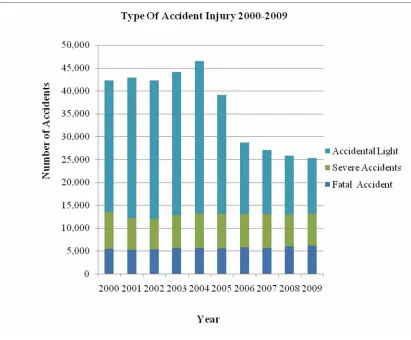
Figure 1.1 Accident Injury Statistics (2000-2009 3 Figure 1.2 Number of Accident by State from 1997 – 2006 4 Figure 1.3 Road Accident Statistic (Royal Malaysian Police 5
(RMP), 2007-May 2010)
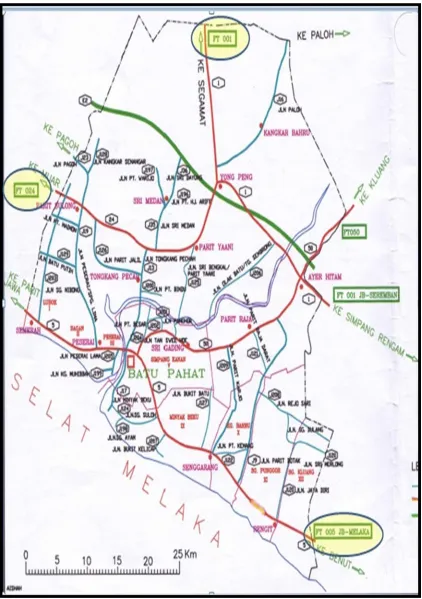
Figure 1.4 Death list stretches in Johor. 7 Figure 1.5 Batu Pahat District Map 8 Figure 2.1 Conflict points at a Four-Approach Un-signalized 18 Intersection
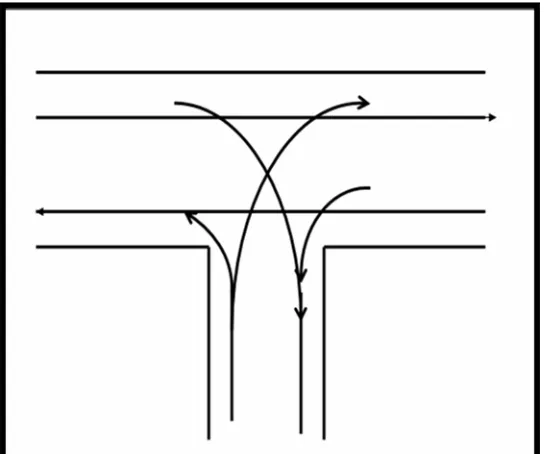
Figure 2.2 Conflict points at a Three-Approach Un-signalized 18 Intersection
Figure 2.3 Main menu option of STAT in Minitab 26 Figure 3.1 General methodology for the dissertation. 28 Figure 4.1 Accident Statistic for 2007 to May 2010 38 Figure 4.2 Personal Injury Accident for FT001 and FT024 39 Figure 4.3 Personal Injury Accident at FT001 (2007-May 2010) 40 Figure 4.4 Personal Injury Accident at FT024 (2007-May 2010) 41 Figure 4.5 Accident by hour for FT 001 and FT 024 42 Figure 4.6 Accident by Hours at FT001 44 Figure 4.7 Accident by Hours at FT024 46 Figure 4.8 Graph percentage accident by hour for FT 001 and 52
FT 024
Figure 4.10 Correlation Accident Prediction Model from 64 Minitab15.0
LIST OF APPENDICES
Appendix A Location Map 73
Appendix B Accidents Data by Hours 75 Appendix C Field Sheet Count Form 78 Appendix D Photos During Field Work 87 Appendix E Metrocount Data for 15 Minutes Traffic Volume 91
and Mean Speed
Appendix F Minitab Analysis 112
CHAPTER 1
INTRODUCTION
1.1 Introduction
In Malaysia from year 2000 to 2009, there are 56,513 people killed on the road, 65,294 people were severe injury and 234,959 people were slightly injured in road accidents (Jabatan Keselamatan Jalan Raya (JKJR), 2000-2009). The accidents increase year by year although there are many programs have been carried out by the authorities in order to reduce the number of accidents.
The road accidents can happen in many types. Generally, the road traffic accident can categorized in four common types where the driver collide with another vehicle or a roadside object, when the driver leaves the lane where they are in, accidents at junctions include rear-end collision and angle or side impacts, accidents that involving pedestrians and cyclists and accident that collide with animals.
Intersection of road can classify as an area that shared by two or more roads where it is design for vehicle s to turn to different directions. Road intersection are complex where vehicles moving in different way of direction. At the same time, pedestrian also seek at the same place to crossing the intersection. Therefore, driver at intersection have to make decision by considering his route, intersection geometry, speed and direction for other vehicle to avoid any accident occur.
Conflicts at an intersection are different for different type of intersection. The number of conflict points increase rapidly with the number of intersection. With fewer conflict points the interacting volume is high. For 3-leg intersection are safer than 4-leg intersection. For signalized intersection also much safer compared to the non-signalized intersection. Traffic operation improves by provided greater distance between conflict points by mean of traffic island or auxiliary lane.
Accident at intersection gives high impact to the road users. In urban area where the traffic volume is high, intersection that provided must accommodate with the high volume for turning movement that traverse to large area. For this situation, the channelization is an effective to make sure that the road intersection safety. Intersection channelization is used to separate turns lane from trough lane that consist of solid white liners or barrier which guide the traffic so that the vehicle can safely negotiate the complex intersection. (Nicholas J. et al., 2002)
Statistical modeling are abstract, simplified that representations of reality that
usually used both either in Science or Technology. Models can be deterministic or probabilistic. Accident prediction models analysis provide an estimate of road safety performance.
An accident prediction models is generally an algorithm pitting a dependent variable against several independent variables, each of which is assigned a constant. The dependent variable in an accident prediction model is the number of accidents, while the independent variables may be quantitative variables such as traffic flow, section length, pavement surface condition, infrastructures geometric characteristics, lighting, weather, and driver behaviors.
attributed to changes in the cross section of roads, assessing the potential safety impact of alternative cross sections when upgrading roads, predicting accident costs and as a measure of safety
In 2009 there were 397,194 road accidents that lead to 6,218 fatalities in Malaysia. Since 2000 to 2008 the accidents consistently above 6,000 but from year 2008 to 2009, the number of accident fatalities injury increases from 5,952 to 6,218.
[image:14.612.121.532.222.562.2]Source: Road of Transport Department
1.2 Problem Statement
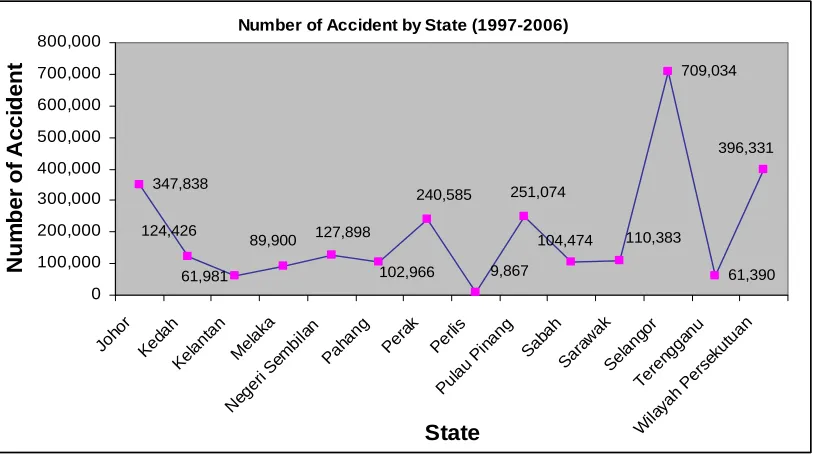
Road accident is one of the major causes of death and injuries in Malaysia. The Road Transport Department of Malaysia reported that the number of accident increase from 2000 to 2009 rapidly. Accidents surrounding area Johor shows the number of road accident rate increased from time to time makes road of Johor second higher after Kuala Lumpur. The comparison number of accident from 2008 to 2009 reported Johor give third higher after Kuala Lumpur about 3080 accident.
Number of Accident by State (1997-2006)
347,838 709,034 61,390 396,331 9,867 102,966 124,426 61,981 89,900 127,898 240,585 110,383 251,074 104,474 0 100,000 200,000 300,000 400,000 500,000 600,000 700,000 800,000 Joho r Keda h Kel ant an Mela ka Neger i Sem
bila n Pah ang Pera k Perli s Pulau Pina ng Saba h Sa raw ak Selan gor Ter engg anu Wila yah P
[image:15.612.123.531.261.488.2]erse kut uan State N u m b er of A c c ident
Figure 1.2: Number of Accident by State from 1997 - 2006
Figure 1.3: Road Accident Statistic (Royal Malaysian Police (RMP), 2007-May 2010)
1.3 Objectives
The objectives of this study are as follow:
a) To investigate accident hotspot locations at the intersection based on accident data and rank the section using Accident Point Weightage.
b) To determine the factors contributing to the Personal Injury Accident at the hotspot location along Federal Route 001 and Federal Route 024 in the Batu Pahat area
c) To develop accident prediction model using Multiple Linear Regression approach.
1.4 Scope of Study
The scope of study will try to focus on two-lane freeway near the intersection federal road areas. The location covers accident hotspot area in Johor. The data of accident record will collect from the Batu Pahat Police Traffic Station.
By analyze the accident number and trend Multiple Regression will use to identify the significant of factors accident causes. The factors involved in transportation crashes consist of geometric factors characteristics and roadway conditions. These factors will analyze to develop the accident prediction model.
FT024
[image:18.612.118.523.72.415.2]FT001
1.5 Project report organization
CHAPTER II
LITERATURE REVIEW
2.1 Introduction
As we know that every day people have to travel. The travel times on the same part of the road can be different every day due to traffic congestion or other reasons. If the travel times on a given day and place would be known in advance another route or another departure time can be chosen. In that case, the travel times have to be predicted in advance also route planner are depending on travel time in order to avoid from an accident.
Accident is commonly occurring involving one or more transportation vehicle in collision that result in property damages, injury or death. Public always expected that transportation system safe and efficient for all user. Transportation is an essential part of modern existence, linking the various activities which people participate especially at home, at school, at work, and go to shopping also traveling.
The vertical and horizontal layouts of the highway make up the alignment. The design of alignment depends on primarily on the design speed selected for the highway. One factors need to be considered in design the alignment is the proper balancing of the grades of tangents with curvatures of horizontal curve and the location of horizontal and vertical curve with respect to each other.
From previous research Zeeger, (1998) based on data for two-lane in
developed accident model with subordinate variable of accident rates by accident types and independent variables of the whole width of shoulder, the width of lane, road vertical alignment, average a daily traffic volume. The result showed that accident rate was decreasing with smooth vertical alignment, more less ADT and wider of lane, whole shoulder, as more less accidents.
By referred to Hadi and Aruldhas(1998) study about developed an accident model by road-grade for Florida state. Using the independent variables were constant road length, AADT, the width of lane and shoulder, and the types and width of median barrier, existence of curve, speed limit, grade and the number of intersections. The result found that to widen the width of median barrier on the four-lane roads enhanced safety and roads with two-way and left-turn median barrier were safer than non-separation roads.
Kay Fitzpatrick (2001) applied the geometric structure variables such as the width of lane, existence of median barrier, curve radius, deflection angle, so examined the relations with accidents. Particularly, in road section of unlike width of lane has been shown an important variable through the model.
In the study of Bonneson and Mccoy(2001), they developed accident prediction model according to each condition by distinguishing separation and non-separation of left-turn lane separating roads away from median non-separation facilities. As a result, they proposed that accidents were affected by AADT, length of roads, density, and land use and so on.
intersections. The response variable was the number of accidents at the intersections. Multiple linear regression was used to analyze data from four-arm (STOP-controlled and signalized) intersections while Poisson and negative binomial regression models were used for three-arm/STOP controlled intersections. Finding showed that the four-arm/signalized models for all accidents showed a positive relationship between increased AADT on major and minor road and, signal timing on the total number of accidents compared to three-arm/STOP controlled.
Bauer and Harwood (2002) provided direct input in to the Accident Analysis Module of the IHSDM. The analysis included all collision type using three-year
crashes frequencies from year 1990 to 1992. Bauer and Harwood used SAS GENMOD procedure in performed the data. The models were developed using the GLM approach with a log-normal regression model and log linear regression model. The variables that follow up to be significant at the intersection:
a) Major road ADT (average Daily Traffic) and minor road ADT
b) Average lane width on major roads
c) Number of major and minor roads
d) Outside shoulder on major roads e) Road lightning
f) Access control on major road g) Design speed on major road h) Road turning channelization
2.2 Factor Contributing to Accident
2.2.1 Human Factors
When alcohol or drugs are involved in the crash it is more likely to be ended as a high severity crash in both types of highways as the relevant variables has positive
parameter in both of the case. The alcohol involvement has been recorded as whether alcohol presented or alcohol contributed towards the crash based on the judgment made by the police officer.
According Paden M, et al. (2004), in many high – income countries about 20% of fatally injured drivers has excess alcohol in their blood (above the legal limit). While studies in low-income countries have shown alcohol to be present in between 33% and 69% of fatally injured drivers.
These finding about the alcohol in blood were also confirmed by (Bedard and Lu, 2002) revealed that the odds ratio of a fatal outcome of a crash increases with age, reaching 4.98 for drivers aged 80+ compared to the drivers aged 40–49 years. Female gender and blood alcohol content greater than 0.30 were also to be found associated with higher fatality odds. Also, the driver side impacts doubled the odds of fatality compared to frontal impacts.
Many type of drugs detected in accident victims are liable to impair driving skills, there is still uncertainty as to whether this translates to an increased accident risk. Likely, drugs include cannabis, opiate – like drugs such as heroin and morphine (Olaf H. Drummer, et al (2004)).
As many previous studies have revealed the variable speed has the tendency of increasing the severity of a crash as it has a positive estimated parameter irrespective of whether freeway or arterial roadway crash. When, at least one of the drivers involved in the crash does not use seatbelts the risk of having a more severe crash is high. In
addition, when the driver is injected or trapped in the vehicle due to the crash there is a higher probability of resulting in higher severe crash in both freeway and arterial roadway.
a) Driver-related factors (age, sex, alcohol level, number of people in the vehicle).
b) Factor relating to the road and the vehicle ( road layout, surface quality, vehicle power and maximum speed)
c) Traffic-related and environment-related factors (traffic density and composition, prevailing speed, weather conditions).
2.2.2 Geometrical Factors
Irrespective of the crash occurrence area, the variable related with the roadway
geometry results in a positive parameter. This implies the fact that when the roadway is not leveled and straight it is more likely to be resulting in a high severity crash. When a crash occurs on an urban or rural interstate or local road the probability of having a more severe injury is less, compared to arterials and collectors.
This may be due to the fact that, when people drive in local roads they might be more careful and also there might be lesser vehicular interactions due to the low traffic volumes on those highways. On interstates, the decreasing trend in having more severe injuries may be due to high safety attributes available on those highways almost uniform travel speed conditions.
2.2.3 Environmental Factors
due to the fact that drivers are more cautious under severe weather conditions and try to maintain lower driving speeds under these conditions.
On the other hand, when the crash occurs under dark or unlit conditions in urban areas, the severity of the crash is going to be higher. However, this variable is non-significant in rural areas.
2.2.4 Vehicular Factors
When the vehicle maneuver before the crash is straight and following the roadway, the propensity of having a more severe crash is high in both urban and rural crashes. The consideration of this factor was in comparison with other types of vehicle maneuvers such as, right turning, left turning, and lane changing. This is in consistency with finding of this study as when two vehicles collide head-on the severity of the crash is increased. In addition, the vehicular faults have the tendency in resulting higher severe crashes in urban roadways. The vehicular faults include faults in tires, wheels, brakes, and windshield.
According to parameter estimations, when the vehicle is registered, chance of having more severe crashes is less in rural areas but in urban areas it is going to increase the severity of the crash. The selection of this variable was based on the intention of assessing the effect of the driver familiarity with the surrounding.
2.3 Crash Type
That is, when the crash occurs off the roadway there is a higher risk for having a severe crash. However, in urban areas, both the single vehicle and multi vehicle crashes are significant but crashes related to animals are non-significant towards the severity of the crash
Classification of the road accident is recorded by the Royal Malaysian Police (RMP). This is determine by the severity of the most seriously injured casualty involved either slight, serious or fatal, using the following criteria :
a) Slight injury – an injury of minor character such as a sprain, bruise, cut or laceration not judged to be severe or slight shock requiring roadside attention.
b) Serious injury – an injury for which a person is detained in hospital as an “ in patient”, or any of the following injuries whether or not detention result, fractures, concussion, internal injuries, crushing, severe cuts and lacerations, severe general shock requiring medical treatment, injuries causing death 30 or more days after the accident.
c) Fatal – death from injuries sustained, resulting than 30 days after the accident.
d) Damage only – damage on vehicle. It is not include fatal and injured.
2.4 Intersections
An intersection is an area, shared by two or more roads, whose main function is to provide for the change of route directions. Intersections vary in complexity from a simple intersection, which has only two roads crossing at a right angle to each other, to a more complex intersection, at which three or more roads cross within the same area.
which is not required at non-intersection areas of the highway, is part of the reason why intersections tend to have a high potential for crashes.
Intersection can classified into three general category where there are grade-separated without ramps, grade-grade-separated with ramps, and at grade. Grade grade-separated usually consists of structure that provide for traffic to cross different levels without interruption. The crashes around grade-separated intersection is reduce due to many of potential conflict between intersecting streams of traffic are limited. Meanwhile at grade intersection there are exist conflicts between intersecting streams (Nicholas J. Garber et al, 2003).
2.4.1 Conflict Points at Intersections
An intersection has a set of conflict point between vehicle paths, and a good design should aim at minimizing the severity of potential accident at these points. The number of conflict points increase rapidly with the number of intersection. With fewer conflict points the interacting volume is high. For 3-leg intersection are safer than 4-leg intersection. For signalized intersection also much safer compared to the un-signalized intersection. Traffic operation improves by provided greater distance between conflict points by mean of traffic island or auxiliary lane.
Conflicts occur when the traffic streams moving in different directions with each others. There are three types of conflicts merging, diverging, and crossing.
The number of possible conflict points at any types of intersections depends on the number of approaches, the turning movement at intersections, and the types of traffic control at the intersections.
Figure 2.1: Conflict points at a Four-Approach Un-signalized Intersection
[image:29.612.118.390.363.590.2]Table 2.1: Relationship between Conflicts of Intersection.
Total
Intersection Diverging Conflict Crossing Conflict Merging Conflict Total Conflict
3 3 3 3 9 4 16 8 8 32 5 49 15 15 79 6 124 24 24 172
2.5 Accident Prediction Model
Statistical or crash prediction model have frequently been used in highway safety studies. They can be used in identify major contributing factors or establish relationship between crashes and explanatory variables, such as traffic flows, type of traffic control, and highway geometric variables.
Multiple Regressions is a statistical technique that allows us to predict model on one variable on the basis of their scores on several other variables. Multiple Regression provided a unified approach to many of the most common statistical procedures used in applied statistics. With using prediction model technique, crash prediction models are developed to estimate the safety performance of certain geometric design features of an existing or planned roadway.
Previous research applied Poisson or negative binomial regression models because of the distributional property of vehicle accidents (Milton and Mannering, 1998). Although the Poisson regression model has desirable statistical properties for describing vehicle accidents, it has an important constraint, which is that the mean and variance of the accident data are constrained to be equal. To overcome this constraint, the negative binomial regression model, has been employed to analyze vehicle
accidents (Miaou, 1994; Poch and Mannering, 1996; Hadi et al., 1995; Shankar et al., 1995; McCarthy, 1999; Carson and Mannering, 2001).
1996) recognized that the single flow model, the true mean number of accidents is model.
For non-junction accidents, Summersgill and Layfield (1996) were investigated non-junction single carriageway by derive the relationship between accident frequency and traffic, pedestrian flows and the features and layout of the road. Their intended use was to identify the potential design improvement, economic appraisal of improvement, effect of traffic management schemes and generally optimize safety and mobility for all road users. The variable that measures considered included:
a) Vehicle flow –AADT both direction, various type proportions
b) Pedestrian flow and density – including proportion of adults age group by sex
c) Speed limit
d) Type of end junction, and type of adjacent junctions
e) Number of lane
f) Lane width
g) Gradient
h) Visibility
i) Number of private or public accesses
j) Bus stop – bays, markings offside
k) Refuges
l) Crossing type
m) Parking and loading regulations
n) Centre road markings
o) Warning sign
A paper by Garber and Ehrhart (2001) investigated about the two-lane highway noted that crash rate was related to the hourly traffic by a U-shaped curve, for examples higher crash rates at lower volumes in early morning and late day hours. As traffic volumes increase speed variances decrease and it is the speed variance that affect the crash rate. It is also noted that the lane width and shoulder width main characteristics affect the safety. Studies have found that the decrease of crash rates with increase lane width.
Hakkert et al (1996) found that two lane roads safety increase with narrower shoulder widths. Researcher collected the 2year and 6 months of accident data for two-lane roads in Virginia and also speed, two-lane width and shoulder width. They used Multiple Linear Regression and Multivariate ratio of polynomials in modeling. They used coefficient of determination (R2) to measure the strength of linear component and Akaike’s information criterion (AIC) for Multivariate models. The researcher
concluded that only Multivariate Ration of polynomials model is adequate. For two lane roads, crash rate is dependent upon a complex interaction between the standard deviation of speed and flow per lane.
Chung, (2005) discovered that Generalized Linear Models is widely used, is that elements affecting in accident are categorized data. Moreover, because accidents are discrete essentially, expression of difference about accident reaction is most efficient in expressed data system by categorized style. And this method makes it possible to test significance of categorized data as fixed quantity.
The result from the analysis, the model formula was expressed as Equation 1 below:
(1) ln(µ) – ln (F) =β0 + βXT
Where, µ : E(y)
F: Offset
Y: Number of accident in the total intersection
β0 :Dummy Variable
β :Vector of parameter
X : vector of the independent variable
For Canale et. Al used data from 400 intersections in the urban area of Catania. The data included accident in 3-years period, traffic volume, geometric characteristics, and traffic control. The set of model developed predict the injury accident frequency in a 3 year period for the following intersection types:
a) Three-leg no control intersection b) Three leg stop controlled intersection c) Four-leg, no control intersection d) Four-leg, stop controlled intersection e) Four-leg, signalized intersection.
Result from the testd both the types of statistical model by using lognormal regression and loglinear regression model (Poisson regression). However from the analysis for all the intersection types the statistical analysis revealed that loglinear regression model was more appropriate.
for T and 4-leg intersections. The models that developed were assumed follow the negative binomial distribution that been included from GLIM software package.
By using the negative binomial distribution, eight different accident models were predicted. The first model included the entire data set that related to the accident data and traffic volume for major and minor roads. The rest of models were classified based on the characteristics such as intersection types (T and 4-leg intersection) regional characteristics and intersection control types.
The results from previous research showed that both models (T and 4-leg intersection) shows that the T intersections were safer compared to the 4 leg intersections. Besides, the results also indicated that the staggered was effective in reducing the prediction number of accidents. The reduction was increased as the traffic volume on the major or minor road increased.
Considering the researcher Poul Greibe (2003) that predicted the models of intersection based on data variables such as traffic flow (motor vehicle, heavy vehicle and vulnerable road users), length of the road section, speed limit, one/two way traffic, number of lanes, road width speed reducing measures, number of minor road crossing/exits/side roads, cyclist facilities, footway, central island, parking facilities, bus stop, and land use.
Poul Greibe used generalized linear modeling techniques to fit the model and the distributions of accident counts were assumed to follow a Poisson distribution. The regression analyses were performed using GENMOOD procedure in SAS software. From data of 1024 junctions and 142km of road links, a number of model were estimated. The model produced in percentage explained and the value in the area of 40% to 80% where the junctions seem to be at lower ends. The 3-legged intersection and 4-legged intersection was examined and it shows that that non-signalized junction in general was safe as signalized junction with the same traffic flows. The accident distribution also shows that the signalized junction have less crossing accident compared to the un-signalized junction but more contribute to the rear-end accidents.
motorcycle crashes, traffic flow, pedestrian flow, traffic speed, intersection geometry, number of intersecting legs and land use were assembled and used in this study. Based on the multivariate analysis, the model as Equation 2 was predicted.
MCA =0.01315 QNMm0.1597 QNMn0.0973 QMm0.1071 QMn0.1336
EXP(0.02418SPEED – 0.0967LWm – 0.0907LWn – 0.01079LNm – β6SHDW+β7LU) (2)
Where MCA = motorcycle crashes per year,
β6 = 0.0, 0.01809 and 0.0502 SHDW = 1, 2 and 3
β7 = 0.0 and 0.01789 LU = 1 and 2
Source: R. S. Radin et al (2003)
REFERENCES
Bauer K.M., D.W. Harwood (2000). Statistical Model of At-Grade Intersection Accidents – Addendum. Report FHWA-RD-99-094, U.S. Department of Transportation.
Canale S., S. Leonardi, G. Pappalardo (2005). The reliability of the urban road network: Accident forecast model. Proceedings of IIIrd International SIIV Congress, Bari, Italy.
Cik Wan Norbalkish Jusoh (2010). Application of Multiple Regression Method for Accident Prediction Model at Two-Lane Federal Road. Universiti Tun Hussein Onn Malaysia Batu Pahat, Johor.
Chung, Sung Bong (2005). Development of an Accident Prediction Model using GLIM (Generalized Log-linear Model) and EB method: A case of Seoul. Journal of the Eastern Asia Society for Transportation Studies, Vol. 6, pp. 3669 - 3682
Cesar Q., Bonesson J., Ida van S. (2003). Red Light Running- A Policy Review. Texas Transportation Institute, The Texas A&M University System, College Station Texas.
Hauer, E., Jerry, C. N., Lovell, J., (1988). “Estimation of safety at Signalized Intersection”. Transportation research Record 1185.
James A. Bonneson, Ptrick T. Mccoy (2001) Effect of Median Treatment on Urban Arterial Safety and Accident Prediction Model, TRR 1581
Jim Scully, Brian Filde (2004). An Evaluation of Intersection characteristics Associated with Crashes at Intersection in Melbourne CBD. Monash University Accident Research Building, Monash University Victoria.
Fitzpatrick K. et. Al (2000), “Speed Prediction rot two lane rural highways”. Research report, FHWA-RD-99-171
Lester A. Hoel, Nicholas J. Garber & Adel W. Sadek (2008). Transportation Infrastructure Engineering: A Multimodal Integration. Thomson Publisher.
Luis Felipe Rodriguez (1998). Accident Prediction Models For Unsignalised Intersections. Department of Civil Engineering, The University Of Columbia.
Maher, M. J., Summersgill, I. (1996) A comprehensive methodology for the fitting of predictive accident models. Accident Analysis Prevention 30 (5)
Miaou, S.P. and Harry, L.,(1993) Modeling vehicle accidents and highway geometric design relationships. Accid. Anal. Prev. 25 6, pp. 689–709.
Mohanmmad A. Hadi and A. S. Jaradat (1998) “ Analysis of Commercia Minibus Accident” Accident Analysis and Prevention vol.30 No.5
Polis Diraja Malaysia (2001); “Statistical Report Road Accident Malaysia 2001”,
Cawangan Trafik Bukit, Ibu Pejabat Polis, Bukit Aman, Kuala Lumpur, PNMB
Poul Greibe (2003). Accident Prediction Models for Urban Roads. Accident Analysis &
Prevention vol. 35 pp. 273-285
R. S Radin Umar, W. I Wan Hashim, S. Harnen, S. V. Wong (2003). Motorcycle Crash Prediction Model for Non-Signalized Intersections. IATSS Research Vol. 27 No 2.
Sally A. Lesik, (2010). Applied Statistical Inference with MINITAB. Taylor & Francis Group, Broken Sound Parkway NW, Suite.
Sharad K Maheshwari, Kelwyn A. D’Souza (2007). Intersection Traffic Accident Modeling and Analysis: Empirical Study in City of Norfolk Allied, VA. Academies International Conference. Proceedings of the Academy of Information and Management Sciences, Volume 11, Number 1.
Shankar, V., Mannering, F., & Barfield, W., Statistical Analysis of Accident Severity on Rural Freeways. Accident Analysis and Prevention, Vol. 28, No. 3, 1996, pp.391-401.
Zeeger (1998)- C. V. Zeeger, J. Hummer L. Herf, D. Reinfurt, and W. Hunter (1986), “ Safety Effects of Cross- Section Design for Two- Lane Roads”, Report No. FHWA-RD-87-008, Faderal Highway Administration, Washington, D. C