Journal of Chemical and Pharmaceutical Research, 2012, 4(4): 1969-1973
Research Article
CODEN(USA) : JCPRC5
ISSN : 0975-7384
Synthesis, spectral and antimicrobial activity of mixed ligand complexes of
Co(II), Ni(II), Cu(II) and Zn(II) with N,O and S donor ligands
R.C Sharma, P.P Giri, Devendra Kumar* and Neelam
Department of Chemistry, Institute of Basic Sciences, Dr. B.R. Ambedkar University, Khandari
Road, Agra, India
______________________________________________________________________________
ABSTRACT
Mixed ligand complexes of bivalent metal ions, viz; Co(II), Ni(II), Cu(II) and Zn(II) of the composition (ML1L2) in
1:1:1 molar ratio, (where L1=diphenylamine-2-mercapto-2’-carboxylic acid (DPMC) and L2=2-furyl
glyoxal-anthranilic acid (FGAA) have been synthesized and characterized by repeated melting point determination, elemental analyses, IR, 1H-NMR, magnetic susceptibility measurements and electronic spectral data. The synthesized ligands and their metal complexes were screened for their antimicrobial activity against two bacteria Staphylococcus aureus (gram +ve) and Escherichia coli (gram -ve) and two fungi Aspergillus niger and Apergillus flavus by Serial Dilution Method. Metal complexes exhibited more activity than their ligands.
Keywords: Synthesis, Spectral, Antimicrobial, Mixed ligand complexes.
______________________________________________________________________________
INTRODUCTION
Over the last few years considerable attention has been devoted to the study of mixed-ligand complexes of
metal(II) containing nitrogen, oxygen and sulphur donor ligands due to their diverse biological activities, such as antifungal[1-3] antibacterial[4-5] anti-inflammatory[6] antipyretic, herbicidal[7] anticancer[8] and antiulcer[9] activities. They also play an important role in the activation of enzymes and are used for storage as well as for transport of active materials [10]. The study of mixed ligand complex formation is relevant in the field of analytical chemistry, where the use of mixed ligand complexes allows the development of methods with increased selectivity and sensitivity. They have also great importance in the field of biological and environmental chemistry [11]. These facts prompted us to synthesize new mixed ligand transition metal complexes, especially biologically important cobalt, nickel and copper complexes, to study the combined antimicrobial activity effect of ligands in conjugation with the metal ions. In continuation of our previous work [12-13], in this article we have reported four new mixed ligand metal complexes with N, S and O donor ligands.
EXPERIMENTAL SECTION
Physical and analytical measurements
All chemicals used were of A.R. Grade. All the solvents used were of high purity and distilled in laboratory before use according to standard procedures. The m.p.’s were determined in open capillary tubes and are uncorrected. C, H and N analyses were carried out on Carlo Erba micro analyzer (Model- 1106). Co, Ni, Cu, and Zn were estimated by precipitating them as pyridine complex [14]. Molecular weights of the compounds were determined by Cryoscopic method [15] in DMSO. IR spectra were recorded on Jasco Model JR report-100 spectrophotometer in KBr medium.1H-NMR spectra were recorded on Bruker Biospin spectrometer DPX-300MHz in DMSO-d6 solvent. The
electronic spectra of metal complexes were recorded in dry DMF/DMSO at room temperature on Shimadzu digital double beam spectrophotometer (Model UV 150-150.02).
Synthesis of furyl-2-glyoxal (FG): 15 ml ethanolic solution of 6.87 g (0.062 mol) SeO2 was mixed with 6.22 ml
(0.062 mol) 2- acetyl furan in 20 ml ethanol .This mixture was refluxed for 6 h. The reduced Se metal was removed by filtration. The solvent thus obtained was removed from the filtrate by distillation. On fractionation, the residue under 30 cm vigreux column yielded a dark yellow colored furan-2-glyoxal.
Synthesis of 2-furyl glyoxal-anthranilic acid (FGAA): 2.7 ml (0.025 mol) furyl-2-glyoxal was dissolved in 15 ml ethanol. To this, 3.42 g (0.025 mol) anthranilic acid dissolved in 20 ml ethanol was added and refluxed for 4 h. The solution thus obtained was concentrated to one third of its volume and allowed to cool in refrigerator. The obtained solid was filtered and washed with ethanol, followed by ether and recrystallized from benzene. It was finally dried in a vacuum desiccator over anhydrous CaCl2.
Synthesis of diphenylamine-2-mercapto-2’-Carboxylic acid (DPMC): 4.69 g (0.03 mol) o-chloro-benzoic acid and 3.75 g (0.03 mol) o-aminothiophenol was suspended in 75 ml of distilled water in the presence of little amount of copper oxide . To this mixture, an aqueous solution of K2CO3 was added in slight excess to neutralize. The mixture
was refluxed on an oil bath for about 4 h and again refluxed for 1 h after adding 1 g of activated charcoal to decolorize it. The contents of flask were filtered while hot and concentrated to its one fourth of original volume on a water bath and allowed to cool. To this concentrated solution dilute HC1 was added for precipitation. The obtained precipitate was filtered, washed with water and dried in a vacuum desiccator over anhydrous CaC12 and
recrystallized from alcohol to obtain grey colored compound.
Synthesis of mixed ligand complexes: 0.123 g (0.0005 mol) DPMC dissolved in 10 ml ethanol was mixed with 10 ml ethanolic solution of 0.122 g (0.0005 mol) FGAA . To this mixture, an ethanolic solution (0.0005 mol) of 0.125 g cobalt acetate tetrahydrate / 0.124 g nickel acetate tetrahydrate / 0.098 g copper acetate monohydrate / 0.109 g zinc acetate dihydrate was added with continuous stirring. The contents were refluxed for 2 - 3 h at pH6-7 . The products thus obtained were filtered, washed with ethanol followed by ether and dried over anhydrous CaC12 in
vacuum desiccator.
Antimicrobial activity:
Antimicrobial activities of the synthesized compounds were screened by determining their Minimum Inhibitory Concentration (MIC) values against two bacteria Escherichia coli (gram-ve) and Staphylococcus aureus (gram+ve) keeping incubation period 24 hours at 37°C and two fungi Aspergillus flavus and Apergillus niger, (Incubation period 96 hours at 28°C) using Serial Dilution Method[16] in suitable nutrient medium (6.0 g peptone, 3.0 g yeast extract, 1.5 g beef extract, 1.5 g agar only for slant and 1.0 g dextrose in one litre distilled water for bacteria and 10.0 g peptone, 20.5 g agar only for slant, 20.0 g dextrose in one litre distilled water for fungi).
RESULTS AND DISCUSSION
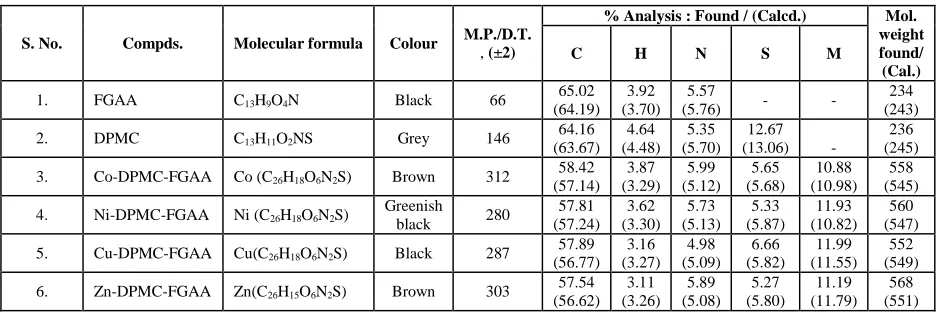
[image:2.595.72.543.587.745.2]All the compounds were colored and stable at room temperature. Physical and analytical data of ligands and their metal complexes have been given in Table 1.
Table 1: Physical and Analytical data of ligands and their Mixed Ligand Complexes
S. No. Compds. Molecular formula Colour M.P./D.T.
, (±2)
% Analysis : Found / (Calcd.) Mol. weight found/ (Cal.)
C H N S M
1. FGAA C13H9O4N Black 66
65.02 (64.19)
3.92 (3.70)
5.57
(5.76) - -
234 (243) 2. DPMC C13H11O2NS Grey 146 64.16
(63.67) 4.64 (4.48) 5.35 (5.70) 12.67 (13.06) -
236 (245) 3. Co-DPMC-FGAA Co (C26H18O6N2S) Brown 312 (57.14) 58.42 (3.29) 3.87 (5.12) 5.99 (5.68) 5.65 (10.98) 10.88 (545) 558
4. Ni-DPMC-FGAA Ni (C26H18O6N2S)
Greenish black 280
57.81 (57.24) 3.62 (3.30) 5.73 (5.13) 5.33 (5.87) 11.93 (10.82) 560 (547) 5. Cu-DPMC-FGAA Cu(C26H18O6N2S) Black 287
IR Spectral studies
IR spectra of ligand FGAA exhibited bands in the region 1620 cm-1(>C=N-)[17], 1490 cm-1(furan ring breathing vibrations) and 1755cm-1 (>C=O stretching vibrations[18]). In the IR spectra of complexes >C=O and >C=N stretching vibrations of the ligand have been shifted towards lower region by 30-40 cm-1 which indicated the participation of oxygen of >C=O and nitrogen of >C=N- moieties in the coordination with metal ions. Both the ligands, FGAA and DPMC, exhibited bands in the region 3490-3480 cm-1 and 1710-1705 cm-1 due to -OH and >C=O stretching vibrations of-COOH[19] groups. In the IR spectra of metal complexes the bands due to –OH stretching vibrations have disappeared which indicated the coordination of ligands with the metal ion via deprotonation of carboxylic groups. In the case of DPMC, a band at 3140 cm-1 due to -NH stretching vibrations has been observed which has shifted towards higher frequency region by 30 cm-1, in the IR spectra of metal complexes, indicating the involvement of NH group in the coordination with metal ions. A weak band at 2650 cm-1 due to -SH stretching vibrations [19] has been appeared in the ligand DPMC. The position of this band has shifted towards lower region by 40 cm-1, in the case of metal complexes, which indicated the involvement of –SH group in the coordination with metal ions. Appearance of new bands in the region 545-535, 450-445 and 330-325 cm-1 due to M-O, M-N and M-S bonds respectively[20] further indicated the coordination of ligands with metal ions through oxygen, nitrogen and sulphur atoms.
1H- NMR spectral studies
1H- NMR spectra of ligand FGAA showed two multiplets in the region δ 7.72-6.61 ppm , δ 8.14 -7.64 ppm and one
singlet at δ 7.54 ppm due to furyl ring protons, aromatic ring protons and >CH=N proton respectively. The ligand DPMC exhibited two multipltes in the region δ 6.83-6.30 ppm , δ 7.88-6.86 ppm and two singlets at δ 4.12 ppm and
δ 3.23 ppm due to –NH- and –SH protons respectively. Both the ligands showed singlets in the region δ 11.34-11.24 ppm due to –OH proton of –COOH group.
1H-NMR spectra of complexes showed a complex multiplet in the region δ 7.94- 6.28 ppm which may be due to
four different types of protons of aromatic rings. The singlets due to protons of >CH=N , -NH , and -SH have shifted to downfield in the range δ 7.98-7.96, δ 4.66-4.51 and δ 3.40-3.35 ppm respectively which is due to decrease electron density and deshielding of protons, as a result of participation of the >CH=N, -NH and –SH, groups in coordination[21-22]. The singlets due to -COOH proton have disappeared in the spectra of complexes which indicated the deprotonation of this group in both ligands during coordination with metal ions[23].
Electronic spectra studies and magnetic susceptibility measurements Cobalt (II) complex
The electronic spectra of Co(II)-DPMC-FGAA complex displayed three bands at 8250, 15640 and 19670 cm-1 corresponding to the transitions 4T1g 4T2g(F), 4T1g 4A2g(F), and 4T1g 4T1g (P) respectively[24]. These
transitions as well as the measured value of magnetic moment 4.82 BM suggested the octahedral geometry for this complex.
Nickel(II)compex
The electronic spectra of Ni(II)-DPMC-FGAA complex exhibited three bands in the region 10800, 16700 and 25670 cm-1 corresponding to the transitions 3A2g 3T2g, 3A2g3T1g and 4A2g3Tlg (P) respectively for octahedral
geometry[24]. The magnetic moment value of this complex was found 3.16 BM which was very close to the value of octahedral environment.
Copper(II) complex
The electronic spectra of Cu(II) -DPMC-FGAA complex displayed three bands at 12000, 16500 and 20000 cm-1 due to 2B1g→2B2g, 2B1g →2A2g and 2B1g→2E1g transitions respectively which suggested that Cu(II) complex has
distorted octahedral geometry[25]. The magnetic moment of this complex was found 1.83 BM which confirmed the octahedral geometry.
Zinc(II) complexes
In the case of mixed ligand complex of Zn(II), no significant absorption bands in their electronic spectra were obtained due to diamagnetic nature of zinc.
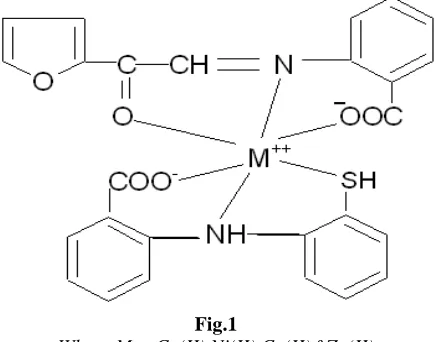
Fig.1
Where M = Co(II),Ni(II),Cu(II)&Zn(II)
The MIC values (Table.2) in general infer that the metal complexes as whole are more active than their fragments. The reason for the increased antimicrobial activity [26] of the complexes as compared to the ligands may be due to the fact that the chelation reduces the polarity of the metal ion by partial sharing of its positive charge with the donor groups and possibly π-electron delocalization within the whole chelate ring. This process thus increases the lipophilicity of the complexes, which subsequently enhances the penetration through the lipid layer of cell membrane and restricts further multiplicity of the microorganism. Among the metal complexes Cu (II) complex was found most active against both bacteria and fungi. The higher antimicrobial activity of Cu (II) complex may be due to higher stability constant of copper complexes.
Table 2 : The Minimum Inhibitory Concentration (X 1O-3) values of ligands and Mixed Ligand Complexes
S. No. Compound Bacteria Fungi
Staphylococcus aureus Escherichia coli Aspergillus niger Aspergillus flavus
1. FGAA 20.57 20.57 10.28 10.28
2. DPMC 20.40 20.40 10.20 10.20
3. Co-DPMC-FGAA 5.47 5.47 2.73 2.73 4. Ni-DPMC-FGAA 5.39 539 2.69 2.69
5. Cu-DPMC-FGAA 5.18 5.18 2.59 2.59 6. Zn-DPMC-FGAA 5.26 5.26 2.63 2.63
REFERENCES
[1]AJ Odolaa; JAO Woods. Archieves of Applied. Sci. Res., 2011, 3 (4), 463-470. [2]S Verma; S Shrivastva; P Rani. J. Chem. Pharm. Res., 2012, 4(1),693-699.
[3] RM Abdel Rahman; ZEl-gendy;MM Fawzy; MB Mahmoud; J. Indian Chem. Soc., 1990, 67, 927-929. [4] M Usharani; E Akila; R Rajavel. J. Chem. Pharm. Res., 2012, 4(1), 726-731.
[5] MM Dutta; BN Goswami; JCS Kataky. J. Indian Chem. Soc., 1990, 67, 332-334.
[6] A Andrade, SF Namora; R G Woisky. J. Inorg. Biochem., 2000, 81, 23-27. [7] SM Ray; SC Lahiri; J. Indian Chem. Soc., 1990, 67, 324-326.
[8] M Mathew; GJ Palenik; GR Clark. Inorg. Chem., 1973, 12, 446-451.
[9] P Arya; N Singh; R Gadi; S Chandra. J. Chem. Pharm. Res., 2010, 2(6), 253-257.
[10] MN Hughes; G Wilkinson; RD Gillard; JA McCleverty. Comprehensive Coordination Chemistry, Vol 6, Pergamon Press, Oxford, 1987.
[11]M Raman; PV Muthuraj; S Ravichandran; A. Kulandaisamy. Indian Acad. Sci (Chem. Sci.), 2003, 115(3), 161-167.
[12] RC Sharma; PP Giri; D Kumar. J. Indian Chem. Soc.,2011, 88, 421-424. [13]D Kumar; J Lal; V Kumar. Proc. Nat. Acad. Sci.(India).2009,79(A),17-21.
[14]AI Vogel, A Text Book Of Quantitative Inorganic Analysis, 3rd ed., Longmans, London, 1968. [15]AJ Dean, Lange’s Hand Book of Chemistry,12thed., Mc Graw- Hill Book Co. Inc., New York, 1978. [16]DF Spooner; G Sykes. Methods in Microbiology, Academic Press, London, 1972.
[image:4.595.198.416.76.247.2][19] YR Sharma. Elementary Organic Spectroscopy, 12th ed., S. Chand and Company Ltd. New Delhi, 2000. [20] K Nakamoto. Infrared and Raman Spectra of Inorganic and Coordination Compounds, 5th ed., John Wiley & Sons Inc., New York , 1997.
[21]NJ Goodwin; W Henderson; BK Nicholson; JK Sarfo; J Fawcett; DRJ Russell J. Chem. Soc., Dalton Trans.,
1997, 45, 4377-4384.
[22] AM Hassaan; MA Khalifa; AK Shehata. Bull. Soc. Chim. Belg. 1995, 104, 121-128. [23] AZ El-sonbaty. Spectrscopy Lett., 1997, 30, 459-462.
[24]ABP Lever. Inorganic Electronic Spectroscopy, Elsevier, Amsterdam , 1968. [25] ABP Lever; E Mantovani. Inorg. Chem., 1971, 10, 817-826.