Journal of Chemical and Pharmaceutical Research
ISSN No: 0975-7384 CODEN(USA): JCPRC5
J. Chem. Pharm. Res., 2011, 3(4):664-669
Dysprosium(III) polyvinyl chloride membrane sensor: A study of
interfering ions effect on efficiency of sensor
Hassan Ali Zamani,a,* Noshin Mehrabian,a Mohammad Reza Abedi,a Soraia Meghdadi,b
a
Department of Applied Chemistry, Quchan branch, Islamic Azad University, Quchan, Iran b
Department of Chemistry, Isfahan University of Technology, Isfahan, Iran
______________________________________________________________________________
ABSTRACT
A PVC membrane sensor for dysprosium(III) ions based on N,N’-bis(naphthalidene)-2-aminobenzylamine(BNA) as a suitable ionophore with a linear dynamic range of 1.0 × 10⁻⁶-1.0 × 10⁻² M, a Nernstian slope of 20.7 ± 0.4 mV per decade, a detection limit of 5.2 × 10⁻⁷ M, pH range of 2.5–8.6 and response time of ~7 s was constructed. In this research, on the fabricated electrode, the potential responses of the recommended Dy(III) membrane sensor to a wide variety of cations were investigated through the matched potential method (MPM). The recommended sensor revealed comparatively good selectivity with respect to most alkali, alkaline earth, some transition, and heavy metal ions. It was successfully employed as an indicator electrode in the potentiometric titration of Dy(III) ions with EDTA.
Keywords: Ion selective electrode, Potentiometry, Sensor, PVC membrane.
______________________________________________________________________________
INTRODUCTION
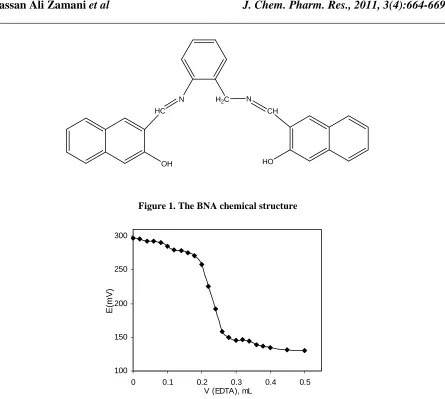
sensitive polyvinyl chloride membrane sensors for various metal ions [3–18], we decided to assess the potentials of using N,N’-bis(naphthalidene)-2-aminobenzylamine(BNA) (Fig. 1) as an ionophore for constructing a highly selective Dy3+-selective sensor that can be used in real time analysis of this element.
EXPERIMENTAL SECTION
Reagents
Reagent grade nitrobenzene (NB), dibutyl phthalate (DBP), acetophenon (AP), benzyl acetate (BA), sodium tetraphenylborate (NaTPB), tetrahydrofuran (THF), and high relative molecular weight PVC were purchased from Merck and Aldrich, used as received. The ionophre BNA was synthesized as described elsewhere [19-22]. The nitrate and chloride salts of all cations used (all from Merck and Aldrich) were of the highest purity available and used without any further purification, except for vacuum drying over P2O5. Triply distilled, de-ionized water was used
throughout.
EMF measurements
All electromotive force (emf) measurements were carried out with the following cell assembly; Ag–AgCl| 1.0×10⁻³ M DyCl3 | PVC membrane: test solution| Hg–Hg2Cl2, KCl (satd).
A Corning ion analyser 250 pH/mV meter was used for the potential measurements at 25.0 °C. The activities were calculated according to the Debye–Huckel procedure.
Electrode preparation
The general procedure to prepare the PVC membrane was to mix thoroughly, 30 mg of PVC, 66 mg nitrobenzene (NB) and 2 mg of NaTPB in 5 mL THF. To this solution was added 2 mg of BNA and the combination was mixed well. The resulting mixture was transferred into a glass dish of 2 cm diameter. A Pyrex tube (5 mm o.d.) was dipped into the mixture for about 5 s so that a nontransparent membrane (about 0.3 mm thickness) is formed. The tube was then pulled out from the mixture and kept at room temperature for at least 12 h. The tube was then filled with internal filling solution (1.0 × 10⁻³ M DyCl3). The electrode was finally conditioned for 24 h by
soaking in a 1.0 × 10⁻³ M DyCl3 [23-35]. A silver/silver chloride electrode was used as an
internal reference electrode.
RESULTS AND DISCUSSION
The ionophore BNA was used as a neutral carrier to prepare the Dy(III) PVC ion-selective membrane sensor. The membrane composition and, especially in some cases, the nature of the additive have a significant influence on the sensitivity and selectivity for a certain ionophore.
Also, the presence of lipophilic and immobilized ionic additives could influence the membrane resistance and, sometimes, the selectivity pattern of the ion-selective PVC membrane, resulting in a good working performance [36, 37]. The membrane sensor with composition of 30% PVC; 66% NB; 2% NaTPB, and 2% BNA exhibits the best performance.
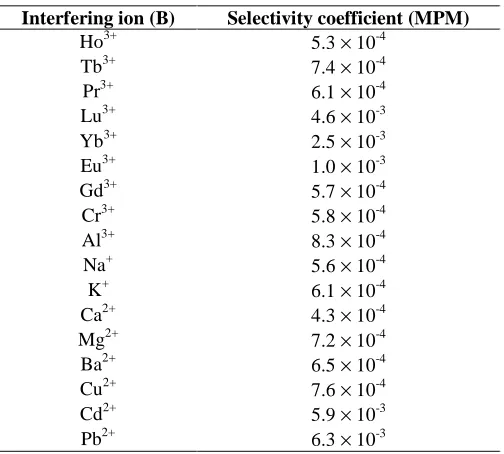
terms of potentiometric selectivity coefficients. For the selectivity coefficient measurements, the matched potential method was used. According to the MPM [38, 39], a specified activity (concentration) of primary ions (A) is added to a reference solution and the potential is measured. In a separate experiment, interfering ions (B) are successively added to an identical reference solution, until the measured potential matches that obtained before the primary ion addition. The MPM selectivity coefficient is then given by the resulting primary ion to the interfering ion activity (concentration) ratio, KMPM = aA/aB. The experimental conditions and the
resulting values are listed in Table 1. For all the tested ions, the selectivity coefficients were of the order 6.3 × 10⁻³ or smaller, indicating that they would not radically disturb the function of the sensor. Therefore, the electrode may be used for Dy(III) ion detection in the presence of certain interfering ions. The characteristics of the sensor were compared with those of the best Dy(III) electrodes reported in the literature [40, 41] (Table 2). It can be concluded that this sensor in terms of selectivity, detection limit, response time and dynamic concentration range, was superior to all previously described Dy(III) sensors.
Table 1: Selectivity coefficients of various interfering ions
Interfering ion (B) Selectivity coefficient (MPM)
Ho3+ 5.3 × 10⁻⁴
Tb3+ 7.4 × 10⁻⁴
Pr3+ 6.1 × 10⁻⁴
Lu3+ 4.6 × 10⁻³
Yb3+ 2.5 × 10⁻³
Eu3+ 1.0 × 10⁻³
Gd3+ 5.7 × 10⁻⁴
Cr3+ 5.8 × 10⁻⁴
Al3+ 8.3 × 10⁻⁴
Na+ 5.6 × 10⁻⁴
K+ 6.1 × 10⁻⁴
Ca2+ 4.3 × 10⁻⁴
Mg2+ 7.2 × 10⁻⁴
Ba2+ 6.5 × 10⁻⁴
Cu2+ 7.6 × 10⁻⁴
Cd2+ 5.9 × 10⁻³
[image:3.595.173.425.332.559.2]Pb2+ 6.3 × 10⁻³
Table 2: Comparison of the selectivity coefficients, linearity range, detection limit and response time of proposed Dy(III) electrode and the previously reported Dy(III) PVC-membrane sensors
Character / reference Ref. 40 (MPM) Ref. 41 (MPM) This work (MPM)
Log Ksel>-2 La3+, Ce3+, Gd3+, Sm3+, Yb3+ ___ ___
Response time (s) <20 <10 ~7 s
Linearity range (M) 1.0 ×10⁻⁵-1.0 ×10⁻¹ 8.0 ×10⁻⁷-1.0 ×10⁻¹ 1.0 ×10⁻⁶-1.0 ×10⁻² Limit of detection (M) 6.0 × 10⁻⁶ 4.2 × 10⁻⁷ 5.2 × 10⁻⁷
HC
H2C
N N
CH
[image:4.595.80.525.73.472.2]HO OH
Figure 1. The BNA chemical structure
100 150 200 250 300
0 0.1 0.2 0.3 0.4 0.5
V (EDTA), mL
E
(m
V
)
Figure 2. Potential titration curve of 25.0 mL from a 1.0×10⁻⁴ M Dy3+ solution with 1.0×10⁻² M of EDTA
Acknowledgements
The authors acknowledge the financial support kindly offered by the Research Council of Quchan Islamic Azad University for the preparation of this study.
REFERENCES
[1] HA Zamani; M Mohaddeszadeh. Anal. Lett., 2008, 41, 2710.
[2] HA Zamani; G Rajabzadeh; MR Ganjali. Bull. Chem. Soc. Japan 2007, 80, 172. [3] HA Zamani; G Rajabzadeh; MR Ganjali; P Norouzi. Anal. Chim. Acta 2007, 598, 51. [4] HA Zamani; MR Ganjali; P Norouzi; M Adib; M Aceedy. Anal. Sci., 2006, 22, 943.
[5] HA Zamani; MT Hamed-Mosavian; E Aminzadeh; MR Ganjali; M Ghaemy; H Behmadi; F Faridbod. Desalination 2010, 250, 56.
[6] HA Zamani; G Rajabzadeh; MR Ganjali; Sensor Lett., 2009, 7, 114.
[7] HA Zamani; MS Zabihi; M Rohani; A Zangeneh-Asadabadi; MR Ganjali; F Faridbod; S Meghdadi. Mater. Sci. Eng. C 2011, 31, 409.
[9] HA Zamani; A Imani; A Arvinfar; F Rahimi; MR Ganjali; F Faridbod; S Meghdadi. Mater.
Sci. Eng. C 2011, 31, 588.
[10] MR Abedi; HA Zamani. Anal. Lett., 2008, 41, 2251.
[11] HA Zamani; A Arvinfar; F Rahimi; A Imani; MR Ganjali; S Meghdadi. Mater. Sci. Eng. C
2011, 31, 307.
[12] H Behmadi; HA Zamani; MR Ganjali; P Norouzi. Electrochim. Acta 2007, 53, 1870.
[13] HA Zamani; M Nekoei; M Mohammadhosseini; MR Ganjali. Mater. Sci. Eng. C 2010, 30, 480.
[14] HA Zamani; G Rajabzadeh; M Masrornia; A Dejbord; MR Ganjali; N Seifi. Desalination
2009, 249, 560.
[15] HA Zamani; MT Hamed-Mosavian; E Hamidfar; MR Ganjali; P Norouzi. Mater. Sci. Eng.
C 2008, 28, 1551.
[16] M Masrournia; HA Zamani; HA Mirrashid; MR Ganjali; F Faridbod. Mater. Sci. Eng. C
2011, 31, 574.
[17] HA Zamani; MR Ganjali; P Norouzi; A Tadjarodi; E Shahsavani. Mater. Sci. Eng. C 2008,
28, 1489.
[18] HA Zamani; G Rajabzadeh; MR Ganjali. Talanta 2007, 72, 1093.
[19] KJ Schenk; S Meghdadi; M Amirnasr; MH Habibi; A Amiri; M Salehi; A Kashi.
Polyhedron 2007, 26, 5448.
[20] SK Srivastava; S Verma; SD Srivastava. J. Chem. Pharm. Res. 2010, 2, 270. [21] CK Patel; CS Rami; B Panigrahi; CN Patel. J. Chem. Pharm. Res. 2010, 2, 73. [22] S Chandra; BN Ghogare; LK Gupta; CP Shinde. J. Chem. Pharm. Res. 2010, 2, 240. [23] HA Zamani; H Ghahremani; H Behmadi. J. Chem. Pharm. Res. 2010, 2, 328.
[24] MR Ganjali; M Tahami; M Shamsipur; T Poursaberi; S Haghgoo; M Hosseini.
Electroanalysis 2003, 12, 1038.
[25] MR Ganjali; M Rezapour; P Norouzi; M Salavati-Niasari. Electroanalysis 2005, 17, 2032. [26] MR Abedi; HA Zamani; MR Ganjali; P Norouzi. Sensor Lett., 2007, 5, 516.
[27] MR Ganjali; P Norouzi; T Alizadeh; A Tajarodi; Y Hanifehpour. Sens. Actuators B 2007, 120, 487.
[28] MR Ganjali; M Emami; M Rezapour; M Shamsipur; B Maddah; M Salavati-Niasari; M Hosseini; Z Talebpoui. Anal. Chim. Acta 2003, 495, 51.
[29] HK Sharma; N Sharma. E-J. Chem. 2009, 6, 1139.
[30] HA Zamani, MR Ganjali, M Salavati-Niasari. Transition. Met. Chem., 2008, 33, 995. [31] HA Zamani; M Mohammadhosseini; M Nekoei; MR Ganjali. Sensor Lett., 2010, 8, 303. [32] VK Gupta, RN Goyal; RA Sharma. Anal. Chim. Acta 2009, 647, 66.
[33] HA Zamani. Anal. Lett., 2009, 42, 615.
[34] HA Zamani; M Rohani; A Zangeneh-Asadabadi; MS Zabihi; MR Ganjali; M Salavati-Niasari. Mater. Sci. Eng. C 2010, 30, 917.
[35] MR Ganjali; F Faridbod; P Norouzi; M Adib. Sens. Actuators B 2006, 120, 119. [36] P Bühlmann; E Pretsch; E Backer. Chem. Rev. 1998, 98, 1593.
[37] MR Ganjali; P Norouzi; A Atrian; F Faridbod; S Meghdadi; M. Giahi. Mater. Sci. Eng. C
2009, 29, 205.
[38] Y Umezawa; K Umezawa; H Sato. Pure Appl. Chem., 1995, 67, 507.
[39] HA Zamani; MR Ganjali; P Norouzi; M Adib. Mater. Sci. Eng. C 2008, 28, 157.
[40] MR Ganjali; J Ravanshad; M Hosseini; M Salavati-Niasari; MR Pourjavid; MR Baezzate.