Munich Personal RePEc Archive
The input-output multi-dimensional
analysis: theoretical framework
Ruiz Estrada, M.A.
University of Malaya
5 January 2010
Online at
https://mpra.ub.uni-muenchen.de/40577/
The Input-Output Multi-Dimensional Analysis: Theoretical Framework
Keywords:
Econographicology, Matrix Algebra, Multi-dimensional graphs
JEL code C67
Corresponding Author Dr. Mario Arturo RUIZ Estrada, Faculty of Economics and Administration
Department of Economics University of Malaya Kuala Lumpur 50603 [H/P] (60) 12-6850293
[E-mail] [email protected]
[Website] www.econonographication.com
Abstract
This paper is interested to propose an alternative approach entitled the input-output
multi-dimensional analysis. This approach is based on the interaction among four
production sectors (agriculture, light industry, heavy industry and services) by “i”
number of sub-sectors under the uses of “j” number of commodities. The idea is to
generate an alternative mathematical and graphical modeling approach to analyze the
behavior of four production sectors and “i” number of sub-sectors to get the final output
of the economy under the construction of the GDP-Surface.
1. Introduction
The modeling of the input-output models were introduced by Professor Wassily
Leontief, he deals with a particular question: “What level of output should each of the n
industries in an economy produce, in order that it will just be sufficient to satisfy the total
demand for that product…” (Leontief, 1951). The model he proposes is a static and partial equilibrium version. Hence, the input-output analysis is not showing a general
equilibrium or dynamic modeling. Therefore, the main idea to generate the input-output
analysis always is simplified by three production sectors (agriculture, industry and
services), in the original paper wrote by Professor Leontief the services sector appear as
householders (Leontief, 1985). The basic structure of the input-output table shows a large
number of production sectors, but we can observe that almost all the examples are based
on the uses of three sectors. This model has a serial of assumptions follow by: first
assumption is that each production sector produces a single homogeneous commodity.
Second assumption is that the model is working under a fixed input ratio. Third
assumption is that all production sectors work under the constant returns to scale. Maybe
this model looks simplistic but we can find that the great contribution of Professor
Leontief is based on the economic modeling shows an alternative view, how the economy
is working based on the interaction of different industries from different production
sectors such as agriculture, industry and services sector and finally is to calculate the
minimum of output to produce a specific commodity to satisfied the basic demand of any
country.
Hence, this paper proposes the uses an alternative mathematical and graphical
modeling approach to study input-output analysis from a multi-dimensional perspective.
Our model is called “The Input-Output Multi-Dimensional Analysis”. We try to
production sectors in our analysis. It is based on the application of Econographicology,
matrix algebra, multi-dimensional partial differentiation and economic modeling in real
time.
2. The Input-Output Multi-Dimensional Analysis
Initially, we have a large number of “j” commodities generated by “i” number of
production sub-sectors by four production sectors (See Expression 1). In our case we
have four production sectors follow by the agriculture, light industry (manufacturing),
heavy industry (under the production of capital goods) and services (See Expression 3, 5,
7 and 9). These four production sectors final output depend on the final total outputs from
all production sub-sectors in each of the four production factors respectively (See
Expression 2, 4, 6 and 8). For example, the agriculture sector (production sector one “S
-1”) exist the production of “j” number of commodities by “i” sub-sectors. A sub-sector
into the agriculture sector or “S-1”, we can mention the production of coffee by a large
number of coffee plantations. Therefore, we assume that the production of any
commodity by each sub-production sector is related to the fast technological challenges
and the domestic and international demand in the market. In the other hand, we assume in
our model that the innovation, research and development of new commodities under low
cost production can generate high demand into different markets simultaneously. We can
observe also that each production sub-sector can show unexpected high or low intensive
exchange of commodities among all sub-sectors in the same production sector (See
Expression 1), it is based on the idea that the market always keep in a dynamic imbalance
state (Ruiz, 2008), to support our argument we application the assumption Omnia Mobilis
(Ruiz, Yap and Shyamala, 2007.b) to generate the relaxation of the exchange of
commodities among all production sectors and sub-sectors in the same production sector.
(1) δSlij : δSlij Where i= {0,1,2,…,∞…}
j = {0,1,2,…,∞…} l = {1,2,3,4}
l = Production sector i = sub-sector j = commodities.
The equation (1) exist two premises follow by:
a. If δSlij = δSlij then the final output into the exchange of this sub-production sector
became 0.
b. If δSlij≠δSlij then the final output into the exchange of this sub-production sector
The sector one (S-1) represent the agriculture sector, this production sector basically
shows a large number of sub-sectors and each sub-sector exist the exchange of infinity
number of commodities among all sub-sectors in the same production sector. The final
output into the box below of each matrix can show the final output after we calculate the
exchange of commodities among all sub-sectors simultaneously. The same situation is
possible to be observed into the sector- 2 (light industry), sector-3 (heavy industry) and
sector-4 (Services).
(2) Sector S-1
Sector S1 G100 G101 G102 . . . G10j S1TO
G100 0 [δG100:δG101]
. . .
[δG100:δG10j] Σ S100G101 [δG101:δG100] 0 . . . [δG101:δG10j] Σ S110
G102 . . . . . . .
. . . . . . . .
G10j [δG10j:δG100] [δG10j:δG101] . . . 0 Σ S10j
S1TI Σ S100 Σ S101 . . . Σ G10j ΣS1
Note: “G” represents commodities
(3) Σ S1 = ƒ (0 ╦ [δG100:δG101] ╦…╦[δG100:δG10j] ╦…╦[δG10j:δG101] ╦ 0)
(4) Sector S-2
Sector S2 G210 G211 G212 . . . G21j S2TO
G210 0 [δG210:δG211]
. . .
[δG210:δG21j] Σ S210G211 [Δg211:δG210] 0 . . . [δG211:δG21j] Σ S211
G212 . . . . . . .
. . . . . . . .
G21j [δS21j:δS210] [δS21j:δS211] . . . 0 Σ S21j
S2TI Σ S210 Σ S211 . . . Σ S21j Σ S2
(6) Sector S-3
Sector S3 G320 GS321 G322 . . . G32j S3TO
G320 0 [ΔG320:δG321]
. . .
[δG320:δG32j] Σ S320G321 [δG321:δG320] 0 . . . [δG321:δG32j] Σ S321
G322 . . . . . . .
. . . . . . . .
G32j [Δg32j:δG320] [δG32j:δG321] . . . 0 Σ S32j
G3TI Σ S320 Σ S321 . . . Σ S32j Σ S3
(7) Σ S3 = ƒ (0 ╦ [δG320:δG321] ╦…╦[δG320:δG32j] ╦…╦[δG32j:δG321] ╦ 0)
(8) Sector S-4
Sector S4 G4n0 G4n1 G4n2 . . . G4nj S4TO
G4n0 0 [Δg4n0:δG4n1]
. . .
[δG4n0:δG4nj] Σ S4n0G4n1 [δG4n1:δG4n0] 0 . . . [δG4n1:δG4nj] Σ S4n0
G4n2 . . . . . . .
. . . . . . . .
G4nj [δGnj:δGn0] [δGnj:δGn1] . . . 0 Σ S4nj
S4TI Σ S4n0 Σ S4n1 . . . Σ S40j Σ S4
(9) Σ S4 = ƒ (0 ╦ [δG4n0:δG4n1] ╦…╦[δG4n0:δG4nj] ╦…╦[δG4nj:δG4n1] ╦ 0)
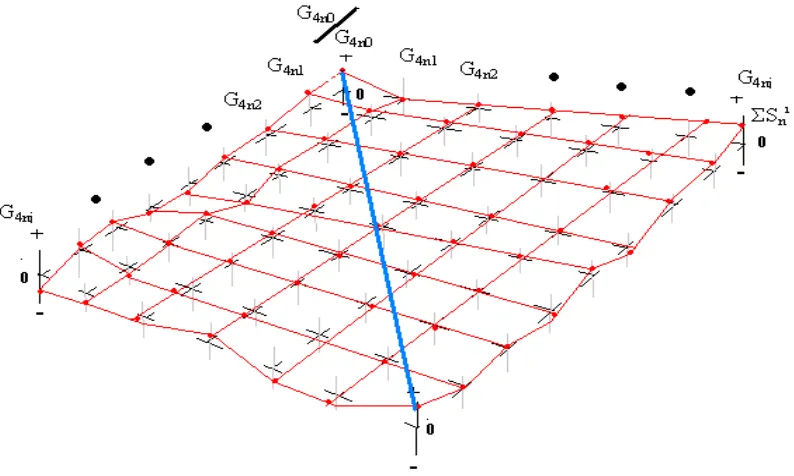
In this part of our model, we suggest to plot each production sector into four
different surfaces, to build each surface, we need to use such as reference all production
sub-sector outputs can be plotted on the surface mapping coordinate system, it can
facilitate to build each multi-dimensional surface for each production sector. After we
plot each production sub-sector, we proceed to join all production sub-sectors by strait
lines from the same production sector until we are available to build a single surface. The
main idea to build the four multi-dimensional surfaces is to observe the behavior of the
exchange of all production sub-sectors “i” by the exchange of a large number of
that in the center part of each surface is equal to 0. The reason is that the same sub-sector
[image:7.612.107.504.141.379.2]cannot sell and buy the same commodity by itself (See Figure 1).
Figure 1: A Multi-dimensional Surface by Production Sector
The input-output dimensional analysis request the application of the
multi-dimensional partial differentiation (See Annex) to observe the changes of two periods of
time between the final time (t+1) and the initial time (t). Also in this part of the model,
we suggest the application of the economic modeling in real time “☼” (Ruiz, 2009) that
consist in successive application of differentiations to observe the changes into the four
production sectors simultaneously (See Expression 10). And also we suggest to apply the
inter-link of all production sub-sectors based on the application of the inter-link
coordinate axis condition that is represented by “╦”.
(10) ☼ΣS1i ≡ ΣS1’ = δƒ’ (S1)t / δ (S1)t+1d’S1 ╦ ΣS1’’= δƒ’’(S1)t/δ (S1)t+1 d2S1 ╦ ΣS1∞ = δ
ƒ∞(S1) / δ (S1)t+1 d∞S1
☼ΣS2i ≡ ΣS2’ = δƒ’ (S2)t / δ (S2)t+1d’S2 ╦ ΣS2’’= δƒ’’(S2)t/δ (S2)t+1 d2S2 ╦ ΣS2∞ = δƒ∞ (S2) / δ (S2)t+1 d∞S2
☼ΣS3i ≡ ΣS3’ = δƒ’ (S3)t / δ (S3)t+1d’S3 ╦ ΣS3’’= δƒ’’(S3)t/δ (S3)t+1 d2S3 ╦ ΣS3∞ = δƒ∞ (S3) / δ (S3)t+1 d∞S3
However, the construction and the final analysis of the input-output multi-dimensional
analysis consist in plot all multi-dimensional partial differentiations from each production
sector: agriculture, light industry, heavy industry and services (See Expression 11) on the
four dimensional physical space coordinate system. (See Ruiz, 2008.a.). In fact, to join
the four production sectors into the same graphical modeling, we suggest inter-link the
four production sectors based on the application of the inter-link of the general coordinate
condition that is represented by “╬”.
(11) GDP-Surface ≡ ☼S* ≡ ☼ΣS1i ╬ ☼ΣS2i ╬ ☼ΣS3i╬ ☼ΣS4i
The final output of the result input-output multi-dimensional analysis, we are
calling “GDP-Surface”. It is depend on the final position that the GDP-surface shows into
the four dimensional physical space coordinate system. We have four possible results
(See Expression 12, 13, 14 and 15) to analyze the behavior of the GDP according to the
speed of exchange of goods and services (economic activity) by production sector and
production sub-sectors.
(12) ☼S* ≡ ☼ +ΣS1i ╬ ☼ +ΣS2i ╬ ☼ +ΣS3i╬ ☼ +ΣS4i
{if +☼S* ∩ R+then the surface ≡ Economic Growth Synchronized}
(13) ☼S* = 0 ≡ ☼ ΣS1i = 0 ╬ ☼ ΣS2i = 0 ╬ ☼ ΣS3i= 0 ╬ ☼ ΣS4i = 0
{if ☼S* ∩ 0 then the surface ≡ General Economic Stagnation}
(14) ☼±S* ≡ ☼ ±ΣS1i ╬ ☼ ±ΣS2i ╬ ☼ ±ΣS3i╬ ☼ ±ΣS4i
{if ☼S* ∩ R+/-then the surface ≡ Irregular Economic Growth}
(15) ☼-S* ≡ ☼ -ΣS1i ╬ ☼ -ΣS2i ╬ ☼ -ΣS3i╬ ☼ -ΣS4i
Figure 2: I-O Multi-dimensional Graphical Analysis
3. Conclusion
We can observe that the input-output multi-dimensional analysis is available to catch up
the interaction of a large number of commodities exchange among different production
sub-sectors in the same production sector, in the same model also is possible to observe
the exchange among the four productions sectors (agriculture, light industry, heavy
industry and services sector) by the application of multi-dimensional partial
differentiations on complex group of functions that they are interacting in the same
mathematical and graphical modeling. Finally, the contribution of Professor Leontief was
great, but not enough to explain the behavior of the dynamic economy behaviors in our
times.
4. References
Ruiz Estrada, M. A. (2007.a). “Econographicology”, International Journal of Economics
Research (IJER), Vol 4-1. pp. 93-104.
Ruiz Estrada, M.A., Nagaraj, S. and Yap, S.F. (2007.b). “Beyond the Ceteris Paribus
Assumption: Modeling Demand and Supply Assuming Omnia Mobilis”. FEA-Working
Paper No.2007-9, pp.1-15.
Ruiz Estrada, M.A., (2009). “Economic Modeling in real Time?”. FEA-Working Paper No.2009-11, pp.1-15.
Leontief, W. (1951). The Structural of America Economy 1919-1939, Second Edition
Input Output Economic. Oxford University Press.
Leontief, W. (1951). The Structural of America Economy 1919-1939, Second Edition
Input Output Economic. Oxford University Press.
Annex
(1) dyij/dxij= 0 or ƒ’(xij) = 0
(2) d/dxij = nxn-1ij or ƒ’(xij) = nxn-1ij
(3) d/dcxij = cnxn-1ij or ƒ’(xij) = cnxn-1ij
(4) d/dxij[αij(xij) ± θij(xij) ±…±.λij(xij)] = d/dxij α(xij) ± d/dij θij(xij) ±…±.λij(xij)
or α’(xij) ± θ’(xij) ±…±.λ’(xij)
(5) d/dxij[αij(xij) θij(xij) … λij(xij)] = α(xij) d/dxij + θij(xij) +…+ .λij(xij)
α(xij) + θij(xij) d/dxij+…+ .λij(xij)
α(xij) + θij(xij) +…+ .λij(xij) d/dxij . . .
(6) d/dxij[αij(xij)/θij(xij)…λij(xij)]=α(xij) d/dxij+θij(xij)+…+λij(xij)/ [θij(xij) +…+ λij(xij)]2
d/dxij[θij(xij)/αij(xij)…λij(xij)]=α(xij)+θij(xij)d/dxij+…+λij(xij)/[αij(xij)+…+ λij(xij)]2
d/dxij[λij(xij)/αij(xij)…θij(xij)]=α(xij)+θij(xij)+…+λij(xij)d/dxij/[αij(xij)+…+ θij(xij)]2
(7) d/dx0j[α0j’(x0j) ╦ θ0j’(x0j) ╦ … ╦ λ0j’(x0j)]…
d/dx1j[α1j’(x1j) ╦ θ1j’(x1j) ╦ … ╦ λ1j’(x1j)]…
d/dx∞j[α∞j’(x∞j) ╦ θ∞j’(x∞j) ╦ … ╦ λ∞j’(x∞j)]…
(8) d/dx0j[α0j’(x0j) ╦ θ0j’(x0j) ╦ … ╦ λ0j’(x0j)] ╬
d/dx1j[α1j’(x1j) ╦ θ1j’(x1j) ╦ … ╦ λ1j’(x1j)] ╬