Munich Personal RePEc Archive
Export Diversification and Economic
Growth in Malaysia
Arip, Mohammad Affendy and Yee, Lau Sim and Abdul
Karim, Bakri
UNIMAS, REITAKU UNIVERSITY, UNIMAS
9 February 2010
Online at
https://mpra.ub.uni-muenchen.de/20588/
Export Diversification and Economic Growth in Malaysia
Mohammad Affendy Arip Lau Sim Yee
Bakri Abdul Karim
Abstract
This paper examines the relationship between export diversification and economic growth in Malaysia. We use annual data from 1980-2007 and time-series techniques of cointegration and Granger causality tests to examine the long-run relationship and dynamic interactions among the variables. The results show the presence of a unique cointegrating vector among the four variables. Consistent with previous studies, we found that export diversification plays significant roles to economic growth in Malaysia. This finding suggests that, in order to sustain future economic growth under the static effect of multilateral and regional trade liberalization, Malaysia should diversify its export commodities and develop greater social and economic cooperation with the rest of the world. As an export-oriented economy, in the long run, export diversification strategy could help stabilizing Malaysia’s export earnings.
Keywords: export diversification, economic growth, revealed comparative advantage JEL Classification: C10, F10, F14
1 INTRODUCTION
The increasing complexity of international trade pattern suggests that the product of one country is no more depending on factor endowment and perfect competition. The modern trade theory contends that international trade has been accommodated with the modern industrial development characteristics. According to Helpman & Krugman (1985, p. 227), the legitimate features of this are: increasing to return scale (IRS); and imperfect competitions. In the past, this subject is often overlooked because the conventional trade theory suggests that in order to benefit from trade activities a country should specialize in its production activities, in which it has a comparative advantage. However, given a different set of international economic characteristics, specialization in economic activities needs greater consideration. In modern international competition, a country cannot solely depend on particular industrial activities and should be more proactive to offset national factor disadvantages in sustaining national competitive advantage. The critical impacts of diversity on economic performance was confirmed by Malizia and Ke (1993), Wagner and Deller (1998), Trendle and Shorney (2004) and Woerter (2007) in their empirical analyses. In addition, the impact of export diversification on economic growth has shown mix results. For instance, Al-Marhubi (2000) and De Ferranti et al. (2002) find
Department of Economics, Faculty of Economics and Business, Universiti Malaysia Sarawak (UNIMAS).
The International School of Economics and Business Administration, Reitaku University.
empirical evidence in support of diversification and growth. In contrast, Pineres and Ferrantino (2000) document no evidence to support the link.
Against this background, this study intends to examine the impact of the degree of specialization and diversification (DSD) on economic growth in Malaysia. To the best of our knowledge, there is no such study has been done on this subject matter in Malaysia. Particularly this is among the first attempt to examine the relationship between DSD and economic growth. This paper is structured as follows. Section 2 provides some theoretical framework, while Section 3 and Section 4 focus on empirical framework and data description, respectively. Empirical findings would be presented in Section 5, while Section 6 concludes our findings.
2 THEORETICAL FRAMEWORK
According to Kenji & Mengistu (2009), export diversification can be categorised into two types. The horizontal diversification and vertical diversification. The former refers to diversity of product across different type of industry, while the latter covers diversity of product within the same industry—i.e. value-added ventures in further downstream activities. Both type of diversification is expected to positively induce economic growth.
Theoretically, there are many way through which export diversification promotes economic growth. According to Herzer and Nowak-Lehmann (2006), export diversification could positively affect economic growth by reducing the dependency on limited number of commodities. This argument is particularly true in the case of commodity-dependent developing countries, where overdependence on agricultural sector could—according to the Prebisch-Singer thesis—reduce the terms of trade. The basic reason for this due to Hesse (2008) is the high degree of price volatility of commodity products.
Another way of illustrating the dynamic effect of export diversification on growth is by linking the connection between these two variables based on modern theory vis-à-vis the classical trade theory. Based on the modern trade theory, there are three main features of modern market behaviour. First, the increasing dynamic features of production factors and national policies to influence the production capacity to grow with increasing return. Second, the expansions of trade model from perfect competition to the imperfect competition especially the monopolistic competition. This is partially related to the first factor, whereby increasing intensity of trade liberalization among nations and mobilization of production factors have enable firms in one country to expand their production without being constrained by diminishing return Krugman & Obstfeld (2003, pp. 126-127). This arguments—in contrast to the classical trade theory—implies that could involve in various production activities without confining to their comparative advantage (see Hausmann, Hwang, & Rodrik (2007).
division. While production in each particular country tries to meets unique characteristic of domestic market demand, it also enters symmetrically into the international market demand and subsequently offers the market with goods and services, which are different in the form of functionalities, taste, design, ingredient, quality, and appearances.1This is termed as the ―home market‖ effects on the pattern of trade by Krugman (1980). According to Krugman (1980) a country tends to export those goods for which they have relatively large domestic market.
3 EMPIRICAL FRAMEWORK
We employ time-series techniques of cointegration and Granger causality tests to examine the long-run relationship and dynamic interactions among the variables of interest. Since these methods are now well known, we mention only those aspects that are relevant in our study. Firstly, for proper model specification, we conduct the unit root and cointegration tests. We apply both the commonly used augmented Dickey-Fuller (ADF) and Phillips-Perron (PP) unit root tests for determining the variables’ orders of integration. Then, to test for cointegration, we employ a vector autoressive (VAR) based approach of Johansen (1988) and Johansen & Juselius (1990), henceforth the JJ cointegration test. Since the results of the JJ cointegration test tend to be sensitive to the order of VAR, following Hall (1989) and Johansen (1992), we specify the lag length that renders the error terms serially uncorrelated.
Having implemented unit root and cointegration tests, we proceed to specification and estimation of Granger causality. In particular, the findings that the variables are non-stationary and are not cointegrated suggest the use of Granger causality of VAR model in first differences. However, if they are cointegrated, a vector error correction model (VECM) or a level VAR can be used.2 According to Granger representation theorem, for any cointegrated series, error correction term must be included in the model. Engle & Granger (1987) and Toda & Phillips (1993) indicate that omitting this error correction term (ECT) in the model, leads to model misspecification. Through the ECT, the ECM opens up an additional channel for Granger-causality to emerge that is completely ignored by the standard Granger and Sims tests.3
Utilizing VECM procedure permits us to make a distinction between the short- and long-run forms of Granger-causality. The short-run causality is determined by the significance of the F -test or chi-square statistics of the differenced independent variables while the long-run causality is determined by the significance of t-test of the lagged ECT. The non-significance of both the t
and F-tests in the VECM indicates econometric exogeneity of the dependent variable (Masih and Masih, 1999). The VECM can then be simply reformulated in matrix form as follows:
1
See Grubel & Llyold (1993, p. 166)
2
Engle & Granger (1987)
3
3 2 1 0 1 1 3 2 1 0 v v v v CAP EMP DSD GDP CAP EMP DSD GDP CAP EMP DSD GDP t k t k i i Eq. 1where GDP is gross domestic product, DSD is degree of specialization and diversification, EMP is employment, and CAP is capital expenditure.
4 DATA DESCRIPTION
The data used in our study are annual data for the period of 1980 to 2007. In this paper, the focal variables are real gross domestic product (GDP) and degree of specialization and diversification (DSD). However focusing on these two variables in a bivariate context may not be satisfactory since they may be driven by common factors thus the results will be misleading. Following Herzer and Nowak-Lehmann (2006), we also include capital expenditure (CAP) and the number of people employed (EMP) as control variables. The main sources of the data are the International Financial Statistics (CD-ROM version) of the IMF and the United Nations Comtrade (UN Comtrade). All data are in logarithm forms. The index of DSD is calculated based on the formula introduced by Balassa (1989) as expressed in Eq. 2.
21 1 N i i RCA RCA N
Eq. 2where Nis number of commodity, RCAiis index of revealed comparative advantage of particular commodity, and RCAis mean of RCA index fromNnumber of samples.
In essence, this method uses the standard deviation of revealed comparative advantage (RCA) indices. Eq. 3 is the mathematical notation for RCA index. Based on the Eq. 2, it is clear that smaller value of standard deviation explains higher degree of export diversification, while the higher value indicates higher degree of specialization or concentration. In other words, over a period of time, if the index continuously decrease, the country is experiecing greater degree of export diversification and vice versa. For this reason, as hypothesized by the economic growth theory, we expect the coefficient of DSD would carry a negative value.
where RCA is index of revealed comparative advantage, Xijis export of commodity i by country j, Xtjis total export of country j, Xiwis export of commodity i in the world, andXtwis total export of the world.
5 EMPIRICAL RESULTS
5.1 Unit Root Tests
[image:6.612.69.545.604.716.2]In order to obtain credible and robust results for any conventional regression analysis, the data to be analyzed should be stationary. Hence, to test for stationarity, the ADF and PP tests are performed based on model with constant and trend. Table 1 reports the ADF and PP tests statistics that examine the presence of unit roots (non-stationary) for all stock indices. Both the ADF and PP tests agree in classifying GDP, DSD, EMP and CAP as I(1) variables, i.e., they are non-stationary in level but become stationary after first differencing.
Table 1: Unit Root Tests
Variable Level First-Difference
ADF PP ADF PP
GDP -1.96 -1.96 -4.02** -3.92** DSD -1.92 -2.29 -3.65** -4.49*** EMP -0.76 -1.84 -4.92*** -5.88*** CAP -2.36 -1.80 -3.41* -3.35*
Notes: 1. ***, ** and * denotes significance at the 1%, 5% and 10% level, respectively.
2. The lag lengths included in the models are based on the Akaike Information Criteria (AIC).
3. The tests of ADF (Augmented Dickey-Fuller) and PP (Phillips-Perron) are based on model with constant and trend.
5.2 Cointegration Tests
Having noted that all variables can be characterized as integrated series with order of integration equals to 1, I(1), we first examine their long-run relations using cointegration analysis. The appropriate lag structure is found to be two which is sufficient to render the error term serially uncorrelated. We use Ljung-Box Q test in order to detect non-auto-correlated residual. The result of JJ cointegration test is reported in Table 2. The trace and maximal eigenvalue statistics suggest the presence of a unique cointegrating vector among the four variables. Thus, these variables are tied together in the long-run and their deviations from the long-run equilibrium path will be corrected.
Table 2: Cointegration Tests
Null hypothesis Test statistics 10 % Critical Value
Trace Max Trace Max
H0: r = 0 54.3105 *
29.9446* 44.9336 25.1241 H0: r ≤ 1 24.3659 18.5593 27.0669 18.8928 H0: r ≤ 2 5.4066 5.3847 13.4287 12.2965 H0: r ≤ 3 0.0218 0.022 2.7055 2.7055 Estimated long-run parameters
(normalized on GDP):
Note: * indicates significance at 5% level. Figures in parentheses are standard error.
The estimated long-run parameters, which are readily available from the JJ procedure, suggest both employment and capital expenditure have a positive relation with economic growth. Meanwhile, as expected, the degree of specialization and diversification is negatively associated with economic growth. Thus, this implies that the export diversification plays significant roles to economic growth. The result is consistent with those of Al Marhubi (2000), Pineres & Ferrantino (2000), Herzer & Lehmann (2006), and Agosin (2007). Thus, it can be hypothesized that export diversification affects long-run growth as suggested by endogenous growth theory, which emphasises the role of increasing returns to scale and dynamic spillover effects.
5.3 Granger Causality Test
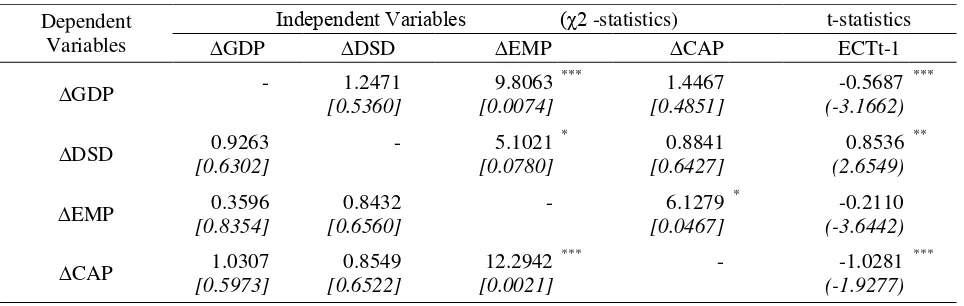
In order to determine the causal nexus among the examined variables, we implement the Granger causality test. As noted, with cointegration, the dynamic causal interactions among the variables should be expressed in a vector error correction form. This allows us to assess both the short-run causality (χ2–
test of the lagged first-differenced terms) and long-run causality (t-test of the error correction terms). The results of the tests are presented in Table 3. Reaffirming the presence of cointegration, we find negative and significant coefficients of the error term for GDP and EMP. Thus this implies that only GDP and EMP bear the brunt of short-run adjustment to return to the long-run equilibrium.
[image:7.612.67.549.532.685.2]The results indicate that there exists a long-run causality from DSD, EMP and CAP to GDP. In addition, there is also a long-run causality running from GDP, DSD and CAP to EMP. Apart from these adjustments towards the equilibrium relationship, we also note several short-run dynamic interactions among the variables. There seems a one-way causation from EMP to GDP and from EMP to DSD. It is interesting to note that we observe a two-way causation between EMP and CAP. Consistent with Rowthorn (1995), he noted that investment in new productive capacity will create job, while the destruction of existing capacity may destroy job.
Table 3: Granger Causality Tests
Dependent Variables
Independent Variables (χ2 -statistics) t-statistics
∆GDP ∆DSD ∆EMP ∆CAP ECTt-1
∆GDP - 1.2471
[0.5360]
9.8063
[0.0074] ***
1.4467
[0.4851]
-0.5687
(-3.1662) ***
∆DSD 0.9263
[0.6302]
- 5.1021
[0.0780] *
0.8841
[0.6427]
0.8536
(2.6549) **
∆EMP 0.3596
[0.8354]
0.8432
[0.6560]
- 6.1279
[0.0467] *
-0.2110
(-3.6442)
∆CAP 1.0307
[0.5973]
0.8549
[0.6522]
12.2942
[0.0021] ***
- -1.0281
6 CONCLUSION AND POLICY IMPLICATIONS
In this study, we examine the relationship between export diversification and economic growth for the case of Malaysia. We use annual data from 1980-2007 and time-series techniques of cointegration and Granger causality tests to examine the long-run relationship and dynamic interactions among the variables. The results show the presence of a unique cointegrating vector among the four variables. Thus, these variables are tied together in the long-run and their deviations from the long-run equilibrium path will be corrected.
In line with previous studies, we also document empirical evidence to support of diversification-led growth in Malaysia. Thus, endogeneous growth theory hypothesis that export diversification affects long-run growth is valid. Several long-run causalities are found from DSD, EMP and CAP to GDP; from GDP, DSD and CAP to EMP. Apart from that, we also note several short-run dynamic interactions among the variables.
REFERENCES
Agosin, M. P. (2007). Export Diversification and Growth in Emerging Economies, Working Paper No.233. Universidad de Chile: Departmento de Economia.
Al Marhubi, F. A. (2000). Export Diversification and Growth: An Empirical Investigation.
Applied Economics Letters, 7, 559-562.
Balassa, B. (Ed.). (1989). Trade Liberalization and 'Revealed' Comparative Advantage. Hertfordshire: Harvester Wheatsheaf.
Engle, R. F., & Granger, C. W. J. (1987). Cointegration and error correction: representation, estimation, and testing. Econometrica, 55, 251-276.
Grubel, H. G., & Llyold, P. J. (Eds.). (1993). The Empirical Measurement of Intra-Industry Trade (Vol. 1). Aldershot: Edward Elgar Publishing Limited.
Hall, S. G. (1989). Maximum likelihood estimation of cointegrating vestors: an example of Johansen’s procedure. Oxford Bulletin of Economics and Statistics, 51, 213-218.
Hausmann, R., Hwang, J., & Rodrik, D. (2007). What You Export Matters. Journal of Economic Growth, Springer, 12(1), 25.
Helpman, E., & Krugman, P. (1985). Market Structure and Foreign Trade: Increasing Return, Imperfect Competition, and the International Economy (2nd ed.). London: The MIT Press. Herzer, D., & Lehmann, N. (2006). What does export diversification do for a growth? An
econometric analysis. Applied Economic Letters, 38(15), 1825-1838. Hesse, H. (2008). Export Diversification and Economic Growth. Retrieved. from.
Johansen, S. (1988). Statistical analysis of cointegration vectors. Journal of Economics Dynamic and Control, 12, 231-254.
Johansen, S. (1992). Testing weak exogeneity and the order of cointegration in Uk modeny demand data. Journal of Policy Modelling, 14, 313-334.
Johansen, S., & Juselius, K. (1990). Maximum likelihood estimation and inference on cointegration with applications to the demand for money. Oxford Bulletin of Economics and Statistics, 52, 169-210.
Kenji, Y., & Mengistu, A. A. (2009). The Impacts of Vertical and Horizontal Export Diversification on Growth: An Empirical Study on Factors Explaining the Gap between Sub-Sahara Africa and East Asia's Performances. Ritsumeikan International Affair, 17, 41. Krugman, P. (1980). Scale Economies, Product Differentiation, and the Pattern of Trade. The
American Economic Review, 70(5), 950.
Krugman, P., & Obstfeld, D. (2003). International Economics: Theory and Policy (754, Trans. 6th ed.). Boston: Pearson Education, Inc.
Pineres, A. G. D., & Ferrantino. (2000). Export dynamics and economic growth in Latin America. Burlington, Vermont: Ashgate Publishing Ltd.
Rowthorn, R. (1995). Capital Formation and Unemployemnt. Oxford Review of Economic Policy, 11(1), 26-39.