http://dx.doi.org/10.4236/ojpm.2016.67017
How to cite this paper: Ezoe, S., Iida, T., Inoue, K. and Toda, M. (2016) Development of Japanese Version of Smartphone Dependence Scale. Open Journal of Preventive Medicine, 6, 179-185. http://dx.doi.org/10.4236/ojpm.2016.67017
Development of Japanese Version of
Smartphone Dependence Scale
Satoko Ezoe
1*, Tadayuki Iida
2, Ken Inoue
3, Masahiro Toda
41Health Service Center Izumo, Shimane University, Shimane, Japan
2Department of Physical Therapy, Faculty of Health and Welfare, Prefectural University of Hiroshima,
Hiroshima, Japan
3Department of Public Health, Gunma University Graduate School of Medicine, Gunma, Japan 4Graduate School of Human Life Sciences, Notre Dame Seishin University, Okayama, Japan
Received 27 July 2016; accepted 19 August 2016; published 22 August 2016
Copyright © 2016 by authors and Scientific Research Publishing Inc.
This work is licensed under the Creative Commons Attribution International License (CC BY).
http://creativecommons.org/licenses/by/4.0/
Abstract
We designed a Japanese version of the Smartphone Dependence Scale (J-SDS) for university stu-dents, and assessed its validity and reliability. For development of this scale, we initially selected 43 preliminary items based on previous studies of Internet and mobile phone dependence. Each response was scored using a Likert scale (0, 1, 2, 3), with higher scores indicating greater depen-dence. After administering the preliminary scale to 149 university students, the final 29 items were selected according to exploratory factor analysis. The final scale consisted of 5 factors: 1) craving and withdrawal, 2) overuse and tolerance, 3) virtual life orientation, 4) disturbance of concentration in class, and 5) physical symptoms. Reliability coefficient (Cronbach’s alpha) values for the 5 factors and total J-SDS were 0.87, 0.87, 0.76, 0.77, 0.69, and 0.92, respectively. We then summed the Likert scores for each item to provide a quantitative overall smartphone dependence score, with higher scores indicating greater dependence. The J-SDS score became significantly higher with longer hours of smartphone use (p < 0.001). Our results suggest that the J-SDS is a re-liable and valid scale for screening university students who may be at risk of developing smart-phone dependence.
Keywords
Smartphone Dependence, Japanese Version of Smartphone Dependence Scale, Internet Addiction, Reliability, Validity, Factor Analysis, University Students
1. Introduction
The smartphone has rapidly developed over recent years and its use has become widespread an established part of daily life in many countries. According to the Ministry of Internal Affairs and Communications of Japan, the penetration rate of mobile phone use was 94.6% in 2014, with smartphones comprising 64.2% of those devices [1]. While this information and communication technology resource is very convenient and popular, various so-cial issues have arisen in association with its use, including changes in interpersonal relationships, interference with school or work, physical health-related problems including pain in the wrists or back of the neck, sleep disturbance, excessive use, and even dependence (addiction). As various applications have been developed for use with smartphones allowing the Internet to become more accessible, patterns of dependence have been rou-tinely reported [2].
Because of its mobility and Internet capabilities, a smartphone can induce characteristics of dependence in users, such as overuse, tolerance, problems with withdrawal, difficulty with performing study or work, and cy-ber life orientation. Previous studies conducted in South Korea of university students have indicated associations of smartphone dependence with mental health, campus life, personal relations, self-control, and life stress [3][4]. Adolescents may be at higher risk for exhibiting problems seen with the use of smartphones as compared to adults, because younger generations typically use smartphones as the primary tool to access the Internet [2][5].
Smartphone dependence especially among adolescents has recently become a very important problem in Ja-pan. However, few valid or reliable scales have been developed to measure such dependence, thus there is an urgent need for a smartphone dependence scale that can be used for Japanese students.
In the present study, we referred to previous studies of Internet and mobile phone dependence to design a Japanese smartphone dependence scale for university students. We then, administered a questionnaire concern-ing smartphone use to 149 university students in Japan, and investigated the construction, as well as reliability and validity of the scale.
2. Subjects and Methods
2.1. Subjects
We recruited 169 healthy university students twenty and over from the Faculty of Medicine of Shimane Univer-sity and the Faculty of Health and Welfare of the Prefectural UniverUniver-sity of Hiroshima in Japan from December 2015 to January 2016. They were from first-year to fifth-year students whose majors were medicine, nursing, or physical therapy. After receiving approval for the study protocol from the review boards of the institutions and informed consent from each participant, the subjects were asked to answer a set of self-reporting questionnaires designed to evaluate smartphone use and dependence. Answers from 149 of the respondents (32 males and 117 females; mean age 22.3 ± 2.1 and 21.1 ± 1.9 years, respectively) who regularly used a smartphone and properly completed all of the questionnaire items were statistically analyzed.
2.2. Demographic Information
Items pertaining to subject personal information, and the extent and nature of their smartphone use were in-cluded in the questionnaire.
2.3. Smartphone Dependence Scale Items
As it has been hypothesized that smartphone dependence has many aspects that are similar to those of Internet addiction, we referred to the Internet addiction criteria [6] when developing smartphone dependence scale. Based on previously developed scales and research findings [2][6]-[13], items that were considered to theoreti-cally and empiritheoreti-cally represent the characteristics of smartphone dependence were selected to comprise the present tool, termed the Japanese version of the Smartphone Dependence Scale (J-SDS). The preliminary scale consisted of 43 items, and each was scored on a 4-point Likert scale (0 = strongly disagree, 1 = disagree, 2 = agree, 3 = strongly agree),with higher scores indicating greater dependence.
2.4. Statistical Analysis
factoring estimation of varimax rotation. A scree plot of ordered eigenvalues was used to determine the appro-priate number of factors extracted. A factor loading value >0.40 was used to determine the items for each factor. The reliability coefficient (Cronbach’s alpha) values of the factors extracted and total J-SDS were calculated for internal consistency determination. Likert scores for each item of the final J-SDS were summed to provide a quantitative overall smartphone dependence score, with higher scores indicating greater dependence. A Kolmo-gorov-Smirnov test was used to determine whether the J-SDS scores were normally distributed. To examine concurrent validity of the J-SDS, we used Spearman’s correlation coefficient to examine the relationships of hours of smartphone use during weekdays and holidays with J-SDS score, and one-way analysis of variance and post hoc analyses to examine the relationships of hours of smartphone use from 10:00 p.m. to 4:00 a.m. and while in bed with J-SDS score. All analyses were performed using IBM SPSS Statistics version 19 [14].
3. Results
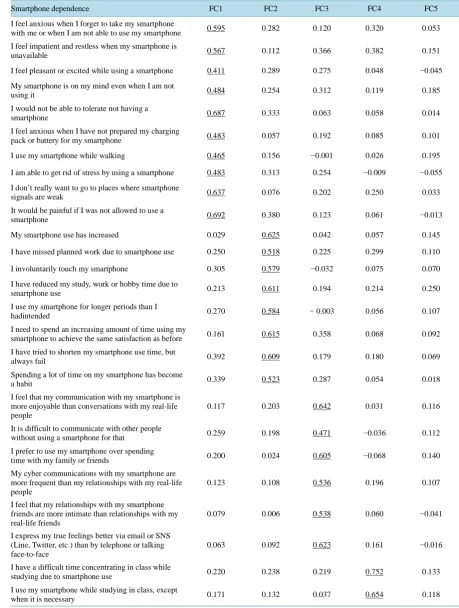
The final 29 items of the J-SDS were selected according to exploratory factor analysis. Factor loading for the 29 variables after rotation of commonfactors extracted is shown in Table 1. Five factors were extracted for these variables, i.e., craving and withdrawal (10 items: first 10 listed in Table 1), overuse and tolerance (8 items: numbers 11 - 18), virtual life orientation (6 items: numbers 19 - 24), disturbance of concentration in class (2 items: numbers 25 and 26), and physical symptoms (3 items: numbers 27 - 29).
The reliability coefficient (Cronbach’s alpha) values of the 5 factors extracted and the total J-SDS were 0.87, 0.87, 0.76, 0.77, 0.69, and 0.92, respectively.
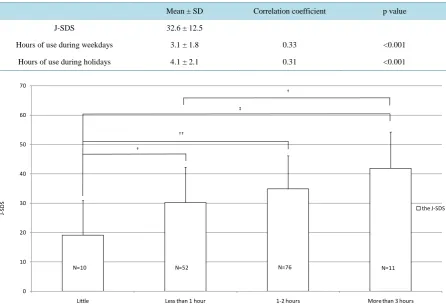
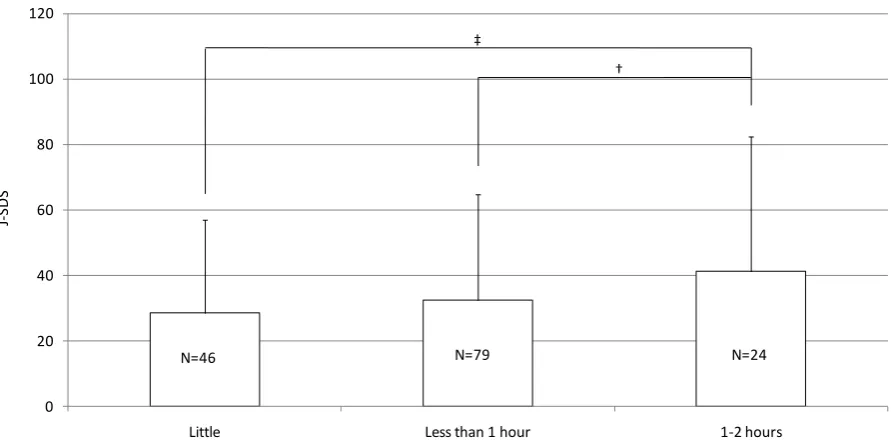
Kolmogorov-Smirnov test results indicated that the scores of the J-SDS were normally distributed (p = 0.72). Mean scores for the J-SDS and hours of smartphone use during weekdays and holidays, as well as Spearman’s correlation coefficient between J-SDS score and hours of smartphone use are shown in Table 2. Hours of smartphone use during weekdays as well as holidays were significantly positively related to J-SDS score. Fig-ure 1 shows the relationship of hours of smartphone use from 10 p.m. to 4 a.m. with J-SDS score. That score showed a significant increase in association with hours of smartphone use from 10 p.m. to 4 a.m. (F = 8.44, p < 0.001). Furthermore, the J-SDS score also significantly increased as the hours of smartphone use while in bed increased (F = 8.95, p < 0.001) (Figure 2).
4. Discussion
We developed the J-SDS on the basis of previous studies and used exploratory factor analysis with university students as subjects to establish its 5-factor structure, i.e.,: 1) craving and withdrawal, 2) overuse and tolerance, 3) virtual life orientation, 4) disturbance of concentration in class, and 5) physical symptoms. The factor “crav-ing and withdrawal” includes the feel“crav-ing of anxiety, impatience, and pain without a smartphone and constantly having one’s smartphone in mind even when not using it, while “overuse and tolerance” refers to long and un-controllable periods of use of one’s smartphone, trying to control one’s smartphone use but failing to do so, and spending an increasing amount of time using the smartphone to achieve the same level of satisfaction as pre-viously experienced. The factor “virtual life orientation” includes the feeling that communication with one’s smartphone is more enjoyable and intimate than relationships with real-life friends or family, “disturbance of concentration in class” refers to having a difficult time concentrating in clas due to smartphone use, and “physi-cal symptoms” include headache, stiff shoulders and pain in the wrists or at the back of the neck due to exces-sive smartphone use. These 5 factors were partially consistent with previously reported findings regarding fac-tors related to Internet addiction, which were listed as unpleasant feelings when off-line (withdrawal), excessive time spent on Internet-related activities (overuse and virtual life orientation), increasing tolerance to the effects of being online, and denial of associated problematic behaviors [6]. Therefore, we consider that the J-SDS has construct validity.
The values for Cronbach’s alpha coefficient for the present 5 factors extracted and total J-SDS were 0.87, 0.87, 0.76, 0.77, 0.69, and 0.92, respectively. Although the value for the factor “physical symptoms” was not so high, the total J-SDS exhibited good internal consistency.
Table 1.Factor loading for 29 variables of smartphone dependence for common factors (FC1, FC2, FC3, FC4, FC5)a in 149 university students extracted by factor analysis.
Smartphone dependence FC1 FC2 FC3 FC4 FC5
I feel anxious when I forget to take my smartphone
with me or when I am not able to use my smartphone 0.595 0.282 0.120 0.320 0.053
I feel impatient and restless when my smartphone is
unavailable 0.567 0.112 0.366 0.382 0.151
I feel pleasant or excited while using a smartphone 0.411 0.289 0.275 0.048 −0.045
My smartphone is on my mind even when I am not
using it 0.484 0.254 0.312 0.119 0.185
I would not be able to tolerate not having a
smartphone 0.687 0.333 0.063 0.058 0.014
I feel anxious when I have not prepared my charging
pack or battery for my smartphone 0.483 0.057 0.192 0.085 0.101
I use my smartphone while walking 0.465 0.156 −0.001 0.026 0.195
I am able to get rid of stress by using a smartphone 0.483 0.313 0.254 −0.009 −0.055
I don’t really want to go to places where smartphone
signals are weak 0.637 0.076 0.202 0.250 0.033
It would be painful if I was not allowed to use a
smartphone 0.692 0.380 0.123 0.061 −0.013
My smartphone use has increased 0.029 0.625 0.042 0.057 0.145
I have missed planned work due to smartphone use 0.250 0.518 0.225 0.299 0.110
I involuntarily touch my smartphone 0.305 0.579 −0.032 0.075 0.070
I have reduced my study, work or hobby time due to
smartphone use 0.213 0.611 0.194 0.214 0.250
I use my smartphone for longer periods than I
hadintended 0.270 0.584 − 0.003 0.056 0.107
I need to spend an increasing amount of time using my
smartphone to achieve the same satisfaction as before 0.161 0.615 0.358 0.068 0.092
I have tried to shorten my smartphone use time, but
always fail 0.392 0.609 0.179 0.180 0.069
Spending a lot of time on my smartphone has become
a habit 0.339 0.523 0.287 0.054 0.018
I feel that my communication with my smartphone is more enjoyable than conversations with my real-life people
0.117 0.203 0.642 0.031 0.116
It is difficult to communicate with other people
without using a smartphone for that 0.259 0.198 0.471 −0.036 0.112
I prefer to use my smartphone over spending
time with my family or friends 0.200 0.024 0.605 −0.068 0.140
My cyber communications with my smartphone are more frequent than my relationships with my real-life people
0.123 0.108 0.536 0.196 0.107
I feel that my relationships with my smartphone friends are more intimate than relationships with my real-life friends
0.079 0.006 0.538 0.060 −0.041
I express my true feelings better via email or SNS (Line, Twitter, etc.) than by telephone or talking face-to-face
0.063 0.092 0.623 0.161 −0.016
I have a difficult time concentrating in class while
studying due to smartphone use 0.220 0.238 0.219 0.752 0.133
I use my smartphone while studying in class, except
Continued
I have headaches due to excessive smartphone use −0.034 0.116 0.110 0.154 0.589
My shoulders are stiff due to excessive smartphone
use 0.124 0.197 −0.053 0.214 0.678
I feel pain in the wrists or back of the neck when using
a smartphone 0.150 0.083 0.175 −0.082 0.603
a
[image:5.595.90.537.229.535.2]FC1, FC2, FC3, FC4, and FC5 represent the first, second, third, fourth, and fifth factors, respectively. The eigenvalues were 9.0, 2.2, 1.9, 1.6, and 1.4, respectively, and the cumulative proportions up to the first, second, third, fourth, and fifth factors were 0.31, 0.39, 0.45, 0.51, and 0.56, respectively.
Table 2. Mean score for Japanese version of Smartphone Dependence Scale (J-SDS), and mean hours of smartphone use during weekdays and holidays, including Spearman’s correlation coefficient values for comparison between J-SDS score and hours of smartphone use.
Mean ± SD Correlation coefficient p value
J-SDS 32.6 ± 12.5
Hours of use during weekdays 3.1 ± 1.8 0.33 <0.001
Hours of use during holidays 4.1 ± 2.1 0.31 <0.001
0 10 20 30 40 50 60 70
Little Less than 1 hour 1-2 hours More than 3 hours
the J-SDS
J-S
DS
N=10 N=52 N=76 N=11
†
†
††
‡
Figure 1. Relationship of hours of smartphone use from 10 p.m. to 4 a.m. with J-SDS score in 149 university students; †: p < 0.05, ††p < 0.005, ‡: p < 0.001 (Bonferroni’s multiple comparison test).
It has been reported that exposure to mobile phone emissions at nighttime may have an effect on melatonin- onset time [15], while mobile phone use has also been shown to be associated with sleep problems [16][17]. Munezawa et al. reported that the use of mobile phones for calling and sending text messages after turning off the lights at night was associated with sleep disturbance in Japanese adolescents [17]. They concluded that since many adolescents frequently use a mobile phone at midnight despite the possible adverse effects on sleep, this lifestyle habit should be carefully considered when formulating preventive strategies against sleep disturbance in that age group. Along that line, we think that the J-SDS score can be a useful index of the adverse effects of smartphone use on sleep, because our results were found to be significantly associated with hours of smartphone use late at night and while in bed.
0 20 40 60 80 100 120
Little Less than 1 hour 1-2 hours
J-S
DS
† ‡
[image:6.595.90.536.83.303.2]N=46 N=79 N=24
Figure 2.Relationship of hours of smartphone use while in bed with J-SDS score in 149 university students; †: p <0.01, ‡: p < 0.001 (Bonferroni's multiple comparison test).
reported and a more objective method is required to better examine concurrent validity. In addition, the subjects were comprised of students from only two universities, the sample size was too small, and the demographic fac-tor was not fully controlled because the gender ratio was not 1:1. As a result, the present sample group is diffi-cult to generalize, and additional examinations with larger and more varied populations are required in order to evaluate the validity and reliability of this scale.
5. Conclusion
In summary, our findings suggest that the J-SDS is a valid and reliable self-administered instrument for screen-ing university students who are at risk of developscreen-ing smartphone dependence.
Acknowledgements
This study was supported by a JSPS KAKENHI Grant-in-Aid for Scientific Research (C) (No. 15K01682).
References
[1] http://www.soumu.go.jp/johotsusintokei/statistics/statistics 05.html
[2] Kwon, M., Kim, D.J., Cho, H. and Yang, S. (2013) The Smartphone Addiction Scale: Development and Validation of a Short Version for Adolescents. PLoS One, 8, e83558. http://dx.doi.org/10.1371/journal.pone.0083558
[3] Choi, H.S., Lee, H.K. and Ha, J. (2012) The Influence of Smartphone Addiction on Mental Health, Campus Life and Personal Relations—Focusing on K University Students. Journal of Korean Data & Information Science Society, 235, 1005-1015. http://dx.doi.org/10.7465/jkdi.2012.23.5.1005
[4] Kim, N.S. and Lee, K.E. (2012) Effects of Self-Control and Life Stress on Smart Phone Addiction of University Stu-dents. Journal of the Korea Society of Health Informatics and Statistics, 372, 72-83.
[5] Kim, D.I, Lee, Y.H, Lee, J.Y., Kim, Y.C., Keum, C.M., et al. (2012) New Patterns in Media Addiction: Is Smartphone a Substitute or a Complement to the Internet? The Korean Journal of Youth Counseling, 201, 71-88.
[6] Young, K.S. (1998) Caught in the Net. John Wiley & Sons, New York.
[7] Mok, J.Y., Choi. S.W., Kim, D.J., Choi, J.S., Lee, J., Ahn, H., Choi, E.J. and Song, W.Y. (2014) Latent Class Analysis on Internet and Smartphone Addiction in College Students. Neuropsychiatric Disease and Treatment, 10, 817-828. [8] Ching, S.M., Yee, A., Ramachandran, V, Lim, S.M.S., Sulaiman, W.A.W., Foo, Y.L. and Hoo, F.H. (2015) Validation
of a Malay Version of the Smartphone Addiction Scale among Medical Students in Malaysia. PLoS One, 10, e0139337.
[9] Kim, D., Lee, Y., Lee, J., Nam, J.K. and Chung, Y. (2014) Development of Korean Smartphone Addiction Proneness Scale for Youth. PLoS One, 9, e97920. http://dx.doi.org/10.1371/journal.pone.0097920
[10] Lin, Y.H., Chang, L.R., Lee, Y.H., Tseng, H.W., Kuo, T.B.J. and Chen, S.H. (2014) Development and Validation of the Smartphone Addiction Inventory (SPAI). PLoS One, 9, e98312. http://dx.doi.org/10.1371/journal.pone.0098312
[11] Kwon, M., Lee, J.Y., Won, W.Y., Park, J.W., Min, J.A., Hahn, C., et al. (2013) Development and Validation of a Smartphone Addiction Scale (SAS). PLos One, 8, e56936. http://dx.doi.org/10.1371/journal.pone.0056936
[12] Toda, M., Monden, K., Kubo, K. and Morimoto, K. (2004) Cellular Phone Dependence Tendency of Female Universi-ty Students. Japanese Journal of Hygiene, 59, 383-386. http://dx.doi.org/10.1265/jjh.59.383
[13] Toda, M., Nishio, N. and Takeshita, T. (2015) Development of a New Scale for Gauging Smartphone Dependence. Japanese Journal of Hygiene, 70, 259-263. http://dx.doi.org/10.1265/jjh.70.259
[14] IBM SPSS Statistics 19 (2010) SPSS Inc.
[15] Wood, A.W., Loughran, S.P. and Stough, C. (2006) Does Evening Exposure to Mobile Phone Radiation Affect Subse-quent Melatonin Production? International Journal of Radiation Biology, 82, 69-76.
http://dx.doi.org/10.1080/09553000600599775
[16] Loughran, S.P., Wood, A.W., Barton, J.M., et al. (2005) The Effect of Electromagnetic Fields Emitted by Mobile Phones on Human Sleep. Neuroreport, 16, 1973-1976. http://dx.doi.org/10.1097/01.wnr.0000186593.79705.3c
[17] Munezawa, T., Kaneita, Y., Osaki, Y., et al. (2011) The Association between Use of Mobile Phones after Lights Out and Sleep Disturbances among Japanese Adolescents: A nationwide Cross-Sectional Survey. Sleep, 34, 1013-1020.
http://dx.doi.org/10.5665/sleep.1152
Submit or recommend next manuscript to SCIRP and we will provide best service for you:
Accepting pre-submission inquiries through Email, Facebook, LinkedIn, Twitter, etc. A wide selection of journals (inclusive of 9 subjects, more than 200 journals) Providing 24-hour high-quality service
User-friendly online submission system Fair and swift peer-review system
Efficient typesetting and proofreading procedure
Display of the result of downloads and visits, as well as the number of cited articles Maximum dissemination of your research work