http://dx.doi.org/10.4236/jss.2016.46008
How to cite this paper: Hou, L.P. and Liu, Y.Z. (2016) The Influence of Stressful Life Events of College Students on Subjective Well-Being: The Mediation Effect of the Operational Effectiveness. Open Journal of Social Sciences, 4, 70-76.
http://dx.doi.org/10.4236/jss.2016.46008
The Influence of Stressful Life Events of
College Students on Subjective Well-Being:
The Mediation Effect of the Operational
Effectiveness
Linping Hou
*, Yaozhong Liu
Jinan University, Guangzhou, ChinaReceived 11 May 2016; accepted 12 June 2016; published 15 June 2016
Copyright © 2016 by authors and Scientific Research Publishing Inc.
This work is licensed under the Creative Commons Attribution International License (CC BY). http://creativecommons.org/licenses/by/4.0/
Abstract
In this study, we adopted three questionnaires to collect the data of stressful life events, opera-tional effectiveness and subjective well-being of college students. Using SPSS 16.0 and AMOS soft-ware, we analysed the relation between stressful life events, operational effectiveness and subjec-tive well-being. It turned out that a) subjecsubjec-tive well-being decreases when stressful life events in-creases, subjective well-being increases when operational effectiveness increases; b) there are four paths through which stressful life events influences subjective well-being: stressful life events have a direct negative effect on subjective well-being; stressful life events affect subjective well- being through confidence; stressful life events affect subjective well-being through cognitive level and degree of confidence; stressful life events affect subjective well-being through confidence and competence.
Keywords
Stressful Life Events, Operational Effectiveness, Subjective Well-Being, College Students, Mediation Effect
1. Introduction
1.1. Stressful Life Events
College students are a special group, they are in a critical period and transitional period before entering society,
*
in this stage they face the dual pressure of school and working. As the period of the stressful life events happen more often, it is also a huge challenge for their well-being. College students of stressful life events mainly come from relationships, learning pressure, blamed by the teacher, friends and relatives, friends and relatives or prop-erty losses, health problems, and the new environment adaptation and so on. On the other hand, because of the particularity of college students’ ages, although the age has reach that level, psychological and social adapta-tion are not, and therefore in the phase of between adults and minors. At adult age, they will face a series of stressful life events, but because of socialization is not enough, it’s hard for them to cope with psychological stressful life events; the low level of operational effectiveness also has affection on the overall subjective well- being.
Studies have pointed out that there were significant positive correlation between the stressful life events and individual alcohol [1] (Fei Xia, Baojuan Ye, 2014), drugs, [2] (Qiang Yang, Baojuan Ye, 2014) use and suicide rate [3] (Hao Li, Wei Zhang, 2011). At the same time, some studies have shown that stressful life events have significant effects on adolescent subjective well-being [4] (Qiaoqiao Fu, Baojuan Ye, zhong-lin Wen, 2012). The stressful life events refer to the individual life of all kinds of negative events, are able to different degree effects on the individual’s psychological and physiological health. Due to the particularity of college students’ physical and psychological, stressful life events may have the impact of subjective well-being.
Based on previous studies, this research puts forward assumption that stressful life events influence the sub-jective well-being of college students negatively.
1.2. Operational Effectiveness and Subjective Well-Being
students’ subjective well-being.
1.3. The Mediator Effect of Operational Effectiveness
Operational effectiveness originated in the research of self-efficacy. Self-efficacy is a core concept that Bandura (1977) proposed in his social learning theory. Self-efficacy refers to the judgment of subject whether oneself can perform a particular task ability, and the main body feeling: is faith in the ability of self. In recent years, self- efficacy is widely used in the interpretation of the main body behavior; Studies have also applied to the individ-ual life experience, traumatic experience, etc., and the specific areas of self-efficacy to become operational ef-fectiveness.
Research has shown that stressful life events negatively predict adolescents’ subjective well-being [4] (Qiao-qiao Fu, Baojuan Ye, zhong-lin Wen, 2012). In this study where college students as participants repeated the experiment, and confirmed that stressful life events also negatively predict the subjective well-being of college students. Although the stressful life events has a direct effect on the individual subjective well-being, but what is the mechanism? Ever less study of stressful life events on the mediation mechanism of college students’ subjec-tive well-being. Researchers recently pointed out, merely explore the direct link between variables is not enough, only the introduction of mediation variables can reveal the stressful life events is “how to” work on college stu-dents’ subjective well-being of [4][6] (Baojuan Ye, Xiaoyu Hu, Qiang Yang, Zhujing Hu, 2014). On the basis of literature review, this study thought operational effectiveness may be a worth considering mediation variable. Operational effectiveness (coping efficacy) refers to the individual demand for oneself can handle stressful situ-ation and deal with the situsitu-ation aroused the general belief (Sandler, Tein, Mehta, Wolchik, & Ayers, 2000). Similar to the emotional evaluation-“excited” theory that the individual can produce certain emotions, measure and evaluation is the key to the individual to spur, stressful life events can significantly affect college students’ subjective well-being, the key is that college students is how to deal with stressful life events that had happened. On this basis, this study puts forward assumption: operational effectiveness is stressful life events the mediating role of the college students’ subjective well-being.
In sum, this study proposed a mediation model. The purpose of this study has two: 1) target college students to investigate the relationship between the stressful life events and subjective well-being. 2) investigate if there is operational effectiveness mediation effect on the relation between stressful life events and college students’ subjective well-being, if there is a mediation effect, to further explore the “how”.
2. Methods
2.1. The Participants
Using cluster random sampling, the selection of three universities in xi ‘an region of shaanxi province 207 col-lege students (M = 21.41, SD = 21.41) as the object of investigation. Of shaanxi normal university, 66, 60 people in Xi’an university of technology, xi ‘an college of science and engineering 81 people; 65 Boys and 142 girls.
2.2. Tools
2.2.1. Stressful Life Events Scale
Consulting the research of Liu Xianchen, Liu Lianqi et al., the stressful life events scale, measure the college students’ interpersonal relationships, learning stress, and loss of property punishment, relatives and friends, health, and adapt to problems and other aspects of life events. Using scoring at six, from “no” to “happened and there are very severely impact”, 1 to 6 points, respectively. To calculate an average of 27 project, the higher the score the more stressful life events happened, the greater the impact. The measurement of stressful life events of cronbach alpha coefficient is 0.85, a good internal consistency reliability.
2.2.2. Operational Effectiveness Questionnaire
“completely in line with” plan 1 to 4 points, respectively. Calculate all the average of all project, the higher the score said the individual’s ability to deal with the problem. The scale of the cronbach alpha coefficient is 0.86, 1/2 reliability is 0.79, shows that the questionnaire has good reliability.
2.2.3. Subjective Well-Being Questionnaire
This research adopted General Well-being Questionnaire developed by American psychologist Fazio, 1977 revi-sion, used to measure the subjective well-being of people, a total of 33 items, each question has 5 to 7 options, is divided into six scales, life satisfaction and interestion, fear of health, energy, sad or happy mood, control of the emotions and behavior, and relaxation and tension. To calculate the average, scores for all project, the higher the said subjective well-being is higher. The scale in 1996 by the psychologist Jianhua Duan was revised in China, the revised scale of a single project scores and total score between 0.47 - 0.79, retest internal consistency coeffi-cient is 0.84.
2.2.4. Statistical Analysis
Using SPSS 16.0 to correlation analysis, the use of AMOS 17.0 path graph is established.
2.3. Procedure
After subjects’ permission and promising all the content will be confidential, questionnaires were measured. Make sure participators understand that there is not right and wrong, the questionnaire results to do scientific research only asked participants to request according to the instructions carefully, independent. All participants completed questionnaires about 15 minutes, all the questionnaires get back on the spot.
3. Results
Scores of three scale K-S single sample S normal distribution test, results show that the scale of the three scores in accordance with normal distribution (p > 0.05).
3.1. Demographic Differences
Demographic data of variance analysis and independent samples T test, the results show that college students’ gender, age, ethnic, professional in stressful life events, operational effectiveness and subjective well-being there is no significant difference (p > 0.05), if only in terms of operational effectiveness and subjective well-being and no significant difference (p > 0.05), however, if ony-child significant differences on the stressful life events (T = 2.646, p < 0.05), The results are shown in Table 1
As we can be seen from Table 1, the only significant differences on the stressful life events (p < 0.05), sug-gesting the not only-child is facing more stressful life events in the lives of than only children.
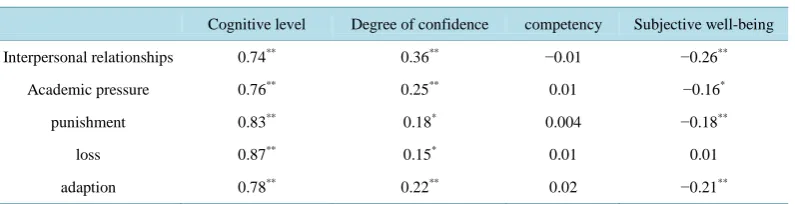
3.2. Correlation Matrix as Shown in Table 2
Correlation analysis showed that the college students’ subjective well-being and stressful life events were re-lated to each dimension is: with interpersonal relationships, learning pressure, or punishment, health and adapta-tion and property loss of loved ones show significant negative correlaadapta-tion (p < 0.01), related to the operational effectiveness of each dimension are negatively related to the competency has significantly (p < 0.01), and cogni-tive level and degree of confidence has significantly negacogni-tive correlation (p < 0.01).
3.3. The Mediation Effect of Operational Effectiveness
[image:4.595.145.483.660.711.2]Use Amos17.0, operational effectiveness as intermediary variables, analysis of the operational effectiveness in
Table 1. T test results on the stressful life events of if only-child.
If only-child M SD F p
1 51.35 16.41
9.769 0.002
2 59.92 22.12
Table 2. The variable correlation matrix.
Cognitive level Degree of confidence competency Subjective well-being
Interpersonal relationships 0.74** 0.36** −0.01 −0.26**
Academic pressure 0.76** 0.25** 0.01 −0.16*
punishment 0.83** 0.18* 0.004 −0.18**
loss 0.87** 0.15* 0.01 0.01
adaption 0.78** 0.22** 0.02 −0.21**
Note: *p < 0.05, **p < 0.01, ***p < 0.001, the same below.
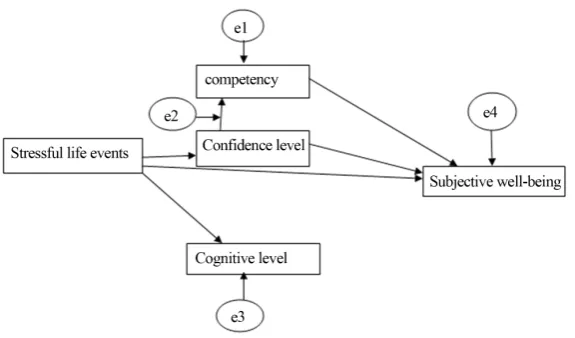
the stressful life events affect college students’ subjective well-being of intermediary role, to build the path dia-gram as shown in Figure 1.
Operational effectiveness as intermediary variables as shown in the path diagram is established. The fitting index χ2 = 0.313, df = 3, P = 0.958, χ2/df = 0.104, GFI = 0.999, CFI = 1.000, RMSEA = 0.000. By the graph, we can see that stressful life events impact on the subjective well-being of college students there are four paths: Stressful life events have a direct negative effect on subjective well-being; Stressful life events affect subjective well-being through confidence; Stressful life events affect subjective well-being through cognitive level and de-gree of confidence; Stressful life events affect subjective well-being through confidence and competence.
4. Discussion
4.1. Differences in Demographic Data Inspection
On demographic data in ANOVA and independent sample T test and found that college students’ gender, age, ethnic, professional in stressful life events, operational effectiveness and subjective well-being were there is no significant difference (p > 0.05), if only child in terms of operational effectiveness and subjective well-being and no significant difference (p > 0.05). However, if only-child has significant differences on the stressful life events (T = 2.646, p < 0.05), showing that compared with the only-child, not only children exposed to more the stress-ful life events in the life, this is a potential threat on their subjective well-being.
Because of irreversibility is the only and family environment, if we want to improve college students’ not on-ly children subjective well-being, on the one hand, to control the frequency of the stressful life events to their daily life, more important is to improve their operational effectiveness, confidence, to be exact, to make them better able to face the stressful life events, improve the subjective well-being.
4.2. The Stressful Life Events and Subjective Well-Being
College students face stressful life events from all aspects of life, society, schools and families can be the source of the stressful life events. College students are still not fully into the society, facing the stressful life events, their subjective well-being will be significantly affected. This study from the six dimensions of stressful life events to collect data, analyze the relationship between the stressful life events and college students’ subjective well-being. Results show that the interpersonal relationship, learning pressure, or punishment, health and adap-tation and property loss of loved ones are showed significant negative correlation and college students subjective well-being, that is to say, stressful life events negative predict college students’ subjective well-being (r = 0.227,
p < 0.05), The impact of stressful life events, the more, the greater the lower the subjective well-being of college students. Stressful life events is direct influence on college students’ subjective well-being, stressful life events, will reduce college students’ subjective well-being. Therefore, if we want to improve the subjective well-being of college students, should start from controling stressful life events: create good interpersonal environment, re-duce the pressure of learning, to rere-duce the punishment situation, for health and adapt to problems and or prop-erty loss psychological intervention, to help it as soon as possible out of the shadow of stressful life events, im-prove the subjective well-being.
4.3. The Mediation Role of Operational Effectiveness
Figure 1. The mediating role of operational effectiveness in the stressful life events the college students’ subjective well-being path graph.
operational effectiveness in the stressful life events and played a partial mediation role between college students’ subjective well-being. Operational effectiveness in three dimensions: the competence, self-confidence and cog-nitive level, path graph analysis shows that there are three paths about the mediation effect on how stressful life events impact on college students’ subjective well-being: stressful life events affect subjective well-being through confidence; Stressful life events affect subjective well-being through cognitive level and confidence; Stressful life events affect subjective well-being through confidence and competence.
The three mediation effect paths of operational effectiveness shows that confidence plays a crucial role. In fact, we can see from Figure 1, operational effectiveness, the other two dimensions both competence and cogni-tive level, the influence on subjeccogni-tive well-being only generate through the confidence. Stressful life events through individual cognitive level, the impact of individual level of confidence, thus influence the individual subjective well-being; Stressful life events through the individual level of confidence affect the individual com-petency, which affect the individual subjective well-being. The higher the degree of confidence, the ability to deal with stressful life events is higher, the higher the college students’ subjective well-being. Confidence in op-erational effectiveness is very important, so how to improve college students’ level of confidence is clear: im-proving college students’ confidence can promote their ability to cope with stressful life events, and once the stressful life events occur, they can deal with it well, subjective well-being remain intact. Schools shall organize middle difficulty activities, to encourage college students to participate in. From a personal point of view, stu-dents should also exercise themselves, increase the degree of confidence, in order to better cope with stressful life events, and improve the subjective well-being.
But there is limition about this research. The data all comes from questionnaires, it is sufficient to analyse the relation of the three variables, but not enough if we want these results to do some good in the real world. In the future research, maybe some field experiments are required to find out, from behavior perspective, that if we do promote operational effectiveness, college students will have higher subjective well-being.
5. Conclusions
Through questionnaire, this study collected the university students who cope with the stressful life events, effi-ciency and subjective well-being aspects of the data, by using SPSS16.0 and Amos17.0. We analyse the data and results show that:
a) Compared with the one-child, not only children face more stressful life events;
b) Correlation analysis shows that stressful life events of each dimension negatively predict college students’ subjective well-being and operational effectiveness positively predicts college students’ subjective well-being;
References
[1] Xia, F. and Ye, B.J. (2014) Stressful Life Events Affect Adolescent Tobacco Use: Basic Psychological Needs and to Respond to the Chain of Mediation Effect. Psychological Science, 5, 1385-1391.
[2] Yang, Q. and Ye, B.J. (2014) Stressful Life Events Affect Worker-Student Drug Use: Family Function and Under-standing the Role of Social Support. Journal of Psychological Science, 5, 111-116.
[3] Li, H. and Zhang, W. (2011) Teenagers Stressful Life Events, the Relationship between Operational Effectiveness and Suicidal Ideation. Journal of Special Education in China, 3.
[4] Ye, B.J., Hu, X.Y., Yang, Q. and Hu, Z.J. (2014) Understanding Social Support, Operational Effectiveness and Stress-ful Life Events Affect Adolescent Academic Achievement Mechanism. Journal of Psychological Science, 11, 342-348.
[5] Wang, J.P., Li, D.P. and Zhang, W. (2010) Families Are Financially Difficult Relationship with the Adolescent Social Adaptation: The Compensation for Operational Effectiveness, Mediation and Regulating Effect. Journal of Beijing Normal University (Social Science Edition), 4.
[6] Wen, Z.L. and Ye, B.J. (2014) Mediation Effect Analysis: Methods and Model Development. Progress in Psychologi-cal Science, 12, 731-745.
[7] Tong, J.H. (2005) Operational Effectiveness: Questionnaire Compiled and the Construction of Theoretical Model.
Journal of Psychology, 5, 413-419.