© 2017, IRJET | Impact Factor value: 6.171 | ISO 9001:2008 Certified Journal | Page 302
EFFECT OF DIFFERENT SALTS ON P(VdC-co-AN)GEL POLYMER
ELECTROLYTESFOR Li –RECHARGEABLE BATTERIES
1,2
M.Shanthi,
1,3M.Ramachandran,
1S.Rajendran,
1R.Subadevi,
1M.Sivakumar*
1
#120, Energy Materials Lab, Department of Physics, Alagappa University, Karaikudi-630003.
Tamil Nadu, India.
2
Department of Physics, Kamaraj College of Engineering and Technology, Virudhunagar- 626001,
Tamil Nadu, India.
3
Department of Physics, Arumugam Pillai Seethai Ammal College, Tiruppattur 630 211Tamil Nadu, India.
---***---Abstract -
Polymeric gel electrolytes, based on
P(VdC-co-AN) comprising of ethylene carbonate as(EC) plasticizer and different lithium salts (LiBF4, LiClO4,and LiCF3SO3) were prepared via solution casting technique. The prepared electrolyte membranes were subjected to XRD, FTIR analyses to authorize the complex formation. AC impedance studies are carried out to investigate the ionic conductivity as a function of frequency in the temperature range from 303 to 353 K. The temperature dependent ionic conductivity plots seem to obey VTF relation. The TG/DTA analysis was carried out to study the thermal stability of the samples.
Keywords:
PVdC-AN, AC impedance studies; TG/DTA, Polymer electrolytes, Ionic Conductivity1. INTRODUCTION
In search of high energy density storage batteries large number of electrolytes comprising of different cations such as cadmium, zinc, lead, cobalt and copper have been reported [1]. The majority of commercial batteries are fabricated with Li +salt solution immobilized in a variety of polymer matrices as electrolyte since lithium is the lightest of all metals. Most research work on polymer electrolyte has been made with lithium salt as ion source. As anode it well establish a contact with the electrolyte and provide good electropositive potential window. Hence, the batteries based on Li/Li + -salt facilitate a high energy density [2, 3]. The concentration of ionic charge carriers in the electrolyte depends on the dielectric constant of the polymer and the lattice energy of the salt. Salts having low lattice energy are preferred because it provides large number of ionic charge carriers by higher dissociation. Hence selection of suitable salt for the electrolyte preparation is inevitable. Accordingly, several reports are available for the significant choice the dopant salt.
Choe et al [4] reported PAN based electrolytes with LiN (CF3SO2)2, LiAsF6, LiCF3SO3 and LiPF6 in a binary mixture of plasticizers EC and PC. SubaDevi et al [5] examined comparison of three salts in blend polymer electrolyte based on Polyvinylidene fluoride (PVdF)–polyethyl methacrylate (PEMA) comprising of binary plasticizers solvents (EC and PC) (ethylene carbonate and propylene carbonate) and
lithium salts LiX (X - ClO4, BF4, CF3SO3). The LiClO4 exhibits
better performance among the other salt based on the systems studied.
In order achieve high ionic conductivity at ambient temperature the influence of different salt on ionic conductivity was analyzed in this Chapter. The appropriate ratio of Polymer, salt and plasticizers were discussed in the previous chapters. In the present work, the polymer electrolyte systems composed of poly (vinylidene chloride – co-acrylonitrile) as a host polymer with plasticizer ethylene carbonate (EC) containing different dopant salts such as lithium tetra chloride(LiClO4), lithium tetrafluoroborate (LiBF4) and lithium trifluoromethane sulfonate (LiCF3SO3) have been prepared.
Sample preparation
© 2017, IRJET | Impact Factor value: 6.171 | ISO 9001:2008 Certified Journal | Page 303 allowed to evaporate THF at room temperature for 5 h.
Then, the films were further dried in a temperature-controlled oven at 50C for 12 h to remove the traces of THF, if any.
Characterization studies
X -ray diffraction (XRD) is the widely used tool to characterize the complex formation and the phase change. The prepared samples were subjected to X-ray diffraction by X’pert PRO PANalytical diffractometer in the scanning range 2θ=10–80 using Cu Kα (wavelength λ = 1541 Å) radiation as source and operated at 40kV. Fourier transform infrared (FTIR) studies were carried with Perkin Elmer 577-IR spectrophotometer in the range of 4000-400 cm-1 in the transmittance mode. The AC impedance studies of the polymer complexes were studied in the temperatures range 303 – 353K using Keithley LCZ 3330Meter. Thermal stability of the film was characterized by TG/DTA at a heating rate of 10C per minute from the room temperature to 400C. Thermal studies were conducted on all the polymer electrolyte samples using using Perkin Elmer STA-6000 thermogravimetry/differential thermal analysis (TG/ DTA) analyzer from STIC Cochin. The thermogravimetric analysis (TGA) and DTA curves were recorded in nitrogen atmosphere from room temperature to 800oC with heating rate 10oC/min.
Results and discussion
[image:2.595.346.521.242.461.2]X-ray diffraction studies
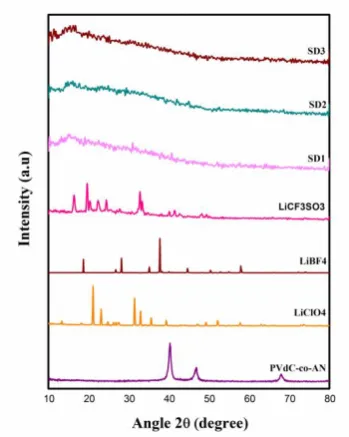
Figure 1 shows the X-ray diffraction pattern for pure PVdC-co-AN, LiClO4, LiBF4, LiCF3SO3, and their complexes of PVdC-co-AN(92)-EC(80)-LiX(8) where (X= ClO4-, BF4- , CF3SO3-, ). The patterns of pure LiClO4 , LiBF4, and LiCF3SO3 show several diffraction peaks due to the crystalline nature of the compounds.
From the figure 1, the x-ray diffraction pattern of polymer PVdC-co-AN shows peaks at 2θ = 40.25, 46.76, 67.94 which indicates the crystalline morphology of the polymer. These peaks completely disappeared in all the complexes due to the addition of plasticizer ethylene carbonate. The inclusion of plasticizer markedly decreases the crystallinity of the polymer and enhances the amorphous phase which influences the segmental mobility of the polymer chain. As a result the ionic conductivity increases. The peaks of pure LiBF4 at 2θ = 27, 38, 44 and 57and peaks of pure LiClO4 at 2θ = 18.40, 23.2, 27.5 and 32.99 and the peaks pertaining to pure LiCF3SO3 at 2θ = 16.42, 19.89, 22.44
and 33.05 are appear in figure 1. These characteristic peaks corresponding to the lithium salts are absent in the prepared complexes. This shows that the lithium salts establish complexation in the polymer matrix. The X-ray diffraction studies confirm the complex formation between the polymer, plasticizer and the different anion salts.
Fig-1: XRD pattern of pure and their Complexes
FT-IR Studies
Figure-2: FTIR spectra of pure and the prepared complexes.
[image:2.595.340.527.533.676.2]© 2017, IRJET | Impact Factor value: 6.171 | ISO 9001:2008 Certified Journal | Page 304 group in the host polymer matrix and exhibits complexation.
This type of interaction will influence the local structure of the polymer and certain infrared active modes of vibration get altered which will be the evidence of complex formation. Figure 2 shows the infrared spectra of PVdC-co-AN, LiClO4, LiBF4, LiCF3SO3, and their complexes. The C=CH2 symmetric stretching at 2975cm-1[ 6,7] of the polymer PVdC-co-AN is shifted to 2958 cm-1, 2973cm-1 and 2966 cm-1 in the complexes. In pure spectra of PVdC-co-AN the vibrational band at 2245 cm−1 and 1642 cm−1 corresponds to the stretching vibration of nitrile group (C≡N)[8]. The intensity of this vibrational band at 2245 cm−1 increased in all the complexes comprising of three different salts. This indicates the strong interaction of cation of the salts with nitrile group. In acrylonitrile based electrolytes, the Li+ ions associate with the nitrogen atoms of the nitrile group since the nitrile is a strong electron dopant [9]. The C=O stretching at 1775 cm -1[6] and CH2 wagging at 1357 cm-1 [6,7] is shifted to 1920 cm-1,1920 cm-1 and 1912 cm-1 and 1405cm-1,1413 cm-1and 1397 cm-1 in the complexes. Thus the FTIR studies ensure the ionic co-ordination of the polymer and their complexes.
Conductivity measurements
Impedance spectroscopy is an essential characterization study in the electrolyte fabrication and investigation. The ionic conductivity of prepared samples comprising of different lithium salts LiClO4, LiBF4, LiCF3SO3 were calculated from = l/RbA, where ‘l’ and ‘A’ represents the thickness and area of the film. Rb is the bulk resistance of the gel electrolyte obtained from complex impedance measurement [10].
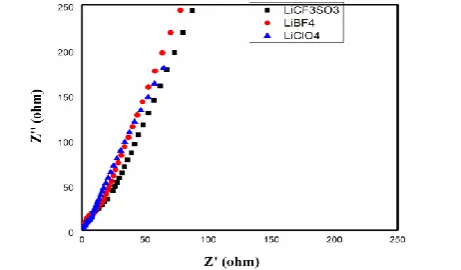
Fig - 3(a) Impedance spectra of PVdC-co-AN (5)-EC (80)-LiX(8) where (X= ClO4-, BF4- CF3SO3-, ).,
Table-1: Ionic conductivity values of PVdC-co-AN (92wt.%) – EC (80wt.%) – LiX (8 wt.%) (Where X = ClO4- ,
BF-4 and CF3SO3-) polymer electrolyte systems
Fig - 3(b) Arrhenius plot of PVdC-co-AN (5)-EC(67)-LiX(8) where (X= ClO4-, BF4- CF3SO3-, ).,
Fig.3 (a) shows the room temperature complex impedance spectra of PVdC-co-AN (92)-- EC (80)-LiX (8) wt % (where X= CF3SO3-, ClO4-, BF4-) polymer electrolyte system. In general, two semicircles should appear in impedance spectrum for a symmetric cell, one at high frequency range corresponding to bulk electrolyte impedance and the other at lower frequency range corresponding to the interfacial impedance [11]. In figure 3a, instead of the high frequency semicircle, a spike appears in the impedance plot. The absence of semicircles at high frequency region indicates that the conductivity is mainly due to ions [12-14]. The conductivities of the prepared samples are given in Table 1. The conductivity values increases with the increase of temperature which can be correlated by free volume model [15]. According to it, the polymer expands and generates free volume which supports the movement of solvated ions along with the polymer segments.
[image:3.595.307.557.155.246.2] [image:3.595.322.547.304.447.2] [image:3.595.46.277.534.669.2]© 2017, IRJET | Impact Factor value: 6.171 | ISO 9001:2008 Certified Journal | Page 305 D = gdv exp(-γV*)/ Vf , where g≈ 1/6, d is the distance
through which the particle are transported (effectively a molecular diameter), v is the velocity of the particle (proportional to T1/2), γ is a factor to allow for overlap of free volume, V* is the critical volume required for migration of the particle, and Vf is the free volume of the medium.
This theory based on the concept that transport of the particles depends upon the formation of holes large enough for diffusive displacement. Hole formation is caused by the statistical redistribution of the free volume and its probability is given by the exponential term of the diffusion coefficient term [11].
9
Figure 3b illustrate the temperature dependent conductivity plots of PVdC-co-AN (92) -- EC (80)-LiX (8)wt % (where X= CF3SO3-, ClO4-, BF4-). The conductivity plots of the electrolytes with different anion salts obey Arrhenius relation.
σ = σo exp(-Ea /KT)
Where σ is the ionic conductivity, Ea is the activation
energy associated with conduction,
K is Boltzmann constant and σo the pre-exponential term.
The conductivity values of PVdC-co-AN (92) - EC (80)-LiX (8) wt % (where X= CF3SO3-, ClO4-, BF4-) polymer electrolyte system and the corresponding activation energy values from the Arrhenius plots are tabulated in Table. 1. The data of table 1, clearly show the conductivity values and the activation energies are good in agreement. The electrolyte system comprising of LiClO4 which have lowest activation energy shows highest conductivity 6.726 x 10⁻³ S/cm. From the Table. 1 the conductivity values of the electrolyte containing LiCF3SO3 salt is lower than those of LiClO4 and LiBF4 electrolytes. The low conductivity may be due the larger anionic radius of LiCF3SO3 ion. The discrepancy in the conductivity of LiCF3SO3 than LiClO4 is presumably due to the diffusion rate of ions which inturn depends on the size of the ion. As mentioned earlier the degree of dissociation of the salts plays vital in the carrier concentration. A similar report has been suggested by Tobhishima and Yamaji[16].
Thermal Analysis
For practical application of polymer electrolytes in batteries not only the high conductivity but also thermal stability should be considered. In order to investigate the thermal stability of PVdC-co-AN polymer electrolytes with different salt content TG/DTA analysis was employed. The vinylidene chloride polymers possess high gas barrier property, shows high resistance to oxidation and permeation
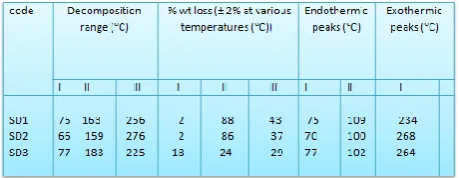
[image:4.595.321.551.252.341.2]of molecules. Though they are highly durable it stays in thermally unstable state. When subjected to heat above 120C it undergoes degradative dehydrochlorination and significant deterioration in the highly ordered structure [17]. TG/DTA results of the prepared samples plasticized PVdC-co-AN electrolytes with different salts are displayed in Table-2.
Table -2: TG/DTA results of the prepared samples
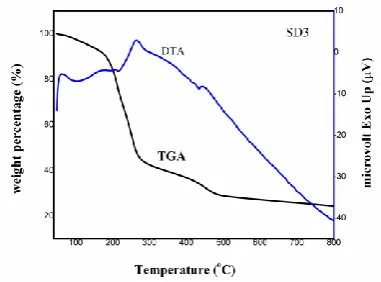
DTA and TG curves of plasticized PVdC-co-AN electrolytes with different salts are shown in Figure 4. It has been observed that all electrolytes undergo two step degradation. Fig 4 (a) shows the TG/DTA traces of PVdC-co-AN (92) -EC (80)-LiClO4 (8wt%) polymer electrolyte. It shows the initial weight loss of upto 3% around 75C may be due to the evaporation of residual solvent or moisture content in the sample. The endothermic peak observed around 98C can be attributed to the evaporation water. The apparent weight loss is observed in the temperature range of 160–256C is mainly due to the degradation of polymer, lithium salt, and plasticizer. The TG/DTA of the sample with LiClO4 as salt is found to be thermally stable up to 256C.
© 2017, IRJET | Impact Factor value: 6.171 | ISO 9001:2008 Certified Journal | Page 306 Fig - 4(a) : TG/DTA of PVdC-co-AN(5)-EC(80)-LiClO4(8)
Fig - 4(b): TG/DTA of PVdC-co-AN (5)-EC(80)-LiBF4(8)
Fig-4(c): TG/DTA of PVdC-co-AN (92)-EC (80) - LiCF3SO3(8).
The TG/DTA curve of PVdC-co-AN (92)- EC(80)- LiCF3SO3(8wt%) polymer electrolyte presented in the figure
4(c). It shows the initial weight loss of upto 3% around 77C may be due to the evaporation of residual solvent or moisture content in the sample. The film with LiCF3SO3 shows second step degradation in the temperature range 183-275C with weight loss of 44%. It is due to the degradation of polymer, salt and plasticizer beyond 275C.
The exothermic peak around 256C, 268C and 264C and in DTA thermogram of the electrolytes indicates the decomposition of the plasticizer ethylene carbonate since its boiling point is 260C. There is no appreciable loss in weight is not observed beyond 275C in the TG of all the three electrolytes. The TG and DTA analysis infers the safe application of all three the electrolytes in lithium secondary batteries and can be operated up to 275C. In particular the film with LiCF3SO3 is thermally more stable than the other two samples. However it is concluded that the electrolyte comprising of LiClO4 is superior to the other two on the basis of conductivity and thermal stability.
3. CONCLUSIONS
Electrolyte membranes composed of poly (vinylidene chloride –co-acrylonitrile) as a host polymer with plasticizer ethylene carbonate (EC) containing different dopant salts such as lithium tetra chloride(LiClO4), lithium tetra fluoro borate and lithium trifluoro methanesulfonate (LiCF3SO3) have been prepared. The complex formation between the polymer, plasticizer and the different salts were ascertained by XRD and FTIR studies. Maximum conductivity (6.726x10⁻³ S/cm) at room temperature with good mechanical stability has been observed for a PVdC-co-AN (92)-EC (80)-LiClO4(8) system. The thermal stability of this polymer electrolyte system is up to 268C is confirmed by TG/DTA analysis.The membrane PVdC-co-AN(92)-EC(80)-LiClO4(8) can be used as an electrolyte in lithium batteries and other electrochemical devices
REFERENCES
[1] M. Gray, Solid Polymer Electrolytes, VCH, New York, Weinheim, Cambridge
[2] F. M. Gray, Polymer Electrolytes , RSC Material Monographs, London, UK, 1997.
[image:5.595.86.279.159.313.2] [image:5.595.90.277.360.490.2] [image:5.595.84.275.541.682.2]© 2017, IRJET | Impact Factor value: 6.171 | ISO 9001:2008 Certified Journal | Page 307 [4] Choe HS, Carroll BG, Pasquarillo DM, Abraham K.M.
Characterization of some poly(acrylonitrile)- based electrolytes. Chem Mater 1997;9:369
[5] R. Subadevi, M. Sivakumar, S. Rajendran, H.-C. Wu, N.-L. Wu, Journal of Applied Polymer Science, 119 (2011) 1–6.
[6] M.L. Oshea, C. Morterra, M.J.D. Low, Mater. Chem. Phys. 27 (1991) 155–179.
[7] Hatice Bodug, Olgun Guven, Radiat Phys, Radiat. Phys. Chem. 80 (2011) 153–158
[8] S. Krimm, C.Y. Liang, J. Polym. Sci. 22 (1956) 95–112.
[9] M.L. Oshea, C. Morterra, M.J.D. Low, Mater. Chem. Phys. 27 (1991) 155–179.
[10] M. Watanabe, J. Appl. Phys. 57 (1) (1995) 123.
[11] M. Watanabe, N. Ogata. in: J.R. MacCullum, C.A. Vincent (Eds), Polymer electrolyte review, Vol.1, Elsevier, New York, 1987.
[12] J .Y. Song, Y.Y. Wang, C.C. Wan, J.Electrochem.Soc 145 (1998) 1207.
[13] K.M. Abraham, M. Alamgir, D.K. Hoffman, J.Electrochem. Soc 142 (1995) 683.
[14] G.B. Appetecchi, F. Croce, A. De Paolis, B. Scrosati, J.Electroanal.chem 463 (1999) 248.
[15] Miyamoto, T.; Shibayana, K. J Appl Phys 1973, 44, 5372.
[16] S.Tobishima, A.Yamaji, Electrochim.Acta 29(1984)267