© 2017, IRJET | Impact Factor value: 6.171 | ISO 9001:2008 Certified Journal
| Page 579
A Review on Automatic Target Recognition and Detection Image
Preprocessing Approaches for SAR Images
Ms. Ritu Patil
1, Mr. Sandeep Dubey
21,2
Department of Electronics and Communication, RGPM, Bhopal
---***---
ABSTRACT- Target detection is that the front-end stage inany automatic target recognition system for artificial aperture microwave radar (SAR) imagery (SAR-ATR). The efficaciousness of the detector directly impacts the succeeding stages within the SAR-ATR process chain. There are various strategies according within the literature for implementing the detector. We provide associate umbrella underneath that the varied analysis activities within the field are loosely probed and taxonomies. First, a taxonomy for the varied detection strategies is projected. Finally, a unique discussion is given, whereby the problems lined embrace suitableness of SAR knowledge models, understanding the increasing SAR knowledge models. We tend to build a contribution toward sanctioning associate objective style and implementation for target detection.
Keywords: synthetic aperture radar; target detection; prescreened; automatic target recognition; Single-feature-based methods; constant false alarm rate; multi-features based methods; expert system-Oriented methods.
1. INTRODUCTION
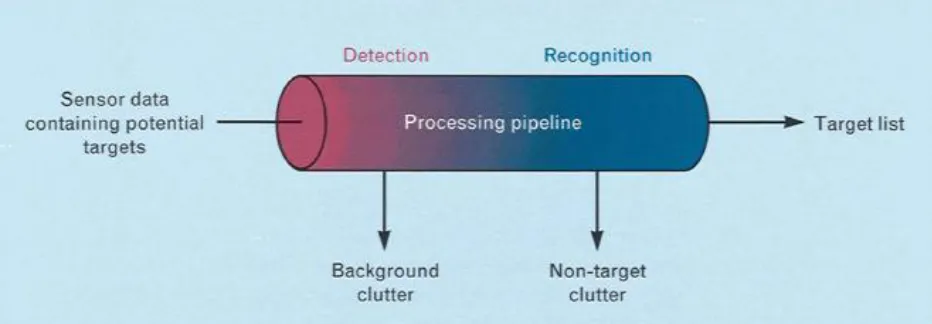
Synthetic aperture radar (SAR) offers distinctive active remote sensing capabilities for each military and civilian application. Target, clutter, and noise are 3 terms of military origins related to automatic target recognition (ATR), and their definition depends on the applying of interest [1,2].Within the case of SAR imaging, target refers to the object(s) of interest within the imaged scene. Clutter refers to manmade (building, vehicles, etc.) and/or natural objects (trees, topological options, etc.) that tend to dominate the imaged scene. Noise refers to imperfections within the SAR image that are a results of electronic noise within the SAR detector, yet as process inaccuracies introduced by the SAR signal processor. The overall structure of associate end-to-end ATR system for SAR imaging (SAR-ATR), as reportable within the literature, is delineated in Fig. 1. To account for the prohibitory amounts of process touching on the input SAR imaging, the strategy is to divide and conquer. Consequently, the SAR-ATR process is split into 3 distinctive stages: detector (also referred to as prescreened), low-level classifier (LLC,
© 2017, IRJET | Impact Factor value: 6.171 | ISO 9001:2008 Certified Journal
| Page 580
Figure 1 The Basic Structure of SAR-ATR end to end SystemII AUTOMATIC TARGET RECONITION (ATR) IN
SAR IMAGES
ATR deals with the data output from one (or more) sensor(s) geared toward a scene of interest. It typically refers to the utilization of pc process capabilities to infer the categories of the targets within the sensory knowledge, and to (optionally) characterize some attributes of interest like articulation, orientation, occlusion, sub-class then on, while not human intervention. The term ATR originated within the military within the early 1980s underneath the Low Altitude Navigation and Targeting Infrared for Night (LANTRIN) program. Today, ATR technology is very important in each military and civilian applications. The ATR downside may be a part of the overall broad downside of machine vision; particularly, however will computers be designed to try to what humans do with efficiency and naturally? Target, litter and noise area unit 3
[image:2.612.73.539.518.680.2]terms of military origins related to ATR and are dependent on the appliance of interest. Within the case of SAR representational process, target refers to object(s) of interest within the imaged scene. Clutter refers to either manmade (e.g., building, vehicles, etc.) or natural objects (e.g., trees, topological options, etc.) that tend to dominate the imaged scene. Noise refers to imperfections within the SAR image that are results of electronic noise within the SAR sensing element similarly as machine inaccuracies introduced by the SAR signal processor. Within the literature, there's a spectrum of ATR issues starting from classifying a pre-known signature in an exceedingly well-characterized litter to recognizing the supply of signature that varies greatly with cause and state, and is found in an exceedingly extremely advanced and possibly occluded scene.
© 2017, IRJET | Impact Factor value: 6.171 | ISO 9001:2008 Certified Journal
| Page 581
Simple detection algorithms area unit applied to any or allthe sensing element knowledge to isolate tiny parts that may contain targets. A lot of advanced recognition algorithms then method the chosen parts of the information to reject non-target clutter and classify targets. Ideally, all targets of interest withstand the pipeline and area unit enclosed within the output target list.
III RECENT ART OF STATES
[1] In 2016 IEEE Transaction Biswajeet Pradhan et al. [5] proposed an article. In In which they planned a brand new semiautomatic Detection Mapping of Flood Extent from Terra SAR-X Satellite Image victimization Rule-Based Classification and Taguchi optimization Techniques. During this paper planned, Floods are among the foremost damaging natural disasters worldwide. Overflowing disaster management programs, flood mapping is associate initial step. This analysis proposes associate economical methodology to acknowledge and map flooded areas by using Terra SAR-X mental imagery. First, a Terra SAR-X satellite image was captured throughout a flood event in Kuala Terengganu, Malaysia, to map the inundated areas. Multispectral Landsat imagery was then wont to find water bodies before the flooding. In synthetic aperture radar (SAR) imagery, the water bodies and flood locations seem in black; therefore, each objects were classified mutually. To beat this downside, the category of the water bodies was extracted from the Landsat image so ablated from that extracted from the Terra SAR-X image. The remaining water bodies described the flooded locations. Object-oriented classification and Taguchi technique were enforced for each pictures. The Landsat pictures were categorized into 3 categories, namely, urban, vegetation, and water bodies. Against this, solely water bodies were extracted from the Terra SAR-X image. The classification results were then evaluated employing a confusion matrix. To look at the potency of the planned technique, unvarying self-organizing information analysis technique (ISODATA) classification technique was applied on Terra SAR-X once using the segmentation method throughout object-oriented–rule-based technique, and also the results were compared. The general accuracy values of the classified maps derived from Terra SAR-X victimization the rule-based technique and Landsat imagery were 86.18 and 93.04, respectively. Consequently, the flooded locations were recognized and mapped by subtracting the 2 categories of water bodies from these pictures. The no inheritable overall accuracy for Terra SAR-X victimization ISODATA was significantly low at solely 57.98. This analysis combined the ways and also the optimization technique used as associate innovative flood detection
application. The undefeated production of a reliable and correct flood inventory map confirmed the potency of the methodology. Therefore, the planned technique will assist researchers and planners in implementing and expediting flood inventory mapping.
[2] In 2016 IEEE SinongQuan et al. [6] proposed an article. In this paper proposed, change detection may be a method of characteristic changes within the state of objects between the references and take a look at pictures. This letter presents a target prescreening methodology that employs the amendment detection technique for automatic target recognition in synthetic aperture microwave radar (SAR) images. First, four translated versions of an inventive SAR image are generated, and therefore the corresponding four chance magnitude relation pictures are computed. Then, a sturdy threshold springs from the magnitude relation of the bar graph at 2 adjacent gray-level values of the chance magnitude relation pictures. Finally, the brink is applied to perform the prescreening. The planned methodology implements the procedure with none previous information and overcomes the weak ability of ancient algorithms. 2 totally different real X-band mobile SAR pictures no inheritable over Beijing are accustomed quantitatively and qualitatively demonstrate the effectiveness of the planned methodology.
look-© 2017, IRJET | Impact Factor value: 6.171 | ISO 9001:2008 Certified Journal
| Page 582
alikes. Polari metric options like geometric intensity,co-polarization power magnitude relation, and span proved to be additional discriminative than different Polari metric and ancient options.
[4] In 2016 IEEE Shigang Wang et al.[8] presented an article. In this proposed article, the increasing resolution of synthetic aperture radar (SAR) pictures makes ship targets seem to be a lot of structured and formed and however contain several weak echoes in their resolution cells, that brings nice challenges for correct scene understanding. During this paper, inspired by the multilayer selective cognition property of the human sensory system, we advance a brand new hierarchic prominence filtering technique for quick and correct ship detection in high-resolution SAR pictures. The prominence of targets is 1st explored to develop a random-forest-based hierarchical sparse model (HSM) for the choice of candidate target regions. Then, a dynamic constant-false-alarm-rate-based contour saliency model (CSM) is planned to step by step filter the false alarms from candidate regions and extract the target outlines for correct detection. Owing to a speedy capture of regions of interest within the HSM and dynamic warning removal within the CSM, our technique will build economical ship detection in high-resolution SAR pictures doable by operating in an exceedingly coarse-to-fine manner. Finally, the planned ship detector is tested on high-resolution SAR information collected from Terra SAR and RADARSAT satellites, showing vital agreement with the bottom truth. It conjointly compared with alternative classical ship detectors, in terms of each speed and accuracy, and shows superior performance, significantly in complicated scenes.
[5] In 2016 IEEE Song Tu et al. [9] proposed an article. In this proposed article, the active contour model (ACM) is wide utilized in target detection of optical and medical pictures, however increasing speckle noise for the most part interferes with its use in synthetic aperture microwave radar (SAR) pictures. To beat this problem, a region- and edge-based convex ACM with high potency is projected for target detection in small-scale SAR pictures. Then, a unique detection formula, which mixes the benefits of a multiscale strikingness detection methodology and therefore the projected high-efficiency ACM, is bestowed to handle a large-scale and high-resolution SAR image mechanically. Target detection experiments in real and simulated SAR pictures show that the projected strategies crush classical ACMs and therefore the common two-parameter constant warning rate detector in terms of potency and accuracy.
[6] In 2015 IEEE David P. Williams et al. [10] proposed an article. In this proposed article, a replacement unsupervised formula for the detection of underwater targets in synthetic aperture sonar (SAS) imaging is projected. The strategy capitalizes on the high-quality SAS imaging whose high resolution permits several pixels on track. One notably novel element of the strategy conjointly detects sand ripples and estimates their orientation. The formula is created quickly by using a cascaded design and by exploiting integral-image representations. As a result, the approach makes near-real-time detection of proud targets in measuring device information aboard an autonomous underwater vehicle (AUV) possible. No coaching information are needed as a result of the projected technique is adaptively tailored to the environmental characteristics of the perceived information that are collected in place. To validate and assess the performance of the projected detection formula, a large-scale study of SAS pictures containing varied mine-like targets is undertaken. The information were collected with the MUSCLE AUV throughout six massive ocean experiments, conducted between 2008 and 2012, in numerous geographical locations with numerous environmental conditions. The analysis examines detection performance as an operate of target kind, aspect, range, image quality, bed atmosphere, and geographical web site. To our information, this study—based on nearly thirty 000 SAS pictures together covering around one hundred sixty kilometer of bed, and involving over 1100 target detection opportunities—represents the foremost in depth such systematic, quantitative assessment of target detection performance with SAS information to this point. The analysis reveals the variables that have the most important impact on track detection performance, namely, image quality and environmental conditions on the seafloor. Ways that to take advantage of the results for adaptive AUV surveys exploitation through-the-sensor information also are advised.
© 2017, IRJET | Impact Factor value: 6.171 | ISO 9001:2008 Certified Journal
| Page 583
estimate some parameters for OBCD; 2) account theunchanged space mask to eliminate the areas while not changes, reducing error amplification development of OBCD; and 3) getting the ultimate modification mask by means that of OBCD methodology. Taking flood detection with multi temporal SAR information as associate example, we have a tendency to compare the new theme with some classical strategies, as well as PBCD, OBCD, and HCD methodology and supervised manual trial-and-error procedure (MTEP). The experimental results of flood detection showed that the new theme was economical and strong, and its accuracy generally will even exceed MTEP.
[8] In 2015 Springer Zongjie Cao et al. [12] proposed an article. In this proposed article,since the standard CFAR rule isn't appropriate for high-resolution target detection of artificial aperture microwave radar (SAR) pictures, a replacement two-stage target detection technique supported variance weighted data entropy is projected during this paper. On the primary stage, the regions of interest (ROIs) in SAR image is extracted supported the variance weighted data entropy (WIE), that has been evidenced to be an easy and effective quantitative description index for the complicated degree of infrared image background. Considering that SAR pictures area unit non-uniform, AN experiment is conducted ahead, during
[image:5.612.42.566.429.731.2]which the worth of the variance WIE from a true SAR image in 3 area unitas with vital completely different uniform levels are tested and compared. The results preliminarily verified that the variance WIE is ready to live the complicated degree of SAR pictures. After that, so as to form the segmentation economical, the rough ROIs area unit more processed with a series of strategies that modify ROIs into regular items. On the second stage, for every of the ROIs, a variation segmentation rule supported the Split-Bregman rule is adopted to extract the target. In our experiment, the projected technique is tested on 2 sorts of SAR pictures, and its effectiveness is with success incontestable.
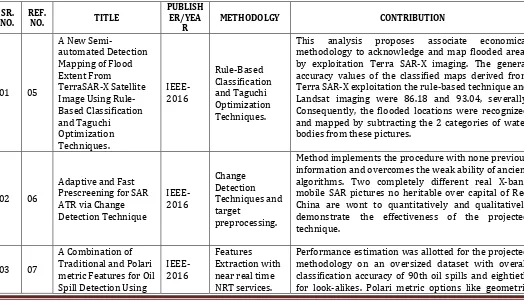
Table 1 Taxonomies of different literature methodologies and their publication.
SR.
NO. REF. NO. TITLE
PUBLISH ER/YEA
R METHODOLGY CONTRIBUTION
01 05
A New
Semi-automated Detection Mapping of Flood Extent From
TerraSAR-X Satellite Image Using Rule-Based Classification and Taguchi Optimization Techniques.
IEEE-2016
Rule-Based Classification and Taguchi Optimization Techniques.
This analysis proposes associate economical methodology to acknowledge and map flooded areas by exploitation Terra SAR-X imaging. The general accuracy values of the classified maps derived from Terra SAR-X exploitation the rule-based technique and Landsat imaging were 86.18 and 93.04, severally. Consequently, the flooded locations were recognized and mapped by subtracting the 2 categories of water bodies from these pictures.
02 06
Adaptive and Fast Prescreening for SAR ATR via Change Detection Technique
IEEE-2016
Change Detection Techniques and target
preprocessing.
Method implements the procedure with none previous information and overcomes the weak ability of ancient algorithms. Two completely different real X-band mobile SAR pictures no heritable over capital of Red China are wont to quantitatively and qualitatively demonstrate the effectiveness of the projected technique.
03 07
A Combination of Traditional and Polari metric Features for Oil Spill Detection Using
IEEE-2016
Features Extraction with near real time NRT services.
© 2017, IRJET | Impact Factor value: 6.171 | ISO 9001:2008 Certified Journal
| Page 584
TerraSAR-X. intensity, co polarization, Power quantitative relation,
span verified to be additional discriminative than alternative Polari metric and ancient options.
04 08
New Hierarchical Saliency Filtering for Fast Ship Detection in High-Resolution SAR Images
IEEE-2016
Dynamic contour model, hierarchical saliency filtering (HSF), random forest,
The projected ship detector is tested on high-resolution SAR knowledge collected from Terra SAR and RADARSAT satellites, showing vital agreement with the bottom truth. It additionally compared with alternative classical ship detectors, in terms of each speed and accuracy, and shows superior performance, notably in advanced scenes.
05 09
Fast and Accurate Target Detection Based on Multiscale Saliency and Active Contour Model for High-Resolution SAR Images
IEEE-2016
Active contour model (ACM), convex, large scale,
Split Bregman.
Target detection experiments in real and simulated SAR pictures show that the projected strategies outgo classical ACMs and therefore the widespread two-parameter constant warning rate detector in terms of potency and accuracy.
06 10
Fast Target Detection in Synthetic Aperture Sonar Imagery: A New Algorithm and Large-ScalePerformance Analysis
IEEE-2015
Autonomous underwater vehicle (AUV), detection, mine countermeasure s (MCM).
The analysis reveals the variables that have the most important impact not off course detection
performance, namely, image quality and
environmental conditions on the seafloor. Ways in which to use the results for adaptation AUV surveys exploitation through-the-sensor knowledge are advised.
07 11
Improving Pixel-Based Change Detection Accuracy Using an Object-Based Approach in Multi temporal SAR Flood Images
IEEE-2015
Pixel-based changedetectio n (PBCD), the object-based change detection (OBCD), and the hybrid change detection (HCD).
a new unsupervised algorithm-level fusion theme (UAFS-HCD) during this
paper to boost the accuracy of PBCD exploitation spatial context data through:
1) obtaining the preliminary modification mask with PBCD initially to estimate some parameters for OBCD; 2) derivation the unchanged space mask to eliminate the areas while not changes, reducing error amplification development of OBCD; and
3) Getting the ultimate modification mask by means that of OBCD technique. Taking flood detection with multi temporal SAR knowledge as associate degree example,
08 12
Fast target detection method for high-resolution SAR images based on variance weighted information entropy
SPRING ER-2015
Variance weighted information entropy, Variational segmentation
© 2017, IRJET | Impact Factor value: 6.171 | ISO 9001:2008 Certified Journal
| Page 585
IV CONCLUSION
SAR may be a microwave radar imaging technique provides necessary information relating to earth’s surface or undersea. SAR is a full of life, day/night and unrestricted remote sensing system. During this paper has studied varied image process and object detection techniques that are helpful in ATR and detection of object of SAR image. The steps concerned in image process and ATR, object detection in SAR image embrace pre-processing, segmentation, feature extraction and classification. Varied detection approach for SAR image are conferred. For each parts, image process and ATR technique with capability to reinforce performance in artificial aperture microwave radar systems were explained, and samples of no-hit or instructive ways from past got.
REFERENCES
[1] DebabrataSamanta, GoutamSanyal, “SAR image
Classification using Fuzzy C-Means” International Journal of Advances in Engineering & Technology, Sept 2012, ISSN: 2231-1963.
[2] KorayKayabol,JosianeZerubia, “Unsupervised
amplitude and texture classification of SAR images with multinomial latent model” IEEE Transactions on Image Processing, Institute of Electrical and Electronics Engineers (IEEE), 2013, 22 (2), pp.561-572.
[3] Rupinderpal Kaur, Rajneet Kaur “Survey of De-noising
Methods Using Filters and Fast Wavelet Transform” International Journal of Advanced Research in Computer Science and Software Engineering, Volume 3, Issue 2, February 2013 ISSN: 2277 128X.
[4] MALLAT, S., S. ZHONG, Characterization of signals
from multiscale edges, IEEE Trans. Pattern Anal. Machine Intelligence, 1992, 14(7), 710–732.
[5] Biswajeet Pradhan, MahyatShafapourTehrany, and
Mustafa NeamahJebur, “A New Semi-automated Detection Mapping of Flood Extent From TerraSAR-X Satellite Image Using Rule-Based Classification and
Taguchi Optimization Techniques”, IEEE
TRANSACTIONS ON GEOSCIENCE AND REMOTE SENSING 2016.
[6] SinongQuan, BoliXiong, Siqian Zhang, Meiting Yu, and
GangyaoKuang, “Adaptive and Fast Prescreening for SAR ATR via Change Detection Technique”, IEEE
TRANSACTIONS ON GEOSCIENCE AND REMOTE SENSING 2016.
[7] Suman Singha, Rudolf Ressel, Domenico Velotto, and