Fabric Defect Detection in Handlooms Cottage Silk
Industries using Image Processing Techniques
R.S.Sabeenian,
PhD. Professor – ECE & CentreHead – SONA SIPRO, Advanced Research Centre, Sona College of Technology, Salem, Tamil Nadu, INDIA
M.E. Paramasivam
Assistant Professor – ECE & Team Member Sona SIPRO Advanced Research Centre, Sona College of Technology, Salem, Tamil Nadu, INDIA.
P.M.Dinesh
Assistant Professor – ECE & Team Member Sona SIPRO Advanced Research Centre, Sona College of Technology, Salem, Tamil Nadu, INDIA.
ABSTRACT
Detection of defect on finished fabrics and their classification based on their appearance plays a vital role in inspection of both hand-woven and machine woven fabrics. Generally the defect detection process is carried out by making use of the manual effort, during which some of fabric defects are very small and undistinguishable and can be identified only by monitoring the variation in the intensity falling on the fabric. Till date, most of the fabric industries in India carry out the process of defect detection by making use of a very skilled labor. An automated system that could detect defects and identify them based on their physical appearance would naturally enhance the product quality and result in improved productivity to meet both customer demands and reduce the costs associated with off-quality.
This paper focuses on developing algorithms to check if a given fabric contains any one of the defects listed out in [1] and if so, what kind of defect and the location of the defect within the analyzed area. The next sections of the paper deal with the defect detection process using Multi Resolution Combined Statistical and Spatial Frequency (MRCSF), Markov Random Field Matrix method (MRFM), Gray Level Weighted Matrix (GLWM) and Gray Level Co-occurrence Matrix (GLCM).
General Terms
Multi Resolution Combined Statistical and Spatial Frequency (MRCSF), Markov Random Field Matrix method (MRFM), Gray Level Weighted Matrix (GLWM) and Gray Level Co-occurrence Matrix (GLCM)
Keywords
Defect Detection in Silk Fabrics, Pattern Recognition,
1.
INTRODUCTION
The textile industry, as with any industry today, is very much concerned with quality. Any industry would be keen on producing the highest quality goods in the shortest amount of time possible. Fabric faults or defects constitute nearly 85% of the defects found by the garment industry. Manufacturers recover only 45 to 65 % of their profits from seconds or off-quality goods. It is imperative, therefore, to detect, identify, and prevent these defects from recurring. Fabric inspection in Indian fabric industry is done by a highly skilled manual fabric inspector, wherein only about 70% of the defects are being detected and the remaining 30% is lost due to human errors [1]. There is a grooving realization and need for an
automated woven fabric inspection system in the textile industry [2].
Handlooms constitute the rich cultural heritage of India. In India handlooms weaving is an economic activity that provides livelihood to many people. The high caliber of art and craft present in Indian handlooms makes it a potential sector for the so as to occupy the topmost section in the Indian market both for the local as well as the international case. The sector accounts for 13% of the total cloth produced in the country. The major advantage in handlooms lies in the introducing innovative designs, which cannot be replicated by the most sophisticated weaving machines. Despite the Government of India taking many steps by providing financial assistance and implementation of various development and welfare schemes, the number of handlooms is continuously reducing all over the country. The reasons are manifold. Very low profit for weavers, high rise in yarn prices, age-old technologies, unorganized production system, lower productivity due to complete human intervention, very low working capital, weak marketing link, overall stagnation of production and sales and, above all, competition from power-loom are the factors forcing the handpower-looms sector difficult to survive[3].
2.
HANDLOOMS FABRIC
PRODUCTION PROCESS MAP
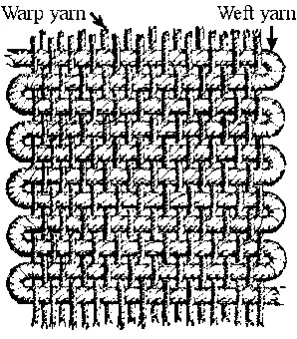
A highly skilled art in which two sets of threads (from now called as Yarn), one called as the Warp and the other called as Weft (Weft is an old English word meaning "that which is woven") are interlaced to form a web appearance, which in turn gives a cloth. The warp threads runs along the length of any given cloth which the weft runs along the breadth. A device that holds the warp while the filling thread (weft) through them is being placed is called as the loom.
[image:2.595.93.242.278.448.2]The process of filling interlaced threads (i.e.) interlacing the weft and warp is known as the weaving. Majority of woven products created are among any one of the three possible weaves viz. plain weave, satin weave, and twill. The fabric can be either plain (in one colour or a simple pattern), or with decorative or artistic designs, including tapestries. If the warp of the weft is tie-dyed before the weave then the process of weaving is called IKAT[2].
Fig. 1 Warp and weft in plain weaving
The process of hand-weaving, along with hand spinning, remains a popular craft in India. But in the West, most of the commercial fabrics are woven on computer-controlled Jacquard looms. Dobby looms were used for weaving simpler fabrics, while complex patterns were the Jacquard owing towards its harness adaptation. Regardless of the complexity of the design a Jacquard loom, with its Jacquard weaving process, makes it more economical for mills to use them to weave all of their fabrics [2-4].
Generally, as any product in the market claims its quality, fabrics too have their own quality. The better the quality; on the customer perspective, the producer can expect more sales and on proprietor perspective, can fix a higher price. The manufacturer would always prefer to produce the highest quality goods within the shortest span of time. Till date, the process of identification, classification and correction of defects produced in a fabric; be it a handlooms or machine weaved, is done manually. Humans are prone to errors; and more over the process involves a huge amount of caution during the process. A statistic proves that even the highest fabric inspector is capable of identifying only up-to 70% of defects, whereas 30% remains unidentified, till it reaches the end-user. All these factors lead to a growing need for an automated fabric defect detection system which is the main objective of this paper[5].
a) Yarn winding from Hank to Bobbin
b) Preparation of Weft on Tie & Dye frame
c) Marking of Design on Weft on Tie & Dye Frame with Charcoal/Fountain Pen
Graphed design for tie-dyeing the threads before
putting on loom.
d)Dyeing with First(lightest) Colour
e) Repeat the (Tie & Dye) process for Third/Fourth Colour as required according
to the Colour in the Design.
f) Placing of the Tie & Dye weft on Tie & Dye Frame for
Rewiding
g)Winding of Tie & Dye Yarn on to Parivattam
h) Pirn Winding from parivattam for Weaving
i)The warp in Preparation for Dyeing
j)Stretching the Warp and Each Unit is Separated from
k)Warp Attaching to the
Reed l)Weaving
[image:3.595.56.287.66.357.2]m)Weaving n)Weaving
Fig. 2 Steps in Silk Weaving
The figure above shows the various steps in the process of the silk fabric handlooms weaving. The figure 2 shows how the silk warp and weft are placed for proper weaving of the fabric.
The figure 2 gives a clear picture of the various processes that are done to the silk weft and the warp before being fed into the handlooms weaving process.
A type of weaving wherein the warp, weft or both are tie-dyed before weaving to create designs on the finished fabric is called IKAT[6]. Water repellent material such as bicycle inner tubes cut into strips and used for resisting areas of a yarn not to be dyed. After wrapping, the warp threads are dyed. When finished and unwrapped from the tubes, the areas under the ties have stayed the original colour. Numerous colours can be added after additional wrappings. The more precise the warp and weft are dyed the more is the clarity of the design as decided by the weaver. Designs generally are worked out on graph paper. Great care is being taken to put the warp on the loom, keeping all the threads in position. The natural movement during weaving gives IKAT designs – a feathered edge which characterizes this technique [7].
In India, the entire weaver’s family is involved in different processes of weaving. The bobbin winding is done by the grandmother in the family, the design on warp threads are marked by the wife and the husband is weaving on a pit loom in the main living area. In one corner the kitchen is functioning and a child wanders around playing while a baby is in a hammock. Life revolves around weaving [6-7].
2.1
MANUAL DEFECT DETECTION
Inspection is the process of determining whether a product has deviated from a given set of specifications. In the textile industry, inspection [8] is needed to assure the fabric quality before any shipments are sent to customers, because defects in fabrics can reduce the price of a product by 45% to 65%.
Currently, the quality assurance of web processing is mainly carried out by manual inspection, a model of which is shown in the figure 3. However the manual inspection is subjected to 30% failure due to fatigue and inattentiveness [9]. Indeed, only about 70% of defects can be detected by the most highly trained inspectors [8-9].
Fig. 3 A Modern manual defect detection system
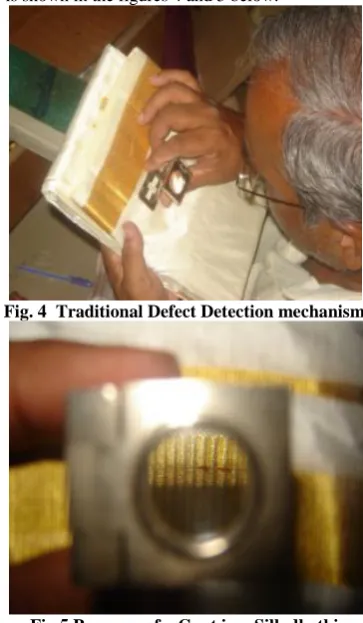
In order to reduce the labor cost involved in the process of defect detection using automated fabric defect detection [10] is more than economical along with the associated benefits. Efficient and robust defect detection algorithms on fabric textures are required to cater the needs of a fully automated fabric inspection system [9-10]. A large number of fabric defects have been listed out in [10-11] which are characterized by their vagueness and ambiguity and identifying them on a fabric is highly challenging. A number of algorithms have been developed to detect fabric defects in which using wavelets are also one of the methods [11]. The first survey on fabric defect detection techniques has been carried out in [1-2] by considering around 160 papers for reference. The process of traditional and manual fabric defect detection in a silk fabric is shown in the figures 4 and 5 below.
[image:3.595.359.499.141.260.2]Fig. 4 Traditional Defect Detection mechanism
[image:3.595.336.518.437.749.2]2.2 Quality Criteria in Silk Weaving
In the warp, a clean surface of the yarn is an absolute must. Any thick places, knots or high neatness defects or hairiness have a strong tendency to make the yarn stick together. This results in end breaking. Thick places in weft are less critical, but on the cone, such devices can interfere in smooth unwinding and any inertia there, can result in weft break[6-7].
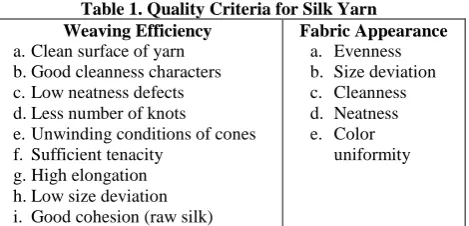
[image:4.595.52.287.180.293.2]Important quality criteria for silk yarn in high production weaving are:
Table 1. Quality Criteria for Silk Yarn Weaving Efficiency
a.Clean surface of yarn b.Good cleanness characters c.Low neatness defects d.Less number of knots
e.Unwinding conditions of cones f.Sufficient tenacity
g.High elongation h.Low size deviation i. Good cohesion (raw silk)
Fabric Appearance
a. Evenness b. Size deviation c. Cleanness d. Neatness e. Color
uniformity
The average strength of all kinds of raw silk and spun silk yarns is by far sufficient to withstand the weaving strains. But the variation of the strength can lead to serious trouble. Thus, not only the average strength, but also the variation and elongation are important. A high elongation can compensate for missing strength. Size deviation is also important for the same reason.
Evenness of the yarn affects the fabric appearance to a great extent. A high unevenness will cause weft bars and stripes in the warp[7-8].
3.
DESIGNED
ALGORITHMS
FOR
DEFECT DETECTION AND THEIR
PERFORMANCE ON SILK FABRICS
In fact it is difficult to fit a single MRFM [12] to each texture pattern, since MRF models are only suitable for the fine textures. If there is a coarse texture, it is more suitable to look the texture as a series of MRFs on different scales and directions. This method can be used in texture classification and texture segmentation effectively. However, the important information in the high-pass filtered part is ignored. In this section a new approach to model the textures will be proposed. The sub-bands are down sampled with the discrete wavelet transform. Thus the texture structure represented by the information of two far away pixels in the original image may become the one represented by immediate neighbors in the sub-band images on the higher levels. This leads to a new model which makes use of all sub-bands in different scales and directions. An original image is decomposed into a series of sub-bands. If each sub band is modeled as an MRFM, then this procedure can be called as Multi-resolution MRFM (MRMRFM) modeling [13].Gray Scale Fabric database contains 60 monochrome images from Brodatz album having the size of 512×512 images. It contains 30 reference images and 30 defective images. Training was done for 30 reference images only [12-13]. The classification done for all the images in the database. The fabric patterns are checked whether it contains any defects and hence the location of the defects is determined based on sub window selection. The sub window sizes are 256×256, 128×128 and 64×64. Correct classification rate of 100 % for all the size was achieved. Color Fabric database contains 130 color images having the size of 512×512 images [12]. It
contains 65 reference images and 65 defective images. Training was done for reference images only. The sub window sizes are 256×256, 128×128 and 64×64. Correct classification rate of 100 % was achieved [14].
The Real time fabric database contains 100 images. It contains 17 real time fabrics and its corresponding 83 defective images. Training was done for 17 reference real time fabric images. The classification rate depends on sub window size. If the size of the sub window reduces the classification rate also reduces. A combination of MRMRFM and MRCSF was done to check its efficiency on various minor and major defects in silk fabrics [1].
The main motive for the proposed method is to develop an economical automated fabric defect detection considering the reduction in labor cost and associated benefits. The development of fully automated web inspection system requires robust and efficient fabric defect detection algorithms [13]. Numerous techniques have been developed to detect fabric defects and the purpose of this paper is to propose a better method when compared to other techniques.
1. Feature Extraction of original image: This is the initial task in which the original non-defective reference samples are collected and their features are extracted using appropriate algorithm and stored in a database. Before feature extraction the sample images are wavelet transformed so that the samples are localized in both time and frequency. MRCSF[12-13] Features like mean, standard deviation, energy, entropy, spatial frequency, Multi Resolution Markov Random Field Matrix[14] and Gray Level Co occurrence Matrix (GLCM) [15] for both the reference fabric and the fabric to be tested were extracted using MATLAB and hence compared for classification. All the above mentioned steps are done using MATLAB Image Processing toolbox and Database Toolbox.
2. Capturing and Feature extraction of test sample: This part comes under the classification stage where the test samples are captured using a digital camera which is attached to a shaft which moves over the entire sample. The movement of the shaft is controlled by embedded system which employs a microcontroller. After capturing the sample images the feature are extracted in the same way as in the case of original image [16].
3. Comparison with Library: In this stage the stored features of the original image and the test sample are compared using the nearest neighborhood algorithm [17]. The test samples are classified as defective or non-defective based on the comparison results.
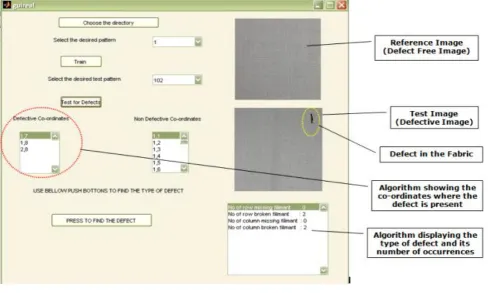
4. Indication of the Defects: The obtained defect is analyzed for its type using the available database of defects and hence the defect type is displayed on the screen. The location of the defect is also displayed on the screen for the ease of the user. Figure 6 & 7 indicates the location & type of the defects [18-20].
Fig. 6: Defect identification in test sample 1
Fig. 7: Defect identification in test sample 2
3.1 GLWM (Gray Level Weight Matrix)
In this method, the local texture information for a given pixel and its neighborhood is characterized by the corresponding texture unit and the global textural aspect of an image is revealed by its texture spectrum. This method extracts the textural information of an image with a more complete respect of texture characteristics. In GLWM method instead of thres-holding [16&19] the image transforming is made with neighborhood to a texture unit with the texture unit number under the ordering way. The transforming conditions
(1)
Where, Vi = The center pixel value;
Vo = The neighboring pixel value
Consider for example, the following image matrix as given below.
25 85 62
29 38 36
38 36 92
Fig. 8: 3 x 3 size image sample
On applying the GLWM as defined in the equation 5.1 with centre pixel as the threshold (i.e.) 38 for the above image matrix the image pixels get modified into the Gray Level Weight Matrix as shown below[16-19].
0 2 2
0 1 0
[image:5.595.404.451.572.635.2]1 0 2
Fig. 9 GLWM Transformation of Fig 5.3
The values of the pixels in the transformed texture unit neighborhood are multiplied by the weights given to the corresponding pixels. Finally, the values of the eight pixels are summed to obtain a number for this neighborhood. This method considers the center pixel value[20] till end of the process for each 3 x 3 matrix. The equation involved in the calculation of GLWM is shown below.
Defect Detection Process using GLWM
The defect detection process using the GLWM consists of two phases viz Training phase and Testing phase
a) Training phase
1) Non-defective silk image each of size 512 x 512[21] is being fed to the system.
2) The above image is cropped to a size of 8 x 8 images (each non-overlapping from each other).
3) All the above images are trained with GLWM algorithm.
4) The same procedure is being done for different types of real-time silk images and the values of GLWM are being stored in the database [16-17].
b) Testing Phase
1) Defective silk image each of size 512 x 512 is being fed to the system.
2) The corresponding silk type is chosen in the databases.
3) The above image is cropped to a size of 8 x 8 images (each non-overlapping from each other).
4) The features are obtained from the defective images[22] using GLWM algorithm.
5) The obtained features are compared with the features available in databases stored during the training phase.
6) Silk fabrics are now categorized as defective and non-defective based on a suitable threshold value for the GLWM features [23].
4. Real-Time Defect Detection
The system consists of two sub modules. The modules are
1. Mount control module
2. Image Processing module
At an occasion only one module will be able to work. This condition is made because of quality control condition.
[image:6.595.320.539.111.255.2]The first module is mount control. The MATLAB GUI is already programmed so that there are some four radio buttons. This radio buttons indicates the four direction movement of mount with camera this is shown in the figure 10 with RED boundary. This GUI Program is able communicate with Parallel port, the signals from the parallel port are digital in nature, so it converted to analog signals[24].
Fig. 10: Mount Control Module
[image:6.595.322.539.298.447.2]Now this signals acts as control signal to relays. The relays controls the four stepper motors. Now the movement of mount is controlled using the parallel communication [21-24].
Fig. 11: Automated Defect Detection System workflow
The second sub module is image processing module. This module is shown figure 12.
Fig. 12:Image Processing Module
The processing module is again sub divided in two Phases they are
Training phase: Reference image or database image is acquired using a Digital camera the image is transformed using Wavelet transform. The transformed is again transformed for second level i.e two level DWT. From the transformed image features are extracted. The extracted features are stored in .mat file, this file will acts as library.
Testing Phase: This phase has the major role in detecting the defects in the fabric. Now, the real time image of the fabric is grabbed from the digital camera mounted on the robot. The transformed is again transformed for second level i.e two level DWT. From the transformed image features are extracted.
Next step is classifier use the features of test image and features of Database image, the features are compared and the classifier output is final result which says the fabric is defective or non defective.
5. Result and Discussion
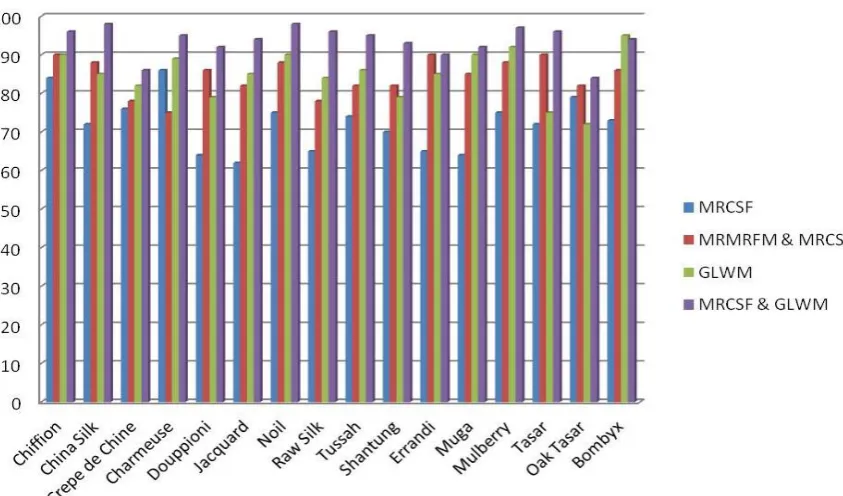
Three different algorithms such as MRMRFM, MRCSF and GLWM for silk fabric defect detection have been discussed above.
[image:6.595.55.292.590.720.2]Fig. 13 Graph plotting for Classification Rate for Different Types of Silk Fabric
In order to solve this problem, all the above said two algorithms viz. MRCSF and GLWM were combined to identify multiple defects for a given silk fabric. In this experiment, it was proved that on an average, the combination of MRCSF and GLWM provides better result for all kinds of minor and major defects. The graph and table shown below indicates the comparison of the classification rate for MRCSF, GLWM and the combinational algorithm.
Table 5.1: Classification Rate for Different Types Of Silk Fabric
Types of Silk Fabrics
MRCSF
MRMRFM & MRCSF
GLWM
MRCSF & GLWM
Chiffion 84 90 90 96
China Silk 72 88 85 98
Crepe de
Chine 76 78 82 86
Charmeuse 86 75 89 95
Douppioni 64 86 79 92
Jacquard 62 82 85 94
Noil 75 88 90 98
Raw Silk 65 78 84 96
Tussah 74 82 86 95
Shantung 70 82 79 93
Errandi 65 90 85 90
Muga 64 85 90 92
Mulberry 75 88 92 97
Tasar 72 90 75 96
Oak Tasar 79 82 72 84
Bombyx 73 86 95 94
6. Conclusion
This paper has discussed various aspects of fabric defects that can be identified using machine vision algorithms. These authors developed a machine vision algorithm for identifying various defects that occurs in silk fabric and in turn checked the same using the matlab. The developed algorithm was in turn used to finding defects in real time silk fabrics and found
to be efficient for detecting various defects present in the fabric.
7. ACKNOWLEDGEMENT
The authors would like to thank the All India Council of Technical Education (AICTE), New Delhi for the financial support and the Sona Trust for the providing the financial and moral support towards the research work. They also wish to thanktheir colleagues of the SONA SIPRO Research team of Sona College of Technology, Salem and their family members for many fruitful discussions. The authors wish to place their special thanks to Dr.S.Jayaraman, Professor, Dean and Head of the Department of Electronics and Communication Engineering, Sona College of Technology, Salem, Tamil Nadu, India and Dr.V.Palanisamy, Principal, Info Institute of Engineering, Coimbatore, Tamil Nadu, India. The Authors also wish to place their special thanks to the authorities of Indian Institute of Handlooms Technology, Salem, Tamil Nadu, India; Co-optex, Salem, Tamil Nadu, India and other handlooms cottage silk industries in and around Salem, Tamil Nadu, India for extending their co-operation capturing non-defective and non-defective images.
7. References
[1] R S Sabeenian, M E Paramasivam and P M Dinesh, “Computer Vision based Defect Detection and Identification in Handlooms Silk Fabrics”, International Journal of Computer Applications 42(17):41-48, March. Published by Foundation of Computer Science, New York, USA, 2012.
[2] Kumar, A. 2008. “Computer-Vision-Based Fabric Defect Detection: A Survey”, IEEE Transactions on Industrial Electronics, DOI: 10.1109/TIE.1930.896476
[image:7.595.51.288.441.667.2][4] T. S. Newman and A. K. Jain. 1985. “A survey of automated visual inspection,” Computer Vision Image Understanding,.
[5] A. D. H. Thomas, M. G. Rodd, J. D. Holt, and C. J. Neill. 1995. “Real-time industrial inspection: A review,” Real- Time Imaging.
[6] Escofet J., Milan M.S. and Rallo M. 2001, “Modelling of Woven Fabric structures based on Fourier Image analysis”. Appl. Opt.,
[7] Henry Y.T.N., Grantham K.H.P., Nelson H.C.Y. 2008. “Motif-Based defect detection for patterned fabric”. Pattern Recognition Letters.
[8] Mak K.L. and Peng P, “Detecting Defects in Textile Fabrics with Optimal Gabor Filters”, In eht proceedings of World Academy of Science, Engineering and Technology, 2006.
[9] Arivazhagan S. and Ganesan L. 2003, “Texture Classification using Wavelet Transform”. Pattern Recognition Letters.
[10]Arivazhagan S., Ganesan L. and Bama S. 2006. “Fault segmentation in fabric images using Gabor wavelet transform”, International Journal of Machine Vision and Applications.
[11]Diagnostic Study of Trichy Handlooms Cluster under the MSME Clusters.
[12]Sabeenian R.S. and Palanisamy V, “Texture Based Medical Image Classification of Computed Tomography images using MRCSF”, International Journal of Medical Engineering and Informatics (IJMEI), Vol. 1, No. 4 pp. 459-472 July 2009.
[13]Sabeenian R.S. and Palanisamy V., “Texture Based Weed Detection Using Multi Resolution Combined Statistical and spatial Frequency”, International Journal of Information and Communication Engineering (ISSN 2070-3740), Vol. 52, pp. 549-553. April 2009.
[14]Sabeenian R.S and M.E. Paramasivam. 2010. “Defect detection and Identification in Textile Fabrics using Multi Resolution Combined Statistical and spatial Frequency Method”. In the proceedings of IEEE International Advance Computing Conference (IACC 2010). DOI: 10.1109/ IADCC.2010.54.
[15]Sabeenian R.S and M.E. Paramasivam. 2010. “An Efficient Bit Reduction Binary Multiplication Algorithm using Vedic Methods”. In the proceedings of IEEE International Advance Computing Conference (IACC 2010).DOI:10.1109/IADCC.2010.54.
[16]Sabeenian R.S and Dinesh P.M. 2011. “Texture Image Classification Using Gray Level Weight Matrix (GLWM)”. In the Proceedings of International Conference of Advances in Information Technology and Mobile Communication (AIM’11) DOI: 10.1007/978-3-642-20573-6_43
[17]Sabeenian R.S and M.E. Paramasivam. 2010. “Handlooms Silk Fabric Defect Detection using First order Statistical Features on a NIOS II Processor” In the Proceedings of Springer International Conference on Advances in Information and Communication Technologies ICT 2010. DOI: 10.1007/978-3-642-15766-0_77.
[18]Sabeenian R.S., Paramasivam .M.E and P.M. Dinesh., “Detection and Location of Defects in Handlooms Cottage Silk Fabrics using MRMRFM & MRCSF” International Journal of Technology And Engineering System (IJTES): Jan – March 2011.
[19]Sabeenian R.S, Paramasivam M.E. and Dinesh P.M. 2011. “Face Recognition Using Gray Level Weight Matrix (GLWM)” In the proceedings of Second International Conference on Advances in Power Electronics and Instrumentation Engineering (PEIE’11), DOI: 10.1007/978-3-642-20499-9_11
[20]Sabeenian R.S and P.M. Dinesh, 2010, “Multi Format Scalable Media Decoder Implementation using OMAP3530”. In the proceedings of International Conference on Computational Intelligence and Computing Research (ICCIC’10) DOI: 10.1109/ ICCIC.2010.5705846..
[21]Sabeenian R.S and P.M. Dinesh, 2010. “Digital Watermarking using Multi Resolution Statistical and Markov Random Field Matrix (MRSMRFM)”. In the Proceedings of IEEE International Conference on Advances in Communication, Network and Computing CNC 2010 DOI 10.1109/CNC.51.
[22]Haralick R.M., Shangmugam K. and Dinstein L. 1973, “Textural Features for Image Classification”, IEEE Transactions on Systems, Man, and Cybernetics,.
[23]Sabeenian R.S. “Texture Image Classification using Multi Resolution Combined Statistical and Spatial Frequency Method” International Journal of Technology And Engineering System (IJTES): Jan – March 2011.
[24]Sabeenian R.S. and Palanisamy V, “Texture Image Classification using Gabor Statistical Features (GSF) and Wavelet Statistical Features (WSF)”. International Journal of Computer Science and Applications (ISSN No. 0974-0767) June 2010.
ABOUT THE AUTHORS
Dr. R.S. Sabeenianis currently working as a Professor in
ECE Department in Sona College of Technology, Salem, Tamil Nadu, India. He received his Bachelors in Engineering from Madras University and his Masters in Engineering in Communication Systems from Madurai Kamaraj University. He received his Ph.D. Degree from Anna University, Chennai in the area of image processing. He is currently heading the research group named Sona SIPRO (SONA Signal and Image PROcessing) centre located at the Advanced Research Centre in Sona College of Technology, Salem. His areas of interest include texture analysis, texture classification and pattern recognition. He has published more than 60 research papers
in various international, national journals and conferences. He has also published around seven books. He is a reviewer for the journals of IET, UK and ACTA Press Singapore. He received the “Best Faculty Award” among Tamil Nadu, Karnataka and Kerala states for the year 2009 given by the Nehru Group of Institutions, Coimbatore, “ISTE
Rajarambapu Patil National Award” for promising Engineering Teacher for Creative work done in Technical Education (Colleges) for the year 2010 and “IETE Biman
for Science and Technology for his research. He received two “Best Research Paper Awards” from Springer
International Conference and IEEE International Conference in the year 2010. His areas of interest include texture analysis, texture classification and pattern recognition.
M.E. Paramasivam, is currently working as the Research Staff in Sona Signal and Image PROcessing Research Centre located at the Advanced Research Centre, Sona College of Technology, Salem. He is also the Assistant Professor in the ECE department of Sona College of Technology, Salem.
He completed his Bachelors in Electronics and Communication Engineering in the year 2005. Later he was selected on an all India basis for pursing the Advanced Post Graduate Diploma in VLSI Design, from VEDANT Center, of Semiconductor Complex Ltd., A Govt. of India Enterprise located at Chandigarh in the year 2006. He also holds a Diploma in Management, Post Graduate Diploma in Management, Post Graduate Diploma in Human Resource Management and Masters in Management. He is a certified Altera Tools trainer, certified by Altera Semiconductors.
USA. He also holds a Masters Degree in Engineering with specialization in VLSI Design in the year 2011. He is currently pursuing his Doctoral Research in the area of Digital Image Processing. He has published and presented 15 research papers, both in technical and non-technical areas, at various conferences conducted around the nation. To his credit he has also published two papers in International Journal. He has written a book on “Electric Circuits and Electron Devices” in 2009. . He has also received a Project grant from the All India Council for Technical Education under the Research Promotion Scheme (RPS).