N A N O E X P R E S S
Open Access
Optical properties of Ag nanoparticle-polymer
composite film based on two-dimensional Au
nanoparticle array film
Long-De Wang
1,2,3, Tong Zhang
1,3*, Xiao-Yang Zhang
1,3, Yuan-Jun Song
1,3, Ruo-Zhou Li
1,3and Sheng-Qing Zhu
1,3Abstract
The nanocomposite polyvinyl pyrrolidone (PVP) films containing Ag nanoparticles and Rhodamine 6G are prepared on the two-dimensional distinctive continuous ultrathin gold nanofilms. We investigate the optical properties and the fluorescence properties of silver nanoparticles-PVP polymer composite films influenced by Ag nanoparticles and Au nanoparticles. Absorption spectral analysis suggests that the prominently light absorption in Ag nanowire/PVP and Ag nanowire/PVP/Au film arises from the localized surface plasmon resonance of Ag nanowire and Au nanofilm. The enhanced fluorescence is observed in the presence of Ag nanowire and Au nanofilm, which is attributed to the excitation of surface plasmon polariton resonance of Ag nanowire and Au nanofilm. The gold nanofilm is proven to be very effective fluorescence resonance energy transfer donors. The fabricated novel structure, gold ultrathin continuous nanofilm, possesses high surface plasmon resonance properties and prominent fluorescence enhancement effect. Therefore, the ultrathin continuous gold nanofilm is an active substrate on nanoparticle-enhanced fluorescence.
Keywords:Metal nanocomposite; Optical properties; Localized surface plasmon resonance; Surface plasmon-enhanced fluorescence
Background
Noble metal nanoparticles with strong localized surface plasmon resonances (LSPRs) have attracted great interests in fields such as nanoscale photonics, biological sensing, surface-enhanced Raman scattering (SERS), photocatalytic and photoelectron-chemical [1], plasmonic absorption en-hancement of solar cell [2-10], nonlinear optics [11-14], and plasmon-enhanced fluorescence [15-22]. Localized plasmons are the collective oscillations of free electrons in metal nanoparticles. The LSPRs arising from the excitation of a collective electron oscillation within the metallic nano-structure induced by the incident light lead to enormous optical local-field enhancement and a dramatic wavelength selective photon scattering at the nanoscale [23-26].
Nanocomposites consisting of metal nanoparticles dis-persed in a matrix of insulating materials such as polymers, ceramics, or glasses have recently received increased inter-est as advanced technological materials because of their unique physical properties. The optical properties of noble metal nanoparticles and their application in surface-enhanced photoluminescence are hot in the study of nanoscience. Recently, investigations of the surface en-hancement effect on of the fluophor fluorescence have opened up a new methodology for modulating and im-proving optical properties. The effects of Ag nanoparticles on fluorescence properties of the dye molecules such as Rhodamine B and Nile blue were reported and observed for strong coupling of the particle plasmon resonance to the molecules. Rhodamine (R6G) is frequently used as one of the most efficient laser dyes characterized by a high-efficiency fluorescence band around 560 nm. The fluorescence properties of R6G have been a subject of great interest because of their potential applications as optical signal amplification and light-emitting diode.
We have recently reported a novel structure gold ultrathin continuous nanofilm possessing high surface plasmon * Correspondence:[email protected]
1
Key Laboratory of Micro-Inertial Instrument and Advanced Navigation Technology, Ministry of Education, and School of Electronic Science and Engineering, Southeast University, Nanjing 210096, People's Republic of China
3
Suzhou Key Laboratory of Metal Nano-Optoelectronic Technology, Suzhou Research Institute of Southeast University, Suzhou 215123, People's Republic of China
Full list of author information is available at the end of the article
resonance properties and boasting a high SERS enhance-ment factor [27,28]. As a continual effort, here we report the composite films of silver nanowire, nanosphere, and R6G-doped polyvinyl pyrrolidone (PVP) polymer on gold nanocrystal deposited on glass substrate. We research the linear absorption and surface plasmon-enhanced fluor-escence optical properties of Ag nanoparticles-polymer composite film. Our results suggest that the ultrathin continuous gold nanofilm can obviously enhance fluor-escence optical properties. The interactions of the light and metal composite nanostructures generate new phe-nomena and realize a new function, which has potential applications in the nanooptics field.
Methods
The fabrication of continuous ultrathin gold nanofilm
Our approach is based on the formation of Au nanofilms on glass utilizing magnetron sputtering deposition of metal atoms. The glass substrate was first cleaned with detergent then ultrasonicated in acetone and isopropyl alcohol for further cleaning and subsequently dried in a vacuum oven at 80°C for 3 h. Metallic gold is sputtered on glass using magnetron sputtering in electrical current 0.38 A, vacuum 0.15 Pa, and Ar flux 25 sccm, discharging at 1 s.
Chemical synthesis of silver nanowires and nanospheres
We used a colloidal synthesis method to prepare silver nanowires improved from literature [29]. At room temperature, l mL ethylene glycol (EG) solution with silver nitrate (AgNO3) (0.9 M) and 0.6 mL EG solution with
so-dium chloride (NaCl) (0.01 M) were added into 18.4 mL EG solution of PVP (MW = 1,300,000) (2.7 M in terms of the repeating unit). Then the mixture was refluxed 185°C for 20 min. After the above processes, the excess PVP and EG were removed by adding deionized water centrifuging at 14,000 rpm for 10 min for three times. The centrifuga-tion ensures that all the products can be collected for the sake of statistics of shapes and size.
In a typical synthesis of quasi-spherical nanoparticles,
0.05 g of AgNO3 and 0.20 g of PVP were dissolved in
20 mL of EG at room temperature. The solution was then heated at 160°C in an oil bath for 1.5 h.
The preparation of silver nanoparticle-PVP polymer composite film
The certain concentration of EG colloidal solutions of silver nanowires, silver nanospheres, R6G, and PVP was dip-coated on glass or gold nanofilm, respectively. The silver nanoparticle-polymer composite films were baked at 60°C for 36 h in a vacuum oven for the complete re-moval of the solvent EG from the films, which is very important to form a good film.
The UV-vis-NIR absorption spectra and fluorescence spectra measurements
The UV-vis-NIR absorption spectra were recorded with a fiber-optic spectrometer (PG2000). Fluorescence spectra were registered with a Shimadzu RF-5301PC spectrofluor-ophotometer (Shimadzu Corp., Kyoto, Japan).
Results and discussion
Morphology of fabricated gold nanofilms
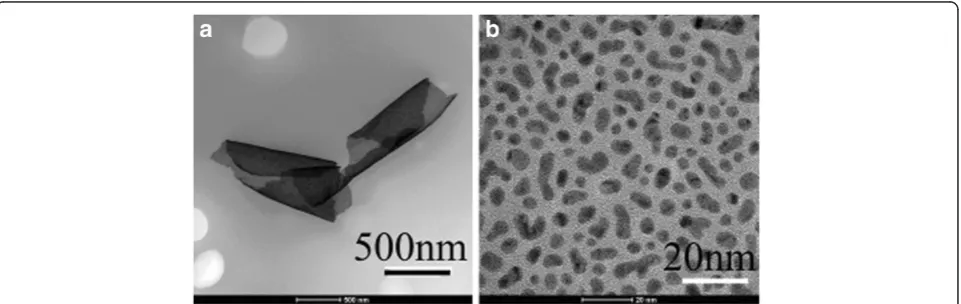
[image:2.595.59.540.562.714.2]Figure 1 shows the morphology of fabricated continuous ultrathin gold nanofilms. From Figure 1a the folded nano-film can be clearly seen as continuous and flexible. From Figure 1b we know that the nanofilm is composed of ran-domly distributed gold nanoparticles with uniform-sized steady link and ultrathin structure. Within the film the size of the gold nanoparticles is only about 10 nm. The distance between nanoparticles is in sub-10 nm which was filled with even thinner amorphous gold, which can be ob-served from the high-resolution transmission electron mi-croscopy (TEM) image shown in Figure 1b.
SEM micrographs of the silver nanowire and nanosphere
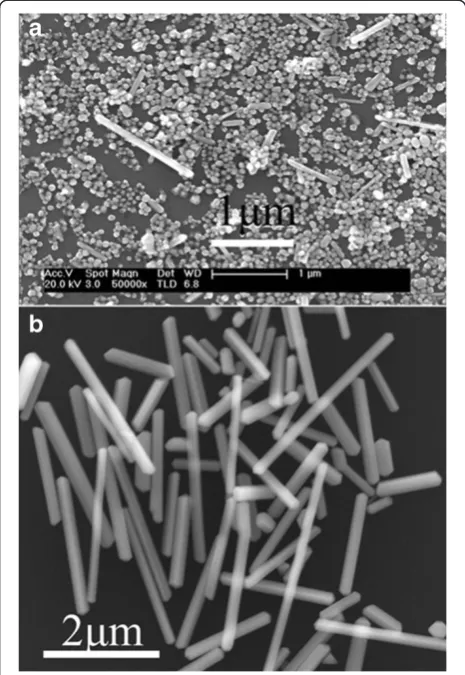
Figure 2 shows a series of silver nanocrystals prepared in the presence of PVP. The scanning electron microscopy (SEM) image in Figure 2a indicates the silver nanospheres with uniform size around 60 nm apart from a small por-tion of the nanowires. The morphologies of silver nano-wires in Figure 2b show the nanonano-wires with different aspect ratios, and the nanowires have very broad size dis-tribution. The length of synthesized longest silver nanowire is about 4μm.
[image:3.595.57.290.368.706.2]UV-vis absorption spectra of the nanoparticle-polymer composite film on the Au nanofilm
Figure 3a shows the comparison of the optical absorption spectra of Ag nanosphere/PVP, Ag nanowire/PVP, Ag nanosphere/PVP/Au film, and Ag nanowire/PVP/Au film. Figure 3b shows the optical absorption spectra of Ag nanoparticles solution. The resonance bands of the plas-monic nanocrystals are mainly dependent on the distribu-tion of the electromagnetic field on the surface of the metal nanocrystals. The absorption of the Ag nanowire/ PVP film comes from the surface plasmon resonance of
Ag nanowire. Compared to Ag nanowire/PVP, the inten-sity and the peak position of the absorption band of Ag nanowire/PVP/Au film in Figure 3a have more strength and a little red shift, respectively. These are contributed from the coupling resonant excitation of surface plasmon polaritons of Ag nanowire and near-surface plasmon polaritons of Au nanoparticles on the ultrathin Au film. The absorption peak at 560 nm of ultrathin gold film is also observed on the Ag nanowire/PVP/Au film. The peak of 370 nm ascribes to the localized surface plasmon reson-ance effect of silver nanowires. The gold nanofilm observ-ably enhances absorbance of silver nanowires. The absorbance of Ag nanowire is apparently higher than that of Ag nanosphere. Under the action of gold nanofilm, the absorbance of Ag nanowire/PVP/Au film is the highest, which can be ascribed to the surface plasmon resonance absorption of Ag nanowire and Au nanoparticles.
However, the absorbances of Ag nanosphere/PVP and Ag nanosphere/PVP/Au film are very weak. In addition, the absorbance resonance peak of silver nanospheres has Figure 2SEM micrographs of the synthesized silver (a) nanosphere
and (b) nanowire.
300 400 500 600 700 800 900 100011001200 0.00
0.05 0.10 0.15 0.20 0.25 0.30 0.35 0.40 0.45 0.50 0.55 0.60 0.65 0.70
a
b
Absorbance
Wavelength/nm
Ag nanowire/PVP/Au film Ag nanosphere/PVP/Au film Au film
Ag nanowire/PVP Ag nanosphere/PVP PVP
300 400 500 600 700 800 0.0
0.2 0.4 0.6 0.8 1.0
absorbance
wavelength/nm
Ag nanosphere Ag nanowire
obviously blueshifted. Meanwhile, the absorption peak at 560 nm of ultrathin gold film disappeared in the Ag nanosphere/PVP/Au film, which means that the surface plasma resonance (SPR) peak of Ag nanosphere is not consistent with that of the Au nanofilm. Compared to Ag nanosphere, the longer Ag nanowire has sharper plasmon resonance that leads to red-shifted plasmon resonance and ensures a better overlap between plasmon resonance and absorption band of Au nanofilm. So there is no resonance-enhanced absorption between the Ag nanosphere and Au nanofilm. It is an important point to keep in mind that the SPR wavelength and the reson-ance intensity is greatly influenced by the kind of metal, particle size and shape, aggregation condition of parti-cles, and so on.
The fluorescence optical properties of nanoparticle-polymer composite film on the surface of the Au nanofilm/glass
The effects of the existence of Ag nanoparticles and Au nanofilm on the fluorescence from the R6G/PVP films are further investigated, as shown in Figure 4. There is no fluorescence from the R6G/Ag nanowire/PVP, R6G/Ag nanosphere/PVP, R6G/Ag nanosphere/PVP/Au film, Ag nanosphere/PVP, and Ag nanowire/PVP films, according to in Figure 4. Thus, the fluorescence peaks of 563 nm shown in Figure 4 are attributed to electric transition of π-π* of R6G doped in the PVP films. The enhanced fluor-escence is observed in the R6G/Ag nanowire/PVP/Au film and R6G/PVP/Au film, and the enhanced factor (Ic/Ib) is about 7.7 and 2.3, respectively. TheIcis the fluorescence absorption peaks of R6G/Ag nanowire/PVP/Au film and R6G/PVP/Au film at 560 nm nearby, respectively.
TheIbis the fluorescence absorption peak of R6G/PVP
at 560 nm nearby.
The fluorescence quenching in the metal colloid film has been observed in the R6G/Ag nanowire/PVP, R6G/Ag
nanosphere/PVP, R6G/Ag nanosphere/PVP/Au film,
according to Figure 4. The SPR resonance absorption peak at 560 nm of Au nanoparticle is consistent with the R6G absorption peak, therefore, the enhanced fluorescence is observed in the R6G/PVP/Au film. According to the op-tical absorption spectrum of Ag nanowire/PVP/Au film in Figure 3, there is strong optical absorption at 563 nm nearby. Therefore, the obviously enhanced fluorescence is observed in the R6G/Ag nanowire/PVP/Au film. These phenomena are ascribed to surface-enhanced fluores-cence, resulting from surface plasmon resonance of Ag nanowire and Au nanoparticle. Especially, the Ag nano-wires and Au nanoparticles possess the capacity to induce strongly enhanced fluorescence due to the coupling reson-ance of surface plasmon polaritons of Ag nanowire and Au nanoparticle. For surface-enhanced fluorescence it is very important that R6G should be closed to the surface of Ag nanoparticles, this is realized under the help of PVP. However, fluorescence quenching occurred once R6G's immediate contact with the metal nanoparticles results in nonradiative energy transfer between the R6G and metal nanoparticles [30].
Without the strong resonance absorption at 560 nm nearby of the Ag nanosphere and the Au nanofilm, there is no fluorescence from the R6G/Ag nanosphere/PVP and R6G/Ag nanosphere/PVP/Au film. Even though the Ag nanowire/PVP has optical absorption at 560 nm nearby in Figure 3, no fluorescence in R6G/Ag nanowire/PVP is ob-served without Au nanofilm. Hereby, it is the Au nanofilm that possesses the surface plasmon-enhanced fluores-cence. The gold nanofilm is proven to be very effective fluorescence resonance energy transfer donors. The main factors that affect surface plasmon-enhanced fluorescence are (1) nanoparticle size and shape of the metal; (2) the distance between metal nanoparticles and luminophor; and (3) the electromagnetic field effect in exciting light, sur-face plasmon polaritons, and fluorescence of luminophor.
Conclusions
The absorption and fluorescence spectra of the nanocom-posite PVP films with Ag nanoparticles and Rhodamine 6G prepared on the two-dimensional continuous ultrathin gold nanofilm have been studied. Absorption spectral ana-lysis suggests that the prominently light absorption in Ag nanowire/PVP and Ag nanowire/PVP/Au film arises from the localized surface plasmons resonance of Ag nanowire and Au nanofilm. The enhanced fluorescence is observed in the presence of Ag nanowire and gold nanofilm, which is attributed to the excitation of surface plasmon polaritons resonance of Ag nanowire and gold nanofilm. We have produced a two-dimensional continuous ultrathin gold
540 560 580 600 620 640
0 100 200 300 400 500 600 700 800
Fluorescence intensity
[image:4.595.56.291.519.685.2]Wavelength/nm 1 2 3 4 5 6 7 8 9
nanofilm which possesses high local-field enhancement effect, high SERS activity, and surface-enhanced fluorescence.
Competing interests
The authors declare that they have no competing interests.
Authors’contributions
L-DW carried out the design and prepared the nanocomposite film, performed the optical absorption and fluorescence analysis of
nanocomposite film, and drafted the manuscript. R-ZL participated in the fabrication of gold films. X-YZ participated in the absorption spectra measurement. Y-JS participated in the synthesis of silver nanoparticles. TZ and S-QZ read the manuscript and contributed to its improvement. All authors read and approved the final manuscript.
Acknowledgements
This work is supported by NSFC under grant number 61307066, Doctoral Fund of Ministry of Education of China under grant numbers
20110092110016 and 20130092120024, Natural Science Foundation of Jiangsu Province under grant number BK20130630, the National Basic Research Program of China (973 Program) under grant number 2011CB302004, and the Foundation of Key Laboratory of Micro-Inertial Instrument and Advanced Navigation Technology, Ministry of Education, China under grant number 201204.
Author details
1Key Laboratory of Micro-Inertial Instrument and Advanced Navigation
Technology, Ministry of Education, and School of Electronic Science and Engineering, Southeast University, Nanjing 210096, People's Republic of China.2Department of Chemistry and Chemical Engineering, Huainan Normal University, Huainan 232001, People's Republic of China.3Suzhou Key Laboratory of Metal Nano-Optoelectronic Technology, Suzhou Research Insti-tute of Southeast University, Suzhou 215123, People's Republic of China.
Received: 11 December 2013 Accepted: 12 February 2014 Published: 31 March 2014
References
1. Long MC, Jiang JJ, Li Y, Cao RQ, Zhang LY, Cai WM:Effect of gold nanoparticles on the photocatalytic and photoelectrochemical performance of Au modified BiVO4.Micro Nano Lett2011,3(3):171–177.
2. Wu J, Mangham SC, Reddy VR, Manasreh MO, Weaver BD:Surface plasmon enhanced intermediate band based quantum dots solar cell.Sol Energy Mater Sol Cells2012,102:44–49.
3. Wang RL, Pitzer M, Fruk L, Hu DZ, Schaadt DM:Nanoparticles and efficiency enhancement in plasmonic solar cells.J Nanoelectron Optoelectron2012,7:322–327.
4. Tvingstedt K, Persson NK, Olle I, Rahachou A, Zozoulenko IV:Surface plasmon increase absorption in polymer photovoltaic cells.Appl Phys Lett
2007,91:113514.
5. Anthony JM, Kathy LR:Plasmon-enhanced solar energy conversion in organic bulk heterojunction photovoltaics.Appl Phys Lett2008,92:013504. 6. Yang J, You JB, Chen CC, Hsu WC, Tan HR, Zhang XW, Hong Z, Yang Y:
Plasmonic polymer tandem solar cell.ACS Nano2011,5:6210–6217. 7. Kochergin V, Neely L, Jao CY, Robinson HD:Aluminum plasmonic
nanostructures for improved absorption in organic photovoltaic devices.
Appl Phys Lett2011,98:133305.
8. Zhu JF, Xue M, Shen HJ, Wu Z, Kim S, Ho JJ, Aram HA, Zeng BQ, Wang KL: Plasmonic effects for light concentration in organic photovoltaic thin films induced by hexagonal periodic metallic nanospheres.Appl Phys Lett
2011,98:151110.
9. Spyropoulos GD, Stylianakis M, Stratakis E, Kymakis E:Plasmonic organic photovoltaics doped with metal nanoparticles.Phot Nano Fund Appl2011, 9:184–189.
10. Atwater HA, Polman A:Plasmonics for improved photovoltaic devices.
Nat Mater2010,19:205–213.
11. Deng Y, Sun YY, Wang P, Zang DG, Jiao XJ, Ming H, Zang QJ, Jiao Y, Sun XQ:Effect of Ag nanoparticles on optical properties of R6G doped PMMA films.Chin Phys Lett2007,24:954–956.
12. Tsutsui Y, Hayakawa T, Kawamura G, Nogami M:Tuned longitudinal surface plasmon resonance and third-order nonlinear optical properties of gold nanorods.Nanotechnology2011,22:275203.
13. Joanna OB, Marta G, Radoslaw K, Katarzyna M, Marek S:Third-order nonlinear optical properties of colloidal gold nanorods.J Phys Chem C
2012,116:13731–13737.
14. Lin G, Tan DZ, Luo FF, Chen DP, Zhao QZ, Qiu JR:Linear and nonlinear optical properties of glasses doped with Bi nanoparticles.J Non Cryst Solids2011,357:2312–2315.
15. Abdulhalim, Karabchevsky A, Patzig C, Rauschenbach B, Fuhrmann B, Eltzov E, Marks R, Xu J, Zhang F, Lakhtakia A:Surface-enhanced fluorescence from metal sculptured thin films with application to biosensing in water.
Appl Phys Lett2009,94:063106.
16. Guo SH, Tsai SJ, Kan HC, Tsai DH, Zachariah MR, Phaneuf RJ:The effect of an active substrate on nanoparticle-enhanced fluorescence.Adv Mater
2008,20:1424–1428.
17. Amjad RJ, Sahar MR, Dousti MR, Ghoshal SK, Jamaludin MNA:Surface enhanced Raman scattering and plasmon enhanced fluorescence in zinc-tellurite glass.Opt Express2013,21:14282–14290.
18. Wertz E, Donehue JE, Hayes C, Biteen JS:Plasmon-enhanced fluorescence intensities and rates permit super-resolution imaging of enhanced local fields.Proc. SPIE2013,8590:85900U1-10.
19. Ekgasit S, Yu F, Knoll W:Fluorescence intensity in surface-plasmon field-enhanced fluorescence spectroscopy.Sensors Actuators B2005, 104:294–301.
20. Guo SH, Heetderks JJ, Kan HC, Phaneuf RJ:Enhanced fluorescence and near-field intensity for Ag nanowire/nanocolumn arrays: evidence for the role of surface plasmon standing waves.Opt Express2008, 16:18417–18425.
21. Kawasaki M, Mine S:Enhanced molecular fluorescence near thick Ag island film of large pseudotabular nanoparticles.J Phys Chem B2005, 109:17254–17261.
22. Zhang J, Fu Y, Chowdhury MH, Lakowicz JR:Metal-enhanced single-molecule fluorescence on silver particle monomer and dimer: coupling effect between metal particles.Nano Lett2007,7:2101–2107.
23. Stewart ME, Anderton CR, Thompson LB, Maria J, Gray SK, Rogers JA, Nuzzo RG:Nanostructured plasmonic sensors.Chem Rev2008,108:494–521. 24. Gao SY, Koshizaki N, Tokuhisa H, Koyama E, Sasaki T, Kim JK, Ryu J, Kim DS,
Shimizu Y:Highly stable Au nanoparticles with tunable spacing and their potential application in surface plasmon resonance biosensors.Adv Funct Mater2010,20:78–86.
25. Zhang XY, Hu A, Zhang T, Lei W, Xue XJ, Zhou YH, Duley WW: Self-assembly of large-scale and ultrathin silver nanoplate films with tunable plasmon resonance properties.ACS Nano2011,5:9082–9092.
26. Zhang XY, Zhang T, Zhu SQ, Wang LD, Liu XF, Wang QL, Song YJ:Synthesis and optical spectra investigation of silver nanochains and
nanomeshworks.Nanoscale Res Lett2012,7:596.
27. Wang LD, Zhang T, Zhu SQ, Zhang XY, Wang QL, Liu XF, Li RZ: Two-dimensional ultrathin gold film composed of steadily linked dense nanoparticle with surface plasmon resonance.Nanoscale Res Lett2012, 7:683.
28. Wang LD, Zhang T, Zhang XY, Li RZ, Zhu SQ, Wang LN:Synthesis of ultrathin gold nanosheets composed of steadily linked dense nanoparticle arrays using magnetron sputtering.J Nanosci Nanotechnol
2013,5:257–260.
29. Tang X, Tsuji M, Jiang P, Nishio M, Jang S-M, Yoon S-H:Rapid and high-yield synthesis of silver nanowires using air-assisted polyol method with chloride ions.Colloids Surf A Physicochem Eng Asp2009,338:33–39. 30. Pons T, Medintz IL, Sapsford KE, Higashiya S, Grimes AF, English DS, Mattoussi H:On the quenching of semiconductor quantum dot photoluminescence by proximal gold nanoparticles.Nano Lett2007, 7:3157–3164.
doi:10.1186/1556-276X-9-155