© 2016, IRJET | Impact Factor value: 4.45 | ISO 9001:2008 Certified Journal | Page 1879
Effect of Reinforcement Pattern on the Behaviour of Skew Slab
Anusreebai S.K
1, Krishnachandran V.N.
21
M Tech Student, Structural Engineering, Sreepathy Institute of Management and Technology
,
Vavanoor, India
2
Assistant Professor, Civil Engineering, Sreepathy Institute of Management and Technology
,
Vavanoor, India
---***---Abstract
– Slab is an extensively used structural element which usually carries uniformly distributed gravity loads. Out of different shapes of slabs, rectangular and skew slabs have quite a good number of applications in modern civil engineering structures. Depending on the shape and the behavior of simply supported skew slabs it can be divided into two types. i) Skew slab with short diagonal to span ratio less than unity and ii) Skew slab with short diagonal to span ratio greater than unity. The use of FEA has been a preferred method to study the behavior of concrete structures as it is much faster than the experimental method and is cost effective. In this study finite element modeling of skew slab by using commercially available Finite Element software, ANSYS, has been carried out. Finite Element modeling of the skew slab (with short diagonal to span ratio less than unity) specimens with different reinforcement pattern has been done and the results obtained are compared. After the analysis it was found that minimum deflection and more load capacity was found on slab with reinforcement pattern of main bar parallel to the free edge and distribution bar perpendicular to the free edge.Key Words
:
Reinforced concrete skew slab, skew angle,
Reinforcement pattern, Finite Element Analysis, ultimate load of skew slab
1. INTRODUCTION
In a reinforced concrete structure, slabs are used to forming roof covering and floors of buildings. Normally, slab is perpendicular to the supports whereas skew slab is a four-sided slab having equal opposite angles other than 900. This shape of the slab facilitates a large variety of options for an engineer in terms of alignment opportunities in case of obstructions.
The behavior of a simply supported skew slab applied by point load at the centre depends on the ratio of short diagonal to its span. Skew slabs with short diagonal to span ratio less than unity show lifting of acute corners whereas skew slabs with short diagonal to span ratio greater than unity do not.
For rectangular slabs, a typical reinforcement pattern is parallel to the edges. Depending on the geometry
and boundary conditions of the slab, this may not be the best reinforcement orientation, especially so in case of skew slabs. For skew slabs, the sides of the slab are not orthogonal and so it is a matter of interest to study the effect of different types of reinforcement schemes to arrive at the best arrangement.
Finite Element Analysis (FEA) is a method used for the evaluation of structures, and providing an accurate prediction of the component’s response subjected to various structural loads. The use of FEA has been a preferred method to study the behaviour of concrete structures as it is much faster than the experimental method. With the invention of sophisticated numerical tools for analysis like the finite element method (FEM), it has become possible to model the complex behaviour of reinforced concrete structures using Finite Element modeling. In this study finite element modeling of skew slab by using commercially available Finite Element software, ANSYS, has been carried out and compared the results with the available experimental results to validate the software. The study on effect of reinforcement pattern on the behaviour of skew slab is examined here by varying the pattern for different skew angle.
2. GEOMETRIC PROPERTIES OF CONTROL
SPECIMEN
© 2016, IRJET | Impact Factor value: 4.45 | ISO 9001:2008 Certified Journal | Page 1880 Fig -1: Dimensions of skew slab
Fig -2: Reinforcement arrangement in skew slab
To understand the effect of reinforcement pattern on the behavior of skew slab, a study was conducted on skew slabs with three different reinforcement patterns as shown in figure3 under different angles:
Pattern1: Main reinforcement is parallel to the free edge and the transverse reinforcement is parallel to the supported edge.
Pattern2: Main reinforcement is perpendicular to the supported edge and the transverse is parallel to the supported edge
Pattern3: Main reinforcement is parallel to the free edge and the transverse is perpendicular to the free edge
pattern-1
pattern-2
pattern-3
Fig -3: Types of arrangement of reinforcement
3. FINITE ELEMENT METHOD
The Finite Element Method (FEM) is a numerical analysis for obtaining approximate solutions to a wide variety of engineering problems. The basic concept behind FEM is that a body or structure is divided into smaller elements of finite dimensions called ‘finite elements’. The original structure is then considered as an assemblage of these elements at a finite number of joints called ‘nodes’. A commercially available FEM Software called ANSYS of version 15 is used for the finite element modeling.
3.1 Modelling
[image:2.595.303.543.66.375.2]© 2016, IRJET | Impact Factor value: 4.45 | ISO 9001:2008 Certified Journal | Page 1881 Fig -4: SOLID 65 Element
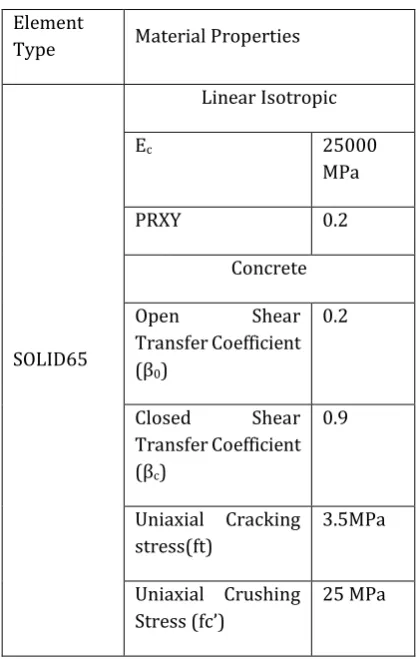
Table -1: Material properties of solid 65 element
Element
Type Material Properties
SOLID65
Linear Isotropic
Ec 25000
MPa
PRXY 0.2
Concrete
Open Shear
Transfer Coefficient (β0)
0.2
Closed Shear Transfer Coefficient (βc)
0.9
Uniaxial Cracking stress(ft)
3.5MPa
Uniaxial Crushing Stress (fc’)
25 MPa
[image:3.595.335.534.259.442.2]The reinforcement was modeled by using LINK 180 element. Depending upon the applications, the element may be thought of as a truss element, a cable element, a reinforcing bar and a bolt. The three-dimensional spar element is having two nodes and each node having three translational degrees of freedom as shown in Figure 5. The material properties provided are given in table 2.
Fig -5: LINK 180 Element
Table -2: Material properties of Link180 element
Element Type Material Properties
LINK180
Linear Isotropic
Ec 200000
MPa
PRXY (ν) 0.3
Bilinear Isotropic
Yield Stress (fy) 415 MPa
This element is capable of plasticity, creep, swelling and stress stiffening effects. The cross sectional area can be given as the real constant.
(a) pattern-1
[image:3.595.57.267.281.611.2] [image:3.595.361.505.513.756.2]© 2016, IRJET | Impact Factor value: 4.45 | ISO 9001:2008 Certified Journal | Page 1882 (c) pattern-3
Fig -6: Different reinforcement pattern on slab with skew angle 300
3.2 Analysis
[image:4.595.320.546.307.696.2]Displacement boundary conditions are needed to constrain the model to get a unique solution. To achieve this, the translations at the nodes UX, UY and UZ are restrained in order to obtain a hinged joint and translations at the nodes UY, UZ are restrained in right side in order to obtain the roller joint. The force or a gradually increasing load in the downward direction is applied at the centre of the slab. The Static analysis type is utilized in this study. The Newton-Raphson method of analysis is used to compute the nonlinear response.
Fig -7: Boundary condition of skew slab
4. RESULTS AND DISCUSSIONS
The results of this study can be mainly included under 2 part such as the result of comparison of experiment and finite element analysis study and study of effect of reinforcement pattern on the behavior of skew slab.
4.1 Comparison of experimental and analytical
results
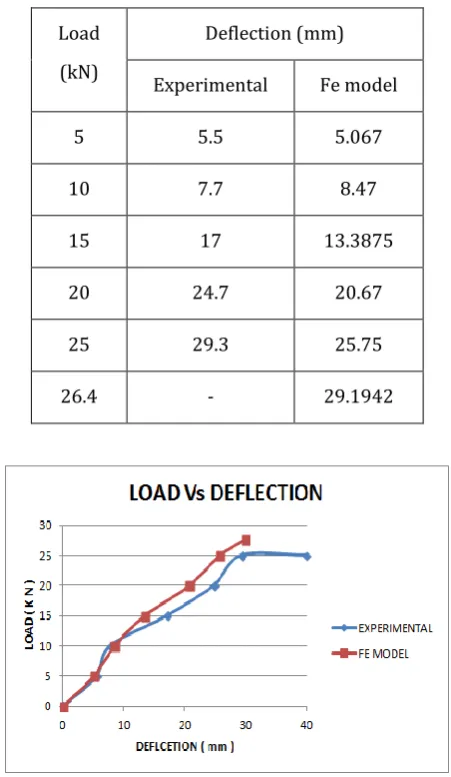
To validate the obtained FEA results, comparison with experimental results are necessary. In the case of experiment, the load was applied gradually at the centre of the test specimen and deflections at the centre of the slab at different load are recorded. In FE Model of skew slab specimen, loads have been applied at the centre of the slabs as done in case of experiment. The load on the structure has been gradually increased in the steps till failure. The load-deflection values at every step have been recorded as in table 3
Table -3: Load and deflection from experiment and FE model
Load (kN)
Deflection (mm)
Experimental Fe model
5 5.5 5.067
10 7.7 8.47
15 17 13.3875
20 24.7 20.67
25 29.3 25.75
26.4 - 29.1942
Chart-1 : Load v/s Deflection comparison graph
[image:4.595.42.277.479.653.2]© 2016, IRJET | Impact Factor value: 4.45 | ISO 9001:2008 Certified Journal | Page 1883 value of load 10kN. At this point minor cracks started to get
[image:5.595.310.558.135.481.2]generated. After this point there is slight variation in curvature in the plot and deflection started increasing. The ultimate load and corresponding deflection for FE model are 26.4kN and 29.1942mm respectively whereas the ultimate load and corresponding deflection came from experimental result was 25kN and 29.3mm respectively.
[image:5.595.49.272.205.371.2]Fig -8: Deformed shape of slab at a load of 5kN
Fig -9: Deformed shape of slab at ultimate a load
4.2 Effect of reinforcement pattern on skew slab
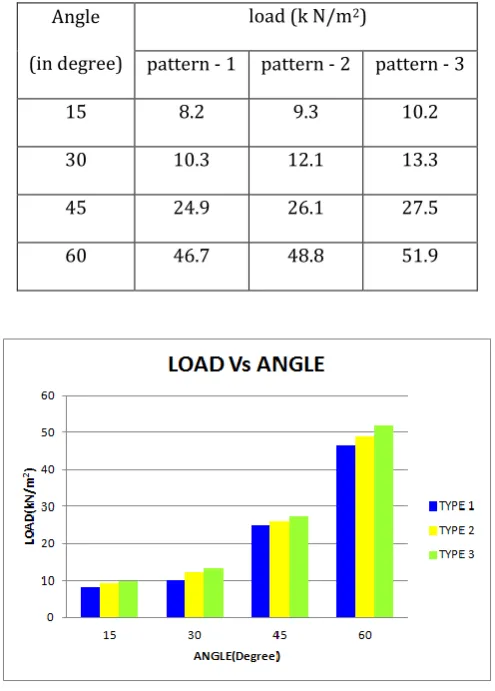
For comparing the effect of reinforcement on skew slab (ratio of short diagonal to span less than one), slab with skew angles of 150, 300, 450, and 600 were modeled with pattern 1, pattern-2 and pattern 3 reinforcements and analyzed to get the crack load. Crack load is the load corresponding to the formation of first crack. The crack load in each case is tabulate in table 4. In the graph showing in the figure 12 x-axis represents the skew angles changing from 150 to 600 and y-axis represents the crack load for skew slab with three patterns of reinforcement
Table -3: Crack load of skew slabs with different pattern at different angle
Angle
(in degree)
load (k N/m2)
pattern - 1 pattern - 2 pattern - 3
15 8.2 9.3 10.2
30 10.3 12.1 13.3
45 24.9 26.1 27.5
60 46.7 48.8 51.9
Chart-2: Load v/s Skew Angle graph of 1, pattern-2, and pattern-3 reinforcement
From chart-2, it is clear that the slabs reinforced with pattern-3 (Main reinforcement is parallel to the free edge and the transverse reinforcement is perpendicular to
the free edge) have higher load carrying capacity whereas
Slab with pattern-1 reinforcement show less load carrying capacity.
4.2 Crack Patterns in skew slabs
The variations of crack pattern have been taken out from the post processer of ANSYS. The figure 11 and 12 represents the crack pattern of slab with skew angle 150 at its yielding load and at ultimate load respectively.
[image:5.595.51.268.407.574.2]© 2016, IRJET | Impact Factor value: 4.45 | ISO 9001:2008 Certified Journal | Page 1884 towards the end of the free edge on the tension face side as
[image:6.595.46.276.169.338.2]the loading progressed and the crack propagation is parallel to the support edge.
[image:6.595.50.271.399.569.2]Fig -11: Crack pattern of skew slab with skew angle 150 at yielding
Fig -12: Crack pattern of skew slab with skew angle 150 at ultimate load
While varying the skew angle from 0-600 the load carrying capacity increases. The behavior of load carrying capacity and skew angle of skew slab with pattern-3 reinforcement is graphically represented in chart-2.
Chart-3: Ultimate load of skew slab with varying skew angle
This increase in load carrying capacity and decrease in deflection corresponding to increase in skew angle is because the maximum force flow between the support lines is through the strip area connecting the obtuse angled corners, as skew angle increases the length of strip area decreases.
5. CONCLUSIONS
In this study the behaviour of reinforced cement concrete skew slab with different reinforcement paatern having different skew angle under static load has been investigated. The following conclusions are obtained from the investigations
1. The general behavior of the finite element models represented by the load-deflection curves show good agreement with the experimental data. It is verified that the finite element analysis can accurately predict the load deformation similar to the experiment.
2. Slab with reinforcement pattern-3(main reinforcement parallel to the free edge and distribution reinforcement perpendicular to the free edge) has more cracking load and ultimate load capacity compare with the other patterns.
3. Also value of deflection is minimum for the type-3 reinforcement pattern
© 2016, IRJET | Impact Factor value: 4.45 | ISO 9001:2008 Certified Journal | Page 1885
REFERENCES
[1] ANSYS (2015): “ANSYS Help” Release 15, ANSYS Inc., Canonsburg.
[2] Anurag.Misra and Trilok Gupta (2007): “Effect on
support reactions of t-beam skew bridge decks.” ARPN Journal of Engineering and Applied Sciences, Vols. Vol. 2, Issue 1, February, 2007
[3] Bari M.W., Rahman M.M., Ali M.M.Y. and Awall M.R. (2004): “Finite Element Analysis of Slab and a Comparative Study with Others Analytical Solution”, 7th ICCT 24, March,2004, pp. 265-272
[4] Dr. Ihsan A.S., Al-Shaarbaf, Munaf A.A., Al-Rmahee. (2009): “Nonlinear Finite Element Analysis of High Stregth Reinforced Concrete Slabs” Al-Qadisiya Journal For Engineering Sciences, Vol. 2, Issue 3, 2009
[5] Huang, Shenton, and Chajes. s.l. (2004): “Load
Distribution for a Highly Skewed Bridge” Journal of Bridge Engineering, Vol. 9, Issue 6, November 1, 2004. ©ASCE, September. 1995
[6] Ibrahim S. I. Harba. (2011): “Effect of Skew Angle on
Behavior of Simply Supported RC T-beam bridge decks”, ARPN Journal of Engineering and Applied Sciences, Vol. 6, Issue 8, August, 2011
[7] IS 456(2000), “Plain and reinforced cement concrete-
code of practice” fourth revision, Bureau of Indian Standard, cement and concrete sectional committee, Civil Engineering Division Council
[8] James A.K. and Habib J.D. (1995): “Nonlinear FE
analysis of RC skewed slab bridges”, Journal of structural engineering, Vol. 12, Issue 19, pp. 1338-1345
[9] Kanhaiya Lal Pandey. (2014),“Behavior of Reinforced
Concrete Skew Slab under Different Loading Conditions” GJESR Research Paper, Vol. 1, Issue 1 [10]Maher Shaker Qaqish (2006), “Effect of skew angle on
distribution of bending moments in bridge slab”, Journal of applied sciences, 2006, pp. 366-372 [11]Maleki Shervin (2002): “Deck modeling for seismic
analysis of skewed slab-girder bridges”, Engineering Structures, 24, 7 May 2002, pp.1315–1326
[12]Mirzabozorg and Khaloo (2003): “Load Distribution
Factors in Simply Supported Skew bridges.” Journal of bridge engineering © ASCE, Vol. 8, Issue 4, July 1, 2003
[13]Mohammad, A Khaleel and Rafik. (1990): “Live load
moment for continuous skew bridges”. Journal of Structural Engineering, Vol. 116, No. 9, September, 1990 pp. 1-13.
[14]S M Nizamud-Doulah and A Kabir. (2001): “Empirical
formulae for the design of reinforced concrete skew slabs” 26th Conference on Our World in Concrete & Structures, Singapore, 27 - 28 August 2001
[15]S.Unnikrishnan Pillai and Devdas Menon(2009), “Reinforced Concrete Design”, Mcgraw hill publishers, edition 3
[16]Sharma B.R. (2009): “Flexural Behaviour of
Reinforced Cement Concrete Skew Slabs” M.E. Thesis, GNDEC, Panjab Technical University
[17]Sindhu B.V, Ashwin K.N, Dattatreya J.K. and S.V Dinesh. (2013): “Effect Of Skew Angle On Static Behaviour Of Reinforced Concrete Slab Bridge Decks”,
International Journal of Research in Engineering and Technology, Vol. 2, Issue 1, November-2013 [18]Sk.Md. Nizamud-Doulah and Ahsanul Kabir. (2002):
“Behaviour of RC skew slabs – finite element model and validation” 27th Conference on Our World In Concrete & Structures, Singapore, 29 - 30 August 2002