© 2016, IRJET | Impact Factor value: 4.45 | ISO 9001:2008 Certified Journal | Page 1482
MODELLING OF INDUCTION MOTOR AND ITS PERFORMANCE WITH
PI,PID(NZ METHOD),PI(ZP) , FUZZY AND GENERALISED PREDICTIVE
CONTROL
1.
S.NAVEEN,
2.N.PREMA KUMAR
1PG Student,Dept.Electrical Engg,A.U. College of Engineering(A),Visakhapatnam,A.P,[email protected]. 2Professor,Dept. Electrical Engg.A.U. College of Engineering(A),Visakhapatnam,A.P,[email protected]
---***---Abstract
—Induction motor is robust system whichruns at their rated speed, however there are many applications where variable speed operations are required. Although range of speed control of induction motor control techniques are available, here a system of fuzzy logic controller and conventional PI controllers is made.The performance of the system is improved by using these controllers. The model includes the transfer function of an induction motor (with certain parameters taken), mathematically modelled PI,PID(zn),PI(pz) controller, fuzzy logic controller and Generalised predictive controller which were coded in MATLAB editor. Simulation was done using MATLAB Simulink software
Key Words: Transfer function of Induction Motor; Fuzzy logic controller; PI controller, Generalised predictive controller, Pole zero placement method
1. INTRODUCTION
In induction motor synchronous speed depends upon frequency and poles of machine. An induction motor always run at a speed less than synchronous speed because the rotating magnetic field produced in the stator will generate flux in the rotor which helps the rotor to rotate, but due to lagging of flux, current in the rotor with flux current in the stator, the rotor will never reach speed of rotating magnetic field speed,synchronous speed .Induction motors generally run at a rated speed so their control techniques are necessary for many industrial applications.[3]
Theseare three phase machines where the speed of the stator revolving flux ( 𝑁𝑠) is given by
𝑁𝑠= 120 𝑓
𝑃
where fis the frequency in Hz and P is number of poles. The following figure
shows the per-phase equivalent circuit of an induction motor regarding stator side.
where,
r1 = resistance of Stator X1 = Stator leakage reactance I1 = Stator current
Rc = Shunt branch resistance
Xm = Magnetizing reactance Ie = Per-phase no-load current
I2 = Rotor current
I2’ = Rotor Current per phase referred to stator X2’ =Standstill rotor reactance referred to stator r2’ = rotor resistance referred to stator
V1 = Stator voltage E1 = Stator induced emf s = slip
Figure 1:Per-phase equivalent circuit referred to Stator side[3]
The electrical equation of machine is𝑉𝑎 = 𝐼𝑎𝑅𝑎+ 𝐽𝑋𝑠𝐼𝑎+ 𝐸𝑏
𝐸𝑏 ∝
𝑑𝜃 𝑑𝑡
Electrical torque is given by 𝑇𝑒 = 𝐾𝐸2𝑅 𝑅2+𝑋2
© 2016, IRJET | Impact Factor value: 4.45 | ISO 9001:2008 Certified Journal | Page 1483
This paper presents the development of efficient and versatile controllers which are used to control the speed of induction motor which is mathematically modelled.
2.BLOCK DIAGRAM AND TRANSFER FUNCTION OF INDUCTION MOTOR
Mathematical modelling of induction motor can be obtained by taking all the basic equations
The electrical equation of machine is
𝑉𝑎 = 𝐼𝑎𝑅𝑎+ 𝐽𝑋𝑠𝐼𝑎+ 𝐸𝑏 (1)
𝐸𝑏 ∝
𝑑𝜃 𝑑𝑡(2)
Applying laplace transforms,
𝑉𝑎 𝑠 = 𝐼𝑎 𝑠 𝑅𝑎+ 𝑗𝑋𝑠 + 𝐸𝑏 𝑠 (3)
We know that
𝐸𝑏 = 𝐾𝑡𝑠𝞱 𝒔 (4)
Substituting, we get ,
𝑉𝑎 𝑠 = 𝐼𝑎 𝑠 𝑍 𝑠 + 𝐾𝑡𝑠𝜃 𝑠 (5)
𝑉𝑎 𝑠 − 𝐾𝑡 𝑠 𝑠𝜃 𝑠
𝑍 𝑠 = 𝐼𝑎 𝑠
Electrical torque is given by 𝑇𝑒 = 𝐾𝐸2𝑅 𝑅2+𝑋2 Taking laplace transforms ,
𝑇𝑒 =𝐸2sin 𝜃 (6)
Mechanical torque is given by 𝑇𝑚 = 𝐽Ӫ + 𝐵ө
Taking laplace transforms,
𝑇𝑚 𝑠 = 𝐽𝑠2+ 𝐵𝑠 𝞱 𝒔
𝑇𝑚 = 𝑇𝑒 ⟹ 𝐸2𝞱 𝒔 = 𝑱𝒔𝟐+ 𝑩𝒔 𝞱 𝒔 (7)
(𝑱𝒔𝟐+ 𝑩𝒔 − 𝑬𝟐)𝞱(𝒔) = 𝑻 𝒎
𝑱𝒔𝟐+ 𝑩𝒔 − 𝑬𝟐= 𝑻𝒎
𝞱 𝒔
𝞱 𝒔 𝑻𝒎 𝒔 =
𝟏 𝑱𝒔𝟐+𝑩𝒔−𝑬𝟐(8)
We know that T ∝ ø𝐼𝑎cos 𝜃 (take 𝞱=0)
T = K ø𝐼𝑎(9)
T =K ø(s)𝐼𝑎(𝑠)
From above we know 𝐾𝑎[𝑉𝑎 𝑠 −𝐾𝑡𝑠𝜃 𝑠 ] 𝑍(𝑠) =(𝑱𝒔
𝟐+
𝑩𝒔 − 𝑬𝟐)𝞱(𝒔)(10)
𝑲𝒂𝑽𝒂(𝒔)=(𝑱𝒔𝟐+ 𝑩𝒔 − 𝑬𝟐)𝞱(𝒔)𝒛(𝒔) +
𝑲𝒕𝒔𝞱(𝒔)
𝑽𝒂(𝒔) 𝞱(𝒔) =
(𝑱𝒔𝟐+𝑩𝒔−𝑬𝟐)𝒛(𝒔)+𝑲𝒂𝑲𝒕𝒔 𝑲𝒂
𝞱 𝒔 𝑽𝒂 𝒔 =
𝐾𝑎 𝑱𝒔𝟐+𝑩𝒔−𝑬𝟐 𝒛 𝒔 +𝑲
𝒂𝑲𝒕𝒔
= 𝐾𝑎
𝑱𝒔𝟐+𝑩𝒔−𝑬𝟐 𝑹
𝒂+𝑳𝒂𝒔 +𝑲𝒂𝑲𝒕𝒔 𝜃 (𝑠)
𝑣𝑎(𝑠)=
𝐾𝑎
𝐽 𝐿𝑎 𝑠3+ 𝑅𝑎 𝐽 +𝐵𝐿𝑎 𝑠2+(𝐵𝑅𝑎 +𝐾𝑎 𝐾𝑡 )𝑠 (11) Parameters taken: 𝐾𝑎 = 0.0190
Where 𝐾𝑎 = 3 2П𝑛𝑠
𝐾𝑡 = 0.5
J(Inertia constant) = 0.076𝑘𝑔𝑚2
R = 4.2Ω
B(Friction coefficient) = 8 L = 3mH
Transfer function gives 𝜃 (𝑠) 𝑣𝑎(𝑠)=
0.0190 0.228𝑠3+24.31𝑠2+33.6𝑠
𝜃(𝑠)
𝑣𝑎(𝑠)
= 0.0190
𝑠 + 1.4 𝑠 + 105.26 𝑠
𝜃 (𝑠) 𝑣𝑎(𝑠) =
0.0190 1.4 1+𝑠
1.4 105.26 1+ 𝑠 105 .26 𝑠
𝐺(𝑠) = 0.0190
1 + 0.71𝑠 1 + 0.0095𝑠 𝑠
© 2016, IRJET | Impact Factor value: 4.45 | ISO 9001:2008 Certified Journal | Page 1484 𝜃 (𝑠)
𝑉𝑎 𝑠 =
0.000128 𝑠1+0
0.00067 𝑠3+0.7195𝑠2+𝑠+0 (12)
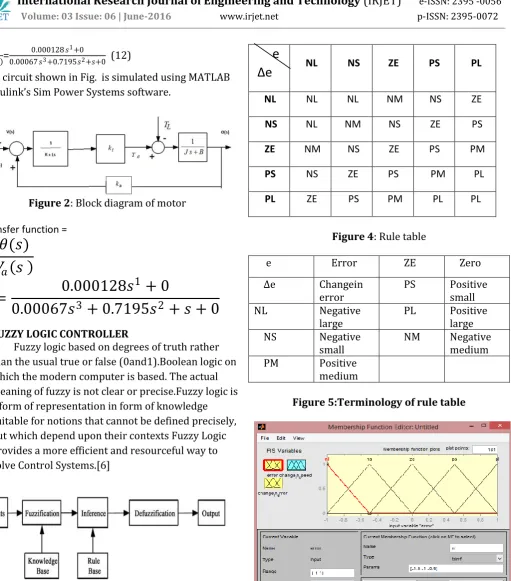
The circuit shown in Fig. is simulated using MATLAB Simulink’s Sim Power Systems software.
Figure 2: Block diagram of motor
Transfer function =
𝜃(𝑠)
𝑉
𝑎𝑠
=
0.000128𝑠
1
+ 0
0.00067𝑠
3+ 0.7195𝑠
2+ 𝑠 + 0
3.FUZZY LOGIC CONTROLLER [image:3.595.54.566.55.637.2]Fuzzy logic based on degrees of truth rather than the usual true or false (0and1).Boolean logic on which the modern computer is based. The actual meaning of fuzzy is not clear or precise.Fuzzy logic is a form of representation in form of knowledge suitable for notions that cannot be defined precisely, but which depend upon their contexts Fuzzy Logic provides a more efficient and resourceful way to solve Control Systems.[6]
Figure 3: Block diagram of fuzzy logic controller
e
∆
e
NL NS ZE PS PLNL NL NL NM NS ZE
NS NL NM NS ZE PS
ZE NM NS ZE PS PM
PS NS ZE PS PM PL
PL ZE PS PM PL PL
Figure 4: Rule table
e Error ZE Zero
∆e Changein error
PS Positive small NL Negative
large PL Positive large NS Negative
small
NM Negative medium PM Positive
[image:3.595.306.565.472.668.2]medium
Figure 5:Terminology of rule table
[image:3.595.37.285.549.638.2]© 2016, IRJET | Impact Factor value: 4.45 | ISO 9001:2008 Certified Journal | Page 1485
4.PI,PID CONTROLLER
The PI (proportional plus integral) controller function is most frequently used controller function in practical
applications. It does not cause offset associated with proportional control. It yields much faster response
than integral action. It is widely used for process industries for controlling variables like level, flow, pressure,, those do not have large time constants[2]. The definition for a proportional feed back control is still
U=𝐾𝑝𝑒 (13)
where
e = is the "error"
KP = Proportional gain
The definition of the integral feed back is
U=𝐾1e∫dt (14)
where KI is the integration gain factor.
In the PI controller we have a combination of P and I control, ie.:
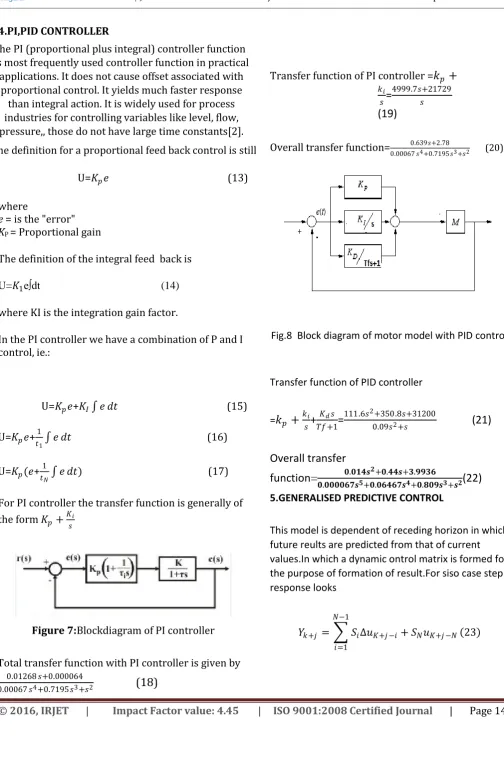
U=𝐾𝑝𝑒+𝐾𝐼 𝑒 𝑑𝑡 (15)
U=𝐾𝑝𝑒+ 1
𝑡1 𝑒 𝑑𝑡 (16) U=𝐾𝑝(𝑒+
1
𝑡𝑁 𝑒 𝑑𝑡) (17) For PI controller the transfer function is generally of the form 𝐾𝑝+
𝐾𝑖 𝑠
Figure 7:Blockdiagram of PI controller
Total transfer function with PI controller is given by 0.01268 𝑠+0.000064
0.00067 𝑠4+0.7195𝑠3+𝑠2
(18)
Transfer function of PI controller =
𝑘
𝑝+
𝑘𝑖𝑠
=
4999.7𝑠+21729
𝑠
(19)
Overall transfer function= 0.639𝑠+2.78
[image:4.595.38.543.75.843.2]0.00067 𝑠4+0.7195 𝑠3+𝑠2 (20)
Fig.8 Block diagram of motor model with PID controller
Transfer function of PID controller
=
𝑘
𝑝+
𝑘𝑖𝑠
+
𝐾𝑑𝑠𝑇𝑓+1
=
111.6𝑠2+350.8𝑠+31200
0.09𝑠2+𝑠
(21)
Overall transfer
function
=
𝟎.𝟎𝟏𝟒𝒔𝟐+𝟎.𝟒𝟒𝒔+𝟑.𝟗𝟗𝟑𝟔
𝟎.𝟎𝟎𝟎𝟎𝟔𝟕𝒔𝟓+𝟎.𝟎𝟔𝟒𝟔𝟕𝒔𝟒+𝟎.𝟖𝟎𝟗𝒔𝟑+𝒔𝟐
(22)
5.GENERALISED PREDICTIVE CONTROLThis model is dependent of receding horizon in which future reults are predicted from that of current values.In which a dynamic ontrol matrix is formed for the purpose of formation of result.For siso case step response looks
𝑌𝑘+𝑗 = 𝑆𝑖∆𝑢𝐾+𝑗 −𝑖+ 𝑆𝑁𝑢𝐾+𝑗 −𝑁
𝑁−1
𝑖=1
© 2016, IRJET | Impact Factor value: 4.45 | ISO 9001:2008 Certified Journal | Page 1486
6.PI (PZ METHOD) CONTROLLER
Pole zero placement is one of the most prominent method for design of PID controller it is based on Sylvester theorem.
𝐾𝑝 = −𝐷𝑒
𝑁𝑒 (24)
𝐾𝑖 = 𝑤2𝐷𝑜
𝑁𝑒 (25) C(s)=𝑠𝐾𝑝+𝐾𝑖
𝑠 (26)
7. RESULTS AND DISCUSSIONS
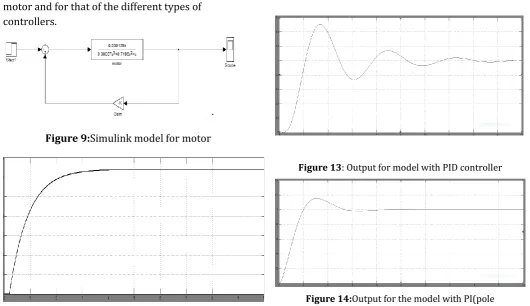
[image:5.595.35.552.5.783.2]All the transfer functions required for simulation were designed in simulink.The results obtained for step input are as follows for transfer function of motor and for that of the different types of controllers.
Figure 9:Simulink model for motor
Figure 10: Result for step input
Figure 11: Simulink model with controllers applied to motor model
Figure 12:Output for the model with PIcontroller
Figure 13: Output for model with PID controller
[image:5.595.33.564.437.743.2]© 2016, IRJET | Impact Factor value: 4.45 | ISO 9001:2008 Certified Journal | Page 1487
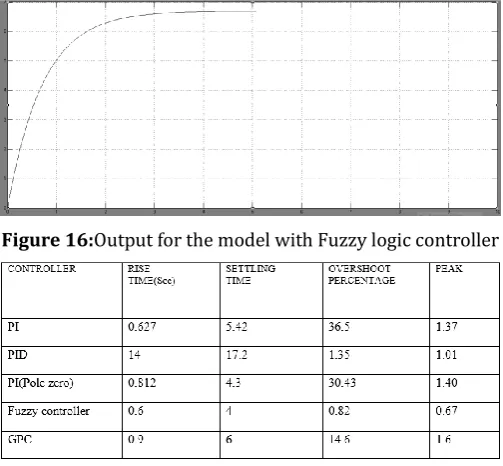
Figure 15:Output for the model with Generalised predictive controller
Figure 16:Output for the model with Fuzzy logic controller
Comparatively better responses are given by PI (Pole zero). PID (ZN) has transient behavior when compared to other two controllers. Settling time of PI (ZN) is large. PI (Pole zero) has no transients and less settling time. Fuzzy logic controller gave a response with lesser peak but the overshoot percentage of GPC is of higher percentage. The conventional controllers designed by Zeigler-Nicolas method gives better performance than Fuzzy and GPC controllers. Amongst all these controllers PI (Pole zero) gives the better performance.
8.CONCLUSION
This paper presents a study between the different types of controllers which were used to regulate the speed of an induction motor which were mathematically
modeled in SIMULINK of MATLAB[3].The designed system was successfully simulated for PI,PID,PI(Pole zero),GPC and fuzzy logic controllers to improve the performance of induction motor.
9.REFERENCES
[1] Speed control of induction motor using fuzzy-PI controller by Divya Asija in 2010 2nd International Conference on Mechanical and Electronics Engineering (ICMEE 2010).
[2] Speed control of induction motors using hybrid pi plus fuzzy by Gauri V. Deshpande1 and S.S.Sankeshwari in International Journal of Advances in Engineering & Technology, Nov. 2013. ©IJAET Vol. 6, Issue 5, pp. 2253-2261
[3.] Speed control of induction motor drive using universal controllerPuja Talukder, Prashant Kumar Soori, andBenetta Aranjo
[4] Modelling of induction motor & control of speed using hybrid controller technology by 1.Ashok Kusagar, 2.DR. S. F. Kodad, 3.DR. B V. Sankar ram
[5] Comparitive study of speed control of induction motor using pi and fuzzy logic control by Anmol Aggarwal, J. N. Rai, Maulik Kandpal
[6] Induction Motor Speed Control using Fuzzy Logic Controller by V. Chitra, and R. S. Prabhakar
[7].
Juan C. Balda and pragasen pillay“ Speed controller design for a vector-controlled permanent magnet synchronous motor drive with parameter variations