2018 3rd International Conference on Information Technology and Industrial Automation (ICITIA 2018)
ISBN: 978-1-60595-607-7
A Multi-Source Data Oriented Network
Intrusion Detection Framework
Based on Rough Set
Huilin Wu, Wenjuan Wu and Shiying Yu
ABSTRACT
Network Intrusion Detection System (IDS) plays an important role in defending against more and more network malicious attacks. As the structure of IDS is growing more and more complex, both the varieties and quantities of the network security devices in IDS are constantly growing, and the size of data that need to process in IDS is also growing rapidly. As a result, there is a need for a framework that can detect network attacks accurately and effectively, while can process multi-source data at the same time. In this paper, we propose a new multi-multi-source data oriented framework based on Rough Set for network intrusion detection. The experimental results show the proposed framework reduces the false alarm rate and improves overall detection accuracy. Furthermore, practical applications show that the framework can handle a large size of data in a complex IDS.1
KEYWORDS
Ids, Multi-Source Data Oriented, Rough Set, Network Security
1
Huilin Wu, Hebei Academy of Sciences Institute of Applied Mathematics, Shijiazhuang, 050081 China
Huilin Wu, Hebei Authentication Technology Engineering Research Center, No. 46 South Youyi Street, Shijiazhuang 050081, China
INTRODUCTION
In recent years, with the rapid popularization of computer Internet technology in China, new type of attacks on network information is also emerging continuously. Intrusion Detection System (IDS) is an important component that provides security to the network information by identifying various kinds of attacks occurring in the networks.
At present, intrusion detection technology has been greatly developed, but there are still several fatal weaknesses in existing systems, such us the high false alarm rate and false alarm rate, lack of self-evolution ability, poor effectiveness and low coordination between different models in a framework.
In this paper, we focus on two main challenges for IDS: the first one is to detect attacks from massive data as efficiently as possible, the second one is to combine and analyze heterogeneous data generated by different kinds of network security devices and detect network attacks from the data.
As the network is becoming more and more complex, and the network scale is growing larger and larger, the size of data that need to be processed in the IDS is also growing rapidly. So, it’s very important for an IDS to process massive data efficiently. The success of an intrusion detection system depends on how well it succeeds in maximizing its detection accuracy while minimizing its false alarm rate. However, the application of data mining to intrusion detection must rely on a large amount of data. It is difficult to build intrusion detection model because of the long training time of support vector machine. Previous researches show that the detection knowledge reduction method based on rough set can discover potential and effective detection rules, and the detection performance of the system is further improved. This paper combines rough set theory with intrusion detection technology, generates the minimum classification detection rules through knowledge reduction, and judges the normal and abnormal situation of data and behavior, so as to effectively improve the detection rate and reduce the error detection rate, so as to better serve the intrusion detection system.
On the other hand, to strengthen the capability of IDS, both the variety and quantity of network security devices are both increasing. The data generated by different devices is heterogeneous as well as asynchronous. However, the data is also associated, we need to do data mining in the data, that will be very helpful for attack detection. As a result, there is a need for a framework that can process massive and multi-source data effectively and accurately for IDS. Existing IDS always focus on how to improve the detection accuracy and efficiency, and the combination and data mining in the multi-source data didn’t arouse much attention. To solve this problem, we also propose a new method to standardize heterogeneous data and mine the associations among the asynchronous data.
detect network security attacks timely. First, the framework can process heterogeneous and asynchronous data that is generated by different source, and the mine the association among the data to detect potential attacks. Second, we propose a Rough Set based algorithm to improve detection accuracy and reduced false alarm rate, with a good accuracy at the same time. In the end, we evaluate the performance of our framework in a public dataset NSL-KDD and show that the algorithm outperforms than the state-of-art researches on accuracy. Furthermore, we show that in the practical application scenarios, our framework can draw up an effective strategy to handle network attacks in real time.
The rest of the paper is organized as follows: Section 2 describes the definitions and theory for the proposed RST technique. Section 3 discusses the proposed framework and the related procedures. Section 5 takes experiment and gives the results. Section 6 concludes the paper.
FUNDAMENTALS OF ROUGH SET THEORY
Anomaly detection have succeeded at spotting new and unfamiliar attacks in practice, it has remained a heavily researched topic in the intrusion detection field [1]. At the moment, machine learning approaches are used for intrusion detection such as SVM、Neural Network、Rough Set Theory, Naïve Bayes, Random Forest and Decision Tree, etc. Previous research has shown that the Rough Set Theory (RST) is very effective for feature extraction and attribute reducing, so in our framework, we use RST as the classifier.
Rough set is a method of dealing with incomplete information proposed by Professor Pawlak of Warsaw University of Technology in Poland in 1982. It does not need any prior information and can effectively analyze and process incomplete, inconsistent and inaccurate data[2]. By analyzing a large number of data, the compatible information is removed according to the dependencies of two equivalent relations in the universe, and the potentially valuable rule knowledge is extracted. This method has been widely used in knowledge acquisition, rule extraction, machine learning, decision analysis, pattern recognition, data mining and other fields. It is very suitable for learning and discovering security rules[3]. This paper attempts to use rough set rules to effectively detect user data and behavior.
Define 1 Given set U and equivalent relation set R, the partition of data set U under equivalent relation set R is called knowledge, which is called U/R.
Define 2 A given knowledge base is a relational system K= (U, R), U is the universe, R is a family of equivalent relations on U.
approximately by using two exact sets, the upper approximation and the lower approximation.
Define 3 the lower approximation of R for X: RX =∪ {Y∈ U /R|Y⊆ X}.
Define 4 the upper approximation of R for X:
R
̅X =∪ {Y∈ U /R|Y∩ X≠ Φ}.
Knowledge reduction is one of the core contents of rough set, so-called knowledge reduction is to delete irrelevant or unimportant knowledge while keeping the classification ability of knowledge base unchanged.
Definition 5 Set Q⊆P, if Q is independent and Ind (Q) =Ind (P), then Q is called a reduction of P. The set of all necessary relations in P is called the core of P and is written as core (P). The relation between kernel and reduction is as follows: core (P) = ∩red (P).
Definition 6 A knowledge representation system is a quaternion S = (U, A, V, f), in which U: the empty finite set of objects is called the universe; A: the non-empty finite set of attributes; V:⋃a∈AVa, Va is the range of attributes a; f: U× A→ V is an information function, which assigns an information value to each attribute of an object, namely:
a∈ A, x∈ U, f(x,a)∈ Va.
Decision table is a special and important knowledge representation system. Most decision-making problems can be expressed in the form of decision tables, which play a very important role in decision-making applications.
Definition 7 Let S = (U, A, V, f) be a knowledge expression system, A=C∪D, C∩D=Φ, C is called conditional attribute set, D is called decision attribute set, the knowledge expression system with conditional attribute and decision attribute is called decision table.
Definition 8 (a, V), (a indicates the attribute value, V indicates the value of the attribute) is an atomic formula, and the atomic formula is also a formula.
Definition 9 if A and B are formulas, then A, A∪B, A∩B, (A), A→B are formulas.
Definition 10 the formula consisting only of definition 8 and definition 9 is a formula.
Definition 11 The logical meaning of Formula A→B becomes the decision rule, A becomes the rule precursor, and B is called the rule consequent. They express a causal relationship. Formula A contains only conditional attributes in the decision table, while formula B contains only result attributes in the decision table.
INTRUSION DETECTION FRAMEWORK
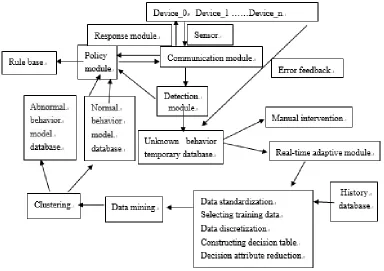
table are reduced, and the output rules are generated. Then the rule base of security system is constructed, the intrusion detector is generated[4], and the initial detection model is established. In the operation of the system, we gradually improve and improve the model to achieve the best detection results.
Data Integration Module
As mentioned before, data is generated by different network security devices, so the data is heterogeneous as well as asynchronous. In the data module, firstly, we do data profiling, cleaning, data standardization. The conversion of numerical and nominal values is required according to the classification model. Normalization is essential to enhance the performance when datasets are too large[5]. Here, we have used min-Max method of normalization. Then, we get a massive and normalized database.
RST-Based Anomaly Detection Module
In this module, first, we use the RST algorithm to do the decision attribute reduction. We select training data from the dataset, then do data discretization, construct decision table. After that, we apply the RST algorithm. In RST, Rossetta [6] was used as data mining software for selecting the highest rank feature. Using the Genetic and the Full mode, 22 subtracted sets were obtained and eight parameters were selected with the highest rank as the most important features.
Second, we apply data mining and clustering method on the training dataset, then we build 2 libraries: abnormal behavior pattern library and normal behavior pattern library. The rules of intrusion detection are generated. After attribute reduction, the redundant attribute values can be deleted to complete value reduction, the decision table is constructed, and then the rules are derived from the decision table. The rules are checked and verified, and put into the rule base. The security detector detects the data and behavior according to the rules in the rule base.
Decision-Making Module
Data collected by all devices in the system is the input of this module. After the data preprocessing procedure, the module analyze the data and match the data with abnormal behavior pattern library and normal behavior pattern library, then the module recognize whether the data is abnormal or not, and draw up a strategy accordingly. For the data that can’t be matched to normal or abnormal behavior, we output it to the self-adaptive module.
Self-Adaptive Module
anomaly detection module, and the output is integrated to the pattern libraries and update them. So the pattern libraries are dynamic adapted according the network and can always detect the network intrusions.
Figure 1. Example of figure.
INTRUSION DETECTION ALGORITHM BASED ON RST
Intrusion detection algorithm can be divided into 2 stages, detection rules generation and detection model learning and updating. The idea of intrusion detection algorithm based on rough set is described as follows:
Algorithm: Intrusion detection algorithm based on Rough Set
Input: Users collected by the system use data and behavior data set S={si|si∈
Userdata or Actdata} to represent the attribute set A in the rough set.
Output: The data and behavior detection rule R={r|Wi=>Ci} is then added to the
security rule library K= {ki| ki∈ IDR-Base}.
Stage I: Set up intrusion detection rules
Step 2. For I = 1 to n, do: For any attribute a ∈ A, according to attribute value Sa, proceed from small to large (Sort (w)), according to attribute weight maximum and minimum value, given parameter k i n advance, get breakpoint set Con (i), I = 1 to K.
Step 3. The decision table ST is constructed with discretized attributes of weights. The reduced attributes set S' is used as conditional attributes and all security rules are used as decision attributes set.
Step 4. Attribute reduction, For I = 1 to n, do: For each attribute AI i n attribute set S, attribute reduction detection Card (ai), set reduce-set = S, if (Card (S) = Card (S-ai), then delete (ai), end do.
Step 5. The decision table is simplified and analyzed, and the redundant and unreasonable rules R0 are eliminated, so that R = R - R0 generates a set of security detection rules R ={r | Wi = > Ci}.
StageⅡ. Intrusion detection analysis
Step 6. The simplified safety detection rules are given to the safety detector for data testing and analysis, and then K = K + R is reasonable.
Step 7. Select the appropriate training samples for multiple training, improve the security detection model and update the detector until a certain misuse rate and false alarm rate is met.
If(Check(ri)==true or GetNewRule()) Then K=K+ ri;
Else if(Check(ri)==false or DeleteRule()) Then K=K-ri;
End if。
Step 8. The algorithm is finished.
EXPERIMENTS
Experimental Environment
Experimental Result
[image:8.612.113.481.186.260.2]After data preprocessing and attribute weight discretization, 4190 training data and 2014 test data are obtained. The intrusion detection algorithm based on rough set is processed. After many tests, the following results are obtained (Table I).
TABLE I. DETECTION RATE AND ERROR RATE TEST DATA (%).
Attack mode Detection rate Error detection rate
Normal data 94.67 4.64
Dos attack 85.68 11.91
U2R attack 77.92 11.72
R2L attack 78.75 13.04
Probe attack 82.86 9.11
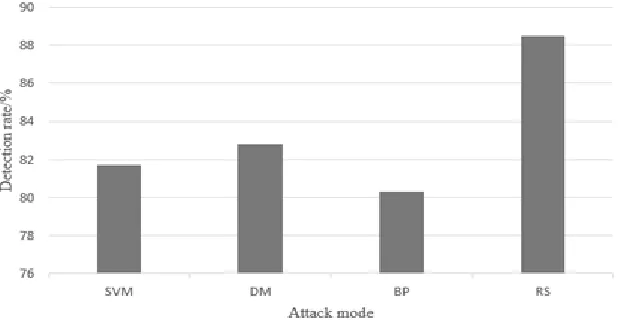
[image:8.612.158.467.468.628.2]From the table data statistics, we can see that the network intrusion detection algorithm based on rough set detection method has been improved in detection rate and error detection rate, which satisfies the security detection requirements of the system. However, due to knowledge reduction, some attributes may be deleted, so that the integrity of the data is affected, there is information loss, and the table reflects a certain category of low detection rate and high error detection rate. But from the detection rate and error detection rate of other attacks, the efficiency and effectiveness of the algorithm has been greatly improved. In order to further verify the validity of the algorithm, we compared it with other intrusion detection methods, such as data mining method (DM), support vector machine method (SVM) and BP neural network method (BP). The following experimental results are obtained (shown in Figure 2).
Compared with other intrusion detection methods, Rough Set has some improvement in detection rate and error detection rate. Because the application of data mining in intrusion detection needs a large amount of data support, and the training speed and computation of detection methods based on support vector machine and BP neural network are relatively large, the effectiveness and detection rate of detection algorithm based on BP neural network, support vector machine and data mining are obviously lower than that based on rough. The method of set detection also fully proves the validity of rough set theory applied to system intrusion detection.
CONCLUSIONS
In this paper we propose an intelligent intrusion detection framework. There are two main contributes in the framework. First, the framework can integrate multi-source data. We integrate data that is heterogeneous and asynchronous by apply data cleansing, standardization and analyses, then we get a massive dataset, on which we can do data mining and build our behavior pattern libraries. Moreover, for the unknown behavior data, we add it to the training dataset and evolve the pattern libraries. Second, we combines rough set algorithm with intrusion detection technology to realize system security detection. Experimental results show that rough set method has a great improvement in detection rate and error detection rate than other detection methods. It can provide more accurate detection reports, and thus can provide efficient intrusion detection services for information systems. Furthermore, we have already implement the framework into practical applications, and results show that our framework can significantly help protect network security.
ACKNOWLEDGEMENTS
This work was supported by the Science and Technology Support Program of Hebei Academy of Sciences (181610), the Science and Technology Support Program of Hebei Province (18210316D).
REFERENCES
1. X.S. Gan, J.S. Duanmu, J.F. Wang, W. Cong. 2013.Anomaly Intrusion Detection Based on PLS Feature Extraction and Core Vector Machine, Knowl. Based Syst. Vol. 40, pp. 1–6.
2. Alom M Z, Bontupalli V R, Taha T M. Intrusion Detection Using Deep Belief Networks[C]// IEEE Aerospace and Electronics Conference, June 15-19, 2015, Dayton, OH, USA.NJ: IEEE, 2016:339-344.
4. Q Zhang, Q Y Zhu, M F Zhang, et al. Dynamic Service Placement in Geographically Distributed Clouds [J]. IEEE Journal on Selected Areas in Communications, 2013, 31(12):762-772.
5. J Pei, J Han, Mortazaviasl B, et al. Mining Sequential Patterns by Pattern-Growth: the Prefix Span Approach[J]. IEEE Transactions on Knowledge and Data Engineering, 2004, 16(11):1424-1440.