THE DETERMINANT FACTORS OF KMS USAGE TOWARDS
ORGANIZATIONAL PERFORMANCE IN OIL AND GAS
INDUSTRY
1 AKBAR BADPA, 2 JUHANA SALIM, 3 JAMAIAH YAHAYA, 4 SEDIGHEH SHAKIB
KOTAMJANI
1,2,3 Faculty of Information Science and Technology, Universiti Kebangsaan Malaysia, 43600, Bangi,
Selangor, Malaysia
4 Faculty of Educational Studies, Universiti Putra Malaysia, 43400 Serdang Selangor, Malaysia
E-mail: 1[email protected], 2[email protected], 3[email protected],4[email protected]
ABSTRACT
Knowledge management (KM) brings about organizational performance and competitive advantages. To make KM practice successful in organizations, KM initiatives or Knowledge Management System (KMS) is required. KMS is the technology that supports KM in creating, sharing, transferring and disseminating knowledge. Likewise, KMS usage brings about organizational performance and competitive advantages in organizations in different sectors such as oil and gas industry. However, systematic review of literature shows that although oil and gas industry has been investing immensely in KMS development, KMS usage has remained sluggish or even failed. Further, there is a paucity of study on determinants of KMS usage in oil and gas industry. Therefore, the current paper developed a conceptual model based on the main information system theories, namely: theory of planned behavior (TPB), technology acceptance model (TAM), and task-technology fit (TTF). Based on KM literature The combination of TAM, TTF and TPB provide a strong predictive power concerning participants‟ use of KMS.
.
The paper integrates the core constructs of the above theories and the factors extracted from the literature stream on KMS. As a result, the paper develops a conceptual model composed of four main dimensions: human, technology, organization and knowledge. The endogenous variable is KMS usage and the dependent variable is organizational performance. Thus, this study provides synopsis of effective factors of KMS usage towards organizational performance that helps system developers and managers at petroleum industry to consider the importance of KMS usage. Thus, the study has theoretical and practical implications.Keywords: Knowledge Management, Information Technology, Information Science, Knowledge
Management System Usage, Organizational Performance
1. INTRODUCTIONS
Nowadays, in the globally highly competitive business environment, knowledge management (KM) plays a crucial role in the organizational performance and competitive advantage. The knowledge-based perception insists on the combination and application of tangible resources (such as knowledge in database) and non-tangible resources (such as knowledge residing in human mind) of organizations to render desired organizational performance and competitive advantage. Along with KM initiatives and innovative thinking, knowledge management systems (KMSs) are designed and developed to
make KM practical in organizations. KMS, as a class of Information System (IS), enhances the job of knowledge creation, transfer, storage and sharing in organizations (Alavi & Leidner 1999). KMS involves both human and technology in organizations to manage organizational knowledge for the organizational performance and
relationships between KMS usage and organizational performance (Anantatmula & Kanungos 2010; He et al. 2009).
Organizational performance is one of the main concerns of developing countries. Organizations in developing economies are struggling to enhance their organizational performance and competitive advantages through using KMS (Danish et al. 2014; Ha et al. 2015). Findings show the positive impact of KMS on organizational performance within the context of developing economies (Kasim 2008; Muhamad Khalil Omar et al. 2016). It is argued that most industries in the developing countries are seeking for their organizational performances through KM practices (Nawab et al. 2015). One of the important sectors is oil and gas industry (Akeel 2013; Li et al. 2016) where immense amount of money is invested in KMS development (Grant 2013). The realization of improvement in organizational performance is associated with effective KMS usage. Studies also highlighted the significance of KMS usage for oil and gas industry (Gardiner 2014; Al Busaidi 2010; Garnt 2013). Braganza et al. (2008) reported that KMS helps oil and gas industry solve the problems connected with services. Akeel (2013) holds that KMS helps cover all the activities of oil and gas industry. Elgobbi (2008) asserts that KMS is crucial for organizations which are seeking for competitive advantages. He adds that KMS helps companies obtain improved quality, cost saving and more rapid development cycles. KMS enhances innovation; strengthens organizational performance; increases the knowledge effectiveness of organization (Elgobbi 2008; Gardiner 2014). However, despite huge investment in KMS in oil and gas industry, there are failure stories of KMS usage (Grant 2013; Leavitt 2002). This suggests that the effective factors of KMS usage be explored to find solutions to the issues of KMS usage.
Knowledge management system (KMS) is the backbone of organizations and provides the necessary infrastructure for KM practices and processes towards organizational performance and competitive advantages. To this end, organizations are growingly investing huge amount of money in developing KMS. However, merely developing IT and KMS would not lead to KMS usage and organizational performance (Oyefolahan et al. 2012). It is argued that besides technology development, the role of human must be taken into account (Drew 1999; Wint 2016). This is because individuals as the end users of the KMS are
affected by social, cultural and political influences (Gardiner 2014). Organization is another determinant of using KMS as the leadership with different styles along with the structure of organization could influence system usage (Wang & Lai 2014). Knowledge features such as its type, source and quality are effective in KMS usage (Elgobbi 2008; Wu & Wang 2006). As such, there are four main dimensions of KMS usage: human, technology, organization, and knowledge, which determine KMS success in different organizations (Hester 2012; Wint 2016). It is argued that oil and gas is one of the pioneers in adopting technology to enhance KM practices through KMS development (Grant 2013; Leavitt 2002). The KMS usage is annually saving millions of USD for oil and gas companies (Grant 2013), though there are stories of KMS failure (Frost 2013). However, comprehensive literature review points out that there is a scarcity of study on the main determinants of KMS usage in oil and gas industry. It is not clear what factors represent the main antecedents of KMS usage in this industry. More importantly, in developing economy very little knowledge is available about the influencing factors of KMS usage. This limitation calls for a comprehensive literature review to explore the main underlying constructs that influence KMS usage towards organizational performance in oil and gas industry to help management address the issue of unwillingness to and withdrawal of KMS usage.
However, there are very limited studies building a conceptual model through integrating the theories of information system, namely technology acceptance model (TAM), theory of planned behavior (TPB) and Task-Technology-Fit (TTF) with four dimensions of KMS usage to measure its determinant factors towards organizational performance, particularly, in the context of oil and gas industry in a developing economy. Such a study on determinant factors of KMS usage will provide a basis for oil and gas organizations to stimulate the decision makers in supporting KMS usage, subsequently, to suggest ways to enhance KMS usage and decision making and bring about organizational performance and competitive advantages (Dickel & Moura 2016).
dimensions based on TPB, TAM, TTF. The objective of this paper is to develop a conceptual model covering the well-known information system theories and the main determinants of KMS usage towards organizational performance in oil and gas industry in developing economy. The paper may provide insights for both public and private petroleum organizations operating in the developing countries within developing economy. The study may significantly impact the view of decision makers, foreign oil and gas giants investing in developing economy and the top level managers at petroleum companies to consider the importance of effective factors of KMS usage for the purpose of organizational performance and competitive advantages.
2. KMS USAGE TOWARDS
ORGANIZATIONAL PERFORMANCE
Knowledge management system (KMS), as a class of IS, supports KM practices. KMS facilitates organizational learning through capturing the important knowledge and making it accessible to the employee upon requirement for reuse. KMS is the system that upholds the company history, experience, as well as expertise, which long-term employees possess. The knowledge that is incorporated into the KMS helps the extant employees and their successors to run the tasks and businesses. In the context of this study, KMS refers to technology as well as management of knowledge creation of experiences and insights which reside inside the human minds. KMS usage is associated with the implementation, analysis, and development of knowledge in such a way that the organization can learn and create knowledge to promote better decision making and result in organizational performance and competitive advantages (Huang et al. 2008; Kulkarni et al. 2006). However, in the context of oil and gas industry, it is necessary to build understanding of the effective dimensions and factors of KMS usage towards organizational performance to help address the issue of sluggishness, withdrawal or failure of KMS usage.
2.1 Effective Factors of KMS Usage in Oil
and Gas Industry
The literature review analysis showed that four dimensions, namely human, technology, organization and knowledge have strong influences on KMS usage. The Human dimension has an important role in KMS usage in organizations, even more significant than technology (Drew 1999),
though its role has been marginalized in the literature of KMS usage until recently (Hester 2012; Wint 2016). As indicated in Table 1, the human dimension is comprised of commitment, subjective norms, trust and socio-political influences, which are catalyst to KMS usage. It is argued that a person’s commitment to organization, the subjective and social norms, the trust and social, political, religious and cultural factors determine an individual’s KMS usage.
The Technology dimension consists of perceived usefulness, perceived ease of use, KMS-self-efficacy, and Task-KMS-Fit. An individual’s attitude towards the usefulness of a system for enhancing job performance and productivity and the easiness, effectiveness and flexibility of the system would encourage him/ her to use the system (Davis 1989). An individual’s self-efficacy and perception of his/her capability in using KMS could strongly affect his system usage (Huang et al. 2008). A match between a task requirement and technology functionality in an organization would impact system usage (El Said 2015; Im & Raven 2003). The Organization dimension is consisted of organizational structure and leadership. In an organization, the activities such as task allocation, coordination and supervision (Spender 1994) coupled with leadership with different styles to manage organizational knowledge contribute to and explain the knowledge workers intension to use KMS (Al Busaidi et al. 2010; Yukl 2002).
2.2 KMS Usage Challenges in Oil and Gas Industry
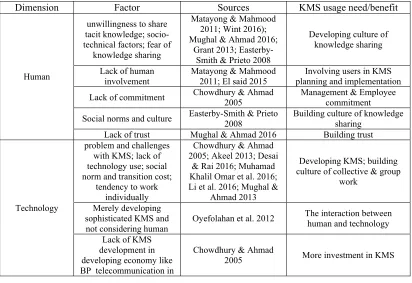
KMS usage has different challenges associated with different dimensions and factors, as shown in Table 2. As indicated in Table 2, there are different challenges and issues associated with KMS usage attributed to different dimensions (human, technology, organization and knowledge) in the context of oil and gas industry.
2.3 Integration of KMS Usage Dimensions
and Factors
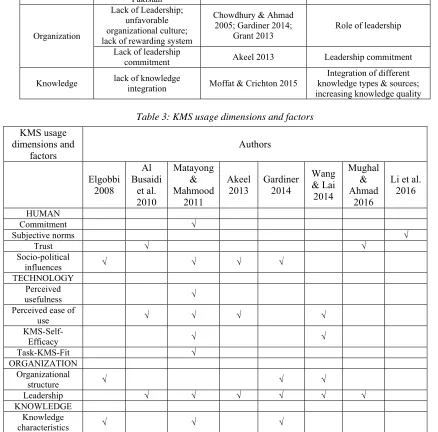
[image:4.612.98.514.262.418.2]Table 3 illustrates the KMS usage dimensions, factors, and the researchers who have investigated these dimensions and factors. The current study is suggesting the integration of these dimensions and factors to provide a comprehensive explanation of the effective factors of KMS usage. This could address or find solutions to KMS usage failure or withdrawal.
Table 1: Effective factors of KMS usage in oil and gas industry
Dimension Factor Sources
Human
Commitment Matayong & Mahmood 2011
Subjective norms Li et al. 2016
Trust Mughal & Ahmad 2016
Socio-political influences Elgobbi 2008; Akeel 2013; Gardiner 2014
Technology
Perceived usefulness Al Busaidi et al. 2010
Perceived ease of use Al Busaidi et al. 2010; Matayong & Mahmood 2011;
KMS-Self-efficacy Wang & Lai 2014
Task-KMS-Fit Matayong & Mahmood 2011
Organization
Organizational structure Chowdhury & Ahmad 2005; Wang & Lai 2014
Leadership Matayong & Mahmood 2011; Chowdhury & Ahmad 2005; Mughal & Ahmad 2016; Wang & Lai 2014; Al Busaidi 2010;
Knowledge Knowledge characteristics Elgobbi 2008; Matayong & Mahmood 2011
Table 2: KMS usage challenges in oil and gas industry
Dimension Factor Sources KMS usage need/benefit
Human
unwillingness to share tacit knowledge; socio-technical factors; fear of
knowledge sharing
Matayong & Mahmood 2011; Wint 2016); Mughal & Ahmad 2016;
Grant 2013; Easterby-Smith & Prieto 2008
Developing culture of knowledge sharing
Lack of human involvement
Matayong & Mahmood 2011; El said 2015
Involving users in KMS planning and implementation Lack of commitment Chowdhury & Ahmad 2005 Management & Employee commitment
Social norms and culture Easterby-Smith & Prieto 2008 Building culture of knowledge sharing Lack of trust Mughal & Ahmad 2016 Building trust
Technology
problem and challenges with KMS; lack of technology use; social norm and transition cost;
tendency to work individually
Chowdhury & Ahmad 2005; Akeel 2013; Desai
& Rai 2016; Muhamad Khalil Omar et al. 2016; Li et al. 2016; Mughal &
Ahmad 2013
Developing KMS; building culture of collective & group
work
Merely developing sophisticated KMS and not considering human
Oyefolahan et al. 2012 The interaction between human and technology
Lack of KMS development in developing economy like BP telecommunication in
Chowdhury & Ahmad
[image:4.612.97.518.452.739.2] [image:4.612.101.513.455.738.2]Pakistan
Organization
Lack of Leadership; unfavorable organizational culture; lack of rewarding system
Chowdhury & Ahmad 2005; Gardiner 2014;
Grant 2013
Role of leadership
Lack of leadership
commitment Akeel 2013 Leadership commitment
[image:5.612.81.519.104.536.2]Knowledge lack of knowledge integration Moffat & Crichton 2015 knowledge types & sources; Integration of different increasing knowledge quality
Table 3: KMS usage dimensions and factors
KMS usage dimensions and
factors Authors
Elgobbi 2008
Al Busaidi
et al. 2010
Matayong & Mahmood
2011
Akeel
2013 Gardiner 2014
Wang & Lai 2014
Mughal & Ahmad
2016
Li et al. 2016
HUMAN
Commitment √
Subjective norms √
Trust √ √
Socio-political
influences √ √ √ √
TECHNOLOGY Perceived
usefulness √
Perceived ease of
use √ √ √ √
KMS-Self-Efficacy √ √
Task-KMS-Fit √
ORGANIZATION Organizational
structure √ √ √
Leadership √ √ √ √ √ √
KNOWLEDGE Knowledge
characteristics √ √ √
As indicated in Table 3, different authors have identified various determinant dimensions and factors of KMS usage in the context of oil and gas industry. This suggests that these dimensions and factors be integrated into a model with a more comprehensive, parsimonious explanatory and predictive power for understanding the effective factors of KMS usage towards organizational performance.
3. RELATED WORK
Given the importance of understanding the theoretical foundation of the effective dimensions and factors of KMS usage towards organizational
performance, the following sections discuss the integration of information system theories, followed by the process of research model development in the context of oil and gas industry.
3.1 Theoretical Background
The review process concerning KMS usage identified many theories which lay the foundations of many researches. Based on literature review, all of the theories were not given equal
broadness, consistency, predictability, viability and testability. Previous empirical studies have used different theories to explain and predict KMS adoption, diffusion, implementation, and usage. The adopted theories include: the theory of reasoned action (TRA) (Ajzen & Fishbein 1980), theory of planned behavior (TPB) (Taylor & Todd 1995), the technology acceptance model (TAM) (Davis 1989), task-technology-fit (TTF) (Goodhue & Thompson 1995), social cognitive theory (SCT) (Bandura 1986), social capital theory (Putnam 1993); the IS success model (DeLone & Mclean 1992, 2003), and the IS continuance model (Bhattcherjee & Premkumar 2004), which have been noted as core theoretical model that have been directly applied to KMS studies (Matayong & Mahmood 2013). However, review of past studies indicates that the theories of TAM, TPB and TTF have widely been used in the context of KMS usage. Thus, the present study will integrate these three theories to establish a conceptual model representing the main determinants of KMS usage in oil and gas industry. In what follows the integration of these theories is discussed at length.
It is argued that KM and KMS are complex and multifaceted phenomenon (Alavi 2001; Michael et al. 2000). In the context of KMS, researchers mainly adopt and integrate socio-psychological and system use theories such as TAM, TPB and TTF to generate parsimonious models with strong predictive and explanatory power (Liao et al. 1999).
Having been driven from socio-psychology, TAM and TPB are used to determine the user’s behavioral intention towards information system usage (Ajzen 1991; Davis 1989; Kuo & Lee 2009). The core constructs of TAM, i.e. PU and PEOU are context-free, flexible and applicable to various research contexts. The social variables of TPB provide more accurate explanation of user’s intention to use the system compared to TAM; and TPB is rich in explaining and predicting the variables that affect the behavioral intentions to IT system usage (Mathieson 1991; Taylor & Todd 1995). Nonetheless, they complement each other and provide a better predictive power towards system acceptance and usage, when integrated.
TTF is adopted from information system field and places emphasis on the match between technology and the task that the technology is designed for (Goodhue & Thompson 1995). It is argued that the integration of socio-psychological
theories and IS theory provides a far stronger predictive and explanatory means than each model alone (Dishaw & Strong 1999). Integration of TAM and TTF provides a model with a strong theoretical foundation to explain the user’s behavior in utilizing system (Dishaw & Strong 1999). These models provide diverse but overlapping perspectives on user’s behavior in relation to KMS use. As each of these models provides a significant explanatory power, consequently, a model established through the integration of these theories might offer significantly more improvement than either model alone (Dishaw & Strong 1999).
Besides, integration of TPB and TTF also establishes a model with strong predictive power (Kankanhalli et al. 2005). TPB posits that human intention to use information system relies on his/her attitudes towards technology, subjective norms and perceived behavioral control (PBC) (Taylor & Todd 1995). TTF provides the fitness between technology and a particular task the individual is completing using the technology. The subjective norms, social and cultural factors can affect user’s intention to use technology for performing tasks. Findings show that intention to system usage and knowledge sharing positively impacts task-KMS-fit (El Said 2015).
Literature evidences numerous studies on theory integration: for example, integration of TAM and TPB in online tax study (Wu & Chen 2005), TAM and TTF to investigate utilization and performance in system use (Dishaw & Strong 1999), TAM and TTF to investigate technology adoption in e-commerce (Klopping & McKinney 2004), TPB and TTF to examine usage of EKR and knowledge seeking (Kankanhalli et al. 2005), TAM and TTF to investigate actual KMS usage (Wu et al. 2006), TAM and TPB to examine the use of online banking system (Chandio 2011), and TAM and TPB to identify significant factors and antecedents to intention to online learning (Saade et al. 2011).
commonly used theories, namely TPB, TTF and TAM develop a model representing the main determinants of KMS usage. Applying the results of the studies conducted in the contexts of developed countries to developing countries may cause the practicability and applicability issues of data collection, analysis and interpretation. Therefore, investigating KMS usage by adopting and integrating TPB, TTF, and TAM theories through data collection in the context of a developing economy is reasonable. the conceptual model proposed in this research paper contributes as research framework for empirical studies in petroleum industry within the scope of developing economy.
4. RESEACH MODEL DEVELOPMENT
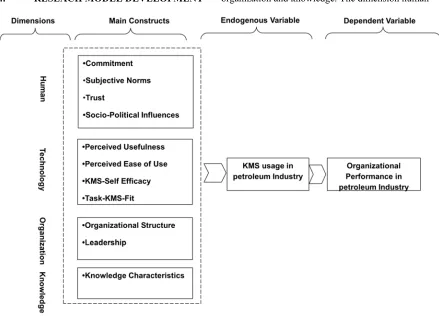
[image:7.612.92.531.289.605.2]This section discusses the process of identifying the main constructs of the conceptual model as well as developing the research model. As discussed, the model is established based on the information system theories, namely TAM, TPB, and TTF. As illustrated in Figure 1, the proposed conceptual model comprises of three parts, namely exogenous variables (dimensions & the main constructs), endogenous variable (KMS usage) and dependent variable (organizational performance). Three information system theories: TAM, TPB and TTF were adopted based on their comprehensive, specific measurement categories, viability, large-scale validity and applicability to KMS usage. The dimensions include human, technology, organization and knowledge. The dimension human
Figure 1: The conceptual model of KMS usage towards organizational performance
contains four constructs: commitment, subjective norms, trust, and socio-political influences. The construct ‘subjective norms’ was adopted from TPB. Commitment, trust and socio-political influences were extracted from the literature stream on KMS usage. The dimension ‘technology’ encompasses perceived usefulness (PU), perceived ease of use (PEOU), KMS-self-efficacy and
4.1 Human Dimension
4.1.1 Commitment (CT)
Commitment is defined as the relative strength of a person’s compliance, identification with, involvement in, internalization, and emotional attachment to a particular group or organization (Malhotra & Galleta 2003; Steers 1997). Commitment to an organization such as oil and gas industry reveals the sense of responsibility to collaborate and involve in activities, such as using KMS, due to the common interest and shared membership (John et al. 2004). Commitment is affected by the extrinsic rewards, social recognition, self-referential and self-generation (Malhotra & Galleta 2003). At the level of self-referential and self-generation, the knowledge worker is genuinely invested in using KMS. Commitment initially emerges and develops out of personal relationships but it can ensue to a social group in organizations that the person belongs to.
In the context of oil and gas, commitment plays a key role in using KMS (Elgobbi 2008). Leadership has a critical role in enhancing staff commitment to KMS usage (Arafa 2015; Chowdhury & Ahmad 2005). In order to increase the staff commitment, they need to be involved in the process of KMS adoption and implementation (Akeel 2013; Grant 2013; Mughal & Ahmad 2016). A study suggests that senior management support, incentives, and integration of work practices increase employee’s commitment (Arafa 2015). Findings show that when extended to the theories of TAM, TPB and TTF, commitment has a strong impact effect on KMS usage (Goh & Sandhu 2013; Lin & Huang 2008). Extending TPB by commitment, prior studies indicate that commitment encourages participants to use online learning system (Abdur-Rafiu & Opesade 2015; Goh & Sandhu 2013).
Jarupathirun and Zahedi (2006) extended TTF by commitment and found that TTF and commitment predict system usage and organizational performance. This shows the compatibility of commitment with information system theories. Previous studies indicated that commitment influences user’s intention to KMS usage (Cheung & Lee 2009; Abdur-Rafiu & Opesade 2015). Cheung and Lee’s (2009) research showed that commitment is a strong predictor of user’s continuous use of the system. Therefore, the current research hypothesizes that the individuals working in oil and gas industry in developing
economy will probably be committed to KMS usage towards organizational performance, which is well-reflected in the following hypothesis: H1. Commitment has a significant and positive effect on KMS usage
4.1.2 Subjective norms (SN)
Subjective Norms (SN) is defined as “an individual’s perception that most people who are important to him/her think he/she should or should not perform a particular behaviour” (Fishbein & Ajzen 2011:131). SN is the perceived interpersonal or social strain to engage or not to engage in some sorts of conduct such as KMS usage (Amy & Collins 2013). An individual will show a higher tendency to use system and share knowledge if he/she perceives conformity and compliance to the social norms is crucial (Goh & Sandhu 2013). Findings recommend that superiors and co-workers’ relationships affect one’s KMS usage (Ong et al. 2005). SN has substantial impact on behavioral intention to use KMS (Ajzen 2012; Ong et al. 2005). In organizations, staff members are usually motivated to use KMS due to their job performance, which is influenced by their supervisors and co-workers comparative nature of job environment. (Ong et al. 2005). Ong et al. (2005) indicated that subjective norms of society have a positive effect on the intention to KMS usage.
In addition to having direct influence on intention to KMS usage (Venkatesh et al. 2003), SN has indirect effect on intension to use system through PU in TAM model (Chow & Chan 2008; Huang, Davison & Gu 2008; Pamela et al. 2012). Study findings on the influence of SN on KMSU are inconsistent as some agree (Goh & Sandhu 2013; Lee 2004), while others disagree with its predictive power of KMSU (Abdur-Rafiu & Opsade 2015; Huang & Chen 2015). Hence, in conformity with the literature stream (Kuo & Young 2008; Lee 2004; Pamela et al. 2012), it is hypothesized that SN might affect employees’ KMSU towards organizational performance, which is verified in the following hypothesis: H2. Subjective Norm has significant and positive effect on KMS usage
4.1.3 Trust (TR)
perform a particular action important to the trustor, irrespective of the ability to monitor or control that other party” (Mayer et al. 1995:712). Trust was found as one of the most intense mechanisms for decreasing complexity and perceived risk of process through positive outcome of system usage (Abdur-Rafiu & Opesade 2015; Goh & Sandhu 2013; Gefen 2004). Trust has been found as an effective factor on users’ behavior to take an effort and devote time to use system (Tatcher et al. 2010; Tung et al. 2008; Jen-Her & Wang 2006). In an organization, trust may persuade the workers to work collaboratively and effectively (Al Busaidi et al. 2007; Mayer et al. 1995). As a multifaceted construct, trust in technology like KMS can lead to effective KMS usage which could lead to organizational performance (Alba et al. 2012; He et al. 2009; Suh & Han 2002).
However, studies also highlight that some technology users are apprehensive and reluctant to share their important data and information with others particularly through online systems (Mughal & Ahmad 2016). In oil and gas industries, due to their geographical diversity, employees are connected through online systems and mostly interact online rather than in face-to-face meetings (Alba et al. 2012). As such, trust could be an important factor to use the system without apprehension and concern (Mughal & Ahmad 2016). This is because trust minimizes the uncertainty and concern and people take risk easily (Akhavan et al. 2006; Tachter et al. 2010), particularly in a society with low political stability like developing economies (Abbas 2012).
When extended to the TAM, TPB and TTF theories, trust predicts KMS usage (Goh & Sandhu 2013; Jarupathirun & Zahedi 2007; Wu & Chen 2005). Adding trust and SN to an integration of TAM and TPB, the effects of trust and SN on KMSU in online tax were indicated (Wu & Chen 2005). Pavlou (2003) extended TAM by adding the variable trust and perceived risk factor. The study findings support the hypothesized model and show that besides PU and PEOU, trust and risk factor were strong predictors of intention to purchase online. Consistently, it is hypothesized that, the employees in oil and gas industry will probably show strong trust in KMS and will use it towards organizational performance. This is verified through the following hypothesis: H3. Trust has a significant and positive effect on KMS usage
4.1.4 Socio-political (SPI)
Socio-political influences refer to the fact that much of individuals’ behavior is influenced by others in community, society and job place where the individuals belongs to; it may involve political, religious and cultural influences (Schneider 2005; Cialdini1994; Kahan 1997). It is argued that organizational knowledge is sustained through social process taking place within communities of practice (Easterby-Smith & Prieto 2008) through the interaction between human and technology (Tseng 2008). However, there is a dilemma about how best to make a balance between social and technical aspects of KM (Prieto & Easterby-Smit 2006). In the context of oil and gas industry and new global economy, technology usage has become a central issue for oil and gas companies (Grant 2013; Kenneth 2006). An exploratory study of several giant oil and gas companies showed that most of their organizations are developing a culture that is supportive of KMS usage through training the knowledge workers (Grant 2013). Thus, the adoption of technology must cater to the culture, social beliefs, values and political views (Clay 2011).
However, past studies have focused on technical side of KMS and have neglected the social, cultural, and political influences. For example, it is not clear whether workers will use KMS or not (Easterby-Smith & Prieto 2008). There has been little discussion about political and social influences on KMS usage, particularly in oil and gas industry (Akeel 2013; Tung-Ching & Huang 2008). Drawing on the rich literature on the importance of socio-political factors in oil and gas industry, it could be decided that socio-political influence might affect the behavioral intention of the employees in oil and gas industry (Akeel 2013; Gardiner 2014). A survey of 245 Chinese and British by Nai and Gill (2007) show the significant differences in terms of internet use, experience attitude, and self-confidence between the students from the two nationalities.
values and expectations. It is noted that individual’s system usage is shaped by his or her social, political and cultural values (He et al. 2009; Hsu & Lin 2008). Hence, consistent with literature, it is hypothesized that socio-political influences may affect the KMS usage towards organizational performance in oil and gas industry in developing economy, which is well-reflected in the following hypothesis: H4. Socio-political influence has significant and positive effect on KMS usage
4.2 Technology Dimension
4.2.1 Perceived usefulness (PU)
Perceived usefulness (PU) is defined as “the degree to which a person believes that using a particular system would enhance his/her job performance” (Davis 1989:320). According to Davis et al. (1989), PU in TAM model, is a significant factor to determine employee’s technology usage. PU reflects a person’s belief about the function of a system in augmenting his/her organizational performance (Alsajjan & Dennis 2010). PU in information system results in outcome and performance (Davis 1989). Correspondingly, the main motivation of the user in using KMS will be the function of KMS in enhancing his/her job performance.
Literature has evidenced PU’s strong effect on KMS usage (Chan & Lu 2004; Pikkarainen et al. 2003; Wang et al. 2003). Adopting TAM in a survey of 449 users, Chu and Lee (2004) indicated that PU mediates the effect of PEOU in using online banking system. Extending TAM by perceived credibility and computer self-efficacy in a study of 123 participants, Wang et al. (2003) found the significant effect of the external variables and PU on online system usage. Adopting TAM in a survey of 618 university students, Alsajjan and Dennis (2010) found that PU and trust are strong predictors of system usage and trust significantly influences PU towards KMS usage. This attribute of PU suggests that users are more willing to use system because of its functions in increasing job performance (Alsajjan & Dennis 2010). Therefore, in the light of the research findings on the significant predictive power of PU on system usage, it is hypothesized that the knowledge workers in oil and gas industry in developing economy will probably perceive KMS usage as useful towards organizational performance, which is verified in the following hypothesis: H5. Perceived usefulness has significant and positive effect on KMS usage
4.2.2 Perceived ease of use (PEOU)
PEOU is referred to as “the degree to which a person believes that using a particular system would be free of efforts” (Davis 1989:320). Research has shown that PEOU has positive and significant effect on intention to use the system (Bih-Yaw et al. 2012; Davis 1889; Pikkarainen et al. 2003). As depicted in TAM model, PEOU has direct and indirect effects on intention to system usage (Davis et al. 1989; Jennex 2005; Mathieson 1991). In a research study conducted by Jennex (2005), he identified PEOU as a factor to support the user to understand how easy a system is to learn and use.
Many previous studies on system usage have adopted TAM model (Lee 2009; Liu et al 2010; Venkatesh et al. 2008). All of these researchers agreed that, one of the key purposes of TAM model is to find out the effects of external variables on internal beliefs, attitudes and users’ system usage intensions (Bih-Yaw et al. 2012; Legris et al. 2001). Hence, investigation and exploration of this positive effect suggest that PEOU be included in the conceptual model. Oil and gas companies are leading companies in regard to KM initiatives and also it is revealed that they are at the forefront of developing new technologies and systems (Grant 2013). In addition, most of the studies on system development have focused on software and application developments (Alina 2013). Several research findings show that PEOU has a great influence on usage of these applications and systems (Chu & Lee 2004; Chau 1996). Similarly, if the designed and developed KMSs in oil industry are appropriate for the given tasks, users will intend to use KMS particularly when they find it easy to use. Hence, consistently, it is hypothesized that the knowledge workers in oil and gas industry in developing economy will perceive KMS as easy to use towards organizational performance which is verified by the following hypothesis: H6. Perceived ease of use has significant and positive effect on KMS usage.
4.2.3 KMS-Self efficacy (KSE)
there is a need to have hard work in difficult times. Therefore, low self-efficacy will result in low performance due to less interest or motivation to perform the assigned task. In such cases, KMS usage in oil and gas industry and organizational performance are influenced by low and high degree of self-efficacy (Sigurd et al. 2013). Research study conducted by Chau (2001) has shown that there is causal association between computer self-efficacy (CSE) and beliefs of usefulness. In KMS context, the PU construct could be reflected by expected outcome that leads to performance (Chau 2001). Moreover, a considerable amount of literature has evidenced the effectiveness of technology-self-efficacy on PEOU factor (Hong et al. 2001; Chau 2001; Venkatesh & Davis 1996; Venkatesh 2000).
In a survey of 192 KMS users, Lin and Huang (2008) found that task interdependence, task technology fit, and KMS self-efficacy were significantly effective on KMS usage. Furthermore, Lin and Huang (2008) argued that KMS self-efficacy significantly and positively correlated with task-technology-fit construct and they hypothesized that KMS self-efficacy is positively related to KMS usage. However, in the context of oil and gas, a study by Wang and Wu (2014) found that KMS-self-efficacy does not significantly affect KMS usage. Nevertheless, the main literature is in support of the influence of KMS-self-efficacy on system usage (Chen et al. 2012; Elayne et al. 2013; Faisal et al. 2013; Lin & Huang 2008; Yew 2005). Therefore, several research studies, conducted on KMS usage, have identified that KMS-self-efficacy (KSE) has positive effects on behavior intention to use KMS (Faisal et al. 2013). Thus, consistently, it is hypothesized that the KMS-self-efficacy of employees working in oil and gas industry in developing economy will probably affect their KMS usage towards organizational performance, which is verified by the following hypothesis: H7. KMS-Self Efficacy has significant and positive effect on KMS usage
4.2.4 Task-KMS-Fit (TKF)
Task-technology-fit (TTF) is defined as “for an information technology to have a positive impact on individual performance, the technology must be utilized, and the technology must be a good fit with the tasks it supports” (Goodhue & Thompson 1995:213). Task-KMS-Fit (TKF) is derived from task-technology-fit construct of TTF theory for the context of this research study. Several studies employed the TTF’s constructs with
various measurement based on their research objectives (Dishaw & Strong 1999). In this paper, KMS represents technology used in organizations to bring about organizational performance, through supporting both explicit and tacit knowledge management. Hence, the investigation of tasks that need to be performed through KMS usage in oil organization is significantly important.
In reference to task, task tacitness and interdependency of task is important to find that KMS is fit to the particular task or not. Task tacitness refers to the knowledge that is in human mind which needs to be completed (Kankanhalli 2005). Therefore, it suggests investigating socialization process in oil and gas industry that helps to make a balance of tacit vs. explicit knowledge, which is one of the most common and frequently used processes of knowledge conversion (Nonaka et al. 2000). Finally, the TKF variable as an effective factor is used to find out what are task and KMS fitness factors. Many studies described the role of TKF on users’ intention to use the system (El Said 2015; Dishaw & Strong 1999). Hence, in the light of the literature stream, it is hypothesized that the fit between task and technology in oil and gas industry may lead to KMS usage, which is represented by the following hypothesis:H8. Task-KMS-Fit has significant and positive effect on KMS usage
4.3 Organizational Dimension
4.3.1 Organization structure (OS)
An organization’s structure defines how activities such as task allocation, coordination and supervision are directed towards the achievement of organizational performance (Spender 1994). One of the most significant discussions in literature of KMS is about the organization’s structure (OS) and its effects on the other factors of KMS usage and organizational performance (Melville et al. 2004; Zack, McKeen, & Singh 2009). Several studies on the effect of organizational structure on system usage were reported (Mills & Smith 2010). Consequently, all of these studies argued that the structure of organization has a strong effect on its performance (John 1972). Thus, in the context of KMS usage in oil and gas industry, which are distributed in upstream and downstream sectors, it needs to be studied to see what parts have which tasks and which task need what technology.
and organizational performance (Damanpour et al. 2009; Raisch et al. 2009; Zheng et al. 2010). A number of studies have found that, leadership, socio-political influences, employees’ attitude and behaviors, commitment, global issues, regional conflicts, national policies, task characteristics and technology characteristics have significant relationship with organizational structure (Chuadhury & Ahmad 2005; Ghiyoung & Raven 2003; Sheridan 2000). Findings show the role of human in organization, mostly his/her involvement, considering the factors of culture, social beliefs, political pressure, and religious views (Belias & Koustelios 2014; Kouabenan 2009; Mullins 2005). Several studies investigated organisational structure’ effects on its workforce, and found that the structure of organization has significant effect on employees’ mindset, attitude and behavior (Kuruppu 2013; Liao et al. 2009; Nishii, Lepak & Schneider 2008), which in turn affect their KMS usage. Hence, it is hypothesized that organizational structure will probably affect employees’ behavioral intention to use KMS in the context of oil and gas industry, which is verified by the following hypothesis: H9. Organization structure has significant and positive effect on KMS usage
4.3.2 Leadership (LP)
Leadership is referred to as an important critical success factor of KMS usage, which has different styles to manage organizational knowledge to achieve organizational performance and competitive advantages (Yukl 2002). Previous studies have reported that, leadership has important influences on KMS, but researchers have not treated leadership influences on KMS usage in much detail (Kuo et al. 2011). In addition, Kuo et al. (2011) believed that leadership has influence on KMS usage through Task-KMS-Fit factor. Hence, the positive effect of leadership on TKF leads to the positive effect of leadership on KMS usage in organization. The association between leaders and subordinates could have direct and indirect effect on KMS usage in organizations (Ren-Zong et al. 2011). Kuo et al. (2011) argued that without consideration of leadership, exerting all benefits from even well-developed KMS is not possible.
Many researches indicate that top management involvement with appropriate leadership style is critical for creating supportive climate as well as providing required resources for system usage (Al-Busaidi & et al. 2010; Bueno & Salmeron 2008). According to Neufeld et al.
(2007), managers in organization through their involvement, support, and leadership style could have significant influence on KMS usage. Committed managers influence commitment of employees to system usage (Elgobbi 2008; David et al. 2007).
Several studies have suggested that sufficient power, authority, and responsibility given to users have strong effects on his/her intention to use system (Archie & Shabana 2010; Qiao & Wei 2009). Furthermore, relevant theories emphasized the empowerment of leaders and suggest sharing KMS related decision-making processes with subordinates, which influence users’ intentional behavior and overall performance of organization (El Said 2015; Martin & Bush 2006). Thus, due to the important role of leadership in KMS usage in organizations, particularly oil and gas industry (Al Busaidi 2010), it is hypothesized that leadership will probably influence employees’ KMS usage, and in turn will enhance organizational performance in the context of oil and gas industry in developing economy, which is verified by the following hypothesis: H10. Leadership has significant and positive effect on KMS usage
4.4 Knowledge Dimension
4.4.1 Knowledge characteristic
2005). Frenz and Ietto-Gillies (2009) have identified own-generation and transfer as two major sources of knowledge. One of the most significant current discussions in IS theories is knowledge quality. In several KMS researches, knowledge quality was counted as one effective construct on users’ intention to use system (Tony et al. 2007). Some studies have identified knowledge quality as KMS characteristic, that have significant effect on KMS usage (Jen-Her & Wang 2006).
Recent evidence suggests that knowledge quality will encourage KMS usage because the higher the qualities of knowledge, the more the people use the relevant system (Tsai & Chen 2007; Wu & Wang 2006). In a research conducted by John and Tang (2011), they hypothesized the positive and significant effects of knowledge quality on individual learning through the system usage. In light of the previous studies, it is hypothesized that the knowledge worker may perceive knowledge characteristics as a determinant of KMS usage towards organizational performance, which is verified by the following hypothesis: H11. Knowledge characteristics has significant and positive effect on KMS usage
4.4.2 Endogenous variable (KMS Usage in
Oil and Gas Industry)
KMS is referred to as a class of information system that supports creation, transfer, and application of knowledge in organizations towards organisational performance and competitive advantage. Two common use types are knowledge sharing and knowledge acquisition & utilization (Alavi & Leidner 2001). Knowledge sharing includes usage behaviors about publishing, contributing to discussions, answering, valuing, and commenting, while knowledge acquisition and utilization includes usage behaviors concerning searching for and reading about knowledge or answers (Alavi & Leidner 2001; Wu & Wang 2006). Many studies discussed the role of IT and its significant and positive influences on organizational performance (Diane 2010; Omar Roaimah 2010; Peslak & Alan 2012). In a survey involving 743 people in companies in South Korea, Choi et al. (2010) indicated that IT support has a positive effect on knowledge sharing and application, which affects knowledge application and in turn it influences the team performance.
Past studies revealed the significant effects of KMS on organizational performance (Chang Lee
et al. 2005; Heeseok & Choi 2003; Shu-Mei 2008). KMS enhances organizational performance through promoting KM practices, high quality decision, service quality enhancement, capturing new knowledge, innovation, marketing, and so on. Comparing and contrasting Western and Japanese approaches to KM, Juhana Salim (2005) suggests that a combination of both Western and Japanese approaches to KM is needed and proposes a model in which human, process and technology in an integrated way can contribute to effective and efficient KMS usage. Therefore, for successful KMS usage, the organizational culture must support continuous online learning and sharing of knowledge.
KMS usage is an endogenous variable that is affected by exogenous variables: human, technology, organization and knowledge, which in turn affects the organizational performance. The indicators of measuring KMS usage comprise knowledge search, knowledge creation, knowledge sharing and contribution, knowledge transfer and request, and knowledge acquisition. The previous research shows that KMS usage influences organizational performance (Ching-Lin Huang 2008).
Therefore, it is hypothesized that as result of employees’ KMS usage in oil and gas industry in developing economy, the organizational performance will probably be enhanced, which is reflected in the following hypothesis: H12. KMS usage has significant and positive effect on organizational performance.
4.4.3 Dependent variable (Organizational
Performance)
Organisational performance is defined as the company's success in achieving business goals and objectives (Choi et al. 2006; Deshpande 1993). It is argued that organizational performance is of paramount importance in any organizations and is the main concern of leadership and top management (Rasul et al. 2012; Wint 2016). Literature shows the significant impact of KMS usage on organizational performance (Ching-Lin Huang 2008; Kasim 2008; Lin & Huang 2008; Wint 2016).
intellectual capital; and intellectual capital significantly, positively influences organizational performance. Wint (2016) showed that information quality, system quality and technology fit were the determinants of KMS usage towards organizational performance. Furthermore, previous studies have reported that usage of KMS in organization is equal to organizational performance (Melville et al. 2004; Premkumar 2008; Sarv & Kohli 2003). Fugate et al. (2009) found a strong positive relationship between KM process and operational and organizational performance. Kasim (2008) found that KM practice significantly contributes to organizational performance. In this paper, organizational performance is the dependent variable that could be predicted significantly by the support of endogenous variable (KMS usage).
5. CONCLUSION
This paper discusses the development of the conceptual model of KMS usage towards organizational performance. The model has proposed 12 testable hypotheses in order to be tested in the future study. The study has extensively reviewed several IS success and acceptance models. Besides, through analysis, the most reliable, suitable, valid, applicable theories for the research context based on the main KMS dimensions were extracted from literature. The uniqueness of the proposed conceptual model is that it has been established through integration of three well-known and widely acknowledged IS theories, i.e., TPB, TAM and TTF which complement each other and provide a strong predictive means for explaining and predicating the relationships between the exogenous variables (human, technology, organization & knowledge) and endogenous variable (KMS usage) towards organizational performance (dependent variable); However, none of the models will be effective if employed separately.
As mentioned, the proposed model integrates and extends three theories (TAM, TPB & TTF) by adding the variables extracted from the literature to offer a parsimonious and comprehensive conceptual model to be tested in the future research by the authors of the current paper in the context of oil and gas industry in a developing economy. The theoretical implication of the study is that the proposed model is unique in its kind since it integrates three well-acknowledged information system theories (TAM, TPB & TTF),
four influential dimensions of KMS usage and their respective variables. This is because literature shows that no research has integrated these theories and dimensions in a single study.
Concerning the practical implication, this model may provide a set of determinant factors of KMS usage, extracted from literature, as guidelines for managers for evaluating the effective dimensions and constructs of KMS usage towards organizational performance. Very few KMS models, if any, exist, showing the relationships between the KMS dimensions, and KMS usage and organizational performance in the context of oil and gas industry (Gardiner 2014;Wang & Lai 2014). Based on findings from previous studies, this study concludes that a study is needed to develop a conceptual model that provide the backgrounds and roadmaps for further empirical studies on effective factors of KMS usage in the context of oil and gas industry within developing economy.
REFERENCES:
[1] Al-Qdah, Mohammad Sh, and Juhana Salim. "A conceptual framework for managing tacit knowledge through ICT perspective." Procedia Technology 11 (2013): 1188-1194.
[2] Akeel, H. 2013. Evaluation of Information Systems Deployment in Libyan Oil Companies: Towards an Assessment Framework (Doctoral dissertation, University of Gloucestershire).
[3] Alavi, M., & Leidner, D. E. 2001. Review: Knowledge management and knowledge management systems: Conceptual foundations and research issues. MIS quarterly, 107-136. [4] Ajzen, I. 1991. The theory of planned behavior.
Organizational behavior and human decision processes, 50(2): 179-211.
[5] Armitage, C. J., & Conner, M. 2001. Efficacy of the theory of planned behaviour: A meta‐
analytic review. British journal of social psychology, 40(4): 471-499.
[6] Bandura, A.1986.Social Foundations of Thought and Action: A Social Cognitive Theory, Prentice-Hall, Englewood Cliffs, NJ. [7] Chandio, F. H. 2011. Studying acceptance of
[8] Chen, S. S., Chuang, Y. W., & Chen, P. Y. 2012. Behavioral intention formation in knowledge Qsharing: Examining the roles of KMS quality, KMS self-efficacy, and organizational climate. Knowledge-Based Systems, 31: 106-118
[9] Davis, F.D.1989.Perceived Usefulness, Perceived Ease of Use, and User Acceptance of Information Technology, MIS Quarterly, 13(3):319-340.
[10]Dickel, D. G., & de Moura, G. L. 2016. Organizational performance evaluation in intangible criteria: a model based on knowledge management and innovation management. RAI Revista de Administração e Inovação, 13(3): 211-220.
[11]Elgobbi, E. M. A. 2008. Technology and knowledge transfer: a case study of the Libyan oil and gas industry (Doctoral dissertation, Durham University).
[12]Gardiner, P. D. 2014. Creating and appropriating value from project management resource assets using an integrated systems approach. Procedia-Social and Behavioral Sciences, 119, 85-94.
[13]Goh, S. K., & Sandhu, M. S. 2013. Knowledge sharing among Malaysian academics: Influence of affective commitment and trust. The Electronic Journal of Knowledge Management, 11(1): 38-48.
[14]Goodhue.D.L, & Thompson, R.L,1995. "Task-technology fIt and individual performance.MIS Quarterly, 19(2): 213-236.
[15]Hester, A. 2012. Measuring alignment within relationships among socio-technical components: A study of wiki technology use. SIGMIS-CPR '12 Proceedings of the 50th annual conference on Computers and People Research, 147-154.
[16]Huang, Q., Davison, R. M., & Gu, J. 2008. Impact of personal and cultural factors on knowledge sharing in China. Asia Pacific Journal of Management, 25(3): 451-471 [17]Humayun, M., Gang, C., & Masood, I. 2013,
April. An empirical study on investigating the role of KMS in promoting trust within GSD teams. In Proceedings of the 17th International Conference on Evaluation and Assessment in Software Engineering (pp. 207-211). ACM. [18]Im, G., & Raven, A. 2003. Fit and social
construction in knowledge management systems. ECIS 2003 Proceedings, 61.
[19]Kasim, R. S. R. 2008. The relationship of knowledge management practices, competencies and the organizational
performance of government departments in Malaysia. International Journal of Social and Human Sciences, 2: 740-746.
[20]Kankanhalli, A., Tan, B. C., & Wei, K. K. 2005. Contributing knowledge to electronic knowledge repositories: an empirical investigation. MIS quarterly, 113-143.
[21]Leavitt, P. 2002. Applying knowledge management to oil and gas industry challenges. APQC, American productivity and quality center.
[22]Moreno, V., & Cavazotte, F. 2015. Using information systems to leverage knowledge management processes: the role of work context, job characteristics and task-technology fit. Procedia Computer Science, 55: 360-369. [23]Nawab, S., Nazir, T., Zahid, M. M., & Fawad,
S. M. 2015. Knowledge management, innovation and organizational performance. International Journal of Knowledge Engineering, 1(1): 43-48.
[24]Oyefolahan, I.O. 2012. The role of socio-technical antecedents in the building of autonomous motivation to use. Proceedings, 2012 IEEE/ACIS 11th International Conference on Computer and
[25]Information Science (ICCIS): 89-92.
[26]Pavlou, P. A. 2003. Consumer acceptance of electronic commerce: Integrating trust and risk with the technology acceptance model. International journal of electronic commerce, 7(3):101-134.
[27]Saade, R., Nebebe, F., & Mak, T. 2011. Knowledge management systems development: Theory and practice. Interdisciplinary Journal of Information, Knowledge, and Management, 6:35-72.