A NOVEL HEURISTIC BASED CLUSTERING FOR
MOBILE AD HOC NETWORKS
1G.R.SREEKANTH, 2 Dr. R.C. SUGANTHE
1
Assistant Professor, Department of Computer Science & Engineering, Kongu Engineering College, Erode, India
2
Professor, Department of Computer Science & Engineering, Kongu Engineering College, Erode, India
Email: 1 [email protected], 2 [email protected]
ABSTRACT
Mobile Ad hoc Network (MANET) is a set of mobile nodes that are infrastructure-less and capable of functioning without the existence of centralized co-ordination. MANETs are helpful in places that have no infrastructure for communications or when that infrastructure is destroyed. The constrained resources in the ad hoc networks have made designing of an efficient and reliable routing a very challenging problem. A smart routing is required to efficiently make use of these constrained resources and also adapting to the dynamic nature of the network. Clustering is one of the approaches for regulating the routing process. Partitioning the network into number of interconnected substructures is called clustering and those substructures are called clusters. The dynamic and unstable nature of the mobile nodes makes it difficult for the cluster formation and constrained resources restrict the determination of clusterheads for each cluster. A large number of approaches have been proposed for the election of clusterheads. In this paper, a new method has been proposed for clusterhead selection using geometric mean by considering multiple factors. The simulation results prove that the proposed method results stable clusters with lower clusterhead change rate and re-affiliation rate than other existing algorithms.
Keywords: Ad hoc networks,Routing, Clusterhead, Weight Based Clustering
1. INTRODUCTION
Ad hoc network is a set of mobile nodes, which has the ability of structuring themselves without any centralized administration. These mobile nodes generally have a limited transmission range. So, each node tries to find the support of its neighboring nodes in forwarding packets. The nodes in an ad hoc network can perform the role as both routers and hosts. Thus, a node does the role of forwarding packets and run user applications. By nature, such networks are suitable for circumstances where either no fixed infrastructure is present or organizing the network is not possible. Ad hoc mobile networks can be used in many applications especially in military, emergency, conferencing and sensor networks. Since all the nodes are mobile in nature, an ad hoc network naturally has a dynamic topology. Since the nodes are being battery power-driven, it limits the capacity of processor, memory, and bandwidth. By nature, ad hoc networks suffer, from the scalability problems in capacity. This leads network functions that are resource effective. These kind of distinctive
features cause new challenges in the design of mobile ad hoc networking protocols. Routing, authentication and authorization must be designed to handle dynamic and volatile network topology. These characteristics of ad hoc network demands the routing protocols based on new and different principles.
Clustering is a process of hierarchically organizing nodes based on their relative proximity to one another. Routing is also done hierarchically, across clusters, to increase routing flexibility. By achieving hierarchical routing, it is possible to increase the scalability of routing by enhancing robustness of routes [3].
In flat routing, the amount of control packet overhead is more and possesses low scalability by comparing to hierarchical routing. Furthermore, control overhead, routing overhead decreases with the hierarchical routing scheme comparing to flat routing. Routing keeps smaller routing table in comparison with flat routing scheme. Failures can be isolated in hierarchical routing so as to minimize the overhead of route maintenance. Though clustering has many advantages, the characteristics and constraints of ad hoc network make the clustering process a challenging one. Geographically adjacent nodes are allocated into the same cluster according to some rules.
The cluster structure improves the scalability of the system [1]. A special mobile node, called “clusterhead”, facilitates the coordination of the system. This can result in reduced transmission overhead. During routing, the set of clusterheads and cluster gateways form a virtual backbone for inter-cluster routing. Thus, the organization of the cluster structure forms an ad hoc network appears smaller and more stable. Whenever a node moves, only mobile nodes residing within the corresponding clusters need to update the information instead of the nodes in the entire network. Thus the overhead is greatly reduced.
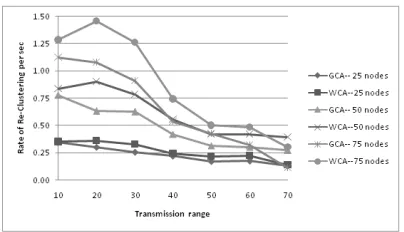
[image:2.595.307.512.79.316.2]In most of the clustering techniques, the nodes are commonly classified into three types[5] as shown in figure1. Under a cluster structure, mobile nodes may be assigned a different status or function, such as a clusterhead node (CH), a clustergateway(GW) node, or clustermember node. A clusterhead normally serves as a local coordinator for its cluster, performing intra-cluster transmission arrangement, data forwarding, and so on. A cluster gateway is a non-clusterhead node with inter-cluster communications capabilities. So it can access neighboring clusters and forward information between clusters. A clustermember is usually called an ordinary node, which is a non-clusterhead node without any inter-cluster links.
Figure 1. Clusters in MANET
There are many issues in cluster formation. The choice of clusterheads for each cluster and the formation of the cluster and its maintenance results in additional overhead. Cluster lifetime is another issue.
It is necessary to configure a cluster and select a clusterhead with longer life time. Re-clustering will occur because of mobility or power drain out of a clusterhead (CH) node. This may result in the re-election of a new clusterhead. Clusterhead nodes and gateway nodes devour more power than other mobile nodes in a clustered network. Thus the shutdown of such nodes is unavoidable. It is crucial to balance the load of the clusterheads.
In this paper, we describe a new approach for stable clusterhead selection. Section 2 analyzes various existing clustering schemes. In section 3, we describe the proposed method of clusterhead selection and explain various metrics considered during clusterhead selection procedure. Section 4 elaborates the formation of clusters. In section 5, we discuss about the simulation and in section 6, analysis of experimental results.
2. RELATED WORK
application scenarios, the clusterheads can be selected [7].
The lowest-ID [2],[4] algorithm, the simplest way of clustering in MANET, is to make use of an unique ID. In this scheme, the unique ID is assigned to each node[2]. All nodes recognize its neighbors ID and clusterhead is chosen according to minimum ID. But, there is no limitation to the maximum number of nodes that can be attached to a single clusterhead . Thus, the battery power of a clusterhead will quickly drain out due to serving as clusterheads for a longer period of time.
In highest degree clustering, the degree of nodes is computed based on its distance from each other’s [17]. All nodes flood its connectivity value within their transmission range. Thus, a node decides to become a clusterhead or remain as ordinary cluster member by comparing the connectivity value of its neighbours with its own value. Node with highest connectivity value in its neighborhood will become clusterhead.
In mobility based clustering, the mobile nodes are grouped together with similar characteristics according to their speed and direction of movement in order to form a stable cluster structure and decrease its influence on cluster topology. Here, the cluster architecture is determined by the mobility behavior of mobile nodes.
MOBIC [16] proposes an aggregate local mobility metric for the cluster formation process such that mobile nodes with low speed relative to their neighbors have the chance to become clusterheads. Random movements in mobile nodes and frequent changes in their speeds from time to time will affect the performance of MOBIC greatly. It is essential to keep the current topology of the MANET stable as long as possible. The clusterheads who form a dominant set in the network, determine the topology and its stability.
In [17],[18] two algorithms, distributed clustering algorithm (DCA) and distributed mobility adaptive clustering algorithm (DMAC) had been proposed. Here, each node is assigned with random weights to select clusterhead. Random weight does not reveal realistic situation. The weight-based distributed clustering algorithm considers multiple factors such as ideal degree, mobility, and battery power of mobile nodes. Depending on the requirements of specific applications, these factors must be used in the metric to select the clusterheads.
WCA [7] uses multiple factors while selecting a clusterhead and many researchers have analyzed on weight factors and multiple parameters in their own way. Most of the weight based clustering schemes use weighted arithmetic mean based computation for clusterhead selection [11],[12],[13]. WCA and other similar schemes perform considerably superior than both of the Highest-Degree and the Lowest-ID heuristics.
In [19], the objectives chosen for clusterhead selection are based on workload of cluster members and workload of the clusterhead. Since routing in cluster based mechanism is possible only by clusterheads, the workload on the member nodes greatly affects the workload of the clusterhead and also its battery power. In [20], the clusterhead is selected based on node trust relationship with neighbor nodes, degree, distance and power.
In this paper, we present a new method for weight computation based on geometric mean for clusterhead selection.
3. PROPOSED WORK
The weighted arithmetic mean is a common method used to unite weights with multiple metrics. Arithmetic mean is lenient and permits deficiency in one factor and that may be compensated by other factors, while geometric mean is rigid and better handles such situations when one factor is dominated by other factors [21]. Here, we have attempted to achieve a better performance than WCA.
Geometric mean better optimizes than weighted arithmetic mean especially while considering multiple parameters that take different range of values. Thus, geometric mean gives appropriate metric when combining multiple factors like neighboring nodes, speed of the mobile node, and residual energy in the perspective of cluster formation of mobile ad hoc network.
3.1 Assumptions
The following properties are assumed about the MANET which during experiment:
• The nodes in the network are moving along a
direction with different speed and having certain pause time before taking the next movement in different direction.
• Each node knows its current location with the
help of GPS aided antenna
• Symmetric link exists between any two nodes
• All the nodes have initial energy of Emax and
more energy is spent by clusterhead than cluster member node.
• Any node in the network becomes failure only
due to the exhaustion of its energy.
3.2 Combined Metric Computation
We propose a Geometric-mean based clustering algorithm, (GCA) that effectively combines the following factors for clusterhead selection. Various factors considered for clusterhead selection are given below:
• Connectivity: It refers the number of one-hop
neighbor nodes (Ci) of node i. A clusterhead
should support optimum number of one-hop neighbors. A threshold value is used to limit a clusterhead from overloading. Maximum load that a clusterhead can handle is given by,
(Equation 1) Where is a threshold that controls the number of neighbors.
• Average distance: It is the mean distance
between a mobile node and its direct one-hop neighbors within its transmission range. A clusterhead is desirable to be located at the center of the cluster. For calculating the average distance, we use
(Equation 2) where ( Xi ,Yi ) and ( Xj ,Yj ) are the locations
of node i and node j respectively and C(i) is the number of direct neighboring nodes.
• Mobility : The average mobility of nodes is
defined as the running average speed [7] for each node. It is measured up to current time T and it is computed by locating the position of mobile node at regular time interval.
(Equation 3)
where ( Xt ,Yt ) and ( Xt-1,Yt-1 ) are the
locations of mobile node at the time period t and ( t – 1 ) respectively.
• Life time: Life time of a node is an important
metric for being a clusterhead because the
clusterhead that has more life time can preserve the topology. Each node spends its energy during transmission, reception, and overhearing of packets. This lifetime is affected by not only the remaining energy but also the drain rate. The clusterhead with high connectivity loses energy quickly. So the drain rate affects the life time of mobile node. The energy drain rate of a mobile node at time t is computed using a proven exponential weighted average method [10] and given by
(Equation 4) where drain_rateprev and drain_ratesample are
computed during the previous interval and the newly derived energy drain rate respectively. The value of is set to 0.3 as in [10]. Life time of a node at time ‘t’ , Nlife is computed by,
(Equation 5)
These four factors are considered for the combined metric computation for each mobile node to become a clusterhead. The geometric mean of these factors(f) given by
That is,
(Equation 6) where is the maximum load that a clusterhead can handle, is the average distance, is speed of the mobile node, is the life time of a mobile node at time ‘t’. A mobile node should be selected as clusterhead which has optimum load, minimum average distance, low mobility and maximum lifetime ( Nlife). The
optimum load, minimum average distance, and low mobility are directly proportional to the Metrict
where as node lifetime is inversely proportional. So the inverse of lifetime is measured.
When we introduce pause time, the mobile nodes halt moving temporarily. Whenever the mobile node stops moving for some time period, the mobility of that mobile node becomes zero. In this situation, the value of Metrict becomes 0 in the
zero values has been discussed in [15] and is given by
where n1 is number of non-zero factors and n2 is number of zero factors and n is the total number of factors. In our case,
(Equation 7)
4. CLUSTER FORMATION AND MAINTENANCE
Clustering process has two phases: formation of clusters and the maintenance of clusters. Cluster organization is logical partitioning of the mobile nodes into various groups. A clusterhead for each group is selected during the clustering process. To begin with, each node floods hello message to neighbors within its transmission range. The message consists of node ID, its location, its role, and metrict (value of the node ) which is calculated
by equation 7. On receiving hello messages, each node builds its neighbor table with neighbor id, its position and metrict value. From time to time, each
node records its location. This is helpful in calculating mobility of that node. Similarly, residual energy and energy drain rate can be computed. The node with a minimum metrict
among its one-hop neighbors is selected as clusterhead.
Once a clusterhead has been selected, it notifies to its member nodes by sending CH message. On receiving the CH message, all the one-hop un-clustered neighbors will become the members of under that clusterhead. By continuously executing this process, all the nodes belongs to any of the cluster. Lowest ID strategy can be used for final decision when two nodes, having same metrict, are
competing for becoming clusterhead.
Cluster maintenance aims to conserve the stability of existing clusters. When any node breaks from its current clusterhead, and tries to join another clusterhead, a link failure occurs between that node and its current clusterhead. This is called as re-affiliation. When two clusterheads comes within same transmission range, the node with minimum Metrict remains as clusterhead, and the
other one changes its role and becomes the member node. The cluster members of the resigned clusterhead will join with either newly selected
clusterhead or with the other clusterheads with minimum Metrict in their transmission range. When
they don’t find such node exists, they announce themselves as clusterhead.
5. SIMULATION SET UP
We simulate the network of N nodes with simulation area 100m x 100m. We used the open source network simulator (ns-2.34) tool for our simulation. Each nodes can move with mobility speed varied uniformly from 0 to given max value. Before taking the next movement in different direction, node waits for certain time slot (pause time) and then starts moving. We use the random way point mobility pattern in our simulation. Each simulation was run up to 600s and the following metrics measured are the average of 30 runs. The performance of our proposed method is measured by the following metrics:
• Rate of re-affiliation per second: Re-affiliation
occurs during the migration of any member node from one cluster to another within the existing clusters. This metric is calculated by dividing the total count of re-affiliations by all the nodes with total simulation time. A lower value of this metric means that more stable clusters are formed.
• Rate of re-clustering : Re-clustering results
when two clusterheads are in same transmission range or when a node become a standalone node i.e it could not be direct neighbor of any existing clusterhead. The rate of re-clustering is evaluated by the ratio of the number of re-clustering happened with the total simulation time. A lower value of this metric is a preferable one to avoid unnecessary path breaks happened during cluster-based routing.
• Cluster lifetime in second: It refers the average
time duration that a mobile node being as a clusterhead. It is measured by taking the ratio of simulation time by the number of clusterhead changes. The maximum value of cluster lifetime reveals that the clusterhead retains its role for longer period.
• No. of clusters: It denotes the total number of
clusters should be formed in order to balance the load of clusterhead.
The above said metrics are studied for varying number of mobile nodes (N) in the network, transmission range and also the mobility speed of the nodes.
In our simulation experiments, N was varied with 25 nodes (light load), 50 nodes (medium load), and 75 nodes (heavy load). The transmission range of nodes was varied from 10m to 70m. At this time, the maximum moving speed of all the nodes in the network was kept as 10m/s. So, any node in the network moves randomly with a speed [0, 10] m/s. Also, we have experimented our proposed work by varying mobility speed(from 5 m/s to 35 m/s) with a fixed transmission range of 40m. These simulations were also done for different network size N (25, 50, 75 nodes). Moreover, we have considered that maximum load that each clusterhead can handle is at most = 10 nodes. The various simulation parameters considered are shown in the table1.
Table 1: Simulation parameters
Parameters Meaning Value
N Number of nodes 25, 50, 75 nodes X x Y Size of the network 100 m x 100 m Speed Speed of nodes 5 to 35 m/s Tx Range Transmission range 10 to 60 m
PT Pause time 10s
HI Hello Interval 3 seconds
Threshold to limit the load of clusterhead
10
Duration Time of simulation 600s Energy Initial energy of the
node
100 J
6. PERFORMANCE ANALYSIS
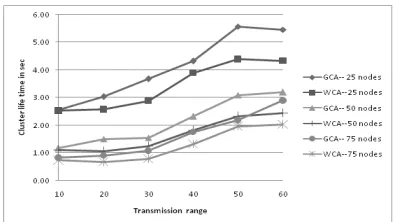
Figure 2 shows the variation in the rate of re-clustering with respect to the transmission range. This experiment was conducted for the various network size N (25,50,75 nodes) with maximum mobility speed of each node is 10 m/s. We have compared our proposed method with WCA method. We noticed that the rate of re-clustering is reduced when increasing the transmission range. When the transmission range increases, a clusterhead covers a larger area and results in less number of clusters. So, minimum number of clusterhead changes only occurred.
From the figure2, we realize that, the rate of re-clustering in GCA method is less than WCA, since
[image:6.595.306.508.187.303.2]GCA normalizes all the clustering parameters equally while calculating the Metric value for the clusterhead selection. Our GCA method forms stable clusters with minimum re-clustering rate.
[image:6.595.305.507.343.467.2]Figure 2. Re-clustering rate by varying transmission range
Figure 3. Re-affiliation rate by varying transmission range
The variation in the rate of re-affiliation with respect to the transmission range has been shown in figure 3. This is simulated with network size (25, 50,75 nodes) with maximum mobility speed 5 m/s. The rate of re-affiliation increases from 10m to 30m transmission range and then it gets reduced with increasing value in transmission range. This is due to that having minimum value of transmission range produces more number of clusters. So, whenever any node makes a movement to some distance, it may disconnected from one cluster and joins in another cluster.
When the transmission range increases, the rate of re-affiliation get reduced since the mobile nodes tend to continue inside the transmission range covered by the clusterhead.
clusterhead covers a larger area and it movements tend to be within its cluster boundary. This also preserves cluster topology and produces more stable clusters. Our proposed GCA algorithm results extended cluster lifetime compared with WCA method when we consider different network sizes N (25, 50, 75 nodes) with maximum speed 5 m/s and results.
Figure 4. Cluster lifetime by varying transmission range
[image:7.595.303.517.275.388.2]Figures 5 to 8 show the variation of the same metrics but by varying mobility speed with fixed transmission range of 40m. These are also experimented for various network size N (25, 50, 75 nodes) with varying mobility speed from 5 m/s to 35 m/s. As the node speed becomes higher, there are more chances that a mobile node (which may be a member or clusterhead) leaves from its current clusters and joins into some other cluster and results in high rate of affiliation and re-clustering. This is clearly understandable from figure 5 and figure 6 respectively. This is also the reason for reduced cluster life time when increase in the speed of mobile nodes which is shown in figure 7.
Figure 5 . Re-clustering rate by varying maximum speed
Figure 6. Re-affiliation rate by varying maximum speed
Figure 7. Cluster lifetime changes by varying maximum speed
[image:7.595.304.503.529.641.2]We have considered same simulation environmental setup for both GCA and WCA. Although both the algorithms form same number of clusters (figure 8), it has been proved that the rate of re-affiliation and re-clustering are minimized in our GCA method comparing with WCA. Also we have achieved an extended cluster life time than that of WCA (figure 7).
Figure 8. Number of Clusters in GCA and WCA
6. CONCLUSION
[image:7.595.89.288.541.654.2]lifetime for the combined metric computation. Key issues for re-clustering have been resolved by this approach and stable clusters are formed. Simulation results prove that the model works better when it is compared to existing weight based clustering algorithm. In future, appropriate weight factors can be assigned during metric computation. Also it can be further improved with optimization techniques and inclusion of security.
REFERENCES
[1] C. R. Lin and M. Gerla, “Adaptive Clustering for Mobile Wireless Networks,” IEEE JSAC, vol. 15, Sept. 1997, pp. 1265–75.
[2] Ephremides, A., Wieselthier, J.E., and Baker, D.J., “A design concept for reliable mobile radio networks with frequency hopping signaling,” in Proceedings of IEEE, pp . 56-73, 1987.
[3] X.Y.Hong, K.X Xu, and M. Gerla, “Scalable Routing Protocols for Mobile Ad Hoc Networks,” IEEE Network, July-Aug. 2002. [4] Gerla, M, and Tsai, J.T.C, “Multicluster,
mobile, multimedia radio network,” ACM/Baltzer Journal of Wireless Networks, pp. 255-265, 1995.
[5] J. Wu and H. L. Li, “On Calculating Connected Dominating Set for Efficient Routing in Ad Hoc Wireless Networks,” Proc. 3rd Int’l. Workshop. Discrete Algorithms and Methods for Mobile Comp. and Commun., 1999, pp. 7–14.
[6] A. McDonald and T. Znati, “A mobility-based framework for adaptive clustering in wireless ad hoc networks,” 1999
[7] M. Chatterjee, S. Das and D. Turgut, “WCA: A Weighted Clustering Algorithm for Mobile Ad Hoc Networks,” Journal of Cluster Computing (Special Issue on Mobile Ad hoc Networks), Vol. 5, 2002, pp.193-204.
[8] Charalampos Konstantopoulos, Damianos Gavalas, and Grammati Pantziou, “Clustering in mobile ad hoc networks through neighborhood stability-based mobility prediction,” 2008.
[9] A.D. Amis , R. Prakash, “Load -Balancing Clusters in Wireless Ad Hoc Networks,” in Proc. 3rd IEEE ASSET’00, Mar. 2000, pp. 25–32.
[10] D. Kim, J.J. Garcia-Luna-Aceves, K. Obraczka, J.-C Cano and P. Manzoni, "Power-aware routing based on the energy drain rate for mobile ad hoc networks", in 11th Int. Conf. on Computer Communications and Networks, 2002,pp. 565– 569
[11] Dhurandher, S.K. Singh, G.V.“Weight Based Adaptive Clustering in Wireless Ad Hoc Networks,” Personal Wireless Communications, 2005.
[12] Kai Liu Jie Su Jun Zhang Feng Liu Cheng Gong “A novel stable cluster protocol for mobile ad hoc networks” in Microwave, Antenna, Propagation and EMC Technologies for Wireless Communications, IEEE, 2005. [13] Gavalas, D. Pantziou, G. Konstantopoulos, C.
Mamalis, B “Lowest-ID with Adaptive ID Reassignment: A Novel Mobile Ad-Hoc Networks Clustering Algorithm,” in Wireless Pervasive Computing, 1st International Symposium, IEEE, 2006.
[14] Sheng-Tzong Cheng, Jian-Pan Li, Gwo-Jiun Horng, “An Adaptive Cluster-Based Routing Mechanism for Energy Conservation in Mobile Ad Hoc Networks” Wireless Personal Communication 2013.
[15] Elsayed A. E. Habib Geometric Mean for Negative and Zero Values, International Journal of Research and Reviews in Applied Sciences, Vol 11 (issue3), June 2012
[16] P. Basu, N. Khan, and T. D. C. Little, “A Mobility Based Metric for Clustering in Mobile Ad Hoc Networks,” in Proc. IEEE ICDCSW’ 01, Apr. 2001, pp. 413–18. [17] S. Basagni, Distributed clustering for ad hoc
networks, in Proceedings of International Symposium on Parallel Architectures, Algorithms and Networks, June 1999, pp. 310–315.
[18] S. Basagni, Distributed and mobility-adaptive clustering for multimedia support in multi-hop wireless networks, inProceedings of Vehicular Technology Conference, VTC , Vol. 2, 1999-Fall, pp. 889–893.
[19] Xibin Zhao, William N.N. Hung , Yafei Yang, Xiaoyu Song (2013), “Optimizing communication in mobile ad hoc network clustering “, journal of Computers in Industry
64 (2013) 849–853, Elsevier Publications.
http://dx.doi.org/10.1016/j.compind.2013.05.005
[20] Geetha G, Dr.N.J.R.Muniraj ,” A Hybrid Cluster Enhanced Secure Multicast Routing Scheme for MANET”, Journal of Theoretical and Applied Information Technology(2014) 588-595