A NOVEL SYNTAX CLASS BASED ADAPTIVE ENCODING
TECHNIQUE FOR CONTRAST STRETCHED
MULTISPECTRAL IMAGES
1
DEEPA.S, 2V.SADASIVAM
1
Assistant Professor, National College of Engineering, Tirunelveli
2
Principal, PSN College of Engineering and Technology,
Tirunelveli, Tamilnadu
E-mail: [email protected]
ABSTRACT
Multispectral images are images with high spatial and spectral resolution. Efficient multispectral image compression plays a key role in most of the geographical applications. The three important phases involved in the proposed adaptive technique are contrast stretching, clustering and encoding based on the resultant clusters. The contrast stretching results in a very clear image and the image is then clustered into smooth and textured regions based on K means algorithm. The spatial orientation tree (STW) wavelet algorithm and the wavelet difference reduction (WDR) algorithm are applied to the smooth and textured regions respectively. The results are compared using the Compression ratio, Peak Signal to Noise Ratio (PSNR) and Structural Similarity (SSIM) Index metrics. It reflects the quality of the proposed work as betterment than the existing state of art techniques with very high compression ratio and minimum image distortion.
Key-Words: STW, WDR, Contrast Stretching, K-Means, PSNR, SSIM
1. INTRODUCTION
Multispectral images are images with high spatial, spectral and radiometric resolution. It is of interest for a large number of applications like detection and identification of surface and atmospheric constituents present, analysis of soil type, environmental studies, military surveillance etc. Multispectral images contain a wealth of data. With the increasing performance of remote sensing systems and the wide diffusion of the images acquired, transmitting such images to the end users on common transmission facilities deserves a high quality compression standard.
Multispectral images mainly differ from other images by its statistical features. But, the existing standard compression algorithms, like the JPEG, JPEG2000, or MPEG standards, do not provide satisfactory results for multispectral data, because they do not focus on the statistical features. Thus, several waveletcompression techniques have been proposed in the last few years.
Decorrelating the spatial and spectral dependencies plays a key role in the success of
efficient compression. It is achieved through transformation. It packs as much information as possible into the smallest number of transform coefficients.
To cover more dynamic range of data, contrast stretch is used thereby enhancing the image. The resultant image is a very clear image which is the preprocessing step in the proposed adaptive encoding technique. Even the infra red bands are made clearly visible.
concept, adaptive transformation. The compression techniques STW and WDR are basically transform coding techniques and therefore apply default transformation.
The encoding algorithm shows its performance on the basis of content. An image can be categorized as semantic classes or datatype classes. Semantic classes are nothing but the regions like clouds, mountains, rivers etc. Datatype classes are smooth regions and textured regions. If a particular region of interest is concerned for the application, semantic classes are exposed and compressed.
The paper deals with datatype classes since the whole image is considered for compression. In the research work, the image decomposition is based on the statistical texture feature and the encoding is by two different algorithms based on the regions identified. STW, SPIHT [11], SPIHT-3D[10], parallel SPIHT [5], scalable SPIHT [8], WDR, ASWDR are the latest wavelet compression algorithms. Among these techniques, STW and WDR are considered in the proposed work.
In this paper, section 2 describes spectral bands, section 3 deals with image enhancement and section 4 deals with clustering where the image is decomposed into smooth and textured regions using K means clustering algorithm. Section 5 exposes the adaptive encoding technique and compares the various existing techniques that guide towards the choice of suitable compression algorithm. Section 6 briefly describes the proposed work. Section 7 shows the results of the proposed adaptive encoding technique for enhanced multispectral images and comparative analysis is based on PSNR, compression ratio, bits per pixel and SSIM and is followed by conclusion and future work.
2. SPECTRAL BANDS
Multispectral images are the main type of images acquired by remote sensing (RS) radiometers. Dividing the spectrum into many bands, multispectral is the opposite of panchromatic, which records only the total intensity of radiation falling on each pixel.
Usually, satellites have three or more radiometers (Landsat has seven). Each one acquires a scene in a small band of visible spectra, ranging from 0.7 µm to 0.4 µm, called red-green-blue (RGB) region, and going to infrared wavelengths of 0.7 µm to 10 or more µm, classified as near infrared (NIR), middle infrared (MIR) and far infrared (FIR or thermal).
Variations in the reflectivity of surface materials across different spectral bands provide a fundamental mechanism for understanding features in remotely-sensed multispectral imagery.
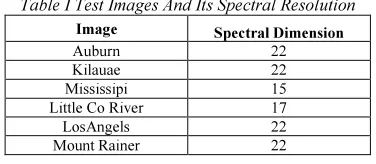
[image:2.595.314.502.242.324.2]In the Landsat case, the seven scenes comprise a seven-band multispectral image. The sample images considered for the proposed work includes several bands. The images and its spectral dimension are tabulated in Table I.
Table I Test Images And Its Spectral Resolution
Image Spectral Dimension
Auburn 22
Kilauae 22
Mississipi 15
Little Co River 17
LosAngels 22
Mount Rainer 22
3. IMAGE ENHANCEMENT
The following section deals with enhancing the acquired multispectral image. The importance of image enhancement is to improve the visual appearance of the image. Not only the visual quality plays the key role but it also provides ”better” preprocessed transform representation for future automated image processing. Transform coding better suits for multispectral images. Transformation is done to identify the hidden information from an image. Image resolution enhancement techniques generate sharper high resolution image. It may use Discrete Wavelet Transform, Discrete Cosine Transform or Karhunen Loeve Transform based on the application of images.
1(A) Original Image
[image:3.595.88.511.88.305.2]1(B) Contrast Stretched Image
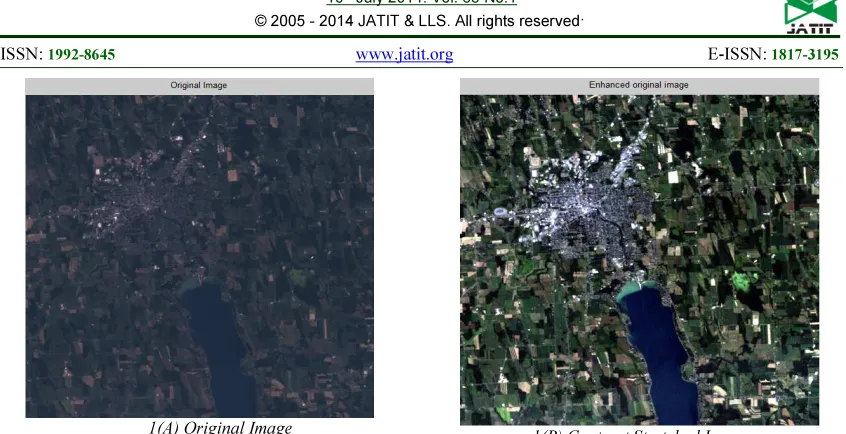
Fig 1: Test Image – Auburn
Table Ii Comparative Results – Existing Coding Techniques
Image SPIHT SPIHT-3D ASWDR
PSNR CR BPP SSIM PSNR CR BPP SSIM PSNR CR BPP SSIM
Auburn 26.80 8.68 2.08 0.9901 21.90 6.79 1.63 0.9215 27.55 13.69 3.37 0.9514
Kilauae Volcano 25.98 1.72 0.41 0.9264 25.98 1.40 0.33 0.7768 29.13 6.53 1.60 0.8917
Mississipi 22.55 3.02 0.72 0.9365 22.55 2.46 0.59 0.7955 25.90 14.67 3.57 0.9182
Little Co River 23.57 3.47 0.83 0.9424 23.57 2.39 0.57 0.8093 24.10 5.38 1.32 0.8270
LosAngels 21.71 4.44 1.07 0.9612 21.71 3.03 0.73 0.4322 25.78 19.33 4.72 0.9240
Mount Rainer 27.86 7.32 1.76 0.9767 27.86 11.15 1.26 0.9338 28.74 11.93 2.94 0.9322
Image STW WDR
PSNR CR BPP SSIM PSNR CR BPP SSIM
Auburn 27.69 13.15 3.15 0.9532 27.55 14.05 3.37 0.9514
Kilauae Volcano 26.49 2.50 0.60 0.7920 29.13 6.67 1.60 0.8917
Mississipi 22.92 4.35 1.04 0.8134 25.90 14.86 3.57 0.9182
Little Co River 24.16 5.09 1.22 0.8289 24.10 5.48 1.32 0.8270
LosAngels 22.10 6.33 1.52 0.7607 25.78 19.69 4.72 0.9240
Mount Rainer 28.90 11.15 2.68 0.9338 28.74 12.24 2.94 0.9322
The contrast stretch uses distinct block processing for image. The stretched image is very much improved with the data covering more of the dynamic range which results in a very clear image. Block procedure is used to compute statistics from large images and hence well suited for multispectral images. The enhancement technique is applied to the image block wise, and the results are combined and returned as a new enhanced multispectral image.
The following steps briefly describe the method used for image enhancement based on contrast stretch using MATLAB.
The original image is shown in Fig 1(a). The resulting contrast stretched image is much improved, with the data covering more of the dynamic range and the resultant contrast stretched image is shown in Fig 1(b). It can be clearly seen
that the image has been enhanced for better visualization.
4. CLUSTERING
Multispectral images can be classified as syntax data classes and semantic data classes. Semantic data classes deal with the regions like mountains, rivers, clouds etc., which are available in the acquired multispectral image. It deals with object classification and identification. Syntax data classes are based on the texture. It deals with smooth and textured regions. Smooth regions are also termed as textureless regions. The proposed work concentrates on syntax classes for classification and encoding.
[image:3.595.89.507.345.532.2]
Algorithms like K means clustering, Fuzzy C Means clustering, stereo vision algorithms[1] follow pixel based segmentation. Pixel based image segmentation is used in the proposed work. It plays a key role in adaptive image compression technique. If and only if the image is properly segmented as smooth and textured regions, the compression can evolve better results.
The simplest method of pixel based image segmentation is called the thresholding method. The key behind the method is to select the threshold value. Several popular methods like the
Maximum entropy method, K-means clustering etc., rely on pixel based segmentation. K- means when combined with parameter weighting can be used for noise suppression in multispectral images[18] and different versions of K-Means are being developed[14]. K-Means can be combined with Principal Component Analysis(PCA) or robust PCA[12] for better results.
The K-means clustering algorithm is an iterative technique that is used to partition an image into K clusters.
[image:4.595.107.293.279.435.2]
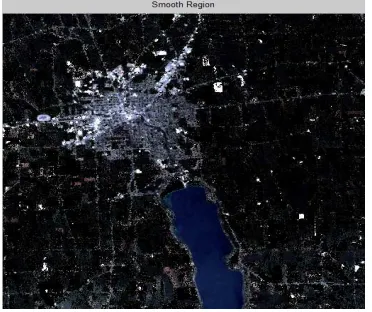
2(A) Smooth Region 2(B) Textured Region
Fig 2: Segmented Clusters Using K-Means
The basic algorithm is:
1. Assign the value of K as 2. 2. Pick K cluster centers randomly.
3. Assign each pixel in the image to the cluster that minimizes the distance between the pixel and the cluster center
4. Re-compute the cluster centers by averaging all of the pixels in the cluster 5. Repeat steps 3 and 4 until no pixels change
clusters
Internal representation of clustering is used
In the proposed work, the multispectral image is first enhanced using contrast stretching. The enhanced image is now segmented into two clusters, namely, smooth and texture clusters/regions. Fig 2 shows the result of clustering for the test multispectral image. Since the image is preprocessed with contrast stretching, the clustering result is better.
5. ENCODING TECHNIQUES
5.1 Existing Encoding Techniques – STW, ASWDR, WDR, SPIHT, SPIHT_3D
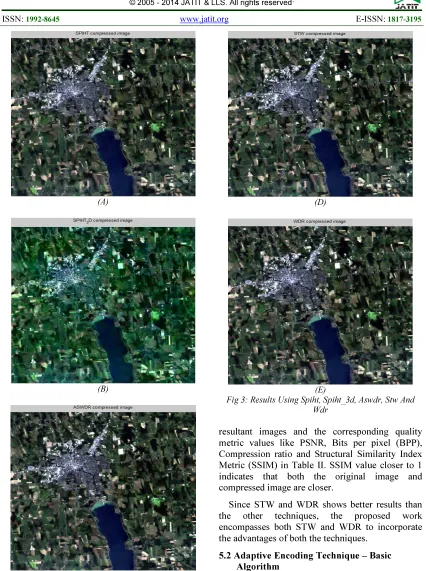
The recent wavelet compression techniques like SPIHT, SPIHT 3D, STW, WDR, ASWDR are used in our proposed work. The techniques are compared and tabulated in Table II. A brief description on the encoding techniques is given below.
The wavelet compression methods involve zerotree method [9] to transmit the positions of significant transform values. The zerotree method gives an implicit, very compact description of the location of significant values by creating a highly compressed description of the location of insignificant values.
[2i+1,2j+1], and each of their children and so on. These descendants of the root reach all the way back to the 1st level of the wavelet transforms.
A zerotree is a quadtree which, for a given threshold T, has insignificant wavelet transform values at each of its locations. Zerotrees can provide very compact descriptions of the locations of insignificant values because it is only necessary to encode one symbol, R say, to mark the root location. The decoder can infer that all other locations in the zerotree have insignificant values, so that their locations are not encoded.
STW (Spatial-orientation Tree Wavelet) uses a different approach to encode the zerotree information [7]. It uses a state transition model. From one threshold to the next, the locations of transform values undergo state transitions. This model allows STW to reduce the number of bits needed for encoding. The core feature of STW is its simplicity and it suits well for multispectral images. The number of bits needed for encoding in STW is lesser than Embedded Zerotree Wavelet algorithm
SPIHT stands for Set Partitioning In Hierarchical
Trees [3]. The term Hierarchical Trees refer to the quadtrees. Set Partitioning refers to the way these quadtrees divide up, partition the wavelet transform values at a given threshold. By carefully analyzing the partitioning of transform values, SPIHT is able to significantly increase the compressive power. It always uses wavelet transformation and for color conversion either ‘KLT’ [16] or ‘RGB’ is used in MATLAB implementation. It outperforms STW with the binary code for the transition states being output one bit at a time. The memory intensive nature of SPIHT can be reduced by using a context-based arithmetic coder [6] and thereby can be used for high speed real-time applications. It suits well for high dimensional data and outperforms JPEG2000. But it involves memory intensive work and compressed images have lesser edge correlations than WDR and ASWDR
WDR(Wavelet Difference Reduction) is used in image processing applications which select region of interest from a compressed image to increase its resolution. The term, difference reduction refers to the way in which WDR[17] encodes the locations of significant wavelet transform values. It includes a significance pass to identify the significant values. The output from the significance pass consists of the signs of significant values along with the sequences of bits which concisely describe the precise locations of significant values. At high compression ratios, the visual quality of WDR
compression is superior to SPIHT. The advantages are Low complexity, Region of Interest capability, embeddedness, progressive SNR.
Adaptively Scanned Wavelet Difference Reduction (ASWDR) is one of the most recent wavelet compression algorithms. The adjective ‘adaptively scanned’ says that the algorithm adapts the scanning order so as to predict locations of new significant values [15]. If the prediction is correct, then the output specifying that location will just be the sign of the new significant value – the reduced binary expansion of the number of steps will be empty. Therefore good prediction schemes will significantly .reduce the coding output. Its advantages include WDR advantages with better perceptual qualities, better rate distortion performance, higher the edge correlation. But it is memory intensive
SPIHT is an efficient embedded technique. The original SPIHT was proposed for 2-dimensional image compression, and it has been extended to 3D applications. 3D-SPIHT [10] is the modern-day benchmark for three dimensional image compressions. It has been applied on multispectral image compression. Various advanced versions of 3D – SPIHT [19] are being developed and its main applications are in video coding. The results for the existing wavelet compression algorithms are shown in Table II.
(A)
(B)
(C)
(D)
[image:6.595.86.512.96.667.2](E)
Fig 3: Results Using Spiht, Spiht_3d, Aswdr, Stw And Wdr
resultant images and the corresponding quality metric values like PSNR, Bits per pixel (BPP), Compression ratio and Structural Similarity Index Metric (SSIM) in Table II. SSIM value closer to 1 indicates that both the original image and compressed image are closer.
Since STW and WDR shows better results than the other techniques, the proposed work encompasses both STW and WDR to incorporate the advantages of both the techniques.
5.2 Adaptive Encoding Technique – Basic Algorithm
is said to be smooth and if not, the region is said to be highly textured. The following steps explore the algorithm for the proposed work.
1.Read the multispectral image.
2.Segment the image into smooth and textured regions.
3.For smooth and textured regions apply different wavelet encoding techniques
[image:7.595.89.499.212.302.2]
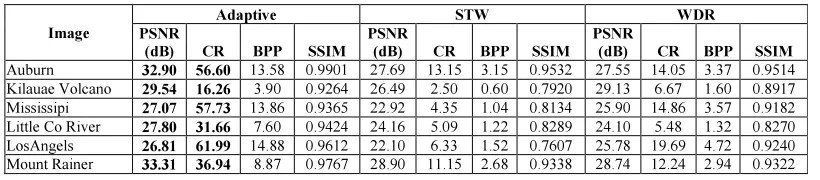
Table Iii Comparative Results – Adaptive Encoding Technique Vs Existing Coding Techniques
Image
Adaptive STW WDR
PSNR
(dB) CR BPP SSIM PSNR
(dB) CR BPP SSIM PSNR
(dB) CR BPP SSIM
Auburn 32.90 56.60 13.58 0.9901 27.69 13.15 3.15 0.9532 27.55 14.05 3.37 0.9514
Kilauae Volcano 29.54 16.26 3.90 0.9264 26.49 2.50 0.60 0.7920 29.13 6.67 1.60 0.8917
Mississipi 27.07 57.73 13.86 0.9365 22.92 4.35 1.04 0.8134 25.90 14.86 3.57 0.9182
Little Co River 27.80 31.66 7.60 0.9424 24.16 5.09 1.22 0.8289 24.10 5.48 1.32 0.8270
LosAngels 26.81 61.99 14.88 0.9612 22.10 6.33 1.52 0.7607 25.78 19.69 4.72 0.9240
Mount Rainer 33.31 36.94 8.87 0.9767 28.90 11.15 2.68 0.9338 28.74 12.24 2.94 0.9322
6. ADAPTIVE ENCODING TECHNIQUE
The following steps briefly describe the method used for image enhancement based on contrast stretch using MATLAB followed by adaptive encoding.
Step 1: Read the LANDSAT multispectral image using LanAdapter class
Step 2: Create an object for the HistogramAccumulator class
Step 3: Setup blockproc with addToHistFcn function handle
Step 4: Compute histogram of the red channel. Step 5: Compute histogram for green channel Step 6: Compute histogram for blue channel Step 7: Compute the Cumulative Distribution Function (CDF) of each histogram
Step 8: Compute the global stretch limits with CDF results.
Step 9: Perform contrast stretch using the block procedure with the computed global stretch limits. Step 10: The contrast stretched enhanced image is segmented into two smooth and textured clusters using K-Means clustering algorithm. Internal representation of clustering is used
Step 11: Apply STW compression technique in the smooth cluster
Step 12: Apply WDR compression technique in the textured cluster.
Step 13: The results are then compared with existing techniques using the metrics PSNR, bits per pixel, Compression ratio and SSIM
The metrics PSNR and compression ratio are compared for the test image and, the fact inferred is, among the existing techniques considered, STW and WDR shows better PSNR results. Thus the proposed adaptive encoding scheme uses the spatial orientation tree(STW) wavelet technique
for smooth regions and the wavelet difference reduction(WDR) for textured regions.
Not only the PSNR but also the new metric Structural Similarity Index (SSIM) metric is also considered for evaluating the technique. SSIM value ranges between -1 and 1. If both images, the original image and the decompressed image, are identical and same, SSIM value results in 1. A value closer to 1 implies that the images vary with little deviation in structure. Table III shows the results using four metrics, Peak Signal to Noise ratio (PSNR), SSIM, bits per pixel (bpp) and compression ratio.
The sample multispectral images are found in [20]. Table III explores the advantage of adaptive encoding technique in terms of higher PSNR, bpp, SSIM and Compression Ratio
7. RESULTS AND DISCUSSION
The performance analysis of the proposed adaptive encoding techniques is done using PSNR, SSIM, bpp and CR (Compression Ratio).
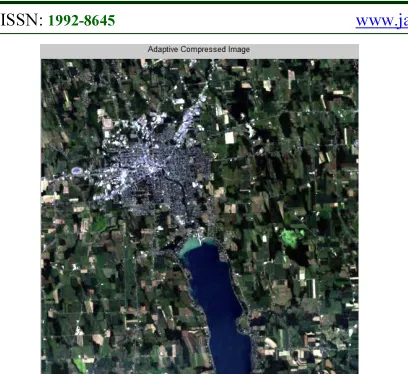
Fig 4 shows the image compressed by Adaptive encoding technique, STW, WDR and the adaptively encoded images. Table II shows the Compression ratio, PSNR values and SSIM for the adaptive encoding technique.
Fig 4: Result By Applying Adaptive Encoding Technique
which is thrice of existing techniques. The ultimate aim of the work is the usage of multispectral images in ground stations with efficient encoding technique. The compression ratio ensures the fact that the heavily loaded multispectral images have been compressed well and the better PSNR values intimate the image quality retention.
Better PSNR shows better visual quality. Better SSIM shows better structural similarity between original and compressed images. In general, PSNR is used to compare two images. But it has been proved to be inefficient in terms of human perception and there comes the SSIM. A new and better metric, the Structural Similarity Index Metric is defined to describe the structural similarity between the compressed and original images. It is based on the fact that spatially closer pixels have strong inter-dependencies which carry important information about the structure of the objects in the image and is calculated as follows for the images x and y:
SSIM(x,y)=(2MxMy+c1)(2Sxy+c2) /
(Mx 2
+My 2
+c1)(Sx 2
+Sy 2
+c2)
where
Mx is the mean of x,
My is the mean of y,
Sx2 is the variance of x,
Sy2 is the variance of y,
Sxy is the covariance of x and y
c1 =(k1L)2
c2=(k2L)2
L is 2 no.of bits per pixel -1
k1=0.01 and k2 =0.03 by default
The SSIM index value ranges between -1 and 1. The value will be exactly 1 if both x and y are same images. It is closer to 1 if both the images are with more or less similar structure. The
implementation of SSIM calculation is available online at [21]. From Table III, it can thereby easily concluded that Adaptive encoding technique results better than the other existing encoding techniques like STW and WDR.
In case of PSNR value, if STW and WDR results in approximately equal values, then the adaptive encoding technique results in a higher value. If WDR results in a noticeable higher value than STW, then, adaptive encoding technique results in a value approximate which shows the dependency of the distribution of smooth and textured regions.
Thus, not only in terms of PSNR, but also in terms of SSIM, Compression Ratio, bits per pixel, the proposed technique shows advantages over the existing techniques. Thereby the proposed work shows better compression ratio with minimum image distortion.
8. CONCLUSION AND FUTURE WORK
The multispectral image compression plays a key role in the success of remote sensing applications. The proposed work shows good compression ratio with minimum image distortion. The image is enhanced and segmented into smooth and textured regions. Based on the regions identified various adaptive encoding scheme is applied and a comparative analysis has been done. The Adaptive encoding technique incorporates the advantages of both STW and WDR which results in high PSNR, SSIM values and in turn better visual quality. The work can be enhanced by enhancing the resultant compressed image, reducing the noise and thereby efficiently used for applications like object identification, ore mining, vegetation etc.
REFERENCES
[1] Boykov, Y. & Kolmogorov, V. “An experimental comparison of min-cut/maxflow algorithms for energy minimization in vision”,
IEEE Transactions on Pattern Analysis and
Machine Intelligence, Volume 26, pp: 359–
374,2001
[2] Haoming Chen; Bing Zeng , ”New Transforms Tightly Bounded by DCT and KLT “, IEEE
Signal Processing Letters , Volume: 19 , Issue:
6, pp: 344 - 347, 2012
[4] Huan Xu; Caramanis, C.; Sanghavi, S., ”Robust PCA via Outlier Pursuit“, IEEE
Transactions on Information Theory , Volume:
58 , Issue: 5 , pp: 3047 – 3064, 2012
[5] Jin, Y.; Lee, H.,”A Block-based Pass-Parallel SPIHT Algorithm “, IEEE Transactions on Circuits and Systems for Video Technology
,Volume: PP , Issue: 99, pp:1 , 2012
[6] Kai Liu; Belyaev, E.; Jie Guo,”VLSI Architecture of Arithmetic Coder Used in SPIHT “, IEEE Transactions on Very Large
Scale Integration (VLSI) Systems , Volume: 20
, Issue: 4 , pp: 697 – 710 , 2012
[7] Kassim, A.A.; Wei Siong Lee, ”Embedded color image coding using SPIHT with partially linked spatial orientation trees “, IEEE Transactions on Circuits and Systems for Video
Technology, Volume: 13 , Issue: 2 ,pp: 203 –
206, 2003
[8] Khelifi, F.; Bouridane, A.; Kurugollu, F.,”Joined Spectral Trees for Scalable SPIHT-Based Multispectral Image Compression “,
IEEE Transactions on Multimedia , Volume:
10 , Issue: 3 , pp: 316 – 329, : 2008
[9] Liang Zhang; Demin Wang; Vincent, A.,” Decoupled 3-D Zerotree Structure for Wavelet-Based Video Coding” , IEEE Transactions on
Broadcasting , Volume: 54 , Issue: 3 , Part: 1 ,
pp: 430 - 436 , 2008
[10]Luigi Dragotti,.P, Poggi.G, Ragozini A.R.P.,” Compression of multispectral images by three-dimensional SPIHT algorithm “, IEEE Transactions on Geoscience and Remote
Sensing , Volume: 38 , Issue: 1 , pp: 416 – 428,
2000
[11]Martin, K.; Lukac, R.; Plataniotis, K.N., “SPIHT-based Coding of the Shape and Texture of Arbitrarily Shaped Visual Objects “,
IEEE Transactions on Circuits and Systems for
Video Technology ,Volume: 16 , Issue: 10 ,
pp:1196–1208,2006
[12]Ran He; Bao-Gang Hu; Wei-Shi Zheng; Xiang-Wei Kong, “Robust Principal Component Analysis Based on Maximum Correntropy Criterion“,, IEEE Transactions on Image
Processing , Volume: 20 , Issue: 6 , pp: 1485 –
1494, 2011
[13]Reddy P.J.. and P.A.Wintz, “Information Extraction, SNR improvement and data compression in multispectral imagery” in IEEE
transaction on commn., COM-21(10)
1123-1131, October 1973
[14]Siddiqui, F.U.; Mat Isa, N.A., “Enhanced moving K-means (EMKM) algorithm for image segmentation “, IEEE Transactions on
Consumer Electronics ,Volume: 57 , Issue: 2 ,
pp: 833 – 841, 2011
[15]Walker, J.S.; Nguyen, T.Q.,” Adaptive scanning methods for wavelet difference reduction in lossy image compression “,
International Conference on Image Processing,
2000, Proceedings. 2000 , Volume: 3 , pp: 182 – 185, 2000
[16]Yoonjoo Lee; Moo Young Kim, “KLT-based adaptive entropy-constrained quantization with universal arithmetic coding “, IEEE
Transactions on Consumer Electronics ,
Volume: 56 , Issue: 4 , pp: 2601 – 2605, 2010 [17]Yuan, Y.; Mandal, M.K., “Novel embedded
image coding algorithms based on wavelet difference reduction “,, IEEE Proceedings
-Vision, Image and Signal Processing ,Volume:
152 , Issue: 1 , pp: 9 -19, 2005
[18]Yu-Hsun Lin, ” Using K-Means Clustering and Parameter Weighting for Partial-Discharge Noise Suppression “, IEEE Transactions on
Power Delivery , Volume: 26 , Issue: 4 , pp:
2380 – 2390, 2011
[19]Zhu, J.; Dansereau, R. M., “Error-Resilient and Error Concealment 3-D SPIHT for Multiple Description Video Coding With Added Redundancy” , IEEE Transactions on Circuits and Systems for VideoTechnology,Volume: 22 , Issue: 6 , pp: 855 - 868, 2012
[20]http://l7downloads.gsfc.nasa.gov/howto.html [21]Z.Wang, “The SSIM index for image quality
assessment”