MULTI MODAL BIOMETRICS USING PALMPRINT AND
PALMVEIN
1V.USHARANI, 2 S.V.SARAVANAN
1Sri Ramakrishna Engineering College, Master of Computer Applications, Coimbatore, Tamilnadu, India 2Christ the King Engineering College, Department of Mechanical Engineering, Karamadai, Tamilnadu,
India
E-mail: [email protected]
ABSTRACT
Personal identification technology is applicable to various systems including area-access control, PC login and e-commerce. Biometrics is a statistical measurement of human physiological/behavioral traits. Biometric techniques for personal identification attracted attention as conventional means like keys, passwords or PIN numbers face problems regarding theft, loss, and reliance on user’s memory. A multimodal biometric system using palmvein and palmprint is proposed by this work. Wavelet based texture features extract features from palmprint while autoregressive model based texture features are extracted for palmvein. Obtained features are normalized using z score normalization and are fused using concatenation. Feature selection is achieved by Correlation based Feature Selection (CFS) and classification by using K NN and Naive Bayes for 50, 75 and 100 features.
Keywords: Multimodal biometrics, Auto Regressive, Wavelet packet tree, k Nearest Neighbor (KNN),
Naïve Bayes, Correlation based Feature Selection (CFS).
1. INTRODUCTION
Biometrics is unique and unchanged, or acceptably changed, over an individual’s life time and is deemed to be one of the best access control solutions. By authenticating individual’s behavioral or biological characteristics instead of tokens or passwords/PIN, biometrics recognition offers high level identity authentication than knowledge and token based counterparts [1]. Among biometrics, fingerprint identification is used in commercial and civilian applications. But, imperfect sensing technology, inter-class variation and intra-class similarity resulted in unimodal fingerprint authentication in some applications and are not able to provide ideal performance. Fusion of multiple biometrics is an option to improve system performance.
Multi-model biometric systems are gaining acceptance due to performance superiority over unimodal systems which are limited as regards with accuracy, processing time and vulnerability to spoofing [2]. Multimodal biometrics advantages are reported in literature. It indicates that combining a user’s multiple sensors, biometric features, units, matchers or enrolment templates could improve biometric system accuracy. Multi-model biometric
systems are designed to mix various biometric data at different levels like feature extraction level, score level or decision level.
Many factors are to be deliberated when designing multimodal biometric systems: (1) nature and number of traits (2) level at which information provided by biometric traits is integrated (3) method to integrate information (4) relationship between cost and performance. Multimodal biometric systems represent two/more combined biometric recognition technologies. They ensure higher security as more than one identity indicator is requested from users making it hard for intruders to fool systems as many fake identities would be needed simultaneously. Fusion at feature extraction level is most effective and hardest to perform simultaneously (features collected from various identifiers must be independent and in same measurement scale, which would represent an identity in more discriminating feature space); Fusion at score matching level (combination of similarity scores by biometric matcher provides higher identification precision);
hierarchical mode. In serial mode, output of one modality narrows down number of possible identities before next modality is used [4]. Hence, multiple sources of information (multiple traits) need not be acquired simultaneously. Also, a decision can be made before acquiring all traits which reduces overall recognition time. In parallel mode, information from multiple modalities is used simultaneously to perform recognition. In hierarchical schemes, individual classifiers are combined in a treelike structure and this mode is relevant when classifiers are many.
Pre-classification fusion is combining information before application of any classifier or matching algorithm. Information is combined after classifiers decisions have been obtained [5] in post-classification fusion. Fusion methods are divided into three categories: rule-based, classification based and estimation-based methods. Such categorization is based on the methods natures, and it inherently means classification of problem space, like the problem of estimating parameters solves estimation-based methods.
Rule-based fusion includes various basic rules to combine multimodal information including statistical rule-based methods like linear weighted fusion (sum and product), AND, OR, MAX, MIN, majority voting. These methods include classification techniques used to classify multimodal observation into one of pre-defined classes. The methods are support vector machine (SVM), Bayesian inference, dynamic Bayesian networks, Dempster–Shafer theory, neural networks (NN) and maximum entropy model. These methods can be further classified as generative and discriminative models from a machine learning perspective.
Estimation category includes Kalman filter, extended Kalman filter and particle filter fusion methods which are primarily used to better estimate state of a moving object based on multimodal data. Palmprints and iris have rich texture features, and information must be extracted regarding feature vector for biometric traits [6] classification. Palms are large in size and have abundant features of different levels, like palm lines, creases, ridges, texture, delta points and minutiae. Faking a palmprint is harder than faking a fingerprint as palmprint texture is complicated; and one rarely leaves his/her palmprint unintentionally.
Feature extraction has a big role in image identification and verification. There are many features in a palm. There are 3 principal lines caused by flexing hand and wrist in a palm, which are named head line, heart line, and life line
respectively [7]. A palm is divided into 3 regions, namely finger-root region I, inside region II and outside region III. The two end points a and b, are determined by life line and heart line intersections on a palm’s both sides. Due to principal lines stability, endpoints locations and midpoint ‘o’ in a palm remain unchanged regarding rotation of hand and change of time. So, these feature lines are reliable and stable features to distinguish one from another.
For better features extraction from an image, feature details should be highlighted properly as they are used in image enhancement steps. To reduce processing time of a system, only needed information is extracted from an image rather than processing entire image. Filters are used to organize an image for this purpose. Filters apply a kernel across image [8]. A kernel represents a specific pixel and its relationship with neighboring pixels. Each neighborhood pixel’s coefficient specifies the relationship’s weight which in turn is specified by coefficients of every neighbor. Filters are divided into two categories: linear (also called convolution) and nonlinear.
Classification is important in identification systems. A fingerprint identification system’s task is finding a fingerprint in a database matching a query fingerprint. A naive identification system will just compare given fingerprint with all database entries. But, for databases of realistic sizes, two related problems are seen when using this approach. Classification can be the first step in identification tasks as it reduces database entries requiring searching [9]. Classification is combining clusters of images between test and training images. The mean distance between training image’s centroid and the image is computed, the closest point chosen and plots value which forms a cluster.
Wavelet based texture features extract features from palmprint while autoregressive model based texture feature are extracted for palmveins. Both features are normalized using z score normalization and fused with concatenation. Feature selection is achieved by CFS. Classification is achieved by using K NN and Naive Bayes. Related works are discussed in section 2, while section 3 describes materials and methods. Results are discussed in section 4 and the conclusion is in section 5.
2. RELATED WORK
subject’s different modalities to share sparse representations. A multimodal quality measure was proposed to weigh every modality during fusion. Further, the algorithm was kernalized to handle data nonlinearity. Optimization problem was solved by resorting to an alternative direction method. Experiments showed that the new method compared favorably with other fusion-based methods.
An approach for combination of multiple biometrics to ensure optimal performance for desired security was presented by Kumar et al., [11]. Multiple biometrics adaptive combination determined optimal fusion strategy and corresponding fusion parameters. Score-level fusion rules ensured desired system performance using a hybrid particle swarm optimization (PSO) model. Experiments illustrated that the new score-level approach achieved better and stable performance over decision-level methods.
Two sets of experiments - quality-dependent and cost-sensitive evaluation - were designed by Poh et al., [12]. Quality-dependent evaluation assesses how well fusion algorithms perform under changing of raw biometric images quality due to changing devices. Cost-sensitive evaluation investigated how a fusion algorithm performs given restricted computation amidst software and hardware failures, leading to errors like failure-to-acquire and failure-to-match. As experiments proved, a promising solution reducing composite cost is sequential fusion, and a fusion algorithm sequentially used match scores to get desired confidence or until all match scores was exhausted, before outputting final combined score.
The merits of using multimodal structures was investigated by Da Costa Abreu and Fairhurst [13] on how different strategies for implementation increased choices available to achieve specific performance criteria. Specifically, merits of a multi-agent computational architecture based implementation to achieve high performance levels were seen when recognition accuracy was the main criterion. It also revealed this strategy’s relative merits compared to other common approaches to practical system realization. Specifically a new approach was proposed and evaluated to implement a negotiating agents based multimodal system.
Multimodal fusion problems involving missing modalities (scores) using SVMs with Neutral Point Substitution (NPS) method were addressed by Poh et al., [14]. Experiments on a publicly available Biosecure DS2 multimodal (scores) data set revealed that SVM-NPS approach achieved very good generalization performance compared to sum
rule fusion, specially with several missing modalities.
A new video-based multimodal biometric verification scheme using face and speech for speaker recognition in perceptual Human-Computer Interaction (HCI) was developed by Jiang et al., [15]. The new approach was tested on a video database of 10 human subjects, and results showed that it attained improved accuracy compared to conventional multimodal fusion with latent semantic analysis and single-modality verifications. MATLAB experiments showed the proposed scheme’s potential to attain real-time performance for perceptual HCI applications.
Minimizing degradation using device-specific quality-dependent score normalization was proposed by Poh et al., [16]. Experiments on Biosecure DS2 data set showed that the last approach reduced false acceptance and false rejection rates simultaneously. Further, compounded effect of normalizing each system individually in multimodal fusion was an improvement in performance over baseline fusion (without using quality information) when device information was given.
Biometrics verification techniques combining digital signature for multimodal biometrics payment system was introduced by Yang [17]. A verification system using fingerprint and face as inputs was designed considering the high universality, distinctiveness, easy collect ability, and hybrid fingerprint features and infrared face features for matching to overcome shortcomings of traditional methods and guarantee the registered multimodal biometrics data integrity. Nine authentication models to authenticate an open network to ensure integrity of this data were analyzed. Finally, a digital signature procedure with Public Key for a biometrics payment system with a safe model was suggested. The new system was applicable to public key platforms also.
A multimodal biometric identification system using iris and fingerprint traits was proposed by Conti et al., [18]. The new multimodal system achieved interesting results with many common databases.
Experiments showed that the new algorithm achieved improved performance than conventional multimodal biometric algorithms.
A new multimodal biometric approach integrating finger vein recognition and finger geometry recognition at score level was proposed by Kang and Park [20]. Results revealed that equal error rate of the new method decreased by as much as 1.089 and 1.627% compared with finger vein recognition and finger geometry recognition methods, respectively.
A personal verification system fusing palmprint and palmvein patterns was proposed by Luo et al., [21]. A device with a Near-Infra-Red (NIR) camera and a NIR illumination source, to capture palmprint and palmvein information in one image simultaneously was designed. A new coding scheme, called Dual Competitive Coding to represent features efficiently, was proposed. Experiments on large database showed that new scheme achieved high recognition accuracy and had high matching speed.
A multimodal biometrics system combining features of fingerprint and palm print to overcome unimodal biometrics limitations was proposed by Mhaske and Patankar [22]. Modified Gabor filter independently extracted fingerprint and palmprint features. Feature provided accuracy compared to traditional Gabor filter. Short Time Fourier transformation is applied for images, better quality. The new methodology had better performance compared to unimodal approaches using individually only fingerprint or palm print. Multiple biometrics helped reduce system error rate.
A multimodal biometrics system combining fingerprint and palmprint features to overcome many limitations of unimodal biometrics like inability to tolerate noise, distorted data and thereby improve performance of biometrics for personal verification was proposed by Chin et al., [23]. The new methodology performed better and was more reliable compared to unimodal approaches using fingerprint or palmprint biometrics solely. This is supported by experiments which achieved equal error rate as low as 0.91% using combined biometrics features.
Multimodal recognition algorithm using palms print and palm vein images were proposed by Gaikwad and Narote [24]. The new algorithm captured local minutae and palmprint and palm vein images global feature storing them as a compact code. After extraction of ROI from source images (2-D) image spectrum was divided into fine sub-components (subbands) using iterated directional filter bank structure. Feature matching technique
was performed with Euclidean Distance algorithm using CASIA Palm print Database V1.0.
To improve personal identification accuracy, when a single sample is registered as template integrating multiple hand-based biometrics was tried out by Shen et al., [25]. To ensure easier fusion the same feature, and decision level fusion strategy were used. Two fusion cases face and palmprint and FKP and palmprint were examples to verify effectiveness. Experiments showed much better performance than single modal biometrics achieved.
3. MATERIALS AND METHODS
This work uses 6 palm print and palmvein images from 200 subjects. The features are extracted using Auto Regressive and wavelet packet tree. The individual feature vectors are then fused, feature selection is applied and the selected features are classified.
3.1 Auto Regressive (AR)
In statistics and signal processing, an Auto Regressive (AR) model represents a random process such that it describes certain time-varying processes in nature, economics, etc. The AR models its output variable as linearly dependent on its own previous values [26]. An autoregressive model of order p is denoted by AR (p). The AR (p) model can be defined as
1 p
t i t i t
i
X
c
ϕ
X
ε
− =
= +
∑
+
(1)
where
ϕ
1, ....
ϕ
prepresents the parameters of the
model, c is a constant, and
ε
t is white noise. This can be equivalently written using the backshift operator B as1
p i
t i t t
i
X
c
ϕ
B X
ε
=
= +
∑
+
(2)
so that,
ϕ
( )
B X
t= +
c
ε
t3.2 Wavelet packet tree
Wavelet packets are specific linear wavelets combinations forming bases that retain much of the orthogonality, smoothness and localization properties of parent wavelets. Linear combinations coefficients are computed by recursive algorithm making newly computed wavelet packet coefficient sequence the root of its analysis tree [27].
Wavelet packet method is a wavelet decomposition generalization offering richer signal analysis. Wavelet packet atoms are waveforms indexed by three naturally interpreted parameters like position, scale and frequency. Wavelet packets are used for many expansions of a signal [28]. Wavelet transforms weakness is overcome by a new transform method based on wavelet transform and called wavelet packets. Wavelet packets represent high frequency information [29]. Wavelet packets represent multi-resolution decomposition generalization. In wavelet packets decomposition, recursive procedure is applied to coarse scale approximation with horizontal, vertical and diagonal details, leading to a complete binary tree.
Texture analysis for feature extraction is critical for success of texture classification. But, metric used to compare feature vectors is also critical. Autoregressive (AR) models consider pixel’s gray level value due to a random process. Thus, each pixel’s value is represented as surrounding pixels weighted sum. Region classification is done by comparing models built for them [30]. Rotation invariant versions were also proposed. AR is a specific case of general MRF approach.
3.3 Score normalization
Score normalization is changing the location and scale parameters of matching score distributions at outputs of individual matchers, so that matching scores of different matchers are transformed to a common domain. When normalization parameters are determined with a fixed training set, it is called as fixed score normalization [31]. Then, matching score distribution of training set is examined and suitable model chosen to fit distribution. Normalization parameters are determined based on the model. In adaptive score normalization, normalization parameters estimation is based on current feature vector. This approach adapts variations in input data like change in length of speech signal in speaker recognition systems.
The most common score normalization technique is z-score calculated using arithmetic mean and standard deviation of given data. This scheme performs well if prior knowledge about average score and score variations of matcher are
available. Specifically, the formula to calculate a Z-score is [32],
Y
Y
Y
M
Z
S
−
=
Subtracting the mean centers distribution and that dividing by standard deviation normalizes distribution. Z-scores interesting properties include having a zero mean and a variance and standard deviation of 1 leading to effect of centering and normalizing. This is due to all distributions being expressed in Z-scores with same mean (0) and variance (1). Hence, Z-scores compare observations from different distributions. That Z-score have a zero mean and a unitary variance is shown by developing formulas for Z-scores sum and for sum of squares of Z-scores.
3.4 Correlation based Feature Selection
Algorithm
Correlation based Feature Selection (CFS) algorithm uses a correlation based objective function to evaluate features usefulness. The objective function Jcfs(λ), also known as Pearson’s correlation coefficient, is based on heuristic that good feature subsets have high correlation with class label but remain uncorrelated among themselves [33].
( )
(
1)
cr cfs
rr
J
λ
λψ
λ
λ λ
ψ
=
+
−
The above equation illustrates merit of λ features subset where ψcr is average feature to class correlation and ψrr is average feature to feature correlation within class.
3.5 K-nearest neighbor
( )
arg max
(x , c )
( )
arg max
( ,
) ( ,
)
j
j
i k j k
x kNN
i k i j j k
x kNN
y d
y
y d
Sim d x y x c
∈
∈
=
=
∑
∑
where di is a test document, xj is one of the
neighbors in the training set,
y
(x , c )
j k∈
(0,1)
indicates whether xj belongs to class, ck and
( ,
i j)
Sim d
x
is the similarity function for di and xj..
3.6 Naïve Bayes Classifier
Bayesian Classification represents a supervised learning method and a statistical method for classification. It assumes an underlying probabilistic model and allows us to capture that model’s uncertainty in a principled way by determining outcomes probabilities. It solves diagnostic and predictive problems. Bayesian classification ensures practical learning algorithms and prior knowledge and data can be combined. Bayesian Classification provides a perspective to understanding and evaluating learning algorithms. It calculates explicit probabilities for hypothesis and is robust to input data noise.
Bayes theorem relates conditional and marginal probabilities of two random events in probability theory. It computes posterior probabilities given observations. Let x = (x1, x2,..., xd) be a d-dimensional instance with no class label, the goal
being to build a classifier to predict unknown class label based on Bayes theorem. Let C = {C1,C2,...,CK} be set of class labels. P(Ck) the prior
probability of Ck (k = 1, 2,...,K) inferred before new
evidence; P(x|Ck) be conditional probability of
seeing evidence x if hypothesis Ck is true. A
technique to construct such classifiers to employ Bayes’ theorem to obtain [36]:
( |
) (
)
(C | )
( |
) (
)
k k
k
k k
k
P x C
P C
P
x
P x C
P C
′ ′ ′
=
∑
A naive Bayes classifier assumes that a particular feature value of a class is unrelated to value of other features, so that:
1
( |
)
(
|
)
d j
k k
j
P x C
P x
C
=
=
∏
4. RESULTS AND DISCUSSION
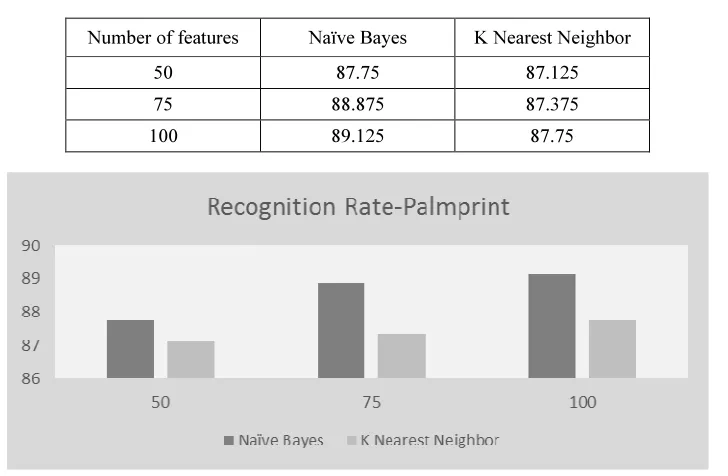
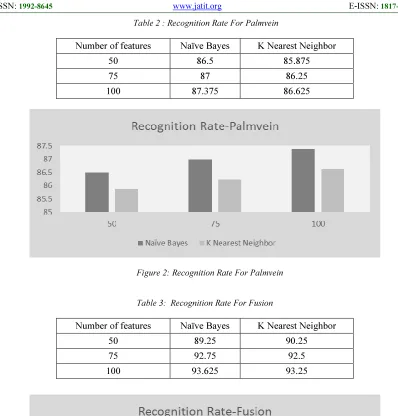
[image:6.595.119.483.496.734.2]6 palmprint and palmvein images from 200 subjects are used. Two images from each subject were used for training and the remaining used for testing. Experiments are conducted with palmprint and palmvein data alone and then with fused features. The recognition rate achieved for various classifiers is evaluated and tabulated in the following tables.
Table 1: Recognition rate for Palmprint
Number of features Naïve Bayes K Nearest Neighbor
50 87.75 87.125
75 88.875 87.375
100 89.125 87.75
Table 2 : Recognition Rate For Palmvein
Number of features Naïve Bayes K Nearest Neighbor
50 86.5 85.875
75 87 86.25
[image:7.595.93.491.109.525.2]100 87.375 86.625
[image:7.595.124.476.402.651.2]Figure 2: Recognition Rate For Palmvein
Table 3: Recognition Rate For Fusion
Number of features Naïve Bayes K Nearest Neighbor
50 89.25 90.25
75 92.75 92.5
100 93.625 93.25
Figure 3: Recognition rate for Fusion
It is observed from the above tables and figures that the fused features help achieve better recognition rate for both the classifiers. It is seen that Naïve Bayes with 100 fused features achieve 7.15% higher accuracy when compared to
also, the classification accuracy is higher when 100 features are used for classification.
5. CONCLUSION
Conventional methods for personal identification are based on what persons possess (a physical key, ID card) or what a person knows (secret password). These methods have problems. Keys are lost, ID cards forged, and passwords forgotten. Recently, biometric personal identification received interest from academia and industry. There are two types of biometric features: physiological (iris, face, fingerprint) and behavioral (voice and handwriting). In this study, a multimodal biometric system based on palmprint and palm vein is presented. Features are extracted using WPT and AR model. It is proposed to fuse the features to achieve higher discrimination in the feature vector to enhance classification. Feature selection is achieved through CFS and classification by using K NN and Naive Bayes for 50, 75 and 100 features. The results proved that fusion outperformed unimodal biometrics. It is observed that when 100 features are used for classification, the proposed fused feature technique improves the recognition rate in the range of 5.05% to 7.65%.
REFRENCES:
[1] Yang, Y., Lin, K., Han, F., & Zhang, Z. (2012). Dynamic weighting for effective fusion of fingerprint and finger vein. PICA: Progress in Intelligent Computing and Applications, 1(1), 50-61.
[2] Ozkaya, N. (2009). An intelligent face features generation system from fingerprints.
[3] Klokova, A. (2010). Comparison of various biometric methods.
[4] Ross, A., & Jain, A. K. (2004, September). Multimodal biometrics: An overview. In Proceedings of 12th European Signal Processing Conference (pp. 1221-1224). [5] Kaur, D., & Kaur, G. (2013). Level of Fusion
in Multimodal Biometrics: a Review. International Journal of Advanced Research in Computer Science and Software Engineering, 3(2).
[6] Bharadi, V. A. Texture Feature Extraction For Biometric Authentication using Partitioned Complex Planes in Transform Domain. www. thesai. org| info@ thesai. org.
[7] You, J., Li, W., & Zhang, D. (2002). Hierarchical palmprint identification via multiple feature extraction. Pattern recognition, 35(4), 847-859.
[8] Bala, R., Bansal, G., & Bansal, R. K. (2013). Palm Features Extraction for Biometric Authentication. International Journal of Emerging Trends in Electrical and Electronics (IJETEE), 2(4).
[9] Bazen, A. M. (2002). Fingerprint Identification-Feature Extraction, Matching and Database Search.
[10]Shekhar, S., Patel, V., Nasrabadi, N., & Chellappa, R. (2013). Joint sparse representation for robust multimodal biometrics recognition.
[11]Kumar, A., Kanhangad, V., & Zhang, D. (2010). A new framework for adaptive multimodal biometrics management. Information Forensics and Security, IEEE Transactions on, 5(1), 92-102.
[12]Poh, N., Bourlai, T., Kittler, J., Allano, L., Alonso-Fernandez, F., Ambekar, O., ... & Vielhauer, C. (2009). Benchmarking quality-dependent and cost-sensitive score-level multimodal biometric fusion algorithms. Information Forensics and Security, IEEE Transactions on, 4(4), 849-866.
[13]Da Costa Abreu, M. C., & Fairhurst, M. (2009). Analyzing the benefits of a novel multiagent approach in a multimodal biometrics identification task. Systems Journal, IEEE, 3(4), 410-417.
[14]Poh, N., Windridge, D., Mottl, V., Tatarchuk, A., & Eliseyev, A. (2010). Addressing missing values in kernel-based multimodal biometric fusion using neutral point substitution. Information Forensics and Security, IEEE Transactions on, 5(3), 461-469.
[15]Jiang, R. M., Sadka, A. H., & Crookes, D. (2010). Multimodal biometric human recognition for perceptual human–computer interaction. Systems, Man, and Cybernetics, Part C: Applications and Reviews, IEEE Transactions on, 40(6), 676-681.
[17]Yang, J. (2010, October). Biometrics verification techniques combing with digital signature for multimodal biometrics payment system. In Management of Commerce and e-Government (ICMeCG), 2010 Fourth International Conference on (pp. 405-410). IEEE.
[18]Conti, V., Militello, C., Sorbello, F., & Vitabile, S. (2010). A frequency-based approach for features fusion in fingerprint and iris multimodal biometric identification systems. Systems, Man, and Cybernetics, Part C: Applications and Reviews, IEEE Transactions on, 40(4), 384-395.
[19]Wang, Z. F., Han, Q., Li, Q., Niu, X. M., & Busch, C. (2009). Complex common vector for multimodal biometric recognition. Electronics letters, 45(10), 495-496.
[20]Kang, B. J., & Park, K. R. (2010). Multimodal biometric method based on vein and geometry of a single finger. Computer Vision, IET, 4(3), 209-217.
[21]Luo, N., Guo, Z., Wu, G., & Song, C. (2011, January). Joint palmprint and palmvein verification by Dual Competitive Coding. In Advanced Computer Control (ICACC), 2011 3rd International Conference on (pp. 538-542). IEEE.
[22]Mhaske, V.D.; Patankar, A.J., (2013). "Multimodal biometrics by integrating fingerprint and palmprint for security," Computational Intelligence and Computing Research (ICCIC), 2013 IEEE International Conference on , vol., no., pp.1,5, 26-28 Dec. 2013
[23]Chin, Y. J., Ong, T. S., Goh, M. K., & Hiew, B. Y. (2009, October). Integrating palmprint and fingerprint for identity verification. In Network and System Security, 2009. NSS'09. Third International Conference on (pp. 437-442). IEEE.
[24]Gaikwad, D.P.; Narote, S.P., (2013), "Multi-modal biometric system using palm print and palm vein features," India Conference (INDICON), Annual IEEE , vol., no., pp.1,5, 13-15 Dec. 2013
[25]Shen, L., Ji, Z., Li, Y., & Bai, L. (2010, October). Coding Gabor Features for Multi-Modal Biometrics. In Pattern Recognition (CCPR), 2010 Chinese Conference on (pp. 1-4). IEEE.
[26]Kalra, S., Chong, M. N., & Krishnan, D. (1997, April). A new auto-regressive (AR) model-based algorithm for motion picture restoration. In Acoustics, Speech, and Signal Processing, 1997. ICASSP-97., 1997 IEEE International Conference on (Vol. 4, pp. 2557-2560). IEEE. [27]Laine, A., & Fan, J. (1993). Texture
classification by wavelet packet signatures. Pattern Analysis and Machine Intelligence, IEEE Transactions on, 15(11), 1186-1191. [28]Graps, A. (1995). An introduction to wavelets.
Computational Science & Engineering, IEEE, 2(2), 50-61.
[29]Sethi, J., Mishra, S., Dash, P. P., Mishra, S. K., & Meher, S. (2011). Image Compression Using Wavelet Packet Tree. International Journal on Signal & Image Processing, 2(1).
[30]Kharate, G. K., & Patil, V. H. (2010). Color Image Compression Based On Wavelet Packet Best Tree. International Journal of Computer Science Issues (IJCSI), 7(4).
[31]Sandler, R., & Lindenbaum, M. (2006, June). Gabor filter analysis for texture segmentation. In Computer Vision and Pattern Recognition Workshop, 2006. CVPRW'06. Conference on (pp. 178-178). IEEE.
[32]Jain, A., Nandakumar, K., & Ross, A. (2005). Score normalization in multimodal biometric systems. Pattern recognition, 38(12), 2270-2285.
[33]H Abdi: Z-scores
[34]Kumar, A., & Zhang, D. (2005, January). Biometric recognition using feature selection and combination. In Audio-and Video-Based Biometric Person Authentication (pp. 813-822). Springer Berlin Heidelberg.
[35]Li, B., Yu, S., & Lu, Q. (2003). An improved k-nearest neighbor algorithm for text categorization. arXiv preprint cs/0306099. [36]Ren, J., Lee, S. D., Chen, X., Kao, B., Cheng,