Stage-dependent modes of Pax6-Sox2 epistasis regulate lens development and eye
morphogenesis
April N. Smith, Leigh-Anne Miller, Glenn Radice, Ruth Ashery-Padan and Richard A. Lang
There was an error published in Development136, 2977-2985.
The acknowledgements should have mentioned the Binational Science Foundation. The corrected acknowledgements section appears in full below.
The authors apologise to readers for this mistake.
We thank Mr Paul Speeg for excellent technical assistance. We are indebted to Dr Hans Arnheiter for providing the anti-Mitf antibodies. This work was supported by NIH RO1s EY10559, EY15766, EY16241 and EY17848, and by funds from the Abrahamson Pediatric Eye Institute Endowment at Children’s Hospital Medical Center of Cincinnati (R.A.L.). Research in the laboratories of R.A.L. and R.A.-P. is supported by the Binational Science Foundation.
Development 136, 3377 (2009) doi:10.1242/dev.043802
CORRIGENDUM
INTRODUCTION
The Pax6and Sox2genes are both known to have major roles in eye development (Callaerts et al., 1997; Chow and Lang, 2001; Treisman, 2004; Kondoh, 2008). Pax6 is a paired domain and homeodomain-containing transcription factor that is essential for eye development in both invertebrates and vertebrates (Quiring et al., 1994). It also has the remarkable ability to induce ectopic eyes, both in flies and frogs, when misexpressed (Halder et al., 1995; Chow et al., 1999). Pax6 is expressed in the presumptive lens in a region that includes the lens placode and adjacent ectoderm (Grindley et al., 1997; Furuta and Hogan, 1998; Ashery-Padan et al., 2000; Dimanlig et al., 2001). According to tissue recombination experiments (Fujiwara et al., 1994), the generation of Pax6mutant chimeric mice (Collinson et al., 2000), lineage-traced ectopic lenses (Chow et al., 1999) and Pax6 conditional deletion (Ashery-Padan et al., 2000), Pax6 has an autonomous role in lens development. When Pax6 is misexpressed in the frog, it has been observed that ectopic lenses can form in isolation, whereas ectopic retina development is always accompanied by adjacent ectopic lens tissue (Chow et al., 1999). This has suggested that the developing lens may provide important signals for formation of the retina.
Sox2 is one member of the larger family of high mobility group (HMG) domain transcription factors (Kamachi et al., 2000). Members of the Sox family have diverse tissue-specific expression patterns throughout early development and have been implicated in
cell fate decisions in numerous processes (Uwanogho et al., 1995). Sox1, Sox2 and Sox3 are all expressed in the lens (Kamachi et al., 1998). Sox2 and Sox3 expression in the early lens placode is dependent on the optic vesicle and this implies that they are responsive to inductive signals (Kamachi et al., 1998). Sox1 is first expressed later during invagination of the lens placode, and also during lens morphogenesis in lens fiber cells (Kamachi et al., 1998). Sox2 has been implicated in lens development through its regulation of the δ1-crystallingene in the chick (Kamachi et al., 2001) and, more recently, of N-cadherin(Matsumata et al., 2005), an adhesion molecule known to be required for normal lens morphogenesis and the differentiation of lens fiber cells (Pontoriero et al., 2009). It has also been proposed that the Sox2gene is regulated by the Sox2 protein product in combination with Pax6 through the N-3 enhancer that is active in the presumptive lens (Inoue et al., 2007). Consistent with an important role for Sox2 in eye development, it was recently shown that, in humans, heterozygous Sox2mutation can result in anophthalmia-esophageal-genital (AEG) syndrome (Fantes et al., 2003; Taranova et al., 2006; Bakrania et al., 2007).
It has been recognized, based on the analysis of cis-acting regulatory elements, that Pax6and Sox2are likely to be cross-regulated during development (Kondoh et al., 2004; Hever et al., 2006; Inoue et al., 2007). Despite this, to date, an assessment of the genetic and functional interactions between Pax6 and Sox2 has not been performed. In the current study, we generated a Sox2 conditional allele in the mouse and, in combination with the existing Pax6conditional allele (Ashery-Padan et al., 2000), formally tested the genetic and functional relationships between Pax6and Sox2in the lens. This showed that in pre-placodal ectoderm, Pax6 and Sox2 expression is not inter-dependent, but that the two proteins cooperate functionally in the very early steps of eye development. Unexpectedly, we show that various combinations Pax6 and Sox2 deletion in the pre-placodal ectoderm have profound effects on the morphogenesis of the eye. This suggests that Pax6 and Sox2 are required for the production of signals that initiate eye morphogenesis. We also show that, in pre-placodal ectoderm, N-cadherin is dependent on Sox2, but not Pax6. After the lens placode
Stage-dependent modes of Pax6-Sox2 epistasis regulate lens
development and eye morphogenesis
April N. Smith1, Leigh-Anne Miller1, Glenn Radice2,*, Ruth Ashery-Padan3and Richard A. Lang1,4,5,†
The transcription factors Pax6 and Sox2 have been implicated in early events in lens induction and have been proposed to
cooperate functionally. Here, we investigated the activity of Sox2in lens induction and its genetic relationship to Pax6in the mouse. Conditional deletion of Sox2in the lens placode arrests lens development at the pit stage. As previously shown, conditional
deletion of Pax6in the placode eliminates placodal thickening and lens pit invagination. The cooperative activity of Sox2 and Pax6 is illustrated by the dramatic failure of lens and eye development in presumptive lens conditional, compound Sox2, Pax6
heterozygotes. The resulting phenotype resembles that of germ line Pax6inactivation, and the failure of optic cup morphogenesis indicates the importance of ectoderm-derived signals for all aspects of eye development. We further assessed whether Sox2and
Pax6were required for N-cadherin expression at different stages of lens development. N-cadherin was lost in Sox2-deficient but not Pax6-deficient pre-placodal ectoderm. By contrast, after the lens pit has formed, N-cadherin expression is dependent on Pax6. These data support a model in which the mode of Pax6-Sox2 inter-regulation is stage-dependent and suggest an underlying mechanism in which DNA binding site availability is regulated.
KEY WORDS: Pax6, Sox2, Development, Eye, Lens, Morphogenesis, Mouse Development 136, 2977-2985 (2009) doi:10.1242/dev.037341
1Division of Pediatric Ophthalmology and 4Division of Developmental Biology, Cincinnati Children’s Hospital Research Foundation, Cincinnati, OH 45229, USA. 2Center for Research on Reproduction and Women’s Health, University of Pennsylvania School of Medicine, Philadelphia, PA 19104, USA. 3Sackler Faculty of Medicine, Department of Human Molecular Genetics and Biochemistry, Tel Aviv University, Tel Aviv, Israel. 5Department of Ophthalmology, University of Cincinnati, Cincinnati, OH 45229, USA.
*Present address: Center for Translational Medicine, College of Graduate Studies, Thomas Jefferson University, Philadelphia, PA 19107, USA
†Author for correspondence ([email protected])
2978
has formed, Pax6 and Sox2 change to a different genetic relationship, whereby Sox2 expression is dependent on Pax6. N-cadherin expression at this later stage is dependent on Pax6. These data support a model in which the mode of Pax6-Sox2 inter-regulation is stage dependent, and point to an underlying mechanism in which DNA binding site availability is regulated.
MATERIALS AND METHODS Animal maintenance and use
Animals were housed in a pathogen-free vivarium in accordance with institutional policies. Gestational age was determined through detection of a vaginal plug. At specific gestational ages, fetuses were removed by hysterectomy after the dams had been anesthetized with isoflurane. In this analysis, eight to 20 embryonic eyes were analyzed for each genotype and stage of development.
Generation of the Sox2floxallele
The Sox2flox allele was generated using conventional gene-targeting
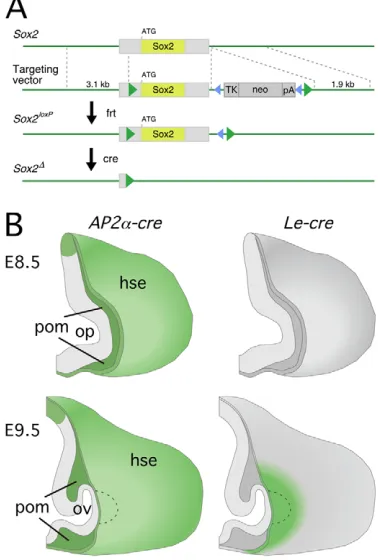
methods. A 5⬘loxPsite was placed in the 5⬘untranslated region of Sox2 and a 3⬘loxPsite downstream of the single Sox2exon (Fig. 1A). The Frt site-flanked neo gene of the targeting vector was excised in vivo using a flippase-expressing mouse line (Rodriguez et al., 2000). A similar allele of mouse
Sox2has been generated by others (Miyagi et al., 2008).
Mouse lines
The following transgenic and gene-targeted mice were used in this study:
Le-cre(Ashery-Padan et al., 2000), AP2α-cre(Macatee et al., 2003), Pax6flox
(Ashery-Padan et al., 2000), Pax6sey(Hill et al., 1991), N-cadherinLacz
(Radice et al., 1997), N-cadherinflox(Kostetskii et al., 2005) and α MHC-Ecad(Luo et al., 2001). All mouse lines used in this study were genotyped by PCR using primers and protocols described previously. Yolk sacs from staged embryos or tail tips were digested overnight at 55°C in lysis buffer and genomic DNA extracted using a Kingfisher 96 Magnetic Particle Processor. Primers for genotyping of the Sox2floxallele were as follows:
VS635, TGGAATCAGGCTGCCGAGAATCC; VS636, TCGTTCTGG CAACAAGTGCTAAAGC; and VS369, CTGC CATAGC CA CT CG -AGAAG. The PCR protocol used was 95°C for 4 minutes followed by 25 cycles of 94°C for 30 seconds, 58°C for 30 seconds and 72°C for 30 seconds, with a final extension period of 72°C for 7 minutes. These primers produce bands of 421 bp for the wild-type allele and 546 bp for the targeted allele.
Immunofluorescence
Immunofluorescence labeling for cryosections was performed as previously described (Smith et al., 2005). All sections were permeabilized with freshly prepared ice-cold 0.5% Triton X-100, 1% sodium citrate in PBS for 5 minutes and then washed three times in 0.1% Tween in PBS prior to blocking. Primary antibody dilutions were as follows: rabbit polyclonal anti-N-cadherin antibody (ABCAM, ab18203), 1:300; sheep polyclonal CHX10 (Exalpha, X1180P), 1:1000; rabbit polyclonal anti-Pax6 (Covance, PRB-278P), 1:2000; rabbit polyclonal anti-Sox2 (Chemicon, AB5603), 1:1000; goat polyclonal anti-P-cadherin (R&D Systems, AF761), 1:100; polyclonal rabbit anti-β-crystallin (generated in our laboratory), 1:5000; and rabbit polyclonal Mitf-1 (a gift from H. Arnheiter, National Institute of Neurological Disorders and Stroke, NIH, USA), 1:2500. Alexa Fluor secondary antibodies and Alexa phalloidins were obtained from Invitrogen or Molecular Probes and used at a dilution of 1:5000 (A-11072, A-11070, A-11016, A11058, A11015, A11055, A-12379). All sections were counterstained with Hoechst 33342 (Sigma, B-2261) for the visualization of nuclei.
RESULTS
Generation of the Sox2conditional allele
In order to effectively study the cooperative roles of Pax6 and Sox2 in the developing mouse lens, we generated a conditional Sox2flox allele (see also Miyagi et al., 2008) using conventional gene targeting in ES cells. The mouse Sox2gene has a single exon and so loxPsites were placed in the 5⬘untranslated region and downstream of the 3⬘UTR (Fig. 1A). A Pax6floxallele was generated previously (Ashery-Padan et al., 2000).
To assess the functions of Pax6 and Sox2 in the developing lens, we took advantage of two Cre-expressing drivers. The Le-cretransgenic mouse line (Ashery-Padan et al., 2000) uses the Pax6ectoderm enhancer (EE) (Williams et al., 1998; Kammandel et al., 1999; Xu et al., 1999) to drive Cre and GFP expression in the developing lens from the placode stage (approximately E9.0) onwards (Fig. 1B). At later stages of development, Le-cre is expressed in the periocular surface ectoderm that includes the presumptive conjunctiva, the corneal ectoderm and the periocular gland epithelia (Williams et al., 1998; Kammandel et al., 1999; Xu et al., 1999; Ashery-Padan et al., 2000; Smith et al., 2005). The AP2α-cre mouse line was generated by inserting the Cre recombinase-coding region into the 3⬘ untranslated region of theAP2αgene (Tcfap2a– Mouse Genome Informatics) using gene-targeting methods (Macatee et al., 2003). This results in a Cre expression domain that includes the dorsal neural tube, neural crest-derived periocular mesenchyme and the head surface ectoderm that includes the presumptive lens at a pre-placodal stage (Fig. 1B). A comparison of the consequences of AP2α-cre and Le-cre mediated gene deletion can be informative (Song et al., 2007), as they represent genetically distinct phases of lens development (Grindley et al., 1995; Lang, 2004).
RESEARCH ARTICLE Development 136 (17)
Fig. 1. The Sox2allele and pattern of AP2α-creand Le-cre expression.(A) Schematic showing the design of the Sox2targeting vector and the final Sox2floxconditional allele. The positive selectable marker neowas removed by crossing the Sox2floxNeoallele with a germline flippase mouse line. (B) Expression patterns (green regions) of
AP2α-creand Le-crein the eye region at E8.5 and E9.5. The dashed line shows the approximate boundary of the lens placode. hse, head surface ectoderm; pom, periocular mesechyme; ov, optic vesicle; op,
[image:3.612.78.267.361.641.2]After lens placode formation, Pax6 is upstream of Sox2
To understand the roles of Pax6 and Sox2 at the placodal stage of lens development, we first performed deletions of each gene separately using Le-cre. Le-cre-mediated deletion of Pax6 confirmed (Ashery-Padan et al., 2000) that Pax6 immunoreactivity in the lens ectoderm was reduced at E9.5 (Fig. 2B) and absent at E10.5 (Fig. 2E). Pax6 labeling in the presumptive retina of Le-cre;
Pax6FL/FL embryos was unchanged (Fig. 2B,E) and served to
illustrate the specificity of the Le-credriver. Phenotypically, Pax6 deletion in the presumptive lens resulted in a failure of lens development from the placode stage onwards (Fig. 2B,E,H,K), as would be anticipated (Ashery-Padan et al., 2000). In addition, the optic vesicle failed to undergo normal morphogenesis; although the expected thickness differential was sometimes observed, the presumptive retinal and retinal pigmented epithelia were not apposed or cupped (Fig. 2E,K). When we labeled for Sox2 in
Le-cre; Pax6FL/FLembryos, there was little change apparent at E9.5 (Fig. 2H) but dramatically reduced immunoreactivity by E10.5 (Fig. 2K). This indicated that at the pit stage of lens development, Sox2 expression is dependent on Pax6.
Conditional deletion of Sox2FL/FL with Le-cre gave reliably diminished Sox2 immunoreactivity in the presumptive lens of E9.5 embryos (Fig. 2I) and an absence at E10.5 (Fig. 2L). The phenotypic consequences of Sox2deletion were milder than in the Pax6mutant: some placodal thickening was apparent (e.g. Fig. 2C) and a lens pit, albeit shallow compared with that of wild type (Fig. 2J), was observed (Fig. 2L). Furthermore, the optic cup of Le-cre; Sox2FL/FL embryos was formed fairly normally with apposed presumptive retina and retinal pigment epithelial layers of appropriate thickness. Immunolabeling for Pax6 in Le-cre; Sox2FL/FL embryos did not detect any changes in Pax6 levels either at E9.5 (Fig. 2C) or at E10.5 (Fig. 2F), indicating that Pax6 expression is not dependent on Sox2. When combined with the above data showing the dependence of Sox2 expression on Pax6, this suggests that after the placodal stage of lens development there is a simple linear genetic pathway with Pax6upstream of Sox2.
At the pre-placodal stage of lens development, Pax6 and Sox2 function in parallel
[image:4.612.51.300.264.634.2]AP2α-cre(Macatee et al., 2003) is expressed earlier than Le-creand is active at E8.5 in the head surface ectoderm that encompasses the pre-placodal presumptive lens. Because Pax6 and Sox2 are not expressed in the crest-derived periocular mesenchyme where AP2α -creis also active, this component of driver activity is not of concern. To determine the function of Pax6and Sox2and to examine their epistatic relationship at pre-placodal stages, we performed conditional deletion of each individual gene with AP2α-cre.
[image:4.612.314.564.425.648.2]Fig. 2. Placodal deletion of Pax6and Sox2produce distinct consequences for lens and eye development. (A-L) Cryosections of the indicated embryonic stage (left) and genotype (top) showing immunofluorescence signal for either Pax6 or Sox2 (red) and nuclei (blue). For clearer examination of areas of targeted deletion (white brackets), red channels are magnified and shown separately, either below (A-C,G-I) or above (D-F,J-L) the parent panel. lp, lens placode; lv, lens vesicle; pr, presumptive retina; prpe, presumptive retinal pigmented epithelium; ple, presumptive lens ectoderm; pi, lens pit; ov, optic vesicle.
Fig. 3. Pre-placodalPax6 is not dependent onSox2.
(A-I) Cryosections of the indicated embryonic stage (left) and genotype (top), showing immunofluorescence signal for Pax6 (red) and nuclei (blue). For clearer examination of areas of targeted deletion (white brackets), red channels are magnified and shown separately, either below (A-C) or above (D-F). lp, lens placode; lv, lens vesicle; pr, presumptive retina; prpe, presumptive retinal pigmented epithelium;
2980
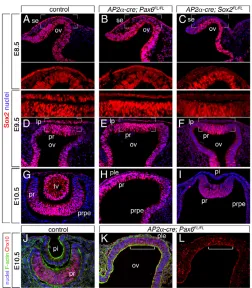
In AP2α-cre; Pax6FL/FL embryos, typical nuclear Pax6 immunoreactivity was largely lost at E8.5 in the surface ectoderm (Fig. 3B), but was somewhat patchy, presumably because some late-deleting cells retained residual Pax6. By E9.5 (Fig. 3E) and E10.5 (Fig. 3H) the presumptive lens ectoderm of AP2α-cre; Pax6FL/FL embryos showed no Pax6 immunoreactivity. We were not able to discern any change in Pax6 immunoreactivity in the optic vesicle at any stage in any (n=20) of the AP2α-cre; Pax6Fl/Fl embryos examined. A phenotypic response to the absence of pre-placodal Pax6 did not become apparent until E9.5 and beyond but manifested as an absence of placodal thickening (Fig. 3E) and a complete failure of eye morphogenesis (Fig. 3H) that was more severe than when Le-crewas used to delete Pax6FL(Fig. 2). Indeed, the phenotype of AP2α-cre; Pax6FL/FL embryos most closely resembles that of Pax6Seyhomozygotes in which the lens placode does not thicken, there is no invagination of either lens pit or optic cup and the optic stalk fails to constrict in the proximal eye region (Grindley et al., 1995). In AP2α-cre; Sox2FL/FLembryos (see Fig. 4 for confirmation of deletion) there was no impact on Pax6 immunoreactivity in the presumptive lens from E8.5 to E10.5 (Fig. 3C,F,I). This indicates that during these stages of lens development, Sox2 is not upstream of Pax6.
As expected, AP2α-cre; Sox2FL/FLresulted in the absence of Sox2 immunoreactivity in the surface ectoderm and presumptive lens from E8.5-E10.5 (Fig. 4C,F,I). The phenotypic consequence of this pre-placodal Sox2deletion was similar to the consequence of placodal deletion with Le-cre, in that the presumptive lens and retina underwent a modest invagination that arrested at the equivalent of E10.0 (Fig. 4I). However, there were also distinctions between AP2α-creand Le-cre mediated Sox2deletion. Unlike Le-cremediated Sox2deletion where the optic cup layers were well formed, AP2α-cre-mediated Sox2 deletion resulted in a failure of the presumptive retina and the RPE to form nested cups. Instead, the RPE was widely separated from the presumptive retina (Fig. 4I) and transitioned to an optic stalk region that, as in AP2α-cre; Pax6FL/FL embryos, showed no proximal constriction. This suggests that the early phase of Sox2expression in the surface ectoderm is required for the production of signals that regulate some aspects of optic cup morphogenesis.
Sox2 labeling of AP2α-cre; Pax6FL/FLembryos revealed that immunoreactivity was retained from E8.5-E10.5 (Fig. 4B,E,H). At first glance, this might appear surprising given the loss of Sox2 in the presumptive lens of Le-cre; Pax6FL/FLembryos at E10.5 (Fig. 2K), but is likely explained by arrested lens and eye development in this genotype. In other words, the eye of the E10.5 AP2α-cre; Pax6FL/FLembryo is developmentally equivalent to an E9.0 eye, and at this pre-placodal stage, Sox2 expression is independent of Pax6. The notion that this represents a developmental arrest is reinforced by the pattern of Chx10 labeling in presumptive retina of AP2α-cre; Pax6FL/FLembryos. Normally, at E9.0, Chx10 is expressed at a low level in a small domain of the central presumptive retina. This region expands to encompass the entire presumptive retina by E9.5 (Fig. 6K) and E10.5 (Burmeister et al., 1996) (Fig. 6C). By contrast, in E10.5 AP2α-cre; Pax6FL/FL embryos, Chx10 was observed in a central domain of presumptive retina at the low expression levels (Fig. 4L) characteristic of the E9.0 eye.
The stage dependence of the severity of the Sox2 mutant phenotype is nicely illustrated by the expression of β-crystallin in both conditional mutants (Fig. 5A-C). In control embryos (Fig. 5A), the lower half of the lens vesicle expressed β-crystallin at E11.5. With AP2α-cre-mediated deletion, only a few differentiated cells could be detected (Fig. 5C), whereas Le-cre -mediated deletion gave an intermediate-sized β -crystallin-expressing region (Fig. 5B). Thus, the phenotype is more severe when Sox2is deleted earlier.
In someAP2α-cre; Sox2FL/FLembryos, lenses of a reasonable size but abnormal morphology were observed later in development. At E17.5, control eyes showed robust β-crystallin and Prox1 labeling (Fig. 5D,G). By contrast, most AP2α-cre; Sox2FL/FLeyes (n=6/10) had no morphologically recognizable lenses but did have an occasional ectopic β-crystallin-positive cell (Fig. 5E,H). The remaining embryos of this genotype (n=4/10) had lenses, albeit of abnormal morphology, that expressed both β-crystallin and Prox1 (Fig. 5F,I). In Pax6conditional mutants generated using either Cre driver, neither morphologically recognizable lenses nor β-crystallin immunoreactivity was ever detected (data not shown) (Ashery-Padan et al., 2000). This is consistent with the idea that Pax6 has the more upstream role in lens development.
Unchanged Sox2 immunoreactivity in the head surface ectoderm of AP2α-cre; Pax6FL/FLembryos (Fig. 4B) is perhaps in contrast with earlier data examining Pax6Sey/Seymutants (Furuta and Hogan, 1998), suggesting that Sox2expression in this location is dependent on Pax6. This information emerged from Sox2in situ hybridization studies performed on Pax6Sey-Neu/Sey-Neu embryos at 27 somites (approximately E10). To examine this issue further, we performed
[image:5.612.49.301.331.619.2]RESEARCH ARTICLE Development 136 (17)
Fig. 4. Pre-placodal expression of Sox2is not dependent on Pax6.
(A-I) Cryosections of the indicated embryonic stage (left) and genotype (top), showing immunofluorescence signal for Sox2 (red) and nuclei (blue). For clearer examination of areas of targeted deletion (white brackets), red channels are magnified and shown separately, either below (A-C) or above (D-F). (J-L) Immunofluorescence signal for nuclei (blue), F-actin (green) and Chx10 (red) in wild-type (J) and AP2α-cre;
Pax6Fl/Fl-deleted embryos (K,L) at E10.5. se, surface ectoderm; lp, lens placode; lv, lens vesicle; pr, presumptive retina; prpe; presumptive retinal pigmented epithelium; ple, presumptive lens ectoderm; pi, lens
immunolabeling on Pax6Sey/Seyembryos. We confirmed that, at E9.5, Pax6Sey/Seyembryos showed no nuclear Pax6 immunoreactivity (Fig. 5K; cytoplasmic immunoreactivity was frequently detected but was not greater than background levels). Furthermore, Pax6Sey/Sey embryos showed Sox2 immunoreactivity at apparently normal levels despite obvious morphological defects (Fig. 5M). Thus, both germline (Pax6Sey/Sey) and conditional (AP2α-cre; Pax6FL/FL) Pax6 deletion suggests that prior to E9.5, Sox2 expression in the surface ectoderm and presumptive lens is independent of Pax6.
Ectodermal Pax6 and Sox2 cooperate in lens development and eye morphogenesis
The possibility that Pax6 and Sox2 cooperate developmentally is raised by their co-expression, by their ability to form a transcription regulation complex (Kamachi et al., 2001) and by the identification of potential binding sites in cis-elements that might mediate cross-regulation (Kondoh et al., 2004; Hever et al., 2006; Inoue et al., 2007). To assess the possibility of Pax6 and Sox2 cooperation in lens development, we generated conditional compound heterozygotes using Le-creand assessed the phenotypic consequences. In E10.5 Le-cre; Pax6+/Fl; Sox2+/Fl embryos, we observed phenotypic variation that ranged from a small but otherwise normal eye (n=10/20; data not shown) to an eye that showed arrested
development at an early stage (n=10/20; Fig. 6E-H). Compared with normal E10.5 eyes that showed a lens pit or lens vesicle (Fig. 4A-D), conditional compound heterozygotes that were severely affected showed no placodal thickening and no lens pit or optic cup invagination. The morphology of these mutant eyes most closely resembled that of the Pax6Sey/Sey(Grindley et al., 1995) or the AP2α -cre; Pax6Fl/Flmutants (Figs 3, 4).
Immunolabeling of severely affectedLe-cre; Pax6+/Fl; Sox2+/Fl embryos revealed that at E10.5, both Pax6 and Sox2 were absent from the surface ectoderm (Fig. 6E,F). Because these embryos are conditional mutants in which Pax6 and Sox2 heterozygote deletion took place approximately one day earlier, the complete loss of Pax6 and Sox2 immunoreactivity probably represents a secondary consequence of loss of the entire lens development program. Chx10 and Mitf are markers for presumptive retina and RPE, respectively, that reveal whether the optic cup has been patterned (Nguyen and Arnheiter, 2000; Horsford et al., 2005). Despite the absence of eye morphogenesis, Chx10 was expressed in central presumptive retina (Fig. 6G, compare with E9.5 control, Fig. 6K), and Mitf in presumptive RPE (Fig. 6H, compare with E9.5 control, Fig. 6L). This indicates that the first steps of optic cup patterning have occurred in Le-cre; Pax6+/Fl; Sox2+/Flembryos, and suggests that a major cooperative function of Pax6 and Sox2 is to signal optic cup morphogenesis.
Sox2 regulates N-cadherin expression
[image:6.612.312.563.59.311.2]The adhesion molecule N-cadherin has a complex pattern of expression in the epithelia of the developing eye. At E8.5, N-cadherin was expressed in both the optic pit and the surface Fig. 5. Sox2 has an important role in lens development.
[image:6.612.53.298.60.388.2](A-M) Cryosections from embryos of the indicated age (left) and genotypes (above) showing immunofluorescence signal for nuclei (blue),β-crystallin (A-C, red; D-F, green) Prox1 (G-I, red), Pax6 (J,K, red) and Sox2 (L,M, red). lp, lens placode; lv, lens vesicle; pr, presumptive retina; ple, presumptive lens ectoderm; pi, lens pit; ov, optic vesicle; r, retina; m, mesenchyme; l, lens.
Fig. 6. Ectodermal Pax6 and Sox2 cooperate in lens and eye development.(A-L) Cryosections from embryos of the indicated ages and genotypes labeled for F-actin (A-H, green), nuclei (I-L, blue), or Pax6, Sox2, Chx10 or Mitf (red) as indicated at left. Asterisk in G indicates a retinal fold that has been grazed in the plane of section. lp, lens placode; lv, lens vesicle; pr, presumptive retina; prpe, presumptive retinal pigmented epithelium; ple, presumptive lens ectoderm; ov, optic vesicle; os, optic stalk.
2982
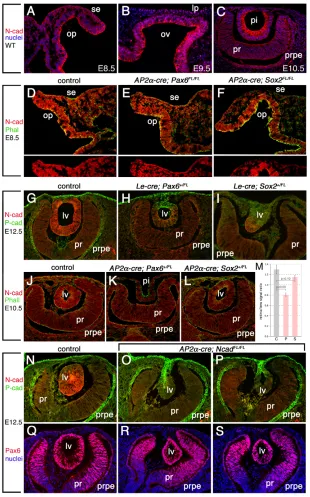
ectoderm of the head fold (Fig. 7A). N-cadherin expression was maintained in the optic vesicle at E9.5 but was downregulated in the lens placode region of the surface ectoderm (Fig. 7B). N-cadherin expression was further retained in the presumptive retina and the RPE of E10.5 embryos and was upregulated in the lens pit during invagination (Fig. 7C). Because it has been suggested that N-cadherinis regulated by Sox family members (Matsumata et al., 2005) or Pax6 (van Raamsdonk and Tilghman, 2000), we assessed this possibility using the conditional mutants.
AP2α-cre; Pax6Fl/Fl embryos at E8.5 showed a wild-type distribution of N-cadherin immunoreactivity (Fig. 7E). By contrast, AP2α-cre; Sox2Fl/Flembryos at E8.5 had lost N-cadherin expression from the surface ectoderm (Fig. 7F). Even though the N-cadherin signal was not high at this stage of development, this change was consistently detected in an analysis of six AP2α-cre; Sox2Fl/Fl
embryos. Previously, it has been shown that Pax6Seyheterozygotes have reduced N-cadherintranscript levels in the lens pit (van Raamsdonk and Tilghman, 2000). Because neither the Pax6nor the Sox2homozygous Le-creconditional mutants developed a lens pit (Fig. 2), it was not possible to assess N-cadherinexpression at this stage in these genotypes. However, we have confirmed that in Le-creand AP2α-creconditional Pax6 heterozygotes (Fig. 7H,K), N-cadherin levels were reduced in the lens pit. In the case of AP2α-cre; Pax6Fl/Flembryos, we quantified this by measuring N-cadherin immunoreactivity and expressing the data as the ratio of presumptive retina to lens pit signal intensity (Fig. 7M); the N-cadherin signal was significantly reduced in the Pax6 mutant (control, n=4; AP2α-cre; Pax6+/Fl, n=9; P=0.00004). A similar analysis for Sox2conditional heterozygotes suggested a reduced N-cadherin signal in the lens pit according to observation of
[image:7.612.49.359.59.556.2]RESEARCH ARTICLE Development 136 (17)
Fig. 7. N-cadherin expression is Sox2 dependent in the pre-placode, but Pax6 dependent subsequently.(A-C) Expression pattern of N-cadherin in the developing wild-type lens from E8.5 to E10.5. (D-L) Cryosections from embryos of the indicated ages and genotypes labeled for the color-coded markers shown on the left. (D-F) The red channel that represents labeling for N-cadherin is shown below the parent panel. (M) Quantification of N-cadherin immunolabeling for control (C), AP2α -cre; Pax6FL/FL(P) and AP2α-cre; Sox2FL/FL(S) E10.5 eyes expressed as the ratio of retina/lens intensity. Significance values according to one-way ANOVA are as indicated. (N-S) Cryosections from embryos of the indicated ages and genotypes labeled for the color-coded markers shown on the left. lp, lens placode; lv, lens vesicle; pi, lens pit; pr, presumptive retina; prpe, presumptive retinal pigmented epithelium; op, optic pit; ov, optic vesicle.
micrographs (Fig. 7I,L), but quantification (Fig. 7M) produced only a trend of reduced N-cadherin signal (control, n=4; AP2α-cre; Sox2+/Fl, n=8; P=0.10). These findings confirm that in the lens pit N-cadherin expression is dependent on Pax6, and leave open the possibility that part of this regulation might be mediated by Sox2 (Fig. 8). The latter suggestion would be consistent with the identification of Sox2-binding sites in N-cadherin enhancers (Matsumata et al., 2005).
To determine whether N-cadherinwas an important component of Sox2-dependent lens development, we deleted N-cadherinat the pre-placodal stage by using an existing Ncadfloxconditional allele (Kostetskii et al., 2005; Li et al., 2005). AP2α-cre; NcadFl/Fl embryos are difficult to produce at lens development stages owing to an early developmental lethality that probably results from neural tube and heart development defects (Radice et al., 1997). However, in embryos that were viable at E12.5, we could confirm that the normally robust level of N-cadherin in the lens vesicle (Fig. 7N) was absent in the conditional mutants (Fig. 7O,P), even though Pax6 expression (Fig. 7R,S) was retained. Furthermore, in AP2α-cre; NcadFl/Fl embryos, as expected (Pontoriero et al., 2009), we observed a failure of the lens vesicle to separate from the surface ectoderm and a persistence of P-cadherin expression (Fig. 7O,P). Even though this phenotype was striking, it was milder that that observed when Sox2was deleted with AP2α-cre (Figs 3, 4) and suggests that N-cadherin is just one of several downstream genes that Sox2 regulates during lens development. Furthermore, because this early deletion of N-cadherinresulted in a phenotype that manifested only at E11.5-E12.5, this suggests that N-cadherin does not have a crucial function in pre-placodal lens ectoderm.
DISCUSSION
In this analysis, we have assessed the genetic relationship and developmental functions of Pax6 and Sox2 in the early stages of lens development in the mouse. We show that there is an epistatic
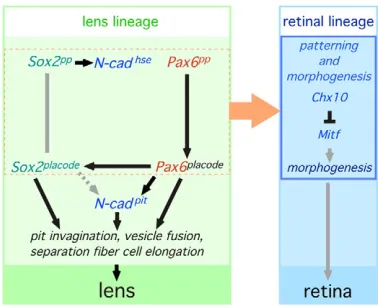
relationship between Pax6 and Sox2, but that this exists only in a defined developmental window. We also show that, when deleted only in presumptive lens, Pax6 and Sox2 have a cooperative action that regulates lens development but that also initiates morphogenesis in the adjacent optic cup. Finally, we show that N-cadherinis regulated by Sox2 and that, during the placodal phase of lens development when Pax6 regulates Sox2, N-cadherin is also dependent on Pax6. These data raise a number of questions. Stage-dependent regulation of Sox2 by Pax6 Our data show that during lens development there are dynamic changes in the genetic relationship between Pax6and Sox2. In pre-placodal lens ectoderm, even though there is evidence for a functional cooperation of the gene products, Pax6 and Sox2 transcription is regulated independently. After lens placode formation, the mode of interaction changes to one in which Sox2 expression is dependent on Pax6. This changing relationship is also illustrated by an assessment of N-cadherin expression. In pre-placodal presumptive lens, N-cadherin expression is dependent on Sox2, but not Pax6. After lens placode formation, N-cadherin expression is dependent on Pax6. These data suggest a model in which Pax6 becomes a regulator of Sox2 after lens induction signaling has been initiated (Fig. 8). The N-3 enhancer of Sox2 (Inoue et al., 2007) is a good candidate for mediating Pax6 regulation of Sox2after placode formation.
In earlier experiments in which Pax6 was conditionally deleted in the presumptive lens with Le-cre(Ashery-Padan et al., 2000), Sox2 immunoreactivity was retained and this contrasts with the current data in which Le-credeletion of Pax6results in the loss of Sox2. An explanation for this difference might lie in the genotype of the experimental animals. Previously, Pax6flox was conditionally deleted on a Pax6heterozygous [Pax6lacZ(St-Onge et al., 1997)] background, whereas here we used the homozygous conditional allele. It might be that the Pax6 heterozygous background produces an earlier developmental defect and that Pax6+/lacZ; Le-cre embryos more closely resemble AP2α-cre; Pax6flox/floxembryos, in which there is an early developmental arrest and in which Sox2 expression is retained. It will be very interesting to compare the eye transcriptomes of these mutants to understand whether these differences define early steps in lens induction.
The observation that the Pax6-Sox2genetic relationship changes with developmental stage suggests that an additional level of transcriptional regulation is at play. Specifically, these data indicate that, regardless of whether regulation is direct or indirect, the Sox2 transcriptional control element that mediates Pax6-dependent regulation in the lens pit is inactive at earlier stages. Clearly there are many mechanisms that could explain this switching. Given the stage of development at which this regulatory switching occurs, it might be that optic vesicle-dependent inductive signaling can throw the switch. Switching might be mediated by co-regulator availability or perhaps by chromatin remodeling (Li et al., 2007). Further investigation will be required to gain an understanding of this mechanism.
[image:8.612.80.269.467.620.2]Pax6 and Sox2 function in lens induction in the context of a larger set of transcription factors and several signaling pathways (Lang, 2004; Medina-Martinez and Jamrich, 2007; Kondoh, 2008). For example, the Six3 transcription factor is known to be important for the early stages of lens development (Liu et al., 2006) and is likely to function in a positive-feedback loop with Pax6 that would result in the enhanced expression of both (Liu et al., 2006). It has been suggested (Liu et al., 2006) that the mechanism of Six3 regulation Fig. 8. A model for ectodermal Pax6 and Sox2 function in early
eye development.The analysis we present indicates that in pre-placodal ectoderm, Pax6and Sox2are regulated independently but functionally cooperate. By contrast, after the lens placode has formed, Sox2 expression is dependent on Pax6. In an unexpected finding, we show that Pax6 and Sox2 in the presumptive lens cooperate to provide signals (orange arrow) that are required for morphogenesis of the optic cup. At the pre-placodal stages, N-cadherin is regulated by Sox2. After the lens pit has formed, N-cadherin is regulated by Pax6. It is possible that in the lens pit, the dependence of N-cadherin expression on Pax6is
2984
of Pax6is direct binding to the ectoderm enhancer (Williams et al., 1998; Kammandel et al., 1999; Xu et al., 1999). It has also been suggested that Six3is upstream of Sox2(Liu et al., 2006) and that, here too, the mechanism is direct transcriptional regulation, in this case, via the N4 enhancer (Uchikawa et al., 2003). The positive regulation of Sox2by a positive-feedback loop provides a strong rationale for its upregulation during early lens development. Pax6 and Sox2 in the presumptive lens regulate optic cup morphogenesis
An unexpected finding from these studies was the absence of optic cup morphogenesis when various combinations of Pax6 and Sox2 were deleted in the surface ectoderm. A mild form of this morphogenesis failure is seen in Le-cre; Pax6flox/floxembryos in which the retina becomes convoluted (Ashery-Padan et al., 2000). When Pax6 is deleted earlier in pre-placodal ectoderm with AP2α -cre, eye morphogenesis fails completely and the phenotype most closely resembles the changes observed in the Pax6Sey/Seymice, which are Pax6germline null (Grindley et al., 1995). This implies that Pax6 expression in the surface ectoderm is required for the production of signals that initiate optic cup morphogenesis, including the epithelial bending that leads to the formation of nested cups of retina and RPE. The distances from the surface ectoderm to the presumptive RPE at the relevant stage of E9.5 are quite large and so, presumably, ectoderm and Pax6-dependent morphogenesis signaling must use a mechanism that can be transmitted or relayed over distance.
The transcription factors Chx10 and Mitf are expressed in the presumptive retina and the RPE, respectively. It has been shown that Chx10 represses Mitf expression and that this is an important element of defining the retinal and RPE territories in the optic cup (Nguyen and Arnheiter, 2000; Horsford et al., 2005). The failure of Chx10 expression to propagate throughout the presumptive retina in AP2α-cre; Pax6flox/floxembryos might provide an explanation for the failure of optic cup morphogenesis. Specifically, Pax6 in the presumptive lens appears to be required for the lens-to-retina signaling that establishes Chx10 expression. In turn, retinal and RPE territories might remain undefined and this might lead to a failure of region-specific morphogenesis. Further analysis will be required to identify the morphogenesis mechanisms involved.
Our findings were similar when Sox2 was deleted in pre-placodal ectoderm, except that the morphogenesis defects were milder. In AP2α-cre; Sox2flox/floxembryos, we typically observed E10.5 eyes with optic stalk regions that had not constricted, although in others there were nested cups of retina and RPE. The difference in the severity of eye morphogenesis defects following pre-placodal deletion of Pax6 and Sox2 presumably reflects the degree to which ectodermal morphogenesis signals are dependent on each transcription factor. Clearly, the dramatic eye morphogenesis failure apparent in some Pax6, Sox2 conditional heterozygotes nicely illustrates the functional cooperation of the two transcription factors. An earlier study (Donner et al., 2007) generated mice that were double heterozygotes for Sox2and Pax6 by using the germline alleles Sox2βgeo2(Avilion et al., 2003) and Pax6Sey-Neu(Hill et al., 1991). In contrast to the current data, the analysis of different stages of eye development in Sox2βgeo2/+; Pax6Sey-Neu/+embryos revealed no exacerbation of the Pax6Sey-Neu/+small eye phenotype by Sox2 heterozygosity. Although this might seem difficult to reconcile with the current analysis, there may be explanations. One possibility is that with Pax6and Sox2germline mutations producing a defect very early in development, the embryo might have the developmental plasticity to accommodate the change without major consequences.
The rapid deletion of Pax6and Sox2conditional alleles at a later stage of development, as in this analysis, is unlikely to allow compensation due to developmental plasticity. There is also the possibility that the germline and conditional alleles for Sox2 and Pax6 do not produce mutations that are functionally equivalent, especially given the complex gene structure and multiple isoforms of Pax6. Further work will be required to better define these issues. In humans, Sox2 heterozygosity leads to anophthalmia-esophageal-genital (AEG) syndrome (Taranova et al., 2006; Bakrania et al., 2007). This contrasts with findings in the mouse where Sox2 heterozygosity does not lead to this syndrome or any obvious eye defects (Avilion et al., 2003). We have also observed that in AP2α-creor Le-cre; Sox2conditional heterozygotes there are no apparent eye defects. However, the dramatic consequences of conditional Pax6, Sox2 heterozygosity do indicate that, on a sensitized background in which there is only half the normal level of Pax6, Sox2 heterozygosity can lead to anophthalmia. Perhaps individuals with AEG syndrome arise when the genetic variability of the human population provides a sensitized background in which Sox2 heterozygosity can have serious consequences.
Acknowledgements
We thank Mr Paul Speeg for excellent technical assistance. We are indebted to Dr Hans Arnheiter for providing the anti-Mitf antibodies. This work was supported by NIH RO1s EY10559, EY15766, EY16241 and EY17848, and by funds from the Abrahamson Pediatric Eye Institute Endowment at Children’s Hospital Medical Center of Cincinnati (R.A.L.). Deposited in PMC for release after 12 months.
References
Ashery-Padan, R., Marquardt, T., Zhou, X. and Gruss, P.(2000). Pax6 activity in the lens primordium is required for lens formation and for correct placement of a single retina in the eye. Genes Dev. 14, 2701-2711.
Avilion, A. A., Nicolis, S. K., Pevny, L. H., Perez, L., Vivian, N. and Lovell-Badge, R.(2003). Multipotent cell lineages in early mouse development depend on SOX2 function. Genes Dev. 17, 126-140.
Bakrania, P., Robinson, D. O., Bunyan, D. J., Salt, A., Martin, A., Crolla, J. A., Wyatt, A., Fielder, A., Ainsworth, J., Moore, A. et al.(2007). SOX2 anophthalmia syndrome: 12 new cases demonstrating broader phenotype and high frequency of large gene deletions. Br. J. Ophthalmol. 91, 1471-1476. Burmeister, M., Novak, J., Liang, M. Y., Basu, S., Ploder, L., Hawes, N. L.,
Vidgen, D., Hoover, F., Goldman, D., Kalnins, V. I. et al.(1996). Ocular retardation mouse caused by Chx10 homeobox null allele: impaired retinal progenitor proliferation and bipolar cell differentiation. Nat. Genet. 12, 376-384.
Callaerts, P., Halder, G. and Gehring, W. J.(1997). PAX-6 in development and evolution. Annu. Rev. Neurosci. 20, 483-532.
Chow, R. L. and Lang, R. A.(2001). Early eye development in vertebrates. Annu. Rev. Cell Dev. Biol. 17, 255-296.
Chow, R. L., Altmann, C. R., Lang, R. A. and Hemmati-Brivanlou, A.(1999). Pax6 induces ectopic eyes in a vertebrate. Development126, 4213-4222. Collinson, J. M., Hill, R. E. and West, J. D.(2000). Different roles for Pax6 in the
optic vesicle and facial epithelium mediate early morphogenesis of the murine eye. Development127, 945-956.
Dimanlig, P. V., Faber, S. C., Auerbach, W., Makarenkova, H. P. and Lang, R. A.(2001). The upstream ectoderm enhancer in Pax6 has an important role in lens induction. Development128, 4415-4424.
Donner, A. L., Episkopou, V. and Maas, R. L.(2007). Sox2 and Pou2f1 interact to control lens and olfactory placode development. Dev. Biol. 303, 784-799. Fantes, J., Ragge, N. K., Lynch, S. A., McGill, N. I., Collin, J. R.,
Howard-Peebles, P. N., Hayward, C., Vivian, A. J., Williamson, K., van Heyningen, V. et al.(2003). Mutations in SOX2 cause anophthalmia. Nat. Genet. 33, 461-463.
Fujiwara, M., Uchida, T., Osumi-Yamashita, N. and Eto, K.(1994). Uchida rat (rSey): a new mutant rat with craniofacial abnormalities resembling those of the mouse Sey mutant. Differentiation57, 31-38.
Furuta, Y. and Hogan, B. L. M.(1998). BMP4 is essential for lens induction in the mouse embryo. Genes Dev. 12, 3764-3775.
Grindley, J. C., Davidson, D. R. and Hill, R. E.(1995). The role of Pax-6 in eye and nasal development. Development121, 1433-1442.
Grindley, J. C., Hargett, L. K., Hill, R. E., Ross, A. and Hogan, B. L.(1997). Disruption of PAX6 function in mice homozygous for the Pax6Sey-1Neu mutation produces abnormalities in the early development and regionalization of the diencephalon. Mech. Dev. 64, 111-126.
RESEARCH ARTICLE Development 136 (17)
Halder, G., Callaerts, P. and Gehring, W. J.(1995). Induction of ectopic eyes by targeted expression of the eyeless gene in Drosophila. Science267, 1788-1792. Hever, A. M., Williamson, K. A. and van Heyningen, V.(2006). Developmental malformations of the eye: the role of PAX6, SOX2 and OTX2. Clin. Genet. 69, 459-470.
Hill, R. E., Favor, J., Hogan, B. L., Ton, C. C., Saunders, G. F., Hanson, I. M., Prosser, J., Jordan, T., Hastie, N. D. and van Heyningen, V.(1991). Mouse small eye results from mutations in a paired-like homeobox-containing gene.
Nature354, 522-525.
Horsford, D. J., Nguyen, M. T., Sellar, G. C., Kothary, R., Arnheiter, H. and McInnes, R. R.(2005). Chx10 repression of Mitf is required for the maintenance of mammalian neuroretinal identity. Development132, 177-187.
Inoue, M., Kamachi, Y., Matsunami, H., Imada, K., Uchikawa, M. and Kondoh, H.(2007). PAX6 and SOX2-dependent regulation of the Sox2 enhancer N-3 involved in embryonic visual system development. Genes Cells12, 1049-1061.
Kamachi, Y., Uchikawa, M., Collignon, J., Lovell-Badge, R. and Kondoh, H. (1998). Involvement of Sox1, 2 and 3 in the early and subsequent molecular events of lens induction. Development125, 2521-2532.
Kamachi, Y., Uchikawa, M. and Kondoh, H.(2000). Pairing SOX off: with partners in the regulation of embryonic development. Trends Genet. 16, 182-187.
Kamachi, Y., Uchikawa, M., Tanouchi, A., Sekido, R. and Kondoh, H.(2001). Pax6 and SOX2 form a co-DNA-binding partner complex that regulates initiation of lens development. Genes Dev. 15, 1272-1286.
Kammandel, B., Chowdhury, K., Stoykova, A., Aparicio, S., Brenner, S. and Gruss, P.(1999). Distinct cis-essential modules direct the time-space pattern of the Pax6 gene activity. Dev. Biol. 205, 79-97.
Kondoh, H.(2008). Shedding light on developmental gene regulation through the lens. Dev. Growth Differ. 50 Suppl. 1, S57-S69.
Kondoh, H., Uchikawa, M. and Kamachi, Y.(2004). Interplay of Pax6 and SOX2 in lens development as a paradigm of genetic switch mechanisms for cell differentiation. Int. J. Dev. Biol. 48, 819-827.
Kostetskii, I., Li, J., Xiong, Y., Zhou, R., Ferrari, V. A., Patel, V. V., Molkentin, J. D. and Radice, G. L.(2005). Induced deletion of the N-cadherin gene in the heart leads to dissolution of the intercalated disc structure. Circ. Res. 96, 346-354.
Lang, R. A.(2004). Pathways regulating lens induction in the mouse. Int. J. Dev. Biol. 48, 783-791.
Li, B., Carey, M. and Workman, J. L.(2007). The role of chromatin during transcription. Cell128, 707-719.
Li, J., Patel, V. V., Kostetskii, I., Xiong, Y., Chu, A. F., Jacobson, J. T., Yu, C., Morley, G. E., Molkentin, J. D. and Radice, G. L.(2005). Cardiac-specific loss of N-cadherin leads to alteration in connexins with conduction slowing and arrhythmogenesis. Circ. Res. 97, 474-481.
Liu, W., Lagutin, O. V., Mende, M., Streit, A. and Oliver, G.(2006). Six3 activation of Pax6 expression is essential for mammalian lens induction and specification. EMBO J. 25, 5383-5395.
Luo, Y., Ferreira-Cornwell, M., Baldwin, H., Kostetskii, I., Lenox, J., Lieberman, M. and Radice, G.(2001). Rescuing the N-cadherin knockout by cardiac-specific expression of N- or E-cadherin. Development128, 459-469. Macatee, T. L., Hammond, B. P., Arenkiel, B. R., Francis, L., Frank, D. U. and
Moon, A. M.(2003). Ablation of specific expression domains reveals discrete functions of ectoderm- and endoderm-derived FGF8 during cardiovascular and pharyngeal development. Development130, 6361-6374.
Matsumata, M., Uchikawa, M., Kamachi, Y. and Kondoh, H.(2005). Multiple N-cadherin enhancers identified by systematic functional screening indicate its Group B1 SOX-dependent regulation in neural and placodal development. Dev. Biol. 286, 601-617.
Medina-Martinez, O. and Jamrich, M.(2007). Foxe view of lens development and disease. Development134, 1455-1463.
Miyagi, S., Masui, S., Niwa, H., Saito, T., Shimazaki, T., Okano, H., Nishimoto, M., Muramatsu, M., Iwama, A. and Okuda, A.(2008). Consequence of the loss of Sox2 in the developing brain of the mouse. FEBS Lett. 582, 2811-2815.
Nguyen, M. and Arnheiter, H.(2000). Signaling and transcriptional regulation in early mammalian eye development: a link between FGF and MITF. Development
127, 3581-3591.
Pontoriero, G. F., Smith, A. N., Miller, L. A., Radice, G. L., West-Mays, J. A. and Lang, R. A.(2009). Co-operative roles for E-cadherin and N-cadherin during lens vesicle separation and lens epithelial cell survival. Dev. Biol. 326, 403-417.
Quiring, R., Walldorf, U., Kloter, U. and Gehring, W. J.(1994). Homology of the eyeless gene of Drosophila to the Small eye gene in mice and Aniridia in humans. Science265, 785-789.
Radice, G. L., Rayburn, H., Matsunami, H., Knudsen, K. A., Takeichi, M. and Hynes, R. O.(1997). Developmental defects in mouse embryos lacking N-cadherin. Dev. Biol. 181, 64-78.
Rodriguez, C. I., Buchholz, F., Galloway, J., Sequerra, R., Kasper, J., Ayala, R., Stewart, A. F. and Dymecki, S. M.(2000). High-efficiency deleter mice show that FLPe is an alternative to Cre-loxP. Nat. Genet. 25, 139-140.
Smith, A. N., Miller, L. A., Song, N., Taketo, M. M. and Lang, R. A.(2005). The duality of beta-catenin function: a requirement in lens morphogenesis and signaling suppression of lens fate in periocular ectoderm. Dev. Biol. 285, 477-489. Song, N., Schwab, K. R., Patterson, L. T., Yamaguchi, T., Lin, X., Potter, S. S.
and Lang, R. A.(2007). pygopus 2 has a crucial, Wnt pathway-independent function in lens induction. Development134, 1873-1885.
St-Onge, L., Sosa-Pineda, B., Chowdhury, K., Mansouri, A. and Gruss, P. (1997). Pax6 is required for differentiation of glucagon-producing alpha-cells in mouse pancreas. Nature387, 406-409.
Taranova, O. V., Magness, S. T., Fagan, B. M., Wu, Y., Surzenko, N., Hutton, S. R. and Pevny, L. H.(2006). SOX2 is a dose-dependent regulator of retinal neural progenitor competence. Genes Dev. 20, 1187-1202.
Treisman, J. E.(2004). How to make an eye. Development131, 3823-3827. Uchikawa, M., Ishida, Y., Takemoto, T., Kamachi, Y. and Kondoh, H.(2003).
Functional analysis of chicken Sox2 enhancers highlights an array of diverse regulatory elements that are conserved in mammals. Dev. Cell4, 509-519. Uwanogho, D., Rex, M., Cartwright, E. J., Pearl, G., Healy, C., Scotting, P. J.
and Sharpe, P. T.(1995). Embryonic expression of the chicken Sox2, Sox3 and Sox11 genes suggests an interactive role in neuronal development. Mech. Dev.
49, 23-36.
van Raamsdonk, C. D. and Tilghman, S. M.(2000). Dosage requirement and allelic expression of PAX6 during lens placode formation. Development127, 5439-5448.
Williams, S. C., Altmann, C. R., Chow, R. L., Hemmati-Brivanlou, A. and Lang, R. A.(1998). A highly conserved lens transcriptional control element from the Pax-6 gene. Mech. Dev. 73, 225-229.
Xu, P. X., Zhang, X., Heaney, S., Yoon, A., Michelson, A. M. and Maas, R. L. (1999). Regulation of Pax6 expression is conserved between mice and flies.
Development126, 383-395.