Prescribing for the ageing patient
Robertson, D
10.12968/npre.2018.16.5.238
Title Prescribing for the ageing patient
Authors Robertson, D
Type Article
URL This version is available at: http://usir.salford.ac.uk/46997/ Published Date 2018
USIR is a digital collection of the research output of the University of Salford. Where copyright permits, full text material held in the repository is made freely available online and can be read, downloaded and copied for noncommercial private study or research purposes. Please check the manuscript for any further copyright restrictions.
Prescribing for the Ageing Patient
Abstract
In this article in the series of ‘bite sized’ pharmacology, we will look at the pharmacological
considerations when prescribing for the ageing patient. This article will illustrate the common
issues to consider when prescribing for the over 65 population. Focus will be on
pharmacokinetics and the four processes that occur after oral drug administration, with
specific details on the factors that affect these processes in this patient group. There will also
be some consideration of multiple morbidity and polypharmacy and a brief area on
compliance. Exercises provided will help you apply this knowledge to your prescribing
practice.
We must remember as prescribers that a drug has to be:
Available in a suitable form
Administered by an appropriate route
Absorbed into the body fluids and tissues
Distributed to its active site
Metabolised, primarily by the liver
Excreted, primarily by the kidneys
These actions that occur after administration are pharmacokinetics and we shall begin by
exploring the differences in this population of patient.
Pharmacokinetics is the action of the body on the drugs that we take. It can be broken down
into four processes as can be seen from table 1. (More detail on each of these processes is
Table 1- The four pharmacokinetic processes that occur after oral drug administration
A- Absorption of the drug D- Distribution of the drug molecules
M- Metabolism of the parent drug
E- Excretion of the drug and its metabolites
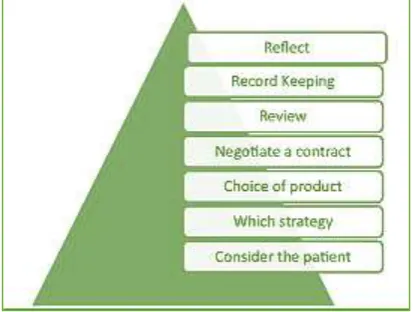
As with all areas of prescribing, it is wise to consider the seven principles of good prescribing
practice when dealing with all patients
Prescribing Pyramid (NPC 1999)
When considering prescribing in this particular subset of patients, it is important to remember
additional information may need to be gathered and the way that you gather and use this
information may be different. We will go on to explore the relevant areas of this framework.
Exercise
Using the BNF, look up the section on prescribing in the elderly. Review all the areas it
Consider the Patient
Consideration of the patient should be modified to reflect the additional considerations
required in the elderly. Normal manifestations of ageing need to be considered in context and
not confused with symptoms or signs of disease. The main factors to consider in addition to
normal consultation and examination are;
• Changes to the normal pharmacokinetic processes
• Altered sensitivity of some target organs
• Increase incidence of multiple pathologies
• Increased incidence of use of drugs with narrow therapeutic index
• Potential increased risk of poor compliance
• Potential increased chance of polypharmacy
Changes to Pharmacokinetics
Absorption
Absorption of drugs from all administration routes except intravenous is required to get the drug from
the site of administration to the blood stream. There are some specific considerations when
prescribing in the elderly.
There can be some issues in using the oral route of administration. Due to the normal manifestations
of ageing there can be age related changes in the gut lumen that can compromise drug absorption.
This is most commonly as a result of loss of surface area, thereby decreasing the absorbing site,
It can also be that the food and fluid intake of an elderly person can be variable. They may eat smaller
meals more often or can skip meals. This affects dosing for drugs that should be given with food or on
an empty stomach and dosing regimens may need to be considered. Some patients may have
swallowing problems and this may mean that either liquid preparations should be considered or if
severe problems encountered, then another route of administration may be required.
Distribution
Distribution of drugs from the plasma to cell and tissues can be compromised. Plasma proteins play a
crucial role in drug distribution and bioavailability and they can be reduced in number in elderly
patients. Serum albumin can be measured if this is a potential area of concern. Circulatory issues can
lead to reduced tissue perfusion so particular attention should be paid to drug disposition in these
patients. Another factor is the change in body composition. There is a reduction in muscle and tissue
mass and changes to the body fat and water ratio. These factors all combine to alter drug distribution
and uptake into cells and tissues.
Metabolism
Drug metabolism primarily occurs in the liver. After the age of 65, liver size is reduced over time. The
liver naturally has a large reserve so the loss of liver volume is not significant but there may be some
corresponding reduction in liver function and this should be checked by blood test prior to heavily
hepatically metabolised drugs. Reduction in drug metabolising enzymes also occurs and this needs to
be taken into account especially when co prescribing drugs known to be hepatic enzyme inhibitors or
inducers. There is also a reduction in liver blood flow which contributes to effective liver function.
Excretion
Drug excretion is largely carried out by the kidney for expulsion in urine. Reduced renal size and
eGFR which can be measured and categorised. Other drugs can have an effect on renal function and
care should be taken when co prescribing with drugs that are known to do this, especially NSAIDs
Pharmacokinetic considerations relate to the ‘which strategy’ and ‘choice of product’ areas of the
prescribing pyramid.
Exercise
Using the BNF, or other drug resource, look up a drug you are likely to prescribe in practice.
Identify if there are any restrictions on prescribing in the elderly or in renal or hepatic
impairment. Reflect on any changes you would need to make to dose or prescribing regimes
in light of this.
Other Areas to be Aware of
Sensitivity to Medicines- pharmacodynamics
As you will have discovered from your reading of the BNF section on prescribing in the
elderly, they can be sensitive to some medicines. The main categories of drug that this is a
concern with are listed below.
Opioids
Benzodiazepines
Antipsychotics
Antiparkinsonian drugs
NSAIDs
Antihypertensive agents
These sensitivities are often pharmacodynamic and the elderly person can have a desired
side effects and adverse effects at what is considered a normal adult therapeutic dose. This is
especially true of the drugs with effects on the central nervous system, such as the opioids,
benzodiazepines, antipsychotics and antiparkinsonian drugs listed above. Patients should be
monitored for cognitive effects as well as sedation and started on lower doses and titrated up
until effect is optimal. The antihypertensive can produce dramatic reductions in blood
pressure in this group of patients increasing risk of falls. The action of the prescriber when
managing elderly patients on these medications also falls under the ‘review’ section of the
prescribing pyramid.
Exercise
Choose a drug group from those listed above that relates to an area of prescribing for you.
Use the online medicines compendium or BNF online to look at the implications of
prescribing this group in the elderly in more detail. Reflect ion how this may change your
prescribing practice with regard to information gathering.
Pathology/Comorbidity/ Polypharmacy
There are many factors that contribute to the increase in medications taken by the over 65
aged population. We have considered the pharmacokinetic and pharmacodynamic above in
relation to ageing, but other factors also need to be considered before prescribing. If we look
at this population and compare them with the general population, on average they will have a
higher rate of chronic long term conditions, more than one condition at a time and be
receiving care from more than one health care professional at a time. This puts them at a
higher risk of side effects and adverse reaction.
Implications of disease needs careful consideration before prescribing. How many conditions
for? As a prescriber, in your 'consideration of the patient’ you should be asking these
questions and gathering information from the patient and any patient notes and recording
your findings accurately (this fits with the record keeping aspect of the pyramid). This is
often called ‘medicines reconciliation’ where you are the prescriber reconcile each
medication with its related condition and ensure any prescribing in place is appropriate and
safe before making any changes to the medication regime. The following key factors should
be elucidated;
• How many medicines?
• Which conditions are they for?
• Are they all needed?
• What are the interactions risks?
• Can you safely add in more medications if this was the aim of the patient contact?
Polypharmacy has often been defined as ‘taking four or more medications concurrently’. It is
important to remember that polypharmacy in itself need not be harmful. Usually there are
clear clinical indications for each prescribed drug, however, with an increased number of
drugs we must as prescribers be aware of the risks that a high medication burden may bring.
Interactions because of medication use increases as the number of drugs increases. Drug-
drug interactions should be assessed for risk using Appendix one of the BNF before any
additional drugs are prescribed. Polypharmacy must be considered at the same time as
multimorbidity as looking at the medication burden alone, without considering the
relationship of each drug to the condition it has been prescribed for, can be harmful in itself.
Exercise
Use appendix one of the BNF to investigate the incidence and severity of drug-drug
Compliance
Compliance with or adherence to medication regimes is not restricted to the elderly, but due to some
of the other factors we have discussed above it can be more problematic for them due to other
conditions, polypharmacy or any memory impairment. We should still always try to reach a
concordant agreement and this falls under the ‘Negotiate a Contract’ section of the prescribing
pyramid. There can be many reasons why elderly patients do not take their medications as prescribed
but these can be grouped into two categories of non-compliance;
• Direct
• Indirect
Direct non-compliance refers to a patient who has made a conscious decision regarding the
taking of their medication/s. Indirect usually refers to the patient still taking the medication
but perhaps not when they should or how they should. This can lead to therapeutic plasma
levels not being maintained and potential in-effect of a drug or toxic effect.
Some patients may benefit from compliance aids or medication being put into special
dispensing boxes to help them remember to take their medication at the right time and in the
correct doses.
Exercise
Can you identify factors for the patients in your area of practice that might affect their ability to
comply with or adhere to the medication regimes? Reflect on how you could manage these from a
pharmacological perspective.
Suggested and Further Reading
Barber and Robertson (2015) Essentials of Pharmacology for Nurses 3rd Edition McGraw Hill
London
Electronic Medicines Compendiumhttps://www.medicines.org.uk/emc/
Rang, H.P., Ritter. J.M., Flower. R.J. and Henderson, G. (2015) Rang and Dales
Pharmacology 8th ed. Churchill Livingstone. London.