ISSN: 1992-8645 www.jatit.org E-ISSN: 1817-3195
DUAL BAND NOTCHED PLANAR PRINTED
ANTENNA WITH SERRATED DEFECTED GROUND
STRUCTURE
1,4
K V L BHAVANI, 2HABIBULLA KHAN, 2D SREENIVASA RAO, 2B T P MADHAV,
3
V RASAGNA REDDY, 3M MONIKA, 3Y DHANUSH CHAND
1
Research Scholar, Department of ECE, K L University, AP, India 2
Faculty, Department of ECE, K L University, AP, India 3
Project Students Department of ECE, K L University, AP, India 4
Electrical Engineering Department, Santa Clara University, Santa Clara, USA
E-mail:1 [email protected]
ABSTRACT
A low profile printed antenna with defected ground structure (DGS) is presented in this work. Initially a square patch radiating element is constructed on one side of the substrate and the other end of the substrate is etched with serrated shape DGS. Three different iterations are examined in this work by changing the number of serrated edges on the ground plane. To improve the gain of the designed antenna models a frequency selective surface is placed beneath the antenna structure as a reflecting surface. The overall performance characteristics of the proposed antenna models are simulated using commercial electromagnetic tool HFSS. Optimized proposed antenna model is fabricated on FR4 substrate and measured results are compared with simulation results for validation.
Keywords: Dual Band, Notched Antenna (NA), Defected Ground Structure (DGS), Serrated Shape, FR4,
High Frequency Structure Simulator (HFSS).
1. INTRODUCTION
Currently, there is an increased interest in
Ultra-wide band (UWB) systems due to the
characteristics such as low cost, low complexity, low spectral power density high precision ranging. Since 2002, the US Federal Communication Commission (FCC) released 3.1 to 10.6 GHz unlicensed band for radio communication [1-2]. Ultra-wide band is a technology for transmitting information spread over a large bandwidth (>500MHz).
Ultra-wideband (UWB) wireless communication is a technology of transmitting large amounts of digital data over a wide frequency spectrum using short pulse, low powered radio signals. However, over the designated UWB frequency band, there exist some narrow bands for other communication systems, such as WiMAX (3.3 to 3.GHz) and WLAN (5.15 to 5.825GHz) which may cause electromagnetic interference with the UWB systems [3-6]. Therefore, it is necessary for UWB antennas performing band notch characteristics in those narrow frequency bands to avert the potential services [7-8].
The UWB technology has another advantage from the power consumption point of view. The UWB antennas are proposed for applications of communication systems, various kinds of antenna test ranges, and high resolution microwave imaging. The narrower instantaneous bandwidth of UWB antennas will degrade the performance of the above applications. Several UWB antennas have been attempted to overcome interference problem using frequency band rejected characteristics
design. Ultra-wideband antenna (UWB)
communication systems have the promise of very high bandwidth, reduced fading from multipath. In the designing of triple or multi-band notch antenna, it is difficult to control bandwidth of the notch-bands in a limited space. Moreover, strong couplings between the band notch characteristics
designs for adjacent frequencies are the
complication in achieving efficient triple band-notch UWB antenna [9-12].
ISSN: 1992-8645 www.jatit.org E-ISSN: 1817-3195 implementation of UWB technology antennas have
been characterized mostly in the frequency domain. Advanced structures like defected grounds and frequency selective surfaces are very much required to enhance bandwidth and gain of the planar antennas [13-14]. This paper is based on the design of such antenna with serrated defected ground structure for bandwidth enhancement [15-16]. The gain will be boosted with proper usage of FSS at bottom side of the antenna as reflector for back scattered waves. The combination of DGS with FSS will definitely improve the performance characteristics of the antenna structures.
2. ANTENNA DESIGN AND GEOMETRY
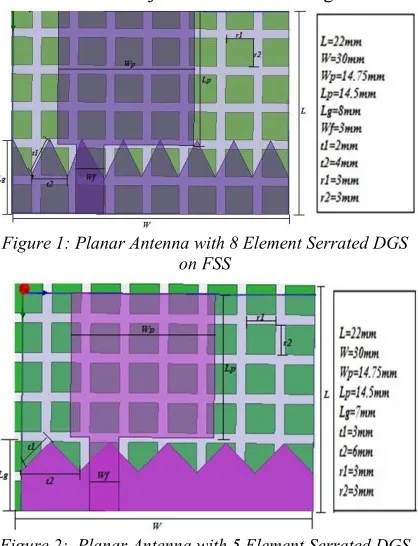
Three different antenna models are designed and simulated in this work. The designed antenna models with their dimensional characteristics are presented in Figure 1, 2 and 3.The corresponding antenna designed parameters are presented in a tabular form in conjunction with these Figures.
[image:2.612.315.523.110.234.2]Figure 1: Planar Antenna with 8 Element Serrated DGS on FSS
Figure 2: Planar Antenna with 5 Element Serrated DGS on FSS
A micro strip line feeding is used in the design of the proposed antenna models consisting of rectangular radiating patch and triangle shaped serrated ground structure. The overall dimension of antenna is around 30 x 22 x 1.6 mm and the patch dimension 14.75 x 14.5mm. The width of the micro strip line feed is taken 3mm to achieve 50 ohm impedance characteristics in a desired band. These
compact antennas are designed on a FR4 substrate with permittivity 4.4 and loss tangent 0.2.
Figure 3: Planar Antenna with 3 Element Serrated DGS on FSS
To enhance the band width of the designed model, the partial ground plane is modified by cutting triangular shape slots and its top edge and further, the top edge of the partial ground plane are reshaped with 8, 5 and 3 elements based structures. The overall performance of these iterations are analyzed and discussed in the subsequent section.
3. RESULTS AND DISCUSSION
The reflection co-efficient of the designed models are presented in Figure 4. Antenna model1 is notching triple band at 7.5GHz, 10GHz, 12.5GHz-20GHz. Antenna model2 is notching dual band from 10GHz-14GHz and 15GHz-18GHz. Antenna model3 is showing large band width at lower frequency band of 8.6GHz and impedance between of 114%.
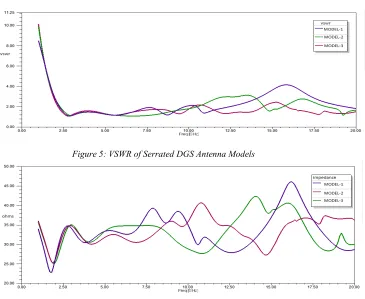
Figure 5 shows the VSWR characteristics of the antenna models with 2:1 ratio in the operating band. Figure 6 shows the impedance characteristics of all the iterations corresponding to resonant frequency. Antenna model3 is showing stable impedance characteristics at lower band at higher band also.
Figure 7 shows the radiation characteristics of antenna model 1 at center resonant frequency. Figure 8 shows the radiation pattern of model 2 and Figure 9 shows the radiation characteristics of model 3 in E-plane and H-plane. The corresponding 3 dimensional radiation pattern with respective to gain can be observed from Figure 10. All the models are showing dipole like radiation in the E-plane and directive radiation in the H-E-plane.
[image:2.612.92.301.345.618.2]ISSN: 1992-8645 www.jatit.org E-ISSN: 1817-3195 Model 3 is showing a peak realized gain of 5 dB
and an average gain of 4.5 dB.
Figure 11 shows the 2-Dimensional directivity curve of the designed models. Model 3 is showing superior directivity in the operating band when compared with other models. A peak directivity of 6 dB at center resonant frequency is obtained for antenna model 3.
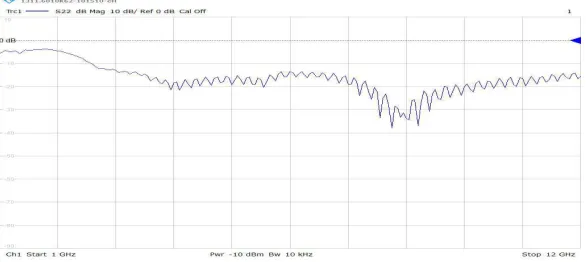
[image:3.612.125.496.226.365.2]Figure 12 shows the prototyped antenna on FR4 substrate. The front side of the antenna consisting of square patch with microstrip line feeding and bottom part consisting of defected ground structure with triangular serrations. The measured results of the proposed antenna S11 parameter is presented in Figure 13. Due to lesser range availability, we have taken measurement up to 12 GHz only. The proposed antenna is working in the wideband below 12 GHz which is similar to simulation results obtained from HFSS.
Figure 4: Reflection Coefficient of Serrated DGS Antenna Models
Figure 5: VSWR of Serrated DGS Antenna Models
[image:3.612.126.491.394.693.2]ISSN: 1992-8645 www.jatit.org E-ISSN: 1817-3195
[image:4.612.91.516.72.214.2]Figure 7: Radiation Pattern of Antenna Model 1 at 2.6 GHz
[image:4.612.136.489.398.520.2]Figure 8: Radiation Pattern of Antenna Model 2 at 2.6 GHz
Figure 9: Radiation Pattern of Antenna Model 3 at 2.6 GHz
[image:4.612.107.514.558.689.2]ISSN: 1992-8645 www.jatit.org E-ISSN: 1817-3195
[image:5.612.193.420.249.364.2]Figure 11: Frequency Vs Directivity of Antenna Models
Figure 12: Fabricated Antenna, (a) Front View, (b) Back View
Figure 13: Measured S11 on Vector Network Analyzer
4. CONCLUSION
This paper is designed for dual band notching of antenna at desired frequency band with the addition of DGS and FSS. The serrated defected ground structure is designed for bandwidth enhancement
and frequency selective surface for gain
enhancement in the proposed antenna. The gain is boosted with proper usage of FSS at bottom side of the antenna, which acts as reflector for back scattered waves. The serrated structure on the ground plane improved the bandwidth of the antenna at lower frequency band. The combination
of DGS with FSS improved the performance characteristics of the proposed antenna structure.
ACKNOWLEDGEMENTS:
[image:5.612.161.454.399.530.2]ISSN: 1992-8645 www.jatit.org E-ISSN: 1817-3195
REFERENCES:
[1] B T P Madhav, Habibulla Khan, D Ujwala, Y Bhavani Sankar, Madhuri Kandepi, A Siva Nagendra Reddy, Davuluri Nagajyothi, “CPW Fed Serrated Antenna Performance Based on Substrate Permittivity”, International Journal of Applied Engineering Research, ISSN 0973-4562, Volume 8, Number 12, Nov-2013, pp. 1349-1354.
[2] D. Sarkar, K. Vaibhav Srivastava, and K. Sauravand, “A compact microstrip-fed triple
band-notched UWB monopole antenna,” IEEE
Antennas Wireless Propag. Lett., vol. 13, pp.
396–399, 2014.
[3] B T P Madhav, K V V Kumar, A V Manjusha, P Ram Bhupal Chowdary, L Sneha, P Renu Kantham, “Analysis of CPW Fed Step Serrated Ultra Wide Band Antenna on Rogers RT/Duroid Substrates”, International Journal of Applied Engineering Research, ISSN 0973-4562, Volume 9, Number 1, Jan-2014, pp. 53-58.
[4] B. P. Chacko, G. Augustin, and T. A. Denidni, “Uniplanar slot antenna for ultrawideband
polarization-diversity applications,” IEEE
Antennas Wireless Propag. Lett., vol. 12, pp.
88–91, 2013.
[5] B T P Madhav, Madhuri Kandepi, Satish Kanapala, B Anjaneyulu, N Anada Rao, K Vijaya Vardhan, “Serrated Spike Antenna Performance Evaluation Based on Arlon Substrate Materials”, International Journal of Applied Engineering Research, ISSN 0973-4562, Volume 9, Number 1, Jan-2014, pp. 117-124.
[6] B T P Madhav, A Manikanta Prasanth, Sreeramineni Prasanth, Batchu Mohan Sai
Krishna, Devani Manikantha, Usirika
Sharmila NagaSai, “Analysis of Defected
Ground Structure Notched Monopole
Antenna”, ARPN Journal of Engineering and Applied Sciences, ISSN 1819-6608, Vol. 10, No. 2, Feb-2015, pp 747-752.
[7] D S Ramkiran, B T P Madhav, Sahithi
Krishnaveni Grandhi, Amara Venkata
Sumanth, Sri Harsha Kota, Leela Krishna Boddu, Compact Microstrip Band pass Filter with Defected Ground Structure, Far East
Journal of Electronics and
Communications”, ISSN:0973-7006, Vol 15, Issue 1, Aug-2015, pp 75-84.
[8] S S Mohan Reddy, P Mallikarjuna rao, B T P Madhav, Asymmetric Defected Ground Structured Monopole Antenna for Wideband
Communication Systems, International
Journal of Communications Antenna and Propagation, ISSN: 2039-5086, Vol 5, Issue 5, Dec-15, pp 256-262.
[9] D. Guha, M. Biswas, and Y. M. M. Antar, “Microstrip patch antenna with defected ground structure for cross polarization suppression,” IEEE Antennas Wireless Propag. Lett., vol. 4, pp. 455–458, 2005. [10] K V L Bhavani, Habibulla Khan, B T P
Madhav, Multiband Slotted Aperture
Antenna With Defected Ground Structure
For C And X-Band Communication
Applications, Journal of Theoretical and Applied Information Technology, ISSN: 1992-8645, Vol 82, No 3, Dec-2015, pp 454-461.
[11] B T P Madhav, Harish Kaza, Thanneru Kartheek, Vidyullatha Lakshmi Kaza, Sreeramineni Prasanth, K S Sanjay Chandra Sikakollu, Maneesh Thammishetti, Aluvala Srinivas, K V L Bhavani, Novel Printed Monopole Trapezoidal Notch Antenna with S-Band Rejection, Journal of Theoretical and Applied Information Technology, ISSN: 1992-8645, Vol 76, No 1, 2015, Pp 42-49.
[12] A. Ghosh, D. Ghosh, S. Chattopadhyay, and L. Singh, “Rectangular microstrip antenna on slot type defected ground for reduced cross polarized radiation,” IEEE Antennas Wireless Propag. Lett., vol. 14, pp.321–324, 2015.
[13] P.Lakshmikanth, Kh Takeshore, B T P Madhav, Printed Log Periodic dipole antenna with Notched filter at 2.45 GHz Frequency for wireless communication applications, Journal of Engineering and Applied Sciences, ISSN: 1816-949X, Vol 10, Issue 3, Aug-2015, pp 40-44. DOI:
10.3923/jeasci.2015.40.44.
ISSN: 1992-8645 www.jatit.org E-ISSN: 1817-3195 [15] M L S N S Lakshmi, Habibulla Khan and B T
P Madhav, Novel Sequential Rotated 2x2 Array Notched Circular Patch Antenna,
Journal of Engineering Science and
Technology Review, ISSN: 1791-2377, Vol 8, issue 4, Dec-2015, pp 73-77.
[16] B. T. P. Madhav, Habibulla Khan, Sarat K. Kotamraju, Circularly Polarized Slotted Aperture Antenna With Coplanar Waveguide Fed for Broadband Applications, Journal of Engineering Science and Technology, ISSN: 1823-4690, Vol. 11, No. 2, Feb-2016, pp 267 – 277.