INDIAN SIGN LANGUAGE RECOGNITION SYSTEM USING
NEW FUSION BASED EDGE OPERATOR
M. V. D. Prasad, P. V. V. Kishore, E. Kiran Kumar, D. Anil Kumar Department of Electronics and Communications Engineering, K.L.University, Guntur. E-mail: [email protected], [email protected], [email protected],
ABSTRACT
The objective is to generate a basis for sign language recognizer under simple backgrounds. Complications arise in extracting shapes of hands and head using traditional segmentation models due to non-uniform lighting. This paper proposes a wavelet based fusion of two weak edge detection models. One is morphological subtraction model and the other is gradient based canny edge operator. Elliptical Fourier descriptors provide shape models with optimized number of shape descriptors. Principle components determined keep the feature vector to a minimum to accommodate all the frames in the video sequence. Classification of the signs is achieved by training a neural network trained with back propagation algorithm. The proposed method is exclusively tested many times with different examples for correct recognition sequence. Finally, the recognition rate stands at 92.34% when compared to similar model using discrete cosine transform based features at 81.48%.
Keywords: Artificial Neural Network (ANN), Canny Segmentation, Elliptical Fourier Descriptors, Morphology Segmentation, Principle Component Analysis.
1. INTRODUCTION
Sign languages are primary language that uses to communicate deaf peoples. Thus, it deals improvement of transmission skills among common creatures and provides renewal for speech among unhearing and mute person. The self-directing sign language recognition concerned vision scholars for long many research mechanisms are going on sign language in order to make the communication between an unhearing and a normal person easy. Examples of varies sign languages are the Sri Lanka, America, Japanese and the native Indian sign languages, and so on.
Sign language recognition is very important not only has the engineering pointed but also for its effect on the human society. An effective sign language recognition method can provide a chance for the deaf to transfer with hearing-impaired people without the need for a human translator. Research has existed narrow to limited methods capable of identifying a least division of a complete sign language. The reason for this is the difficulty in identifying a complete sign language vocabulary - recognition of signs signifying words and sentences undoubtedly is the most challenging issue in the situation of sign identification research.
Reyadh et al. [1] introduced an alphabet signs recognition system with a success rate in naked hand 50%, red hand 75%, Black Hand 65% and white hand 80%. In the image processing stage, the images of gestures are changed to a histogram which is used to identify the surface behavior by KNN algorithm.
In [2], Mohamed developed an automatic Arabic sign language recognition. The classification and moment of the Support vector machines are used in feature selection with an average recognition rate of 87%. Omar [3] proposed a neuro-fuzzy system that deals with images of simple hand signs and succeeded a recognition rate of 90.55%.
Kishore PVV [4] proposed 4-Camera model. The segmented hand gestures with extracted shapes created a feature matrix described by elliptical Fourier descriptors which are classified with back propagation algorithm trained artificial neural network. The normal recognition rate in the proposed 4 Camera model for sign language recognition is about 92.23%.
Neural Network is constructed to classify and recognize gestures from video frames of signers. The proposed VVMI [5] for SLR offers a recognition rate of around 93%.
The dynamic time wrapping based level building (LB-DTW) algorithm was proposed in [6] to solve sign sequence segmentation and sign recognition. This LB-DTW introduces two problems in recognition. One is under the bad relationship the recognition rate is very low and HMM was incorporated to improve recognition rate by calculating the similarity between sign model and testing sequence. On the other hand, the grammar constraint and sign length constraint are employed to improve recognition rate. In experiments with a KINECT data set of chines sign language containing 100 sentences composed of 5 signs each, the proposed method shows superior recognition performance and lower computation compared to other existing techniques.
The method proposed in [7] involves extracting the hand gestures form original color images. The segmented hand positions shape modulated using Chan-Vese (CV) active contour model and obtained 92.1% recognition rate.
In this paper a system for Indian sign language gesture recognition is being proposed. The system is based on morphology, canny edge operator fused with discrete wavelet transform. Elliptical Fourier descriptors and PCA extracts the feature matrix. The gesture pattern recognition was carried out using BPNN (Back Propagation Neural Networks). The method was tested among the different gesture scenarios.
2. SYSTEM ARCHITECTURE
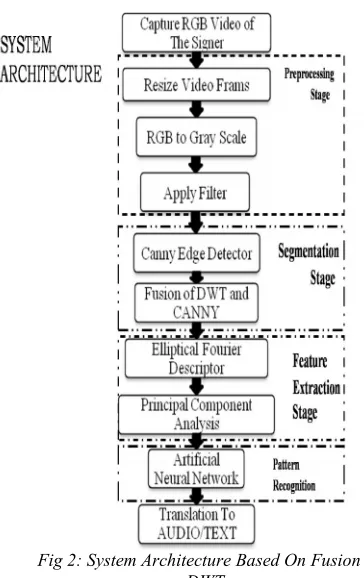
The system outline based on the four broad problems parallel to video preprocessing, image segmentation, feature extraction and pattern classification. Figure 1 shows the system architecture with Morphology [8] and canny segmentation [9].
The architecture of fusion discrete wavelet transforms of the canny and morphological operations in video sequences shown in figure 2. The hand and head segmentation outputs are given to next processing of signs. The extracted shape features are optimized and then saved to the database. The Principal component analysis (PCA) optimizes the large feature matrix before saving into database. The system can now be tested with sign videos using artificial neural network using back propagation training algorithm [10].
The sign language videos created by using simple backgrounds were trained and tested with different signers by using proposed algorithm.
3. VIDEO SEGMENTATION
MORPHOLOGY AND CANNY
The region based segmentation [11] method using the spatial information of the image such as color and texture of the objects. But this proposed technique suffers from the regularity problem. Such as image should possess uniform color and texture data.
[image:2.612.317.499.220.509.2]Canny edge based segmentation used to detect boundary pixels of the image. By changing the light intensity, the boundary of the pixels will be changed.
Fig. 1: System Architecture With Canny And Morphology Based Segmentation
[image:2.612.94.300.624.701.2]Here 1 taken as image frame, the set of all image pixels can be portioned by applying segmentation to produce non overlapping regions
1 2
{ , , ... , } n and combined forms the image
frame1.
The fundamental morphological operations like Dilation and Erosion [12] were used. First the grey scale video sequences are dilated and then eroded by using the structuring element. This operation isolates the hand and head portions from the background of the video frames. The video frames are then treated with a gradient operator and then treated with canny edge detector. This method helps in extraction of fine edges and preserves hand and head shapes in the sign video image [13].
Threshold plays a critical role in determining true edges for a video sequence when operated by canny edge operator. The entire process for single video frames is shown in Figure 3. In Figure 3(e) the decision on threshold was a difficult one and after a number of iterations it was fixed at 0.4. Figure 3(f) shows sign video frame with only canny operator with the same threshold of 0.4 results in unwanted edges.
Observing keenly Figures 3(e) and Figure 3(f) shows that the morphological and canny operated video frames preserves the shape of the hands of the signer, which plays a vital role in gesture classification.
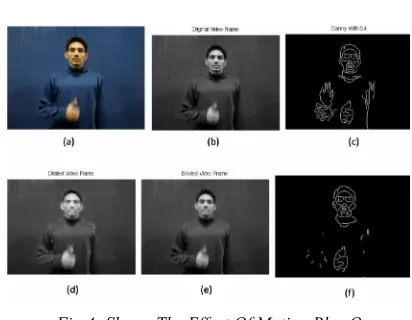
The procedure described to extract shapes of hands and head of the signer is subjected to brightness variations, background variations, motion blur and change in video sensor equipment. Figure 4 shows the same technique applied to a video frame having brightness variations and motion blur.
Figure 4 clearly indicates that the segmentation procedure for video frame under brightness variations and motion blur produce false segmentation. This happens in the same video which produced excellent segmentation result as shown in Figure 3. The discussed technique was improved by applying wavelet based fusion algorithm.
3.1 Subtraction of Dilation and Erosion
The dilated video frame is subtracted from the eroded video frame and is given by
1 {( 1 ) ( 1 )}
S S (1) The below figure 5 shows the result of
1 by applying above operation in video sequences. From Figure5, the hand and head portions are highlighted when compared to the rest of the body of the signer. But to extract the hand shapes and head portion again edge detection has to be done along with other after segmentation processes. [image:3.612.318.524.93.253.2]Fig 3: Segmentation Using Morphology And Canny Edge Operator
Fig 4: Shows The Effect Of Motion Blur On Segmentation. (A), (B) Original Color & Gray Video Frames, (C) Canny Operated With Threshold Of 0.4, (D) ,(E) Are Dilation And Then Erosion Operated (F) Morphological Gradient And Then Canny Applied
The advantages of two segmentation operations can be mixed to design a segmentation operation. Hence to extract hands and head clearly, it was found desirable to mix the goodies of Canny and morphology edges with the help of wavelet fusion algorithm.
3.2 Fusion with Wavelet transforms
The previous techniques suffer from the drawbacks such as changes in brightness of the video objects during motion and motion blur induced due to non-uniform movement of hands. These limitations are successfully handled using fusion algorithm with Discrete Wavelet Transform for video segmentation [14].
Wavelet transform [15] uses a fully scalable adaptable window to slice the signal into time-frequency representations. The window is shifted along the signal and frequency spectrum is calculated at every location. This process is repeated for each cycle with slightly smaller or larger windows.
The continuous wavelet transform (CWT) is redundant because CWT maps 1D continuous time signal into 2D scale-time representation. An improved wavelet transform based fusion method is given in this paper.
First we detect the edges using the operations discussed in section 3 and section 3.1, and fuse them to get the final edge image. It is proved that this fusion method [16] helps us to get intact video image edge detection and exact location performances.
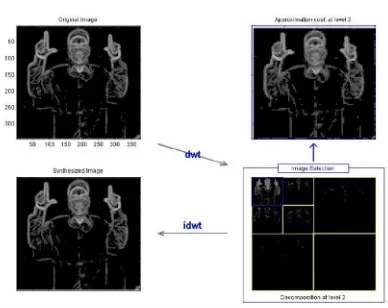
This multi resolution analysis of 2D DWT permits to decompose a video frame into approximations and details. The 2D discrete wavelet transform divides the image into low (L) and high (H) frequency components at level1.
The 2D video frame
1( , )
x y
passes through low pass filter and a down sampler of level 2 to produce approximate image at level-1 wavelet decomposition. Similarly 2D video frame1
( , )
x y
is applied to a high pass filter and down sampler to create detailed image at level-1 wavelet decomposition. In level 2 the decomposition of the low frequency data can be divided into LL and high frequency LH. The figure 6 shows the video frame of the 2D daubechies for level 2 in wavelet decomposition.The DWT of 1( , )x y size M N is
0
1 1 1
0 1 0 0 , m, n
( , , ) M N j
x y
W j m n
MN
(2)Here integers are j, m, n, M, N, i= {H, V, D}, 0
j is an arbitrary starting scale and the coefficients
W
define an approximation of f at scale j0.1 1 1
, m, n 0 0
1
( , m, n) M N
i i o j x y W j MN
(3)Figure 6 shows the adding the above equation coefficients horizontal, vertical and diagonal details. The translated basis function j0, m, nand
, m, n
i j
shown below,
0, m, n 2 2 (2 , 2 1)
j
i i j
j x m n
(4)
2
, m, n 2 (2 , 2 1)
j
i i i j
j x m n
[image:4.612.93.289.75.314.2] (5)
Fig 5: Dilation-Erosion For Frames Of Signs
[image:4.612.326.520.154.308.2]Given W andWi, 1 is obtained via inverse
DWT as:
0
1 0
0
1 1 ( j j i)
j j
m n i j j
W W
MN
(6)4. FUSION
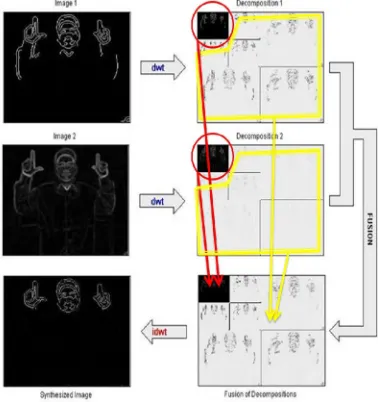
Image fusion is the combine two or more different images to form a new image using a certain algorithm. For sign videos we intend to use DWT based image fusion on Canny operated and morphology activated frame into a single amalgamated video image frame that is more enlightening and more suitable for further computer processing [17].
Figure 7 show the Process of Image fusion and provide a glimpse into the image fusion with multi resolution wavelet transform. The Dilation-Erosion video frame is decomposed using level-2 Daubechies wavelets into approximate and detail coefficients. Figure 8 depicts the results of image fusion on a video frame.
The final output video frame is reconstructed using 2D Inverse Discrete Wavelet Transform (IDWT) from eq.5, 6. Figure8 show the result produced using the above algorithm. The fusion process is applied to deformed video frames which produced motion blur and change in brightness levels to check the robustness of the algorithm. The results are shown in Figure 9.
The effectiveness of the fusion process as the last reconstructed video frame shows a shape on the hand even though it is blurred due to motion and all the unwanted false edges produced in the previous edge detection methods are not a part of the final video frame.
Figure 10 shows the segmentation for some frames of a sign “COW” using fusion of canny and DWT. We can observe that the motion blur has no effect on the segmentation process.
[image:5.612.321.522.192.335.2]The next Figure 11 shows frames from a different signer for sign ‘SIX’ in Indian Sign Language and the result of segmentation using DWT based fusion algorithm.
[image:5.612.93.299.281.387.2]Fig 7: Image Fusion Process
Fig 8: Image Fusion Applied to a video frame
Fig 9: Fusion Algorithm For Motion Blurred And Brightness Changing Video Frame
[image:5.612.319.522.426.521.2]Fig 10: Shows Video Frames Of Sign ‘COW’ Segmented Using Fusion Of Canny And DWT
[image:5.612.100.289.495.696.2] [image:5.612.320.523.643.721.2]5. RESULTS AND DISCUSSION
The Fourier descriptors allow a small set of selected numbers that label a shape for an image frame. This property of Fourier descriptors is useful because of the coefficients of Fourier diffuse shape data which is not unmoved to conversion, rotation and changes scale. But the changes in these limits can be connected to changes on descriptors.
The video frame is rotated by an angle of 20 degrees and the Fourier descriptors are computed and found that the Fourier descriptors for the rotated image unchanged as shown in Figure 12. The rigid nature of Fourier descriptors made them an excellent choice for generating feature vector for sign language interpreter system.
For a complex video of the singer with 120 frames we get a matrix of 120 120 values signifying the shape data of the hands and head. In this video we have 351 signs get very large feature vector and consume more handling time in the following stages.
The feature vector obtained in the previous stage using elliptical Fourier descriptors is minimized in size using principal component analysis (PCA) [18].
In single video the Fourier descriptors matrix is
120 80 and we ensure 9 singers with 351 signs for each which creates large feature matrix. By using PCA to moderate measurements of the feature vectors.
The initial feature vector for a sign video sequence was120 80 . After treating the
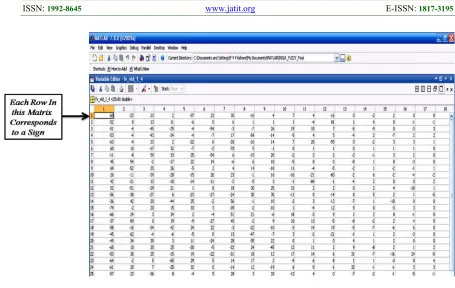
120 80 feature vector with PCA and keeping the threshold above 90%, we create a new feature vector of reduced dimensionality of size1 20 . Finally the entire video sequence for a single sign can be represented with row vector having 20 values.
The feature vector matrix shown in figure 13 and their uniqueness [19] shown in figure 14. Every single row in the feature vector matrix matches to a video sign which inputs the classifier in the following stage.
The final step of the sign language recognition system is the pattern recognition. Earlier this measure of the system was applied using Hidden Markov Models (HMM) [20], Neural networks [10] and to some extent fuzzy logic [21]. The sign language recognition system discussed in this thesis was deployed using two approaches: Artificial Neural Networks and fuzzy inference system. In this section we concentrate exclusively on Neural Networks. The next chapter is dedicated to fuzzy inference system.
Figure 13: Feature Vector Matrix ( Page 584)
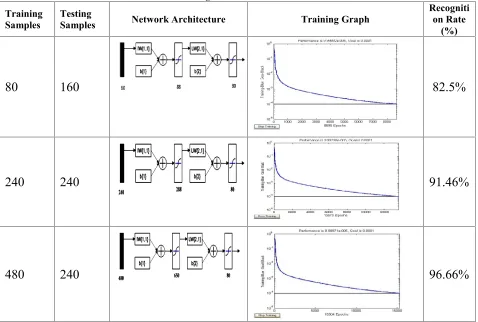
Initially we have employed an artificial neural network to complete the task of identifying and classifying 80 gesture signs. The input layer 80 neurons and 88 output neurons in the hidden layer in neural network.
This segment presents the results of the experiments performed using a personal computer to classify gestures of sign language. The training set of data consists of 80 video sequences of size256 256 . Also the samples of each sign were taken under different conditions with small changes in orientation. We have a total of 720 videos representing 80 different signs by 9 different signers.
[image:6.612.336.500.244.376.2]The network is trained and tested for different samples of the database. Table 1 gives the details of the training and testing process. The first two columns give number of samples for training and testing. The third column shows the neural network architecture created for training and testing. Column four shows the plot produced while training. The last column shows the recognition rates calculated from testing the corresponding networks.
Fig 12: Invariance Of Elliptical Fourier
[image:6.612.99.299.282.353.2]Table 1: Details Of Training And Testing Of Sign Videos Under Simple Backgrounds With Different Samples And Their Recognition Rates
Training
Samples TestingSamples Network Architecture Training Graph
Recogniti on Rate
(%)
80
160
82.5%
240
240
91.46%
480
240
96.66%
The next table 2 summarizes the entire gesture
[image:7.612.139.474.500.623.2]classification process. The last row giving the average values for the entire gesture recognitionprocess using ANN.
Table 2: Gesture Classification Results Summary
Number of samples for training
Number of epochs for training
Number of unknown samples for
testing
Number of Correctly Recognized
samples
Recognition rate
80 8695 160 132 82.5%
240 13572 480 439 91.46%
480 15304 720 696 96.66%
540 18345 720 711 98.75%
335 13979 520 495 92.34%
The average recognition rate was 92.34% for the total classification method which is on par with other researchers for American Sign Language [22] and Chinese Sign Language in [23].
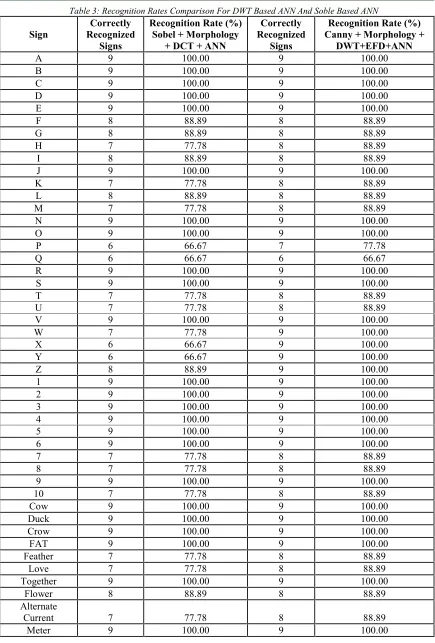
Table 3: Recognition Rates Comparison For DWT Based ANN And Soble Based ANN
Sign RecognizedCorrectly Signs
Recognition Rate (%) Sobel + Morphology
+ DCT + ANN
Correctly Recognized
Signs
Recognition Rate (%) Canny + Morphology +
DWT+EFD+ANN
A 9 100.00 9 100.00
B 9 100.00 9 100.00
C 9 100.00 9 100.00
D 9 100.00 9 100.00
E 9 100.00 9 100.00
F 8 88.89 8 88.89
G 8 88.89 8 88.89
H 7 77.78 8 88.89
I 8 88.89 8 88.89
J 9 100.00 9 100.00
K 7 77.78 8 88.89
L 8 88.89 8 88.89
M 7 77.78 8 88.89
N 9 100.00 9 100.00
O 9 100.00 9 100.00
P 6 66.67 7 77.78
Q 6 66.67 6 66.67
R 9 100.00 9 100.00
S 9 100.00 9 100.00
T 7 77.78 8 88.89
U 7 77.78 8 88.89
V 9 100.00 9 100.00
W 7 77.78 9 100.00
X 6 66.67 9 100.00
Y 6 66.67 9 100.00
Z 8 88.89 9 100.00
1 9 100.00 9 100.00
2 9 100.00 9 100.00
3 9 100.00 9 100.00
4 9 100.00 9 100.00
5 9 100.00 9 100.00
6 9 100.00 9 100.00
7 7 77.78 8 88.89
8 7 77.78 8 88.89
9 9 100.00 9 100.00
10 7 77.78 8 88.89
Cow 9 100.00 9 100.00
Duck 9 100.00 9 100.00
Crow 9 100.00 9 100.00
FAT 9 100.00 9 100.00
Feather 7 77.78 8 88.89
Love 7 77.78 8 88.89
Together 9 100.00 9 100.00
Flower 8 88.89 8 88.89
Alternate
Current 7 77.78 8 88.89
Magnet 9 100.00 9 100.00
EM Wave 9 100.00 9 100.00
Second 9 100.00 9 100.00
Technology 7 77.78 8 88.89
Amplitude 7 77.78 8 88.89
Radio 9 100.00 9 100.00
Photography 7 77.78 8 88.89
Communication 9 100.00 9 100.00
Audio
Frequency 9 100.00 9 100.00
Get Out 9 100.00 9 100.00
Upwards 9 100.00 9 100.00
Virtual Image 9 100.00 9 100.00
Goods Returned 7 77.78 8 88.89
TOTAL 1100/1350 81.48 1236/1350 92.34
The results clearly indicate that the procedure followed for V2MI using DWT fusion has a clear edge over the procedure using Sobel edge operator.
6. CONCLUSION
A model for sign language recognizer is proposed in this work where video database is captured in the laboratory with simple backgrounds. Videos captured are subjected to segmentation with a new improved method of wavelet based video fusion. Compared to traditional segmentation models the edges of moving shapes are reconstructed perfectly. The shapes are further optimized with elliptical Fourier descriptors. Principal component analysis packs the feature vector for a particular sign from multiple frames into a single vector. Neural network object is trained with the feature vector with back propagation algorithm. Multiple sample testing enabled us to arrive a recognition rate that is close to proposed in literature.
REFRENCES:
[1] Naoum, Reyadh, Hussein H. Owaied, and Shaimaa Joudeh. "Development of a new Arabic sign language recognition using k-nearest neighbor algorithm." (2012).
[2] Mohandes, Mohamed. "Arabic sign language recognition."International conference of imaging science, systems, and technology, Las Vegas, Nevada, USA. Vol. 1. 2001.
[3] Al-Jarrah, Omar, and Alaa Halawani. "Recognition of gestures in Arabic sign language using neuro-fuzzy systems."Artificial Intelligence133.1 (2001): 117-138.
[4] Kishore, P. V. V., et al. 4-Camera model for sign language recognition using elliptical fourier descriptors and ANN. Signal Processing And Communication Engineering Systems (SPACES), 2015 International Conference on. IEEE, 2015.
[5] Kishore, P. V. V., A. S. C. S. Sastry, and A. Kartheek. Visual-verbal machine interpreter for sign language recognition under versatile video backgrounds. Networks & Soft Computing (ICNSC), 2014 First International Conference on. IEEE, 2014.
[6] Yang, Wenwen, Jinxu Tao, and Zhongfu Ye. "Continuous sign language recognition using level building based on fast hidden Markov model."Pattern Recognition Letters(2016).
[7] Kishore, P. V. V., and P. Rajesh Kumar. "Segment, Track, Extract, Recognize and Convert Sign Language Videos to Voice/Text."International Journal of Advanced Computer Science and Applications (IJACSA) ISSN (Print)-21565570 (2012).
[8] Gupta, Sakshi, and Ravindra K. Singh. "Mathematical morphology based face segmentation and facial feature extraction for facial expression recognition."Futuristic Trends on Computational Analysis and Knowledge Management (ABLAZE), 2015 International Conference on. IEEE, 2015.
[9] Jiang, Wen, et al. "Image segmentation with pulse-coupled neural network and Canny operators."Computers & Electrical Engineering46 (2015): 528-538.
[11]Yang, Bai, Huimin Yu, and Roland Hu. "Unsupervised regions based segmentation using object discovery."Journal of Visual Communication and Image Representation31 (2015): 125-137.
[12]J. Serra (1982). Image Analysis and Mathematical Morphology. Academic Press, London.
[13]P.V.V.Kishore, P.Rajesh Kumar, “Edge Detection Using Discrete Wavelet Transform
and Image Fusion” at
National Conference on Signal Processing & Communication Systems (NCSPCS-2010) on 25-26, Feburary, at ECE Dept. RVR & JC College of Engineering, Guntur,pp26.
[14]P.V.V.Kishore, P.Rajesh Kumar, K. Sujatha and A.Arjuna Rao “Computer Vision Based
Gesture Classification
Algorithm for Indian Sign Language Using Wavelet Transform and Neural Network” Proceedings at International Conference on Information Systems Design and Intelligent Applications-2012 (INDIA-2012), 05-07,January 2012. ISBN:978-981-07-1158-0_c 2012 Computer Society of India, pp138-143. [15]Li, Dong-ming, et al. "Research on
wavelet-based contourlet transform algorithm for adaptive optics image denoising." Optik-International Journal for Light and Electron Optics127.12 (2016): 5029-5034.
[16]Ghassemian, Hassan. "A review of remote sensing image fusion methods."Information Fusion(2016).
[17]P.V.V.Kishore, P.Rajesh Kumar, ―Edge Detection Using Mathematical Morphology
and Multilevel Discrete
Wavelet Transform‖ proceedings at National Conference on Signal Processing and
Communications(NCCSP-2010) on 27-28,march 2010, at QIS college of engineering, ongole, pp66-70.
[18]Morales, J. A., et al. "Ultra high speed deterministic algorithm for transmission lines disturbance identification based on principal component analysis and Euclidean norm."International Journal of Electrical Power & Energy Systems80 (2016): 312-324.
[19]Kishore, P. V. V., P. Rajesh Kumar, and A. Arjuna Rao. "Static Video Based Visual-Verbal Exemplar for Recognizing Gestures of Indian Sign Language."Digital Image Processing3.9 (2011): 530-537.
[20]Yang, Wenwen, Jinxu Tao, and Zhongfu Ye. "Continuous sign language recognition using level building based on fast hidden Markov model."Pattern Recognition Letters(2016).
[21]Anil Kumar, D., Kishore, P. V. V., Prasad, M. V. D., Raghava Prasad, Ch., “Fuzzy Classifier for Continuous Sign Language Recognition from Tracking and Shape Features” Indian
Journal of Science and Technology, vol. 9, may (2016).
[22]Zamani, Mahdi, and Hamidreza Rashidy Kanan. "Saliency based alphabet and numbers of American sign language recognition using linear feature extraction."Computer and Knowledge Engineering (ICCKE), 2014 4th International eConference on. IEEE, 2014.