ISSN: 1992-8645 www.jatit.org E-ISSN: 1817-3195
APPROACH TO THE ASSESSMENT OF UNIVERSITY
GLOBALIZATION INDEX
1MAXIM V. SERGIEVSKIY & 1KONSTANTIN S. ZAYTSEV
1
National Research Nuclear University MEPhI (Moscow Engineering Physics Institute), Moscow, Russia
ABSTRACT
It is impossible to imagine the present-day world without changes of politics, economics, social life caused by globalization. The globalization within society influences and updates the system of education quite naturally that is a factor of competitiveness advance and of the modern nation development. That is why in order to determine the general level of nation globalization it is necessary to determine the globalization level of education which is a boundary zone between social life and culture. The purpose of this article is to analyze the informative aspect of factors influencing on integration processes of university education and to formulate an approach for quantitative estimation of globalization index of education of a separate university and of a set of universities. Quality of education as well as its involvement in world global processes is mainly determined by curriculum content and first of all by the set of subjects composing this curriculum. The absence of subjects that are of great importance for the particular scientific sphere is this very factor that reduces the quality of education. To a lesser degree the quality of education also depends on the way the academic activity is organized including teachers’ qualifications and the way classes are held. That is the reason why at this work we describe an approach to the evaluation of the globalization level of a separate university, which is based on the comparative analysis of its curriculum content of different subjects with the curriculum content of the world leading universities, or the so-called “ideal curriculum”. In order to calculate the globalization index of education in the informative aspect we have introduced a relative additive criterion that uses weighted values of subjects included in the overall ranking. Keywords: The Globalization Index Education, Globalization Systems Education, Modernization Of
Education, Quality Of Education, Content Of Education, Curriculum, Information Technology
1. INTRODUCTION
The present-day realities and trends of economy and of society’s cultural life are closely connected to the globalization processes. The most prominent processes are: involvement of significant amount of human resources in political and economic processes, considerable contraction of markets, intensification of producer’s competition, enforced race after the access to limited resources. Specialized institutes [1] and individual researchers [2]; [3], [4] studying the globalization single out four closely connected aspects of this process development: political, economic, social and cultural globalization. They also mention factors which provide the basis for the globalization index calculation.
The globalization is directly influenced by national education systems. They have to fit in economic conversions and to promote them [5]. Education of the postindustrial period is one of the key factors for solving major problem of innovational activity improvement, in other words of the increase of modern state competitiveness. The reason for this is the fact that size and intensity of innovative
process are key components of economic and political authority of the country [6].
The globalization of economic, social, political and cultural life of the modern society requires not only the exchange of goods and funds, but also the exchange of knowledge, students and teachers between higher educational institutions of the world. Thus the globalization of education is a natural and reasonable component of the total globalization [3]. The lack of options in globalization processes of education is quite evident, because an attempt to avoid integration into the global educational space will most likely end up first in technological and then in moral degradation [2]. These grounds determine the necessity to control the globalization level of education.
ISSN: 1992-8645 www.jatit.org E-ISSN: 1817-3195 institution as well as of the educational system as a
whole.
The main purpose of this article is to implement the approach to defining the globalization index of educational institutions which include not only formal but also content factors. In order to fulfill this purpose it is necessary to choose comparative evaluation metrics, to define content factors, to apply the given approach to defining the globalization level to the real university.
2. Materials and Methods
At this work we describe an approach to the evaluation of the globalization level of a separate university, which is based on the comparative analysis of its curriculum content of different
subjects with the curriculum content of the world leading universities, with the so-called “ideal curriculum”. In order to make the research more accurate we use curriculums of baccalaureate specialty Computer Science. In this article we define the curriculum as a sum-total of academic subjects studied in different forms but the volume and sequence of studying are definite.
The choice of leading universities was made according to the analysis of three the most popular rankings: ARWU, THE, QS [7], [8], [9], though it’s quite possible to use any other ranking if necessary. Fragments of these rankings for
[image:2.612.86.561.303.742.2]2013-2014 are given in Tables 1-3.
Table 1. Rankings of universities ARWU (course Computer Science – 2013)
_______________________________________________________
World
Rank Institution
Total Score
______________________________________________________
1 Stanford University 100
2 Massachusetts Institute of Technology
(MIT) 97.8
3 University of California, Berkeley 89.4
4 Princeton University 77.8
5 Harvard University 77.4
6 Carnegie Mellon University 76.8
7 Cornell University 73.1
8 The University of Texas at Austin 70.9 9 University of California, Los Angeles 69.4 10 University of Southern California 66.2 11 University of California, San Diego 65.2
12 University of Toronto 65.2
13 California Institute of Technology 64.9
14 University of Illinois at
Urbana-Champaign 63.8
15 University of Maryland, College Park 62.5 16 University of Michigan – Ann Arbor 61.8
17 University of Oxford 59.8
18 Technion-Israel Institute of
Technology 58.6
19 Purdue University – WestLafayette 57.7
20 Rutgers, The State University of New
Jersey – New Brunswick 57.1
21 Columbia University 56.9
22 Georgia Institute of Technology 56.9 23 Weizmann Institute of Science 56.3
24 The Hong Kong University of Science
and Technology 55.6
[image:2.612.80.302.306.736.2]25 University of Washington 55.3
Table 2. Rankings of universities THE (Top 100 universities for Engineering and Technology 2013-14)
_________________________________________________________
Rank Institution Overall
score
---
1 Massachusetts Institute of Technology
(MIT) 93.1
2 Stanford University 91.9
3 University of California, Berkeley 90.6
4 California Institute of Technology
(Caltech) 90.5
5 Princeton University 89.5
6 University of Cambridge 88.8
7 University of Oxford 87.6
8 ETH Zürich – Swiss Federal Institute
of Technology Zürich 86.9
9 Imperial College London 86.0
10 University of California, Los Angeles
(UCLA) 84.9
11 Georgia Institute of Technology
(Georgia Tech) 82.3
12 Carnegie Mellon University 81.3
13 National University of Singapore (NUS) 79.8 14 University of Texas at Austin 79.4
15 École Polytechnique Fédérale de
Lausanne 78.9
16 University of Michigan 78.7
17 Cornell University 77.3
18 University of Illinois at Urbana
Champaign 74.3
19 Northwestern University 72.1
20 University of California, Santa Barbara 71.0
ISSN: 1992-8645 www.jatit.org E-ISSN: 1817-3195
______________________________________________________
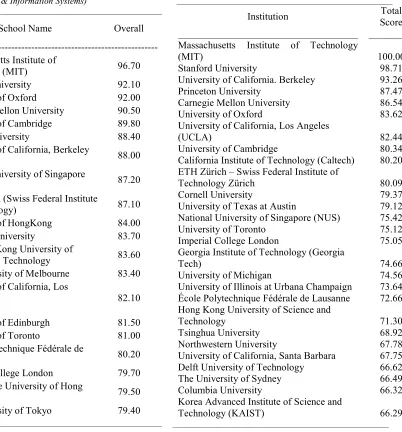
We need to generalize the results of rankings under analysis in order to get a unified scale of leading Computer Science universities. First we standardize all ranking in 100-point scale. Then we compare rankings according to their competency level. For this research we have
chosen only widely recognized ranking systems
[image:3.612.150.552.200.632.2]ARWU, THE and QS, that is why we consider that they have the 1 level of competency. The next standardization will help us to get final overall ranking of world universities (Table 4).
Table 3. QS ranking by Subject 2013 (Computer Science & Information Systems)
___________________________________________________________
QS
Rank School Name Overall
---
1 Massachusetts Institute of
Technology (MIT) 96.70
2 Stanford University 92.10
3 University of Oxford 92.00
4 Carnegie Mellon University 90.50
5 University of Cambridge 89.80
6 Harvard University 88.40
7 University of California, Berkeley
(UCB) 88.00
8 National University of Singapore
(NUS) 87.20
9 ETH Zurich (Swiss Federal Institute
of Technology) 87.10
10 University of HongKong 84.00
11 Princeton University 83.70
12 The Hong Kong University of
Science and Technology 83.60
13 The University of Melbourne 83.40
14
University of California, Los Angeles
(UCLA)
82.10
15 University of Edinburgh 81.50
16 University of Toronto 81.00
17 Ecole Polytechnique Fédérale de
Lausanne 80.20
18 Imperial College London 79.70
19 The Chinese University of Hong
Kong 79.50
20 The University of Tokyo 79.40
___________________________________________________________
Table 4. Overall ranking of universities
______________________________________________________
Institution Total
Score ____________________________________ _________ Massachusetts Institute of Technology
(MIT) 100.00
Stanford University 98.71
University of California. Berkeley 93.26
Princeton University 87.47
Carnegie Mellon University 86.54
University of Oxford 83.62
University of California, Los Angeles
(UCLA) 82.44
University of Cambridge 80.34
California Institute of Technology (Caltech) 80.20 ETH Zürich – Swiss Federal Institute of
Technology Zürich 80.09
Cornell University 79.37
University of Texas at Austin 79.12
National University of Singapore (NUS) 75.42
University of Toronto 75.12
Imperial College London 75.05
Georgia Institute of Technology (Georgia
Tech) 74.66
University of Michigan 74.56
University of Illinois at Urbana Champaign 73.64 École Polytechnique Fédérale de Lausanne 72.66 Hong Kong University of Science and
Technology 71.30
Tsinghua University 68.92
Northwestern University 67.78
University of California, Santa Barbara 67.75
Delft University of Technology 66.62
The University of Sydney 66.49
Columbia University 66.32
Korea Advanced Institute of Science and
Technology (KAIST) 66.29
______________________________________________________
It is evident that the overall ranking, that we will use for the purpose of our research, includes universities of all continents. We consider overall ranking score of universities to be the weighting features of their curriculum matter. Thus we can make a conclusion that curriculum content weights are determined according to
statistical analysis of different components of universities activity, expert poll and reliable analytical evaluation of universities achievements.
[image:3.612.89.305.239.626.2]ISSN: 1992-8645 www.jatit.org E-ISSN: 1817-3195 (Table 4). The subject is included in overall list
even if it is mentioned only in one university curriculum. The overall score of the subject is determined as a sum of the subject weight in all universities, which include it in their curriculum. Weight of every mandatory subject in the university curriculum is equal to the weight of the curriculum itself. The subject has zero weight if it is absent in the curriculum. Weight of the subject from selectory course is determined as the product of curriculum weight and a fraction, the numerator of this fraction is number of selectory subjects that a student should choose from this selectory course and the denominator of this fraction has the total number of subjects in the selectory course. Note that the number of hours set for studying the subject in any university has no influence on the subject rank.
3. Results
It is necessary to pay attention that different universities use different names for academic subjects which have more or less similar programs [10], [11], [12], [13], [14], [15]. We treat these subjects as equivalent and use one uniform name for them. For example, courses named as Compilers, Compilers and
Interpreters, Compilers Design are considered to be equivalent. Courses Wireless Networking,
Embedding Wireless Systems, Wireless
Computing and Sensor Networks could be
considered as equivalent in some ways.
The subject program from one university quite often comprises materials of two or more subjects from other universities. For such cases we decided to regard not one general course but several special ones. For example, the subject
Operating Systems and Networks is quite naturally divided into two: Operating Systems
and Computer Networks, which are included into the final list of subjects.
Ranking results of subjects included in curriculums of the universities (Table 4), which teach students the course of Computer Science, are presented in Table 5. Note that not all subjects with less than 10 points are included in this Table.
We divide all subjects of the rankings into two parts: all subjects with the rankings above a certain threshold equal to N points we include into the first part and will study further and all other subjects will compose the second part.
Table 5. Overall Ranking Of Subjects
Subject name Ranking (R) Subject name Ranking (R)
-Programming and Data Structures - Databases
- Programming languages - Design and Analysis of algorithms - Operating Systems
- Discrete Mathematics - Computer Security - Computer Networks - Computer Architecture - Compilers
- Computer Graphics and Image Processing - Artificial Intelligence
- Object Oriented Software Development - Concurrent programming
- Computational Complexity - Object Oriented programming
100.00 90.61 87.61 87.24 87.12 83.40 71.42 64.29 64.26 62.38 55.60 54.69 51.65 47.45 45.50 45.00
- Wireless Systems - Computer Animation - Web-programming - Functional Programming - Distributed System - Project Management - Software Engineering
- Mobile and Multimedia Networking - Information Systems
- Natural Language Processing - Data Mining
- Digital Technology - Programming Methodology - Machine Learning - Software Specification
33.92 29.59 29.26 23.52 22.52 20.97 12.88 9.32 6.79 6.74 4.51 4.06 3.37 3.37 2.73
Surpassing of the threshold N (in this work it is equal to 20 points) guaranties that the subject will be included into curriculums of some universities from the top of the ranking or it will be included into curriculums of a large number of universities from the bottom part of the ranking and more often into both parts simultaneously. The threshold N is a controlled parameter of the created system. The authors have created a special software application that helps to form the value of the threshold according to rankings data received from the net.
ISSN: 1992-8645 www.jatit.org E-ISSN: 1817-3195
G =100*
∑
∑
= =
n
i n
i
i
R
iR
1 1
i
)
/
*
(
β
,where Ri – is overall ranking of i subject from
Table 5,
βi = {0, 1} – «0», if the subject is not included
into the curriculum of the university to be evaluated, «1», for another case,
n – is number of subjects in Table 5.
Overall ranking Ri evaluates the contribution of
every subject according to its significance for universities.
We will test the offered approach on baccalaureate curriculums of Russian universities where Computer Science is a major. According to national standard of the 3d generation professional education cycle in the Russian Federation consists from basic and variable part.
Basic part of education courses “Applied Mathematics and Informatics” and “Applied Informatics” include the following profession-oriented subjects: “Programming Languages and Methods”, “Databases”, “Numerical Techniques”, “Operating Systems”, “Computer Networks”, “Computer Networks, Systems and Telecommunications”, “Information Systems and Technologies”, “Data Systems Engineering”, “Information Security”, “Software Engineering”. We can also add general subjects directly connected to the discussed professions: “Informatics and Programming”, “System Theory and System Analysis”, “Computer Architecture”, “Computer Graphics”.
Variable part of curriculum cycle is defined by universities at their own discretion. This very part of academic program (profile) displays the specific character, educational focuses and methods of their implementation. This means that the correct organization of variable part of professional cycle ensures that the curriculum meets the present-day educational requirements of leading foreign universities.
It should be taken into account that focused specialization within the course requires a number of subjects typical for this specialty only. For example, specialty “Software engineering” implies preparatory studying of such subjects as “Software Systems Engineering”, “Test Techniques”, “Object-Oriented Analysis”, “CASE tools”, etc. In this work we discuss only those subjects that compose curriculums of courses related to the Computer Science field. Let’s compare a set of subjects from the highlighted area of Table 5, i.e. the subjects
which we regard as mandatory in the global world to subjects taught for example in 2013 at
National Research Nuclear University MEPhI
for specialty “Applied Mathematics and Informatics” and “Applied Informatics”. According to this comparison we can make a conclusion that curriculums of this university do not cover (completely or partially) modules of such subjects as: Compilers, Artificial
Intelligence, Wireless Systems,
Web-programming, Distributed Systems. Thus,
according to the formula the globalization index of educational content of the university under investigation will be G=83.88.
In order to implement the represented calculations we have developed a special information system. Database of this system contains information about rankings of universities, information about their curriculums, types of academic sessions and some quantitative aspects. This system also has basic parameters of national educational standards including a list of mandatory subjects. Lists of subject names are unified and gathered in renewable reference books in two languages – Russian and English. Weight indexes that define the value of different subjects for different specialties could vary. There are applications that automatically replace outdated rankings by new ones every year.
4. DISCUSSION
Further technocratic development of curriculum comparison provokes a detailed examination of curriculum content (certain philosophies, technologies, software products). It provides opportunity to copy the best examples. However there are many attached problems related to political, cultural and infrastructural peculiarities of certain countries and territories that are vividly discussed by researchers of globalization processes.
ISSN: 1992-8645 www.jatit.org E-ISSN: 1817-3195 contain any ideas about content variations
depending on specific character of countries. In the work [17] it is mentioned that the present-day available literature has no detailed analytical researches devoted to interconnection between economic growth and globalization of Central and Eastern Europe which has transitional economy. There are references based on economic factors only. A specific attention is paid to the fact that in order to form a globalization model specification it is necessary to be able to evaluate the consequences of growth of such variables as education and federal expenditure on infrastructure which are hardly mentioned in available resources.
The research field is described in a volumetric work [5] devoted to evolution of higher education globalization based on triangulation theory. This description corresponds to a classical work [18] and highlights 5 basic globalization coordinates that should be evaluated in accordance with the indicators: teachers and students, brand’s image, international cooperation, administrative support of successful programs, advance of global perception towards integration. However this work does not offer an answer to the question: how to mark successful programs with regard to their content and how to change global perception towards the integration. There is a similar research [19] where a regression analysis is used. In this research authors try to estimate the influence of political, economical and demographic factors on globalization of higher education. According to the article the author failed to find any reliable impacts of these factors on the globalization of public education. The existing indicators of universities world rankings are analyzed in a critical manner in work [20]. The author of this work points out that regional universities have no chance to change the established status quo in a global ranking. The only way out for the universities that are outside the top list is to make better curriculums than leaders. Single issues of globalization in the field of training of masters were considered in Russia [21].
Therefore a discussed approach of evaluation of a globalization level of a separate university is based on a comparative analysis of its curriculum content in different academic courses. The aim of this approach is to reduce the dependence of globalization level of education from bureaucratic factors of politics, economics, infrastructure and demography. The
globalization index is calculated in accordance with integrated specifications of the leading universities curriculums. Further investigation should be made concerning the problem of choosing a threshold value for the purpose of detection of valuable subjects in the overall ranking (Table 5); and also concerning the question of determination of weighting coefficients of different rankings of universities according to which the overall ranking is calculated. It might be efficient to use simulated models in these investigations [22]. The recommended globalization index helps to determine whether the set of subjects of a particular course corresponds to the world standards. In other words the quality of education approaches the world standards with the increase of globalization index.
5. Conclusion
The discussed approach to formation of globalization index of university education is based on comparative analysis of its curriculum content with some “ideal curriculum”. The application of this approach ensures permanent results even in a constantly changing world regardless of any existing single rankings of universities and without any risks for national, ethnic of confessional uniqueness of a nation. According to the suggested procedure for formation of the overall ranking of the world universities and then for the creation of an “ideal curriculum” we can make the following conclusions.
We can take the calculated overall scores of universities for weighting features of their curriculums; therefore we can confirm that curriculum weights are determined according to statistic analysis of different components of universities activity, to expert poll and reliable analytical evaluation of universities achievements.
The hypothesis-driven threshold value applied to cut-off non-attractive subjects guaranties that the subject will be included into curriculums of some universities from the top of the ranking or it will be included into curriculums of a large number of universities from the bottom part of the ranking and more often into both parts simultaneously.
ISSN: 1992-8645 www.jatit.org E-ISSN: 1817-3195 the most common threshold value of subject
weights (yes/no) and consider them to be independent. If we take into account subjects correlations then we have to set weighting coefficients by values of the interval [0, 1] and we will also need additional information for calculations.
The given approach to defining university globalization index gives opportunity to shift the index calculation procedure from the absolutely formal assessment scope to combined ones, which include both formal and content factors. In the long view the development of this approach in terms of teaching resource record and mass open on-line courses module application will increase the content component of combined assessments.
REFERENCES
[1] KOF Index of Globalization. (2014). Retrieved March 13, 2015, from http://globalization.kof.ethz.ch/.
[2] Rudenko, V. (2012). Globalization of Education and a Problem of Keeping National Cultural Values. Theory and practice of social development, 6. Retrieved March 13, 2015, from
http://teoria-practica.ru/rus/files/arhiv_zhurnala/2012/6 /s%D0%BEci%D0%BEl%D0%BEgiy%D 0%B0/rudenko.pdf.
[3] Shtatskaya, Т. (2009) The globalization of education. Successes of modern natural science, 11, 65-65. Retrieved March 13,
2015, from
www.rae.ru/use/?section=content&op=sh ow_article&article_id=7784214.
[4] Ivanovsky, Z. (2006). Higher education in the context of globalization. Globalization and the Humanities, 109-114. Retrieved March 13, 2015, from http://www.zpu-journal.ru/zpu/2006_1/Ivanovskiy/17.pdf. [5] Johnson, L. (2012). Measurement and
evaluation of globalization in higher education: the creation of global interaction. PhD thesis, University of Southern California, Los Angeles, California.
[6] National innovation system of the United States: history, political practice, strategy development. (2011). Proceedings of the Organization of innovative activities at U.S. universities, Nizhny Novgorod State
University name N.I. Lobachevski, Nizhny Novgorod, 23.
[7] Academic Ranking of World Universities in Computer Science – 2013. (2014). Retrieved March 13, 2015, from http://www.shanghairanking.com/Subject CS2013.html.
[8] TimesHigher Education World University Rankings' Engineering and Technology. (2014). Retrieved March 13, 2015, from http://www.timeshighereducation.co.uk/w orld-university-rankings/2013-14/subject-ranking/subject/engineering-and-IT. [9] S World University Rankings. (2014).
Retrieved March 13, 2015, from http://www.topuniversities.com/university
-rankings/university-subject-rankings/2013.
[10] Thmson Reuters. (2014). Retrieved March
13, 2015, from
http://thomsonreuters.com/.
[11] EH Zurich. Department of Computer Science. (2014). Retrieved March 13,
2015, from
http://www.inf.ethz.ch/education.
[12] TH Zurich. Department of Computer Science. Bachelor's Program. (2014). Retrieved March 13, 2015, from http://www.inf.ethz.ch/education/bachelor /bachelorcourses215.
[13] Tchnion – Israel Institute of Technology. Computer Science Department. (2014). Retrieved March 13, 2015, from http://www.cs.technion.ac.il/courses/all. [14] University of Toronto. (n.d.). Retrieved
March 13, 2015, from
https://registrar.utm.utoronto.ca/regcal/W EBDEP7.html.
[15] Ntional University of Singapore. School of Computing. (2014). Retrieved March 13,
2015, from
http://www.comp.nus.edu.sg/undergraduat es/cs_cs_prospective.html.
[16] Oegova, O., & Zabulionite, K. (2014). Linguocultural Globalization: Objective Tendencies and the Perspective Issue. Procedia – Social and Behavioral Sciences, 154(28), 475-481.
[17] Gurgul, H., & Lach, L. (2014) Globalization and economic growth: Evidence from two decades of transition in CEE. Economic Modelling, 36, 99-107. [18] Salmi, J. (2009). The Challenge of
ISSN: 1992-8645 www.jatit.org E-ISSN: 1817-3195 and Development. The World Bank,
Washington, DC 20433, 115.
[19] Nyang'oro, C. (2013). Globalization and the Public Provision of Higher Education: Empirical Evidence from Selected Countries. FIU Electronic Theses and Dissertations. Retrieved March 13, 2015, from
http://digitalcommons.fiu.edu/etd/878. [20] Rust, V., & Kim, St. (2012). The Global
Competition in Higher Education. University of California Los Angeles. World Studies in Education, 13(1), 5-20. [21] Zaytsev K. & Sergievskiy M. (2014) Use
of Foreign Experience for Organization Masters Education Program in IT. Alma Mater, 5, 62-67.