ISSN: 1992-8645 www.jatit.org E-ISSN: 1817-3195
REAL POWER GENERATION TRACING FOR
DEREGULATED POWER SYSTEM USING THE FLOWER
POLLINATION ALGORITHM TECHNIQUE
1
S. H. M. KERTA, 2Z. A. HAMID, 3I. MUSIRIN
2
Faculty of Electrical Engineering, Universiti Teknologi MARA, Malaysia
E-mail: [email protected], [email protected]
ABSTRACT
In deregulated power market, providing a fair and non-discriminatory service pricing is still in debate on ‘who should be blame’ for the losses contribution. The use of traditional methods such as postage stamp and MW mile methodology is said to be unreliable and biasing because of neglecting the power flow and physical constraints. Thus, a new theory called electricity tracing has been developed to solve the problem concerning non-discriminatory tranmission service pricing. The most common methods used are Proportional Sharing Principle (PSP) and Superposition Theorem (ST). However, due to necessity of matrix inversion and singularity of matrix in the mathematical equation, it is likely an error will occur and result in unsatisfactory outputs. To explore a new method, this paper demonstrates an Artificial Intelligence (AI) based optimization method, that is, Flower Pollination Algorithm (FPA) to perform real power generation tracing. The experiment and comparative studies on IEEE-14 bus power system have verified the capability of the proposed method for real system application with promising results.
Keywords: FPA, Generation Tracing, Losses Allocation, Matrix Inversion, Proportional Sharing Principle
1.
INTRODUCTIONNowadays, the electrical power industry is shifted from monopolistic vertical structure to a deregulated market structure. The deregulated market consists of four main player, the
independent service provider (ISO), the
transmission companies (TRANSCO), the
generation companies (GENCO) and the
distribution companies (DISCO). Hence, the allocation charges among this players must be made fully fair and transparent [1]. The introduction of deregulated market in countries like New Zealand, Australia and a few regions in Canada, is an approach to increase the efficiency in operation and at the same time to reduce the energy price [2]. Perhaps, Scandinavia countries are the most established in deregulated market [3]. Nevertheless, allocation charge for generators and loads is complicated to be performed since it is hard to trace from which power of generators or loads contributed to each transmission lines on certain bus. Since then, there are various methods to allocate the charges introduced by researches: the MW mile method, contract path method and
postage stamp allocation [4]. In the case of power scheduling, article [5] has explored the optimal
control theory technique called Maximum
Principle. This technique validates whether the power scheduling is feasible for penalty charged to GENCOs. For spot market price, the optimal bidding and contracting strategy has been explored in [6] for providing a free risk trade among GENCO and DISCO under the specific merits. There are many other methods of charge allocation available for deregulated power market [7]. However, none of the mentioned methods give satisfactory results. This problem has already attracted many researchers to find a new solution for effective and transparent allocation of losses charge. The outcome of studies has brought to the emergence of a new method called power tracing. The advantage of tracing method is that the method take account of the physical power flow constraints and able to trace the power contributed by generators or loads [8].
ISSN: 1992-8645 www.jatit.org E-ISSN: 1817-3195
loads. Thus, the algorithm based on Proportional Sharing Principle (PSP) was proposed by Bialek in [9] and [10]. The technique is based on Topological Generator and Load Distribution Factor (TGLDF) and the element of the technique consists of upstream and downstream algorithm. TGLDF frequently uses a large matrix inversion in mathematical equation. However, the power system need to be assumed lossless in transmission lines which leads the tracing results less accurate. Kirschen method make an extension in PSP by organizing each loads and buses into homogeneous group [11]. The concept of domain generator, common and link have also been introduced for power tracing. Meanwhile, Dai et al has developed the power tracing for reactive power and it is proven to be suitable for large system [12]. Nevertheless, Kirschen and Dai techniques are still based on PSP and this has made both techniques carried the same weakness as in TGLDF method.
Later, the Superposition Theorem (ST) was proposed by Teng [13]. The technique used a circuit theory in the tracing algorithm and it is able to trace the voltages, current, real and reactive
power from both generators and loads
simultaneously. However, the existence of negative sharing in the tracing results is unable to be defined and leads to confusions. Afterward, the tracing power using prediction based algorithm such as Artificial Neural Network (ANN) was exploited by [14] and [15]. The ANN is proven to have a robust tracing process but the characteristic of tracing results has no uniqueness since the training data rely on the existing power tracing techniques. Article [16] has proposed power tracing via SVC, which is extension studies on prediction of the manner of reactive power in the deregulated market. Later, a hybrid method has been developed by Shareef and Mustafa in [17] by combining the existing power tracing method such as Common, Node and Graph method. However, due to the complexity of power tracing and a lot of assumptions have to be considered, the method became less attractive as it is easy for an error to occur in the tracing results. After that, article [18] has proposed a power tracing using optimization method and the primary elements for control variables, constraint and objective function are specified accordingly. The proposed method successfully created the algorithm which is free from matrix inversion and assumptions such as PSP. In article [19], the optimization technique using Genetic Algorithm has been explored for power tracing. Later, the article [20] has
successfully implemented Evolutionary
Programming which satisfies the power system constraints. Recently, the article [21] has proven that the use of Artificial Bee Colony (ABC) is far
more superior than the Particle Swarm
Optimization (PSO) technique in terms of computation time and the accuracy of tracing results. On overall, these reviews have motivated the authors to conduct a study on electricity tracing by means of different approach.
This paper proposes a bio-inspired optimization algorithm by means of Flower Pollination Algorithm (FPA) which is developed by Yang [22]. It was reported that the FPA techniques offers a good computation time, robust in finding the best solution and simplicity. In article [23], FPA technique is able to perform good optimization considering continuous domain. To establish the algorithm equations, FPA requires only small number of parameters which makes it an easier tool to be implemented for optimization problem [24]. In fact, the key mechanism of exploration and exploitation embedded within FPA algorithm namely global and local pollination, allows for effective optimization in the searching space. In articles [25], the author has proven that the FPA is better as compared to Bat algorithm (BA). Therefore, the above reviews have motivated this research to apply power tracing via FPA techniques. The developed technique will be applied in IEEE 14-bus test system concerning real power generation tracing. The performance of the proposed tracing algorithm will be compared with other methods.
2.
METHODOLOGYIn this section, two conventional power tracing algorithms are presented: Topological Generator and Load Distribution Factor (TGLDF) and Superposition Technique (ST) as proposed by [9] and [13] respectively. Besides that, two Artificial Intelligence algorithms for power tracing will be described, namely the Artificial Neural Network (ANN) and Flower Pollination (FPA).
2.1 Conventional Power Tracing
Conventional power tracing is strictly based on matrix operation and derivation. For the purpose of this paper, two conventional power tracing algorithms namely the TGLDF and ST are explained as follows:
ISSN: 1992-8645 www.jatit.org E-ISSN: 1817-3195
This method was proposed by J. Bialek [9]. The method assumes that the power flow through a node will be proportionally shared through all path that bring outflows from that node.
This principle was developed to find the usage capacity of generator and load via upstream and downstream algorithm. When looking the tracing at the nodal balance of inflow (upstream looking algorithm), the total power through each node, Pi
can be expressed as:
(1)
Equation (1) shows that the power contribution from each Pgk through a node is equal to |Au-1|.Pgk;
where, Au is n x n upstream distribution matrix and
(i, j) element of Au is equal to:
∈ − = − = = − otherwise ; 0 for ; | | for ; 1 ]
[ α(iU)
j i j ij ij u P P c j i A (2)
Where Pj represent power through bus j, Pj-i
represent the line flow into line j-i , and αi(u) is the
sets of nodes supplying directly to bus i .
Therefore, the line outflow of transmission line i-l according to proportional sharing principle (PSP) can be calculated as:
(3)
Similarly, the load demand PL-i can be calculated as:
(4)
The equation is useful to find where the contributor’s power for a certain load comes from.
B) Superposition method
This method was proposed by Teng [13]. The method is developed based on circuit theories,
equivalent current injection and equivalent
impedance. Firstly, the converged power flow results has to be obtained in order to find the power injections, bus voltage angles, bus voltage magnitudes and power flows at both ends of a line. After that, the complex power injection, Sn,Gof a
generator bus n can be expressed as:
(5)
Where, Pn,G and Qn,G are real and reactive power
injection at n-th generator bus respectively.
Then, the following equations are used to determine the equivalent current injection of generator and equivalent impedance of load. The corresponding equivalent current injection of generator, In,Gis:
(6)
Where, Vn,G is the voltage at n-th generator bus
obtained from the converged power flow solution. Next, the corresponding equivalent impedance of load, Zi,L is:
(7)
Where, Vi,L , Ii,,Land Si,L = Pi,L + jQi,L are the voltage,
current and power of load at i-th bus obtained from the converged power flow solution.
After the equivalent impedance was integrated into the admittance matrix, the relationship between bus voltages and bus current injections can be formed into a transmission system with N buses as follows: = = ∆ ∆ ∆ 0 0 , 1 1 1 1 11 1 M M L L L M O L O M L L M L L L M L L M M I Z Z Z Z Z Z Z Z N V n V V G n NN N nN nn n N n n n n (8)
Equation (8) shows that the voltage at bus i contributed by generator at bus n (i.e. ∆Vi n) can be
written as: (9) gk n k ik u i l i i i l i l
i A P
P P P P P
P = ⋅ = ∑ ⋅
= − − − − 1 1 ] [ gk n k ik u i i L i i i L i
L A P
P P P P P
P = ⋅ =
∑
⋅= − − − − 1 1] [ n i P A P n k gk u
i [ ] ; for 1,2,...,
1 1 = =
∑
= −jQ
P
S
n,G= n,G+ n,G* , , , , + = G n G n G n G n V jQ P I L i L i L i L i L i L i jQ P V I V Z , , 2 , , , , = = − G n in n
i z I
V = ∗ ,
ISSN: 1992-8645 www.jatit.org E-ISSN: 1817-3195
And the voltage of bus i contributed by all generators will be:
(10)
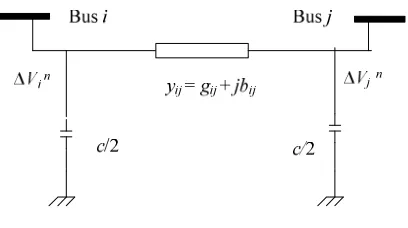
[image:4.612.92.296.204.318.2]Next, to determine the contributed current by any particular generator, the following figure needs to be considered.
Fig. 1. A transmission line section model
The line current between buses i and j
corresponding to the voltage contributed by generator bus can be expressed as:
(10a)
(10b)
Where, yij = gij + jbijis the line admittance from bus
i to j and c/2 is the line charging susceptance. Thus, Δiij
n
and Δiji n
are the line currents from bus i to bus j and bus j to bus i respectively, contributed by generator at bus n. Therefore, the total line current from bus i to j is expressed as:
(11)
Since the voltage and current can be identified, the complex power flow, Sij from bus i to j can be
expressed as:
(12)
(13)
From the equation (13), the complex power flow contributed by generator at bus n is given as:
(14)
And the complex power loss on the line between bus i and j can be expressed as:
(15)
Lastly, the real power loss contributed by generator at bus n can be expressed as:
(16)
Thus, the total line losses in any particular line can be expressed as:
(17)
In summary, this tracing method has 4 essential steps which are the tracing of voltages, current, power flow and losses through equations (10), (11), (15) and (17) sequentially.
2.2 Artificial Intelligence Method
In this section, the method of power tracing via Artificial Intelligence (AI) will be explained briefly. The AI has an important role in solving complex mathematical problem. The power tracing has benefits in using AI method as its solver. Recently, there are numerous studies on how to solve power tracing problem via AI approaches. The commonly used method is the Artificial Neural Network (ANN) and Optimization method. The ANN is a supervised learning inspired from the biological neurons and suitable for forecasting and predicting future data. The optimization method is a process to find the best solution inspired by nature movement likes flocking of birds, bacteria and ant colony. The AI approaches have proven to be less computational burden and easy to be implemented. The following subsections will explain in brief on the methodology involving AI methods.
∑
=∆ = NG
n n i i V V 1
(
ij ij)
( )
inj n in ij n V 2 jc jb g V V
i ∆
+ ∆ −∆ = ∆
(
+)
∆ ∆ −∆ =∆ jn
ij ij in jn
jin V V g jb jc2 V
i * 1 1 * ) ( ∆ ∆ = =
∑
∑
= = G G N n n ij N n n i ij iij V I v i
S ∑ ∆ = = G N 1 n n ij ij i I ∑ ∆ = = G N 1 n n Loss , ij Loss , ij P P
(
)
(
G G)
G G N ij N ij ij ij N i N i i i ij i i i i v v v v S ∆ + ∆ + + ∆ + ∆ ∗ ∗ ∆ + ∆ + + ∆ + ∆ = − − 1 2 1 1 2 1 ... ... K K ∑ ∆ = = G N 1 n n ij Loss , ij s S * )
( nij
i n
ij V i
s = ∆
∆
( )
( )
nji n
ij n
loss
ij s s
P = ∆ + ∆
ISSN: 1992-8645 www.jatit.org E-ISSN: 1817-3195
A) Artificial Neural Network (ANN)
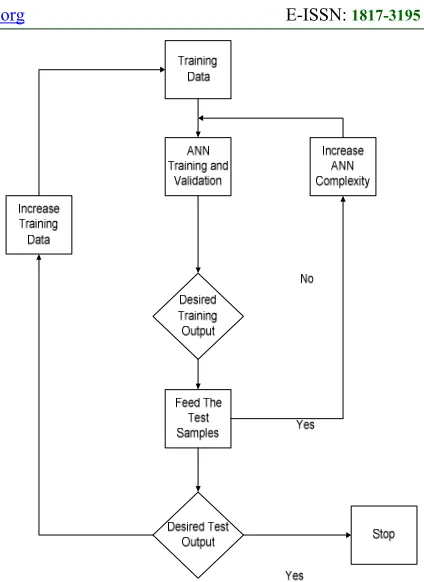
The ANN consists of three basic layers; input, output and hidden layer. Each layer has a number of nodes and connected between each layer. This connection is represented by weighted input data [26]. In addition, the ANN performs two major tasks; namely the training and testing. Training is the process of adapting the data to produce the desired output and to be presented as input memory. If the desired output data is unsatisfactory, the ANN complexity need to be increased such as creating more connection between weights input data. In contrast, testing is the integral part of training process and create response at the output memory. In relation to the power tracing, the input training data is acquired from the conventional power tracing methods such as TGLDF or Superposition theorem. The input will be connected to a number of layers in the systems to produce a desired output. Various techniques have been introduced using other methods to be represented as the input training data such as in [14] and [15]. Above all, the training data will be tested to create a response from output memory and if the ANN testing failed to satisfy the desired output, the training data need to be increased until the satisfactory results are successfully achieved. Nevertheless, the performance of power tracing using ANN is still based on the results from conventional power tracing. Hence, there is no uniqueness in the tracing results. The process of power tracing using ANN is illustrated in Fig. 2.
B) Optimization method
[image:5.612.311.523.74.365.2]Optimization approach has been explored by [18]. The basic elements of the method consist of control variable, constraint and objective function. The control variable must not violate the specified constraints in order that the objective function can be maximized or minimized. The process to find the best solution under the guidance of objective function will determine the effectiveness and robustness of the algorithm. In applying the optimization approach, researchers have proven that the method is simple in calculation without complexity of mathematical formulation and provide fairness for losses charge allocation. In virtues of that, this paper intends to exploit the benefits of optimization techniques through the application of the Flower Pollination Algorithm (FPA).
Fig 2. ANN Algorithm Assisted Power Tracing
2.3 Real power tracing concept
Since the topic of this paper will involve the real power contributed by generators, it is necessary to derive the mathematical relationship for generator’s contribution in losses, line flows and load powers before formulating it into FPA. In [18], the contribution of generators of power Pgk in line
flows, Pfl k
and load, PLi k
is given as:
(18)
(19)
Here, xfl k
is the power flow fraction of l-thline and xLik is the load power fraction of i-th load
contributed by k-th generator respectively. More importantly, the equation (18) and (19) can be defined as the percentage of a generator’s output power used by a specific transmission line and load in the system. The summation of generator contribution in line flow of l-th line is expressed as:
(20)
gk k fl k
fl x .P
P =
gk k Li k
Li x .P
P =
ngen fl fl
fl
fl
P
P
P
ISSN: 1992-8645 www.jatit.org E-ISSN: 1817-3195
Substituting (18) into (20):
(21)
(22)
Meanwhile, the generator contribution in i-th load can also be described as:
(23)
Where, the term ‘ngen’ as in (22) and (23) represents the number of generators in the system. Both equations will be the equality constraints to ensure no violation caused by FPA during optimization process.
2.4 The Proposed Power Tracing Method
This section explains briefly the methodology of power tracing via FPA. The FPA is a bio-inspired algorithm in which has been evolving around 125 million years by the transfer of pollen using wind, insect, bird and other animals [22]. The pollen is carried in two ways, namely biotic and abiotic. In biotic pollination, the insects and animals carry the pollen to the stigma. While in abiotic pollination, wind or diffusion in water is the tools for the pollination. According to the survey in [25], 90% of pollination takes biotic pollination process which requires an animal and insects to be the pollinators. By a close look into the pollination, there are two methods of pollination, cross-pollination and self-pollination.
Cross-pollination is a process of pollination from a pollen of a flower of a different plant. By contrary, self-pollination is the pollination of a flower, from pollen of the same flowers or different flowers of the same plant, which often happens when there is no available pollinator. Biotic, cross-pollination may be happened in long distance. Bees, bats, birds and flies are mostly used as pollinators which are able to fly for a long distance which obeying the Levy distribution. So, these pollinators are considered as the carrier of the global pollination. In addition, there is a pollinator such as bees which tend to visit exclusive certain flower species while bypassing other flower species. This is known as flower constancy which has the advantages to maximize the transfer of pollen to the same species of flower, hence, maximizing the reproduction of the same flower species [22] – [25]. The objective of flower
pollination is to ensure the survival of the fittest and the optimal reproduction of plants in terms of number as well as the fittest [22]. This section will discuss briefly the process of FPA in accordance to the power tracing.
A) The Philosophy of FPA
The FPA as invented by Yang [22] is to be implemented in the power tracing algorithm. To understand the concept of FPA, there are primary processes involved namely the biotic and abiotic pollination, local and global pollination. For simplicity, the essential processes are summarized as follows:
1. Rule 1 – Biotic and cross-pollination can be considered as a process of global pollination, and pollen-carrying pollinators move in a way which obeys Levy flights.
2. Rule 2 – For local pollination, abiotic
pollination and self-pollination are used.
3. Rule 3 – Pollinators such as insects can
develop flower constancy, which is equivalent to a reproduction probability that is proportional to the similarity of two flowers involved.
4. Rule 4 – The interaction or switching of local
pollination and global pollination can be controlled by a switch probability p ϵ [0; 1], slightly biased towards local pollination.
B) Power Tracing using FPA
In this section, the FPA begins with initial random number generation, evaluation of fitness, production and selection of new generation. The algorithm will take a longer computation time due to a large pool of control variables; namely, the number of generators, transmission lines and load buses. If the formulation of algorithm is not done properly, it will result in the burden of computation. Therefore, the performance of programming is essential to provide a good converged result of optimization. The elements of algorithm such as control variable, objective function, equality and non-equality constraint will be set properly to give proper guide for the algorithm. For the purpose of this paper, the problem formulation was inspired by the research conducted in [20], except for the type of algorithm used to perform the optimization; namely, the newly developed FPA. The appropriate control variables, constraint and objective function are explained below:
∑
=
=ngen
k
gk k
fl
fl x P
P 1
. i.e
∑
=
=
ngenk
gk k Li Li
x
P
P
1
.
ngen g ngen fl g
fl g fl
fl
x
P
x
P
x
P
P
2 2 ,1
1
.
+
.
+
...
+
.
ISSN: 1992-8645 www.jatit.org E-ISSN: 1817-3195
i) Control Variable – The matrix X as in (24) represents the individual candidates for FPA that consists of contributed line flow and load power fraction by k-th generator (i.e. xsl
k
and xLi k
respectively). Hence, xsl k
and xLi k
represent the control variables in this algorithm. The order of matrix X is given as (nbr + nload) x ngen, where
nbr, ngen, nload represent number of lines, number
of generators and number of loads respectively.
= ngen nload L k nload L nload L ngen Li k Li Li ngen L k L L ngen L k L L ngen nbr s k nbr s nbr s ngen sl k sl sl ngen s k s s ngen s k s s x x x x x x x x x x x x x x x x x x x x x x x x , , 1 , 1 2 2 1 2 1 1 1 1 , , 1 , 1 2 2 1 2 1 1 1
1 ... ...
L L M M M M O M O M L L M M M M O M O M X (24)
In fact, the line flow fraction consists of end power and receiving-end power. The sending- sending-end power fraction is chosen to be the control variable since it comes directly from the generator bus. Therefore, the receiving-end power and losses fraction are calculated via (25) and (26) as follows:
(25)
(26)
Where, Psl and Prl represent the sending- and
receiving-end power of l-th line respectively. The fraction xsl
k
and xrl k
represent the sending- and
receiving-end power fraction of l-th line
respectively.
ii) Constraint – The FPA is subjected to some considerable constraints to limit the searching process. This is given as follows:
(27)
(28)
(29)
(30)
The constraint in (30) ensures that the contributed fractions in matrix X are always in positive values and does not exceed the corresponding generators power. This will effectively enhance the accuracy of tracing results.
iii) Objective function – The proposed objective function was derived from power-balance equation. This hypothetical equation should be utilized as the fitness to guiding the searching of FPA. Firstly, power generated by a generator should be equal to the summation of total load power and losses contributed by that generator. Mathematically:
(31)
The loss of l-thline contributed by a generator is described by (32) as follows:
(32)
By substituting (23) and (32) into (31), the following is obtained.
(33) After simplification: (34) Rearrange (35): (35) Or: (36)
∑
∑
= = + = nbr l k l loss nload i k Li gk P PP 1 , 1 k sl sl rl k
rl P .x
P x = k rl k sl k l ,
loss x x
x = −
gk k l loss k l
loss
x
P
P
,=
,.
gk nbr l k l loss nload i gk k Li
gk x P x P
P . .
1 , 1
∑
∑
= = + =∑
∑
= = + = nbr l k l loss nload i k Li x x 1 , 1 10
1
1 , 1=
−
−
∑
∑
= = nbr l k l loss nload i k Lix
x
∑
∑
= = − − = nbr l k l loss nload i k Ligk x x
E 1 , 1 1 ) ( min
∑
==
ngen k gk k sl slx
P
P
1.
∑
= =ngen k gk k rlrl x P
P 1 .
∑
= = ngen k gk k Li Li x PP 1 .
1
,
,
,
0
≤
, k≤
Li k l loss k rl k
sl
x
x
x
ISSN: 1992-8645 www.jatit.org E-ISSN: 1817-3195
Where, Egk is the generation-demand balance error
of k-th generator participated in the power tracing. Hence, the objective of the algorithm is to minimize the error Egk as low as possible.
C) Overall Algorithm for FPA-based-tracing
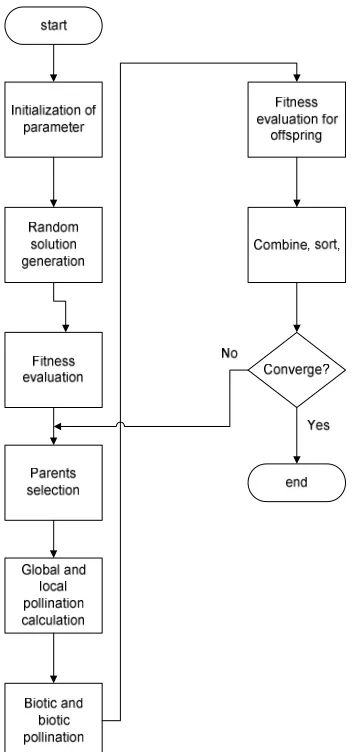
[image:8.612.94.270.225.601.2]Fig 3. illustrates the process of FPA in searching the best fraction of load power and losses to be allocated to each generator.
Fig 3. Flower Pollination Algorithm Assisted Power Tracing
Based on Fig. 3, the algorithm is explained briefly as follows:
i) FPA initialization
First of all, the initial number of pollen is set to 50. The primary FPA parameters which are the
probability of switch from global pollination and local pollination, p is set to 0.8 respectively.
ii) Random solution generation
Initially, all control variables as in matrix X are generated randomly subjected to the specified constraints as in (27) – (30). The process of random generation will be terminated if all individuals, which are the matrices X’s have been filled with satisfactory fraction values.
iii) Fitness evaluation
Secondly, the output of each randomly generated
matrix X is analyzed by means of fitness
evaluation. At this step, the error Egk as in (36) are
calculated and the population is sorted according to the fitness value. This means that the topmost solution will have the best fitness value and vice versa for the bottommost solution.
iv) Solution update process
To establish the new solutions using the FPA solution update process, the Rule 1 to 4 made by Yang in [22] will be converted into solution update equations. First, in global pollination step, flower pollen gametes are carried by pollinators such as insect, and pollen can travel over a long distance because insects can often fly and move in a much longer range. Therefore, Rule 1 and flower constancy can be represented mathematically as:
(37)
Where, Xi t
is the i-th pollenor the solution vector Xi
at iteration t, and g* is the current best solution
found among all solutions at the current iteration. Here, γ is a scaling factor to control step size. The scaling factor, γ is set to 0.01. In addition, L(λ) is the parameter that corresponds to the strength of pollination, which essentially is also the step size with λ is set to 1 x 10⁻⁶. Since insects may move
over a long distance with various distance steps, we can use Levy flight to imitate this characteristic efficiently; that is, to draw L(λ) > 0 from a Levy distribution. This is given as follows:
(38)
Where, Г(λ) is the standard gamma function and
this distribution is valid for large steps s > 0. Then, to model the local pollination, both Rule 2 and Rule 3 can be presented as:
) )(
( *
1 t
i t
i t
i X L g X
X + = +γ⋅ λ −
) 0 (
1 ) 2 sin( ) (
~ ⋅ 1 >> > Γ
⋅
+ s so
s
L λ
ISSN: 1992-8645 www.jatit.org E-ISSN: 1817-3195
(39)
Where, Xi t
and Xj t
are pollen from different flowers of the same plant species. This essentially imitates the flower constancy in a limited neighborhood. Mathematically, if Xi
t
and Xj t
comes from the same species or selected from the same population, this
equivalently becomes a local random walk if ε is
drawn from a uniform distribution in [0, 1]. In order to mimic the switches of flower pollination for both global and local, the switch probability, p is used (Rule 4).
v) Assigning new generation
The selection of the offspring population (the new population of matrix X) are evaluated via fitness
evaluation. Subsequently, both parents and
offspring population are combined and sorted according to their quality of fitness; that is, the highest solution represents the b-th matrix X with the smallest error Egk among the population. The
last half of the combined population will be discarded, while the first half will be assigned as the new generation in the next iteration as if to maintain the original population number.
vi) Convergence test
Eventually, the optimization will be terminated if all matrices X’s have tolerable difference of fitness.
3.
RESULT AND DISCUSSIONThe developed algorithm was tested on IEEE 14-bus power system for validation process. The power system consists of 3 synchronous generators with 23 transmission lines for delivering MW power to consumer, and 14 buses with 13 of them contain loads. Although having numerous number of control variables, the FPA algorithm requires about 52 seconds for searching process. This means that the proposed algorithm was successful in providing finite results. In this section, the proposed algorithm was successfully tested for allocation of losses and load power to generators. There are 2 competing methods for the purpose of comparative study, namely the Topological Generator and Load Distribution Factor (TGLDF) and Superposition Theorem (ST) as proposed in [9] and [13] respectively. All the results in this section are presented in the Appendices of this paper.
3.1 Allocation of losses to generators.
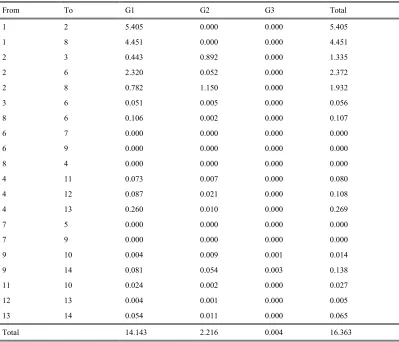
The generator contributions in losses using FPA, TGLDF and ST are tabulated in Table A1, Table A2 and Table A3 respectively.
It has been validated that the tracing results produced by the algorithm satisfied the constraints in equations (27) – (30). The total losses obtained by using FPA are equal with that of the original power flow results. Furthermore, there is no negative sharing of losses obtained by using FPA method. Based on Table A1, line losses from bus 9 to 14 contributed by generator G1, G2 and G3 are 0.081 MW, 0.054 MW and 0.003 MW respectively. In addition, the total losses contributed by generator G3 is 0.004 MW. This shows that, the losses contributed by generator G3 using FPA is far smaller than that of the TGLDF’s and ST which result to 0.032 MW and 1.219 MW respectively.
In contrast to TGLDF’s method as in Table A2, this method was unable to trace the individual losses of each transmission line. As can be seen from Table A2, the method indicates only total losses contributed by each generator, which means that it failed to detect which generators became the major contributor for the losses in transmission line. For example, the total real power losses is 16.35 MW and the total contributed losses by G1, G2 and G3 are 15.092, 1.226 and 0.032 MW respectively. This method involves a lot of mathematical assumptions. For instance, the method treat the line flow to be lossless and perform the tracing process using 3 assumptions according to [9]; namely, average line flow, gross flows and net flows. As a result, this has lead to less accuracy in tracing results. In addition, using the large matrix inversion can lead to error in calculation if the matrix is singular.
For ST method as in Table A3, it was successful in resulting transparent result as that of FPA. Through the method, the individual losses of each transmission line was able to be traced and allocated to generators. For example, from bus 1 to bus 2, the line losses contributed by generators G1, G2, G3, G4 and G5 are 2.262 MW, 1.336 MW, 0.809 MW, 0.512 MW and 0.482 MW respectively. In addition, there is an increase in generators participations in the losses contribution; where, there are two synchronous condensers namely generator G4 and G5 that also contribute the losses to the system. However, synchronous condenser which is frequently known as synchronous capacitors in practical does not give any significant contribution to the real power issues. The machine acts as a stabilizer in transmission line and supplies only reactive power to the system. Therefore, it is illogical to say that synchronous condenser take part in real power losses. In addition, the ST method was unable to make the result of total losses )
(
1 t
i t j t
i t
i X X X
ISSN: 1992-8645 www.jatit.org E-ISSN: 1817-3195
free form negative contributions. For example in Table A3, the losses in transmission lines from bus 8 to 4 contributed by generators G1, G2 and G3 are -1.193 MW, -0.872 MW and -0.748 MW respectively. Since there is no concrete reason for the occurrence of negative sharing, it cannot be accepted in the real power market as it introduces confusing interpretation in the transmission service pricing.
As a result, FPA method holds several advantages compare to the conventional methods. The FPA method has no mathematical assumptions; hence, leads to more accuracy in results. There is no large matrix inversion is required here. This can minimize the error during computation process. From here, the FPA method is proven to be easy for implementation, robust for result accuracy and efficient for optimization.
3.2 Generator contribution on MW loads
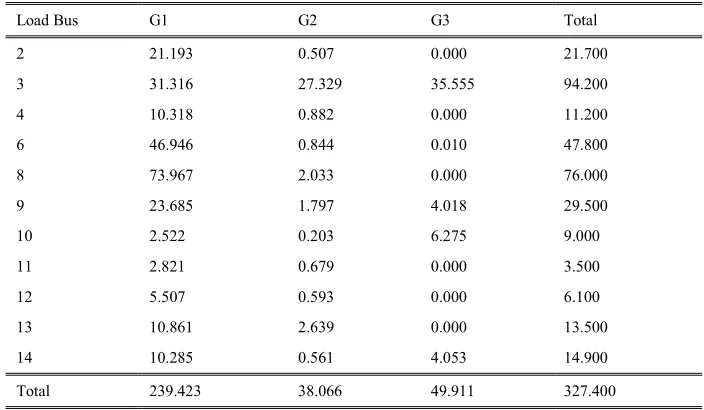
The generators contributions on MW loads using FPA, TGLDF and ST are tabulated in Table A4, Table A5 and Table A6 respectively.
By considering FPA in Table A4, the total load power allocated to generator G1, G2 and G3 are 239.423 MW, 38.066 MW and 49.911 MW respectively, while the result produced by TGLDF as in Table A5 for G1, G2 and G3 are 253.75 MW, 40 MW and 50 MW respectively. For ST as in Table A6, the total contributed load power by the generators G1, G2 and G3 are 247.448 MW, 42.83 MW and 48.781 MW respectively. In addition, based on ST there are additional generators namely G4 and G5 that have contributed total load power of -7.254 MW and -4.413 MW respectively. The overall load power in the system resulted from FPA, TGLDF and ST are 327.392 MW, 343.75 MW and 327.4 MW respectively.
As for TGLDF, the total MW loads is larger as compared to ST and FPA. Nevertheless, there is no much different on the result among the three methods and it is acceptable for this case. For TGLDF, the method makes several assumptions such as proportional sharing principle and used a matrix inversion for the calculation. As a result, the total MW loads less accurate as compared to the FPA. For ST, the assumptions need to be undertaken are by transforming the generator bus as an equivalent current injection and load bus as equivalent impedance. Only when the impedance matrix is non-singular, the tracing results can be acquired. However, the existence of negative sharing makes it less accurate.
From here, FPA holds several advantages as compared to other methods. For instance, the FPA
is free from any assumptions and no matrix singularity need to be accounted for calculation. This has given the FPA more flexibility and efficiency in terms of performance.
3.3 Comparison optimization method with proposed method
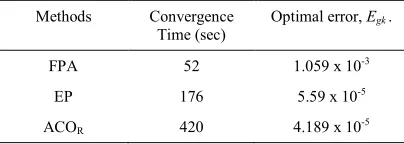
The results for performance of FPA, EP and
ACOR are tabulated in Table 1. The comparative
study will be focused on the required time for
convergence and the optimal error, Egk resulted
[image:10.612.316.518.257.329.2]from each algorithm.
Table 1: Performance of algorithm after optimization
Methods Convergence
Time (sec)
Optimal error, Egk .
FPA 52 1.059 x 10⁻³
EP 176 5.59 x 10⁻⁵
ACOR 420 4.189 x 10⁻⁵
The FPA results in a finite computation time in
searching for optimal error, Egk. Based on the
results tabulated in Table 1, the time taken for FPA,
EP and ACOR to converge are 52, 176 and 420
seconds respectively. This entails that the FPA method shows an excellent computation speed over the others. While EP is average in computation
time, the ACOR takes longer time for searching the
best solution. In addition, it is obvious that FPA results in tolerable error value as that of EP and ACOR. Based on Table 1, although the error value
produced by ACOR is the lowest, the error value of
1.059 x 10⁻³ resulted from FPA is still satisfactory.
Based on these findings, EP and ACOR reflect their
merit only in the context of solution optimality, but unable to promise fast optimization. Hence, FPA offers a better optimization scheme as it has given a
satisfactory solution with promising speed
concurrently.
4.
CONCLUSIONISSN: 1992-8645 www.jatit.org E-ISSN: 1817-3195
maintain its simplicity regardless of the size of power system and constraints. On overall, the comparative studies have verified the competency and capability of the proposed method for deregulated market environment. For future recommendation, the proposed method will be run in larger test systems such as 57-bus power systems.
ACKNOWLEDGEMENT
The authors would like to acknowledge The Research Management Institute (RMI) of UiTM and Ministry of Higher Education Malaysia (MOHE) for the financial support via the Research Acculturation Grant Scheme (RAGS) with project code: 600-RMI/RAGS 5/3 (189/2014).
REFERENCES
[1] M. Shahidehpour, H. Yamin, and Z. Li, “Market Operations in Electric Power Systems : Forecasting, Scheduling, and Risk
Management,” Wiley and Sons Inc.
Publication, 2002.
[2] M. W. Mustafa and M. H. Sulaiman, “Transmission Loss Allocation in Deregulated
Power System via Superposition and
Proportional Tree Methods,” 2nd IEEE Int. Conf. Power Energy (PECon 08), December 1-3, 2008, Johor Baharu, Malaysia, vol. 3, pp. 988–993, 2008.
[3] A. Mazer,”Electric Power Planning for Regulated Markets.” Wiley and Sons Inc. Publication
[4] Z. Hamid, I. Musirin, M. M. Othman, and M. N. a Rahim, “Comparative studies between various power tracing techniques for reactive power allocation,” ICCAIE 2011 - 2011 IEEE Conf. Comput. Appl. Ind. Electron., no. Iccaie, pp. 96–101, 2011.
[5] X. G. X. Guan, F. G. F. Gao, and a. Svoboda, “Energy delivery capacity and generation scheduling in the deregulated electric power market,” Proc. 21st Int. Conf. Power Ind. Comput. Appl. Connect. Util. PICA 99. To Millenn. Beyond (Cat. No.99CH36351), pp. 25–30, 1999.
[6] D. J. Wu, P. Kleindorfer, and J. E. Zhang, “Optimal Bidding and Contracting Strategies in the Deregulated Electric Power Market : Part II,” Proceeding 34th Hawaii Int. Conf. Syst. Sci., no. IEEE, pp. 1–10, 2001.
[7] O. Pop, C. Barbulescu, P. Andea, D. Jigoria-Oprea, F. Coroiu, and O. Tirian, “ComParison
of power system tracing cost allocation methods,” EUROCON 2011 - Int. Conf. Comput. as a Tool - Jt. with Conftele 2011, no. 1, pp. 1–4, 2011.
[8] Z. M. Z. Ming, S. L. S. Liying, L. G. L. Gengyin, and Y. N. Y. Ni, “A novel power flow tracing approach considering power losses,” 2004 IEEE Int. Conf. Electr. Util. Deregulation, Restruct. Power Technol. Proc, vol. 1, pp. 355–359, 2004.
[9] J. Bialek and P. A. Kattuman, “Proportional
Sharing Assumption in Tracing
Methodology,” IEE Proceedings-Generation, Transm, vol. 151, no. 4, pp. 527–532, 2004. [10] J. Bialek, “Topological generation and load
distribution factors for supplement charge allocation in transmission open access,” IEEE Trans. Power Syst., vol. 12, no. 3, pp. 1185– 1193, 1997.
[11] D. K. Ron and A. G. Strbac, “Contributions of individual generators to loads and flows,” IEEE Trans. Power Syst., vol. 12, no. 1, pp. 52–60, 1997.
[12] Y. Dai, X. D. Liu, Y. X. Ni, F. S. Wen, Z. X. Han, C. M. Shen, and F. F. Wu, “A cost allocation method for reactive power service based on power flow tracing,” Electr. Power Syst. Res., vol. 64, no. 1, pp. 59–65, 2003. [13] J. H. Teng, “Power flow and loss allocation
for deregulated transmission systems,” Int. J. Electr. Power Energy Syst., vol. 27, no. 4, pp. 327–333, 2005.
[14] M. W. Mustafa, A. B. Khairuddin, H. Shareef, and S. N. A. Khalid, “Identification of Source to Sink Relationship in Deregulated Power Systems Using Artificial Neural Network,” 8th Int. Power Eng. Conf. (IPEC 2007), pp. 6– 11, 2007.
[15] M. De, N. B. D. Choudhury, and S. K. Goswami, “Transaction based power flow solution and transmission loss allocation using neural network,” Power Electron. Drives Energy Syst. & 2010 Power India, 2010 Jt. Int. Conf., 2010.
[16] M. Mandal and A. Chakrabarti, “Reactive Power Tracing of a Multibus Power System in Presence of SVC,” International Conference on Control, Instrumentation, Energy & Communication, pp. 254–258, 2014.
ISSN: 1992-8645 www.jatit.org E-ISSN: 1817-3195
[18] A. R. Abhyankar, S. A. Soman, and S. A. Khaparde, “Optimization approach to real power tracing: An application to transmission fixed cost allocation,” IEEE Trans. Power Syst., vol. 21, no. 3, pp. 1350–1361, 2006. [19] M. H. Sulaiman, M. W. Mustafa, and O.
Aliman, “Transmission loss and load flow allocations via genetic algorithm technique BT - 2009 IEEE Region 10 Conference, TENCON 2009, November 23, 2009 - November 26, 2009,” pp. 1–5, 2009.
[20] Z. Hamid, I. Musirin, M. M. Othman, and M. N. A. Rahim, “New formulation technique for
generation tracing via Evolutionary
Programming,” Int. Rev. Electr. Eng., vol. 6, no. 4, pp. 1946–1959, 2011.
[21] A. R. Minhat, M.W. Mustafa, I. Musirin and S. N. Abd Khalid, “Implementation of Artificial Bees Colony Algorithm on Real
Power Line Loss Allocation,”IEEE 8th
International Power Engineering and
Optimization Conference (PEOCO2014),
March 24-25, pp. 658–662, 2014.
[22] X.-S. Yang, M. Karamanoglu, and X. S. He, “Flower Pollination Algorithm: A Novel Approach for Multiobjective Optimization,” vol.46, Issue 9, pp. 1222–1237, 2014.
[23] G. P. Zhang, E. B. Patuwo, and H. Michael “Forecasting with artificial neural networks: The state of the art,” Int. J. Forecast., vol. 14, no. 1, pp. 35–62, 1998.
[24] X. S. Yang, M. Karamanoglu, and X. He,
“Multi-objective Flower Algorithm for
optimization,” Procedia Comput. Sci., vol. 18, pp. 861–868, 2013.
[25] N. Sakib, “A Comparative Study of Flower Pollination Algorithm and Bat Algorithm on
Continuous Optimization Problems,”
ISSN: 1992-8645 www.jatit.org E-ISSN: 1817-3195
[image:13.612.121.520.152.494.2]APPENDICES
Table A1: Allocation Of MW Losses To Generator Using FPA
From To G1 G2 G3 Total
1 2 5.405 0.000 0.000 5.405
1 8 4.451 0.000 0.000 4.451
2 3 0.443 0.892 0.000 1.335
2 6 2.320 0.052 0.000 2.372
2 8 0.782 1.150 0.000 1.932
3 6 0.051 0.005 0.000 0.056
8 6 0.106 0.002 0.000 0.107
6 7 0.000 0.000 0.000 0.000
6 9 0.000 0.000 0.000 0.000
8 4 0.000 0.000 0.000 0.000
4 11 0.073 0.007 0.000 0.080
4 12 0.087 0.021 0.000 0.108
4 13 0.260 0.010 0.000 0.269
7 5 0.000 0.000 0.000 0.000
7 9 0.000 0.000 0.000 0.000
9 10 0.004 0.009 0.001 0.014
9 14 0.081 0.054 0.003 0.138
11 10 0.024 0.002 0.000 0.027
12 13 0.004 0.001 0.000 0.005
13 14 0.054 0.011 0.000 0.065
Total 14.143 2.216 0.004 16.363
Note: G means generator bus.
Table A2: Allocation Of MW Losses To Generator Using TGLD
Generator Bus
Total
G1 G2 G3
Total 15.092 1.226 0.032 16.350
[image:13.612.160.478.567.623.2]ISSN: 1992-8645 www.jatit.org E-ISSN: 1817-3195
Table A3: Allocation Of MW Losses To Generator Using ST
From To G1 G2 G3 G4 G5 Total
1 2 2.262 1.336 0.809 0.512 0.481 5.401
1 8 3.632 -0.885 -0.122 1.150 0.680 4.456
2 3 0.327 -0.771 1.571 0.071 0.135 1.332
2 6 1.544 -0.703 0.023 0.733 0.775 2.371
2 8 1.163 -0.539 -0.055 0.873 0.495 1.936
3 6 -1.641 0.337 0.365 0.556 0.436 0.053
4 11 0.116 0.006 0.001 -0.026 0.000 0.098
4 12 0.117 -0.002 0.001 -0.029 -0.007 0.079
4 13 0.343 0.001 0.007 -0.102 -0.008 0.241
6 7 -0.725 -0.407 -0.420 0.397 1.156 0.000
6 9 -0.075 -0.295 -0.289 0.297 0.361 0.000
7 5 0.000 0.000 0.000 0.000 0.000 0.000
7 9 0.594 -0.106 -0.083 0.121 -0.526 0.000
8 6 -0.489 0.090 0.181 0.094 0.231 0.107
8 4 -1.193 -0.872 -0.748 2.484 0.328 0.000
9 10 0.009 -0.006 -0.006 0.043 -0.027 0.013
9 14 0.159 -0.023 -0.018 0.102 -0.093 0.126
11 10 0.033 0.002 -0.003 0.015 -0.009 0.038
12 13 0.010 0.001 0.001 0.003 -0.002 0.013
13 14 0.108 0.006 0.003 -0.039 0.007 0.085
Total 6.295 -2.831 1.219 7.254 4.413 16.350
Note: G means generator bus.
Table A4: Allocation Of MW Loads To Generator Using FPA
Load Bus G1 G2 G3 Total
2 21.193 0.507 0.000 21.700
3 31.316 27.329 35.555 94.200
4 10.318 0.882 0.000 11.200
6 46.946 0.844 0.010 47.800
8 73.967 2.033 0.000 76.000
9 23.685 1.797 4.018 29.500
10 2.522 0.203 6.275 9.000
11 2.821 0.679 0.000 3.500
12 5.507 0.593 0.000 6.100
13 10.861 2.639 0.000 13.500
14 10.285 0.561 4.053 14.900
Total 239.423 38.066 49.911 327.400
[image:14.612.129.481.506.711.2]ISSN: 1992-8645 www.jatit.org E-ISSN: 1817-3195
Table A5: Allocation Of MW Loads To Generator Using TGLDF
Load Bus G1 G2 G3 Total
2 17.889 4.406 0.000 22.295
3 40.496 9.974 46.311 96.781
4 10.898 0.927 0.000 11.824
6 40.834 8.077 1.886 50.797
8 73.950 6.288 0.000 80.237
9 25.201 4.985 1.164 31.350
10 8.099 1.297 0.249 9.645
11 3.459 0.294 0.000 3.753
12 5.996 0.510 0.000 6.506
13 13.326 1.133 0.000 14.459
14 13.602 2.110 0.390 16.103
Total 253.750 40 50 343.750
Note: G means generator bus
Table A6: Allocation Of MW Loads To Generator Using ST
Load Bus G1 G2 G3 G4 G5 Total
2 20.955 2.286 2.143 -2.163 -1.522 21.699
3 70.909 12.229 17.120 -3.825 -2.235 94.198
4 9.943 0.920 1.063 -0.222 -0.505 11.200
6 30.579 7.860 8.008 0.508 0.843 47.799
8 52.545 11.740 11.800 -0.229 0.141 75.998
9 25.475 2.753 3.163 -1.329 -0.564 29.499
10 8.041 0.768 0.902 -0.436 -0.276 9.000
11 2.914 0.339 0.379 -0.050 -0.082 3.500
12 4.006 0.823 0.842 0.355 0.074 6.100
13 10.703 1.410 1.532 0.118 -0.263 13.500
14 11.377 1.700 1.830 0.017 -0.025 14.900
Total 247.448 42.830 48.781 -7.254 -4.413 327.392
[image:15.612.128.485.390.595.2]