A CONVICTIVE FRAMEWORK FOR QUALITY BASE
CONSTRUCTION AND EVALUATION OF E-LEARNING
WEBSITE
1R. SILAMBANNAN
,2DR. M. V. SRINATH
1Part -time Research Scholar, Senior Chemical Assistant – IV,
Salem Steel Plant, Salem,India. 2
Professor in Computer science and Engineering Mahendra Engineering College, Namakkal (Dt),India. E-mail:[email protected] ,[email protected]
ABSTRACT
Websites are playing a strategic role in different domains such as education, government, business, etc. They support the communication and interaction among organization and users. However, the usability of the website by the users depends highly on the quality and design of the site. In order to construct a website that fulfills the quality requirement of users, authors of this article has evolved an efficient framework for constructing an e-learning website. The framework learns the quality parameters that are required by the end users from various quality models and through survey taken by different websites. Based on the knowledge acquired through learning, an e-learning website is constructed that satisfies the user’s quality desires. In addition to building a website, the framework also collects feedback from end user. Feedbacks are analyzed to find the efficiency and quality of the website. To find the effectiveness of the constructed website, authors evaluated the website using quality parameter. Experimental result presented in this article shows the quality of the constructed e-learning website and their usability.
Keywords: - Framework, E-learning website, feedback, quality parameters, quality evaluation .
1. INTRODUCTION
Rapid progression and popularity of the internet led to the development of an enormous amount of websites for business, educational institutions, government, etc, since websites are the easiest way to have interaction with the end users. As a result, today there are millions of websites exists in the internet. The performance and design of websites, which are present at the current time is looking different from those that are there in earlier days. Yet, only very small percentage of websites satisfies the user’s requirement while others lack in quality. Websites that fail to satisfy their user will also fail to keep the users and visitors to that site. Therefore, developing websites with high quality is the major necessity of today’s users. There are several guidelines and techniques that are available to enhance and improve the websites. Nevertheless, maximum of these guidelines are related to improving the design of websites. Quality parameter and quality based evaluation techniques; standards and models are not widely used. Very few quality models are proposed for websites, they all provide a broad list of quality characteristics. None of the quality models focus on the quality factors that are related to the properties of the website and the viewpoints of end users. Moreover,
characteristics of quality mainly focus on the usability of the websites, whereas the other essential features like functionality, performance and quality of the information present in the website are deserted. Nowadays, various quality models are discussed and proposed in diverse domains depending on their requirements.
One of the most discussed domains for construction of the quality website is educational domain. There is a high demand for e-learning websites for different reasons. If the site is correctly implemented, then it adores the following benefits:
• It lowers the delivery cost and also it is cost effective
• Deliver the content easily and quickly
• Effective learning
• Geographical barriers are eliminated
• Flexible
• Global opportunity
• Higher retention
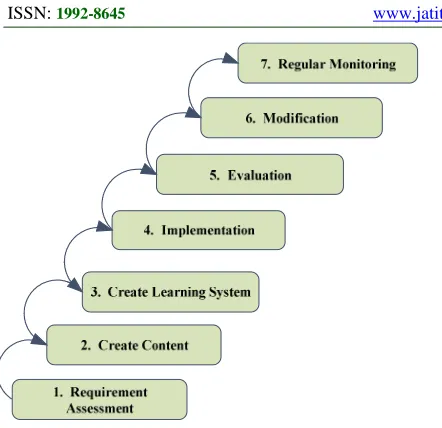
Figure 1: Steps To Build E-Learning Website
Three elements are assessed in step one. (1) Both the existing and future contents are assessed that are to be placed in the e-learning system. (2) The ability and skill of the learners are analyzed thoroughly. Based on the ability the design and content of the e-learning site are designed. (3) Finally, organizational requirements are assessed to determine the budget for development and delivery of the e-learning website. Once the assessments of the elements are finished it is desirable to create the content for websites. Content creation can be from either existing, or it can be created newly. The existing content should be given briefly and should not wander as well as it should be learner directed. Third step is the development of learning system, where all the contents are organized in a proper manner, and they are all ready to deliver the content via the website. Once the system is constructed, then they are implemented and launched for usage. Though it is successfully launched, it is monitored either periodically are randomly in order to obtain the feedback from users. Depending on the feedback, they are evaluated to find the performance of the implemented system. Results of the evaluations are helpful to carry out the modifications in the content as well as the design of the system, which is the sixth step in building the website for e-learning. Updated version of the system is implemented by replacing the old version (i.e. before modification) and monitored regularly to detect the user requirements and their satisfaction level. All the above steps are general steps to construct an e-learning web site.
In this paper, authors have evolved a framework, which is used to construct an e-learning website. Quality based construction and evaluation
of the website is the main goal of the proposed work. Many existing models focus on design of the website, whereas the framework presented in this paper mainly focus on the quality of the website. Various quality models and quality based feedback from multiple websites are taken as the source to build the framework. The websites that are created using this framework are evaluated to find the impact that it made on the user. Quality parameters such as usability, content, reliability, functionality, efficiency, etc. are used as metric to evaluate the constructed website. The evaluation results are used to carry out the modifications in the launched website. Once the modifications are taken successfully, then the updated version is launched.
Rest of this paper is structured as follows: In section 2, the works that are relevant to the proposed framework are examined. The design and construction of the framework, and the website building are discussed elaborately in section 3. Analysis of the constructed website and their results are presented in the section 5. Finally, in section 6 authors conclude the paper with some ideas to enhance the proposed work in the future.
2. RELATED WORKS
This section deals with the research works that were carried out earlier related to quality based website creation and their evaluation techniques.
A website for subject based learning was created in [11], which was intended to provide study and practical platform for the researchers. Designing subject based websites were different from other learning websites since learning and teaching styles were different. Authors of [11] and [3] used Browser/Server structure to link the website with the university network (WAN). In [11] they have developed the site by dividing it into five different modules namely (1) subject based modules, (2) collaborative learning, (3) learning online assessment, (4) Experts lecture and (5) E-learning module. Information management subject was given in web-based interactive teaching, practice and research in [3]. The website uses ASP technology, VBScript and JavaScript. Likewise, a mathematical website construction for school teachers is discussed in [4].
dynamic, was constructed for women in [10]. Where, the website contains lot of workshops that are useful for high school girls are presented. A bilingual demonstration course website was constructed in the article [15], which describes the construction of website, and improves the quality. Continues redesigns were required for public sector’s websites where there was low user satisfaction. An intelligent evolution model depending on the data mining tools was proposed in [5]. This technique improved the user satisfaction, mainly where there need continues redesign and complementing the current key web pages.
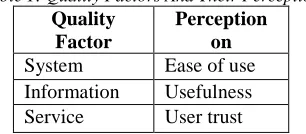
[image:3.612.120.273.583.650.2]For the past few years, scholars have concentrated on evaluation of website quality. Former benchmark assessments were focused on number of hits a website can handle within a given time. Some of the evaluation models and techniques were discussed in this section. Academicians of [2] have evaluated the quality of different Malaysian University websites using a hybrid model. The model is the combination of Linear Weighted Model (LWM) and Fuzzy Analytical Hierarchy Process (FAHP). They have calculated the page size, response time, load, broken link, accessibility errors, optimal score, etc, using the hybrid model proposed. The model proposed were better performed and also fairly guaranteed the performances on the criteria. This work has some limitations in terms of time factor and number of sample size used for evaluation. In [14] to evaluate the website, authors used neural network. Experimental results section of that paper showed that, neural network based technique have evaluated the website very quickly and accurately. Authors of [13] have analyzed the quality of e-commerce website based on the information systems success model and Technology Acceptance Model (TAM). They have found that three major quality factors of website have different effect on user satisfaction as shown in Table 1.
Table 1: Quality Factors And Their Perception
Quality Factor
Perception on
System Ease of use Information Usefulness Service User trust
Scholars of [7] have developed a theoretical acceptance model to evaluate an e-commerce website. This model comprises of ten parameters to evolve a framework for computing the e-commerce website. The ten parameters are listed as below: (1) website quality (2) ease of use (3) usefulness (4)
playfulness (5) trust (6) perceived risk (7) behavior control (8) subjective norms (9) attitude to use and (10) intension to use the website. These parameters were used to understand the relationship between the user and the customers of website e-commerce. Moreover, interrelationship among these attributes was also discussed. In [6] a series of online diagnostic toll was used to determine the various dimensions of Asian e-Government website’s quality. Here, authors used the criteria that were similar to the criteria suggested in the paper [2]. 5 different Asian countries e-government sites were used as sample for analyzing the quality. Results presented in [6] expressed that the analyzed website was neglecting the quality and performance criteria. Scholars of [8] carried a study on various attributes of quality that user percept on an information websites. It was confirmed by them, that satisfaction of a user with website was asymmetric and non-linear. Depending on the user activity, satisfaction of a user with the website navigation and information value changes considerably. In addition to those findings, authors also determined that the color scheme measurement was found to forecast successful task fulfillment. Authors of [1] have focused on measuring the website and the factors that found what should be tested in a website to ensure the quality. Following steps are taken to compute the website.
• Purpose of the website evaluation should be defined
• Exploitation of test scenarios
• Execute and compute the test plan defined in step 2
• Unremitting testing and measurement In order to assure the quality of website, some set of tests should be conducted either automatically or repeatable, which explains the properties and behaviors that were required for analysis. A study was carried out with an aim to motivate the quality of e-learning applications of a university in Malaysia [12]. Website Motivational Checklist was adopted in this study to access the quality of the website. The computation was carried out in four different dimensions namely (1) stimulating (2) organization (3) meaningful and (4) easy-to-use. Analysis of results suggested that the e-learning system needs improvement in terms of directions, engagement and usable.
3. PROPOSED WORK
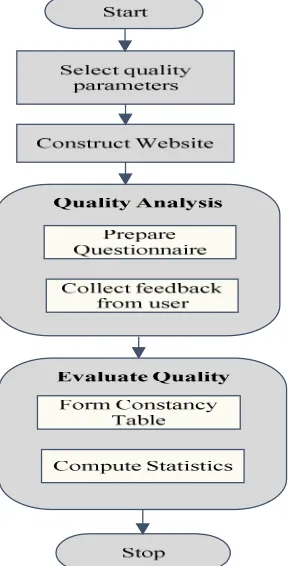
which satisfies the user’s requirement. Initially, the proposed framework selects the quality attributes, based on which the e-learning website is created. The constructed website is evaluated through the user feedback. The detailed process of proposed work is presented in the corresponding subsections. The overall flow of the work is depicted in the Figure 2.
3.1 Selection of Quality Parameters
The triumph of website can be determined through numerous factors. There exist various research work on website success, each one suggests different factors essential to construct a successful e-learning website. Content, technology and design are considered the most common factors for the success of websites.In order to build a new quality based website, authors carried out an extensive study on the quality factors for website and finalized five major influential quality factors namely:
1. Usability 2. Content 3. Reliability 4. Efficiency and 5. Functionality
These influential quality attributes are further subdivided into number of sub quality factors.
Figure 2: Overall Flow of Proposed Framework
3.1.1 Usability
[image:4.612.312.534.188.273.2]This factor is the collective effect of various design goals such as, easy to understand, remember, find, and learn. Usability factor is composed of efficiency, errors, learn-ability, satisfaction, memorability and utility. Moreover, usability has the sub characteristics as shown in the Figure 3
Figure 3: Sub Characteristics Of Usability
3.1.2 Content
[image:4.612.309.552.396.489.2]Content is referred as the king of the website. It denotes the quality of the information given in the website. The content provided in the website should be relevant, and appropriate to end users. This part acts as the most critical part in the design of the website. Figure 4, depicts the sub characteristics of content.
Figure 4: Sub characteristics of Content
3.1.3 Reliability
This factor typically focuses on the performance of the website. It mainly determines, whether the website is accessible for user or not up to the ability of the website to restore quickly on the occurrence of any kind of problem at any time. The sub characteristics of reliability can be depicted in the Figure 5.
[image:4.612.123.267.432.715.2] [image:4.612.337.498.612.695.2]3.1.4 Efficiency
[image:5.612.312.556.143.329.2]Throughput of a website is analyzed by the efficiency factor. In addition to time, it also specifies that the website must be technically proficient to support users. It also specifies the competence of the website to sustain numerous browsers. Sub characteristics of efficiency are presented in the Figure 6.
Figure 6: Sub Characteristics Of Efficiency
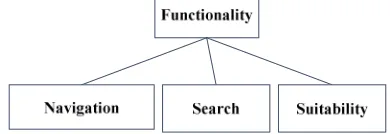
3.1.5 Functionality
[image:5.612.136.283.201.275.2]This factor denotes the task that is helpful to finish stated or implied needs. This factor also describes, whether the services presented in the website is suitable for the consumer or not. Interoperability and security are also included as the sub quality factor of functionality. List of sub quality factors of the functionality are represented in Figure 7.
Figure 7: Sub Characteristics Of Functionality
3.2 Construction of Website
Depending on the quality parameters selected, authors constructed an e-learning website. The website satisfies all the influential quality parameters and the sub factors efficiently. The constructed website’s home page is shown in the Figure 8.
3.2.1 Usability
In order to fulfill the usability factor the website is organized in easy way such that, the links, labels and terms presented in the website matches the user’s terms, which helps the users to easily and quickly operate the website. In order to assist novice users about working with the e-learning website, authors have also designed webpage that guides the user to handle the website in an efficient
way. The pages in the website are very attractive and have proper links among them. In addition to the above usability functions the website also supports multiple-languages.
Figure 8: Home Page Of Constructed E-Learning Website
3.2.2 Content
Authors mainly focus on this factor since it is the most important factor that decides the quality of the website. So they have presented the information that is highly related to the concept as well as they are highly accurate. The content provided in the website is also error free in terms of grammar and spelling. Further, the website contains most recent information, i.e. it displays the contents that are recently updated. References and citations are clearly mentioned by the authors in the website for all the referred information.
3.2.3 Reliability
[image:5.612.95.290.416.483.2]3.2.4 Efficiency
To efficiently handle the website, authors have concentrated on the time that it takes to load a page or to perform a task. For fast responses more than one server is used. They have designed the website in such a way that they can load and response a responder within short duration. So any request that comes to the website will be forwarded to the server that has fewer loads. Thereby, the response time is decreased. It is also technically capable to support different access of the website.
3.2.5 Functionality
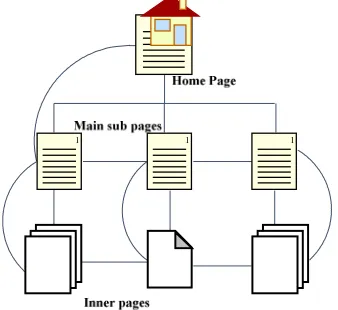
[image:6.612.91.260.387.542.2]A good navigation structure, searching technique, and appropriate functionalities are provided by the websites to their end user. The pages are arranged in the website in a way that they can be accessed simultaneously. To obtain such access, persistent connection is given among all the main level pages. By this navigation structure users can navigate from any page to any other page. The sample structure can be represented as shown in Figure 9. Thereby it satisfies the functionality quality.
Figure 9: Sample Navigation Structure
3.3 Gather Feedback from User
The website that is constructed should be tested to find the user satisfaction of the website. It is evaluated through feedback obtained from the user. To obtain the user feedback, authors prepared a questionnaire and added as a webpage in the e-learning website. The questionnaire is created to measure the websites. The questions in it are of three types namely (1) attitudinal: requests the user to response relating to belief or opinion (2) factual: requests the users of the website to response the questions concerning known facts (3) classification:
regards personal characteristics, which allow dividing data into categories.
The collected questions are neither consists of abstract term that may lead to response wrongly nor direct the user to one specific answer. Authors mainly focus on the interesting and appealing nature of questions, which implicitly increases the response rate. The responses for these questions are collected and they are stored for evaluation of website in the subsequent step. Questionnaire used to collect data that is given in appendix A. Figure 10, shows the screen shot for feedback collection.
3.4 Evaluate: Quality of Website
To evaluate the quality of the constructed website, authors initially frame a constancy table. From the table detailed accuracy is manipulated. These computations are discussed in the following subsection.
3.4.1 Frame constancy table
[image:6.612.311.537.508.689.2]The table is framed to count the frequency of each topic (i.e. each webpage) is accessed. This table is useful to gather the frequency of user visits. Cumulative percentage of the count is taken to perform further computations, which is calculated from the equation 1. The percentage is computed from the metric point and the number of visitors to a website. The metric values are the one, which are taken from the feedback of users. The response option and their corresponding metric values are listed in the Table 2. If a user chooses “neutral” then the metric value is assigned as 0.5. These values are stored for all the responders.
Table 2: Feedback Option And Their Associated Metric Points
Feedback option Metric
Points
Strongly Agree 1.00
Agree 0.75
Neutral 0.50
Disagree 0.25
Strongly Disagree 0
% ∗ (1)
In equation 1, MP denotes the metric point and Frequency expresses the number of users visited the site.
3.4.2 Compute statistics
The mean, variance and standard deviations are computed for each question in the questionnaire using the equation 2, 3, and 4 respectively.
∑
ೝೞ
(2)
Where X represents the rating of a single user and denotes the total number of responders. Variance is computed from the squared difference from mean.
∑ మ
ೝೞ
(3)
√ (4)
The standard deviation values for the questions that belong to the same factors are summed to determine the values for each influential quality parameter. Based on the value authors are able to determine, where the modifications are required to further enhance the quality of the website.
4. EXPERIMENTAL RESULTS
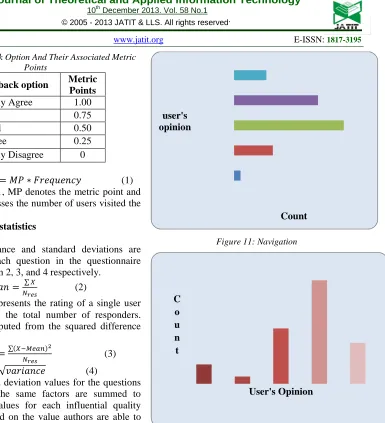
The website that is constructed in the previous section is evaluated and analyzed in this section. For experimental purpose authors randomly choose 90 user’s feedback and evaluated the website. Major focus is given to navigation, browser independence, uniqueness, and information clarity criterions. Figure 11; express the user’s satisfaction towards the navigation. This parameter is used to express how easy to access the website even to the users those who has no knowledge about browsing. It depicts, only 2 users among the 90 gives negative impact on navigating the website.
Figure 11: Navigation
Figure 12: Browser Independence
A website should support all type of browser. This attribute describes the portability of the website. This parameter analyzed through feedback obtained from the user related to the browser independence questions presented in the questionnaire (Refer appendix A). From Figure 12, explicitly shows that 90 out of 83 users agree that the website support all type of browsers. Therefore, the constructed website can be executed anywhere without considering the type of browser.
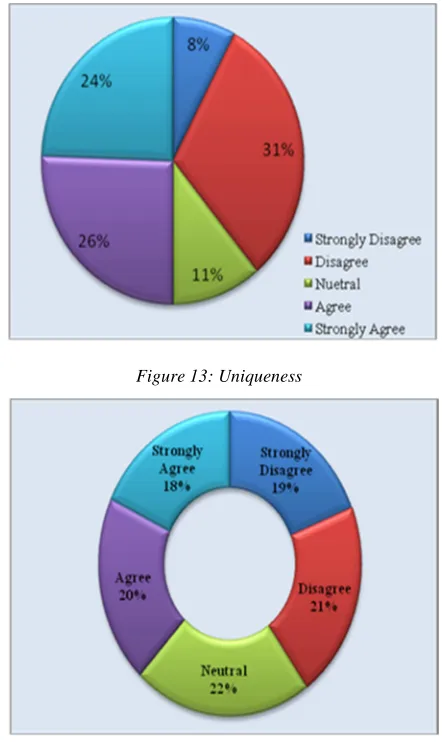
The content and the logos present in the website should be unique. The unique content plays a typical role in the website creation and user satisfaction. Similar to browser independence the uniqueness of the website is also determined through the user feedback. Figure 13, portrays that the 75% of the users have agreed that the content present in the website are unique. It also denotes that the information that is referred from other sources is also cited correctly.
Count user's
opinion
C o u n t
Apart from the uniqueness of the content it is important to concentrate on the clarity of the information presented in the website. The information presented should be relevant to the user concept and should satisfy them. If this parameter is failed to satisfy a user then it is highly impossible for the website to keep users.
[image:8.612.123.534.43.281.2]However, the constructed quality based website is analyzed through the user feedback on information clarity. The results are shown in the Figure 14. It clearly shows that 60% of the users agree that very clear information is provided in the constructed e-learning website. Analysis on the uniqueness and clarity implicitly refers that the content an influential quality parameter also up to the user fulfillment.
Figure 13: Uniqueness
Figure 14: Information Clarity
[image:8.612.86.307.299.670.2]In addition to the above parameter evaluation, an author also performs an overall rating analysis. The result of that analysis is expressed in the Figure 15.
Figure 15: Overall Rating
It also delineates that 90 out of 57 users rated the website positively. This expresses that the five influential quality parameters such as usability, content, reliability, functionality and efficiency are satisfied the user’s quality requirement. Only 33 users are not fulfilled with the website.
Figure 16: Comparison Of Influential Quality Parameter
The factors on which the users are not satisfied are found using the equation 4 and it is portrayed in Figure 16. It represents the user satisfaction towards the quality parameters. Those values are the summation of the values that are derived from the equation 4, for each group of influential quality parameter. It is evident from Figure 16 that, users are satisfied with the content factor. The constructed e-learning website requires more concentration on the reliability influential factor and accessibility, i.e. sub influential quality factor of efficiency. If the accessibility factor is improved,
Count User's
[image:8.612.303.536.391.562.2]then implicitly the efficiency factor will be enhanced. Therefore, the website that is constructed required to be modified from the aspect of efficiency and reliability.
5. CONCLUSION
A quality based e-learning website is construction in this paper through a framework. The framework initially analyzes the quality models and other quality based websites to select the influential quality factors. Usability, content, reliability, efficiency, functionality and their sub quality parameters are taken as influential quality factors. The elected factors are used to construct the quality based website. To analyze the effectiveness of the website feedback from the users are collected. This is accomplished through framing questionnaire in an efficient way. Responses to the questions in the questionnaire are collected as feedback from the user. These feedbacks are evaluated to determine the quality of the constructed website. The experimental results show that the constructed website has high quality in terms of content factor, whereas it requires more concentration on the efficiency and reliability factors.
The following idea can be implanted in future to enhance the proposed framework. The influential and sub quality factors that are selected by the framework are ordered on their essential definitions. Nevertheless, some of the sub quality parameters reflect inconsistent item score, i.e. they do not appraise an analogous concept to the remaining factors. To order the factors hierarchically in a reasonable way, authors use a factor analysis method. This method helps to obtain structured and well refined list of influential and sub quality factors.
REFRENCES:
[1] Aganwal R, Ghosh B, Banerjee S, and Kishore Pal S, “Ensuring Website quality: a case study,” in the proceedings of the IEEE International conference on Management of Innovation and Technology, vol. 2, pp. 664-670, 2000.
[2] Dominic P. D. D., and Jati H, “Evaluation method of Malaysian University website: Quality website using hybrid method,” in the proceedings of International Symposium in Information Technology, vol. 1, pp. 1-6, Jun 2010.
[3] Hu Changping, and Zhao Xueqin, “Construction of Web-Based Learning Platform for Information Management Subject - Case Study on "Information Service & User” Course
Website,” in the proceedings of International Conference on Computer Science and Software Engineering, vol. 8, pp. 760-763, 2008.
[4] Jack Carter, and Beverly J. Ferrucci, “Mathematical website constructions for prospective elementary school teachers,” in the proceedings of Open Conference on Communications and Networking in Education: Learning in a Networked Society, pp. 255 – 266, 1999.
[5] Jang Hee Lee, and Gye Hang Hong, “Intelligent website evolution of public sector based on data mining tools,” in the proceedings of the 5th international conference on Web Engineering, pp. 267-272, 2005.
[6] Jati H, and Dominic D. D., “Quality Evaluation of E-government Website Using Web Diagnostic Tools: Asian Case,” in the proceedings of the International Conference on Information Management and Engineering, pp. 85-89, Apr 2009.
[7] Junjun Li, “Theoretical Model of Consumer Acceptance: In the view of Website Quality,” in the proceedings of International conference on E-Business and Information System Security, pp. 1-4, May 2009.
[8] Kincl T, and Strach P, “Key concerns for website quality: Reflecting on user views,” in the proceedings of the international Conference on Information Sciences and Interaction Sciences, pp. 103-108, Jun 2010.
[9] Lei He, Xiaoyu Zhang, Liang Wang, and Li Xu, “The Construction of Topic-Based Learning Websites: From the Practice of Designing a Learning Website,” in the proceedings of International Conference on Computational and Information Sciences, pp. 771-774, 2010. [10]Mary Beth Rosson, Hansa Sinha, Tisha
Hansford, and Jan Mahar, “Offering Early Success Experiences in Software Construction: Experiences Teaching Dynamic Website Development to High School Girls,” in the proceedings of IEEE International Conference on Advanced Learning Technologies, pp. 485-460, 2010.
[11]Ping Li, Jianna Duan, Weinian Wang, and Ziying Zhou, “Subject-Based Learning of University courses Website Construction,” in the proceedings of International Conference on Industrial Control and Electronics Engineering, pp. 882-884, 2012
International Conference on User Science and Engineering, pp. 77-82, Dec 2012.
[13]Tao Zhou , and Shuren Zhang , “Examining the Effect of E-commerce Website Quality on User Satisfaction,” in the proceedings of second international Symposium on Electronic Commerce and Security, vol. 1, pp. 418-421, May 2009.
[14]Yanhua Sun, “An Assessment Method for College Library Web Site Based on Neural Network,” in the proceedings of the Second International Conference on Intelligent System Design and Engineering Application, pp. 773-775, 2012.