364
IMPROVING WIRELESS SENSOR NETWORK LIFESPAN
THROUGH ENERGY EFFICIENT ALGORITHMS
1M.KARPAGAM, 2DR.N.NAGARAJAN, 3K.VIJAIPRIYA
1Department of ECE, Assistant Professor, SKCET, Coimbatore, TamilNadu, India
2Principal, CIET, Coimbatore, TamilNadu, India
3Department of ECE, PG Scholar, SKCET, Coimbatore, TamilNadu, India
E-mail: [email protected], [email protected], [email protected]
ABSTRACT
One of the main challenges of wireless sensor network is maximization of the lifetime of the sensor node since the energy efficiency determines the lifetime of a sensor node, power consumption of the sensing device should be minimized. To conserve power, sensor node should shut off the power supply when not in use. In this paper, we present some energy efficient algorithms to enhance the network lifetime. By introducing sink mobility into wireless sensor networks, the network performance including lifetime, energy efficiency and end-to-end delay can be enhanced. Further, by increasing the number of sleep nodes using smack sets, the network performance can be greatly improved. The Energy-efficient Fixed-sink Clustering Algorithm (EFCA) and Energy-efficient Mobile-sink Clustering Algorithm (EMCA) have been simulated in the NS-2.32 surroundings.
Keywords: EFCA, EMCA, Residual Energy, Smack Set, WSN.
1. INTRODUCTION
A sensor network is composed of a large number of sensor nodes, which are densely deployed either inside the phenomenon or very close to it. The position of sensor nodes need not be engineered or pre-determined. This allows random deployment in inaccessible terrains or disaster relief operations. On the other hand, this also means that sensor network protocols and algorithms must possess self-organizing capabilities [1].
One of the most important constraints on sensor nodes is the low power consumption requirement. Many energy efficient routing algorithms and protocols have been proposed to prolong network lifetime for WSNs in recent years [2]. The sensor devices are usually powered by tiny and irreplaceable batteries which are difficult to recharge. Thus, the design of energy efficient network layer algorithms is very important to prolong the network lifetime.
The lifetime of the network is defined to be the time at which the first node runs out of energy [3]. There are two alternatives to increase the lifetime of the network. They are topology control and energy aware routing.
Intuitively, the following advantages can be achieved if the mobile sink nodes are well deployed and scheduled. First, the hot spot problem can be largely mitigated when the sink nodes move around. Second, energy balancing can be achieved among sensor nodes with prolonged network lifetime. Third, transmission latency can be reduced and throughput can be improved under multiple sink nodes environment. Finally, some isolated nodes or data under sparsely deployed networks can be periodically accessed by mobile sink nodes to improve network performance [5].
365
2. BASIC DEFINITIONS AND ASSUMPTIONS
The following assumptions regarding of the algorithm are made:
• Wireless links are bi-directional and
symmetric
• Sensors are uniform and fixed after
deployment
• Sink nodes are energy unconstraint
and they can move freely with a particular velocity
• Perfect MAC layer with no collisions
is supported
• Sensors can change their power
based on the relative distance
• The network is homogeneous
• The algorithm is set at time t
• The sinks and clusters are already
created
• The sink nodes are randomly
distributed in the network
2.1 The Proposed Methods:
In this section, the effect of static and mobile sink nodes on the network performance is studied. Two algorithms namely Energy-efficient Fixed-sink Clustering Algorithm (EFCA) and Energy-efficient Mobile-sink Clustering Algorithm (EMCA) are proposed. In these algorithms Cluster Head is selected using an approach called Smack set. In these algorithms, we use multiple sinks to prolong the network lifetime.
2.1.1 Energy-efficient Fixed-sink Clustering Algorithm (EFCA):
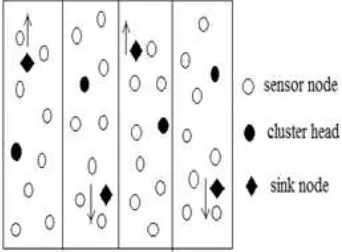
[image:2.612.329.519.75.236.2]When fixed sink nodes are deployed, the entire network is divided into several clusters, as depicted in Figure 1. Each cluster having one Cluster Head (CH) for data collection and the rest of the sensor nodes are ordinary nodes. The Cluster Heads are selected using Smack set. In EFCA, each CH selects a best sink to send data. This selection is based on the distance of the Cluster Head to the sink node. Sensor nodes whichever is closer to the sink node sends data directly to the sink node as the energy consumption for sending data to sink node is much less than the energy required to send it to the Cluster Head.
Figure 1: Multiple Fixed Sinks In EFCA
2.1.2 Energy-efficient Mobile-sink Clustering Algorithm (EMCA):
In EMCA, the sink nodes move with a particular velocity v. When mobile sink nodes are deployed, it broadcasts its current position and velocity to all sensor nodes using a broadcast message. Since all the sensor nodes and the CHs knows the velocity and initial positions of the sink nodes, the exact position of any sink node can easily be calculated at any point of time. The influence of sink moving velocity, position and number of sink nodes on network performance is studied [5]. The CH will be selected by using the Smack set approach. The total energy consumption decreases as the number of the sinks increases. It can be seen from Figure 2. Also, the multi-hop transmission can save energy inside each cluster.
Figure 2: Multiple Mobile Sinks In EMCA
2.1.3 Smack set:
In this paper an approach is presented for maximizing the lifetime of WSN through CH selection using smack sets. In this approach whichever node has lower residual energy level are put into sleep state and among the remaining
[image:2.612.338.509.474.600.2]366 connectivity with other nodes and higher residual energy is taken to be the cluster head.
2.1.4 Residual energy:
If any node Sj has larger residual energy
than Si, it becomes the new cluster head candidate
and broadcasts new message with its own information to the others. If Sj has equal residual
energy with Si, compare the ID. The node with a
smaller ID wins. If Sj has smaller residual energy
than Si, it still broadcasts the message of Si. In this
way, the node with the largest residual energy is chosen as the cluster head [5].
Since we assume that algorithm is operational at time t, the network nodes have
variable residual energies. The energy is
represented in three levels: high, medium, low. The nodes which have high and medium residual energy levels will form the topology at time t [4].
3. METHOD FOR SELECTION OF CLUSTER HEAD
Step 1: Consider the first sink and cluster assignment of sensor nodes in a network.
Step 2: Recognize the nodes based on the residual energy (high, medium) to form the current topology of the network.
Step 3: Recognize smacking set node
Step 4: Recognize the cluster head from each cluster.
4. DESCRIPTIVE MODEL
[image:3.612.319.518.72.274.2]In this paper we consider a wireless sensor network with four clusters C1, C2, C3, and C4 for both EFCA and EMCA respectively. In EMCA, Cluster 1 consists of 10 sensor nodes and 1 mobile sink node, cluster 2 consists of 20 sensor nodes and 1 mobile sink node, cluster 3 consists of 30 sensor nodes and 1 mobile sink node, and cluster 4 consists of 40 sensor nodes and 1 mobile sink node. The model is worked out for cluster 1 and the results are tabulated.
[image:3.612.337.528.296.459.2]Figure 3: Cluster 1 Step 1:
Table 1: Node Residual Energies In Cluster 1 Cluster
s
Sin k
Nod e ID
Residua l Energy
Resul t
C1 S1 1 Medium Yes
C1 S1 2 High Yes
C1 S1 3 Low No
C1 S1 4 Low No
C1 S1 5 Low No
C1 S1 6 Medium Yes
C1 S1 7 Medium Yes
C1 S1 8 Medium Yes
C1 S1 9 High Yes
C1 S1 10 High Yes
Step 2:
From the above table the following nodes are recognized to form the topology based on the residual energy of the nodes.
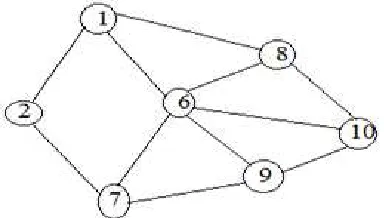
[image:3.612.325.517.528.637.2]367 Figure 5: Smack Set Nodes In The Given Cluster
Step 3:
Smack set for the above network SS = {2, 6, 8}
These nodes are the active nodes and the remaining nodes are sent to sleep mode.
Step 4:
[image:4.612.125.519.73.239.2]Recognizing cluster head
Table 2: Smack Set Nodes Along With Degree
Node ID Degree of the
node
2 2
6 5
8 3
Since sensor node 6 is having the highest degree, it is selected as cluster head.
Similarly the algorithm is applied for every cluster in the network and corresponding smack set; cluster head are identified and implemented in the energy efficient algorithms.
5. SIMULATION RESULTS
The two energy efficient clustering algorithms are compared with the most popular hierarchical routing algorithm like Low-Energy Adaptive Clustering Hierarchy (LEACH) in terms of energy utilization and network lifespan.
5.1 EFCA Performance Analysis
Figure 6 illustrates the total energy consumption in joule unit of EFCA under dissimilar scale networks. The entire network is separated into numerous clusters and the multiple fixed sink nodes are arbitrarily deployed in the network. From the graph we can infer that total energy consumption unit’s decreases as the number of sink increases.
Figure 6: Total Energy Consumption In EFCA
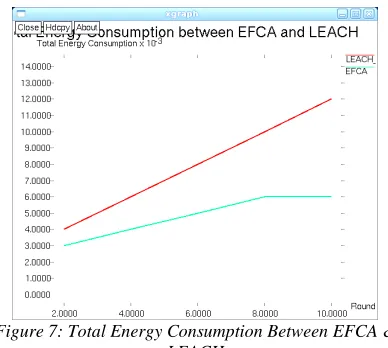
[image:4.612.93.278.320.415.2]The total energy consumption of EFCA and LEACH in joule unit is also considered, as depicted in Figure 7. In 10 rounds, EFCA shows much improved performance with less energy utilization than LEACH.
Figure 7: Total Energy Consumption Between EFCA & LEACH
5.2 EMCA Performance Analysis
Figure 8 illustrates the total energy consumption in joule unit of EMCA under dissimilar scale networks. The whole network is divided into several clusters and the multiple mobile sink nodes are arbitrarily deployed in the network.
[image:4.612.320.514.329.503.2]368 Figure 8: Total Energy Consumption In EMCA
Figure 9: Total Energy Consumption Between EMCA & LEACH
6. CONCLUSION
The aim of improving the lifetime of the wireless sensor network is achieved by using multiple mobile sink nodes and switching the nodes with low residual energy to sleep state. In this paper energy efficient clustering algorithms are discussed. When the sink nodes move around, the hot spot problem can be largely decreased. A set of sleeping nodes are recognized based on the residual energy level using smack set. The selection of cluster head is observed from the above example. Maximum throughput and network lifetime is achieved under multiple sink node surroundings.
REFERENCES
[1] I. Akyildiz, W. Su, Y.
Sankarasubramaniam, E. Cayirci,
“Wireless sensor networks: a survey,” Journal of Computer Networks, vol. 38, no. 4, March 2002, pp. 393-442.
[2] K. Akkaya, M. Younis, “A survey on
routing protocols in wireless sensor networks,” Elsevier Ad Hoc Network Journal, vol. 3, no. 3, May 2005, pp. 325-349.
[3] Ye Tian, Min Sheng, JiandongLi, Yan
Zhang, Junliang Yao and Di Tang,
“Energy aware Dynamic Topology
Control Algorithm for wireless Ad Hoc Networks,” IEEE 2008.
[4] B. Jayalakshmi, M. Neelima, “Maximizing
wireless sensor network lifetime through cluster head selection using hit sets,” IJCSI International Journal of Computer Science Issues, vol. 9, issue 2, no. 3, March 2012, pp. 328-331.
[5] Jin Wang, Yue Yin, Jianwei Zhang,
Sungyoung Lee, R. Simon Sherratt, “Mobility based energy efficient and multi-sink algorithms for consumer home
networks,” IEEE Transactions on