ISSN: 1992-8645 www.jatit.org E-ISSN: 1817-3195
RESEARCH OF MULTI-ATTRIBUTE TRADE OFF
OPTIMIZATION ON CRITICAL CHAIN MULTI-PROJECT
SCHEDULING
1 WANG WEIXIN *, 1 WANG XU , 2 GE XIANLONG ,3LIN YA ,1 CHEN YANG , 1 GAO JIA 1 College of Mechanical Engineering, Chongqing University,Chongqing 400030,China;
2 School of Management, Chongqing Jiaotong University, Chongqing 400074,China
3 Deptment of Information Engineering, Chongqing Communication Institute, 400035, China
E-mail: [email protected]
ABSTRACT
For the multi-attribute tradeoff optimization of critical chain multi-project scheduling (CCMPS),
multi-attribute utility function was adopted to conduct comprehensive optimization of time, cost, quality,
robustness and the optimization model was established. Using randomness and stability of Normal Cloud
Model, cloud genetic algorithm was designed to generate priority of multi-project scheduling activities and
obtain dispatching plan finally. Effectiveness of the model and algorithm were verified by a case study.
Keyword : Critical Chain ; Multi-Project Scheduling ; Time-Cost-Quality- Robustness ; Cloud Genetic
Algorithms
1. INTRODUCTION
Rabbania[1] put forward a schedule method for
resource-constrained random network project;
Bevilacqua. etc[2] illustrated that CCM can shorten
the duration of the project and reduce operating
costs in maximum through application instances.
Peng[3] argued that the earlier the project begins, the
lower risk of time delay is and presented improved
ways of CCM. Wuliang Peng. Etc[4] analyzed
resource constraints, multi-mode activities,
uncertain activity duration and built up the model
of multi-mode critical chain project scheduling.
Jingwen Zhang. etc[5] used resource consumption to
calculate activity cost, established schedule models
for two categories of resource-constrained time-cost
tradeoff project based on discrete time-cost tradeoff
project scheduling and designed its two-stage
hybrid optimizing algorithm. Qiong Liu. etc[6],
proposed to build scheduling optimization model of
critical chain multi-project aiming at the
maximization of robustness and minimum of
duration. Ali Salmasnia. etc[7] introduced quality
parameters into the traditional time-cost tradeoff
project scheduling problem. Based on analysis of
research status on CCMPS problem, scholars of
domestic and overseas have been tried to innovate
theoretical model and solving algorithm to find out
more optimal project scheduling scheme of
CCM.Babak Abbasi[8] designed a multiple objective
model for project scheduling, which aims at the
minimum of duration and maximization of
There are mainly three types of existing research:
the first is single objective optimization, that is to
choose one attribute from time, cost and quality as
objective function to build mathematical models;
secondly, the three attributes are considered
simultaneously in constructing multi-objective
optimization models, which will be transformed
into single-objective optimization and solved; third,
the robustness of solution in critical chain project
scheduling and quality robustness are studied. In
practical, time, cost and quality are three major
concerns for operators, and the robustness of
multi-project scheduling is the key to success of
multi-project operation mode. Therefore, the
time-cost-quality-robustness tradeoff optimization
of CCMPS will have considerable realistic
significance.
2. PROBLEM DESCRIPTION
Suppose there are N projects in CCMPS, which are executed parallel without predecessor or successor relationship among them. Project
i
hasi
J
activities. Activitys
0 ande
0 are the virtual beginning and virtual ending, which represents the start and end of multi-project without occupying resources. The kinds of renewable and non-renewable resources arek
andp
separately,similarly,
S
ij andE
ij mean starting and endingtime of the project.
A
ijrepresents the activityj
inproject
i
;t
ijrepresents the planned project duration;ij
P
andU
ijare sets of predecessor and successoractivities of
A
ij ;r
ijk is demand quantity ofresource
k
in activityA
ij;R (
kk
=
1, 2,
L
p
)
isavailable quantity of
k
-th kind of renewableresource;
R
p(
p
=
1, 2,
L
p
)
is total quantity ofp
-th kind of non-renewable resource;r
ijk stands for the quantity of renewable resource demanded by activityj
of projecti
in unit duration;ijp
nr
means the gross quantity of non-renewableresource demanded by activity
j
of projecti
;q
ijisthe quality index when activity
j
of projecti
is carried out.Assume
T
,C
,Q
,L
represents time, cost, quality and robustness to do tradeoff optimization of CCMPS, which can be decomposed into weighted polynomial as follows according to decomposition theorem of multi-attribute utility function.( , , , ) ( ) ( ) ( ) ( )
, , , 0
1
T C Q L
T C Q L T C Q L
u T C Q L α u T α u C α u Q α u L
α α α α α α α α
= • + • + • + • ≥ + + + =
(1)
( )
u T
,u C
( )
,u Q
( )
,u L
( )
represent the utility function of time, cost, quality, robustnessseverally, whose weight coefficient is
α
T,α
C,Q
α
,α
Land the optimization objective is to obtain the maximum. Quadratic function form of utility function can be employed as the solution space and utility functions are all concave. Assume the utility value of total project durationD
is 1, then( )
(
)
2,[
[
0, 20, 2]
]
, 0
T T T D T D
u T
T D
ϕ β ∈
− −
=
∉
(2) The total cost of multi-project management
consists of the cost of renewable and non-renewable resources and when its utility value is 1, then
( )
(
( ))
(( ))2
0, 2 1
1 ,
, 0, 2 1
0
C C C U C U
u C
C U
η
ϕ β η
η ∈ − • − − − • = ∉ − •
(3)
If utility value of quality attribute is 1, then
( )
(
1)
2,( )
( )
0,1, 0,1
0
Q Q Q Q
u Q Q
ϕ
β
− − ∈ = ∉ (4)
When utility value of robustness equals 1, then
( )
(
1)
2,( )
( )
0,10,1 , 0
L L L L
u L L ϕ β − − ∈ = ∉
(5)
3 . ESTABLISH THE MODEL OF CCMPS
3.1 Analysis Multi-Attribute Tradeoff Optimization Objective Of Ccmps.
The process of scheduling and controlling in
critical chain multi-project management are very
complicated and total duration is always the focus
ISSN: 1992-8645 www.jatit.org E-ISSN: 1817-3195 objective pursued in critical chain multi-project
management is the minimum of time, that is:
0
min
T
=
E
e+
PB
(6) The total cost of multi-project managementconsists of the cost of renewable and
non-renewable resources. Setting
c
p equals theunit price of
p
-th kind of non-renewable resourcein unit duration and
c
kequals the unit price ofk
-th kind of renewable resource in unit duration, then the objective function of project cost in criticalchain multi-project management is:
1 1 1 1
min
N J K P
ijk k ij ijp p
i j k p
C r c t nr c
= = = =
= +
∑ ∑ ∑
∑
(7)The quality attribute of project needs to be
quantified for the purpose of doing systemic and
deep research on CCMPS. Here, intermediate
variable is introduced into each activity for
representing earned quality value(
EQV
ij), whose computational formula is:ij ij ij
EQV
=
EV
×
q
(8)ij
EV
is the earned value of activityj
in projecti
,ij
q
is the quality index of activityj
when executedin project
i
, which measures the actual quality level of activities and can be calculated by:ij
q
=actual quality level of activityj
/ prescribedquality level of activity
j
×
100% (9)Therefore, the total quality level of multi-project
scheduling can be expressed by weighted average
of quality level in all activities, which is:
1 1
1 1
1
max
N J ij N J
i j ij i j
Q
EQV
EV
= == =
=
×
∑ ∑
∑∑
1 1
1 1
1
N Jij ij N J
i j ij i j
EV
q
EV
= == =
=
×
∑∑
×
∑ ∑
(10)
Quantization of robustness is the key in
robustness research of CCMPS, however, there
isn’t mature study on this issue: maximizing
minimum activity slack time can only increase the
random time of activities in CCMPS rather than
ensuring its abundance. For this reason, robustness
will be quantified with the average value of slack
time and minimum slack time of activities in this
model and its calculation method is given:
min
(
) /
ij ij
A A
L
=
s
+
∑ ∑
s
ξ
(11)(
)
min
ij ijA U ij
s
=
S
−
E
(12)In the formula above, ij A
s
is the free slack timeof activity
A
ij, ij US
is the starting time ofij
A ’s
successor activity,
ξ
is the number of activitieson non-critical chain. When free slack time of
activities on critical chain equals zero (robustness
of critical chain reaches the maximum), the free
slack time of activities on non-critical chain will be
maximized (flexible time of all activities on
non-critical chain will be enough) which will
improve stability of starting time for successor
activity and then increase global robustness.
In order to guarantee the rate of completion on
time and increase robustness of project quality,
proper project buffer determined by the expectation
probability of completion on time should be setting
up in CCMPS according to self-adaptation which
( )
(
)
(
)
1 1
/
N J
ijk ij k
i j
RUF k
r
t
T
R
= =
=
∑ ∑
×
×
1, 2, ,
k
=
k
(13)T
represents the length of critical chain and non-critical chain separately when calculating theproject buffer and the time. The smaller value
between buffer size and free float of the last activity
on non-critical chain should be given to the buffer,
in that way, the change of the critical chain because
of oversized buffer can be avoided effectively.
3.2 Build The Tradeoff Optimization Model
On the basis of considering time, cost, quality
and global robustness which are mostly concerned
by organizers and contractors, multi-attribute utility
function was adopted to conduct comprehensive
optimization of time, cost, quality, robustness, and
the optimization model was established as follows:
max ( , , , )
u T C Q L
(14). .
s t
E
ij−
E
i j( )−1≥
t
ij (15)( )
{
}
1 1
(1 max )
N J
ij i j
PB RUF k VAR
= =
= + ×
∑ ∑
(16)1 1
N J
ijk k i j
r
R
= =
≤
∑ ∑
(17){
,
}
ij pq nm nm pq nm pq
A
∈
P
∪
A
E
=
S
k
=
k
,
;
ij pq
A
∈
NCC A
∈
CC
(18) In the model above:ij
VAR is the variance of activity duration;
pq
A
represents the activities on critical chain;NCC
is the set of activities on non-critical chain;CC
is the set of activities on critical chain;be executed until the completion of current
activity and activity can’t be stopped once it started
for the sake of continuity; formula (16) represents
that project buffer value will be setup with
self-adaptation; formula (17) expresses that
resource consumption in one activity can’t exceed
its total amount; formula (18) shows the position to
insert the buffer, namely, a feeding buffer
PB
willbe inserted between one activity and critical chain
when the activity is resource-constrained but
doesn’t belong to critical chain or it is a successor
activity.
nm
k
stands for the kinds of resources needed byactivity
A
nm;Formula (14) (The objective function) means to
maximize total utility of multi-attribute tradeoff
optimization in CCMPS; formula (15) reflects the
predecessor and successor relationship among the
project, which demands that successor activity can’t
4. DESIGN CLOUD GENETIC ALGORITHM
Cloud Genetic Algorithm (CGA) introduces
cloud model theory into traditional genetic
algorithm and the randomness and stable tendency
of a normal cloud model are adopted to design the
probabilities of crossover and mutation,
Pc
andPm
. GreaterPc
andPm
were set up in the initial stage for the purpose of generating superiorindividuals quickly, while in the later stage,
smaller
Pc
andPm
were set up along withcrossover operator of maximum retention
mechanism to protect superior genes from damage .
The reason for doing above operations is to
improve global optimization ability. Adaptive
operator is imported via cloud generator together
with excellent characteristics of genetic algorithm
which can avoid premature convergence to promote
the adaptive adjustment of control parameters of
Normal Cloud Model while population fitness
changes, in this way, accuracy in searching
precision and searching coverage can be improved.
ISSN: 1992-8645 www.jatit.org E-ISSN: 1817-3195
probability
Pm
of CGA can make dynamicadjustment accord to fitness and Show a linear
change with their self-fitness. The individual with
higher fitness has lower probability of crossover
and mutation, conversely, the lower fitness leads to
higher probability.
The formula for adaptive generation of
Pc
andPm
is as follows:Generating algorithm of
P
c:
Ex
=
f
,f
is the average of population;(
max)
1:
En
=
f
−
f
C
,C
1 is controlcoefficient;
2
:
nHe
=
E C
;C
2 is control coefficient;( )
:
Enn
=
Rand En
∗
He
+
En
;(
)
( )
2 '
2
2 '
1
' 3
,
:
f Ex Enn
c
k e
f
f
P
k
f
f
− −
≥
=
<
,
f
'is the biggerfitness relatively in crossover operation.
Generating algorithm of
P
m:
Ex
=
f
,f
is variation individual;(
max)
3:
En
=
f
−
f
C
,C
3 is controlcoefficient;
4
:
He
=
En C
,C
4 is control coefficient;( )
:
*
Enn
=
Rand En
He
+
En
;( ) ( )
2 2
2 2
4
:
f Ex Enn
m
k e
f
f
P
k
f
f
− −
≥
=
<
1
,
,
4k
L
k
are constants within[ ]
0,1
,let
k
1= =
k
31,
k
2=
k
4=
0.5
. It can be seen thatthe higher initial value of
P
candP
m will decreasealong with the population evolutionary.
There are three important control parameters in
cloud model: Entropy
En
, reflecting the steepnessof cloud model, Expectation
Ex
, indicating thehorizontal position of cloud model and Hyper
Entropy
He
, standing for the dispersion andfluctuation of cloud droplet. Stability of cloud
model will drop if
He
is too high while randomnesswill descend when
He
is too low. The introductionof adaptive operator can effectively control the
self-adaptation of parameters, adjust the
convergence rate at the average value
f
avg ofpopulation fitness and improve search capability of
individuals with low fitness on the premise of
maintaining the stable tendency of superior
individuals for generating a larger solution space.
Individuals will adapt to environment in accordance
with distribution of population fitness when
adaptive CGA is adopted to solve multi-attribute
tradeoff optimization in CCMPS, which could
improve the robustness of algorithm significantly.
Control parameter of algorithm could adjust
population fitness dynamically, urge the individuals
around the average of self-fitness to drive
evolutionary optimization of entirety and avoid
getting into local optimality effectively. The
(1) Code design: Chromosome structure with
multi-group code is selected in this article and each
chromosome corresponds to a list of priority.
Natural coding indicates the priority of mission
which is a natural number within [1,
m
] and ahigher value means a greater priority.
(2) Initial population: Full permutation
W t
u( )
of priority is generated randomly and the priority of
each mission settled by chromosome is important
basis of generating critical chain. The ultimate
critical chain can be determined through the steps
mentioned above, then calculate project buffer and
the embedded buffer and confirm the insert
position.
(3) Fitness function: Fitness function is the
foundation to evaluate merits or defects of
chromosome and let fitness
function
fit t
( )
=
1/
u t
( )
.u t
( )
is the desiredvalue of individual, so the one, whose fitness is
lower, is more superior.
(4) Selecting operator: Firstly, roulette-wheel
selected operator is designed and relative fitness of
individuals in species is calculated and ranked.
Secondly, divide bets area into sectors according to
fitness, which, in other words, will give outstanding
chromosomes more chance to be passed into next
generation.
(5) Crossover operator: Produced crossover
probability
Pc
of population through X -generatorof cloud model, calculate the certainty
degree
u
,Ex
,En
andHe
, generate a pair ofindividuals by X -conditional cloud generator, employ double-crossing point operation and then
chose one crossing point of gene to put the selected
gene code at the first place of progeny
chromosomes, delete the same gene code in
paternal chromosome and copy other gene codes
into progeny in order, adjust position of crossing
point when some progeny chromosomes contrary to
restraints is generated.
(6) Mutation operator: Produce mutation
probability
Pm
of population viaX
-generator ofcloud model, give the original individual to
Ex
andcalculate
En
andHe
, create a new individual withcloud generator and update it when the random number, within (0, 1),meets
temp
>
u
.(7) Repeat (2)-(6) and stop the process
when
Maxgen
=
50
or terminal condition is met,then output results.
5. EXPERIMENT AND SIMULATION
Take the multi-project scheduling problem
consisted of three parallel projects as an example to
test and simulate tradeoff optimization model and
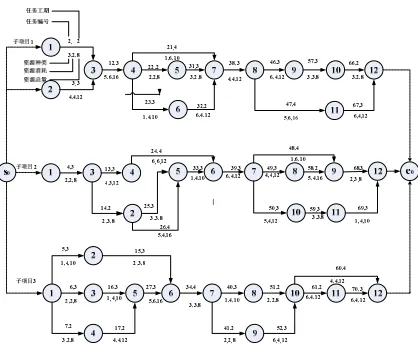
its solving algorithm above. As shown in fig.1,
there are 32 activities(including virtual starting and
ending activity), 6 kinds of resources(4 of them are
renewable and the other 2 are non-renewable) and
the usage amount, total amount of resources and
project duration has already been marked in fig.2,
the rate of indirect cost
c
=
4
,the single price of the 6 resources are:1 2 3 4
3
p p p p
c
=
c
=
c
=
c
=
,c
k1=
c
k2=
2
.The utility function of time
T
,costC
, qualityQ
and robustnessL
areu T
( )
,u C
( )
,( )
u Q
andu L
( )
, and specific value of parameters can be get according to respective upperand lower limits:
ϕ
T=
1
, 21
19
Tβ
=
,ϕ
C=
1
,2
1
1100
Cβ
=
,ϕ
Q=
1
,β
Q=
1
,ϕ
L=
1
β
L=
1
. Setting weight to each parameter with frequently-used expert evaluation method or the actual need in enterprises and the weight coefficientISSN: 1992-8645 www.jatit.org E-ISSN: 1817-3195 Multi-attribute utility function of CCMPS can be
simplified as the following based on the analysis above:
(
)
(
)
2(
)
2(
(
)
2)
(
( )
2)
2 2
1
1
, , ,
1
19
1
1100
1
1
1
1
19
1100
T C Q L
u T C Q L
=
α
−
T
−
+
α
−
C
−
+
α
− −
Q
+
α
− −
L
[image:7.612.87.509.95.659.2]
Figure 1. Gantt Chart Of Multi-Project Scheduling
[image:7.612.207.416.437.609.2]Realize CGA by using Mpple12.0 to solve the built model. Assume the population size
50
Popsize
=
and let evolution algebra50
Maxgen
=
in order to ensure the diversity of population, then the maximum utility value of project 2 on critical chain is :(
, , ,
)
0.893
u T C Q L
=
,T
=
32
,C
=
1632
,0.911
Q
=
,L
=
0.884
.Seen from fig.1 that the result of the
optimization model, with four attributes of time,
cost, quality and robustness, can help managers
and operators control and supervise the process of
multi-project scheduling effectively. More energy
should be given to activities on critical chain
according to the experimental result and operators
can change decisions based on different emphasis
points to achieve maximum global utility.
6. CONCLUSION
Tradeoff relationship among attributes in
CCMPS was considered in this model and utility
function was employed to realize optimization.
The randomness and stable tendency of a normal
cloud model are adopted to design the probabilities
of crossover and mutation which was given a
greater value in the initial stage for the purpose of
generating superior individuals quickly, while in
the later stage a smaller value were set up along
with crossover operator of maximum retention
mechanism to protect superior genes from damage.
In the last, effectiveness of the model and
algorithm were verified by a case study.
ACKNOWLEDGEMENT::::
Project No. CDJZR12118801 and CDJZR1211000
8 supported by the Fundamental Research Funds f
or the Central Universities, China.
Project No.11BGL006 supported by the National
Social Science Foundation, China.
Project No.10YJC630039 supported by Humanity
and Social Science Youth foundation of Ministry
of Education,China.
Project NO.CSCT2010AA2044 supported by The
Chongqing City Key Science Program,China.
REFERENCES:
[1] Rabbani M., Ghomi S.M.T.F., Jolai F., Lahiji
N.S.,”A new heuristic for resource-constrained
project scheduling in stochastic networks using
critical chain concept”. European Journal of
operational Research, 2007, Vol. 176, No. 2,
pp.794-808.
[2] Bevilacqua M., Ciarapica F.E., Giacchetta G..
“Critical chain and risk analysis applied to
high-risk industry maintenance : a case study “ ,
International Journal of Project Management ,
2009 , Vol. 27, No. 4, pp. 419-432.
[3] Peng W.L., Xu H.. “The scheduling problem of
active critical chain method “, Information
Technology Journal,2012, Vol. 11,No. 7, pp.
829-839.
[4] Peng W.L., Jin M.L., Ji G.t., “Multi-mode
critical chain project scheduling problem with
heuristic approach”, Computer Integrated
Manufacturing Systems, 2012, Vol. 18, No. 1,
pp. 93-101.
[5] Zhang J.W., Shen H.F., “Two categories of
resource-constrained time/cost trade-off project
scheduling problem and its two-stage hybrid
optimizing algorithm”, “Computer Integrated
Manufacturing Systems”, 2011,Vol. 17,No. 9,
pp. 2035-2042.
[6] Liu Q., Lin K., Zhang C.Y., Zhu
H.P., ”Multi-project robust scheduling based
on critical chain”, Computer Integrated
Manufacturing Systems, 2012, Vol. 18, No. 4,
ISSN: 1992-8645 www.jatit.org E-ISSN: 1817-3195 [7] Mokhtari H., Salmasnia A., Bastan M., “three
dimensional time , cost and quality trade off
optimization in project decision making”,
Advanced Material Research, 2011, pp.433-440, pp.
5746-5752.
[8] Abbasi B., Shadrokh S., Arkat J., “Bi-objective
resource-constrained project scheduling with
robustness and make span criteria”, Applied
Mathematics and Computation , 2006, Vol. 180, No. 1,
pp. 146-152.
[9] Ma L.,Guan Z.L., He M.,et al, ”Research on
the adaptive buffer sizing method based on the
critical chain theory”, Journal of Huazhong
University of Science and Technology: Natural Science Edition, 2008, Vol. 36, No. 11, pp.