M A R C H 1 9 9 5
WRL
Technical Note TN-46
Experience with a
Wireless
World Wide Web Client
The Western Research Laboratory (WRL) is a computer systems research group that was founded by Digital Equipment Corporation in 1982. Our focus is computer science research relevant to the design and application of high performance scientific computers. We test our ideas by designing, building, and using real systems. The systems we build are research prototypes; they are not intended to become products.
There are two other research laboratories located in Palo Alto, the Network Systems Lab (NSL) and the Systems Research Center (SRC). Another Digital research group is located in Cambridge, Massachusetts (CRL).
Our research is directed towards mainstream high-performance computer systems. Our prototypes are intended to foreshadow the future computing environments used by many Digital customers. The long-term goal of WRL is to aid and accelerate the development of high-performance uni- and multi-processors. The research projects within WRL will address various aspects of high-performance computing.
We believe that significant advances in computer systems do not come from any single technological advance. Technologies, both hardware and software, do not all advance at the same pace. System design is the art of composing systems which use each level of technology in an appropriate balance. A major advance in overall system performance will require reexamination of all aspects of the system.
We do work in the design, fabrication and packaging of hardware; language processing and scaling issues in system software design; and the exploration of new applications areas that are opening up with the advent of higher performance systems. Researchers at WRL cooperate closely and move freely among the various levels of system design. This allows us to explore a wide range of tradeoffs to meet system goals.
We publish the results of our work in a variety of journals, conferences, research reports, and technical notes. This document is a technical note. We use this form for rapid distribution of technical material. Usually this represents research in progress. Research reports are normally accounts of completed research and may include material from earlier technical notes.
Research reports and technical notes may be ordered from us. You may mail your order to:
Technical Report Distribution
DEC Western Research Laboratory, WRL-2 250 University Avenue
Palo Alto, California 94301 USA
Reports and technical notes may also be ordered by electronic mail. Use one of the fol-lowing addresses:
Digital E-net: JOVE::WRL-TECHREPORTS
Internet: [email protected] UUCP: decpa!wrl-techreports
To obtain more details on ordering by electronic mail, send a message to one of these addresses with the word ‘‘help’’ in the Subject line; you will receive detailed instruc-tions.
Experience with a Wireless
World Wide Web Client
Joel F. Bartlett
March, 1995
Abstract
In order to separate promises from practice in PDAs and wireless com-munications, we decided to try to build a wireless PDA-based client to access the World Wide Web. Using equipment available in the winter of 1994, we were able to build a client that we call W4, the Wireless World Wide Web. In this paper we describe our initial design choices, implementation, experience with the device, and close with some thoughts about next steps in this area.
This is a preprint of a paper that will be
presented at IEEE Spring COMPCON95, San Francisco,
California, March 5-9, 1995.
Table of Contents
1. Introduction 1
2. Choosing an application 1
3. Choosing a PDA 1
4. Choosing wireless communications 1
5. Application architecture 3
6. Experience with W4 3
7. Reflections on W4 5
7.1. Less power 5
7.2. Fewer pieces 5
7.3. Improved Wireless Communications 5
7.4. Improved processor performance 6
8. Other approaches 6
9. Conclusion 6
1. Introduction
A number of people have seen personal digital assistants, PDAs, with wireless communication as the "next big thing" in the computer industry. At the same time, there has been a lot of uncertainty of how PDAs and their applications will evolve. Today’s PDAs, with their limited computational power, storage, wireless communication bandwidth, and display size, offer a chal-lenge: can you build anything, and if so, would anyone want to use it? Rather than adding to the speculation about the future of PDAs, we decided to put our mobile computing dreams in perspective by building a wireless interactive application using equipment readily available in the winter of 1994. This paper reports our results.
Sections 2 through 5 provide a roughly chronological record of the design and implementation of W4, a "proof of concept" for a Wireless World Wide Web client. Section 6 reports our ex-perience with the device and sections 7 through 9 conclude with some observations about future developments in this area.
2. Choosing an application
A wireless client for the World Wide Web [2] was chosen as the sample application. A num-ber factors encouraged this choice:
•The client/server interface is well documented and significant amounts of code are publicly available.
•Existing clients like Mosaic [4] have established a de facto user interface.
•A large number of service providers are converging on the Web.
•A significant number of people inside and outside of Digital are interested in the Web.
3. Choosing a PDA
The Apple Newton MessagePad was an easy choice as it had generated a lot of interest and most important, the developers toolkit was available. After some experiments using and pro-gramming the Newton, attention turned to wireless communications.
4. Choosing wireless communications
From the beginning, we were not interested in wireless local area communications. We wanted the focus to be on the PDA and not on the installation and management of the network. If we got something built, we wanted to take it on the road. Much of the "look and feel" of mobile computing is lost if you can’t bring the demo to the customer.
EXPERIENCE WITH A WIRELESS WORLD WIDE WEB CLIENT MARCH 1995
ARDIS was attractive because it had good in-building service, was available nationwide, and charged on a per packet basis. Unfortunately, the service available in our area was oriented toward two-way paging and had neither the data rate nor the network latency required for an interactive application.
Attention then turned to analog cellular telephones. While little information about data com-munications was available from the cellular vendors, we constructed a system consisting of three parts: a Newton, a Motorola CELLect modem, and a Motorola MicroTAC cellular telephone. With an initial communications choice in hand, focus turned to the application architecture.
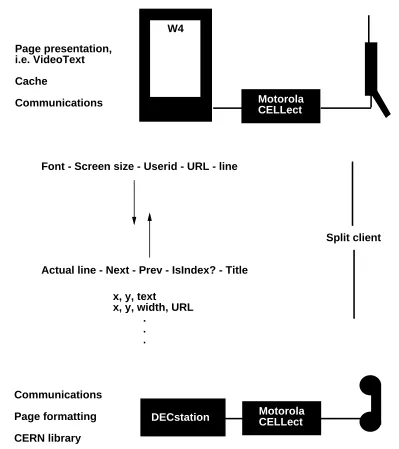
W4
Motorola CELLect
Motorola CELLect DECstation
Page presentation, i.e. VideoText Cache
Communications
Communications Page formatting CERN library
Split client Font - Screen size - Userid - URL - line
Actual line - Next - Prev - IsIndex? - Title
x, y, text
x, y, width, URL .
[image:6.612.82.481.237.686.2]. .
Figure 1: W4 block diagram showing split-client architecture
EXPERIENCE WITH A WIRELESS WORLD WIDE WEB CLIENT MARCH 1995
5. Application architecture
Early experiments suggested that the PDA should do as little as possible and that wireless bandwidth be conserved. This resulted in the client being split between the PDA and an ULTRIX workstation, with the bulk of the application residing in the workstation.
The PDA acts as a video-text client, displaying screens representing a portion of a hypertext document. Each screen is identified with a tag that contains the document’s Universal Resource Location (URL) and an offset within the document. In the simplest PDA-based client, when a hypertext link or scroll arrow is tapped by the user, the tag associated with the interactor is sent in a request to the workstation. The workstation obtains the document from the Web, parses it (caching the result for later requests), formats the desired screen for the PDA, and then replys to the PDA’s request.
The reply is a screen description composed of simple screen drawing commands that were designed for efficient decoding in the PDA. Each line of text is specified by its x,y coordinates and a text string. Each hypertext link is represented by its x,y coordinates, the link width, and the tag. New commands for handling images, line drawings, and forms could be easily added to the protocol.
In order to improve performance and allow operation without communications, a simple cache was added to the PDA-based client. Each time a screen description is received by the PDA, it is added to the cache. Before the PDA makes a request to the workstation for a screen, it checks to see if it is in the cache.
The final performance improvement was to add prefetching to the PDA-based client. After a screen is displayed, the PDA checks to see if the next sequential screen of the document is in the cache. If it isn’t, then the screen is requested from the workstation.
6. Experience with W4
Our experience with transmitting data over analog cellular telephones has been generally posi-tive. Depending upon geographic location, we can communicate at 1200-4800 baud using LAPM error control and V.42 bis compression. While in some buildings, calls can only be placed near windows, the only time that we’ve been completely unable to initiate a connection was when the PDA shared a phone cell with a World Cup soccer game. Data transmissions are minimized by only sending screens to the PDA that have a high probability of being viewed. At 4800 baud, interactive response is satisfactory.
EXPERIENCE WITH A WIRELESS WORLD WIDE WEB CLIENT MARCH 1995
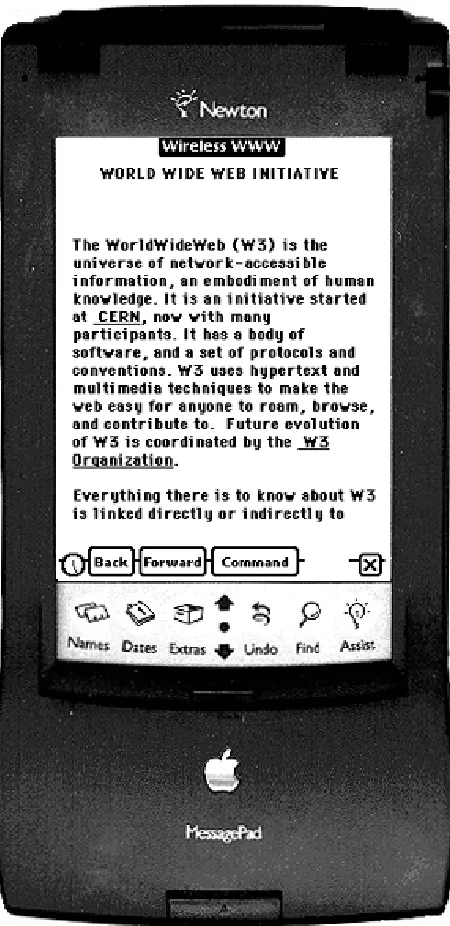
Figure 2: W4 showing the first screen of a document describing the World Wide Web.
The URL is http://info.cern.ch /hypertext/WWW/TheProject.html.
PDA memory is fairly limited which forces the screen cache into a PCMCIA card. For W4, we’ve found that a 1 MB card provides plenty of cache. However it also occupies the PDA’s only PCMCIA slot.
A pleasant discovery is that most Web documents are quite readable on a 320x240 pixel screen, even though they were designed for a much larger display. The biggest thing Mosaic users notice is not the screen size, but the lack of images and forms.
EXPERIENCE WITH A WIRELESS WORLD WIDE WEB CLIENT MARCH 1995
In many cases though, information providers will gladly accept the smaller display in ex-change for Web services away from the desktop. For example, Digital’s service organization is looking at the Web as a vehicle for delivering service documentation. To investigate this, they produced a hypertext trouble shooting guide for the PATHWORKS PC integration environment. The guide was easily adapted for the PDA’s screen size and the entire document can be stored in .3 MB on the PDA. One can easily envision service personnel carrying a device like W4 with commonly used documents cached in the device and additional documents and updates only a phone call away.
7. Reflections on W4
The experience reported in the previous section demonstrates the utility of existing PDAs and wireless communications systems. We’d now like to turn our attention to some things that need improvement. Our predictions on the pace of innovation are tempered by our experience build-ing W4; we’d like to be proven too conservative.
7.1. Less power
W4 uses three kinds of batteries: a 9-volt in the modem, 4 AAs in the Newton (possibly rechargeable), and a rechargeable battery on the cellular telephone. Newton battery life is not a problem, but the modem and cellular telephone rapidly exhaust their batteries. In practice, this isn’t a large problem as the cellular telephone also rapidly consumes money; a minimum of $.30 per minute in our area. In the short term, reducing the number of separate pieces in W4 is the best way to reduce the number of types of batteries and chargers that one travels with.
7.2. Fewer pieces
W4 consists of three pieces: a modem, a cellular telephone, and a PDA. The modem can be eliminated by using a cellular telephone with an integral modem such as the AirCommunicator which is available today. If the screen cache could be moved into the PDA’s main memory, then the cellular telephone and modem could be replaced by a PCMCIA card supporting cellular digi-tal packet data (CDPD). CDPD cards and communication services should start to become avail-able in 1995.
An alternative is a PDA with integral wireless communications like Motorola’s Marco and Envoy communicators.
7.3. Improved Wireless Communications
While Wall Street Journal articles may talk enthusiastically about CDPD and personal com-munications services (PCS), the reality for wide area wireless comcom-munications in the United States is analog cellular telephones and digital data carriers like ARDIS.
EXPERIENCE WITH A WIRELESS WORLD WIDE WEB CLIENT MARCH 1995
At the same time, digital data carriers like ARDIS are committed to service improvements and talk of linking their systems with CDPD systems.
We expect CDPD systems to provide an application with a data rate of 10-19.2 kbps, an im-provement over existing cellular systems. While network latency may be worse than that cur-rently offered by a dedicated cellular circuit, we’ll have to move W4 to a CDPD system to see if this negatively affects the application.
7.4. Improved processor performance
When designing for PDAs it might be dangerous to assume that processor speeds will rapidly improve. Cost, size, and power reduction seem to be more important than performance improve-ments. When more processor power is provided, it may not be available to the application programmer as it could be used to provide such things as software modems, improved hand-writing recognition, or animation.
8. Other approaches
Since W4 was completed in the summer of 1994, two other Newton-based web browsers have been announced. Gessler [3] describes a system where the developers chose to move more of the document processing into the PDA than was done in W4. In order to do this, they also required a higher bandwidth connection to the PDA. The result is a system that appears to have lower performance than W4 and does not support wireless communications. The authors are aware of these limitations and are counting on advances in PDAs and wireless communications to im-prove their system.
A recent announcement by AllPen Software [1] describes a browser with an architecture similar to W4’s. Their system replaces W4’s cellular connection with a fast, wireless local area network. They take advantage of this significant increase in bandwidth to support document images and forms on the PDA.
9. Conclusion
In October of 1994, Wired magazine announced the death of PDAs. We beg to differ; W4 is proof that it is possible to build useful wireless PDA-based applications today. By carefully splitting the client between the PDA and a stationary host, we’ve been able to build a portable unit with good performance. The biggest obstacle for the mobile user of this system is the size of the mobile unit, not the limitations of the PDA and communications system. Equipment has become available in the last year that can reduce the size.
Progress in wide area wireless communications has not been as rapid. The actual bandwidth available to applications, the interactive response time, and the cost of using CDPD systems are unknown. We hope communications suppliers will not limit their vision to electronic mail, but recognize that W4 is an example of a class of truly interactive, wireless applications that should be encouraged. How improvements in this area will ultimately be delivered is not clear as PDAs and wireless communication have often been characterized by aggressive product promises fol-lowed by tentative product rollouts.
EXPERIENCE WITH A WIRELESS WORLD WIDE WEB CLIENT MARCH 1995
10. References
[1] Todd Courtois, Ray Rischpater.
Portal: A PDA-to-World-Wide-Web Interface.
PDA Developers 3(1):18-20, January/February, 1995.
[2] Tim Berners-Lee, Robert Cailliau, Ari Luotonen, Henrik Frystyk Nielsen, Arthur Secret. The World-Wide Web.
Communications of the ACM 37(8):76-82, August, 1994.
[3] Stefan Gessler, Andreas Kotulla. PDAs as mobile WWW browsers.
In Second World Wide Web Conference ’94: Mosaic and the Web. October, 1994. The URL is http://www.ncsa.uiuc.edu/SDG/IT94/Proceedings/
DDay/gessler/www_pda.html.
[4] National Center for Supercomputing Applications. NCSA Mosaic Home Page.
The URL is http://www.ncsa.uiuc.edu /SDG/Software/Mosaic/ NCSAMosaicHome.html.
A portion of this material was presented at the IEEE Workshop on Mobile Computing Sys-tems and Applications, December 1994, Santa Cruz, California.
AirCommunicator is a trademark of Air Communications, Inc.
Apple, Newton, and MessagePad are trademarks of Apple Computer, Inc.
EXPERIENCE WITH A WIRELESS WORLD WIDE WEB CLIENT MARCH 1995
WRL Research Reports
‘‘Titan System Manual.’’ ‘‘The USENET Cookbook: an Experiment in Michael J. K. Nielsen. Electronic Publication.’’
WRL Research Report 86/1, September 1986. Brian K. Reid.
WRL Research Report 87/7, December 1987. ‘‘Global Register Allocation at Link Time.’’
David W. Wall. ‘‘MultiTitan: Four Architecture Papers.’’
WRL Research Report 86/3, October 1986. Norman P. Jouppi, Jeremy Dion, David Boggs, Mich-ael J. K. Nielsen.
‘‘Optimal Finned Heat Sinks.’’ WRL Research Report 87/8, April 1988. William R. Hamburgen.
WRL Research Report 86/4, October 1986. ‘‘Fast Printed Circuit Board Routing.’’ Jeremy Dion.
‘‘The Mahler Experience: Using an Intermediate WRL Research Report 88/1, March 1988. Language as the Machine Description.’’
David W. Wall and Michael L. Powell. ‘‘Compacting Garbage Collection with Ambiguous WRL Research Report 87/1, August 1987. Roots.’’
Joel F. Bartlett.
‘‘The Packet Filter: An Efficient Mechanism for WRL Research Report 88/2, February 1988. User-level Network Code.’’
Jeffrey C. Mogul, Richard F. Rashid, Michael ‘‘The Experimental Literature of The Internet: An
J. Accetta. Annotated Bibliography.’’
WRL Research Report 87/2, November 1987. Jeffrey C. Mogul.
WRL Research Report 88/3, August 1988. ‘‘Fragmentation Considered Harmful.’’
Christopher A. Kent, Jeffrey C. Mogul. ‘‘Measured Capacity of an Ethernet: Myths and WRL Research Report 87/3, December 1987. Reality.’’
David R. Boggs, Jeffrey C. Mogul, Christopher ‘‘Cache Coherence in Distributed Systems.’’ A. Kent.
Christopher A. Kent. WRL Research Report 88/4, September 1988. WRL Research Report 87/4, December 1987.
‘‘Visa Protocols for Controlling Inter-Organizational ‘‘Register Windows vs. Register Allocation.’’ Datagram Flow: Extended Description.’’
David W. Wall. Deborah Estrin, Jeffrey C. Mogul, Gene Tsudik, WRL Research Report 87/5, December 1987. Kamaljit Anand.
WRL Research Report 88/5, December 1988. ‘‘Editing Graphical Objects Using Procedural
Representations.’’ ‘‘SCHEME->C A Portable Scheme-to-C Compiler.’’
Paul J. Asente. Joel F. Bartlett.
WRL Research Report 87/6, November 1987. WRL Research Report 89/1, January 1989.
EXPERIENCE WITH A WIRELESS WORLD WIDE WEB CLIENT MARCH 1995
‘‘Optimal Group Distribution in Carry-Skip Ad- ‘‘The Distribution of Instruction-Level and Machine
ders.’’ Parallelism and Its Effect on Performance.’’
Silvio Turrini. Norman P. Jouppi.
WRL Research Report 89/2, February 1989. WRL Research Report 89/13, July 1989.
‘‘Precise Robotic Paste Dot Dispensing.’’ ‘‘Long Address Traces from RISC Machines:
William R. Hamburgen. Generation and Analysis.’’
WRL Research Report 89/3, February 1989. Anita Borg, R.E.Kessler, Georgia Lazana, and David W. Wall.
‘‘Simple and Flexible Datagram Access Controls for WRL Research Report 89/14, September 1989. Unix-based Gateways.’’
Jeffrey C. Mogul. ‘‘Link-Time Code Modification.’’
WRL Research Report 89/4, March 1989. David W. Wall.
WRL Research Report 89/17, September 1989. ‘‘Spritely NFS: Implementation and Performance of
Cache-Consistency Protocols.’’ ‘‘Noise Issues in the ECL Circuit Family.’’ V. Srinivasan and Jeffrey C. Mogul. Jeffrey Y.F. Tang and J. Leon Yang. WRL Research Report 89/5, May 1989. WRL Research Report 90/1, January 1990.
‘‘Available Instruction-Level Parallelism for Super- ‘‘Efficient Generation of Test Patterns Using scalar and Superpipelined Machines.’’ Boolean Satisfiablilty.’’
Norman P. Jouppi and David W. Wall. Tracy Larrabee.
WRL Research Report 89/7, July 1989. WRL Research Report 90/2, February 1990. ‘‘A Unified Vector/Scalar Floating-Point Architec- ‘‘Two Papers on Test Pattern Generation.’’
ture.’’ Tracy Larrabee.
Norman P. Jouppi, Jonathan Bertoni, and David WRL Research Report 90/3, March 1990. W. Wall.
‘‘Virtual Memory vs. The File System.’’ WRL Research Report 89/8, July 1989.
Michael N. Nelson.
‘‘Architectural and Organizational Tradeoffs in the WRL Research Report 90/4, March 1990. Design of the MultiTitan CPU.’’
‘‘Efficient Use of Workstations for Passive Monitor-Norman P. Jouppi.
ing of Local Area Networks.’’ WRL Research Report 89/9, July 1989.
Jeffrey C. Mogul.
‘‘Integration and Packaging Plateaus of Processor WRL Research Report 90/5, July 1990. Performance.’’
‘‘A One-Dimensional Thermal Model for the VAX Norman P. Jouppi.
9000 Multi Chip Units.’’ WRL Research Report 89/10, July 1989.
John S. Fitch.
‘‘A 20-MIPS Sustained 32-bit CMOS Microproces- WRL Research Report 90/6, July 1990. sor with High Ratio of Sustained to Peak
Perfor-‘‘1990 DECWRL/Livermore Magic Release.’’ mance.’’
Robert N. Mayo, Michael H. Arnold, Walter S. Scott, Norman P. Jouppi and Jeffrey Y. F. Tang.
Don Stark, Gordon T. Hamachi. WRL Research Report 89/11, July 1989.
EXPERIENCE WITH A WIRELESS WORLD WIDE WEB CLIENT MARCH 1995
‘‘Pool Boiling Enhancement Techniques for Water at ‘‘Interleaved Fin Thermal Connectors for Multichip
Low Pressure.’’ Modules.’’
Wade R. McGillis, John S. Fitch, William William R. Hamburgen.
R. Hamburgen, Van P. Carey. WRL Research Report 91/9, August 1991. WRL Research Report 90/9, December 1990.
‘‘Experience with a Software-defined Machine Ar-‘‘Writing Fast X Servers for Dumb Color Frame Buf- chitecture.’’
fers.’’ David W. Wall.
Joel McCormack. WRL Research Report 91/10, August 1991.
WRL Research Report 91/1, February 1991.
‘‘Network Locality at the Scale of Processes.’’ ‘‘A Simulation Based Study of TLB Performance.’’ Jeffrey C. Mogul.
J. Bradley Chen, Anita Borg, Norman P. Jouppi. WRL Research Report 91/11, November 1991. WRL Research Report 91/2, November 1991.
‘‘Cache Write Policies and Performance.’’ ‘‘Analysis of Power Supply Networks in VLSI Cir- Norman P. Jouppi.
cuits.’’ WRL Research Report 91/12, December 1991.
Don Stark.
‘‘Packaging a 150 W Bipolar ECL Microprocessor.’’ WRL Research Report 91/3, April 1991.
William R. Hamburgen, John S. Fitch. ‘‘TurboChannel T1 Adapter.’’ WRL Research Report 92/1, March 1992. David Boggs.
‘‘Observing TCP Dynamics in Real Networks.’’ WRL Research Report 91/4, April 1991.
Jeffrey C. Mogul.
‘‘Procedure Merging with Instruction Caches.’’ WRL Research Report 92/2, April 1992. Scott McFarling.
‘‘Systems for Late Code Modification.’’ WRL Research Report 91/5, March 1991.
David W. Wall.
‘‘Don’t Fidget with Widgets, Draw!.’’ WRL Research Report 92/3, May 1992. Joel Bartlett.
‘‘Piecewise Linear Models for Switch-Level Simula-WRL Research Report 91/6, May 1991.
tion.’’ ‘‘Pool Boiling on Small Heat Dissipating Elements in Russell Kao.
Water at Subatmospheric Pressure.’’ WRL Research Report 92/5, September 1992. Wade R. McGillis, John S. Fitch, William
‘‘A Practical System for Intermodule Code Optimiza-R. Hamburgen, Van P. Carey.
tion at Link-Time.’’ WRL Research Report 91/7, June 1991.
Amitabh Srivastava and David W. Wall. ‘‘Incremental, Generational Mostly-Copying Gar- WRL Research Report 92/6, December 1992.
bage Collection in Uncooperative
Environ-‘‘A Smart Frame Buffer.’’ ments.’’
Joel McCormack & Bob McNamara. G. May Yip.
WRL Research Report 93/1, January 1993. WRL Research Report 91/8, June 1991.
‘‘Recovery in Spritely NFS.’’ Jeffrey C. Mogul.
WRL Research Report 93/2, June 1993.
EXPERIENCE WITH A WIRELESS WORLD WIDE WEB CLIENT MARCH 1995
‘‘Tradeoffs in Two-Level On-Chip Caching.’’ ‘‘Complexity/Performance Tradeoffs with Non-Norman P. Jouppi & Steven J.E. Wilton. Blocking Loads.’’
WRL Research Report 93/3, October 1993. Keith I. Farkas, Norman P. Jouppi. WRL Research Report 94/3, March 1994. ‘‘Unreachable Procedures in Object-oriented
Programing.’’ ‘‘A Better Update Policy.’’
Amitabh Srivastava. Jeffrey C. Mogul.
WRL Research Report 93/4, August 1993. WRL Research Report 94/4, April 1994.
‘‘An Enhanced Access and Cycle Time Model for ‘‘Boolean Matching for Full-Custom ECL Gates.’’ On-Chip Caches.’’ Robert N. Mayo, Herve Touati.
Steven J.E. Wilton and Norman P. Jouppi. WRL Research Report 94/5, April 1994. WRL Research Report 93/5, July 1994.
‘‘Software Methods for System Address Tracing: ‘‘Limits of Instruction-Level Parallelism.’’ Implementation and Validation.’’
David W. Wall. J. Bradley Chen, David W. Wall, and Anita Borg. WRL Research Report 93/6, November 1993. WRL Research Report 94/6, September 1994. ‘‘Fluoroelastomer Pressure Pad Design for ‘‘Performance Implications of Multiple Pointer
Microelectronic Applications.’’ Sizes.’’
Alberto Makino, William R. Hamburgen, John Jeffrey C. Mogul, Joel F. Bartlett, Robert N. Mayo,
S. Fitch. and Amitabh Srivastava.
WRL Research Report 93/7, November 1993. WRL Research Report 94/7, December 1994. ‘‘A 300MHz 115W 32b Bipolar ECL Microproces- ‘‘How Useful Are Non-blocking Loads, Stream
Buf-sor.’’ fers, and Speculative Execution in Multiple Issue
Norman P. Jouppi, Patrick Boyle, Jeremy Dion, Mary Processors?.’’
Jo Doherty, Alan Eustace, Ramsey Haddad, Keith I. Farkas, Norman P. Jouppi, and Paul Chow. Robert Mayo, Suresh Menon, Louis Monier, Don WRL Research Report 94/8, December 1994. Stark, Silvio Turrini, Leon Yang, John Fitch,
Wil-liam Hamburgen, Russell Kao, and Richard Swan. WRL Research Report 93/8, December 1993. ‘‘Link-Time Optimization of Address Calculation on
a 64-bit Architecture.’’
Amitabh Srivastava, David W. Wall. WRL Research Report 94/1, February 1994.
‘‘ATOM: A System for Building Customized Program Analysis Tools.’’
EXPERIENCE WITH A WIRELESS WORLD WIDE WEB CLIENT MARCH 1995
WRL Technical Notes
‘‘TCP/IP PrintServer: Print Server Protocol.’’ ‘‘Boiling Binary Mixtures at Subatmospheric Pres-Brian K. Reid and Christopher A. Kent. sures’’
WRL Technical Note TN-4, September 1988. Wade R. McGillis, John S. Fitch, William R. Hamburgen, Van P. Carey.
‘‘TCP/IP PrintServer: Server Architecture and Im- WRL Technical Note TN-23, January 1992. plementation.’’
Christopher A. Kent. ‘‘A Comparison of Acoustic and Infrared Inspection WRL Technical Note TN-7, November 1988. Techniques for Die Attach’’
John S. Fitch.
‘‘Smart Code, Stupid Memory: A Fast X Server for a WRL Technical Note TN-24, January 1992. Dumb Color Frame Buffer.’’
Joel McCormack. ‘‘TurboChannel Versatec Adapter’’
WRL Technical Note TN-9, September 1989. David Boggs.
WRL Technical Note TN-26, January 1992. ‘‘Why Aren’t Operating Systems Getting Faster As
Fast As Hardware?’’ ‘‘A Recovery Protocol For Spritely NFS’’
John Ousterhout. Jeffrey C. Mogul.
WRL Technical Note TN-11, October 1989. WRL Technical Note TN-27, April 1992. ‘‘Mostly-Copying Garbage Collection Picks Up ‘‘Electrical Evaluation Of The BIPS-0 Package’’
Generations and C++.’’ Patrick D. Boyle.
Joel F. Bartlett. WRL Technical Note TN-29, July 1992. WRL Technical Note TN-12, October 1989.
‘‘Transparent Controls for Interactive Graphics’’ ‘‘The Effect of Context Switches on Cache Perfor- Joel F. Bartlett.
mance.’’ WRL Technical Note TN-30, July 1992.
Jeffrey C. Mogul and Anita Borg.
‘‘Design Tools for BIPS-0’’ WRL Technical Note TN-16, December 1990.
Jeremy Dion & Louis Monier.
‘‘MTOOL: A Method For Detecting Memory Bot- WRL Technical Note TN-32, December 1992. tlenecks.’’
‘‘Link-Time Optimization of Address Calculation on Aaron Goldberg and John Hennessy.
a 64-Bit Architecture’’ WRL Technical Note TN-17, December 1990.
Amitabh Srivastava and David W. Wall. ‘‘Predicting Program Behavior Using Real or Es- WRL Technical Note TN-35, June 1993.
timated Profiles.’’
‘‘Combining Branch Predictors’’ David W. Wall.
Scott McFarling. WRL Technical Note TN-18, December 1990.
WRL Technical Note TN-36, June 1993. ‘‘Cache Replacement with Dynamic Exclusion’’
‘‘Boolean Matching for Full-Custom ECL Gates’’ Scott McFarling.
Robert N. Mayo and Herve Touati. WRL Technical Note TN-22, November 1991.
WRL Technical Note TN-37, June 1993.
EXPERIENCE WITH A WIRELESS WORLD WIDE WEB CLIENT MARCH 1995
‘‘Ramonamap - An Example of Graphical Group-ware’’
Joel F. Bartlett.
WRL Technical Note TN-43, December 1994. ‘‘Circuit and Process Directions for Low-Voltage
Swing Submicron BiCMOS’’
Norman P. Jouppi, Suresh Menon, and Stefanos Sidiropoulos.
WRL Technical Note TN-45, March 1994.
‘‘Experience with a Wireless World Wide Web Client’’
Joel F. Bartlett.