S T U D Y P R O T O C O L
Open Access
Knowledge translation in child
welfare
—
improving educational outcomes
for children at risk: study protocol for a
hybrid randomized controlled pragmatic
trial
Thomas Engell
1*, Ingvild Barbara Follestad
1, Anne Andersen
1and Kristine Amlund Hagen
2Abstract
Background:In Norway, a disproportionately high number of children receiving Child Welfare Services (CWS) struggle academically and drop out of school. Academic attainment is one of the strongest protective factors against societal marginalization. The present study is part of a knowledge translation project in collaboration with local CWS with the aim to develop, implement, and evaluate Enhanced Academic Support (EAS) for primary school children in CWS.
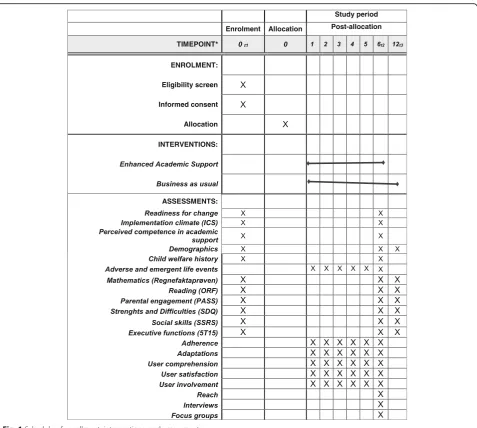
Methods/design:The study is a mixed-methods hybrid type 2 randomized, controlled pragmatic trial. The participants are approximately 120 children whose families receive support measures from three child welfare agencies in and around Oslo, Norway, and practitioners from these agencies. Families are randomly assigned to either the EAS condition or “business as usual”support. Primary outcomes are math and reading skills, parental involvement in school, and intervention fidelity. Questionnaires and academic tests are administered at baseline, post-intervention (after 6 months), and at follow-up (after 12 months). Implementation drivers are assessed before and after the trial period, and intervention fidelity is monitored during the trial through checklists and structured telephone interviews. Semi-structured interviews and focus groups are conducted after the trial.
Discussion:This hybrid study has two implications. (1) The effects of providing EAS to children in child welfare will be investigated. The study also explores how each core component of the intervention and the use of specific adaptations, implementation drivers, and other important child-level covariates moderate the overall effects. The results can provide valuable knowledge about how to deliver precise and effective academic support to increase academic skills and prevent dropout. In turn, this can promote academic completion and well-being, outcomes that are beneficial for both children and society at large. (2) The study also evaluates the feasibility of applying an Integrated Knowledge Translation model designed to develop, implement, and evaluate research-supported practice in health, care, and welfare services in less time than is usually the case. If deemed successful, this model will provide an efficient collaborative approach to translate the best available evidence into effective evidence-based practice, applicable in effectiveness research and quality improvement efforts.
Trial registration:ISRCTN,ISRCTN38968073. Registered on 18 September 2017.https://doi.org/10.1186/ISRCTN38968073.
Keywords:Effectiveness study, Hybrid study, Knowledge translation, Implementation, Academic support, Child welfare, Education, Primary school children, Core components, Common elements
* Correspondence:[email protected]
1The Regional Centre for Child and Adolescent Mental Health, Eastern and
Southern Norway, PO Box 4623, 0405 Oslo, Norway
Full list of author information is available at the end of the article
Background
Translating knowledge into effective and sustained practice
The translation of knowledge from research into effect-ive and sustained practice is a critical issue in health, care, and welfare systems [1]. More successful transla-tional efforts will likely result in improved services for patients, clients, and users and less inadequate treatment and care [2]. Municipal health, care, and welfare services in Norway experience increasing demands to ensure safe and effective services of high quality. Steps toward meet-ing these demands likely include identification of factors that contribute to favorable outcomes, supply and trans-lation of the best available knowledge, and the establish-ment of quality monitoring and feedback systems.
Need for knowledge translation in Child Welfare Services
In Norway, the Child Welfare Services (CWS) need sup-port to succeed in quality improvement endeavors. The majority (approximately 70%) of CWS is delivered by municipal agencies located across the country [3]. These agencies vary considerably in size and organizational structure. They differ in terms of methods of practice, approaches for quality improvement, and quality moni-toring systems. Although a state-led body governs and serves the municipal CWS agencies, the responsibility for ensuring and improving quality of services rests with local municipal government and the agencies them-selves. CWS agencies often juggle demanding directives, high caseloads, scarce resources, and a high rate of staff turnover. Their practitioners hold challenging jobs and are prone to stress and burnout [4]. The Norwegian Child Welfare Act, section 4-4 [5] states:“The child wel-fare service shall contribute to provide the individual child with sound circumstances and opportunities for development by providing advice, guidance and assist-ance.” To meet increasing demands to ensure safe, ef-fective, and high-quality advice, guidance, and assistance, municipal child welfare agencies would benefit from professional support.
Marginalization and academic achievement among children in child welfare
Contributing to a healthy upbringing is important in it-self, but it is also a good investment socially and eco-nomically. As a group, children in families who receive CWS are at greater risk of developing mental health is-sues and behavioral and substance abuse problems, and are also at greater risk for future unemployment and en-gaging in criminal behavior [6].
Children in child welfare in Norway are more than twice as likely to drop out of school compared to their peers [7]. Only two in ten children who have been involved with CWS complete secondary school on schedule, and 35%
are neither employed nor in education by the time they reach 23 years of age [7]. In comparison, six in ten chil-dren in the general population complete secondary school on time, and under 10% are neither employed nor in edu-cation at the age of 24 years [8]. Children in CWS are often found to have knowledge gaps very early on in their academic careers, deficits that over time grow bigger and frequently result in academic failure and dropout [9]. Additionally, individual factors such as mental health, so-cial skills, and executive functioning are likely to affect these children’s ability to succeed academically [10, 11]. Academic achievement is one of the strongest protective factors against later marginalization [12,13]. In a study of 7000 Swedish children with a history of foster care, aca-demic achievement strongly predicted positive outcomes in adulthood (i.e., not being on welfare, and showing less illness, drug abuse, and criminal behavior), even when other factors such as socioeconomic status were con-trolled [9]. Most studies on the provision of academic sup-port to children in the CWS have focused on children in foster care [14–16]. Recently published statistics in Norway, however, show that children involved with CWS who are living with their biological parents are at a similar risk of academic failure as children who are placed outside the home [7].
Practitioners in CWS have reported that the children in their care need more appropriate and tailored support to succeed academically [17]. However, child welfare agen-cies lack the methods, training, and allocated resources to provide academic support. Research has indicated that providing academic support to children and their families outside of school hours, and especially at home, has very useful potential [14, 15]. Meta-analyses have shown that positive parental involvement (e.g., homework support, parent-teacher communication, positive communication about school, positive parental expectations) affects chil-dren’s academic performance positively [18,19]. A system-atic review of out-of-school-time academic (OSTA) programs for children at risk of dropout in the USA found that reading- and math-focused OSTA programs can im-prove reading and math achievement [20]. The authors highlighted the need to combine OSTA programs with other educational, community, and family support to achieve sustained effects.
Using Integrated Knowledge Translation to develop and evaluate academic support in child welfare
and school personnel) in collaborative partnerships to exchange, create, and utilize knowledge to address re-search issues [21]. The IKT model applied in the present project has combined IKT principles with methods from quality improvement and innovations in knowledge syn-thesis (we have labeled our model IKT-K, to distinguish it from other knowledge translation approaches). IKT-K entails synthesizing the best available evidence and translating the evidence into locally tailored and flexible research-based practice. IKT-K is structured in five phases: synthesis, co-creation, implementation, evalu-ation, and sustainment or de-implementation. During the first three phases, a locally tailored academic support intervention (Enhanced Academic Support, EAS) was developed based on common elements of effective aca-demic interventions. EAS was implemented in three child welfare agencies, and its effects on academic achievement and parental involvement will be evaluated in this randomized controlled trial. The trial also evalu-ates the quality of EAS implementation and feasibility of the IKT-K model.
Aims and hypotheses
The present study has three overarching aims:
1. To evaluate the feasibility of the IKT-K model designed to develop, implement, and evaluate empirically supported practice in CWS
2. To evaluate the effects of the intervention, EAS, on children in CWS and their families
3. To explore associations between implementation drivers (readiness, climate, fidelity) and outcomes for children and families.
The following research questions will be examined to evaluate Aim 1:
To what degree are the core components of EAS
implemented in the CWS?
What adaptations are made to the core components
of EAS?
What are stakeholders’perceptions of the IKT-K model’s feasibility and usefulness, as assessed in focus groups?
To what degree are climate for implementing
evidence-based practice (EBP) and susceptibility for change of practice (readiness for change) associated with intervention fidelity in the CWS?
To what degree will practitioners in the
experimental group increase their perceived competence in delivering academic support to children and families from pre- to post-intervention?
To what degree is adherence to core components of
EAS associated with academic achievement and parental involvement for families in the EAS group?
The following hypotheses will be tested to evaluate Aims 2 and 3:
Children in families who receive the EAS intervention will improve their academic
achievement relative to children and families in a parallel, active comparison group who receive
“business as usual”(BAU) support.
Parents who receive the EAS intervention will increase their engagement in their children’s school situation relative to parents who receive BAU.
Intervention effects will be moderated by child age, readiness for change, and climate for implementing EBP.
Covariates include children’s mental health, social skills, and executive functioning scores, as well as child gender and pre-intervention academic per-formance (math and reading) and parental involvement.
Intervention effects (measured by academic performance tests and parental involvement) are associated with climate for implementing EBP and readiness for change.
More adherence to EAS principles will be positively associated with academic achievement and parental involvement for families in the EAS group
Methods and design
Participants
Eligible participants are boys and girls in primary school and their parents, whose family receives support mea-sures from CWS. We plan to recruit 120 children and their parents.
Inclusion criteria
The following inclusion criteria must be met:
1. Children in families receiving support measures from municipal CWS
2. Boys and girls in the 1st to 7th grades and their parents/caregivers
3. Parents/caregivers who give informed consent. Consent, assent, and the questionnaires are
available in Norwegian, English, Arabic, and Somali.
Exclusion criteria
The exclusion criteria are as follows:
1. Developmental disability
2. Parents/caregivers not able to give informed consent due to language restriction (not able to understand Norwegian, English, Arabic, or Somali)
3. One child only from each family can participate
The study also includes managers and practitioners at the local child welfare agencies (N= 160), the children’s teachers, and other stakeholders (parents and youths who previously received CWS, youth from user organi-zations, and local school counselors; estimated N= 22) in and around Oslo, Norway.
[image:4.595.60.538.85.513.2]Power calculation
The study aims to recruit 120 families. The intervention under study is newly developed; hence, we used a meta-analysis testing the overall effect of similar inter-ventions (targeting parental involvement in children’s learning, including “paired reading”) to inform the re-quired sample size. The outcomes used to assess effect sizes in the meta-analysis were a combination of differ-ent standardized and unstandardized reading measures. The suggested effect sizes were in the range ofd= .65 to 1.15 [22]. Withα< 0.5, power = 0.80, and expected effect size d= .65, the necessary sample size is n= 78, with 39 families in each group. Although the Oral Reading Flu-ency (ORF) test administered in the current trial is simi-lar to the assessments used by the studies in the meta-analysis, none of those studies used the actual ORF test of this trial. Hence, the power calculation lacks some precision. To account for uncertainty in the power calculation, subgroup analyses (of gender, site, and CWS measure), and possible study dropouts, and to compen-sate for the possibility of non-normal distribution of scores, more participants than deemed necessary accord-ing to the power calculation were recruited. Based on in-formation from the participating CWS agencies about their target groups, this sample size seems attainable.
Knowledge translation procedure
The first phase of the IKT-K model, the synthesis phase, started in January 2016.
In the synthesis phase, an adapted common elements methodology [23, 24] was applied to identify common practice, process, and implementation elements (N= 166 elements) of interventions with a significant positive effect on academic attainment for children at risk of school dropout. A systematic review was conducted [25]. All in-formation available about the effective interventions (N= 31) was reviewed by coders and plotted as elements in a matrix created to compare frequencies. Frequency-based algorithms were applied to identify common elements of effective interventions and common combinations of these. The four most common elements were selected as core components and used in the development of the aca-demic support intervention. The frequency with which these core components appeared in non-effective inter-ventions or interinter-ventions with negative effects was also reviewed, and their given weight of importance was ad-justed accordingly. Algorithms were also applied to extract process and implementation elements most frequently used in combination with common elements. Taken to-gether, the results of these analyses pointed to specific practice elements (e.g., actions or activities), their rate of involvement in effective interventions, methods of effect-ive deleffect-ivery, recipient characteristics, deleffect-ivery conditions,
and promising combinations of elements (a manuscript on the methodology and results is in preparation).
In theco-creation phaseand through a series of work-shops, facilitated teams consisting of researchers, an education specialist, a coordinator, CWS practitioners, users (parents and youths), school personnel, and other stakeholders collaborated in developing a locally tailored academic support intervention (EAS) based on the com-mon elements profiles. The teams also prepared the training program and local implementation plans, and made pragmatic adjustments to the research design.
Prior to tailoring the implementation plan, an assess-ment of the climate for impleassess-menting evidence-based practice and readiness to change was conducted in each CWS. Each phase of the IKT-K model includes specific implementation strategies designed to overcome typical barriers to implementation and sustainment. Assess-ments of climate and readiness were used to identify particularly prominent or unpredicted barriers and facili-tators which warranted increased effort or additional strategies.
In theimplementation phase, the implementation was prepared, the training program was conducted, re-cruiters and assessors were trained, and the intervention and research infrastructures were piloted. Particularly engaged practitioners and managers were offered roles as site champions and given additional training in the EAS intervention and knowledge translation. Champions were assigned roles and responsibilities such as coordin-ation, ongoing coaching, following up of recruiters, lead-ership engagement, etc. Adaptations were made based on feedback from practitioners and other stakeholders during piloting.
In theevaluation phase, a hybrid type 2 pragmatic trial will be applied to evaluate the effectiveness of EAS and the feasibility of the IKT-K model. The term “hybrid type 2” refers to research designs that evaluate clinical (or behavioral or educational) interventions and imple-mentation strategies simultaneously [26]. Focus groups and semi-structured interviews with practitioners, users, and other stakeholders will be conducted to gain further understanding of the feasibility and usefulness of both EAS and the IKT-K model.
In thesustainment or de-implementation phase, data from the evaluation phase will inform an overall evaluation of EAS together with the co-creation teams. In collaboration, these teams will decide whether to carry out sustainment and improvement strategies or de-implementation strategies.
Intervention
and dialogue. Trained practitioners tried out the delivery of EAS during the 5 months of piloting. They have also participated in a full day booster session, and a second booster session is planned after 6 months of recruitment to the study. The practitioners receive ongoing coaching from local EAS champions at each site and from the ex-ternal implementation team running the study (The Re-gional Centre for Child and Adolescent Mental Health, Eastern and Southern Norway, study authors KAH, AA, IBF, TE) upon request. The amount of coaching is moni-tored. The practitioners have received an EAS hand-book, in addition to various pedagogical, educational, and planning materials to be used with children and families.
EAS consists of four core components: (1) guidance in positive parental involvement in school, (2) structured tutoring in reading and math, (3) guidance in homework structure and routines, and (4) guidance in positive reinforcement, praise, and feedback. These four compo-nents are delivered to families in six sessions over a period of 6 months with support and follow-up between sessions. The sessions are delivered at home visits, or in other settings at the family’s preference. The first session is assigned to build rapport with the family and to iden-tify goals together with the family, and one session at the end is assigned to evaluate, repeat material as needed, and create a sustainment plan with the family. The four sessions in between are assigned to each core component.
Each of the visits consists of specific actions and activ-ities (practice elements) for the practitioners and the families to engage in together. Practitioners are also instructed on how these actions and activities ought to be carried out (process elements). Important implemen-tation elements such as ongoing support, local tailoring, and intervention flexibility are integrated into the deliv-ery of the intervention. Even though core components are assigned to separate sessions, and practice and process elements are clearly described, flexibility within fidelity is encouraged. This means that practitioners can adapt the sequence of components, emphasis on compo-nents, combinations of compocompo-nents, and time between sessions as they see fit, as long as they adhere to the practice and process elements of the core components and report adherence, dosage, and adaptations in the monitoring checklists after each session (see the section
“Monitoring and safety”). Additionally, pre-defined component-specific adaptations that are likely to be use-ful in different settings and scenarios are described and encouraged in training and in the handbook.
EAS is designed to be a flexible supplement to the support that families in CWS already receive. Hence, EAS is delivered in addition to the family’s child welfare measure. The practitioners are free to combine EAS
sessions with other measures or help they provide, or they can deliver EAS in separate sessions with the fam-ily. A session usually varies in length from 30 to 120 min. The session length is monitored.
Comparison condition (business as usual)
The comparison condition is “business as usual” (BAU) in Norwegian CWS. The content, structure, and length of BAU vary among agencies and among individual prac-titioners. Children and families in the BAU condition have been assigned a practitioner who has not received EAS training but who follows the family and offers regu-lar support measures. These measures may include ad-vice and guidance, parent training, financial aid, parent relief, etc. Meetings can take place both at the families’ homes and other settings, such as the child welfare of-fice or the school. BAU can also include some academic support, typically in the form of facilitating parent-teacher communication or the use of homework support at the school or in the community. Information about services provided in the BAU condition is col-lected using end-of-intervention-checklists (see the sub-section“Implementation measures”).
Implementation strategies
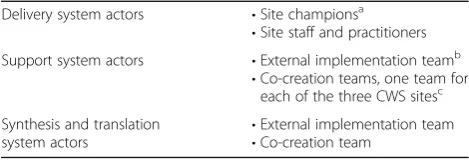
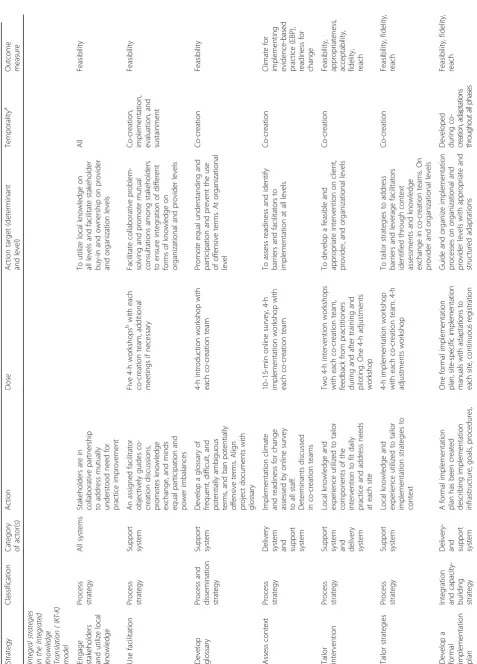
The following tables describe implementation strategies that are either planned, in progress, and/or completed in the study using current guidelines for reporting imple-mentation studies [27, 28]. Table1 describes implemen-tation actors, and Table 2 describes implementation strategies. To categorize which level each strategy tar-gets, categorization based on a dynamic adaptation process (DAP) framework [29] is used (involving system, organization, provider, and client levels). The first seven strategies are integral in the IKT-K model. Additional strategies are applied based on the intervention, context assessments, and knowledge exchanged between stake-holders in co-creation teams.
Measures
[image:6.595.304.539.619.700.2]The primary implementation measures are related to intervention fidelity (adherence to core components,
Table 1Actors involved in implementation strategies
Delivery system actors •Site championsa
•Site staff and practitioners
Support system actors •External implementation teamb
•Co-creation teams, one team for each of the three CWS sitesc
Synthesis and translation
system actors •
External implementation team
•Co-creation team a
Managers, practitioners b
Researchers, educator, coordinator, research assistants c
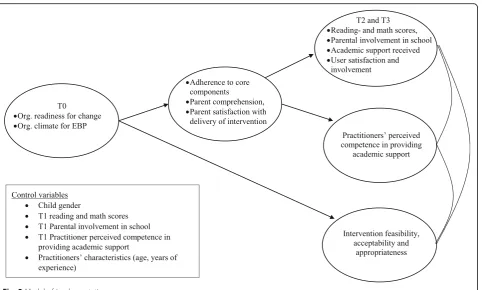
parent comprehension of core components, and user satisfaction with delivery of intervention components). Primary effectiveness outcomes are reading and math scores and parental involvement in school. The ORF test has two subscales: a fluency score and an accuracy score. A composite variable of the two reading outcomes will be made.
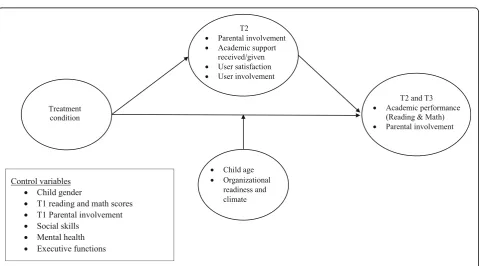
Secondary outcomes (and covariates) are measures of intervention feasibility, acceptability, and appropriate-ness; practitioners’ perceived competence in providing academic support; and children’s mental health and ad-justment, social skills, and executive functioning. The theoretical implementation model is shown in Fig.2.
Organizational readiness for change and organizational climate for implementing EBP are measured to inform the implementation process and to be tested as predic-tors in the implementation model (see Fig.3).
Implementation measures
The following implementation measures are used in this study:
A monitoring checklist has been developed to
measure adherence to core components, dosage, competence in delivery, parent comprehension of core components, adaptations, and user involvement and satisfaction with delivery of intervention components. The checklist is completed by EAS practitioners using smartphones after each intervention session and by parents answering the
same questions in telephone interviews after each intervention session (see the section“Monitoring and safety”for more details).
An end-of-intervention checklist measures academic
support received/given, emergent life events/adverse events, and overall user satisfaction and involvement during the last 6 months (intervention period). It has been developed specifically for this study and is administered at the post-assessment to parents (15 items), children (16 items), and practitioners (20 items) in both conditions. Items are rated on a 4-point scale (“not at all”,“to a small degree”,“to some degree”,“to a large degree”). Each version ends with an open question about any additional information to be answered in free text.
Intervention feasibility, acceptability, and
appropriateness will be measured using three four-item scales: Acceptability of Intervention Measure (AIM), Intervention Appropriateness Measure (IAM), and Feasibility of Intervention Measure (FIM) [30]. The AIM, IAM, and FIM are completed by the EAS practitioners post-intervention.
Organizational readiness for change is assessed using an unpublished questionnaire made by the study authors with 32 items rated on a 5-point scale (ranging from“strongly disagree”,“somewhat disagree”,“unsure”,“somewhat agree”, to“strongly agree”). The questionnaire measures organizational factors, characteristics, needs, and work climate as well as staff characteristics, qualities, and needs. It is
[image:10.595.59.540.452.718.2]administered to all employees at all CWS sites, pre- and post-intervention. Organizational managers answer two additional items measuring
organizational resources and opportunities.
Organizational climate for implementing evidence-based practice (EBP) is assessed using the Implementation Climate Scale (ICS) [31]. The scale consists of 18 items rated on a 5-point scale (from“not at all”to“very great extent”). The ICS assesses the degree to which there is a strategic organizational climate supportive of EBP implementation. Subscales include focus on EBP, educational support for EBP, recognition for EBP, rewards for EBP, selection (employment) for EBP, and selection (employment) for openness. The ICS is admin-istered to all employees at all CWS sites pre- and post-intervention. It has been validated with practitioners in 32 mental health organizations and 12 child welfare services in the USA [31,32].
Practitioners’perceived competence in providing academic support is measured using an unpublished questionnaire developed by the study authors. It includes 12 items rated on a 5-point scale ranging from“strongly disagree”(0) to strongly“agree”(5). The questionnaire assesses knowledge and use of competencies relevant to the core components of EAS without using the specific wording of the core components in the EAS handbook. It is administered pre-training and post- intervention to EAS practitioners.
CWS employees’perceptions of the implementation
process and the EAS intervention will be gauged by conducting focus group interviews post-intervention. An interview protocol will be prepared based on the IKT-K model and the DAP framework, including questions about the appropriateness and acceptability of EAS. Some of the topics to be discussed in the focus groups will include results from the quantitative data analyses.
Semi-structured interviews will be conducted with a selection of participating children and parents after the intervention to learn more about their
experiences with EAS. To select families to approach for participation in interviews, a randomization procedure in the Confirmit software will be used. Randomization will be stratified to select families who benefited from the intervention, who did not benefit from the intervention, and families with different ethnicities from each of the three sites.
Effectiveness measures
The effectiveness measures used in the study are described as follows:
TheOral Reading Fluency (ORF)test [33] measures
children’s reading abilities. The test consists of three short passages that are grade level- and season-sensitive (i.e., there are different passages for fall,
[image:11.595.60.543.85.375.2]winter, and spring). Children are asked to read the text aloud to the interviewer. Each reading sequence is timed to one minute. The interviewer monitors the reading and alerts the child when the time is up. The number of errors and the number of words read are recorded. The median scores of both errors and number of words read from the three passages are used. The test gives a score for fluency and a score for accuracy in reading. It is normed for children in the 2nd to 5th grades in Norway. The ORF test is administered to children at the pre-intervention, post-intervention, and follow-up assessments.
TheTest of Arithmetic(“Regnefaktaprøven”),
developed by the University of Stavanger, Norway, is used to measure the children’s mathematical abilities. It consists of two sets of addition problems and two sets of subtraction problems (each set with a different difficulty level) and one set each of multiplication and division problems. Children are asked to complete as many problems within a 2-min timeframe as they can. The number of correct answers is tallied up. The Test of Arithmetic is normed for Norwegian children in each grade level of elementary school and is administered to children at the pre-intervention, post-intervention, and follow-up assessments.
Parental involvement in school is assessed using the
Parent and School Survey (PASS)[34], a 24-item
survey scored on a 5-point Likert scale administered to parents. The PASS questionnaire asks parents to indicate how involved they are in their children’s schoolwork, school activities, and collaboration with school personnel. It is administered at the
pre-intervention, post-intervention, and follow-up assessments.
Secondary measures and covariates
The following are the secondary measures and covariates used in the study:
TheStrengths and Difficulties Questionnaire (SDQ)
[35–37] is a 25-item questionnaire that measures emotional problems, behavioral problems, hyperactivity, difficulties with peers, and prosocial behavior. Each item is rated on a 3-point scale (0 =“not true”, 1 =“sometimes true”, 2 =“certainly true”). The SDQ has a child/youth, parent, and teacher version. It also consists of an impact score that measures the degree of negative influence any problems have on different aspects of the child’s daily life (such as family activities and learning at school). Large population studies using the SDQ have been conducted in Norway [38,39]. Regional norms for children and youth in Norway are available. The SDQ will be
administered to children, parents, and teachers at the pre-intervention, post-intervention, and follow-up assessments.
TheSocial Skills Rating System (SSRS)[40] is a
standardized, multi-rater instrument that assesses social skills in children. It is administered to children, parents, and teachers. The children’s version has 34 items divided into four subscales: cooperation, assertion, empathy, and self-control. The parent scale includes 38 items measuring cooperation, self-esteem, responsibility, and self-control. The teacher’s version has 30 items assessing cooperation, self-esteem, and self-control. Each item is rated on a 4-point Likert scale, ranging from 1 (“never”) to 4 (“very often”). The SSRS has been used with Norwegian samples in earlier studies [41], and the teacher’s version has been validated and normed for children and adolescents in Norway [42]. The SSRS will be administered to children, parents, and teachers at the pre-intervention, post-pre-intervention, and follow-up assessments
Five-to-Fifteen[43] is a 181-item questionnaire
developed to assess attention deficit hyperactivity disorder (ADHD), common comorbid conditions to ADHD, and associated problems in children and youth aged 5 to 17 years. The present study uses four subscales of the questionnaire with a total of 28 items which assess executive functions (attention and concentration, overactivity and impulsivity, passivity/inactivity, and planning/organizing). Items are rated on a 3-point scale (“does not apply”,
“applies sometimes/to some extent”,“applies”) and are administered to parents and teachers at the pre-intervention, post-intervention, and follow-up assessments. The parent version of Five-to-Fifteen has been validated and normed with Nordic samples (Swedish, Danish, and Finnish) with acceptable psychometric properties [44]. The teacher version has been validated and normed in Danish samples with acceptable psychometric properties [45].
Demographics and background information.Parents
(current and previous child welfare measures) is obtained from child welfare practitioners with parental consent.
Procedures
Referral
Children and their families are referred to a child welfare agency by notification of concern (e.g., by teachers, com-munity nurses, physicians, police, or others). The agency either opens a case of inspection or dismisses the note of concern. If probable concern is established, but not in terms of out-of-home placement recommendation, the family is offered support measures from CWS. If the family accepts, they are eligible for study inclusion if they fulfill the inclusion criteria.
Enrollment
At that point, a case worker at the child welfare agency reviews the family’s eligibility. If they are eligible, the case worker provides neutral information about the study and asks if the family is interested in participating. If they are interested, the case worker asks for oral con-sent to provide the research staff with the family’s con-tact information.
If consent is given, the research coordinator calls the parent and provides more information about the study and answers questions.
Consent
A home visit is scheduled to complete the recruitment and pre-assessments. A trained interviewer visits the family and provides detailed information about the study to both parents (if they are both present) and child. The interviewer reviews eligibility, verbal assent is collected from the child, and written, informed consent is col-lected from parents electronically on iPads. The parent is also asked to give consent to allow the child welfare practitioners to receive an oral summary of assessment results and for the research team to contact the child’s teacher. Consents and questionnaires are available in Norwegian, English, Arabic, and Somali.
Pre-assessment
Directly after consent, pre-assessments commence. The parent and child are each handed an iPad to answer ques-tionnaires, and the interviewer administers the reading and math assessments on paper with the child. The pre-assessments take about 60 min to complete. After completion, an email with a link is sent to the child’s pri-mary teacher providing information about the study, an invitation to answer questionnaires, and the secure online questionnaires. Within a week after pre-assessments, an oral summary of results from the assessments of reading and math skills, mental health, social skills, and executive functions is provided to the family’s assigned child welfare
practitioner with the parent’s permission. The post-inter-vention and follow-up assessments are also conducted in home visits by an interviewer.
Randomization
At the time of consent, parents and children are in-formed that they will be randomly allocated to one of two conditions; one group, the BAU condition, receives regular measures from CWS, whereas the experimental condition receives the EAS intervention in addition to a regular child welfare measure. Blinding is not possible in this study; child welfare practitioners who have received EAS training will exclusively give EAS to study families, and parents and children will most likely understand to which group they have been assigned.
After completing the pre-assessment, participants are automatically randomized to either the intervention group (EAS) or the comparison group (BAU). A com-puter software (Confirmit) generates a random numbers table to assign random numbers to participants within blocks. A block randomization with a block of 10 is used, and randomization is carried out site-wise. The re-search coordinator informs the team manager at the site to assign the case to a practitioner with or without EAS training. All edit trails in Confirmit are recorded. Out-come assessors are blinded to allocation. In-depth tech-nical details can be provided upon request.
Intervention: Enhanced Academic Support (EAS)
Families allocated to the intervention group are assigned a practitioner with training in EAS. EAS is delivered as described in the “Methods and design” subsection
“Intervention”.
Comparison condition: business as usual (BAU)
Families allocated to the BAU group are assigned a prac-titioner without training in EAS. BAU is delivered as de-scribed in the “Methods and design” subsection
“Comparison condition (business as usual)”.
Post-assessment
Six months after pre-assessment, the post-assessment is administered. A selection of participating families will be invited to semi-structured interviews, and a selection of participating practitioners and other stakeholders will be invited to participate in focus group interviews.
Follow-up assessment
Six months after post-assessment, the follow-up assess-ment is administered.
Statistical analyses
outcomes-specific manner. A significance level of .05 will be used.
Outcomes will be evaluated using analysis of covariance (ANCOVA), controlling for baseline scores and covariates. Children’s age, implementation drivers, children’s mental health, social skills, and executive functions will be tested in regression models, as will possible subgroup analyses. To test for indirect effects (or mediation), models will be tested in a structural equation modeling (SEM) framework. Indir-ect effIndir-ects variables include PASS, Five-to-Fifteen , and the end-of-intervention checklist measures. Implementation drivers as predictors of outcomes will be tested in regres-sion models. We will evaluate effectiveness in two parts. The pre-post outcome analysis will use ANCOVA with baseline measures and covariates as control variables. We will test intervention effects including all data waves in SEM. See Figs. 2 and 3 for the theory of intervention change depicting variables included in the analyses.
We will examine and present data both in intention-to-treat (ITT) and as-treated (AT) designs, as the two approaches answer different questions. An ITT design answers the question “Does the intervention make a difference?” An AT analysis, on the other hand, answers the question“What are the effects likely to be if the client (or family) is exposed to the intervention?” We consider both of these questions important. This procedure has been recommended as best practice [46].
We will use multiple imputation for missing values for the pre-post ANCOVA in an ITT design. In the SEM models, missing data will be estimated using full infor-mation maximum likelihood.
Monitoring and safety Audit and feedback
After each session of EAS with the family, the practi-tioner completes a dynamic fidelity checklist on their smartphone/tablet or computer using an online survey. The survey takes about 5–10 min to complete, depend-ing on the number of core components and adaptations that were used in the session. After completion, an auto-mated reminder is sent to the project coordinator, and an available interviewer calls the parent and conducts a structured telephone interview. Two additional attempts are made if the parent does not answer the call. The interviewer uses an online survey to retrieve an inter-view guide and plot the parent’s answers. The interview guide is based on the checklist the practitioner recently completed. That is, detailed questions are only asked about the core components that the practitioner stated were used in the last session. Additionally, parents are asked if they remember doing something else in the ses-sion. If they mention another core component, they are asked detailed questions about that as well. The inter-view is structured this way to limit the amount of
questions asked to practitioners and parents and to pre-vent attrition due to long checklists and interviews. The total number of questions available to practitioners is 113; however, an average checklist requires 25–30 an-swers (minimum 19). An average parent interview con-tains 20–25 questions (minimum 14).
Variables audited
The variables audited are duration of session, contact since last session, adherence to core components, par-ents’and children’s comprehension of core components, use of pre-defined adaptations of core components, use of additional adaptations to core components (free text), client satisfaction, client involvement in decisions, and adverse events or relevant emergent life events.
Feedback
Monitoring data from each site are aggregated bi-monthly and used as feedback to the practitioners. KAH and TE, together with the site champions, deliver feed-back on team meetings. On request from the practi-tioners, they can receive individual feedback to use in ongoing coaching with the site champions. Emphasis is placed on adherence to core components, frequently used adaptations, and client satisfaction. Group-level feedback reports are also delivered via newsletters.
In cases of severe drift, serious adverse events, or re-peatedly poor client satisfaction, KAH and TE will con-fer with site champions to commence one of the following contingency plans: additional booster training with the team, individual booster training with a practi-tioner, or gathering of the local EAS practitioners to dis-cuss additional adaptation or change.
Stopping rules (discontinuation criteria)
The following criteria are considered grounds for discontinuation:
If a family’s regular child welfare measure is
concluded or terminated, and the family is no longer receiving child welfare support
If the CWS practitioners or data collectors uncover acute suicidality, psychosis, abuse, or other
conditions that render the EAS intervention and data collection not viable, safe, or ethical
If the CWS practitioners uncover any serious adverse effects of the EAS intervention, rendering it unsafe to offer clients
If the child is placed out of home and/or parents lose custody of the child
Withdrawn consent from the study
Withdrawn government funding (the Research
Council of Norway)
In cases of dropout or discontinuation, the family will be asked to complete post-assessment if it is deemed ethical and viewed as appropriate by the family’s child welfare case worker.
Data management
The Regional Centre for Child and Adolescent Mental Health, Eastern and Southern Norway has a license and data management agreement with Confirmit. All elec-tronic data are collected using the web-based tool Con-firmit Authoring, and all websites used to collect data are encrypted with a security clearance. Data on paper are stored in a secure safe with access restricted to au-thorized research personnel. All data are stored in ac-cordance with standards and regulations set by the ethics committee Norwegian Centre for Research Data (NSD). Sensitive information is stored separately from directly identifiable information. An identification key is stored electronically in a secure database. Only autho-rized research personnel have access to the key. Further information can be provided upon request.
Handling and follow-up of adverse events, data monitoring committee (DMC)
This study is an effectiveness trial conducted in existing child welfare agencies, not in a research facility. The intervention is considered low risk and no more intru-sive than what is normally being delivered to children and families in CWS. The participating agencies have in-ternal procedures for detecting, reporting, and following up on any adverse events in their clients. The study does not pose any restrictions on the agencies’internal proce-dures for handling adverse events or offering other ser-vices if deemed appropriate. In the event of the agency terminating a family’s EAS intervention, the research team will be informed, and post-assessment will be con-ducted if deemed appropriate by the agency. In cases of perceived risk of adverse harm inflicted on people or property, research personnel will report to authority, abiding by law. The trial is not blinded, as the practi-tioners know what kind of service they offer the children and their families. No interim analyses will be con-ducted, in order not to bias the progression of the study. For these reasons, the current study has not appointed a DMC.
Access to source data
The Regional Centre for Child and Adolescent Mental Health ensures that the investigator/institution will permit trial-related monitoring, audits, reviews, and regulatory inspections, by providing direct access to source data/doc-uments if needed, and that such inspections do not violate the rights and/or anonymity of trial participants, including
children, their families, their therapists, or other CWS employees.
Discussion
This hybrid study has two main aims: (1) to evaluate the feasibility of an Integrated Knowledge Translation (IKT-K) model used in Child Welfare Services (CWS) designed to develop, implement, and evaluate empiric-ally supported practice; and (2) to test the effectiveness of Enhanced Academic Support (EAS), a home-based intervention to improve academic achievement in chil-dren and their families in child welfare.
Advances in implementation science have outlined strat-egies that are likely to be pivotal to succeed in transla-tional efforts, such as developing collaborative partnerships with stakeholders, using facilitation, and adapting and tailoring to context [47]. Similar strategies have long been used in the field of quality improvement, such as co-creation (or co-production) methods [48], often combined with iterative process models designed for continuous improvement [49]. The IKT-K model applied in this study attempts to utilize the best available evidence from implementation science together with established quality improvement methods to advance knowledge translational efforts. Involving stakeholders in mutually dependent partnerships is an integral strategy in this study, operationalized using facilitated co-creation ap-proaches to locally tailor adaptable aspects of the study. The aim of these strategies is to utilize local knowledge and expertise, ensure buy-in from stakeholders, and thus promote acceptability, implementation, and sustainment of the newly introduced practice change. If feasible, this model can offer a pragmatic, efficient, and usable ap-proach to development, implementation, and sustainment of evidence-based practice, which in turn can support knowledge translation and quality improvement in health, care, and welfare services.
returns successful investments in education can provide for individuals and society.
Trial status
Recruitment commenced in January 2018, and the trial is currently in progress. The estimated completion date of the trial is December 2019.
Additional file
Additional file 1:SPIRIT 2013 checklist: recommended items to address in a clinical trial protocol and related documents. (DOC 121 kb)
Abbreviations
BAU:Business as usual; CWS: Child Welfare Services; EAS: Enhanced Academic Support; EBP: Evidence-based practice; ICS: Implementation Climate Scale; IKT: Integrated Knowledge Translation; IKT-K: Integrated Knowledge Translation-KOBA model; KOBA: Kunnskapsoverføring i Barnevernet; PASS: Parent and School Survey; SDQ: Strengths and Difficulties Questionnaire; SSRS: Social Skills Rating System
Acknowledgements
We would like to express our gratitude to the CWS agencies participating in this collaborative effort. We also wish to thank everyone involved at the agencies and other stakeholders such as parents, adolescents, and school counselors for their invaluable contributions to the study. We are grateful to our colleagues at the Regional Centre for Child and Adolescent Mental Health, Eastern and Southern Norway (RBUP) and the Norwegian Centre for Child Behavioral Development (NUBU) for their support, to the Research Council of Norway for financial support, and to RBUP and NUBU for financial and administrative support.
Funding
The study receives partial funding from the Research Council of Norway under the program Health, Care and Welfare Services Research. The study is also partially funded by RBUP and NUBU. The study is sponsored with academic material from Gyldendal Agency (http://eng.gyldendal.no/ Gyldendal/Agency).
Availability of data and materials
The datasets generated and/or analyzed during the current study are not publicly available due to confidentiality requirements, but they are available in summarized forms from the corresponding author on reasonable request.
Dissemination plans
Results will be published in peer-reviewed and scientific journals, presented at national and international conferences, and used for educational purposes in the field of education and child welfare. Results will be disseminated re-gardless of magnitude or direction of effects.
Authors’contributions
TE has made substantial contributions to design and to acquisition of data, and will take part in the analysis and interpretation of data. He has been involved in drafting the manuscript, given final approval of the version to be published, and agreed to be accountable for all aspects of the work in ensuring that questions related to the accuracy or integrity of any part of the work are appropriately investigated and resolved. IBF has made substantial contributions to study coordination and acquisition of data. She has given final approval of the version to be published and agreed to be accountable for all aspects of the work in ensuring that questions related to the accuracy or integrity of any part of the work are appropriately investigated and resolved. AA has made substantial contributions to study implementation, has given final approval of the version to be published, and agreed to be accountable for all aspects of the work in ensuring that questions related to the accuracy or integrity of any part of the work are appropriately investigated and resolved. KAH, the principal investigator (PI), has made substantial contributions to design and to the acquisition of data
and is responsible for analysis and interpretation of data. She has been involved in drafting the manuscript, given final approval of the version to be published, and agreed to be accountable for all aspects of the work in ensuring that questions related to the accuracy or integrity of any part of the work are appropriately investigated and resolved. All authors read and approved the final manuscript.
Authors’information
TE is a Ph.D. candidate at RBUP and the Department of Psychology, University of Oslo (UiO). IBF is a research coordinator at RBUP. AA is a clinical and education specialist at RBUP. KAH (PI) is a senior researcher at NUBU and a senior advisor at RBUP.
Ethics approval and consent to participate
The study protocol was first reviewed by the Regional Ethics Committee for Medical Research, Southern Norway (REK South-East). REK appointed the Nor-wegian Centre for Research Data (NSD) as the appropriate ethics committee to review the study. Ethics approval from NSD was obtained in October 2016, with revisions approved in October 2017, project number 47161. Fur-ther revisions will be communicated to NSD for approval.
If an eligible family agrees, a child welfare practitioner provides a research coordinator with a parent’s contact information. The coordinator calls the parent and provides additional information about the study. A home visit is scheduled where a research assistant obtains informed consent from the parent and informed assent from the child. In cases of siblings, Norwegian CWS usually attach child welfare measures to one of the children. This child would be eligible for participation, and not the siblings. However, if the measure is attached to the family, and two or more children in the family are eligible to participate, the youngest child is asked for participation. In cases of twins, one of the children will be selected at random, unless the family has a preference on which child to include. The consent form is available on iPads or paper and in Norwegian, English, Arabic, or Somali. Assent forms are available in Norwegian.
Consent for publication No issues were identified.
Competing interests
The authors have been responsible for the development of the EAS intervention and thus may wish to find positive effects of the intervention. However, the authors are aware of their position and will analyze and interpret the results objectively. The authors have no financial interests in this trial.
Publisher’s Note
Springer Nature remains neutral with regard to jurisdictional claims in published maps and institutional affiliations.
Author details
1
The Regional Centre for Child and Adolescent Mental Health, Eastern and Southern Norway, PO Box 4623, 0405 Oslo, Norway.2The Norwegian Center for Child Behavioral Development (NCCBD), a University of Oslo affiliate, Postboks 7053 Majorstuen, 0306 Oslo, Norway.
Received: 13 February 2018 Accepted: 26 November 2018
References
1. Proctor E, Luke D, Calhoun A, McMillen C, Brownson R, McCrary S, Padek M. Sustainability of evidence-based healthcare: research agenda,
methodological advances, and infrastructure support. Imp Sci. 2015;19(1):88. 2. Lau R, Stevenson F, Ong BN, Dziedzic K, Treweek S, Eldridge S, et al.
Achieving change in primary care—causes of the evidence to practice gap: systematic reviews of reviews. Imp Sci. 2015;11(1):40.
3. Statistics Norway (SSB). Child Welfare Services. 2016.https://bufdir.no/ Statistikk_og_analyse/Barnevern/. Accessed 6 Feb 2018.
4. Barford SW, Whelton WJ. Understanding burnout in child and youth care workers. Child Youth Care Forum. 2010;39(4):271–87.
6. Kristoffersen LB, Clausen SE. Child Welfare clients in Norway 1990–2005: a longitudinal study. NOVA Rep. 2008;3:08.
7. Statistics Norway (SSB). Education and Child Welfare Services. 2016. https://bufdir.no/Statistikk_og_analyse/Barnevern/Barnevern_skole/. Accessed 8 Feb 2018.
8. Bø TP, Vigran Å. Youth not in education, employment or training. Statistics Norway report. 2014. http://www.ssb.no/arbeid-og-lonn/artikler-og-publikasjoner/ungdom-som-verken-er-i-arbeid-eller-utdanning. Accessed 6 Feb 2018.
9. Vinnerljung B, Berlin M, Hjern A. Skolbetyg, utbildning och risker för ogynnsam utveckling hos barn. Socialstyrelsens Soc Rapp. 2010;7:227–66. 10. Ogden T, Hagen KA. Adolescent mental health: prevention and
intervention. New York: Routledge; 2014.
11. Sattler JM. Assessment of children: cognitive applications. La Mesa: Jerome M. Sattler, Publisher; 2001.
12. Wilson SJ, Tanner-Smith EE, Lipsey MW, Steinka-Fry K, Morrison J. Dropout prevention and intervention programs: effects on school completion and dropout among school-aged children and youth. Campb Syst Rev. 2011; 2011:8.
13. Berlin M, Vinnerljung B, Hjern A. School performance in primary school and psychosocial problems in young adulthood among care leavers from long term foster care. Child Youth Serv Rev. 2011;33:2489–94.
14. Seeberg ML, Windsvold A, Sverdrup S. Skoleresultater og
utdanningssituasjon for barn i barnevernet: En kunnskapsoversikt. NOVA Rep. 2014;4:13.
15. Forsman H, Vinnerljung B. Interventions aiming to improve school achievements of children in out-of-home care: a scoping review. Child Youth Serv Rev. 2012;34(6):1084–91.
16. Trout AL, Tyler PM, Stewart MC, Epstein MH. On the Way Home: program description and preliminary findings. Child Youth Serv Rev. 2012;34(6):1115–20.
17. Kavli H, Sjøvold JM, Ødegaard KS. Kartlegging av holdninger til skolegang for barn og unge med tiltak fra barnevernet. Oslo: Rambøll; 2015. 18. Hattie JAC. Visible learning: a synthesis of 800+ meta-analyses on
achievement. Abingdon: Routledge; 2008.
19. Nye C, Turner H, Schwartz J, Nye C. Approaches to parent involvement for improving the academic performance. Campb Syst Rev. 2006;2006:4. 20. Knopf JA, Hahn RA, Proia KK, Truman BI, Johnson RL, Muntaner C, et al.
Out-of-school-time academic programs to improve school achievement: A community guide health equity systematic review. J Public Health Manag Pract. 2015;21(6):594.
21. Jull J, Giles A, Graham ID. Community-based participatory research and integrated knowledge translation: advancing the co-creation of knowledge. Implement Sci. 2017;12(1):150.
22. Sénéchal M, Young L. The effect of family literacy interventions on children’s acquisition of reading from kindergarten to grade 3: A meta-analytic review. Rev Educ Res. 2008;78(4):880–907.
23. McLeod BD, Sutherland KS, Martinez RG, Conroy MA, Snyder PA, Southam-Gerow MA. Identifying common practice elements to improve social, emotional, and behavioral outcomes of young children in early childhood classrooms. Prev Sci. 2017;18(2):204–13.
24. Chorpita BF, Daleiden EL, Weisz JR. Identifying and selecting the common elements of evidence based interventions: a distillation and matching model. Ment Health Serv Res. 2006;7(1):5–20.
25. Engell T, Hagen KA, Hammerstrøm KT, Kornør H. Community- and home-based interventions for improving academic achievement in children at risk: a systematic review protocol. Prospero Int Prospect Reg Syst Rev. 2016. https://doi.org/10.13140/RG.2.1.4317.7041.
26. Curran GM, Bauer M, Mittman B, Pyne JM, Stetler C. Effectiveness-implementation hybrid designs: combining elements of clinical effectiveness and implementation research to enhance public health impact. Med Care. 2012;50(3):217.
27. Leeman J, Birken SA, Powell BJ, Rohweder C, Shea CM. Beyond
“implementation strategies”: classifying the full range of strategies used in implementation science and practice. Implement Sci. 2017;12(1):125. 28. Proctor EK, Powell BJ, McMillen JC. Implementation strategies:
recommendations for specifying and reporting. Implement Sci. 2013; 8(1):139.
29. Aarons GA, Green AE, Palinkas LA, Self-Brown S, Whitaker DJ, Lutzker JR, et al. Dynamic adaptation process to implement an evidence-based child maltreatment intervention. Implement Sci. 2012;7(1):32.
30. Weiner BJ, Lewis CC, Stanick C, Powell BJ, Dorsey CN, Clary AS, Boynten MH, Halko H. Psychometric assessment of three newly developed
implementation outcome measures. Implement Sci. 2017;12(1):108. 31. Ehrhart MG, Aarons GA, Farahnak LR. Assessing the organizational context
for EBP implementation: the development and validity testing of the Implementation Climate Scale (ICS). Implement Sci. 2014;9(1):157. 32. Ehrhart MG, Torres EM, Wright LA, Martinez SY, Aarons GA. Validating the
Implementation Climate Scale (ICS) in child welfare organizations. Child Abuse Negl. 2016;53:17–26.
33. Arnesen A, Braeken J, Baker S, Meek-Hansen W, Ogden T, Melby-Lervåg M. Growth in oral reading fluency in a semitransparent orthography: concurrent and predictive relations with reading proficiency in Norwegian, Grades 2–5. Read Res Q. 2017;52:177–20.
34. Ringenberg MC, Funk V, Mullen K, Wilford A, Kramer J. The test-retest reliability of the Parent and School Survey (PASS). Sch Community J. 2005; 15(2):121–34.
35. Goodman R. The Strengths and Difficulties Questionnaire: a research note. J Child Psychol Psychiatry. 2007;38:581–6.
36. Goodman R. The extended version of the Strengths and Difficulties Questionnaire as a guide to child psychiatric caseness and consequent burden. J Child Psychol Psychiatry. 2007;40:791–801.
37. Goodman R, Meltzer H, Bailey V. The Strengths and Difficulties Questionnaire: a pilot study on the validity of the self-report version. Eur Child Adolesc Psychiatry. 1998;7:125–30.
38. Van Roy B, Kristensen H, Groholt B, Clench-Aas J. Prevalence and characteristics of significant social anxiety in children aged 8-13 years: a Norwegian cross-sectional population study. Soc Psychiatry Psychiatr Epidemiol. 2009;44(5):407–15.
39. Heiervang E, Stormark KM, Lundervold AJ, Heimann M, Goodman R, Posserud M, et al. Psychiatric disorders in Norwegian 8- to 10-year-olds: an epidemiological survey of prevalence, risk factors, and service use. J Am Acad Child Adolesc Psychiatry. 2007;46(4):438–47.
40. Gresham FM, Elliott SN. Social Skills Rating System. Circle Pines: American Guidance Service; 1990.
41. Sørlie M, Hagen KA, Ogden T. Social competence and antisocial behavior: continuity and distinctiveness across early adolescence. J Res Adolesc. 2008; 18(1):121–44.
42. Ogden T. The validity of teacher ratings of adolescents’social skills. Scand J Educ Res. 2003;47:63–76.
43. Kadesjö B, Janols LO, Korkman M, Mickelsson K, Strand G, Trillingsgaard A, et al. Five-To-Fifteen-Revised (5–15R). 2017.www.5-15.org. Accessed 9 Feb 2018. 44. Hysing M, Bøe T. Psychometric properties of the Norwegian version of Five
to Fifteen (5-15). Psych Test Child. 2013;1:3.
45. Lambek R, Trillingsgaard A. Elaboration, validation and standardization of the five to fifteen (FTF) questionnaire in a Danish population sample. Res Dev Disabil. 2015;38:161–70.
46. Fidler F, Faulkner C, Cumming G. Analyzing and presenting outcomes. In: Nezu AM, Nezu CM, editors. Evidence-based outcome research: a practical guide to conducting randomized controlled trials for psychosocial interventions. New York: Oxford University Press; 2008.
47. Waltz TJ, Powell BJ, Matthieu MM, Damschroder LJ, Chinman MJ, Smith JL, Proctor E, Kirchner JE. Use of concept mapping to characterize relationships among implementation strategies and assess their feasibility and importance: results from the Expert Recommendations for Implementing Change (ERIC) study. Implement Sci. 2015;10(1):1.
48. Bovaird T. Beyond engagement and participation: user and community coproduction of public services. Public Adm Rev. 2007;67:846–60. 49. Varkey P, Reller MK, Resar RK. Basics of quality improvement in health care.