MAY-JUNE 2017, VOL- 4/32 www.srjis.com Page 561 ROLE OF SCHOOL COUNSELOR IN MOTIVATING UNDER ACHIEVERS
Prof. Deokar Sanjay Baban
Sou. NirmalataiThopte College of Education, Bhor, Dist-Pune 412206
Nearby all under achievers, at one time or another are referred to the school either by a
teacher or the students, parents will the intellectually under achiever high expectation that the
counsellor can magically „cure‟ the students lack of achievement motivation. However, even
though the task may seem impossible and the expectations unrealistic, school counsellor are
well qualified professionals in an advantageous position to help under achievers improve
their performance.
In the next few years, increasing demands for school counsellors to help students and
staff deals with crises such as violence, bullying, drugs and suicide have seemed to pull
[image:1.595.83.509.494.693.2]counsellors away from a focus on less urgent matters such as working with underachievers.
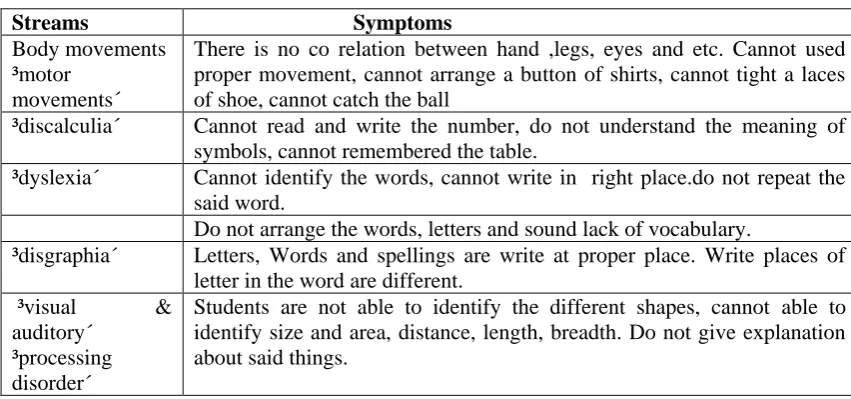
Table .learning disability : streams and types.
Streams Symptoms Body movements
³motor movements´
There is no co relation between hand ,legs, eyes and etc. Cannot used proper movement, cannot arrange a button of shirts, cannot tight a laces of shoe, cannot catch the ball
³discalculia´ Cannot read and write the number, do not understand the meaning of symbols, cannot remembered the table.
³dyslexia´ Cannot identify the words, cannot write in right place.do not repeat the said word.
Do not arrange the words, letters and sound lack of vocabulary.
³disgraphia´ Letters, Words and spellings are write at proper place. Write places of letter in the word are different.
³visual &
auditory´ ³processing disorder´
Students are not able to identify the different shapes, cannot able to identify size and area, distance, length, breadth. Do not give explanation about said things.
MAY-JUNE 2017, VOL- 4/32 www.srjis.com Page 562 LEARNING DISORDER (Learning disability):
Learning disability is a classification that includes several areas of functioning in
which a person has difficulty learning in a typical manner, usually caused by an unknown
factor or factors.
While learning disability, learning disorder and learning difficulty are often used
interchangeably, they differ in many ways. Disability refers to significant learning problems
in an academic area. These problems, however, are not enough to warrant an official
diagnosis. Learning disorder, on the other hand, is an official clinical diagnosis, whereby the
individual meets certain criteria, as determined by a professional (psychologist, paediatrician,
etc). The difference is in degree, frequency, and intensity of reported symptoms and problems
and thus the two should not be confused. When the term 'learning disabilities' is used, it
describes a group of disorders characterized by inadequate development of specific academic,
language and speech skills. Types of learning disabilities include reading academic, language
and speech skills. 'Types of learning disabilities include reading disability (dyslexia),
mathematics disability (dyscalculia) and writing disability (dysgraphia).
The unknown factor is the disorder that affects the brain's ability to receive and
process information. This disorder can make it problematic for a person to learn as quickly or
in the same way as someone who is not affected by a learning disability. People with a
learning disability have trouble performing specific types of skills or completing tasks if left
to figure things out by themselves or if taught in conventional ways.
Individuals with learning disabilities can face unique challenges that are often
pervasive throughout the lifespan. Depending on the type and severity of the disability,
interventions and current technologies may be used to help the individual learn strategies that
will foster future success. Some interventions can be quite simplistic, while others are
intricate and complex. Current technologies may require student training to be effective
classroom supports. Teachers, parents and schools can create plans together that tailor
intervention and accommodations to aid the individuals in successfully becoming
independent learners. School psychologists and other qualified professionals quite often help
design the intervention and coordinate the execution of the intervention with teachers and
MAY-JUNE 2017, VOL- 4/32 www.srjis.com Page 563 Strategies for using counselling under achiever’s model
As a part of school counsellor‟s efforts to implement a development guidance approach that addresses the needs of all students, he/she should review each student‟s
academic progress on a regular basis. To follow up with students for whom underachievers is
identified as a significant problem, the following strategy is suggested
1. Through a combination of individual group and/or family counselling as well as
consultation with teachers, explore the extent to which each input variable presented in the
counselling underachievers model ia an asset or a barrier to the students‟ academic achievers.
2. Make a written list of the variables and in collaboration with the student, rate each one on
the scale of 1 to 5, with 1 being a barrier and 5 being in assets.
3. Again in collaboration with the student, for each “1” brainstorm ways that the barrier might be addressed and for each “5” brainstorm ways that the student might capitalize on
her/his asset.
Focusing on one barrier and one asset at a time, prepare a written action plan including
specific activities which the student will undertake, a timeline for their completion, and a
follow up session with the counsellor to review progress.
Continue focusing on other barriers and assets with appropriate rewards given at mutually
agreed upon level of success.
Problems about underachiever
1. The student is not able to do physical moments such as wear their own clothes, going to
toilet etc. and because of this they depend on others for that.
2. These type of student are not learned with normal students.
3. They always need support of other because lack of coordination.
4. These students become more aggressive.
5. They cannot mix with other children. Others children. Others cannot accept and
participate in their games.
Inclusive Education :
The school which give admissions to the all such type of students without thinking on
mentally, physically, emotionally and linguistic or other situation are called inclusive school
MAY-JUNE 2017, VOL- 4/32 www.srjis.com Page 564 Special characteristics with reference to aspiration, attitude and self-concepts:
1. Reference to aspiration
To become quite handsome or beautiful or to look more masculine or feminine in the eyes
of others, especially the member of opposite sex.
Desire and aspiration to love and to be loved by the parent‟s family, teachers, peers and
companions.
Aspiration of becoming the centre of attraction and object of admiration and praise.
Aspiration becomes economically independent.
Aspiration getting admission in a prized of self-interesting academic and professional
course or vocation and profession.
Aspiration getting good life partner for leading a happy married life.
Aspiration of devoting time and energy for sacking others including country, religion and
a particular section of the society.
Aspiration of becoming a leader reformer or detector.
2. Reference to attitude
Attitude towards their somatic structure and physical appearance.
Attitude regarding independence by asserting their release from earlier accepted
dependence on parents and other adults.
Attitude towards opposite sex among boys and girls as they approach the adolescence
period.
Attitude related to idealism, adolescence is the age of action. An adolescent boy or girl is
a reformist and seeks change by nature.
Attitude related to hero worship. Their love and admire for somebody is at its peak and so
an attitude of hero worship can be generally found in adolescent boys and girls.
Attitude regarding group loyalty adolescent are quite faithful to the group to which they
belongs.
Attitude towards religion and morality during adolescents feeling and emotions can take
MAY-JUNE 2017, VOL- 4/32 www.srjis.com Page 565 3Reference to self-concept
Concept about the life is termed as one‟s self concept. The totality of attitudes,
judgements and values of an individual relating to his behaviour, abilities and qualities
may be referred to as his self-concept.
Identity crisis – adolescents most often struggle in identifying their selves. With regard to
itself they may come across with a crisis known as identify crisis self-crisis if identify is
defined as a sense or knowledge of how one‟s own personality.
Love for the phenomenon self and development of self-esteem.
Counseling is a „prevention that better than cure‟ like this the student face the critical
situation.
Reference