http://dx.doi.org/10.29322/IJSRP.9.08.2019.p9213 www.ijsrp.org
Development of Learning Devices
Intructured Inquiry Model With
Brainstorming Strategy To Improve Creative
Thinking Ability Of Basic School Students
𝐑𝐑𝐑𝐑𝐑𝐑𝐑𝐑𝐑𝐑𝐑𝐑𝐑𝐑𝐑𝐑𝐑𝐑𝐑𝐑𝐐𝐐𝐐𝐐𝐐𝐐𝐑𝐑𝐐𝐐𝐑𝐑𝐍𝐍𝐑𝐑𝐍𝐍𝐍𝐍𝐍𝐍𝐑𝐑𝐑𝐑𝟏𝟏, 𝐓𝐓𝐓𝐓𝐑𝐑𝐍𝐍𝐐𝐐𝐐𝐐𝐑𝐑𝐑𝐑𝐑𝐑𝐐𝐐𝐑𝐑𝐍𝐍𝐑𝐑𝟐𝟐,𝐖𝐖𝐑𝐑𝐑𝐑𝐐𝐐𝐍𝐍𝐐𝐐𝐖𝐖𝐑𝐑𝐐𝐐𝐐𝐐𝐐𝐐𝐐𝐐𝟑𝟑
𝑃𝑃𝑃𝑃𝑃𝑃𝑃𝑃𝑔𝑔𝑔𝑔𝑔𝑔𝑔𝑔𝑔𝑔𝑔𝑔𝑃𝑃𝑔𝑔,𝑆𝑆𝑃𝑃𝑔𝑔𝑃𝑃𝑔𝑔𝑈𝑈𝑈𝑈𝑈𝑈𝑈𝑈𝑔𝑔𝑔𝑔𝑃𝑃𝑈𝑈𝑃𝑃𝑈𝑈𝑃𝑃𝑜𝑜𝑆𝑆𝑔𝑔𝑔𝑔𝑔𝑔𝑆𝑆𝑔𝑔𝑈𝑈𝑔𝑔𝟏𝟏, 𝐿𝐿𝑔𝑔𝐿𝐿𝑃𝑃𝑔𝑔𝑔𝑔𝑔𝑔𝑔𝑔,𝑆𝑆𝑃𝑃𝑔𝑔𝑃𝑃𝑔𝑔𝑈𝑈𝑈𝑈𝑈𝑈𝑈𝑈𝑔𝑔𝑔𝑔𝑃𝑃𝑈𝑈𝑃𝑃𝑈𝑈𝑃𝑃𝑜𝑜𝑆𝑆𝑔𝑔𝑔𝑔𝑔𝑔𝑆𝑆𝑔𝑔𝑈𝑈𝑔𝑔𝟐𝟐
𝐿𝐿𝑔𝑔𝐿𝐿𝑃𝑃𝑔𝑔𝑔𝑔𝑔𝑔𝑔𝑔,𝑆𝑆𝑃𝑃𝑔𝑔𝑃𝑃𝑔𝑔𝑈𝑈𝑈𝑈𝑈𝑈𝑈𝑈𝑔𝑔𝑔𝑔𝑃𝑃𝑈𝑈𝑃𝑃𝑈𝑈𝑃𝑃𝑜𝑜𝑆𝑆𝑔𝑔𝑔𝑔𝑔𝑔𝑆𝑆𝑔𝑔𝑈𝑈𝑔𝑔𝟑𝟑
Email: [email protected], [email protected], [email protected]
DOI: 10.29322/IJSRP.9.08.2019.p9213 http://dx.doi.org/10.29322/IJSRP.9.08.2019.p9213
ABSTRACT
This study aims to produce science learning device products such as Syllabus, Learning Implementation Plans (RPP), Student Worksheets (LKS), Student Teaching Materials, and Valid, practical and effective Test Sheets structured inquiry models with Brainstorming strategies to improve thinking skills creative elementary school students. This research was carried out using a 4-D model, namely the stages of defining, designing, developing, disseminating and testing in the fourth grade of Nginden Jangkungan Elementary School 1/247 2018/2019 academic year with One -Group Pretest-Posttest Design. The data analysis technique uses quantitative and qualitative descriptive analysis techniques. The results showed: 1) valid, according to the assessment of the three validators with valid categories, 2) practical, according to the assessment of the two observers seen from the activity of students increasing at each meeting and the implementation of RPP, 3) effective, seen from the significant differences between the results of the pretest and posttest tests of students' creative thinking and positive responses of students. Based on the results of data analysis, it can be concluded that the development of inquiry learning model tools is structured with valid, practical, and effective brainstorming strategies to improve the creative thinking skills of elementary school students.
Keywords: Development of Learning Devices, Structured Inquiry, Brainstorming Strategies, Creative Thinking.
I. Introduction
Everyone is required to have the ability and skills to operate technology, the ability to collect and process information, the ability to cooperate, the ability to innovate, and the ability to have a career in this global era. In this regard, the world of education is required to be able to make various adjustments and changes. Efforts that can be done are with 4C, namely: (1) Critical Thinking and Problem Solving; learning based on a problem so that students are able to think of an original solution to the problem. (2) Creativity and innovation, learning that must condition students to create innovation and develop their creativity. (3) Communication, learning that adheres to constructivism theory. (4) Collaboration, the learning process carried out in groups so as to be able to provide and receive advice from other people (Ministry of National Education, 2006).
http://dx.doi.org/10.29322/IJSRP.9.08.2019.p9213 www.ijsrp.org Supardi (2014) shows that creative thinking has a positive influence on student learning achievement. creative thinking is also listed in Law No. 20 of 2003 which has the aim of developing the position of students to become human believers who fear God, have noble character, knowledge, health, skillful, creative, and independent.
Based on the results of observations and interviews in schools about science subjects, students have not been able to connect between the material explained in school with daily life, students are less active in learning, difficulty developing the ability to think creatively in teaching and learning, and still fixated on the material delivered by the teacher . Some teachers revealed that they were not used to using innovative learning models that could actually create a more interactive and enjoyable learning environment. This is in accordance with the opinion of Puspita (2010) that one of the problems that occur in education in Indonesia is the weak learning process. Tukan (2010) states that the weakness of the learning process in our country is because it emphasizes more on silent student vocal teachers which means that during learning students are not encouraged to develop their thinking skills and rely more on material memorization.
The results of the interview imply that the implementation of learning in the classroom, especially science subjects, still often uses conventional methods such as lectures and discussions even though many science materials require experiments. The method used by the teacher makes students less active so students have difficulty concluding the concept of learning, students only listen to the explanation from the teacher. The right learning model in science learning is a learning model that is characterized by discovery learning, requires techniques or tools that can stimulate students to be involved in learning. this is consistent with Carin (2009) 's opinion that learning activities should be related to ways to find out about nature systematically, so that science is not only mastery of a collection of knowledge in the form of facts, concepts, or principles but also involves the process of discovery. Learning through discovery allows students to gain knowledge and skills through experience so that it helps students understand and master concepts. Things that are found by students during learning are expected to help students to achieve the expected understanding of the concept.
Fun, creative and innovative learning can encourage and motivate students to master the learning material, therefore the teacher must choose the right learning methods and strategies so that the teacher can deliver learning material effectively and in accordance with the student environment. The learning model that fits the needs of students above is a structured inquiry learning model. The teacher's role in the structured inquiry learning model is to select topics, questions and provide material and work procedures. In the learning process students are required to analyze the results and draw conclusions from scientific activities that have been carried out (Ismunandar, 2013).
Teachers as role models for students in schools must master and be able to apply varied learning models and are able to increase the active role of student learning in learning. This is in accordance with the research from Handriani et al. (2015) which uses one model that provides opportunities for students to interact actively, namely applying a structured Inquiry model. In applying structured inquiry methods, students are required to discuss in groups, interact together, make observations, and experiment with teacher guidance. In making observations students work to find answers to these problems. Through the application of structured inquiry methods students can construct understanding and the interrelationship between the material they learn and the real world they face. Thus students will more quickly and easily receive subject matter so that they will get better learning outcomes.
The application of appropriate teaching methods will have a positive impact on learning activities. In addition to the structured Inquiry model, there are studies from Romadhoni et al (2014) that use brainstorming strategies. The brainstorming method allows students to be more productive and create a fun learning atmosphere. Student productivity through the development of problems solved or creative expressions of opinion allows students to understand the material in depth and subsequently shown by good learning achievement. With the conditions for each idea put forward, each member should not be criticized beforehand, making the brainstorming method expected to be able to create a more pleasant learning atmosphere, so as to increase students' interest in learning.
http://dx.doi.org/10.29322/IJSRP.9.08.2019.p9213 www.ijsrp.org and Romadhoni et al. (2014) on brainstorming explained that the model and strategy were appropriate to be used to improve students' creative thinking skills that had an impact on their learning outcomes. The difference in this study with previous research is that researchers combine structured inquiry models using brainstorming strategies because inquiry or discovery models that require students to be active are more perfect if accompanied by brainstorming strategies that make students work together with friends and discuss, and dare to make a deal when collect various kinds of ideas.
This study aims to have a decent learning device with a structured inquiry model with a brainstorming strategy that improves the ability to think creatively in elementary school students. The benefits of this study are the availability of structured inquiry learning models with brainstorming strategies for schools, teachers, and students who can help improve the creative thinking skills of grade IV elementary school students on the material nature of light and optical devices.
II. Method
This research is a development research that aims to develop products. The development model used is a 4D model consisting of define, design, develop, and disseminate and tested in the fourth grade of Nginden Jangkungan Elementary School 1/247 2018/2019 academic year with One-Group Pretest-Posttest Design.
Data collection techniques used to measure the validity, practicality, and effectiveness of learning devices developed with structured inquiry models with brainstorming strategies in the form of syllabus, lesson plans, teaching materials, worksheets, observation sheets, questionnaires, and tests. While the analysis of the validity of structured inquiry model learning devices with brainstorming strategies is done by converting the average validation results according to suggestions and criticisms from the validator. Furthermore, it was tested to 30 elementary school students in fourth grade of Nginden Jangkungan Elementary School 1/247 to find out the feasibility and content of the learning device products that will be given to students. The analysis of the practicality of learning devices is obtained from the results of the average implementation of RPP and student activities, which are subsequently converted into predetermined criteria. While the effectiveness of structured inquiry learning model tools with brainstorming strategies can be measured based on the results of students' creative thinking tests and student responses to learning.
III. Result and Discussion
The results of the development of structured inquiry learning model tools with light material brainstorming strategies and their nature to improve the creative thinking skills of elementary school students can be said to be feasible including valid, practical and effective. The following are the results of the validation of syllabus, lesson plans, teaching materials, worksheets, and tests of creative thinking skills obtained from the three validators, including:
A. Learning Tool Validation
[image:3.595.100.458.483.720.2]1. The developed syllabus is assessed by three validators as can be seen in the graph below.
Figure 1 Results of Validation of Syllabus
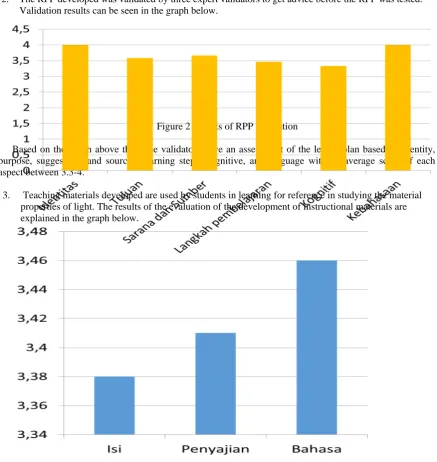
http://dx.doi.org/10.29322/IJSRP.9.08.2019.p9213 www.ijsrp.org 2. The RPP developed was validated by three expert validators to get advice before the RPP was tested.
[image:4.595.87.525.79.542.2]Validation results can be seen in the graph below.
Figure 2 Results of RPP Validation
Based on the graph above the three validators gave an assessment of the lesson plan based on identity, purpose, suggestions and sources, learning steps, cognitive, and language with an average score of each aspect between 3.3-4.
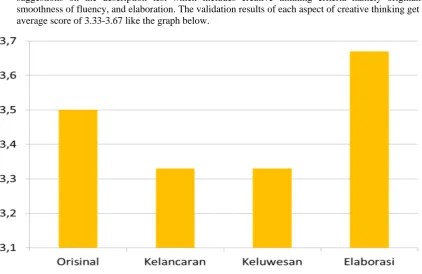
3. Teaching materials developed are used by students in learning for reference in studying the material properties of light. The results of the evaluation of the development of instructional materials are explained in the graph below.
Figure 3 Results of Validation of Teaching Materials
Based on the above graph the three validators gave an assessment of the Teaching Materials based on content, presentation, and language with an average score of each aspect between 3.38-3.46.
http://dx.doi.org/10.29322/IJSRP.9.08.2019.p9213 www.ijsrp.org Figure 4 Results of Student Worksheet Validation
Based on the above graph, the three validators gave an assessment of the worksheet based on identity, material, activity indicators, objectives, images, initial information, experimental steps, observation data space, creative assignments, appropriate models and strategies, and conclusion writing spaces with average scores. average for every aspect between 3-4.
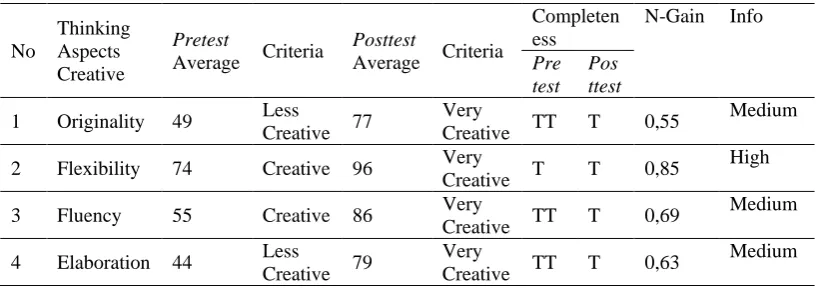
5. The creative thinking ability test sheet is validated by 3 validators. The validator provides opinions or suggestions on the description test which includes creative thinking criteria namely originality, smoothness of fluency, and elaboration. The validation results of each aspect of creative thinking get an average score of 3.33-3.67 like the graph below.
Figure 5 Results of Test Validation
B. Practicality of Learning Devices
[image:5.595.91.514.412.686.2]http://dx.doi.org/10.29322/IJSRP.9.08.2019.p9213 www.ijsrp.org 1. Results of the Implementation of the Learning Plan
[image:6.595.112.522.480.624.2]The results of the implementation of learning get a percentage of 79% -90%
Figure 6 Learning Outcomes Results 2. Results of Observation Analysis of Student Activities
The results of observational analysis of activities that were assessed and observed by two observers during the learning took a percentage between 75% -96%
C. Effectiveness of Material Teaching Learning Materials with a Contextual Approach 1. Student Response
The responses and opinions of students about a learning that has been done is an understanding of student responses. Student responses are presented in the form of questionnaires and given after learning is complete. The results of students' responses to learning using structured inquiry models and brainstorming strategies with percentage details that answered "yes" between 73% -90% while answering "no" between 10% -27%.
2. Test of Creative Thinking Ability
The creative thinking ability test is in the form of a description of 9 questions given to 30 students before being given treatment (pre-test) and after being given treatment (post-test). Data obtained at pretest as many as 28 students were not completed and 2 other students were declared complete with a score above 70. In the posttest activity there was an increase, all students scored above 70.
Based on the results obtained in the pretest-posttest activities that the value obtained by students between the pretest and posttest values increased. Improvement in the test of creative thinking ability can be seen from N-Gain which is in the medium and high category.
Table 1 Student Creative Thinking Ability
No
Thinking Aspects Creative
Pretest
Average Criteria
Posttest
Average Criteria
Completen ess
N-Gain Info
Pre test
Pos ttest
1 Originality 49 Less
Creative 77
Very
Creative TT T 0,55
Medium
2 Flexibility 74 Creative 96 Very
Creative T T 0,85
High
3 Fluency 55 Creative 86 Very
Creative TT T 0,69
Medium
4 Elaboration 44 Less
Creative 79
Very
Creative TT T 0,63
Medium
Based on the table above, the results of tests of students' creative thinking abilities are at the average N-Gain score of 0.55-0.85 with the moderate category on the three creative aspects and the high category on the aspect of flexibility
IV. Discussion
The validity of the learning device developed was seen from the analysis and assessment of three validators. Validator analyzes, provides suggestions / input for improvement and assessment on each learning device developed. A device is said to be used if the device meets criteria that are feasible, practical, and effective (Nieven, 1999). In addition, according to BSNP (2006), a device is deemed feasible and valid in accordance with the criteria, meaning that the device is arranged in a complete and systematic manner so that learning becomes fun, inspiring, interactive, and motivates students to be active in learning. The validation results of the learning device developed in detail are explained as follows.
http://dx.doi.org/10.29322/IJSRP.9.08.2019.p9213 www.ijsrp.org Learning Implementation Plans that have been developed as a guide for teachers in providing learning using structured inquiry models with brainstorming strategies to improve students' creative thinking skills in accordance with the opinion of Sugiyono (2006) that is learning through logical, objective, logical, and rational observation and recording processes in learning and interaction activities to achieve a goal. RPP is assessed or validated by three validators. The results of the assessment of the RPP described in table 4.1 consist of three discussions, namely the presentation of content, language, and time allocation with a total of 11 statements that scored between 3.33-4. After the discussion process, improvements were made to the lesson plan according to the validator's suggestions. Some of the improvements made in the RPP are replacing the formulation of indicators, namely the triggering word into a more operational word so that it is easy to measure or evaluate student activities by replacing them with decisive words. Another improvement is about the stages of structured inquiry model activities that have not been too visible in learning. the stages of structured inquiry model activities are also adapted to several aspects of creative thinking which include the ability to find new ideas known as fluency in thinking, being flexible in developing an idea or flexibility, having a fast and responsive response to certain situations or original, and thinking in detail or elaboration to make it more visible in learning.
The results of the validation of Student Teaching Materials (BAS) developed, are presented in table 4.2 with three discussions, namely about content, presentation, and language getting scores between 3.33-3.67 with a total of 19 statements included in the valid category according to the adapted assessment from Ratumanan and Laurens (2015) which showed that the score was included in the valid category with a slight revision. The three validators gave approval that the teaching materials developed could be used in the study with several revisions. Some of the improvements or revisions suggested by the validator are the fonts used should be replaced so that they are more clearly read by elementary school students, it is recommended to present the images in each experimental step both experiments about the nature of light and about making optical devices, and need diagram or explanation of human processes seeing an object around it. According to Nieven (1999) in developing material in a teaching material must be adjusted to the level of knowledge of students.
Other learning tools that are validated after RPP and teaching materials are Student Worksheets (LKS). LKS developed based on a structured inquiry model with a brainstorming strategy was measured by three expert validators presented in table 4.3 getting valid results with scores between 3-4 with a total of 11 statements. LKS given to students consists of four LKS. LKS 1 contains the experimental activities of light properties propagating straight and penetrating clear objects that stimulate students to think creatively solve problems that occur related to events in everyday life about light that propagates straight, students also must determine objects that can be penetrated by light an observation table. The next LKS, which is LKS 2, contains experiments on the nature of light that can be reflected and decomposed. In this learning activity students are given several mirrors which are included in a flat, concave and convex mirror. Students are stimulated to express their creative ideas when distinguishing the results of shadows on the three mirrors. The activity carried out by the students is to prove that light can be described by making bubbles from the liquid soap that is seen with the sun's heat. LKS 3 contains student activities about the last nature of light, namely light can be refracted. Problems in daily life about refraction of light are presented in the LKS and make students with the group discuss seeking solutions to problems. The last LKS is a four LKS about making a simple optical instrument (kaleidoscope). The selection of kaleidoscope as an optical instrument that will be made by students with the group is because this is a new thing for students. Previously students were only taught how to make a color spectrum and use a periscope on light material explanations. The kaleidoscope that is made combining the properties of light can be reflected.
Suggestions given by the validator on LKS one to four are at each stage of the steps in the LKS should be given a picture so that students are more interested and can understand clearly when conducting experiments with their groups. LKS used contains experiments that must be done by students and groups that can improve their creative thinking skills. In this learning activity students are expected to be active in each activity. Students also have to build collaboration with groups and express creative ideas that will later be agreed upon in filling out the questions contained in the LKS. The activity in learning science lies in two aspects, namely the aspect of acting and active thinking. Science learning in schools is centered on students and emphasizes the importance of active learning which will change the opinion that teachers always provide information and become a source of knowledge for students (NRC, 1996).
http://dx.doi.org/10.29322/IJSRP.9.08.2019.p9213 www.ijsrp.org accordance with Permendikbud No. 54 of 2013 concerning Competency Standards for Primary and Secondary Education Graduates.
The next component of the learning device after the RPP syllabus, LKS and teaching materials is a test of creative thinking skills described in table 4.5. The test sheet was developed to find out the students' creative thinking skills after the inquiry model was structured with a brainstorming strategy. This test is given before and after teaching and learning activities. The creative thinking ability test sheet is used to determine the ability of students to think original, smooth, flexible, and detailed. In addition, tests are also arranged to provide training and motivate students to find knowledge by themselves. This is supported by the opinion of Schunk (2012) which explains that students need to be trained, get feedback, obtain tinjuan and explanations, and get motivations that affect learning. Assessment was carried out in the form of pretest and posttest.
Tests given to students are in the form of descriptions. Each question contains aspects of creative thinking. The test of creative thinking ability uses a description of the questions that students can answer freely and broadly according to their imagination and opinions. In some questions requires student answers more than one answer so students can write various creative ideas about solutions to problems that are in the question. Assessment of the answers to each question ranges from 1-4 according to the existing assessment criteria and is given a score of 0 if the student does not provide an answer to the question. The creative thinking aspects of originality, fluency, and flexibility consist of each of the 2 questions, while the elaboration aspects have 3 questions with the total test questions being 9 questions.
The results of the validation assessment of the creative thinking ability test by three validators are presented in table 4.5 by getting a score between 3.33-3.67 which is included in the valid category and can be used without revision. The validator only gives suggestions on the presentation of the images contained in the test questions. It should be clearer by enlarging the size. Creative thinking tests are arranged according to the environment around students that are often found and found so students are not familiar and can apply new knowledge gained in everyday life. Problem solving or learning like this requires conceptual understanding so students can do what they have learned in real life (Anderson and David, 2001).
Based on the description above, the results of the assessment of RPP, BAS, LKS, syllabus and creative thinking ability tests are valid, so that they can be used in research with several improvements and improvements to the selection of letters that fit elementary school students, choosing the appropriate operational verbs on the indicator so that it is easy to take measurements or assessments, present images and diagrams in the process of seeing an object, present images at each step of the experiment, show steps for activities that use a structured inquiry model with brainstorming strategies for each learning activity, and time management that must be correct really noticed because all activities contain experiments.
The next discussion about learning devices after validity is practicality. The practicality of structured inquiry learning models with brainstorming models was analyzed through the implementation of RPP and student activities during learning. The results of the analysis of the implementation of RPP meetings 1, 2, and 3 obtained a well implemented category and were very well presented in tables 4.6 to 4.8 with a percentage of 75% -100% in each activity. The activities observed consisted of 5 research focuses, namely preliminary activities, core activities, final activities, classroom management, and time management. During the learning process, researchers are observed by two observers. Observers have the duty to observe carefully whether the learning activities carried out by the researcher are appropriate or not in accordance with the lesson plan. This is in accordance with the opinion of Sugiyono (2016) a process of observation and recording that is systematic, logical, objective, and rational regarding various activities in the form of thoughts and in interactions to achieve certain goals. Observers try to observe whether there are learning activities that appear and do not appear, or learning activities that are only discussed quickly and not too detailed by the researcher. The results of observations that have been made indicate that learning activities are appropriate, all activities have arisen, researchers are coherent in teaching, and can manage the class well. This is in accordance with a study by Sari et al (2015) on the Implementation of Guided Inquiry Combined with Brainstorming Activities to Improve Integrated Science Process Skills in Biology Learning in eleventh grade students of MIA 2 Karanganyar Senior High School 1. This research proves that by applying the inquiry model and brainstorming helps students understand science concepts or material by the way they directly find out their knowledge by conducting experimental activities in groups that work together to solve a problem by discussing and mutually agreeing.
http://dx.doi.org/10.29322/IJSRP.9.08.2019.p9213 www.ijsrp.org very high student activity in receiving learning with a percentage of 75% -96% in each activity in accordance with the criteria delivered by Riduwan (2010). They carry out learning activities according to the focus of research that supports them to be active, work together and play a creative role in solving problems in daily life related to the subject matter of light.
A good learning tool is seen in terms of validity, practicality, and effectiveness. The effectiveness of learning devices can be analyzed from the results of student responses and the results of tests of creative thinking skills. Questionnaire for student responses is given at the end of the lesson, namely at the third meeting of each class. Questionnaire for student responses was filled by 30 students who were the subjects of the study. The results of student responses are presented in table 4.12 with details of the percentage that answered "yes" between 73% -90% while answering "no" between 10% -27% in statements relating to the implementation of learning. In accordance with Riduwan's assessment criteria (2010) the results of student responses belong to the strong and very strong category of learning. They were interested in structured inquiry model learning with brainstorming strategies because the model and strategy jasmine students gave rise to creative ideas in the form of opinions which were grouped together and discussed to be agreed upon. Students also feel that learning with these models and strategies is easy to understand especially given a companion book, which is student teaching materials that have been given interesting colors and images so that students are more interested and motivated to read them. Learning carried out by students with structured inquiry models with brainstorming strategies is very fun to increase student motivation for activities carried out high by marked positive responses given by students. This statement is in line with the opinion expressed by Kurl Kelvin (Sanjaya, 2014) that factors that can encourage individuals to behave because of the motivation that arises because there are benefits of certain attractions.
The effectiveness of a device can also be seen from the results of students' creative thinking tests. The results of the students' creative thinking ability test presented in table 4.13 show students have creative thinking skills with an average gain of 0.44-0.93 which is included in the medium and high categories. there was an increase in the results of the students' creative thinking test at the pretest and posttest. Students who get the complete score are students who get a score of more than 70. At the pretest there are two students who complete from 30 students, while in the post all students get a complete category. The low level of creative thinking ability of students who were asked on the pretest questions because students had not obtained the question information. In addition, students are also not used to solving problems that require themselves to think creatively. Another factor that causes the low level of creative thinking of students at pretest is because students do not have direct learning with them looking for answers from experiences done by students, so that there is a difference of understanding in working on a problem. The test uses a structured inquiry model with a brainstorming strategy that consists of 9 problem questions, each of which contains aspects of creative thinking including, original, flexibility, fluency, and elaboration. N-gain calculation is not only done on students but also on aspects of creative thinking presented in table 4.14. The original aspects, fluency, and elaboration get moderate gain while the flexibility aspect gets high gain. The average score of n-gain aspects of creative thinking is between 0.55-0.85. This is in accordance with research by Kadir et al. (2017) on the Implementation of Open-Inquiry Approaches to Improve Students' Learning Activities, Responses, and Mathematical Creative Thinking Skills combined with research by Romadhoni (2014) on the Effectiveness of Applying Brainstorming Methods to Improvement Interests and Economic Learning Achievements of Grade X Students at YPKK 3 in Sleman. The results of this study indicate that by applying the inquiry model and adding brainstorming strategies to science learning make students improve imagination, creativity, and work together in solving problems.
V. Conclusion
After doing the research, it can be concluded that the structured inquiry learning model with appropriate brainstorming strategies is used in terms of its validity, practicality, and effectiveness as well as improving students' creative thinking skills. The advice that can be given is if you want to improve your ability to think creatively, use a structured inquiry model with brainstorming strategies that have been proven to improve the creative thinking skills of elementary school students. If using a structured inquiry model learning tool with a brainstorming strategy, time preparation and management needs to be considered, because the learning involves experimental activities and requires considerable time. Research needs to be conducted for the wider trial subjects in the use of structured inquiry model learning tools with brainstorming strategies
VI. References
Carin. (2009). Hakikat Pembelajaran IPA. Diunduh dari http://www.anwarholil.blogspot.com/2009/01/hakikat-pembelajaran-ipa.html Depdiknas. (2006). Peraturan Menteri Pendidikan Nasional No. 20, 22, 23, 24, tentang Standar Isi dan SKL untuk Satuan Pendidikan
http://dx.doi.org/10.29322/IJSRP.9.08.2019.p9213 www.ijsrp.org Handriani, Harjono, Aris. (2015). Pengaruh Model Pembelajaran Inkuiri Terstruktur Dengan Pendekatan Saintifik Terhadap
Kemampuan Berpikir Kritis Dan Hasil Belajar Fisika Siswa. Jurnal Pendidikan Fisika dan Teknologi (ISSN. 2407-6902). Volume I No 3. Diunduh tanggal 25 april 2018
Ismunandar. (2013). Inkuiri dan Standar-standar Pendidikan Sains Nasional, Sebuah Panduan untuk Pengajaran dan Pembelajaran. Bandung: National Academy Press.
Kadir, Lucyana, dan Gusni Satriawati. (2017). The Implementation Of Open-Inquiry Approach To Improve Students’ Learning Activities, Responses, and Mathematical Creative Thinking Skills. Journal on Mathematics Education ISSN 2087-8885. Diunduh tanggal 11 Juni 2018
Nieven, N. 1999. Prototype to Read Product Quality: Design Approaches and Tools in Education and Training. Netherland: Springer- Science+Business Media, B.V.
National Research Council (NRC). (1996). National Science Education Standards.Washington, DC: National Academy Press Riduwan. (2010). Skala Pengukuran Variabel-variabel Penelitian. Bandung: Alfabeta
Romadhoni, Sarif. (2014). Efektivitas penerapan metode brainstorming terhadap peningkatan minat dan prestasi belajar ekonomi siswa kelas X SMK YPPK 3 Sleman. Diunduh darihttps://eprints.uny.ac.id/16057/1/SKRIPSI tanggal 26 Mei 2018
Sari, Dewi Puspita, Amalia Rosyada, dan Murni Ramli. (2015). Diunduh pada http://jurnal.fkip.uns.ac.id/index.php/pdg/article/view/7340 13 Januari 2019
Schunk, Dale. H. (2012). Learning Theories: An Educational Perspectives, 6th Edition. New York: Pearson Education Inc Sudarma. (2013). Strategi Berpikir Kreatif. Jakarta: Indeks.
Sugiyono. (2013). Metode Penelitian Pendidikan. Bandung: Alfabeta
Supardi. (2014). Ide-Ide Kreatif Mendidik Aak Bagi Orang Tua Sibuk. Yogyakarta: Ar-Ruzz Media