R E S E A R C H
Open Access
Surgical trials and trial registers: a cross-sectional
study of randomized controlled trials published in
journals requiring trial registration in the author
instructions
Julia LS Hardt
1, Maria-Inti Metzendorf
2and Joerg J Meerpohl
3*Abstract
Background:Trial registration and the reporting of trial results are essential to increase transparency in clinical research. Although both have been strongly promoted in recent years, it remains unclear whether they have been successfully implemented in surgery and surgery-related disciplines. In this cross-sectional study, we assessed whether randomized controlled trials (RCTs) published in surgery journals requiring trial registration in their author instructions were indeed registered, and whether the study results of registered RCTs had been submitted to the trial register and were thus publicly available.
Methods:The ten highest ranked surgery journals requiring trial registration by impact factor (Journal Citation Reports, JCR, 2011) were chosen. We then searched MEDLINE (in PubMed) for RCTs published in the selected journals between 1 June 2012 and 31 December 2012. Any trials recruiting participants before 2004 were excluded because the International Committee of Medical Journal Editors (ICMJE) first proposed trial registration in 2004. We then searched the World Health Organization (WHO) International Clinical Trials Registry Platform (ICTRP) to assess whether the identified RCTs were indeed registered and whether the results of the registered RCTs were available in the register.
Results:The search retrieved 588 citations. Four hundred and sixty references were excluded in the first screening. A further 25 were excluded after full-text screening. A total of 103 RCTs were finally included. Eighty-five of these RCTs (83%) could be found via the ICTRP. For 7 of 59 (12%) RCTs, which were registered on ClinicalTrials.gov, summary study data had been posted in the results database.
Conclusions:Although still not fully implemented, trial registration in surgery has gained momentum. In general, however, the submission of summary study data to ClinicalTrials.gov remains poor.
Keywords:Trial registration, Randomized controlled trials, Surgery journals, Results reporting
Background
Selective reporting of study results distorts the body of evidence available for clinical decision making. In recent years, several guidelines and recommendations have been published in order to increase transparency of sci-entific research. One of the key policy initiatives of this
development towards more transparency was the call for the obligatory registration of all clinical trials in public trial registers. In September 2004, the International Com-mittee of Medical Journal Editors (ICMJE) proposed‘ com-prehensive trial registration as a solution to the problem of selective awareness’. In order to advance this goal, the ICMJE decided to require the registration in a public trials register as a mandatory condition for the consideration for the publication of a study report. The ICMJE trial registration requirement policy applies to all trials which started patient recruitment beginning 1 July 2005, and was * Correspondence:[email protected]
3Department of Medical Biometry and Medical Informatics, German Cochrane Centre, University Medical Center Freiburg, Berliner Allee 29, 79110 Freiburg, Germany
Full list of author information is available at the end of the article
adopted by all ICMJE member journals [1]. Since then, many other journals in addition to the ICMJE member journals have adopted the ICMJE policy.
The implementation of comprehensive mandatory trial registration would allow scientists, clinicians, and study participants to track trials and prevent biased reporting, for example the non-reporting of trials with negative or inconclusive results. Therefore, even unfavorable trial re-sults would not be lost to the pool of medical know-ledge. Based on the information provided by the register, prospective investigators would be able to formulate new research questions, plan new trials to fill the gaps in the knowledge base, and avoid unnecessary duplications [2]. Furthermore, public electronic access to all trials could inspire researchers to collaborate and could also support trial recruitment [3].
In April 2007, the ICMJE expanded the definition of clin-ical trials that have to be registered by adopting the World Health Organization (WHO) definition of a clinical trial, which also includes preliminary trials (phase I trials). The deadline for the implementation of these modifications was 1 July 2008 [4]. One month after the ICMJE’s expansion of the definition, in May 2007, the WHO launched its Inter-national Clinical Trials Register Platform (ICTRP) in order to offer an international portal for identifying, deduplicat-ing, and searching trials from registers all over the world. The ICTRP requires a minimum trial registration data set consisting of 20 items [2], which is also supported by the ICMJE [5]. As of 1 July 2007, the member journals of the Surgery Journal Editors Group (SJEG) require registration of all prospective clinical trials prior to the enrollment of the first patient [6]. Trials which had started recruitment before the deadline had to register before editorial review. Manuscripts are now required to specify the registration number in the abstract [7].
But how did all these policy recommendations, regula-tions, and statements influence the practice of trial regis-tration? By examining the development and growth of ClinicalTrials.gov, the largest public trial register, which was created as a result of the Food and Drug Administra-tion ModernizaAdministra-tion Act (FDAMA) in 1997, it can be con-cluded that trial registration has gained momentum and that there has been major progress within the last decade. As of 13 November 2013, ClinicalTrials.gov included more than 154,000 studies from across all 50 American states and 185 countries worldwide (http://www.clinical-trials.gov/ct2/resources/trends).
In September 2008, the ClinicalTrials.gov results data-base was launched to meet the requirement in Section 801 of the Food and Drug Administration Amendments Act (FDAAA 801) that study sponsors or principal in-vestigators report basic results for‘applicable clinical tri-als’ (ACTs). A trial is considered ‘applicable’ if it meets the following criteria: phase II to IV interventional study
involving drugs or medical devices regulated by the FDA; at least one site in the USA; and initiated or on-going as of 27 September 2007, or later [8]. For all ap-plicable trials, the results have to be submitted no later than 12 months after the trial’s completion date (http:// www.clinicaltrials.gov/ct2/manage-recs/fdaaa - WhenDo INeedToRegister). The summary results data in the results database are presented mainly in a tabular format and are publicly accessible. This does not only benefit researchers and journal editors but also patients and the general pub-lic. The main objectives of the ClinicalTrials.gov results database are to reduce publication bias and selective out-come reporting and to promote complete reporting by structured data entry [9].
Although the facts and numbers presented above indi-cate a remarkable success of the initiatives and efforts to promote trial registration and results reporting, it remains unclear whether these have been successfully imple-mented as integral parts of clinical research in surgery and surgery-related disciplines. We therefore chose to explore whether randomized controlled trials (RCTs) published in the ten highest ranked (by impact factor) surgery journals that require trial registration in their author instructions were indeed registered. We also chose to address the question of whether the study results of the registered RCTs were publicly available on the trial register website.
Methods
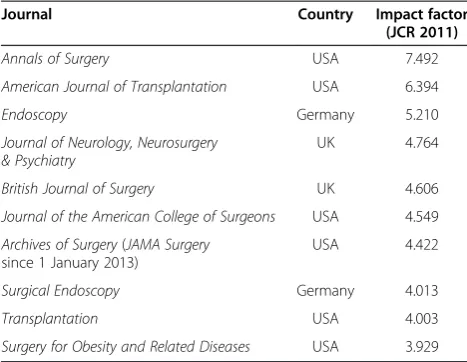
We accessed the Journal Citation Reports (JCR) Science Edition 2011 on 8 January 2013. Two authors (JH and MIM) independently identified the first ten journals among the top surgery journals by impact factor that re-quired trial registration in the author instructions on their websites (Table 1). All journals not explicitly re-quiring trial registration in their author instructions were excluded. We intentionally chose the ten journals with the highest impact factors assuming that their pol-icies and publishing practices would meet the current highest standards. Moreover, we expected that trialists publishing in such top-class journals would be more likely to act in an exemplary manner with regard to trial registration and results reporting.
The American Journal of Surgical Pathology (impact factor 4.352) and Annals of Surgical Oncology (impact factor 4.166) were excluded because the author instruc-tions of these journals did not require trial registration. JCR, Journal Citation Reports.
the PubMed format [10]. The search strategy was slightly modified to fit the surgical setting (Additional file 1).
One author (JH) screened titles and abstracts, excluded clearly irrelevant references, and downloaded full-texts of all potentially relevant citations. Then, two authors (JH and MIM) independently screened the full-texts and ex-cluded non-randomized studies. Trials recruiting partici-pants prior to 2004 were also excluded because the ICMJE first proposed comprehensive trial registration in a state-ment published in September 2004, which requires regis-tration in a public trials register for trials that started enrollment after 1 July 2005 only. All discrepancies were resolved by re-examining the full-texts and in discussion with a third author (JM).
In the next step, two authors (JH and MIM) independ-ently searched the ICTRP (27 February 2013) for infor-mation on the registration of all included RCTs. Trials were searched for either with the registration identifica-tion quoted in the publicaidentifica-tion or, if this identificaidentifica-tion was not provided, with different keywords describing the topic of the trial. We searched using the ICTRP’s stand-ard search form, which searches within the title, primary sponsor, health condition(s), intervention(s), countries of recruitment, main identification, and secondary identifi-cation(s) of the trial data. Additionally, we used Boolean operators to broaden or narrow the search. If such a search was not successful, we took a more sensitive ap-proach by searching first for the main author’s name, second for the most specific terms of the institutional name stated in the authors’ affiliations, or third for the country or city the trial was conducted in combined with one or two specific terms describing the trial. Trials not found through these extensive ICTRP searches were considered to be unregistered.
Reviewing the full-texts and the information given on the trials register website, we collected data regarding the fol-lowing topics and parameters: sample size, country of main investigator, national versus multinational and monocenter versus multicenter setting, surgical subspecialty, study ob-jective, and start of patient recruitment. Furthermore, we extracted information on whether trial registration was ex-plicitly mentioned in the article, meaning whether the art-icle included at least one full sentence describing that the trial was registered in a specific trial register. We also reviewed whether the registration number was specified in the title, abstract, or main text, since the SJEG member journals as well as the ICMJE demand specifications of the trial registration number in the abstract as evidence of registration [7]. Moreover, the ICMJE even recommends that authors list the trial registration number the first time a trial acronym is used in the manuscript (http://www. icmje.org/publishing_10register.html).
Finally, the primary trial registers were checked for study results of the registered RCTs. We defined study results as either a citation to a publication reporting the trial or, in the case that ClinicalTrials.gov was the pri-mary register, if aggregate sumpri-mary data were provided in addition to a citation. Two authors (JH and MIM) ex-tracted the following information for the registered RCTs: primary register; link to a PubMed citation or list of publication(s) provided by the investigators; and, if ClinicalTrials.gov was the primary register: aggregate summary study data posted in the ClinicalTrials.gov re-sults database; automatic link to a PubMed citation mapped via the ClinicalTrials.gov identifier (NCT num-ber); and study start date and study registration date (‘study first received’ in ClinicalTrials.gov) in order to identify whether trials were registered retrospectively or prospectively.
We did not explicitly assess if the RCTs registered in ClinicalTrials.gov were ACTs according to the FDAAA 801. Ethics approval was not required for this study.
Results
There were 199 journals in the subject category‘surgery’ indexed in JCR 2011. The first ten surgery journals with the highest impact factors ranging from 7.492 to 3.929, which explicitly required trial registration in their online author instructions, were chosen (Table 1).
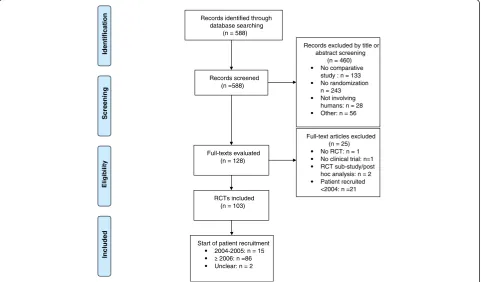
[image:3.595.56.290.122.303.2]The search for RCTs published between 1 June 2012 and 31 December 2012 retrieved 588 citations. From these, 460 clearly irrelevant references were excluded by title or abstract screening. We then evaluated the full-texts of the remaining 128 references (Additional file 2) and excluded 25 of these for the following reasons: 21 studies had started patient recruitment prior to 2004, two citations reported sub-studies of older RCTs, one re-ported a non-randomized trial, and one was a study not
Table 1 The first ten journals among the top surgery journals by impact factor that required trial registration in the author instructions
Journal Country Impact factor
(JCR 2011)
Annals of Surgery USA 7.492
American Journal of Transplantation USA 6.394
Endoscopy Germany 5.210
Journal of Neurology, Neurosurgery & Psychiatry
UK 4.764
British Journal of Surgery UK 4.606
Journal of the American College of Surgeons USA 4.549
Archives of Surgery(JAMA Surgery since 1 January 2013)
USA 4.422
Surgical Endoscopy Germany 4.013
Transplantation USA 4.003
concordant with the WHO definition of a clinical trial (http://www.who.int/ictrp/en/). This last study had inves-tigated whether there were any differences in the learning outcomes of healthy participants who had trained to proficiency on low- or high-fidelity laparoscopic surgical simulators. The remaining 103 citations were further in-vestigated. The majority of the RCTs (n = 86; 83%) had initiated patient recruitment during or after 2006, 15 RCTs (15%) had started to recruit participants in 2004 or 2005, and two RCTs (2%) did not state the start of re-cruitment (Figure 1).
Trial registration
Eighty-five of the 103 analyzed RCTs (83%) could be iden-tified in the ICTRP (Table 2; Additional file 3). Of these 85 RCTs, 15 (18%) had been registered prospectively, 45 (53%) had been registered retrospectively, and 21 (25%) had been registered within the same month as the study start date. For the remaining four studies, we were not able to find information on the study start and registration dates for the following reasons: three of the RCTs were only registered in the European Union Clinical Trials Register (EU-CTR), which does not provide the date of study registration, and one RCT was registered in a Belgian register, which is publicly not accessible. All RCTs that were prospectively registered had enrolled the first patient in or after 2006. None of the RCTs
which started patient recruitment in 2004 or 2005 had been registered prospectively (Table 2).
Seventeen (81%) of the 21 excluded RCTs with patient recruitment before 2004 had been registered. All of them had been retrospectively registered after enrollment of the first patient.
Sixty-eight (80%) of the 85 registered trials specified the registration identifier: 25 in the main text only, 21 in the abstract and main text, ten in the abstract only, two in the title and main text, one in the acknowledgments sec-tion, and nine below or above the list of author affiliations (two of them additionally specified the identifier in the main text and abstract, respectively). The 17 (20%) regis-tered trials without specification of the registration num-ber were not classified as ‘registered’ unless they were found in the ICTRP searching with words extracted from the publication. One RCT which specified the registration number in the abstract and main text reported the wrong number twice. The reported number actually belonged to another RCT of the same first author, and we discovered the correct NCT identifier by searching the ICTRP. More-over, we found four registered RCTs which were catego-rized as a prospective cohort study (n = 3) or prospective case–control study (n = 1).
Forty-four of the 68 (65%) RCTs specifying the regis-tration number also mentioned trial regisregis-tration expli-citly in a full sentence in the abstract and/or main text.
Records identified through database searching
(n = 588)
Screeni
n
g
Incl
u
ded
Eli
g
ib
il
ity
Identificat
ion
Records screened (n =588)
Records excluded by title or abstract screening
(n = 460) No comparative study : n = 133 No randomization: n = 243 Not involving humans: n = 28 Other: n = 56
Full-texts evaluated (n = 128)
Full-text articles excluded (n = 25) No RCT: n = 1 No clinical trial: n=1 RCT sub-study/post hoc analysis: n = 2 Patient recruited <2004: n =21 RCTs included
(n = 103)
Start of patient recruitment 2004-2005: n = 15
[image:4.595.58.540.433.715.2]2006: n =86 Unclear: n = 2
Eighteen of the 103 included RCTs (17%) did neither report trial registration nor could they be found in the ICTRP. Upon examination of the unregistered RCTs, we noted the following differences to the registered RCTs: all these RCTs were national and all had been under-taken in a single-center setting, except for three RCTs conducted at two to three centers. In addition, it seemed that the median sample size was smaller (66 versus 126; Table 3).
Reporting results
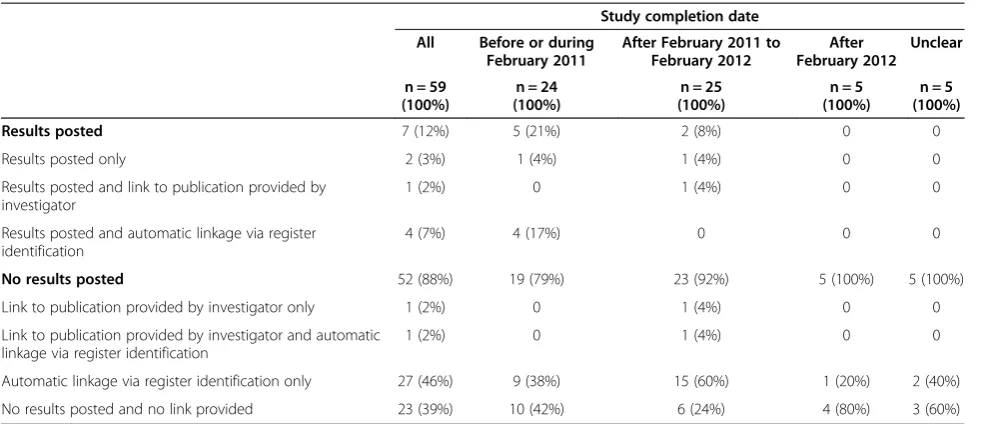
Sixty-one of the 85 registered RCTs were registered on ClinicalTrials.gov. One of these RCTs was still ongoing and published as a study protocol only, another one had been withdrawn before enrollment of the first patient. Both were excluded from further analysis, and the remaining 59 RCTs were included. For 7 (12%) of them,
results had been posted in the results database (Table 4). In our sample, the proportion of RCTs with summary data posted on ClinicalTrials.gov was smaller among the retrospectively registered trials in comparison to RCTs with prospective registration (3/45 (7%) versus 3/15 (20%); relative risk 0.33; 95% confidence interval 0.08, 1.48;P= 0.15).
[image:5.595.56.542.101.255.2]As mentioned in the Methods section, we did not ex-plicitly assess whether the RCTs registered in Clinical-Trials.gov were ACTs according to the FDAAA 801. However, there are several reasons to assume that most of the included RCTs were not ACTs. First, not all of them had at least one site in the USA and were initiated or ongoing as of 27 September 2007, or later. Second, several included RCTs compared surgical procedures in-stead of drug or device interventions. Thus, we presume that most of the analyzed trials were not required to
Table 2 Registration of RCTs stratified by start of patient recruitment
Start of patient recruitment
All 2004 to 2005 During or after 2006 Unclear
n = 103 (100%) n = 15 (100%) n = 86 (100%) n = 2 (100%)
Registered RCTs 85 (83%) 14 (93%) 71 (83%) 0
Registration (number) mentioned in article 68 (80.0%) 11 (71.4%) 57 (70.4%)
Registration (number) not mentioned in article 17 (20.0%) 3 (21.4%) 14 (19.7%)
Registered prospectively 15 (17.6%) 0 15 (21.1%)
Registered retrospectively 45 (52.9%) 12 (85.7%) 33 (46.5%)
Study start and registration within same month 21 (24.7%) 1 (7.1%) 20 (28.2%)
Unclear time relation between study start and registration 4 (4.7%) 1 (7.1%) 3 (4.2%)
Not registered 18 (17%) 1 (7%) 15 (17%) 2 (100%)
[image:5.595.57.539.503.726.2]RCT, randomized controlled trial.
Table 3 Study characteristics of the included RCTs
Study characteristic Registered RCTs (n = 85) Unregistered RCTs (n = 18)
National,
multinational setting
68 (80%), 17 (20%) 18 (100%), 0
Monocenter, multicenter setting
49 (58%), 36 (42%) 15 (83%), 3 (17%)
Sample size (median (range))
126 (12 to 66,000) 66 (12 to 256)
Country of main investigator
USA (n = 13), Germany (n = 8), Netherlands (n = 7), China (n = 6), Italy (n = 6), Norway (n = 6), UK (n = 5), Japan (n = 4), Austria (n = 3), Belgium (n = 3), Denmark (n = 3), South Korea (n = 3), Spain (n = 3), Sweden (n = 3), Switzerland (n = 3), Finland (n = 2), Egypt (n = 2), New Zealand (n = 2), and Australia, France, and India (for all n = 1)
South Korea (n = 5), USA (n = 5), Brazil (n = 2), UK (n = 2), and China, Finland, India, and Ukraine (for all n = 1)
Surgical subspecialty or surgery-related discipline
General surgery (n = 24), endoscopy/gastroenterology/ gastrointestinal surgery (n = 14), nephrology/kidney transplantation/surgery (n = 10), bariatric surgery (n = 6), hepatology/liver transplantation/hepatobiliary surgery (n = 6), anesthesiology/surgery (n = 5), pediatrics/pediatric surgery (n = 3), psychiatry/neurology/surgery (n = 5), cardiology/heart transplantation/cardiothoracic surgery (n = 2), colorectal surgery (n = 2), and other (n = 8)
General surgery (n = 9), gastroenterology/gastrointestinal endoscopy/gastrointestinal surgery (n = 3), anesthesiology (n = 2), neurosciences/neurology/psychiatry/otolaryngology (n = 2), pediatric surgery (n = 1), and reconstructive breast surgery (n = 1)
report summary data to ClinicalTrials.gov according to the FDAAA 801.
Twenty-five RCTs had been registered in trial registers other than ClinicalTrials.gov: International Standard Ran-domised Controlled Trial Number Register (ISRCTN; n = 7), EU-CTR (n = 4), The Netherlands National Trial Regis-ter (NTR; n = 3), Australian New Zealand Clinical Trials Registry (ANZCTR; n = 2), German Clinical Trials Regis-ter (DRKS; n = 2), Japan Primary Registries Network University Hospital Medical Information Network (JPRN-UMIN; n = 4), Belgian register (n = 1), Chinese Clinical Trial Registry (ChiCTR; n = 1), and Clinical Trials Registry -India (CTRI; n = 1). Of these registers, DRKS, ISRCTN, CTRI, ANZCTR, NTR, and JPRN-UMIN provide a data field for a link to publications on the study record page. The study record page of only 5 (26%) of the 19 RCTs pri-marily registered in these registers included a link to PubMed citations or a list of publications. EU-CTR and ChiCTR did not provide a data field for links to publica-tions, and the Belgian register is not publicly accessible.
Discussion
Eighty-five of the 103 analyzed RCTs (83%) were regis-tered and 80% (68/85) of the regisregis-tered trials specified the registration identifier, for example the NCT number, in the study report. In addition, 65% (44/68) of RCTs specifying the registration number also mentioned trial registration explicitly in a full sentence in the abstract and/or main text. Though the ICMJE trial registration
policy requires trial registration before the enrollment of the first patient, only 18% of the registered trials had been registered prospectively. The majority were regis-tered retrospectively (53%) or within the same month as the study start date (25%). This implies that with regard to the vast majority of registered trials, it cannot be ex-cluded that initial details of study design, objective, eligi-bility criteria, or primary and secondary outcomes were changed after study start. For this specific reason, retro-spective registration is only suboptimal. On the other hand, retrospective registration is helpful for the identifi-cation of trials, especially those still ongoing or not yet published.
The results of only 7 (12%) of the 59 RCTs registered on ClinicalTrials.gov had been submitted to the Clinical-Trials.gov results database. As mentioned before, we did not assess whether these 59 RCTs were ACTs. Thus, it re-mains unclear whether the legal requirements to submit aggregate summary data to ClinicalTrials.gov really per-tain to the included RCTs. Nonetheless, investigators of all trials registered in ClinicalTrials.gov can voluntarily sub-mit summary data to the results database. Though the legal requirement to report results applies only to certain interventional trials, sponsors and investigators should be encouraged to use the results database for timely dissem-ination of their research findings publicly [11].
[image:6.595.56.547.99.311.2]For 28 (47%) of the trials registered on ClinicalTrials. gov there was at least a link provided to publications, which are automatically mapped to these studies by the
Table 4 Results availability for registered RCTs stratified by completion date
Study completion date
All Before or during February 2011
After February 2011 to February 2012
After February 2012
Unclear
n = 59 (100%)
n = 24 (100%)
n = 25 (100%)
n = 5 (100%)
n = 5 (100%)
Results posted 7 (12%) 5 (21%) 2 (8%) 0 0
Results posted only 2 (3%) 1 (4%) 1 (4%) 0 0
Results posted and link to publication provided by investigator
1 (2%) 0 1 (4%) 0 0
Results posted and automatic linkage via register identification
4 (7%) 4 (17%) 0 0 0
No results posted 52 (88%) 19 (79%) 23 (92%) 5 (100%) 5 (100%)
Link to publication provided by investigator only 1 (2%) 0 1 (4%) 0 0
Link to publication provided by investigator and automatic linkage via register identification
1 (2%) 0 1 (4%) 0 0
Automatic linkage via register identification only 27 (46%) 9 (38%) 15 (60%) 1 (20%) 2 (40%)
No results posted and no link provided 23 (39%) 10 (42%) 6 (24%) 4 (80%) 3 (60%)
ClinicalTrials.gov identifier (NCT number). In 29 (48%) cases there was no reporting of results or link to publi-cations available at all.
Nguyenet al. recently published data on the public avail-ability of trial results assessing cancer drugs in the USA. They analyzed 646 trials (including 209 RCTs) regarding results posting at ClinicalTrials.gov and/or publication of results in journals. One year after the completion of the tri-als, the results of only 9% of all trials (12% of the RCTs) were available at ClinicalTrials.gov [12]. These data are similar to our own results. Moreover, Nguyenet al. reports that, despite the FDAAA, results of almost half of the trials assessing cancer drugs were not publicly available (neither at ClinicalTrials.gov nor in journals) three years after com-pletion of the trials [12].
Jones et al. recently conducted a cross-sectional ana-lysis of 585 trials with at least 500 participants, which were prospectively registered with ClinicalTrials.gov to estimate the frequency with which results of large RCTs registered with ClinicalTrials.gov are not publicly avail-able. Almost one third (n = 171) of the included 585 RCTs remained unpublished. Of the 171 unpublished RCTs, almost 80% (n = 133) had no results available in the ClinicalTrials.gov results database [13].
Comparing our findings regarding trial registration to those from disciplines not related to surgery, it seems that the awareness of the need for trial registration has grown in the surgical research community. The pro-portion of registered RCTs in this study by far exceeds the reported numbers from other recent trials. Milette
et al. investigated the transparency of outcome reporting and trial registration of RCTs published in top psycho-somatic and behavioral health journals between January 2008 and September 2009 [14]. Of the 63 articles reviewed, only 13 (20.6%) had been registered. A similar proportion of registered trials were reported by McGeeet al. who con-ducted a cohort study of all RCTs in kidney transplantation published between October 2005 and December 2010 and determined trial registration and declaration of registration by authors [15]. Of the 307 included trials, only 74 (24%) had been registered; 44 (59%) of the registered trials de-clared trial registration details at least within one study report. Moreover, the authors investigated factors as-sociated with trial registration. Trial registration was more likely if the trial was published more than once, in later years, or if it was reported in journals following the ICMJE guidelines. Furthermore, trials conducted in the USA were significantly more likely to be registered than European trials. Trial registration was also less likely for tri-als not declaring their funding source. Regarding the fac-tors associated with declaration of registration details, McGee et al. found that registered trials were more likely to declare registration details in related reports if they were published in a journal complying with the ICMJE
guidelines or in later years (2007 to 2010). Compared to European trials, trials conducted globally were less likely to declare registration details. Interestingly, USA trials were no more or even less likely to declare registration de-tails than trials conducted in Europe.
Califf et al. recently examined the characteristics of clinical trials (in three different medical specialties: car-diovascular, mental health, oncology) registered in Clini-calTrials.gov. Their analysis showed that the proportion of prospectively registered trials increased over time (from 33% in October 2004 to September 2007 to 48% in October 2007 to September 2010) [16]. This is con-cordant with our results (Table 2).
Reveiz et al. investigated another important aspect of trial registration: its potential influence on reporting qual-ity [17]. The authors conducted a cross-sectional study of 148 RCTs from the highest ranked journals (JCR 2006) and analyzed this sample with regard to adherence to key methodological items of the Consolidated Standards of Reporting Trials (CONSORT) statement and several other secondary outcomes,inter aliatrial registration. Of these, 36% of the included RCTs reported trial registration. Reporting quality was significantly better if trial registra-tion was declared in the trial report.
Several studies have examined whether journals pub-lishing original articles in specialties such as urology and pediatrics endorse recommendations aimed at the im-provement of publication practice. Meerpohl et al. ana-lyzed the online author instructions of 69 journals indexed in the subject category‘pediatrics’of JCR 2007 with regard to endorsement of the Uniform Requirements for Manu-scripts (URM) of the ICMJE, of five major reporting guidelines, disclosure of conflicts, and trial registration [18]. Only 16 (23%) of the included 69 journals either rec-ommended or required trial registration. This means that more than three quarters of pediatric journals did not re-quire/recommend trial registration in August 2008. One year later, Meerpohlet al. analyzed 41 pediatric open ac-cess journals with regard to good publication practice [19]. The authors came to the conclusion that pediatric open access journals mention certain recommendations and guidelines, for example the URM, more frequently than conventional journals, but that the endorsement was still only moderate. Trial registration, for example, was only recommended/required by approximately a third (32%) of the included journals.
It is, however, not the journal editors’main responsibility to ensure good publication practice, especially complete trial registration. Primarily, trialists are in charge of regis-tering their trials. Reveizet al. surveyed the corresponding authors of a random sample of 500 clinical trials published between May 2005 and May 2006 [21]. Of the 275 trialists who completed the questionnaire, 64% supported the registration of all 20 items of the WHO minimum data set that should be recorded for clinical trial registration, while 6% did not support any of them. Only 21% of the respon-dents had registered all of their trials since 2005. However, 47% declared the intention to provide all 20 items of the WHO data set to a publicly accessible register for future clinical trials. Comparing the respondents who received mixed or only industry funding with those receiving only non-industry funding, the latter were significantly more likely to intend to provide all 20 WHO data set items for future trials.
Looking into the future of trial registration and report-ing, their successful implementation as integral parts of clinical research highly depends on the continuous ef-forts and initiatives taken by trialists, journal editors, ethic boards, and funders.
There are some limitations to this study. We stu-died a cohort of RCTs published between June 2012 and December 2012. Due to the moderate sample size, the generalizability of the results might be limited. RCTs could have been missed, because the PubMed search was per-formed only 6 weeks after the evaluated time period. Some citations might not yet have been fully indexed with MeSH terms in MEDLINE. However, the Cochrane RCT filter does not only use MeSH terms to identify RCTs, but also text words within the database’s title/abstract field, which have been validated for identifying RCTs. Thus, the chance to have missed publications reporting an RCT not yet indexed with MeSH terms is relatively low. It is also possible that we erroneously declared a trial as unregis-tered if it was regisunregis-tered within a register not included in the ICTRP search platform and the registration was not mentioned in the publication. In addition, since the ana-lyzed cohort of RCTs was taken from the ten journals with the highest impact factors (according to JCR 2011) which explicitly required trial registration in their instructions to authors, our results might overestimate the compliancy with trial registration and therefore might not be transfer-able to the entirety of surgery-related journals. This likely implies a limited external validity of our results.
Conclusions
Although still suboptimal, the situation is improving over time and trial registration is gaining momentum. How-ever, complete prospective trial registration has not yet been achieved even in top surgery journals, which expli-citly require trial registration in their author instructions.
Furthermore, the results reporting process, for example the submission of study results to the ClinicalTrials.gov results database, is still not widely practiced. Researchers, peer reviewers, and journal editors should therefore con-tinue to collaborate to improve trial reporting and registration.
Additional files
Additional file 1:PubMed search strategy for identifying RCTs in 10 surgery journals.
Additional file 2:Extracted data of 128 references evaluated as full texts.
Additional file 3:Extracted data of 85 registered RCTs. Abbreviations
ACT:Applicable clinical trial; ANZCTR: Australian New Zealand Clinical Trials Registry; ChiCTR: Chinese Clinical Trial Registry; CONSORT: Consolidated Standards of Reporting Trials; CTRI: Clinical Trials Registry - India;
DRKS: German Clinical Trials Register; EU-CTR: European Union Clinical Trials Register; FDAAA: Food and Drug Administration Amendments Act; FDAMA: Food and Drug Administration Modernization Act; ICMJE: International Committee of Medical Journal Editors;
ICTRP: International Clinical Trials Register Platform; ISRCTN: International Standard Randomised Controlled Trial Number; JCR: Journal Citation Reports; JPRN: Japan Primary Registries Network; NTR: The Netherlands National Trial Register; RCT: Randomized controlled trial; SJEG: Surgery Journal Editors Group; UMIN: University Hospital Medical Information Network; URM: Uniform Requirements for Manuscripts; WHO: World Health Organization.
Competing interests
The authors declare that they have no competing interests.
Authors’contributions
JH conceived and designed the study, undertook data extraction, analysis, and interpretation, and drafted and revised the manuscript. MIM designed and executed the search strategies, undertook search documentation, data extraction, analysis, and interpretation, and revised the manuscript. JM conceived and designed the study, undertook data analysis and
interpretation, and drafted and revised the manuscript. All authors read and approved the final manuscript.
Acknowledgements
We thank Caroline Mavergames at the German Cochrane Centre for copy editing the article.
The study received no funding.
Author details
1Department of Surgery, University Medical Center Mannheim, University of Heidelberg, Theodor-Kutzer-Ufer 1-3, 68135 Mannheim, Germany.2Library, University Medical Center Mannheim, University of Heidelberg,
Theodor-Kutzer-Ufer 1-3, 68135 Mannheim, Germany.3Department of Medical Biometry and Medical Informatics, German Cochrane Centre, University Medical Center Freiburg, Berliner Allee 29, 79110 Freiburg, Germany.
Received: 4 June 2013 Accepted: 18 November 2013 Published: 1 December 2013
References
2. Sim I, Chan AW, Gulmezoglu AM, Evans T, Pang T:Clinical trial registration: transparency is the watchword.Lancet2006,367(9523):1631–1633. 3. Rohrich RJ, Longaker MT:Registering clinical trials in plastic and
reconstructive surgery.Plast Reconstr Surg2007,119(3):1097–1099. 4. Laine C, Horton R, DeAngelis CD, Drazen JM, Frizelle FA, Godlee F, Haug C,
Hébert PC, Kotzin S, Marusic A, Sahni P, Schroeder TV, Sox HC, Van der Weyden MB, Verheugt FW:Clinical trial registration: looking back and moving ahead.Lancet2007,369(9577):1909–1911.
5. De Angelis CD, Drazen JM, Frizelle FA, Haug C, Hoey J, Horton R, Kotzin S, Laine C, Marusic A, Overbeke AJ, Schroeder TV, Sox HC, Van Der Weyden MB:Is this clinical trial fully registered? A statement from the
International Committee of Medical Journal Editors.Ann Intern Med2005, 143(2):146–148.
6. Madoff RD:Surgical publishing.Br J Surg2013,100(7):847–849. 7. Surgery Journal Editors Group:Consensus statement on mandatory
registration of clinical trials.Ann Surg2007,245(4):505–506.
8. Tse T, Williams RJ, Zarin DA:Reporting“basic results”in ClinicalTrials.gov.
Chest2009,13(1):295–303.
9. Zarin DA, Tse T, Williams RJ, Califf RM, Ide NC:The ClinicalTrials.gov results database: update and key issues.N Engl J Med2011,364(9):852–860. 10. Lefebvre CME, Glanville J:Chapter 6: Searching for studies. InCochrane
Handbook for Systematic Reviews of Interventions. Version 5.1.0.Edited by Higgins JPT, Green S. Oxford: The Cochrane Collaboration; 2011. http:// www.cochrane-handbook.org.
11. Ross JS, Tse T, Zarin DA, Xu H, Zhou L, Krumholz HM:Publication of NIH funded trials registered in ClinicalTrials.gov: cross sectional analysis.
BMJ2012,344:d7292.
12. Nguyen TA, Dechartres A, Belgherbi S, Ravaud P:Public availability of results of trials assessing cancer drugs in the United States.J Clin Oncol 2013,31(24):2998–3003.
13. Jones CW, Handler L, Crowell KE, Keil LG, Weaver MA, Platts-Mills TF: Non-publication of large randomized clinical trials: cross sectional analysis.BMJ2013,347:f6104.
14. Milette K, Roseman M, Thombs BD:Transparency of outcome reporting and trial registration of randomized controlled trials in top psychosomatic and behavioral health journals: A systematic review.
J Psychosom Res2011,70(3):205–217.
15. McGee RG, Su M, Kelly PJ, Higgins GY, Craig JC, Webster AC:Trial registration and declaration of registration by authors of randomized controlled trials.Transplantation2011,92(10):1094–1100.
16. Califf RM, Zarin DA, Kramer JM, Sherman RE, Aberle LH, Tasneem A: Characteristics of clinical trials registered in ClinicalTrials.gov, 2007–2010.
JAMA2012,307(17):1838–1847.
17. Reveiz L, Cortes-Jofre M, Asenjo Lobos C, Nicita G, Ciapponi A, Garcia-Dieguez M, Tellez D, Delgado M, Sola I, Ospina E:Influence of trial registration on reporting quality of randomized trials: study from highest ranked journals.
J Clin Epidemiol2010,63(11):1216–1222.
18. Meerpohl JJ, Wolff RF, Niemeyer CM, Antes G, von Elm E:Editorial policies of pediatric journals: survey of instructions for authors.Arch Pediatr Adolesc Med2010,164(3):268–272.
19. Meerpohl JJ, Wolff RF, Antes G, von Elm E:Are pediatric Open Access journals promoting good publication practice? An analysis of author instructions.BMC Pediatrics2011,11:27.
20. Kunath F, Grobe HR, Keck B, Rucker G, Wullich B, Antes G, Meerpohl JJ:Do urology journals enforce trial registration? A cross-sectional study of published trials.BMJ Open2011,1(2):e000430.
21. Reveiz L, Krleza-Jeric K, Chan AW, de Aguiar S:Do trialists endorse clinical trial registration? Survey of a Pubmed sample.Trials2007,8:30.
doi:10.1186/1745-6215-14-407
Cite this article as:Hardtet al.:Surgical trials and trial registers: a cross-sectional study of randomized controlled trials published in
journals requiring trial registration in the author instructions.Trials
201314:407.
Submit your next manuscript to BioMed Central and take full advantage of:
• Convenient online submission
• Thorough peer review
• No space constraints or color figure charges
• Immediate publication on acceptance
• Inclusion in PubMed, CAS, Scopus and Google Scholar
• Research which is freely available for redistribution