Influence of Fine Aggregate Particle Size and Fly-ash on
the Compressive Strength of Mortar for SCC
Er. Gupta Ankush, Dr. Chandak Rajeev and Er. Koshta M.K.
Department of Civil Engineering, Jabalpur Engineering College, Jabalpur, M.P., India
Abstract- Self-compacting concrete (SCC) generally has higher
powder content than normally vibrated concrete (NVC) and thus it is necessary to replace some of the cement by mineral admixtures such as fly-ash to achieve an economical and durable concrete. SCC contains a large mortar volume as compared to NVC. This work presents the influence of fine aggregate particle size and fly ash on the compressive strength of mortar for SCC. Mortar mixes consists of five different cement replacement percentage (CRP) by fly-ash are investigated for four different particle sizes of fine aggregate. The compressive strength of mortar cubes at the curing time of 7, 28 days was determined.
Index Terms- Self-Compacting Concrete, mortar, fly ash,
compressive strength.
I. INTRODUCTION
elf compacting concrete (SCC), which flows under its own weight and does not require any external vibration for compaction, has revolutionized concrete placement. SCC has a higher powder content than normally vibrated concrete. In SCC, increasing the cement content alone to increase the quantity of powder material leads to a significant rise in material cost and often has other negative effects on concrete properties (e.g., increased thermal stress and shrinkage, etc.). Thus requirement for increased powder content in SCC is usually met by the use of mineral admixtures along with cement. Industrial by-products or waste materials such as limestone powder, fly ash, silica fume and granulated blast furnace slag are generally used as mineral admixtures in SCC. Besides the economical benefits, such usage of by-products or waste materials in concrete reduces environmental pollution. The compressive strength of mortar is an important property as mortar finally becomes a major part of concrete. SCC has a coarse aggregate content substantially less than that of normal concrete , typically (31-35% by volume). Therefore, mortar phase of SCC mix covers about 70% of total volume of concrete. The strength of mortar fraction of SCC influences the strength of concrete. In the present study, the influence of fine aggregate particle size on compressive strength of mortar at different cement replacement percentage (CRP) levels by fly ash was evaluated.
Self- Compacting mortars are being tested for the following reasons:
It contains all of the materials except coarse aggregate and the effect of test variables will be similar to those in concrete.
Assessing the properties of mortar is an integral part of many SCC mix design processes and therefore knowledge of mortar properties is itself useful.
Batching and testing concrete involves significant efforts, particularly in a research laboratory and with mortar a greater number of combinations of variables can be investigated in a given time.
The variables can be easily controlled, the test methods are similar to that for concrete and the properties can be easily measured.
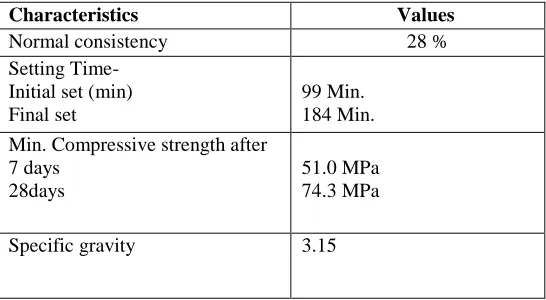
II. MATERIALS AND EXPERIMENTAL PROCEDURE Cement:- Ordinary Portland cement (grade 53) was
[image:1.612.309.582.402.552.2]used and conforms to IS 12269- 1987. Its physical properties are as given in table 1.
Table 1 - Physical Properties of Cement
Characteristics Values Normal consistency 28 % Setting Time-
Initial set (min) Final set
99 Min. 184 Min.
Min. Compressive strength after 7 days
28days
51.0 MPa 74.3 MPa
Specific gravity 3.15
Fly-ash :- Fly-ash and its chemical analysis report is obtained from Sanjay Gandhi thermal power station, Birsinghpur, dist. Shahdol, M.P., India. The chemical and physical properties of fly-ash are given in the table 2 and table 3 respectively.
Table 2 - Chemical Properties of fly-ash
Elemental Oxides Percentage Silicon Di-oxide (SiO2)
Aluminium oxide (Al2O3) Calcium Oxide (CaO) Magnesium Oxide (MgO) Manganese oxide
Sodium Oxide (Na2O) Potassium Oxide (K2O) Iron Oxide
Phosphorus Pentoxide Sulphur Trioxide (SO3) Titanium Di-oxide 63.41 % 25.88 % 0.34 % 1.13 % none detected 1.19 % 1.22 % 3.14 % 1.65 % 0.53 % 1.51 %
Table 3 - Physical properties of fly ash
Chemical Admixtures:-Superplasticiser or high range water reducing admixtures are an essential components of SCC. Conplast SP430 confirms to ASTM-C-494 Type “F” was used as superplasticiser. It is based on Sulphonated Napthalene polymers and supplied as a brown liquid instantly dispersible in water.
Table 4 - Properties of Conplast SP430
Specific gravity 1.220 to 1.225 at 300C Chloride content Nil to IS 456
Air entrainment Approx 1% additional air is entrained
Fine Aggregate:-The sand confirming to IS 650: 1966 was used as fine aggregate. Four fine aggregates, based on particle sizes was analysed, viz.
Particle size 1 in between 90 µ to 300 µ , denoted as 90 µ < PS-1< 300 µ
Particle size 2 in between 300 µ to 500 µ , denoted as 300 µ < PS-2< 500 µ
Particle size 3 in between 500 µ to 710 µ , denoted as 500 µ < PS-3< 710 µ
Particle size 4 in between 710 µ to 1 mm , denoted as 710 µ < PS-4< 1 mm
Table 5 - The physical properties of sand
Physical properties of fine aggregate Colour Grayish White Specific Gravity 2.64
Absorption in 24 hours
0.80%
Shape of grains Sub angular
Water:- Ordinary potable water available in the laboratory was used.
Experimental procedure for SCC Mortar:-
The compressive strength of various mix proportions (mix design) as given in table was determined by preparing 120 nos., 70.7 mm size cubes. The mortar cubes were demoulded 1 day after casting and cured in water at normal room temperature for 7 days and 28 days. The cubes were tested in compression testing machine as per IS 4031:1988.
III. MORTAR MIX PROPORTIONS
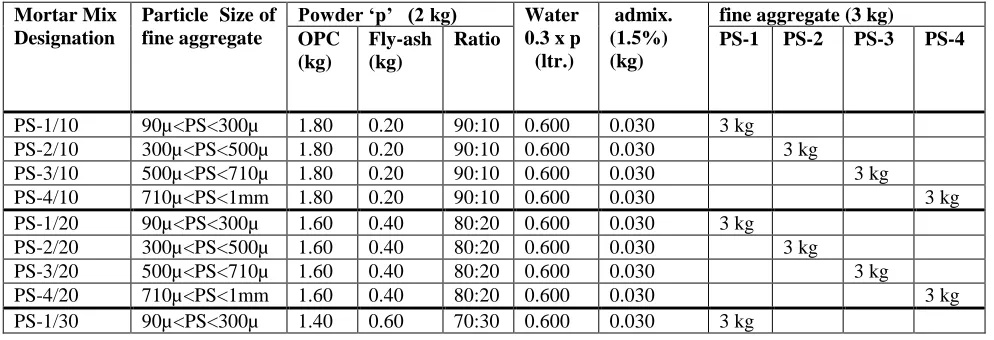
Table 6 gives the mortars proportion details. The mortar mixtures contains powder which composed of five weight proportions of OPC and fly ash, i.e. 90:10,80:20,70:30,60:40,50:50. The water to powder ratio (w/p) was 0.3 and the superplasticiser dosage was 1.5 percent by weight of powder. The quantities except particle size of fine aggregate in the SCC mix is kept constant to avoid any other variation on the compressive strength due to quantities and quality of any ingredient in the mortar mix.
Table 6 - Mortar mix proportions
Mortar Mix Designation
Particle Size of fine aggregate
Powder ‘p’ (2 kg) Water 0.3 x p (ltr.)
admix. (1.5%) (kg)
fine aggregate (3 kg) OPC
(kg)
Fly-ash (kg)
Ratio PS-1 PS-2 PS-3 PS-4
PS-1/10 90µ<PS<300µ 1.80 0.20 90:10 0.600 0.030 3 kg PS-2/10 300µ<PS<500µ 1.80 0.20 90:10 0.600 0.030 3 kg
PS-3/10 500µ<PS<710µ 1.80 0.20 90:10 0.600 0.030 3 kg
PS-4/10 710µ<PS<1mm 1.80 0.20 90:10 0.600 0.030 3 kg PS-1/20 90µ<PS<300µ 1.60 0.40 80:20 0.600 0.030 3 kg
PS-2/20 300µ<PS<500µ 1.60 0.40 80:20 0.600 0.030 3 kg
PS-3/20 500µ<PS<710µ 1.60 0.40 80:20 0.600 0.030 3 kg
PS-4/20 710µ<PS<1mm 1.60 0.40 80:20 0.600 0.030 3 kg PS-1/30 90µ<PS<300µ 1.40 0.60 70:30 0.600 0.030 3 kg
Physical Properties Test Result
Colour Grey Blackish
PS-2/30 300µ<PS<500µ 1.40 0.60 70:30 0.600 0.030 3 kg
PS-3/30 500µ<PS<710µ 1.40 0.60 70:30 0.600 0.030 3 kg
PS-4/30 710µ<PS<1 mm 1.40 0.60 70:30 0.600 0.030 3 kg PS-1/40 90µ<PS<300 µ 1.20 0.80 60:40 0.600 0.030 3 kg
PS-2/40 300µ<PS<500 µ 1.20 0.80 60:40 0.600 0.030 3 kg
PS-3/40 500µ<PS<710µ 1.20 0.80 60:40 0.600 0.030 3 kg
PS-4/40 710µ<PS<1mm 1.20 0.80 60:40 0.600 0.030 3 kg PS-1/50 90µ<PS<300µ 1.00 1.00 50:50 0.600 0.030 3 kg
PS-2/50 300µ<PS<500µ 1.00 1.00 50:50 0.600 0.030 3 kg
PS-3/50 500µ<PS<710µ 1.00 1.00 50:50 0.600 0.030 3 kg
PS-4/50 710µ<PS<1mm 1.00 1.00 50:50 0.600 0.030 3 kg
Mortar mix with sand PS -1 and 10 % cement replacement percentage (CRP) by fly-ash designated as PS-1/10 Mortar mix with sand PS -2 and 20 % cement replacement percentage (CRP) by fly-ash designated as PS-2/20 Mortar mix with sand PS -3 and 30 % cement replacement percentage (CRP) by fly-ash designated as PS-3/30 Mortar mix with sand PS -4 and 40 % cement replacement percentage (CRP) by fly-ash designated as PS-4/40
Mortar mix with sand PS -1 and 50 % cement replacement percentage (CRP) by fly-ash designated as PS-1/50 and so on….
IV. EXPERIMENTAL RESULTS
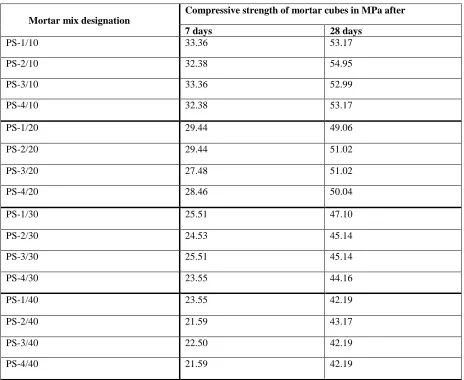
The compressive strength of SCC mortar cubes of 70.7 mm size of different mix proportions after 7 and 28 curing time in
[image:3.612.75.539.350.730.2]water was determined by testing cubes of each sample by compression testing machine in MPa, are given in the table 7.
Table 7 - Results of compressive strength of SCC mortar
Mortar mix designation
Compressive strength of mortar cubes in MPa after
7 days 28 days
PS-1/10 33.36 53.17
PS-2/10 32.38 54.95
PS-3/10 33.36 52.99
PS-4/10 32.38 53.17
PS-1/20 29.44 49.06
PS-2/20 29.44 51.02
PS-3/20 27.48 51.02
PS-4/20 28.46 50.04
PS-1/30 25.51 47.10
PS-2/30 24.53 45.14
PS-3/30 25.51 45.14
PS-4/30 23.55 44.16
PS-1/40 23.55 42.19
PS-2/40 21.59 43.17
PS-3/40 22.50 42.19
PS-1/50 18.64 38.27
PS-2/50 19.63 39.25
PS-3/50 17.66 38.27
PS-4/50 17.66 39.25
Graphical representations of compressive strength of mortar cubes:-
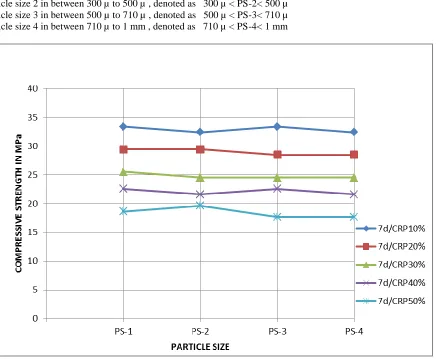
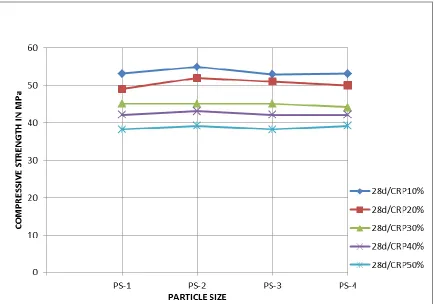
The graphical representations of the relationship between the compressive strength for 7days and 28 days curing time of the
samples v/s different particle size of fine aggregate are given in Fig. 1 and Fig. 2.
[image:4.612.90.530.218.577.2]Particle size 1 in between 90 µ to 300 µ , denoted as 90 µ < PS-1< 300 µ Particle size 2 in between 300 µ to 500 µ , denoted as 300 µ < PS-2< 500 µ Particle size 3 in between 500 µ to 710 µ , denoted as 500 µ < PS-3< 710 µ Particle size 4 in between 710 µ to 1 mm , denoted as 710 µ < PS-4< 1 mm
Fig 2 – Compressive strength of mortar cubes after 28 days curing
V. DISCUSSION OF RESULTS
The relationship between the compressive strength for 7days and 28 days curing time of the samples having different particle size of fine aggregate are given in Fig. 1 and Fig. 2. Strength increases with increase in curing time for all mixes. The strength is more for mix having 10% CRP; whereas the strength is lowest for mix having 50% CRP. In the present investigation increase in the fly ash content replacing cement from 10% to 50% resulting in the decrease of compressive strength of mortar cubes from 33.36 MPa to 17.66 MPa for 7 days and from 53.17 MPa to 39.25 MPa for 28 days of curing time. The mortar’s compressive is almost the same for particle sizes 1, 2, PS-3, PS-4 with same CRP. The increase in fly ash reduces the compressive strength at all curing time.
VI. CONCLUSION
Thus we conclude from the Fig. 1 and Fig. 2, that the fine aggregate particle size does not influence the compressive strength of mortar cubes at any given curing time. The compressive strength of mortar cubes is more influenced by its powder composition at any particular curing time.
REFERENCES
[1] _______Specification and guidelines for Self-Compacting concrete, EFNARC, U.K.,February 2002.
[2] Gettu Ravindra, Shareef Shaik Nawaz, Ernest Kingsley JD.; Evaluation of the robustness of SCC, Indian Concrete Journal, Volume 83, Number 6, June 2009, P. 13-19.
[3] Sengupta Anirwan and Santhanam Manu; Influence of aggregate characteristics on Uniformity of SCC, Indian Concrete Journal, Volume 83, Number 6, June 2009, P. 50-60.
[4] Okamura Hajime and Ouchi Masahiro; Self Compacting concrete, Journal of Advanced Concrete Technology, Japan Concrete Institute Vol-1, No.1, 5-15, April 2003.
[5] Nepemuceno Miguel and Oliveira Luiz; Parameters for self–compacting Concrete Mortar Phase.
[6] Krishna Murthy.N. Narasimha Rao, A.V. Ramanna Reddy I.V. and Vijaya Shekhar Reddy. M.; Mix Design Procedure for Self-Compacting Concrete , IOSR Journal of Engineering Vol. 2, Issue 9, Sept 2012, P. 33 - 41. [7] Dubey Rahul and Kumar Pradeep; Effect of Fly-ash on Water/ Powder ratio
and Superplasticiser Dosage in Self- Compacting Mortars, International Journal of Architecture, Engineering and Construction, Vol. 2, No. 1, March 2013, 55-62.
[8] Domone P.; Proportioning of Self- Compacting concrete – the UCL method, UCL, Department of Civil, Enviromental and Geomatic Engineering, November 2009.
[9] Jayashree C., Santhanam Manu and Gettu Ravindra; Cement-Superplasticser Compatibility - Issues and challenges, Indian Concrete Journal, Volume 85, Number 7, July 2011, P. 48-60.
[10] _______EFNARC European project group; The European Guidelines for Self-Compacting Concrete Specification, Production and use, May 2005. [11] Chowdhury Subrato, Kadam Sandeep and Keskar Sandeep; Impact of fine
aggregate Particle size on rheology and compressive strength of mortar for SCC, The Indian Concrete Journal , April 2011, P. 51-59.
[12] _______Methods of physical tests for hydraulic cement, IS 4031: 1988, Bureau of Indian standards, New Delhi, India, 1988.
AUTHORS
First Author – Er. Gupta Ankush, Department of Civil
Engineering, Jabalpur Engineering College, Jabalpur, M.P.,India Second Author – Dr. Chandak Rajeev, Department of Civil Engineering, Jabalpur Engineering College, Jabalpur, M.P.,India
Third Author – Er. Koshta M.K. , Department of Civil