ISSN 2250-3153
Cost Reduction Using Alternative Fuel in a Forging
Industry
Binoy C N
*, Joseph George
**, Sijo M T
****
Mechanical Department, SCMS School of Engineering & Technology
**
Mechanical Department, SCMS School of Engineering & Technology
***
Assistant Professor, Mechanical Department, SCMS School of Engineering & Technology
Abstract-Environmental concern and availability of petroleum fuels have caused interests in the search for alternate fuels for internal combustion engines. Conversion of waste to energy is one of the recent trends in minimizing not only the waste disposal but also could be used as an alternate fuel for Industries. Waste plastics are indispensable materials in the modern world and application in the industrial field is continually increasing. In this context, waste plastics are currently receiving renewed interest. As an alternative, non biodegradable, and renewable fuel, waste plastic oil is receiving increasing attention. In the present paper waste plastic pyrolysis oil, waste plastic pyrolysis oil and its blend as an alternative fuel for a forging industry has been introduced. In this study, Applicability of waste tyre pyrolysis oil was studied basis on a forging industry. Pyrolysis oil which is derived from waste rubber tyres was analyzed as an alternative fuel in forging industry. Pyrolysis oil was tested for the required specifications and compared with existing fuel. As because of its low flash point an attempt was done to blend pyrolysis oil and furnace oil to get the required flash point. Satisfactory result was got & Cost analysis on the basis of results was made. Cost analysis proves that using of pyrolysis tyre oil instead of current furnace oil will be beneficial for the forging industry
Index Terms- Alternative Fuel, Tyre Pyrolysis Oil, Forging Industry, Cost Analysis
I. INTRODUCTION
lternative fuels are a material that can be used for fuel other than conventional fuels which are typically petroleum based. Usually alternative fuels are better for the environment. As the conventional fuels are depleting special attentions are now given for alternative fuels and they are gaining universal interest. Unlike rest of the world, India’s demand for diesel fuels is roughly six times that of gasoline hence seeking alternative to mineral diesel is a natural choice [1]. Industrial sector in India is developing and the need for fuels are also increasing as the industry is mainly depended on fossil fuels, the price fluctuation make their planning difficult and their cost of production will also increase. As this difficulty exists, they are searching for alternative fuels which can be a substitute for the present fuel with an economical benefit too. Waste to energy is the recent trend in the selection of alternate fuels [2]. Studies are made before on the subject Tyre pyrolysis oil as an alternative fuel. Disposal of waste rubber products is becoming an environmental challenge in many developing countries due to their
non-biodegradability characteristic. Majority of waste rubber products are generated from worn or damaged automotive tyres and industrial conveyor belts [3]. Scrap tyre disposal is also a major environmental hazard. Waste plastics do not biodegrade in landfills, are not easily recycled, and degrade in quality during the recycling process [4]. Pyrolysis of scrap tyres will produce tyre Pyrolysis Oil (TPO), which has volatile capability. Tyres are bulky, designed to be tough and durable and once they are no good as tyres, they are difficult to cut up, hard to store or transport, thus making them very difficult to recycle in an economically viable manner [5]. According to Mr. Hirenkumar M Patel there are around billions tires which are thrown away every year in India. The numbers are expected to increase due to increasing numbers of vehicles. If the scrap tires are not managed well, the scrap tire can give bad effects to the environment and people’s health. One of the solutions is pyrolysis process. Pyrolysis oil is made by this process [6].
Most of the studies find the feasibility of using pyrolysis oil as an alternative fuel for diesel engines. Pyrolysis of waste vehicle tires with the purpose of fuel production for the usage as a fuel in internal combustion engine can be Seen as a hygienic, environmentally acceptable and efficient way of disposing them [6]. As waste disposal is also a major problem tyre pyrolysis can be adopted as a method through which fuel which has comparable features with diesel. Pyrolysis is the chemical decomposition of organic substances by heating the word is originally coined from the Greek-derived elements pyro "fire" and lysys "decomposition". Pyrolysis is usually the first chemical reaction that occurs in the burning of many solid organic fuels, cloth, like wood, and paper, and also of some kinds of plastic. In this study the feasibility and cost analysis of pyrolysis oil in a forging industry is studied. Cost reduction can also achieved by using pyrolysis oil, as it is cheaper than diesel and has almost same properties of diesel.
A. The present study
The study was conducted in a forging industry in Kerala, India. It is evident from previous research that no such work was carried out in forging industry where the tyre pyrolysis oil used as an alternative fuel for oil fired furnace.
The objectives of the study are:
To test the alternative fuel and its required specifications.
To compare the result with the company requirements. To do cost analysis of using pyrolysis oil against present
II. IDENTIFY,RESEARCHANDCOLLECTIDEA
A. Description of case study plant
This study was carried out at an integrated forging unit located in India. The case study plant is a public sector undertaking under the Government of Kerala, India. There are approximately 500 employees working at 10 departments of the plant. The firm cater to a wide range of Industries. Complex & high precision
aerospace forgings, specialised forgings for defence, heavy forgings for commercial vehicles, railways and other components for automobiles etc. Presently the firm deals with Brahmos missile projects also.
B. Description of subject
Due to the change in the crude oil price in global market the fuel price is increasing almost every month. These fluctuations are giving a future forecast that the price will increase to the higher side. Presently the industry uses High Speed Diesel (HSD) for heat treatment and Furnace Oil (FO) in oil fired furnace for heating billets. Uncertainty in fuel price in the present scenario makes firms planning difficult and leads to increase the overall production cost. The firm needs 80-90 kilolitres of furnace oil and 30-40 kilolitres of high speed diesel per month. From the
[image:2.612.36.287.325.485.2]Figure 1 Fuel price in the year 2013 (April- September)
month of April to September, the price of HSD varied from 60.22 Rs to 71.43 Rs. Within six months of time the price
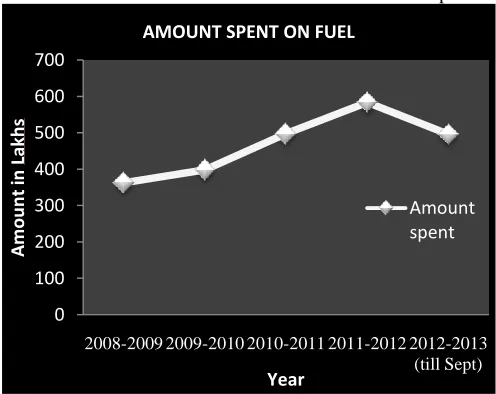
increase per liter is more than 10 Rs. Bearing this drastic increase in fuel price made the company’s profit became questionable and proper planning affected due to this. Cost spent by the company is shown below. From the figure it’s clear that the amount spent on fuel is increasing year by year. By using simple exponential smoothing the amount for the year 2012-2013 was forecasted as 574.22 Lakhs. Smoothing factor taken as 0.9 based on the data study. From 2008 to 2012 there is 38% increase in the amount spent for the fuel. Here the feasibility of pyrolysis oil which can be a substitute was studied. To bring down the cost and thereby enhancing the profit alternative fuel can be introduced.
C. Tyre Pyrolysis Oil
Pyrolysis is the thermal decomposition at higher temperatures in an inert atmosphere. It is derived by slow pyrolysis of waste rubber products such as tyres. In a a slow pyrolysis process, the rubber containing material is heated in an oxygen free reactor at high temperatures. The resulting gases are condensed into liquid to form tyre pyrolysis oil (TPO). The oil derived from pyrolysis of rubber has been known as a material with excellent and consistent fuel properties with a high calorific value. It may be used directly as fuel or blended with other fuels. Pyrolysis of 1 ton tyre will give 420 liters of tyre oil, 150 kg of steel wire, 270 kg of carbon black.( consuming 52 liters of diesel ).
D. Properties
Pyrolysis Tyre Oil was tested in Silver Assay Lab, Salem for the parameters testing. The analysis was based upon a quantity of 500 ml of pyrolysis oil. The parameters were Total Ash, Gross Calorific Value (on dry basis), Viscosity, Specific Gravity, Moisture, Carbon, Hydrogen, Nitrogen, Sulphur, Oxygen and Flash point. The results of the tests are given below.
PARAMETERS RESULTS
Total Ash 0.01%
Gross Calorific Value 10920 Kcal/Kg Viscosity at 40° C 3.23 cSt
Specific Gravity 0.92 gm/cc
Moisture 0.75%
Carbon 87.2%
Hydrogen 12.5%
Nitrogen 0.12%
Sulphur 0.08%
Oxygen 0.10%
Flash Point < 32°C
Table 1 TPO Properties
E. Comparison
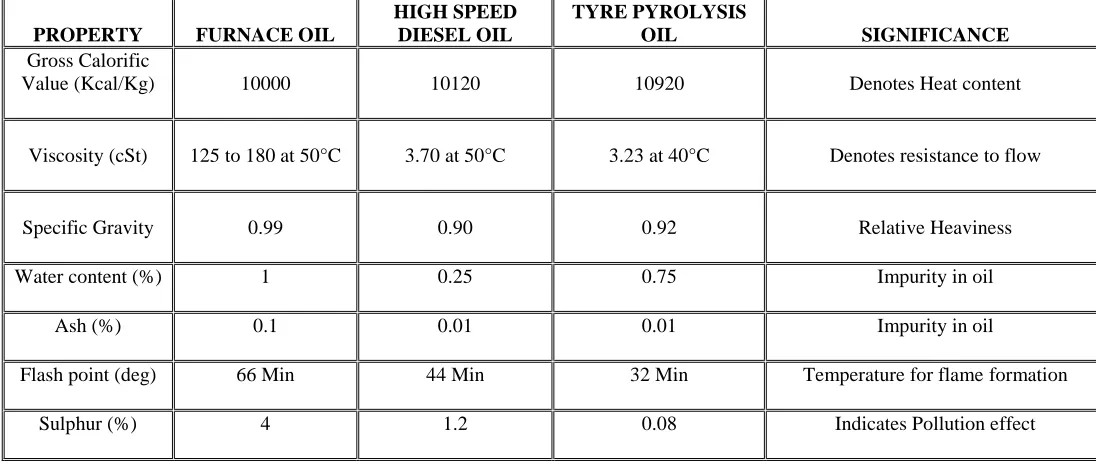
The main parameters required by the fuel as per the firm is Gross Calorific Value, Viscosity, Specific gravity, Moisture, Ash, Flash point & Sulphur. The comparison is given in table 2. From the comparison it’s clear that it has the parameters better than the presently using furnace oil and high speed diesel oil. It has high gross calorific value, low viscosity, comparable specific gravity, water content percentage is less than furnace oil, Ash percentage is less, flash point is less, and sulphur content percentage is the 0
20 40 60 80
Apr/13 May/13 Jun/13 Jul/13 Aug/13 Sep/13
P
rice
Time of Purchase Fuel Price in 2013
Price Per Litre
0 100 200 300 400 500 600 700
2008-2009 2009-2010 2010-2011 2011-2012 2012-2013 (till Sept)
A
m
o
u
n
t
in
Lakh
s
Year AMOUNT SPENT ON FUEL
[image:2.612.43.291.528.725.2]ISSN 2250-3153
F. Problem
Though all other factors were acceptable for the firm, the firm made a stand that they cannot follow the pyrolysis oil cost reduction.The problem with pure pyrolysis oil observed was its low flashpoint. The firm concluded that it will be a threat to safety of the firm
III. EXPERIMENTAL STUDIESANDFINDINGS In order to solve the problem an attempt was made to blend furnace oil and tyre pyrolysis oil in an expectation to get a higher flash point.
A. Experiment
Experiment was conducted for testing flash and fire point testing using Cleaveland apparatus. First the samples were made of 0%, 25%, 50%, 75%, 100% mix of TPO in FO. Samples were collected from Mandakan Energy products (TPO) and Indian Oil Corporation (FO)
Blending : Tyre Pyrolysis oil & Furnace oil Mixing ratio : 0%, 25%, 50%, 75%, 100%-mix of TPO
Place : SCMS Thermal Lab
[image:3.612.308.564.181.364.2]Apparatus : Cleaveland apparatus for Flash & Fire point
Figure 3 Experiment samples
[image:3.612.29.577.478.710.2]50 ml of sample will be poured into a provided space in the
Table no 2 Comparison of parameters with FO, HSD and TPO
apparatus. Thermometer will be dipped in the sample oil in order to monitor temperature. Put heater on and monitor the temperature. Flash will be given using an external source per degree rise in temperature. The temperature at which the sample will show flash of fire first, is noted and this is the flash point of the particular sample. The temperature at which the flash changes to continuous fire is also noted, this is the fire point of the sample. The same was conducted for 3 times for each sample. Average will be taken for each flash and fire point. The results got from the experiment are given below.
PERCENTAGE MIX OF TPO
AVERAGE FLASH POINT
AVERAGE FIRE POINT
0 % 121°C 135°C
25 % 78°C 91°C
50 % 70°C 86°C
75 % 58°C 71°C
100 % 30°C 49°C
Table 3 Flash and Fire point Test Results
IV. RESULTS
A. Interpretation
As per company specification the minimum flash point should be 66°C. Taking into consideration of the above experimental results 50:50 ratios can be accepted instead of using furnace oil. It has flash point at 70°C and fire point at 86°C. For heat treatment shop the fuel used is high speed diesel oil. As a replacement for this 75% pyro 25% furnace oil mix can satisfy the requirement. It has flash point at 58°C & fire point at 71°C. It must be noted that there might be better results between the
PROPERTY FURNACE OIL
HIGH SPEED DIESEL OIL
TYRE PYROLYSIS
OIL SIGNIFICANCE
Gross Calorific
Value (Kcal/Kg) 10000 10120 10920 Denotes Heat content
Viscosity (cSt) 125 to 180 at 50°C 3.70 at 50°C 3.23 at 40°C Denotes resistance to flow
Specific Gravity 0.99 0.90 0.92 Relative Heaviness
Water content (%) 1 0.25 0.75 Impurity in oil
Ash (%) 0.1 0.01 0.01 Impurity in oil
Flash point (deg) 66 Min 44 Min 32 Min Temperature for flame formation
percentage 50-75pyro-fo mix for FO and for HSD 75-100pyro-fo
mix.
B. Cost Analysis
As the fuels are different in their calorific values, it won’t be correct if found directly the cost difference of using proposed fuel and fuel using at present. The total calorie needed by the company in a year was found out by using total usage of fuel and calorific value of the same. Then total quantity & cost of Tyre pyrolysis oil needed to meet the energy calculated was found out. Difference between the amount spent on present fuel and amount which needed to meet the Energy will be the profit.
● Cost of 1 liter of Furnace oil = 44.88
● Cost of 1 liter of HSD = 71.43
● Cost of 1 liter of Tyre pyrolysis oil = 40.07 ● Average quantity of Furnace oil = 998.70 KL
● Average quantity of HSD = 405.07 KL
● At present the amount required to buy the average quantity of FO & HSD =(998.70*44880.90)+ (405.07*71439.10) = 737.60391*105 ● Calorific value of FO needed = 998.7*103*0.99 = 988713*10000
= 988.713*107 Kcal ● Calorific value of HSD needed = 405.075*103*0.90
=364567.5*10120 =368.94231*107 Kcal ● Total calorific value needed in an year
Calorific value of (HSD+FO) =1357.65531*107 Kcal ● Total blended quantity of TPO(50:50) required to meet total
calorific value of FO = 988.713*107 /10460 = 945232.3136 Kg = 945232.3136 /0.95*103 = 994.9813827 KL
● Cost required to meet calorific value of FO
= 994.9813827*42475.45 = 422.6228197*105
● Total blended quantity of TPO(75:25) required to meet total calorific value of HSD
= 368.94231*107 /10690 = 345128.4471 Kg = 345128.4471 /0.95*103 = 367.1579225 KL
● Cost required to meet calorific value of HSD
= 367.1579225*41272.725 = 151.5360797*105 ● Total cost required to meet total calorific value
= (151.5360797*105 + 422.6228197*105) = 574.1588994*105 ● Profit = ( Total amount spent for fuel - Amount
= (737.60391*105 - 574.1588994*105) = 163.4450106*105
V. DISCUSSION & CONCLUSION
One of the key interests of this study was to reduce the cost of production in a forging industry. The dimensions included in finding a best alternative fuel. In phase tyre pyrolysis oil which is derived from waste rubber tyres is chosen first as an alternative by comparing with the alternative fuels presently using. Tyre pyrolysis oil was selected on the easiness of availability, cost effectiveness, no change in infrastructure, waste recycling technology. The parameters of tyre pyrolysis oil were found satisfactory and it was compared with the presently using high speed diesel oil and furnace oil. Comparison showed it has all the necessary parameters except the requirement of desired flash point. Firm concluded that low flash point of tyre pyrolysis oil will be a safety threat. So an attempt was made to blend tyre pyrolysis oil and furnace oil. Experiment with the samples 0%, 25%, 50%, 75%, 100% mix of tyre pyrolysis oil was made and tested for flash and fire point testing using Cleaveland apparatus. From the results 50:50 ratios could be effectively used as an alternative for furnace oil and 75% pyro 25% furnace oil mix could be effectively used as an alternative for high speed diesel oil.
Cost analysis based on the results was done and from that it could be stated that if tyre pyrolysis blend is used in that firm, then the company could gain a profit of 1.63 Crore per year.
ACKNOWLEDGEMENTS
The authors gratefully acknowledge the support and cooperation provided by the respondents and management of the forging studied. The authors would like to thank everyone who with their constructive comments helped to improve the quality of the paper. We express our thanks to Mandakan Energy products & Indian Oil Corporation who gave us samples and thereby enhancing the quality of the paper.
REFERENCES
[1] Pawar Harshal R. and Lawankar Shailendra M. Waste plastic Pyrolysis oil Alternative Fuel for CI Engine – A Review, Research Journal of Engineering Sciences, ISSN 2278 – 9472, Vol. 2(2), 26-30, February (2013).
[2] Murugan S., Ramaswamy M.C. and Nagarajan G., The use of tyre Pyrolysis oil in diesel engines, Waste Management, 28, (12), 2743-2749 (2008).
[3] Jefrey Pilusa and Edison Muzenda, Qualitative Analysis of Waste Rubber-Derived Oil as an Alternative Diesel Additive, (ICCEE'2013) April 15-16, 2013 Johannesburg (South Africa)
[4] M. P. Hirenkumar, and M.P. Tushar, “Emission Analysis of a Single Cylinder Fuelled with Pyrolysis Oil Diesel and its Blend with Ethanol,” IJEST, vol. 4, pp. 2834-2838, 2012.
[5] B.E.E. Molewa, Notice of Approval of an Integrated Industry. Waste Tyre Management Plan of the Recycling and Economic Development Initiative of South Africa. South African National Department of Environmental Affairs, vol. 569 No. 35927, 2012.
ISSN 2250-3153
[7] Mr. Marek A. Wojtowicz and Michael A. Serio, Pyrolysis of scrap tyres: Can it be profitable, Chemtech.
[8] Mr. M. N. Islam, Mr. M. F. R. Khan and Mr. M. Z. Alam, Production and Characterization of Scrap Tyre Pyrolysis Oil and its Blend, International Conference on Mechanical Engineering 2003 (ICME2003) 26- 28 December 2003, Dhaka, Bangladesh.
[9] M.Rofiqul Islam, M. Parveen, H. Haniu and M. R. Islam Sarker, Innovation in Pyrolysis Technology for Management of Scrap Tire: a Solution of Energy and Environment, International Journal of Environmental Science and Development, Vol. 1, No. 1, April 2010 ISSN:2010-0264.
[10] Debalaxmi Pradhan, R.K. Singh, Recovery of Value Added Chemicals from Waste Tyre Pyrolysis.
[11] Rebecca Sebola, Jefrey Pilusa, and Edison Muzenda, Characteristics of Tyre Derived Fuel-Diesel Blends.
[12] G V N Kumar, G G Srinivas, Anilkumar C H, Experimental Investigations on Diesel Engine Fueled with Tyre Pyrolysis and Diesel Blends, IJEED Issue 2 Vol 7 ( November 2012) ISSN 2249-6149 .
[13] Debalaxmi Pradhan and R. K. Singh, Thermal Pyrolysis of Bicycle Waste Tyre Using Batch Reactor, International Journal of Chemical Engineering and Applications, Vol. 2 , No. 5 , October 2011.
[14] Bhatt Prathmesh M, Patel Paresh D, Suitability of Tyre Pyrolysis oil (TPO) as an Alternative Fuel for Internal Combustion Engine, IJAERS/Vol. I/ Issue IV/July-Sept., 2012/61-65.
AUTHORS
First Author – Binoy C N, Mechanical Department, SCMS
School of Engineering & Technology, [email protected] Second Author – Joseph George, Mechanical Department,
SCMS School of Engineering & Technology, [email protected]
Third Author – Sijo M T, Assistant Professor, Mechanical
Department, SCMS School of Engineering & Technology,