International Journal for Research in Applied Science & Engineering Technology (IJRASET)
ISSN: 2321-9653; IC Value: 45.98; SJ Impact Factor : 6.887 Volume 6 Issue II, February 2018- Available at www.ijraset.com
1006
©IJRASET (UGC Approved Journal): All Rights are Reserved
Experimental Analysis on Diffusion of Liquid in To
Gas
Dheramendra Kumar Rathore1, Saurabh Kumar2,
1
M. Tech, Thermal engineering scholar, Mechanical engineering department, Raipur institute of technology, Raipur, India)
2
Assistant Professor, Mechanical engineering department, Raipur institute of technology, Raipur, India)
Abstract: With increasing demand of energy require environmental concern. It is the driving force to search the ways for saving the fuel. In the present work diffusion coefficient of the different volatile liquids are calculate by a simple experiment and study about the effect of temperature variation on diffusivity are also report.
Keywords: Petrol, Methanol, Diffusion, Diffusivity, thermostatic water bath.
I. INTRODUCTION
In diffusion, we are basically find out the non-availability of diffusivity of volatile liquid. We are refers on previous papers, so, those are discussed about the liquid diffusion applied to analysis, determination of the diffusion coefficient by the using of different gas chromatographic, and the study about the effect on oxygen diffusion coefficient of the presence in clean water of some compounds encountered in biological media. In all the papers to study about the, determination of diffusion coefficient in simple liquid and their volatile property, and this are determined by the various chromatography method so do not find out the diffusion coefficient of whose liquid, diffusivity of those liquid are not available, and diffusivity is very important factor for the mass transfer we are already discussed about that, so we are find out the diffusion coefficient of the different volatile liquid by an simple experiments and study about the effect of temperature variation and also study about the changes in concentration of volatile liquid then what are the effect of its diffusion coefficient. Diffusion is the movement of an individual component through the mixture due to some physical driving force. It occurs all mass transfer operation in at least one phase or often both phase. Diffusion can be two types, molecular diffusion and Eddy diffusion depending up on the phase conditions. The transfer through the stagnant layers known as molecular diffusion and this is a slow process. Diffusion is a mass transfer phenomenon that causes the distribution of chemical species to become more uniform in space as time passes. The mass transfer species is the evolution of its concentration in space and time , if the concentration of species is initially not uniform then overtime, diffusion causes mass transfer in favour of a more uniform concentration. In case of molecular diffusion, since the mass transfer occurs from a region of high concentration to one of lower concentration, the flux is proportional to the concentration gradient.
Α
OR
= -DAB
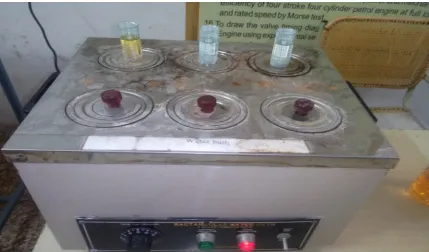
Fig: front view of thermostatic water bath.
Awater bathis laboratory equipment made from a container filled with heated water. It is used to incubate samples in water at a constant temperature over a long period of time. All water baths have a digital or an analogueinterface to allow users to set a desired temperature.
II. LITERATURE REVIEW
T. Graham [1], Discussed about the liquid diffusion applied to analysis. The property of volatility, possessed in various degrees by so many substances, affords invaluable means of separation, as is seen in the ever-recurring processes of evaporation and distillation. J Chromatogr A [2], Discussed about that the determination of diffusion coefficients by gas chromatography. Jamnong wong, Marupatch, Loubiere, Karine, Dietrich, Nicolas, Gilles[3], Those are discussed about the study of : (i) studying the effect on oxygen diffusion coefficients of the presence in clean water of some compounds usually encountered in biological media and (ii) quantifying their consequences on liquid-side mass transfer coefficients. The oxygen diffusion coefficients D were firstly measured in various synthetic liquid phases containing either salt, sugar (glucose) or surfactant. Brahm D. Prasher,Yi Hua Ma [4], those are study about the Liquid diffusion in micro porous alumina pellets.
III. METHODOLOGY
In case of non - availability of diffusivity value, we are the same can be determined by the using of simple experiment devised by Stefan. For the purpose, the liquid should be fairly volatile.
The different volatile liquid is taken in a different –different small diameter test tube and is allowed to diffuse to atmosphere by holding it inside a thermostatic bath. And by this thermostatic bath to maintaining the temperature is constant at the whole experiments.
The level of the liquid at the start of the experiment and after an appreciable time interval are accurately noted. The water bath temperature is set at the desired level and to wait the bath attains the set temperature.
The test tube is filled with petrol to within 2 centimeter of the top of the test tube. The initial diffusion height of the liquid in the test tube from the top is noted down.
Then the diffusivity ( ) is calculated corresponding to its bath temperature. The diffusional flux or the diffusivity for the process is,
= ( )
Where,
= Density of liquid
= Molecular weight of the liquid = Time of diffusion
International Journal for Research in Applied Science & Engineering Technology (IJRASET)
ISSN: 2321-9653; IC Value: 45.98; SJ Impact Factor : 6.887 Volume 6 Issue II, February 2018- Available at www.ijraset.com
1008
©IJRASET (UGC Approved Journal): All Rights are Reserved
[image:4.612.119.548.75.327.2]Fig : Experimental setup for measurement of diffusivity.
IV. RESULT AND DISCUSSION
LIQUID DIFFUSIVITY (m
2
/S)
OBTAINED VALUE ACTUAL VALUE
400C 500C
Methanol 0.47 X 1 0.7 X 1 1 - 1
Petrol 0.8 X 1 1.83 X 1 1 - 1
It can be concluded from the above experiments that the value of diffusivity for different volatile liquid is obtained and is approximate to the original value so our experiment is validate. so diffusivity increases with increases in temperature.
REFERENCES
[1] “ Mass Transfer Operations, “Robert E. Trebyl, McGrawvHill Book Co., International Edition, 1981. [2] “Fundamental of Heat and Mass Transfer, “G.K. Roy, Khanna Publishers, Fifth Edition, 2008. [3] “principles of Heat and Mass Transfer” S.D. Dawande, Central Techno Publications.
[4] Beiki H, Esfahany M, Etesami N (2013) Turbulent mass transfer of Al2O3 and TiO2 electrolyte nano fluids in circular tube. Micro fluid Nano fluidics
15(4):501–508.