MOTIVATION, LEARNING AUTONOMY, PERCEPTION,
AND WRITING ACHIEVEMENT
(A Thesis)
By
NINA FATRIANA
MASTER IN ENGLISH LANGUAGE TEACHING STUDY PROGRAM LANGUAGE AND ARTS EDUCATION DEPARTMENT
TEACHER TRAINING AND EDUCATION FACULTY LAMPUNG UNIVERSITY
i ABSTRACT
THE IMPLEMENTATION OF PERSONAL ICT-BASED PUBLISHING AND INTERMEDIATE EFL STUDENT’S MOTIVATION, LEARNING AUTONOMY,
PERCEPTION AND WRITING ACHIEVEMENT
By
Nina Fatriana
This research aimed at finding out which types of motivational orientation (MO) drove the digital native students, seeking the correlation between their MO, learning autonomy (LA), and writing achievement WA), measuring how the MO and LA influenced their WA, and tracking their perceptions in engaging with the personal weblog publishing activity as the final stage of the internet- based writing process instruction. This one group pre test- post test research applied both offline and blended writing processes with personal weblog publishing as the treatment. The subjects were 46 students of English literature major whose drafts to be measured, and whom were given the computer literacy, The MO, the LA , and the perception questionnaires to respond to.
The result of data analysis showed that the subjects were slightly more extrinsically motivated (total mean, 28.89) than intrinsically motivated (27.72) when engaging with personal weblog publishing activity. It was all the extrinsic motivation types also that correlated positively with their LA and WA, in that the EM external correlated with LA (0.252) and WA ( 0.099), the EM identified with LA ( 0.372) and WA ( 0.137), and the EM introjected with LA (0.226) and WA(0.327). Further, the students’ MO and LA
contributed as much as 32.8% to their WA, and they perceived this personal weblog publishing activity positively.
MOTIVATION, LEARNING AUTONOMY, PERCEPTION,
AND WRITING ACHIEVEMENT
By:
NINA FATRIANA
A Thesis
Submitted in a partial fulfillment of The requirements for S-2 Degree
MASTER IN ENGLISH LANGUAGE TEACHING STUDY PROGRAM LANGUAGE AND ARTS EDUCATION DEPARTMENT
TEACHER TRAINING AND EDUCATION FACULTY LAMPUNG UNIVERSITY
v
The writer’s name is Nina Fatriana. She was born on September 9, 1972 in Bandar Lampung. She is the second child of four children of the late Mr. Enjun Ahmuddipura and Mrs. Maryamah Enjun Ahmudipura.
She graduated from State Elementary School 1 Sawah Lama in 1985. Then she continued her study at State Junior High School 2 Bandar Lampung and graduated in 1988. After that she entered State Senior High School 2 Bandar Lampung and graduated in 1991. In the same year she was accepted at English Education study program at Lampung University and graduated in 1996. In 2014, she was registered as a student of the 1stbatch of Master of English Education at Lampung University.
She started teaching English at Teknokrat English course in 1993, and she has been teaching at STBA Teknokrat since 2000. In the same year, she was serving the country as a civil servant teacher at SMKN 2 Kalianda up to the present time.
vi
DEDICATION
By offering my praise and gratitude to Allah SWT for the abundant blessings to me, I would proudly dedicate this piece of work to:
My two beloved mothers, Mrs. Maryamah Enjun Ahmudipura and Hj. Siti Choiriah Syaifuddin Dahlan
My most beloved husband, Fikri Hamidy, S.E., S.Kom.,M.S.Ak
My most beloved lovely daughter, Raihanidya Salma
My fabulous friends of the 1stbatch of Master of English Education.
vii
Alhamdulillahirabbil’alamin, praise to Allah SWT, the Almighty and Merciful
God, for blessing the writer with faith, health, and opportunity to finish this thesis entitled “Personal ICT-Based Publishing and Intermediate EFL Students’ Motivation, Learning autonomy, Perception, and Writing Achievement”.
Gratitude and honor are addressed to all persons who have helped and supported the writer until completing this thesis, since it is necessary to be known that it will never have come into its existence without any supports, encouragements, and assistances by several outstanding people and institutions. Therefore, the writer would like to acknowledge her respect and sincere gratitude to:
1. Prof. Dr. Patuan Raja, M.Pd., as the first advisor, for his assistance, ideas, advice, and cooperation in triggering the writer’s spirit for conducting research on writing skill and in finishing her thesis.
2. Dr. Muhammad Sukirlan, M.A., as the second advisor, for his advice, cooperation and encouragement to finish her thesis.
3. Mr. Mahpul, M.A., Ph.D., as the 1st examiner, for his advice and critical ideas in reviewing this thesis.
4. Dr. Flora, M.Pd., as the Chief of Master of English Education Study Program, for her unconditional help, support, and motivation, and all lecturers of Master of English Education Study Program .
5. Dr. H. Muhammad Fuad, M.Hum., as the 2ndexaminer and the dean of FKIP Unila, for his contribution, ideas, and support.
6. DR. HM. Nasrullah Yusuf, S.E., M.B.A., as the Director of STBA Teknokrat Lampung, for the permission to conduct the research.
7. Elizabeth Ngesti Rosa EWK, S.Pd., S.S., M.A., as co writing teacher for her participation, help and support in this research.
viii
9. Her beloved mothers, Mrs. Maryamah Enjun Ahmuddipura and Hj.Siti Choiriah Syaifuddin Dahlan who have always prayed and supported the writer.
10. Her most beloved husband, Fikri Hamidy, S.E., S. Kom., M.S. Ak 11. Her most beloved lovely daughter Raihanidya Salma
12. Her brothers and her sisters in law, for their prayers.
13. Her beloved niece, Siska Puspitalia for her support and assisstance 14. All beloved big families,the Ahmudipura’s and the Dahlan’s
15. All lovely friends of the 1st batch of Master of English Education, for their solidarity, care, cooperation, togetherness, craziness, and irreplaceably unforgettable happy moments.
16. All my Kalianda commuter friends, Evi Adrijani, S.P., Dra. Dayang Manggaraini, Risnawati S.Pd., M.Pd, Dwi Prihanto, S.Pd. , and Laily Rahayu, S.Pd. for their support and understanding during the process of finishing her thesis.
Finally, the writer fully realizes that this thesis may contain some weaknesses. Therefore, constructive comments, criticisms, and suggestions are always appreciatively welcomed for better composition. After all, the writer expects this thesis will be beneficial to the educational development, the reader, and particularly to those who will conduct further research in the same area of interest.
Bandar Lampung, 28 July 2016 The writer,
ix
“
Balance means : we pursue our worldly
accomplishments as if we would live eternally, and we
compete doing heavenly services as if we would die
tomorrow
”
-x
CONTENT
I. INTRODUCTION ... 1
1.1 Background ... 1
1.2 Research Questions ... 10
1.3 Objectives ... 11
1.4 Uses ... 11
1.5 Scope ... 12
1.6 Definition of Terms... 12
II. LITERATURE REVIEW ... 16
2.1 Process Approach in Writing ... 16
2.2 Computer Assisted Language Learning (CALL) ... 18
2.2.1 Computer Mediated Communication (CMC) ... 20
2.2.2 Digital Native and Digital Immigrant... 24
2.2.3 Weblog Technology in Teaching Writing ... 25
2.3 Publication ... 26
2.3.1 The Urgency of Publishing Students’ Writing products ... 27
2.3.2 Students’ Writing Product Publishing Media ... 30
2.3.3 Weblog: Forms and Feature ... 31
2.3.4 Types of Blogs ... 32
2.4 Motivation ... 32
2.4.1 Maslow's Hierarchy of Needs and Motivation ... 38
2.4.2 Information and Communication Technology and Students’ Motivation in Writing English ... 39
2.4.3 Weblog Publishing and Motivation to Write... 41
2.5 Learning Autonomy ... 45
2.5.1 Weblog Publishing and Learning Autonomy ... 47
2.6 Student Perception ... 50
2.6.1 Weblog Publishing and Student Perception ... 52
2.7 Writing Achievement ... 54
2.7.1 The Holistic Scoring ... 54
2.7.2 The Analytic Scoring ... 56
2.7.3 Weblog Publishing and Students Writing Achievement ... 57
2.6 Theoretical Assumptions ... 59
2.7 Hypotheses ... 64
III. METHOD ... 65
3.1 Research Design... 65
3.2 Research Variables... 66
3.2.1 The Dependent Variables ... 66
3.2.2 The Independent Variable ... 67
xi
3.5 The Instruments ... 69
3.5.1 Questionaires ... 69
3.5.2 Students’Writing Scores ... 72
3.6 Validity and Reliability Tests ... 73
3.6.1 Validity of Students’ Motivational Orientation Questionaire . 73 3.6.2 Reliability of Students’ Motivational Orientation Questionaire ... 78
3.6.3 Validity of Learning Autonomy Questionnaire ... 78
3.6.4 Reliability of Learning Autonomy Questionnaire ... 79
3.7. Hypothesis Test ... 80
3.8. The Procedure of the research ... 81
3.8.1 Administering Prerequisite Computer Literacy Questionnaire 81
3.8.2 Conducting Off Line Treatment of Writing Process... 82
3.8.3 Conducting Blended Off line – On line Writing Process .. 85
IV. RESULT AND DISCUSSION ... 93
4.1 Result ... 93
4.1.1 The Implementation of Offline Writing Process Instruction and Blended Offline – Online Writing Process Instruction ... 95
4.1.2 Hypothesis Testing Result ... 95
4.1.2.1 Prerequisite Computer Literacy Questionaire Result 96
4.1.2.2 Personal Weblog Publishing and Students’ Motivational Orientation ... 99
4.1.2.3 Correlations between Students’ Motivational Orientation, Learning Autonomy and Writing Achievement on Personal Weblog Publishing ... 101
4.1.2.4 The Contribution of Student’s Motivational Orientation and Learning Autonomy to Their Writing Achievement ... 106
4.1.2.5 Student’s Perception on Personal Blog and Class Bulletin Blog Publishing ... 108
4.1.2.5.1 Students’ General Perception ... 108
4.1.2.5.2 Students’ Perceptions on the selection of the Best Works on Class Bulletin Blog ... 111
4.1.2.5.3 The Selected Student Writers and Their Writing Works ... 118
4.2 Discussion ... 125
4.2.1 CALL, Internet-Based Writing Process Instruction, Personal Weblog Publishing and Students’ Motivational Orientation ... 125
xii
4.2.3 Internet Based Writing Process Instruction, Students’ Motivational Orientation, Learning Autonomy and Their Contribution to Students’
Writing Achievement ... 128
4.2.4 Internet Based Writing Process Instruction and Students’ Perception ... 129
V. CONCLUSION ... 133
5.1 Conclusion ... 133
5.2 Suggestion ... 135
5.2.1 Suggestion for Researcher/ Writing Teacher ... 135
5.2.2 Suggestion for Intermediate EFL Students ... 137
xiii
TABLES
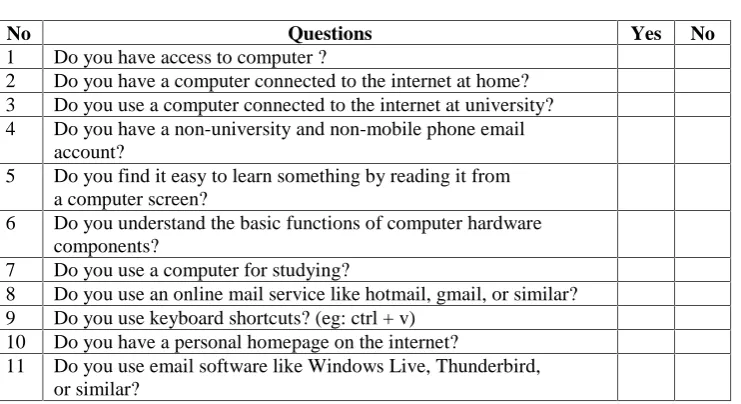
Table 3.1 Computer Literacy Questionnaire ... 69
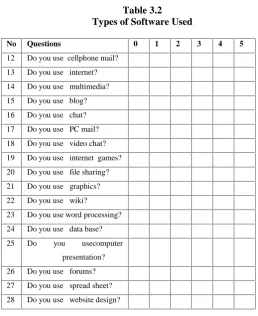
Table 3.2 Types of Software Used ... 70
Table 3.3 Validity of Amotivation Items ... 75
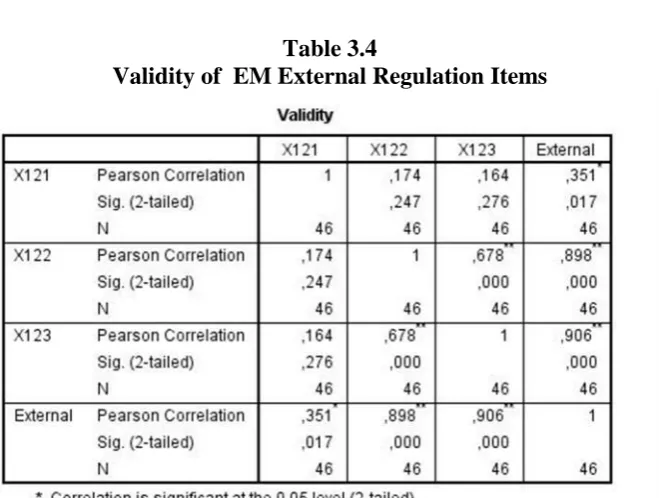
Table 3.4 Validity of EM External Items ... 75
Table 3.5 Validity of EM Identified Items ... 76
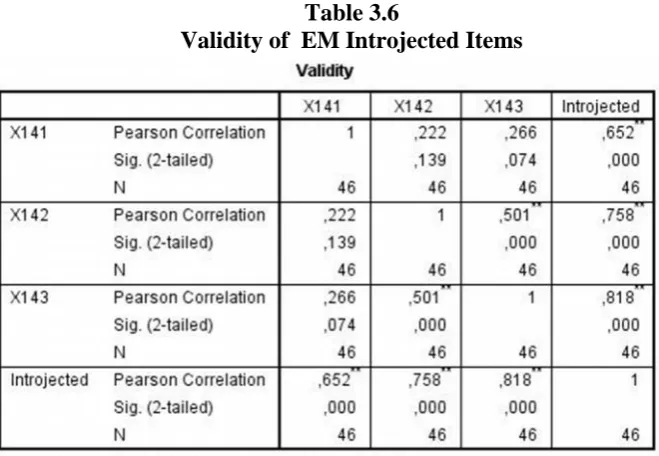
Table 3.6 Validity of EM Introjected Items ... 76
Table 3.7 Validity of IM Accomplishment Items ... 77
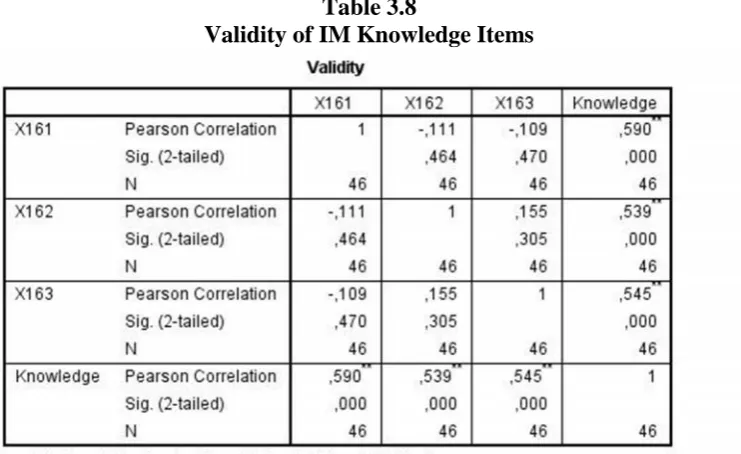
Table 3.8 Validity of IM Knowledge Items ... 77
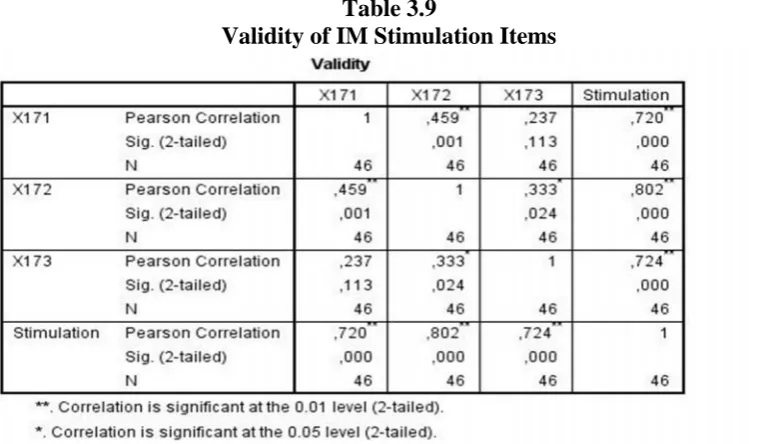
Table 3.9 Validity of IM Stimulation Items ... 78
Table 3.10 Reliability of Motivational Orientation Questionnaire ... 78
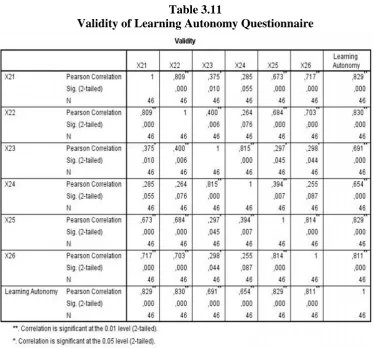
Table 3.11 Validity of Learning Autonomy Items ... 79
Table 3.12 Reliability Learning Autonomy questionnaire ... 80
Table 3.13 The Hypotheses of the Research ... 80
Table 4.1 Students’ Access to Computer and Usage... 98
Table 4.2 Types of IT Tools and the Frequency of Usage ... 99
Table 4.3 Descriptive Statistics of MOQ ... 100
Table 4.4 Students’ Motivational Orientation on Personal Weblog Publishing ... 101
Table 4.5 Student’s Learning Autonomy on Personal Weblog Publishing ... 102
Table 4.7 Paired Sample Statistics of students’ WA ... 103
Table 4.8 Paired Sample Correlation ... 103
Table 4.9 Paired Sample Test ... 104
Table 4.12 Regression Analysis between Motivational Orientation and Learning Autonomy on Writing Achievement ... 107
Table 4.13 Contribution of Motivational Orientation and Learning Autonomy on Writing Achievement ... 107
Table 4.14 Students’ Perception : Joyfulness in Blogging ... 108
Table 4.15 Students’ Perception : Difficulty in Blogging ... 109
Table 4.16 Students’ Perception: Insteresting Aspects in Blogging ... 109
Table 4.17 Students’ Perception: Usefulness in Blogging ... 110
Table 4.18 Students’ Perception : Creativity in Blogging... 110
Table 4.19 Students’ Perception: Instructiveness in Blogging... 111
Table 4.21 Students’ Perception on Class Bulletin Blog Publishing ... 112
Table 4.22 Selected Students’ MO, La, and WA ... 119
xiv
Table 4.20 Comparison of Correlation Analyses of Motivational Oriantation, Learning Autonomy and Writing Achievement between 46 Group and 19 Group ... 123
Table 4.26 Regression Analysis on Selected Students’ MO, LA and WA ... 124 Table 4.27 Contribution of Selected Students’ MO, LA, and WA ... 124
xv
PICTURES
Picture 3.1 Students’ Motivational Orientation on Personal Weblog
Publishing Questionnaire ... 70
Picture 3.2. Learning Autonomy Questionnaire on Personal Weblog Publishing Questionnaire ... 71
Picture 3.3 Students’ Perception on the Class Bulletin Blog Publishing ... 72
Picture 3.4 Example of Upside Down Pyramid Chart ... 84
Picture 3.5 Example of Students’ Personal Weblog ... 86
Picture 3.6 Class Bulletin Blog ... 86
Picture 3.7 Students’ Cycle Blog Links ... 87
Picture3.8 Cycle Blog Links Pattern of Interaction ... 87
Picture 3.9 Example of Students’ Uploaded First Draft ... 88
Picture3.10 On Line Peer Editing Rubric ... 89
Picture3.11 Peer Editing Rubric ... 89
Picture3.12 Answer Sheet of Peer Editing Rubrics ... 89
Picture 3.13 Example of Peer Comment on a Students’ Blog ... 90
Picture 3.14 Example of Student’s Final Draft Published on Personal Webblog ... 90
Picture 3.15 Announcement of the Selected Works on Class Bulleting Blog 91
Picture 3.16 List of the Selected Works on Class Bulletin Blog ... 91
Picture3.17 Example of the Selected Writing Work ... 92
xvi
APPENDICES
Appendix 1 Writing Rubrics Appendix 2 Syllabus of Writing 5
Appendix 3 Questionnaire on Students’ Perception
Appendix 4 Questionnaire on Weblog Publishing and Motivation Appendix 5 Questionnaire on Computer Literacy
Appendix 6 Questionnaire on Weblog Publishing and Learning Autonomy
Appendix 7 Peer Correction Rubric
Appendix 8 Lesson Plans for Off line Activities ( cause –effect/ process ) Appendix 9 Lesson Plans for Blended Mode
Activities(Comparison-contrast/ classification) Appendix 10 Data Elicitation
Appendix 11 Recapitulation of Students’ Writing Achievement Appendix 12 Correlations between Students’ MO, LA and WA Appendix 13 The Selected Student Writers and Their Works
Appendix 14 Correlation between Selected Students’ MO, LA and WA Appendix 15 Class Bulletin Blog Publishing Questionnaire Result Appendix 16 List of Students’ Blog Links and Examples of Uploaded
Drafts
This chapter describes the background of the problem which elaborates the urgency for conducting the research, the implementation of process approach in the writing instruction in Indonesia, and publication media for students’ writing
products, as well as the trend in using information technologies as the possible media for students’ writing product publication. This chapter also describes the
research questions, objectives of the research, uses of the research, and scope of the research.
1.1 Background
Compared to the other three English skills, writing skill is the last skill taught in the EFL classrooms in Indonesia. That is because Indonesian students commonly
think that studying English means studying vocabulary and grammar, and the observable evidence that students have learned English is that they can
communicate in English. In other words, they comprehend (listening skill) and produce English (speaking skill). Only later, then will they think of reading and writing. They will think of reading, and at last, writing, when it is the time to deal
2
The phenomenon above is quite acceptable and natural since vocabulary and grammar are the elements of language. These two elements, inseparable with the sound (pronunciation), initiate the stage of students’ language learning either in
the first language or second language/foreign language context, along with the gradual learning to communicate (listening and speaking) with others. Thus, the
first stages of receptive and productive skills are carried out. Then, when it deals with getting science and knowledge, and thanks to the invention of letters as well as text structures or organizations of ideas, students began learning reading and
writing (the further receptive and productive skills).
Beginning in the 1970s, the paradigm for teaching writing changed from a focus on the product to a focus on the underlying process of writing used by professional authors (Bowen et al 2014). Murray (1978) pioneered the idea of
using the more authentic process approach to writing in the class room that begins with substantial prewriting, then drafting, revising, editing and publishing. This process approach to the teaching of writing, popularized by Graves (1983) is
the prefered method of teaching writing in many English as L1 and L2/FL classrooms nowadays including in Indonesia.
There have been many studies concerning the teaching of writing as a whole process approach that is, 1) the prewriting stage which includes generating ideas,
and organizing ideas or outlining, 2) the drafting stage or developing ideas and ;3) the editing , revising and final drafting stage (Graves, 1983; Murray, 1980;
In Indonesian EFL case however, it seems that less practices deal with what the teacher and the students should do with the final products , or 4) publishing stage. Merely, the writing process will result in a final draft that will be scored
later by the teacher. This scoring stage is a backstage activity, unseen by students. At last, they just find out their score as excellent, or fair, or bad in a
short moment of test distribution time.Those who get excellent score do enjoy the victory, but it’s only a lapse moment, and then they will keep their work in the drawer of their study table. Even if it can be re enjoyed, they can only re enjoy it
alone. Just like what happened in the institution where this research was conducted, students had been used to the treatment of process approach in writing
since they learned the basic paragraph writing course. They did improve their writing after they had gone through the process writing stages- the pre writing, first drafting, editing, revising and final drafting. They indeed showed their
increasing achievement in writing from the compared scores of their first drafts and their final drafts. Yet, the stages merely stopped in final drafting phase, and then scoring by the teacher and result distribution at the end. In other words, no
more follow ups were done on the students’ final drafts.
Actually, students need publication media for exposing and magnifying their victory, for sharing their thought, and for gaining respects and inputs or comments from others so that it is hoped to increase their motivation to write more and better
4
In this cybernetic era, most students are savvy users of technology. They grew up with the internet~the social networks and web or blogs~ that provide an instant dynamic multimedia delivery system. They enjoy blogging and communicating by
using electronic communication. This is the life of students today (Bowen et al, 2014). Available technology allows students to choose the writing form that best
present their thoughts as well as the vehicle to deliver to their chosen audience (Prensky, 2001). Furthermore, blogs provides students a venue to publish their writing and get immediate feedback, which will help students improve their
writing skills (Davis and McGrail, 2009). In other words, facilitating successful lesson that involve the use of technology can create a positive learning experience.
Therefore, it can increase students’ motivation toward education (Knezek, Miyashita, and Sakamoto, 1993).
Several studies have spotted interests on the use of ICT for motivation in language learning, (Bullock, 2001; Passey, Rogers, Machell, McHugh). Some are focusing on the use of Weblogs , Nings, Wikis, podcasts, and other powerful
webtools in teaching the process of writing in and out of the classroom ( Richardson, 2006; Boas, 2011). Some others are on the paedagogical potential of
weblogs in developing the students’ writingskill, just as a study conducted by Sampath and Zalipour (2010), which was aimed at exploring the possibilities of using weblog as paedagogical tool in developing the writing skills of ESL
learners, and the impacts these activities can have on students’ motivation to write in English as independent learners.This was highlighted also in the study by
writing on sites with user generated content. He found out that Blogs may be best for practicing fluency and building community since they have smaller audience ,
( and could be made private by changing the privacy setting ).
Likewise, Weider (2012) conducted case study on how far online publishing and authentic audience could improve student writing. The research revealed that
students perceived writing for the teacher in a vastly different way thanwriting for an authentic audience of peers. The research revealed that students likedwriting
for an audience other than the teacher and cared more about their writing because they wanted others to view them as good writers. They also came to understand the need to know who their audience was when writing. They wanted to write
using themes that would be of interest to their audience of readers.
Other studies suggested that using computer and internet in language teaching especially the writing skill, promote motivational aspects on the students as they are the digital natives of this present era (Warschauer, 1996; Mahmood, Halim
and Ghani, 2013). Similar ideas on the motivational aspects of learning writing with computer were proposed by a group of researchers ( Bowen, Moore,
Niemeyer and Holmes ; 2014). One study by Blackstone, Spiri and Naganuma (2007) reports on innovative approach on the implementation of a cycle blogging activities within different level of courses in an English for academic purposes
composition program in an English medium university in Japan. It demonstrated that students had extremely positive attitudes towards both blogging and
6
audience includes his or her classmates, the teacher and potentially anyone with an internet connection, motivation to engage in meaningful written communication appears to increase.
Now that we are acknowledged with the fact that blog publishing has positive
nature on the researchers’or teachers’point of views. It will be fair to know how students view and feel about the blog publishing . Some studies have spotted on this area, such as was conducted by Wan and Tan ( 2011). The study found out
that students were aware of their audience when they blogged and that they geared their writing towards their audience. In addition, they also interacted with
others through the use of comment - feature on their weblogs. Furthermore, the majority of the students enjoyed blogging and found weblogs useful for English language learning. This study found that weblogs are promising interactive tools
for English language learning.
Similarly, Dujsik (2012) in his study reported that student bloggers: 1) enjoyed
blogging due to their perceived reading and writing incentives, the exchange of cultural knowledge, and networking; 2) employed the writing process to complete
their written assignment. The findings suggested that weblogs can foster EFL learners’ motivation, development of reading skills, and development of cultural knowledge, as well as facilitate their writing process via cyberspace.
Other similar attitudes were reported by Kizil and Arslan ( 2012 ) who conducted
writing. The students were given a Post Instruction Perception Questionaire divided into four categories: students’ perception towards effect of a) blog on overall writing performance; b) blog use on the component of writing; c) blog use
on the feedback and revision; d) effect of blogging on interest, motivation and technology use. The result showed that students had positive perception of blog
use in their writing course and they believed that carrying on the the writing activities through blog software especially contributed to the improvement of the content and organization of their writing.
In Indonesia EFL context to add the list, there was one study conducted by Sari
(2014) which was aimed at investigating student bloggers’ attitudes towards the
application of class blog in an informal learning situation. Blogging was certainly seen as a fun writing activity by the student bloggers. It resulted from the fact that
contrary to school learning, while blogging, the students experienced on autonomous learning, getting direct feedback from readers, and most importantly, a complete freedom in writing. Some of blogging contributions for EFL writing
are multi literacy,direct feedback from readers, motivation, autonomous learning, critical thinking and language awareness, networking, freedom to write and self
confidence.
It is interesting to know that autonomous learning appeared to be one of the
positive effects of blogging and writing. More findings on the students’ learning autonomy, there were some studies one of which was by Hayta and
8
performed by EFL students, including the use of computer technology in their self-regulated langauge learning process with the result showing that students made use of a good amount of autonomous learning activities and they benefited
from technology in their language learning process to a certain extent. Foroutan, Noordin and Hamzah (2013), also reported on the effect of weblog on the
students learning autonomy. The findings revealed that students enjoyed the process of publishing their writings, and exchanging their experience on the weblog. Students also acknowledged weblog as a tool which provides more
opportunities to publish and share their writing freely, extend their interaction with their peers outside the class setting, enable them to publish and share
interesting videos, give them the chance to look for the appropriate materials in the world wide web,and check their sentences in the Google simultaneously. Students enjoyed some features which cannot be found in conventional modes of
teaching and learning, such as experiencing unlimited time and place, more independency in publishing and exchanging comments.
These previous studies apparently were the advanced improvement of CALL researches on writing instructions subject to L1 and L2 context, which mostly
implemented the overall aspects of online writing instruction. In EFL context in Indonesia, it might be somewhat risky to do all over instructions on line. Indonesian writing teachers willing to use webolg in his writing instruction
should be aware of students’ proficiency level aspect, so that students publish
the proofread, minimum mistakes-edited and originaly- guaranted drafts. Thus,
learning situation. It means that there must be off line process and on line process in the writing process instruction. This research will then further investigate the use of students’ personal ICT based publishing (weblogs) as the final stage of
their writing process (on line), after going through preliminary steps of the writing process (off line).
In summary, based on those previous studies it can be concluded that weblog publishing promotes motivation as well as learning autonomy, and it increases
students’ writing achievement. The fact that writing process does improve the students writing achievement~ students write first draft ( their pre test ) and they
edit and revise it and then they produce better final draft ( post test) ~ is obvious. However, none of those previous studies specified which type of motivation was affected by students’ webolg publishing. As a matter of fact,
according to Valerand et al (2000) there are seven sub scales in the motivational orientation inventory including amotivation, extrinsic motivation external (EME), extrinsic motivation introjected (EM Introjected), extrinsic motivation identified (
EM identified), Intrinsic motivation knowledge (IMK), intrinsic motivation accomplishment (IMA), and the last, intrinsic motivation stimulation ( IMS).
Further, none of these studies had tried competitiveness on the students’ weblog publishing and their perception if such competition were actually set up. In
addition, these previous studies did not elaborate in particular how students performed autonomous language learning activities through weblog publishing
10
ability to take charge of one’s own learning, while Little (2006) suggests several tenets which are fundamental for improving autonomy in language learner: learner involvement, learner reflection, and appropriate target language use.
With the blended off line and on line scenario in the instruction of wriitng
process, this present study will try to find out: 1) which specific type of motivation is affected by the EFL students’ personal weblog publishig; 2)what perceptions the students have in mind if competitiveness is conditioned through
the selection of the best writing product to be published on the class blog; 3) how far this blog publishing affects the students’ writing achievement; 4) in what
ways this blog publishing promotesstudents’ learning autonomy.
1.2 Research Questions
Based on the background described previously, there appear four enquiries: 1) Does personal weblog publishing affect students’ motivational orientation? 2) Is there any corelation between students’ motivational orientation, learning
autonomy, and writing achievement in the process of personal weblog publishing activity?
3) Do both students’ motivational orientation and learning autonomy contribute to their writing achievement?
4). What are the students’ perceptions on the personal weblog and class
1.3 Objectives
The objectives of this research are:
1. To find out whether personal weblog publishing activity affects the
students motivational orientation.
2. To find out whether there is corelation between the students’
motivational orientation , learning autonomy, and writing achievement in the process of publishing their writing on their personal weblogs.
3. To find out whether both students’ motivational orientation and
learning autonomy involved in publishing their writing work on their personal weblogs contribute to their writing achievement.
4. To explorewhat perceptions the students have on their personal weblog and class bulletin blog publishing activity.
1.4. Uses
The uses of this research are:
1. Theoretically, the result of this research can be used as a reference for the next researcher who will concentrate on the teaching of writing skill with
process approach by using ICT.
2. Practically, to inform the readers, English teachers, language researchers,
12
1.5 Scope
This research is a quantitative research with pre experimental - one group pre test post test - design. It collected information on a particular type of motivation, their
learning autonomy, their writing achievement , and their perception in relation with this personal weblog publishing. The data were collected from questionnaires
on students’ computer literacy, motivations , learning autonomy, andon students’ perceptions. The writing achievement was seen from their first drafts and final drafts scores .
1.6 Definition of Terms 1.Publishing
To publish is to make content available to the general public. While specific use
of the term may vary among countries, it is usually applied to text, images, or other audio-visual content on any traditional medium, including paper (newspapers, magazines, catalogs, etc.). The word publication means the act of
publishing, and also refers to any printed copies .
2.ICT Based Publishing
3. Personal Weblog
The term weblog as initiated by Barger in 1997 refers to a personalized webpage which is arranged according to the reverse chronological diary form. Aaron
Campbell (2003) suggests that blogs can be used for personal, educational, journalistic and commercial purposes . In terms of blogs in education, Campbell
states that there are three types of blogs that can be used in ESL classrooms: the tutor blog, the learner bog and the class blog.
3. Motivation
Motivation is a theoretical construct used to explain behavior. It represents
reasons for people’s actions, desires, and needs. Motivation can also be defined as
one’s direction to behavior or what causesa person to want to repeat a behavior or vice versa. Vallerand et al (2000) divide motivation into seven sub types, namely
amotivation, extrinsic motivation external (EME), extrinsic motivation introjected (EM Introjected), extrinsic motivation identified ( EM identified), Intrinsic motivation knowledge (IMK), intrinsic motivation accomplishment (IMA), and
the last, intrinsic motivation stimulation ( IMS).
5. Autonomous Learning
Holec ( 1981) defines autonomous learning as the ability to take charge of one’s
own learning, and considering both goals and content, Nunan ( 1995) proposes
14
tenets which are fundamental for improving autonomy in language learner: learner involvement, learner reflection, and appropriate target language use.
6. Student Perception
To percept, to interpret, to reflect and to concept are all acts through which people
give ‘meaning’ to their surrounding world. In the literature on students’
perceptions about learning, all these concepts are used to identify students’ ideas,
beliefs, opinions, images, and preferences about their educational context and
their educational activities.
Students’ perceptions are the beliefs or opinions that students have as a result of realising or noticing something, especially something that is perhaps not obvious
to other people, for example: teachers, parents, or outsiders. Students’ perceptions
are the result of direct experiences in the educational context. These experiences
can be very different from teachers’ experiences or parents’ experiences of the
educational context. Students in this respect, construct their own world. But not all students experience the same educational context. Thus, students’ perceptions
can differ between different groups of students. And because of diverse personal characteristics and different individual histories, not every student experiences the
7. CALL (Computer Assisted Language Learning)
According to Levy ( 1997), CALL is the search for and study of applications of the computer in language teaching and learning". CALL embraces a wide rangeof
information and communications technologyapplications and approaches to teaching and learning foreign languages, from the ‘traditional’ behavioristic
CALL, the drill-and-practice programs that characterized CALL in the 1960s and
1970s (Taylor 1980) to communicative CALL (Underwood, 1984) which varies
in three types that is, the computer as tutor (Taylor 1980), computer as stimulus
(Taylor and Perez, 1989) and the computer as a tool or workhorse softwares
(Brierley & Kimbel: 1991) to more recent manifestations of CALL, e.g. as used
in avirtual learning environmentand Web-baseddistance learning. .
In Summary, this study was a CALL- based genre, particularly the internet- based
process approach writing instruction which tried to investigate the impacts of the implementation of personal weblog publishing and class bulletin blog publishing as the final stage of writing process instruction, on the students’ type of
motivation based on Vallerand’s seven sub types of motivation, the intencity of
students’ learning autonomy involved in performing the stages of this internet
-based writing process instruction, the correlations between them as well as their contribution to the students’ writing achievement. Last but not least, Students’ perceptions as the subjects of this study, and altogether as digital natives in this
II. LITERATURE REVIEW
This chapter describes the concepts which are related to the research, such as CALL-computer assisted language learning, internet/communication technology
in language learning, the concepts of writing skill, process apporach writing, publication, self actualization need, motivation, students’ perception, and learning autonomy. This chapter also discusses the support of communication
technology towards the students’ motivation, writing achievement, and writing autonomy through elaborations of previous related researches, and ends with
theoretical assumptions and formulation of hypotheses.
2.1 Process Approach in Writing
Goldstein and Carr (1996), authors of the summary report of National Assessment of Educational Project NAEP describe a process in which writers make multiple
decisions. Process writing refers to a broad range of strategies that include pre writing activities such as defining audience, using a variety of resources, planning the writing, as well as drafting and revising. These activities collectively refered
to as “process oriented instruction” approach writing as problem solving.
about which they will have something to say; pre-writing that uses graphic organizers and outlines to show students how to plan their writing; drafting, revising, and asking for feedback through peer review; and using assessment
rubrics that are shown to students before they produce their texts to make expectations clear. Instructors should always keep in mind that writers do not
perform these stages linearly, but rather like in a pinball game (Campbell 1998), in which the ball moves back and forth.
Relating to the process writing on the internet, Boas (2011) implemented writing process instruction on various types of essay writing through blogs and Nings.
This research exemplified how web and social networking tools offered excellent opportunities to conduct pre writing, drafting, peer review, and revising steps in the writing process, beside advancing students’ digital literacy.
Another study about the writing process was conducted by Blackstone, Spiri and Naganuma (2007). This study was a blended learning type combining half of the
writing process off line ( pre writing, first drafting, editing and revising) with the blogging buddy or peer editing techniques before the students publish their final
draft on the blogs ( on line). The study demonstrated that students had extremely positive attitudes towards both blogging and blogging buddy system. The researchers found out that when a student’s audience includes his or her
18
To sum up, teaching writing as a process is a must, in order to give insight to the students on how a professional writer work in stages to produce writing product. Further, teacher plays important role in each stage as a guide and an editor for the
students to pass thorugh each stage of writing process.
2.2 Computer Assisted Language Learning ( CALL )
Computer-assisted language learning (CALL) is succinctly defined in a seminal
work by Levy (1997) as "the search for and study of applications of the computer
in language teaching and learning". CALL embraces a wide range of information and communications technologyapplications and approaches to teaching and
learning foreign languages, from the ‘traditional’ behavioristic CALL, the
drill-and-practice programs that characterized CALL in the 1960s and 1970s (Taylor
1980) to communicative CALL (Underwood, 1984) which varies in three types
that is, the computer as tutor (Taylor 1980), computer as stimulus (Taylor and
Perez, 1989) and the computer as a tool or workhorse softwares (Brierley &
Kimbel: 1991) to more recent manifestations of CALL, e.g. as used in avirtual
learning environmentand Web-baseddistance learning. It also extends to the use of corpora and concordancers, interactive white boards, Computer-mediated
communication (CMC), language learning in virtual worlds, and mobile-assisted
language learning (MALL) (Warschauwer, 2000).
Bullock (2001), gave an example of the third type of CALL as a tool or workhouse software in langauge teaching. He found out that the majority of
amending work) and interesting. Further, the very nature of ICT often lends itself to group work, which enhanced their enjoyment of the tasks. Interestingly, the nature of these tasks also enabled students to work more independently as they
were sometimes away from the classroom environment and were therefore less reliant on the teacher. Further, coupled with the ability to work in pairs and small
groups, there was a significant improvement in the motivation of the majority of the students involved in this case study. In particular, the group had been more enthusiastic to begin tasks and this enthusiasm had been sustained for their
duration. As for writing skills, the students’ willingness to redraft and the quality of the presentation that can be achieved using ICT had resulted in writing that is
of a higher standard, and had seen more interesting, involving writing, possibly as a result of working in pairs and being able to share ideas.
In other words, facilitating successful lesson that involves the use of technology can create a positive learning experience. Therefore, it can increase students’
motivation toward education, no matter what the culture of the students’ country
is (Knezek, Miyashita, and Sakamoto, 1993) because based on their study in three countries for four years, there was no indications that the impact of
computer use in the school environment is restricted to or strongly influenced by any particular culture.
Further, Bowen, Moore, Niemeyer and Holmes ( 2014) proposed ways to use technology to motivate students’ writing. They underlined that because writing
20
find innovative techniques to help their students grow in creativity and originality. They proposed some websites for publishing students’ writing as a great
motivational tools for students and the Core Curriculum College and Career
Readiness Anchor Standards for Writing (2011) as well as the National Technology Standards along with the sample of lesson plan and rubric to serve as
a guide for teachers who need assistance in incorporating technology into their classroom.
In short, in line with the progressive improvement of information and
communication technologies, CALL or computer assisted language learning will always improve to facilitate the comfort of language learning .
2.2.1 Computer Mediated Communication
Computer-mediated communication (CMC) has been defined as "synchronous or
asynchronous electronic mail and computer conferencing, by which senders encode in text messages that are relayed from senders' computers to receivers (Walther, 1992). CMC has also been described as "any communication patterns
mediated through the computer" (Metz, 1992). Walther and Burgoon (1992) argue that, "for many of us, CMC is no longer a novelty but a communication channel
through which much of our business and social interaction takes place, and this transformation is expected to continue". They note, "CMC produces much different affective and relational patterns than do other types of communication,
Computer Mediated Communication (CMC), which has existed in primitive form since the 1960s but has only became wide-spread in the last five years, is probably the single computer application to date with the greatest impact on language
teaching. For the first time, language learners can communicate directly, inexpensively, and conveniently with other learners or speakers of the target
language 24 hours a day, from school, work, or home. This communication can be asynchronous (not simultaneous) through tools such as electronic mail (email), which allows each participant to compose messages at their time and pace, or it
can be synchronous (synchronous, "real time"), using programs such as MOOs, which allow people all around the world to have a simultaneous conversation by
typing at their keyboards. It also allows not only one-to-one communication, but also one-to-many, allowing a teacher or student to share a message with a small group, the whole class, a partner class, or an international discussion list of
hundreds or thousands of people.
Computer Mediated Communication allows users to share not only brief messages, but also lengthy (formatted or unformatted) documents - thus
facilitating collaborative writing - and also graphics, sounds, and video. Using the World Wide Web (WWW), students can search through millions of files around
the world within minutes to locate and access authentic materials (e.g. newspaper and magazine articles, radio broadcasts, short videos, movie reviews, book excerpts) exactly tailored to their own personal interests. They can also use the
22
To conclude, CMC is written communication by means of computer and internet connection which can be a direct contact (synchonuous) or an indirect contact (asynchronuous) between one to one or one to many computer users. This CMC
has many advantages in various types of business, not to mention in education. It becomes a very valuable means for language learners to practice communicating
in the target language.
One related study on CMC in Indnesian EFL context was conducted by Lie (2013) which explored the use of social media in a content course for digital
natives. Thus, the researcher arrived at the conclusion that based on the research, 1)she was able to facilitate and inspire student learning and creativity,2) she was able to design digital age learning experiences and assessments,3) she was able to
model digital age work and learning.
Another study that implemented CMC was conducted by Sampath and Zalipour
( 2010). The researchers show an interest in looking into the possibilities of using Information and Communication Technology (ICT) tools for language teaching and learning. Their study discusses the application of the latest ICT tool, which is
known as weblog as an effective tool in ESL classrooms. The aim of their study is to explore the pedagogical potentials of weblog in developing the writing skills of
ESL learners.
In particular, this study wished to identify and discuss the characteristics of weblogs as an appropriate and effective tool in assisting the learners in various
blogging activities and the impacts of these activities on students’ motivation to write in English as autonomous learners.
These previous studies apparently were the advanced improvement of CALL
researches on writing instructions subject to L1 and L2 context, which mostly implemented the overall aspects of online writing instruction. In EFL context in Indonesia, it might be somewhat risky to do all over instructions on line.
Indonesian writing teachers willing to use webolg in his writing instruction should be aware of students’ proficiency level aspect, so that students publish
the proofread, minimum mistakes-edited and originaly- guaranted final drafts. Thus, Indonesian EFL writing teachers should conduct the writing process in a blended learning situation. It means that there must be off line process and on line
process in the writing process instruction. This research would then further investigate the use of students’ personal ICT based publishing (weblogs) as the
final stage of their writing process(on line), after going through some preliminary steps of the writing process (off line).
In short, digital natives are those generations born in the nineties up to present time who can adapt easily with the digital products and the digital languages
24
2.2.2 Digital Native and Digital Immigrant
Today’s students – kindergarten through college – represent the first generations
to grow up with digital technology. They have spent their entire lives surrounded by and using computers, video games, digital music players, video cams, cell
phones, and all the other toys and tools of the digital age. Computer games, email, the internet, cell phones and instant messaging are integral parts of their lives. It is now clear that as a result of this ubiquitous environment and the sheer volume of
their interaction with it, today’s students think and process information fundamentally differently from their predecessors (Prensky,2001). Further, he
said that our students now are Digital Natives.Our students today are all ‘native speakers’ of the digital language of computers, video games and the Internet.
While those of us who were not born into the digital world but have, at some later
point in our lives, become fascinated by and adopted many or most aspects of the new technology are called Digital imigrants. The importance of the distinction is this: As Digital Immigrants learn –like all immigrants, some better than others –
to adapt to their environment, they always retain, to some degree, their "accent," that is, their foot in the past. The ‘digital immigrant accent’ can be seen in such
things as turning to the Internet for information second rather than first, or in reading the manual for a program rather than assuming that the program itself will teach us to use it.
In short, digital natives are those generations born in the nineties up to present
because they were surrounded by those stuffs from their early life, while the digital immigrants were those generations born before the nineties who took much
longer time to adapt with the digital products and their languages.
2.2.3. Weblog Technology in Teaching Writing
The term weblog as initiated by Barger in 1997 refers to a personalized webpage which is arranged according to the reverse chronological diary form. Campbell
(2005) in Milliner (2015) suggests that blogs can be used for personal, educational, journalistic and commercial purposes. In terms of blogs in education,Campbell states that there are three types of blogs that can be used in
ESL classrooms: the tutor blog, the learner bog and the class blog. He suggests various positive and possible uses of these weblogs. The integration of blogs in
English classes report that web publications provide the learners with a realaudience and a collaborative environment where students interact by proving and receiving feedback andthus, enhancing their writing skills. In short, weblog in
writing class is not a new thing anymore, and it certainly can enhance students’ experience in writing (Boas, 2011; Mahmood and Halim, 2014; Sampath and
26
This research then, implemented the personal blog for students to publish their writing works and the class bulletin blog created by the writing teacher to publish the selected students’ writing works to set up the competition among them.
2.3. Publication
To publish is to make content available to the general public. While specific use of the term may vary among countries, it is usually applied to text, images, or other audio-visual content on any traditional medium, including paper
(newspapers, magazines, catalogs, etc.). The word publication means the act of publishing, and also refers to any printed copies .
‘Publication’ is atechnical term in legal contexts and especially important in copyright legislation. An author of a work generally is the initial owner of the copyright on the work. One of the copyrights granted to the author of a work is
the exclusive right to publish the work.
With the increasing importance attributed to digital technologies, the digital media fit in the dichotomy between alternative and mainstream media. Blogs, Facebook,
Twitter and other similar sites, while not necessarily created to be information media, increasingly are being used to spread news and information, potentially
acting as alternative media as they allow ordinary citizens to bypass the gate keepers of traditional, mainstream media and share the information and perspectives these citizens deem important. Additionally, digital media provide an
normally marginalized by the mainstream media. However, some have criticized the weaknesses of the Web. First, for its ability to act as both "alternative and a mass medium brings with it the tension of in-group and out-group
communication.’ Second, the Web ‘rarely lives up to its potential’ with
constraints to access.
This research attempted to use internet especially weblog as a medium to publish
students’ writing works so that they could share their ideas as their works were accessible by anyone connected with the virtual world, and they are open for
likes, comments, critics and compliments, as well.
2.3.1 The Urgency of Publishing Students’ Writing Products
Publishing is probably the least used aspect of the writing process in schools. Publishing emphasizes finishing a complete work and producing a quality
product. Publishing emphasizes that writing is a social process – an exchange of ideas between authors and readers, not just a performance for the teachers.Having feedback from readers provides motivation for writing and emphasizes higher
level thinking such as creativity and organization (Olthouse, 2010). The way is by giving students examples of child writers who published best selling works and it
is possible to do.Caution that instant success is not probable: Children should begin with small goals such as publishing for family and friends, and later progress to publishing online and entering contests. Students and teachers should
28
Actually, there is a real pride in authorship. Students are proud to see themselves in print and will work harder at their writing than at times when publishing is not
a part of their Writing class. There are more advantages of publishing students writing products (Bridges, 1984)
1. It creates a positive,student centered climate for writing.The teacher who publishes student writing in whatever form says to her students, in 3effects, that she valued both writing and the writer; this statement can
only enhance the classroom environment.
2. The writing students do become real rather than existing in a vacuum,
rather than being read only by the teacher for a grade. Published writing has a real audience beyond the teacher.Thus, students gain a sense of themselves as real writers, not just journeymen practicing at writing by
doing more English assignment.
3. Peer group asumed increased importance.Students engaged in publishing project should read each other’s writing throughout the project, and as they
interact with each other moving toward a common goal of publication.They reinforce and contribute to each others’ success.
4. Publishing focuses more on the process of writing than on the product.At first, this may seem a curious contradiction, since the ultimate purpose of publishing is the production of a finished piece of writing, a product.But
in writing for publication,students engage fully in the dynamics of the writing process;as they consider the needs of a real audience beyond the
the necessity of substantial prewriting and of repeated drafting, of revising for more than cosmetic reasons. The result is better writing.
5. Publishing helps to decrease writing apprehension. Often, the students were met in our classes are writing apprehensives who have had but little
sucess. By entering actively into a publishing project, the apprehensive writer achieves success as a writer, and in learning to write and to produce
good writing, that writer begins to develop self confidence and self esteem. Success in writing works to create a more positive attitude toward writing in particular and learning in general. The writer grows, thereby
validating our work in teaching writing.
6. Publishing reinforces learning. As a student works to say it right, he focuses tightly on content;in preparing a piece of writing for publication,
he tends to probe a subject ever more deeply until that subject becomes his. And as he works through the final stages of the process, he considers
correctness; so his understanding and use of grammar and mechanics are reinforced.
7. Publishing helps make the English or language arts class fun.It is an active
rather than passive enterprise, as such, it engages the students attention and interest more fully than other less active,less student centered
30
In conclusion, teachers can help students to choose the appropriate publishing for their students’ writing work by considering the features, economicality and
students’ needs.
2.3.2 Students’Writing Product Publishing Media
There are at least 15 paid and free On line Publishing media for our students
writing products. Writing teacher may select the appropriate one for their students (Olthouse, 2010), namely :
1.TOONTASTIC APP, aniPad app that allows children to create animated stories using a puppet-theater interface.
2.COMICBOOK APP, a1.99 iphone and ipad app that allows you to create comic books from photos and images.
3. STORYBIRD.COM, a website where students compose storybooks based on collections of original artwork.
4. SCRIBBLE PRESS.COM AND APP, a website and iPad app that students can use to create books which they can pay to have printed as hardcover.
5. BOOK CREATOR APP, an iPad app that allows children to create multimedia ebooks that can be read in iBooks and can be shared via dropbox.
6. GLOGSTER.COM, a website that allows students to create and share multimedia collages.
7. KIDBLOG.COM, a teacher moderated blogging website.
8. CLASS WEBSITE, which keep parents and students up to date by publishing writing on a class website or blog.
9. FIGMENT.COM, a website where can write fiction, post their fiction with a cover imagine, comment, discuss, and collaborate with other writers, and enter contests.
11. SELF-PUBLISHING, a Web-based companies that offer self-publishing and editing services in hard copy and ebook.
12. WATTPAD APP, a mobile app for writing and sharing ebooks.
13. NANOWRIMO.COM, a web-based free project encouraging students to write a 50,000 word book in one month.
14. PRINT PUBLICATIONS, an Imagine Magazine John Hopkins CTY Themed writing by youth .Stone Soup Stories and Art by 8-13 year olds
15.FASTWEB.COM, a web-based free search engine for finding essay and scholarship contests.
2.3.3 Weblog: Forms and Features
The weblog is commonly known as a blog. The term “blog” is a contraction of
two words: web and log. Weblog, or blog for short, is used as both a noun and a verb. Blogs are a fairly new tool for written communication and interaction and
appear in many different languages (Galien and Bowcher, 2010). The rise in popularity has resulted in new words being added to the English language, such
as: blog, blogging, bloggers, and blogosphere (Ross, 2002).Weblogs are defined simply as “online diaries; logs of thoughts, reflections; a space for individuals to write whatever they choose with an option for readers to comment on what they
have read” (Eastment, 2005). Similarly, Efimova and Fiedler (2003) characterize blogs as“personal diary-like-format websites enabled by easy to use tools and
32
2.3.4 Types of Blogs
Three types of blogs have been described by Campbell (2003): the tutor blog; the
learner blog; and the class blog. The tutor blog is run by the tutor for the learner, and its purpose is to give reading practice to the learners, promote exploration of
English websites, encourage online exchange by use of comment buttons, provide class or syllabus information, and serve as a resource of links for self-study. Learner blogs are run by individual learners themselves. Learner blogs are best
suited for reading and writing classes. The class blog is the result of the collaborative effort of an entire class. It can be used for posting messages, images,
and links related to classroom discussion topics. Class blogs could also be used as a virtual space for an international classroom language exchange (Campbell, 2003).
This present research however, was trying to make use of two kinds of weblogs , the students’ personal weblogs as a media for publishing their writing works, and a class weblog maintained by teacher to publish the selected students’ best
writing products. It was actually an adaptation of number 8, the class website.
2.4 Motivation
Motivation is a theoretical construct used to explain behavior. It represents
reasons for people’s actions, desires, and needs. Motivation can also be defined as
vice versa. Vallerand et al (1992, 2000) divide motivation into seven sub types, namely: amotivation, extrinsic motivation external (EME), extrinsic motivation introjected (EM Introjected), extrinsic motivation identified ( EM identified),
Intrinsic motivation knowledge (IMK), intrinsic motivation accomplishment (IMA), and the last, intrinsic motivation stimulation ( IMS).
a. Intrinsic Motivation.
In general, intrinsic motivation refers to the fact of doing an activity for itself, and the pleasure and satisfaction derived from participation
(Deci,1975; Deci and Ryan, 1985). An example of IM is the student that goes to class because he or she finds it interesting and satisfying to learn
more about certain subjects. Deci and Ryan ( in Dornyei, 1998) posit that IM stems from the innate psychological needs of competence and self-determination.Thus activities that allows individuals toexperience in such
feeling will be engaged in again freely out of IM. Further, this IM is divided into three types:
First, Intrinsic motivation –to know (knowledge). This type of IM has a
vast tradition in educational research. It relates to several construct such as exploration, curiosity, learning goals, intrinsic intellectuality, and IM to
learn. Thus, IM to-know (knowledge) can be defined as the fact of performing an activity for the pleasure and the satisfaction that one can experience while learning or exploring when trying to understand
something new. For instance, students are intrinsically motivated to know when they read a book and the sheer pleasure that they experience when
34
Second, IM toward Accomplishment (to accomplish things). This second type of IM has been studied in developmental psychology as well as in
educational research as mastery motivation (Harter, 1981). In addition, other authors had postulated that individuals interact with the environment
in order to feel competent, and to create unique accomplishment ( Deci’1975; Deci and Ryan, 1985, 1991). Finally, to the extent that individuals focus on the the process of achieving rather than on the
outcome, achievement motivation can be seen as being subsumed under the umbrella of IM to accomplish things. Thus, IM to accomplish things
can be defined as the fact of engaging in an activity for the pleasure and satisfaction experienced when one attempt to accomplish or create something. Students who extend their work beyond the requirements of a
term paper in order to experience pleasure and satisfaction while attempting to surpass themselves display IM toward accomplishment.
Third, Intrinsic motivation to experience stimulation ( IM to experience stimulation). This type of IM is operative when someone engages in an
activity in order to experience stimulating sensation ( e.g. sensory pleasure, aesthetic experiences as well as fun and exitement) derived from one’s engagement in the activity. Students who go to class in order to
and exciting passages represent examples of individuals who are intrinsically motivated to experience stimulation in education.
b. Extrinsic Motivation.
Contrary to IM, extrinsic motivation (EM) pertains to a wide variety of behaviors which are engaged in as a means to an end, and not for their
own sake. Deci and Ryan ( 1985, 1991) have proposed three types of EM that can be ordered along a self continuum, from the lower to higher levels of self determinations, they are : external regulation, introjected, and
identification. Beginning in the external regulation type of EM, behavior is regulated through external means such as rewards and constraints. For
instance, a student might study because his parents force him to. Next, with introjected regulation, the individual begins to internalize the reason for his action. However, this form of internalization , while internal to the
person, is not truly self determined since it is limited to a past external contingency. Thus a student might study because he thinks it is what a good student is supposed to do. The highest continuum, the EM
identification happens to the extent that the behavior becomes valued and judged as important for the individual, and especially that it is perceived
as chosen by oneself. The individual might study because it is important for him.
c. Amotivation.
Individuals are amotivated when they do not perceive contingencies between outcomes and their own actions. They are neither intrinsically not