Journal of Criminal Law and Criminology
Volume 26
Issue 1
May-June
Article 7
Summer 1935
Scope of the Problem of Delinquency and Crime
and the Contributions of Psychiatry
George M. Lott
Follow this and additional works at:
https://scholarlycommons.law.northwestern.edu/jclc
Part of the
Criminal Law Commons,
Criminology Commons, and the
Criminology and Criminal
Justice Commons
This Article is brought to you for free and open access by Northwestern University School of Law Scholarly Commons. It has been accepted for inclusion in Journal of Criminal Law and Criminology by an authorized editor of Northwestern University School of Law Scholarly Commons.
Recommended Citation
THE SCOPE OF THE PROBLEM OF DELINQUENCY
AND CRIME AND THE CONTRIBUTIONS
OF PSYCBIATRY
GEORGE M. LoTr, M.D.'
Introduction
These remarks will be made in an effort to stimulate discussion about what Psychiatry can contribute toward the general problem of Delinquency and Crime. It may be helpful to spend some time in a review of the many influences and factors, which must be considered by a Psychiatric Clinic undertaking a small share in the responsibility for the rehabilitation of those, who, by circumstances, surrounding influences and physical or personality handicaps, have run counter to social" customs or the laws of the community and been unfortunate enough to get into serious trouble.
Cost of Crime
When we think of the recent remarks of Senator Royal S. Cope-land,2 the Chairman of the Committee appointed by the United States Senate tor investigate crime, who said that according to authoritative estimates the cost of crime totals approximately one-fourth of the national income, it is self-evident that time and thought may be well spent on this problem. This is especially so when we realize that this sum exceeds by three times oar total expenditures in the United States for education. These -figures seem large, but they may be taken at least as an indication of the importance of the problem.
Basis of This Study
The statements, discussion and conclusions, which will be out-lined in this paper, are based upon the experience gained during one and a half years intensive study of 407 cases referred to the Rhode Island Stat&- Public Welfare Commission's Psychiatric Clinic, which has a Staff composed of a Psychiatriht and two Psychologists. The social.investigative and t-eatment work, which has been accomplished,
'Rhode Island State Psychiatrist.
2Address delivered before the National Educational Association,
has had to have been carried out by the cooperative efforts of the Probation Officers and Staffs of the different Bureaus and Institu-tions who have selected the cases to be examined. For the most part only difficult or problem cases have been received from the referral sources, which include all the State Courts, the Attorney General's Department, the Probation Bureau, Children's Bureau, and the nine custodial, corrective or penal institutions under the State Public Wel-fare Commission.
Type of Cases
In a small centralized state like Rhode Island, it has been pos-sible for one man to examine cases of all ages, sexes and conditions from dependent and delinquent children to repeated offenders and *long termers in the State Prison. A few cases had been contacted at some time by the majority of the social and corrective agencies in * the State. It has thus been our privilege to obtain a bird's eye view of the wide sociological problem dealt with by the Section on Forensic Psychiatry and Conduct Disorders. It should be borne in mind that this series really represents the worst problems in the State, most 6f whom had been handled by a variety of Community and State Agencies before coming to the Clinic's attention.
The Psychiatric Approaches Involved
Because of the extent of the field and .the limited facilities of tle Clinic, it has been necessary for the Psychiatrist to perform many other duties than would ordinarily be required of him in the average clinic. Yet this situation has its advantages, as Well as disadvantages, because it has enabled him to gain a more intimate contact with a very wide variety of very practical problems. It has also forced him to utilize to the utmost all the resources of the psychiatric and ortho-psychiatric approaches in the evaluation of the wide variety of per-sonalities, which presented- themselves to him for examination.
Statistical Material
DELINQUENCY AND CRIME
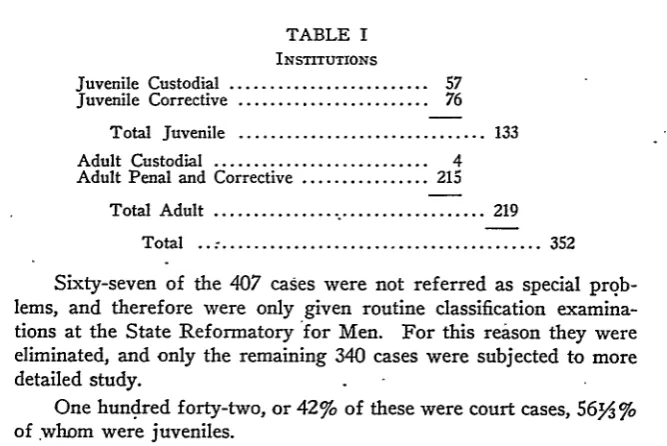
TABLE I
INSTITUTIONS
Juvenile Custodial ... 57
Juvenile Corrective ... 76
Total Juvenile ... 133
Adult Custodial ... 4
Adult Penal and Corrective ... 215
Total Adult ... ... 219
Total ... 352
Sixty-seven of the 407 cases were not referred as special prob-lems, and therefore were only given routine classification examina-tions at the State Reformatory for Men. For this reason they were eliminated, and only the remaining 340 cases were subjected to more detailed study.
One hundred forty-two, or 42%Y of these were court cases, 56y 7o of .whom were juveniles.
Personality Attributes
The outstanding motivating personality attributes have not yet been subject to statistical analysis, but include adolescent rebellion, carried over Intagonisms, and a variety of overcompensatory mechan-isms and other conflicts. The insecurities and feelings of inadequacy, rejection and difference were very prominent. Traces of the roots of most maladjustments and emotional twists were found in the early family and other environmental relationships.
Thirty-one, or 9%, of the
310
cases had very serious physical disabilities such as epilepsy, congenital lues, disabling arteriosclerosis, birth injuries, orthopedic coriditions, and the like. Fourteen of thesewere juveniles, and 17 were adults.
Degree and Types of Abnormality and Prognoses.
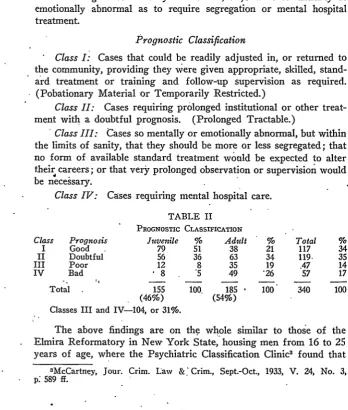
[image:4.454.54.388.67.290.2]that two-thirds of these very 'abnormal cases (Class III) were defin-itely mentally defective (morons' intelligence or less) while one-sixth of the prolonged treatment group with a doubtful prognosis were so endowed.
As these were what might be considered the most involved prob-lems in the State, it was not surprising to find that 57, or 17%, re-quired care and treatment in a mental hospital. Due to legal and other barriers, it was only possible to secure actual admission to a mental hospital in 49, or 12%, of the total series.
Including those mentally unbalanced, 31% were so mentally or emotionally abnormal as to require segregation or mental hospital treatment.
Prognostic Classification
Class I: Cases that could be readily adjusted in, or returned to
the community, providing they were given appropriate, skilled, stand-ard treatment or training and follow-ip supervision as required. (Pobationary Material or Temporarily Restricted.)
Class 11: Cases requiring prolonged institutional or other
treat-ment with a doubtful prognosis. (Prolonged Tractable.)
I Class III: Cases so mentally or emotionally abnormal, but within
the limits of sanity, that they should be more or less segregated; that no form of available standard treatment would be expected to alter their careers; or that very prolonged observation or supervision would be necessary.
Class IV: Cases requiring mental hospital care.
TABLE II
PROGNOSTIC CLASSIICATION
Class Prognosis Juvenile % Adult % Total %
I Good 79 51 38 21 117 34 II Doubtful 56 36 63 34 119. 35
III Poor 12 8 35 19 .47 14
IV Bad "8 '5 49 '26 57 17
Total 155 100. 185 100 340 100 (46%) (54%)
Classes III and IV-104, or 31%.
The above findings are on the whole similar to those of the Elmira Reformatory in New York State, housing men from 16 to 25 years of age, where the Psychiatric Classification Clinic8 found that
3
[image:5.454.42.391.195.606.2]DELINQUENCY AND CRIME
50% of those admitted could be readily fitted back into society, "if given proper treatment and training." Their researches also revealed that 32% were mentally or emotionally abnormal, and should be more or less segregated, as no form of treatments would alter their careers, and they would need to be kept under observation.
Intelligence of This Group
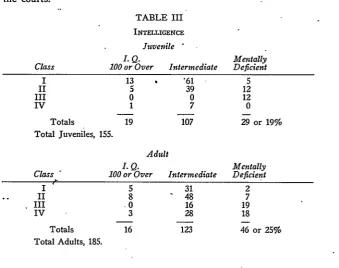
Twenty-two per cent, or a little over one-fifth, of these completely studied cases were definitely mentally deficient; i. e., their intelligence did not exceed that of a moron. Because we have so far been unable to have a separate defective delinquent institution, it was not sur-prisirig that among these 18 long standing defective delinquent cases were encountered. 'Fourteen imbeciles were found. As 26% were of border-line intelligence, 48%, or less than one-half, of this series had subnornal mentalities. Thus 52% had normal intelligence, including over 10%o, who had a relatively high mental ability as represented by an. evaluated equivalent intelligence quotient of 100 or above. Again we must remind ourselves that this finding is not representative of the average delinquent or criminal population, as these cases represent only the worst problems in the corrective and penal institutions and the courts.
TABLE III
INTELLIGENCE
Juvenile
I. Q. Mentally
Class 100 or Over Intermediate Deficient
I 13 ' 61 5
II 5 39 12
III 0 0 12
IV 1 7 0
Totals 19 107 29 or 19% Total Juveniles, 155.
Adult
I. Q. Mentally
Class 100 or Over Intermediate Deficient
I 5 31
II 8 48
III .0 16
IV 3 28
Totals 16 123
Total Adults, 185.
2
7
[image:6.454.60.400.335.603.2]'All Cases
I. Q., 100 or above 35 10+% 52%
Intermediate 142 42-% Normal
Borderline 88 26-% 26-% Borderline Moron 61 18-% 22% Mentally Imbecile 14 4 % Deficient
Totals 340 100 %
PREVENTION OF DELINQUENCY AND.CRIME
Methods of Approach
Every group engaged in this type of reconstructive work is at-tempting to attack these far reaching problems by every means at their command. Each may emphasize some means in which they are tliemselves especially interested, such as boys' clubs, disciplinary regimes, simple detention and segregation into homogeneous groups, occupational or trade training, commercialized production manufactur-ing projects, continuous labor, fixed drill-like systems, educational or lecturing procedures, individualized programs based upon study and understanding of each personality, athletic and sports programs, pre-parole substitutes, etc., followed by a variety of pre-parole and social follow-ups after release. Some .elements of most of these methods will be involved in any well rounded effort.
-Factors in Success or Failure
DELINQUENCY AND CRIME 67
of the clinics' studies as fundamental and all-important in seeking to understand what may be profitably attempted in attacking the problem of delinquency and crime prevention.
Who Appear Before Our Courts
Before we proceed further let us survey briefly the group who appear before our courts and have to be dealt with. According to the Division of Investigation of the Department of Justice in Washington, D. C., where most of the arrests in the United States are reported by name and fingerprints approximately three out of every five persons arrested during the year 1933 were below thirty years of age. About one in every five was below the age of twenty-one; one between twenty-one and twenty-four; and the third one in every five, between the ages of twenty-five and twenty-nine. The greatest number of arrests occurred in that group which was nineteen years of age. Nineteen and six-tenths per cent of all persons taken into custody were twenty-one years old or younger. None of these figures includes those youngsters taken before the Juvenile Courts, where their fingerprints are not taken; so they represent the more serious offenses at ages when such behavior is not excused on the ground of juvenile irre-sponsibility.
Other studies have been made which indicate that the intellectual level of prisoners is about the same as for the general population as a whole. It should therefore not be said that our so-called criminal
classes are mentally defective. (Footnote No. 2 supra.)
Corrective Measures Need Not Be an Added Cost
It is therefore evident that. reconstructive and remedial work is well justified in our corrective schools and penal institutions for most of the characters are young enough to be modified to some extent and future offenses thereby prevented. Such efforts should therefore insure less social injury and prevent much expense in future court trials and institutional maintenance. Often the community is re-quired to support the dependents of a prisoner. The cost of main-taining a psychiatric clinic, institutional training equipment and staff and other cprrective measures will undoubtedly save indirectly more
than they cost directly.
Scope of the Problem
bal-ance, ability to take responsibility and the general character of our young men qnd young women. Whether the members of our com-munity emerge from childhood and adolescence with emotional and physical handicaps and become social misfits, or whether they de-velop into good citizens, fathers and mothers, depends on the nature of the attitudes and influences which have surrounded them, and the "stuff" of which they were made. We might almost say that their outcome depends upon their choice of parents.
Responsibility of Educators
Our schools are our greatest training centers for good citizen-ship. However, Professor Ben D. Wood of Columbia and other educators have called attention to the finding that some time honored customs and the average standard school curriculum, when insisted upon without regard to the intelligence or needs of the individual pupils, provoke or perpetuate negative reactions and anti-social atti-tudes in a certain percentage of school children. Not only the home and neighborhood, but also the school, must therefore take part of the responsibility for preventing the initiation or aggravation of a trend toward juvenile delinquency.
Responsibility of Agencies Dealing With Delinquents
Emotional and other handicaps may bring, them into legal or other difficulties and the first contact is made with the police, who are the protectors and friends of all honest people.. At this time they may be put through severe accusatory questioningi receive the impression that others think them untruthful, and other measures which increase their antagonism to society; or be handled according to their intel-ligence, understanding and general character. Whichever method is employed will depend upon how much the police. are aware of good psychology and the far-reaching effects for good or for evil of their methods, especially on the youthful first offender.
There may follow long months of delay languishing in jail await-ing trial surrounded perhaps by dubious companions, or a speedy court decision m~ay be arrived at, depending upofl the form of the laws governing the procedure, and the efficiency and adequacy of the legal staff and court facilities furnished by the public.
Our man may get on -probation, and the character of the proba-tionary supervision furnished may determine whether he can make good or will become a repeater. The comparatively brief mention here of probation, the courts and the prosecution agencies do not do justice to their importance.
DELINQUENCY AND CRIME
the penal or "correctional" institution, his general attitudes and fundamental character may have become so asocial as to require more reconstructive handling and expense than would have been otherwise necessary. While in confinement he or she may, or may not, be prop-erly studied, classified, placed in his or her proper age and character group, taught a means of livelihood and, if redeemable, develop a sense of social responsibility. The institution will only be able to have a well rounded reconstructive program if properly financed by the legislature to secure the necessary building, equipment and trained staff personnel.
One might dwell indefinitely upon the inefficiencies, the wide vari-ation, in penalties, the contradictions, and the concepts discarded long ago by science, which still bind the courts and other agencies by re-maining in tl~e present legal codes. The committees of several na-tional associations and bodies have been.collaborating in the effort to remedy this situation.
Suppose- the reform school or prison has been fortunate enough to-be'able to do a fine piece of character building through individual study and treatment, and our prisoner is one fine morning paroled ol released with a five dollar bill in the pocket of his one suit of clothes and without nearby family or friends save the wise old-timer or gang associates made during his period of awaiting trial or While serving sentence. iere is the most vulnerable period in our whole penal and. correctional system. "All the time and effort expended may be lost for the lack of an understanding supporting advisor in the person of a skilled, capable parole or probation officer during the most precarious weeks or months while the former prisoner is making a place for him-self in a changed and sometimes hostile city. The dread of his record hangs over his head and it is sometimes months before self-confidence is restored. During this time, if no understanding friend is near, who is to blame the well intentioned ex-prisoner or ex-reformatory inmate if he joins with his friends, the hardened old-timer or gang, who welcome him with open arms to his disaster. Too often his good intentions are turned sour by an accusing visit from the police after every crime committed in that neighborhood. The expert probation and parole officer will not be present in sufficient numbers to do a good job it the citizens of the state do not see to it that sufficient funds are provided to hire enough of them.
Individual Study of Prisoners
for it. When such remarks are applied to the present measures and plans of modem penology, such thoughts are based upon a misunder-standing of what these plans and policies actually involve. Let it be emphatically stated that psychiatric clinics and penological experts are not in favor of the indiscriminate lenient handling of criminals.
The only brief held is for the individual study and treatment of prisoners of any age or sex.
A prisoner, whose antagonism to authority arose in the
relation-ship with a parent who was an unsympathetic, inconsistent, harsh disciplinarian, will have his social attitude made worse by severe han-dling. Another offender, who emerged from childhood without suf-ficient disciplinary training, may require firm and even a certain period of severe treatment to enable him to be considerate of the rights of others.
The Real Protection Due Society
In all of these considerations the protection due society should never be lost sight of, but it is believed, that we are dealing With erring members of the human family, who will sooner or later return to the social group. Therefore for its own protection society must see to it that delinquent and asocial members are constructively dealt with. This is simply an enlightened way of saying that the citizens of the community have a right to be really protected in return for their staggering expenditures on protective, legal, corrective and penal sys-tems. We have come to realize that mere detention for a short or a long period does not necessarily accomplish this -protection. We cannot
profitably avoid this issue, because, although a "sure cure" for a social behavior problem is the death penalty, such a solution has rarely been in popular favor.
The Contribution of Psychiatry
The part any psychiatric clinic plays in such a deserving effort is largely limited to social, physical, psychological and personality or psychiatric studies and trgatment of each juvenile or adult offender. During these procedures some knowledge is gained of fhe fundamental and frequently concealed personality twists and other causes of unac-ceptable behavior. When such information is placed at the disposal of probation and parole officers, children's bureau workers and the institution staffs, who really have everyday contacts with the indi-vidual in question, it has been found that greater strides may be made in enabling the boy or girl, or man or woman to fit themselves back into society again in a harnionious manner.
in-DELINQUENCY AND CRIME 71
mates into types for segregation purposes so that all classes of law-breakers may be kept from daily association, and thus prevent our corrective and penal institution from becoming training schools in crime.
A third duty is to determine by standard tests individual
apti-tudes, so that those without trades may acquire them in the shops of the institution during confinement and thereby have the means of honestly supporting themselves on release. Case after case have been encountered in the past, who after years of imprisonment have been released with no- knowledge of a trade or occupation to enable them to successfully compete in earning an honest living. There is a realization of the need for more training classes and shops.
A fourth and prime duty of the clinic is to aid in the selection of probation and parole material through character studies.
CONCLUSIONS
The statements made during my previous remarks and the con-clusions which follow are presented in the nature of a progress report and perhaps shed light upon our general problem as to what psychi-atric clinics furnishing personality studies have accomplished and can accomplish. I believe we shall all agree that while the role of psychiatry has its limitations in the attack upon sociological-penolog-ical problemg, that science has some important contributions to make. Let us face frankly the whole wide scope of the problem of the prevention of delinquency and crime, and consider how the home, the school, the churches, the police methods, the prosecution- and court facilities, the legislatures, the legal profession, the methods and means of utilizing probation and parole, and the attitude of the public must all share the responsibility. 'The juvenile and adult courts, reform schools, jails and prisons and the psychiatric clinics assigned to them for personality, aptitude and classification studies, to be used for segregation, reconstructive treatment and training measures and to aid in the selection of probation and parole material, have a very im-portant part to play, but by no means should be shouldered with the whole responsibility. One phase of the work is essentially dependent upon the others to achieve success. There is no doubt but that the psychiatric tlinics should be more utilized for examination before trial to attack the problem nearer its source. The juvenile courts, are in vital need of such service, and in many localities a clinic is an integral part of the court.
Prisoners Returned to the Community
realize that it receives very little real protection for its immense ex-penditures on police, courts and prisons unless the prisoner returns better than when sentenced. If, as sometimes is the case, he comes back to the community more anti-social than he was before, then society is in reality supporting agencies highly destructive to itself. It is consequently self-evident that prisons and reformatories must be provided with the buildings, equipment and trained staff so that they may function as treatment centers. More confinement for pun-ishment has lent itself to the formation of training schools in crime. Classification and segregation is the first law of penology.
Responsibility of the Public
Once society and its leaders are fully aware of the easily over-looked origins and vital influences at work before and after the fre-qiiently dramatic court session, a real understanding can be had con-cerning the wide scope of the problem of the prevention of delin-quency and repeated offenders.
We -have concluded that about 34% of even the worst problems in one state may be readily fitted-back in the community by the intel-ligently directed cooperative efforts such as have been developed by psychiatric and child guidance clinics.
Future Attack on Original. Sources
Perhaps some day through the enlightening efforts to all -special-ized, groups engaged in combating this tremendous social problem, the original sources may be more widely and directly dealt with. I refer
to the influences at work in the home and the neighborhood as typified by delinquency areas. The rigid unadalitable educational cur-riculum, which initiates rebellious tendencies, the unfruitful reliance upon mere punitive measures, and the stresses and strains of our so easily disjointed social and economic structure are some of the other original causes which make it so difficult for most every one to attain an efficient personality adjustment.'
Tio continue to set up an increasingly elaborate system of social agencies, courts and prisons to take care of the products of such fundamental sources as we have mentioned, without a major effort at their correction, is so absurdly costly and inefficient that it can be likened to a fireman, who continually sprays water upon the smoke instead of the fire.
Present Relationship of Psychiatry to the Problem of Crime
DELINQUENCY AND CRIME 73
courts, probation, parole and children's bureaus, and juvenile and adult corrective schools, jails and prisons, do furnish essential as-sistance by supplying personality, aptitude and classification studies. Such data must be available in order to formulate the required recon-structive treatment and training plans for each different individual; and to prescribe the essential elements of the probationary, parole or social follow-up necessary for each case.
BIBLIOGRAPrY
Hulbert, Harold S., and Sheehan, Frank J.: Relation of the Psychi-atrist to the Juvenile Court, Jour. of Criminal Law and Crim-inology, v. 25, .No. 2, 1934.'
McCartney, James L.: Institutional Routine, Jour. of Criminal Law and-Criminology, v. 24, No. 3, 1933:
Callender, John Hancock, Research Secretary of National Committee on Prisons and Prison Labor: Modern Penology and Prison Design, Architectural Forum, September, 1931.
Branham, V. C., New York State Deputy Commissioner of Correc-tion: Prognostic Administrative Classificationsuggested in 1931. Chute, Charles L.: Progress of Probation and Social Treatment in the Courts, Jour. Criminal Law and Criminology, v. 24, No. 1,
1933.
Healy, William: Prevention of Delinquency and Criminality, Jour. Ciminal Law and Criminology, v. 24, No. 1, 1933.
Glueck, Bernard: Psychiatric Clinic in a Prison System, New York Medical Jour., v. 105, April, 1917.
Lane, Winthrop D.: A New Day Opens for Parole, Jour. of Crim-inal Law and Criminology, v. 24, No. 1, 1933.
Copeland, Royal S.: Chairman of the Senate Committee to Investi-gate Crime in an Address before the National Educational As-sociation, 1934.
Schwartz, Louis A.: "The Depression Stew," American Jour. of Criminal Law and Criminology, v. 24, No. 6, 1934.
Patey, Heny C., and Stevenson, George S.: Mental Healith Empha-sis in Education, American Jour..of Orthopsychiatry, v. 3, No. 4.
1933.
Glueck, Bernard: 608 Admissions to Sing Sing Prison, Mental Hy-giene, v. 11, No. 1.