EXPLORING MOORE SPACE-FILLING GEOMETRY FOR COMPACT FILTER REALIZATION
EZRI MOHD
A project report submitted as partial fulfilment of the requirements for the award of
Degree of Master of Electrical Engineering
Faculty of Electrical and Electronic Engineering Universiti Tun Hussein Onn Malaysia
ACKNOWLEDGEMENT
, Praise to The Almighty Allah, finally with His limitless kindness for granting me a healthy and strength to complete this work at last. For my beloved mother and father, my wife and sons for supporting me during my study.
The author would like to express his sincere appreciation to his supervisor, Prof. Madya Dr. Samsul Haimi bin Dahlan for the support given throughout the duration for this project.
ABSTRACT
A compact RF filter is desirable in modern wireless communication system. The Moore curves fill the defined space and compact the effective geometry within the same line length. The miniaturization rate of the planar microstrip filter can be accomplished by applying the Moore curves with defined iteration and yet still maintaining the acceptable performance. In this work, the 2nd iterated Moore curves bandpass filter is designed to operate at center frequency, fcenter= 2.45GHz on
ABSTRAK
TABLE OF CONTENTS
TITLE i
DECLARATION ii
ACKNOWLEDGEMENT iii
ABSTRACT iv
ABSTRAK v
TABLE OF CONTENTS vi
LIST OF TABLES ix
LIST OF FIGURES x
LIST OF SYMBOLS AND ABBREVIATIONS xiv
LIST OF APPENDICES xvi
LIST OF PUBLICATIONS xvii
CHAPTER 1 INTRODUCTION 1
1.1 Overview 1
1.2 Problem Statement 2
1.3 Objectives of the Project 2
1.4 Scope of the Project 3
1.5 Outline of the Report 4
CHAPTER 2 LITERATURE REVIEW 6
2.1 Introduction 6
2.2 Background of Fractal Geometry 6
2.3 RF Filter’s terminology 8
2.3.1 Bandpass definition 8
2.3.2 Selectivity 10
2.3.3 Quality factor, Q 11
2.4 Moore Fractal Resonator 12
2.5 Review of Fractal Resonator 13
2.5.2 Hilbert Resonator 16
2.6 Coupling Coefficient of Coupled Line 17
2.6.1 Input and Output Coupling 17
2.6.2 Adjacent Resonator’s coupling 19
2.7 Class of Coupling 21
2.8 Review of Microwave Fractal Filter 22
2.9 Defected ground structure DGS 25
2.10 Conclusion 27
CHAPTER 3 METHODOLOGY 28
3.1 Introduction 28
3.2 Design and development study 28
3.3 Simulation 32
3.4 Fabrication 34
3.5 Measurement 36
CHAPTER 4 DEVELOPMENT OF MOORE FRACTAL RESONATOR 38
4.1 Design of Moore Fractal Resonator 38
4.2 Resonator’s dimension 38
4.3 Performances of Moore Resonator 40
4.4 Parametric Studies of Moore Resonator 42
4.5 Measurement of Moore Resonator 44
4.6 Conclusion 47
CHAPTER 5 DEVELOPMENT OF MOORE BANDPASS FILTER 48
5.1 Design Approach 48
5.1.1 Topology of Coupled Moore Resonator 48
5.1.2 Technique of Feeding 50
5.2 Parametric Studies on geometry’s dimension 51
5.2.2 Distance gap between Moore resonators elements,gspacing 55 5.3 Moore Filter design at center frequency,
center
f = 2.45GHz 60
5.3.1 Optimized dimension of designed
Moore fractal filter 60
5.3.2 Transmission Response 61
5.3.3 Surface current density 63
5.4 Comparison with Parallel-Coupled
Line Filter 64
5.5 Moore Filter with DGS 66
5.6 Realization of Moore bandpass filter 70
5.6.1 Fabrication 70
5.6.2 Measurement 70
CHAPTER 6 CONCLUSION AND RECOMMENDATION 73
6.1 Conclusion 73
6.2 Recommendation 75
REFERENCES 76
LIST OF TABLES
1.1 Scope of the proposed Moore filter 4
2.1 Fractal applications in different fields 8
2.2 Requirement of modern RF bandpass filter 8
4.1 Comparison of resonator’s size 40
4.2 Transmission characteristics of modelled resonators 41
4.3 Relation between resonant frequency and value of gap,g and width,w 43
4.4 Transmission characteristics of measured resonators 45
5.1 Transmission characteristic associated to variation of x and w 51
5.2 Validation of equation 5.1 between calculation and simulation 53
5.3 Validation of equation 5.2 between calculation and simulation 55
5.4 Summary of passband region attributes 62
5.5 Comparison of passband attributes 65
5.6 Simulated frequency suppression with different length of DGS transverse slot, s 68
5.7 Summary of comparison between measurement and simulation 72
LIST OF FIGURES
2.1 Examples of fractal geometries 7 2.2 Transmission coefficient, S21of bandpass filter 9 2.3 Symmetrical response of bandpass filter 11 2.4 (a) Moore curves and (b) Hilbert curves with
2nd iteration level (n=2) 12
2.5 Square dual-mode resonator with Minkowski’s iteration [8] 14
2.6 Relationship between L and g at 14GHz and transmission characteristic for 1st iteration square Minkowski resonators. [8] 14
2.7 Transmission characteristics of square, 1st and 2nd iteration Minkowski resonators. [8] 15
2.8 Transmission characteristics of 2nd square Minkowski resonators. [8] 15 2.9 Open line λ/2 resonator to Hilbert fractal
curves. [8] 16
2.10 Transmission characteristics of Hilbert
Resonator. [8] 16
2.11 Types of coupling between resonators 17 2.12 Method used to determine the unloaded
quality factor 18 2.13 Reference plane added to RLC equivalent
circuit. [9] 19 2.14 response with input/output are weakly
coupled [8] 20 2.15 Class of coupling between resonators. [8] 22 2.16 Transmission zero and selectivity 22 2.17 (a) 2nd iteration and (b) 3rd iteration of Hilbert
2.18 3rd order meandered line with (a) magnetic coupling and (b) electrical coupling and
their transmission responses [11] 24
2.19 3rd order Hilbert filter with (a) magnetic coupling and (b) electrical coupling and their transmission responses. [11] 24
2.20 (a) 2nd and (b) 3rd iteration of Moore fractal and their transmission responses. [12] 25
2.21 (a) 3-Dimensional view of the DGS unit section. (b) The newly proposed equivalent circuit. [14] 26
3.1 Process flow of the project 39
3.2 Mesh solver and adaptive mesh refinement setting 33
3.3 Boundary conditions setting 33
3.4 Flow chart of fabrication process using photolithography technique 34
3.5 Laminator machine 35
3.6 UV exposure machine 35
3.7 The measurement outcome of network analyzer 37
3.8 Measurement setup to excite both ports of Moore resonator 37
4.1 Evolution of Moore fractal 38
4.2 Geometry of designed resonators, (a) half-wavelength resonator, (b) 1st iteration Moore, (c) 2nd iteration Moore. 39
4.3 Transmission characteristic of modelled resonators 40
4.4 Gap and width of Moore resonator 42
4.5 Transmission response with gap variation [w=2.5mm] 43
4.6 Resonant frequency with gap variation [w=2.5mm] 43
4.8 Realization of the resonators, (a) half-wavelength resonator, (b) 1st iteration Moore, (c) 2nd iteration Moore 45 4.9 Comparison between simulation and
measurement of λ/2 line resonator 46 4.10 Comparison between simulation and
measurement of 1st iteration Moore resonator 46 4.11 Comparison between simulation and
measurement of 2nd iteration Moore resonator 47 5.1 Optimized dimension of Moore resonator
element 48 5.2 Proposed topologies of the filter 49
5.3 Transmission characteristic S21 for electric and
magnetic coupling 49
5.4 Input/output feeding technique 50 5.5 Transmission response of Moore filter with
tapping and mutual coupling feedlines 50 5.6 Relation between center frequency,
center
f
(GHz) and length of x (mm) 525.7 S21 response with different width of fractal at center frequency,
f
center=2.45 GHz 545.8 Distance spacing, gspacing between Moore
resonators with magnetic coupling 56
5.9 Coupling coefficient, k associated with distance spacing, gspacing 56
5.10 Transmission response, S21 associated with variation of distance spacing, gspacing 57 5.11 Extremely over-coupled with distance gap,
spacing
g = 0.1mm 58
5.12 Over-coupled with distance gap,
spacing
5.13 Under-coupled with distance gap,
spacing
g = 2.0mm and 4.0mm 59
5.14 Optimized dimension of designed Moore filter 60 5.15 Transmission response of designed Moore filter 61 5.16 Bandpass response of designed Moore filter 61 5.17 Simulated surface current at 2.45GHz
(passband region) 63 5.18 Simulated surface current at 2.8GHz
(reject band region) 64
5.19 Conventional 6th order parallel coupled line
bandpass filter 64
5.20 Comparison of passband characteristic between Moore filter and parallel coupled
line filter 65
5.21 The dumbbell DGS at the Moore I/O feedlines 67
5.22 Transmission response with different length of DGS transverse slot, s 67
5.23 Relation between frequency suppression and length of DGS transverse slot, s 68 5.24 Moore bandpass filter with dumbbell DGS 69 5.25 Transmission response of Moore bandpass
filter with DGS 69 5.26 The fabricated Moore bandpass filter 70 5.27 Comparison between simulated and
measured result of the proposed filter
(full observed range) 71
5.28 Comparison between simulated and measured result of the proposed filter
LIST OF SYMBOLS AND ABBREVIATIONS
r
ε
- Dielectric constanteff
ε - Effective dielectric constant
AR
L - Maximum passband ripple
λ - Wavelength of the radio wave
c
f - Resonant frequency
center
f - Center frequency of the filter
H
f - Upper frequency at -3dB below from insertion loss
L
f - Lower frequency at -3dB below from insertion loss
f
∆ - Different between two split peak frequency
out
P - Output power from filter
in
P - Input power to filter
Q - Quality factor
e
Q - External quality factor
L
Q - Loaded quality factor
U
Q - Unloaded quality factor
n
- Level of Moore iterationn
S - Total perimeter length of Moore fractal with n-iteration
L - Length of outer area side Moore fractal
w - Width of fractal
g - Gap spacing between Moore segments
spacing
g - Gap spacing between two coupled Moore resonators
x - Length of Moore open line segment
k - Coupling coefficient
11
S - Reflection coefficient
21
o
Z - Characteristic impedance BW - Bandwidth of bandpass filter I/O - Input and output
UV - Ultra-violet RF - Radio frequency
LIST OF APPENDICES
APPENDIX TITLE PAGE
A Published Paper 79 B Moore BPF with upper cavity: A brief study 87 C Datasheet: RT/duroid®5870/5880 by Rogers
Corporation 88 D Datasheet: Bandpass Cavity Filter SF24251 by
LIST OF PUBLICATIONS
Journal:
(i) Mohd, E. & Dahlan, S. H. (2017). Miniaturization of Resonator based on Moore Fractal. TELKOMNIKA (Telecommunication, Computing, Electronics and Control), Universitas Ahmad Dahlan (UAD), Vol.13,
CHAPTER 1
INTRODUCTION
1.1 Overview
In a front-end receiver of microwave communication systems, RF filter is an essential component. The filters are designed to pass specific frequency within a particular passband and reject the other frequency outside the operating frequency band. Nowadays, the bandpass filter with high performance, compact size and low cost is desired to enhance the overall performance of communication system. The well-known planar structure filter such as microstrip is already in small size but there are needs to reduce the size of a particular application especially in portable communication devices.
Currently, the miniaturization of microwave filter focuses on a planar filter structure. Open line resonator filter is a famous filter structure that had been widely studied and commercialized. Parallel coupled line and hairpin resonator are preferred for passband application and can frequently be found inside communication devices. These structures are simple to design and the bandwidth can be controlled with ease. As further development, they are benefited from its flexibility to fold the resonator as a result of more compact form.
higher order of filter could be designed by iterative construction while the overall physical realization is miniaturized.
The high dielectric constant substrate is used to miniaturize microstrip filter and a variable geometry of filters is required. Hence, numbers of new filter configuration can be modelled possibly. However, dissipation losses correlated with the size of the filter and it affect the performance of the filter overall. The parametric study will be conducted to define ‘trade-off’ between the technical performance and miniaturization based on application.
1.1 Problem Statement
With rapid demand for smaller and reliable wireless communication system, RF devices miniaturization become the research trend. A new filter circuit design which suits the manufacturing ability and cost yet still maintaining the required performance is developed.
The parallel coupled line resonator is popular for designing the narrowband filter and widely used for many years since 1958. However, there are disadvantages of this filter although it requires simple design and supports a wide range of fractional bandwidth from 5% to 50%. The length of coupled line resonator is too long and increases directly proportional to the order of the filter. The hairpin line filter is developed based on parallel coupled line filter with folding the λ/2 resonator structure. Recently, the microstrip fractal geometry had become a trend in designing planar structure on RF devices such as antenna and filter. The Moore fractal has several unique criteria such as essential dual properties, space curve filling and self-similarity which is the iteration can be done in a defined space. Theoretically, this feature will enable the miniaturization of the filter. In this thesis, by applying Moore fractal construction, a compact bandpass filter applicable for wireless application in ISM band is modelled, designed and validated.
1.1 Objectives of the Project
agreement. In this work, the miniaturization is expected to be achieved by using high permittivity material, RT/duroid®5880 and fractal configuration with its variation of resonant structure. The configuration of parallel coupled line filter is designed and its physical realization are observed as well as filter’s performance to be compared with designed Moore fractal filter.
The challenging task is to design a bandpass filter with lowest possible insertion loss while miniaturizing the filter and keeping the low coupling between resonators. Some parameters highly correlated to each other and achieve one requirement may reduce the other one. Hence, analysis and parametric study of the trend is presented in this work. To achieve the aim, the objectives of the study are: (i) To design a compact bandpass filter using Moore fractal at ISM band. (ii) To analyze the performance of Moore fractal filter in term of geometry and
technical aspect.
(iii) To explore the correlation between variations of Moore geometry with electrical performance of the Moore BPF.
(iv) To prototype a Moore BPF and validate experimentally.
1.2 Scope of the Project
A compact resonator filter is achieved by using a Moore fractal structure. A reduction in the form factor is made by folding the resonator line while maintaining its length approximately and is represented in term of iteration. The iterative construction of the fractal Moore filter geometry is limited up to the second iteration. This designed filter is compared with conventional parallel coupled line. The scope of this work are:
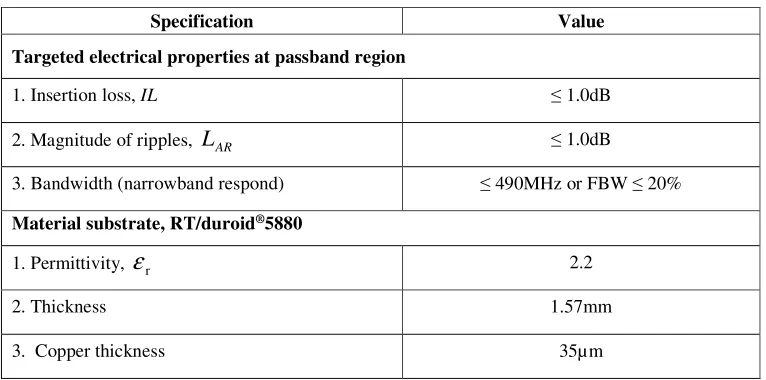
(i) Design and fabricate a microstrip 2nd order of bandpass Moore fractal filter at center frequency of 2.45GHz with a narrowband response based on electrical and material specifications as shown in Table 1.1.
(iii) The optimized design of the Moore BPF should consider the accuracy of in-house fabrication which is set up to 0.5mm precision to guarantee the desired geometry.
(iv) The resulted correlation between geometry’s dimensions and the transmission characteristic of the designed Moore BPF are valid for a defined range of width of fractal, w and center frequency, only.
[image:20.612.132.515.298.488.2](v) The simulated results are verified experimentally in a typical laboratory environment without any special shielding and setup by using a calibrated network analyzer that able to sweep for a range of frequency from 500MHz to 10GHz.
Table 1.1: Specification of the proposed Moore filter
Specification Value
Targeted electrical properties at passband region
1. Insertion loss, IL ≤ 1.0dB
2. Magnitude of ripples, LAR ≤ 1.0dB
3. Bandwidth (narrowband respond) ≤ 490MHz or FBW ≤ 20%
Material substrate, RT/duroid®5880
1. Permittivity,
ε
r 2.22. Thickness 1.57mm
3. Copper thickness 35µm
1.5 Outline of the Report
This report consists of six chapters. Chapter 1 presented the overview of the project and its objectives. The scope limitations of the works are also described briefly in this chapter.
Chapter 2 presented the literature review by discussing general knowledge of microstrip fractal and its associated characteristics. The evolution of conventional microstrip transmission line to Moore resonator fractals are explained. The main filter characteristics that define the performance of the filter such as selectivity and coupling technique are discussed. Then, the advantages and limitations of other fractal resonators and filters by other researchers are reviewed.
Chapter 3 explained the methodology of the project to accomplish the objectives with a scope above. The approach starts with the development of single element of Moore resonator through simulation and realization to validate the potential as a filter. With a verified result from Moore resonator, the Moore bandpass filter is designed. This chapter also describes the simulation procedure and fabrication technique.
Chapter 4 described the first stage of this project by presenting a resulted preliminary study of Moore resonator by simulation and experiment. This study also involved the comparison between different iteration of Moore fractals and their performances. The correlation between Moore geometries and transmission characteristics is reviewed.
Chapter 5 focused on developing the ultimate goal of this project which is designing a Moore bandpass filter. In this chapter, the variation of technique to excite the filter through different class coupling and feedline are explained. The outcomes of parametric studies and the resulted correlation between different parameters with transmission characteristic are discussed. This chapter also revealed the control parameters of the Moore fractal geometry to achieve specific filtering criteria.
CHAPTER 2
LITERATURE REVIEW
2.1 Introduction
Chapter 2 discussed the general background of microwave fractal filter based on planar microstrip technology. The suitability of Moore fractal curve to be used as a microstrip microwave bandpass filter is explored. Studies are done based on knowledge on planar coupled mode microstrip since the fractal curve will have many adjacent microstrip structures on completed filter’s geometry and induced a coupling effect. Coupling between microstrip coupled line is one of the elements that made a microwave filtering’s effect. Besides, reviews about other previous studies on microwave resonator or filter based on fractal curves are discussed. Some fractal design consideration and transmission characteristics are compared. At the end of this chapter, the advantages and limitation of the microwave fractal filters which are done by previous researchers will be summarized.
2.2 Background of Fractal Geometry
There are many types of fractal iteration that had been introduced as early as 1870s. The simplest structure to describe the fractal iteration is Cantor. The Cantor set give us an early idea about fractal iteration and consists a set points lying on a single line segment. The Cantor iteration has infinite numbers and self-similarity properties. Others types of fractal geometry are Peano, Hilbert, Sierpinski, Von Koch and Moore in Figure 2.1. From visual observation, one should notify that these curves are actually repeating themselves in fractional dimension with finite occupied area.
Figure 2.1: Examples of fractal geometries
Nowadays, fractals are implemented in many fields due to their main properties; self-similarity and space filling. In microwave field, fractal have been used to develop compact RF devices, most notably antennas and filters. Some of these applications are summarized in Table 2.1.
(a) Cantor line (b) Peano curve (c) Hilbert curve
Table 2.1: Fractal applications in different fields.
Field Application
Statistical Probability theory called statistical fractal to predict extreme/catastrophic
events.
Chemistry Research structural design and optimized design of microfluidic and
nanofluidic devices for mixing, reaction and heat transfer.
Acoustics Invention of a revolutionary type of acoustic barrier of soundproof walls.
Cosmology Understanding the distribution of luminous matter in the universe.
Computer Science Apply degree of recursion and self-similarity at different scales in creating
an animation or to compress lossy image.
Electromagnetic Miniaturization of RF devices and performance enhancement such as
selective frequency and harmonic suppression. [3]
2.3 RF Filter’s terminology
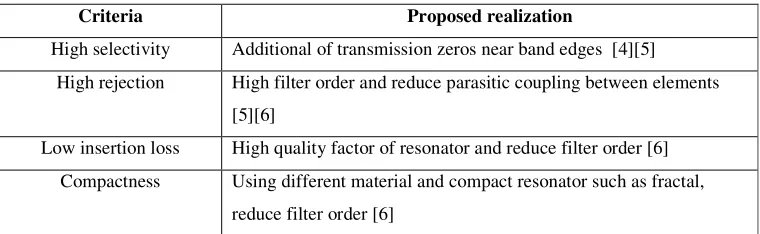
[image:24.612.133.518.436.554.2]In order to produce high performance of the filter, there are main criteria that the filter must be able to fulfill. Table 2.2 concludes the general need and the proposed realization.
Table 2.2: Requirement of modern RF bandpass filter
Criteria Proposed realization
High selectivity Additional of transmission zeros near band edges [4][5]
High rejection High filter order and reduce parasitic coupling between elements
[5][6]
Low insertion loss High quality factor of resonator and reduce filter order [6]
Compactness Using different material and compact resonator such as fractal,
reduce filter order [6]
2.3.1 Bandpass definition
dual-band of bandpass filter. The characteristic response of passband filter also should be considered prior to its application.
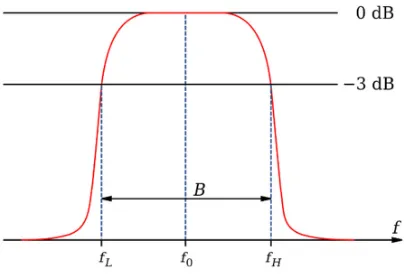
[image:25.612.219.421.229.366.2]When designing a bandpass filter, we must determine the level of rejection or attenuation that must be achieved by the filter at frequencies outside of its passband bandwidth. The bandwidth is associated with cut-off frequencies upper and lower of filter’s center frequency at -3dB from maximum insertion loss in passband region. Figure 2.2 illustrated the terminology to express the bandwidth of passband filter.
Figure 2.2: Transmission coefficient, S21of bandpass filter
The bandwidth is calculated by subtracting the lower frequency, fLwhere the response attenuates by 3dB from the higher frequency, fHwith same attenuation level as equation 2.1.
BW = fH − fL (2.1) The bandwidth of the filter can be categorized as narrowband or wideband. It depend on the range of the passband region and the suitability based on application. Generally, the category of the filter is determined by fractional bandwidth, FBW in percentage.
Fractional bandwidth, FBW = *100
center
f BW
(2.2)
magnitude decibel (dB). Insertion loss is an indicator of forward transmission gain of 2-port network system.
Insertion loss, ILdB =
in out
P P 10
log
10 (2.3)
To realize the definition of filtering characteristics for RF system, the device
must be able to attenuate 50% of the input power in stopband region. Calculate using
the formulation of insertion loss, ILdBwould be approximately -3.01dB. Theoretically, the low insertion loss in passband region is desired due to zero loss in
allowing all the input power and high insertion loss as possible as can be is desired
in stopband region.
2.3.2 Selectivity
Selection of proper RF filter for a certain application is determined by its selectivity.
Selectivity is described as the level of attenuation at some frequencies that is rejected
from passband region of the filter. It usually is represented by a slope which indicate
how many decibel drop from cut-off frequency in both lower and upper side. For an
example, the cavity resonator at 155MHz has a selectivity which can be described as
15dB drop at interval of 1MHz in both lower and upper cut-off frequencies.
Normally, the transmission coefficient of RF bandpass filter is not
symmetrical. The response may be described of having 5dB drop at interval 1MHz
at lower side of center frequency and 10dB at upper side. This condition indicated
that the filter has a better selectivity at upper side of center frequency. The Chebyshev
response has a better selectivity than Butterworth response which is indicated by a
sharp slope, while quasi-elliptic response usually has an equal selectivity in both side
from center frequency.
The selectivity of the filter can be improved by using a quasi-elliptic response
[4]. Quasi-elliptic response has transmission zeros in both side of center frequency.
Figure 2.17 illustrates the importance of having symmetrical response with
occurrences of finite transmission zeros. The writers proposed a source load coupling
to realize quadrupled in second order filter in order to create two finite transmission
Figure 2.3: Symmetrical response of bandpass filter [4]
2.3.3 Quality factor, Q
High performance of the filter generally achieve high value of quality factor. The Q
factor can described as a unit less ratio of the total energy stored in the lumped
element of the resonator (inductor and capacitor) to the dissipated power in the
resistor. As we may recalled, the microstrip microwave resonator can be represented
by an equivalent lumped elements circuit. However the extraction of the accurate
lumped elements of the filter always become a great challenges to the researchers
especially when dealing with complex structural like fractal geometry.
There are two ways to extract the quality factor of resonator; equivalent of
lumped elements circuit and transmission type measurement [7]. Since in this work
implement the Moore fractal, the latter method of extraction is reviewed in section
2.5.1 later on.
2.4 Moore Fractal Resonator
Microwave resonators that are designed using planar technologies such as microstrip
can be compacted by adopting the fractal construction. Recently, researchers are
exploring the fractal construction in order to meet the needs of smaller antennas and
filters with reduced cost.
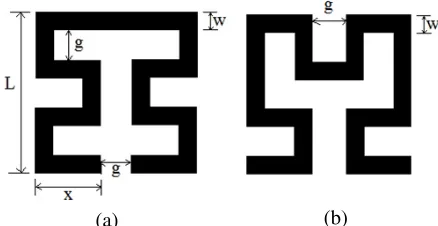
The Moore fractal curve is a continual line that is folded several times in term
of iteration. Moore fractal begin with a single line and has a special recursive
SFC make a miniaturization on RF devices is possible. Hilbert and Moore curve are
outlined in Figure 2.4. The main different is the endpoints of these fractal, Moore has
its endpoint coincides with each other and create a spacing gap. From microstrip
technology’s perspective, a gap between microstip lines creates a capacitance which
[image:28.612.211.430.194.307.2]influences the coupling characteristic.
Figure 2.4:(a) Moore curves and (b) Hilbert curves with 2nd iteration level( = 2).
The total perimeter length, S of Moore fractal is determined by with n is the iteration level.
Sn
(
n)
n *L1 2 1 1 2 − + +
= (2.4)
L is the length of outer area side Moore fractal and determined the area occupied by fractal curve. From study, the total length of line segment is longer from
its origin but the physical area is miniaturized. To develop a resonator using Moore
fractal, the single resonator with certain length is folded to some iteration.
Theoretically, the total length is maintained to resonate it to the same frequency for
different iteration. However, the length need to be optimized in physical realization
to achieve same resonant frequency for a half wavelength resonator, first iteration
and second iteration respectively.
Ideally, the designer would prefer to fit resonator in the small area as much
as possible by increasing the iteration level of Moore curve. As for microstrip, the
width, w and the gap space between, g are the parameters needed to be defined to model a Moore curve. It depends on the iteration level, n. A higher iteration Moore
curve would decrease the resonator width, w and spacing between lines, g to fit the
total perimeter length, S curves in the smaller area. The relation between dimensions as depicted by:
L=2n*
(
w+g)
−g (2.5)The external side, L could be controlled by defining the width of the resonator, w and spacing between lines, g. However, from the study the other external side, x would be varying to resonate the structure to a specific frequency for second
iteration ( = 2) and is defined as an optimization technique.
A smaller width of resonator, w would increase the dissipation losses, thus the quality factor, Q should diminishes. So, the designer should consider this parameter if the application emphasize on higher quality factor, Q and at the same
time, miniaturization is required. The trade-off between miniaturization and
dissipation losses should be defined well according to priority.
2.5 Review of Fractal Resonator
This section discussed about studies that had been done on microwave resonators.
The studies reveals the suitability and potential of two types of resonators for
compacted RF devices and filters based on Minkowski and Hilbert fractal curves. [8]
2.5.1 Minkowski Resonator
The square dual-mode resonator is designed to be operated at center frequency,
14GHz. As depicted in Figure 2.5, the iteration of Minkowski fractal can be done by
removing several small square or rectangular repeatedly. The iteration techniques can
be done in two methods; square iteration or rectangular iteration. The designer should
Figure 2.5: Square dual-mode resonator with Minkowski’s iteration [8]
We should notice that the value of L is preserved while the value of g
decreases after each iteration. After an infinite number of iterations, we should expect
that there is no more left as the iteration has consumed the space square.
For a dual mode resonator to be operated at a specific frequency is determined
by the value of L and g. The writers concluded the relationship between L and g to maintain a resonant frequency at 14GHz and some cases to validate the transmission
characteristics in Figure 2.6.
Figure 2.6: Relationship between L and g at 14GHz and transmission characteristic for 1st iteration square Minkowski resonators. [8]
With same resonant frequency at 14GHz, the rate of miniaturization can be
controlled by the value of g. This is a definite conclusion that the Minkowski iteration is capable of producing a smaller square dual-mode resonator. In term of transmission
characteristics, the first spurious frequency which is twice resonant frequency occurs
[image:30.612.136.510.416.545.2]the highest frequency and the writers concluded the miniaturization also could
improve the spurious response.
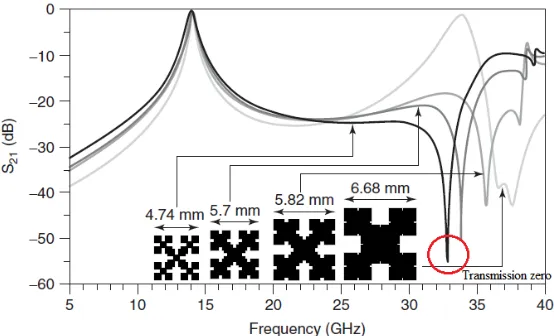
Further investigation, Minkowski with 2nd iteration resonator had been
developed to observe the transmission characteristics. Figure 2.7 shows the
comparison of the square resonator with 1st and 2nd Minkowski’s iteration. The first
spurious frequency is attenuated significantly in higher iteration and in addition to
that, also produce the transmission zero characteristics. The writers also designed
four different sizes of 2nd Minkowski’s iteration to examine the transmission
characteristics and the result is depicted in Figure 2.8. The smaller size of the
resonator with same Minkowski’s iteration would also provide a better spurious
[image:31.612.185.454.294.460.2]response.
Figure 2.7: Transmission characteristics of square, 1st and 2nd iteration Minkowski
resonators.[8]
[image:31.612.184.461.520.688.2]2.5.2 Hilbert Resonator
The Hilbert fractal curve is constructed by folding a single open line resonator to ‘U’
shape and is iterated by a special curves. The iteration can be done by repeated
folding again and again into finite space with infinite length. A λ/2 open line
[image:32.612.142.504.373.459.2]resonator is folded according to Hilbert’s curve up to 2nd Hilbert’s iteration as in
Figure 2.9. All the resonators are designed with respective dimension to have same
resonant frequency at 9.78GHz.
From transmission characteristics as illustrated in Figure 2.9, we noticed that
open line resonator and ‘U’ shape resonator have a spurious response at twice the
resonant frequency. The 1st iteration Hilbert had a spurious frequency slightly above
twice the resonant frequency and produced transmission zeros response. The 2nd
iteration Hilbert also had a spurious frequency above twice the resonant frequency
and the transmission zero is apparently moved closer to the resonant frequency. This
response suggested an improvement in selectivity.
[image:32.612.151.488.454.693.2]
Figure 2.9: Open line λ/2 resonator to Hilbert fractal curves. [8]
As a conclusion, the fractal resonator especially Minkowski and Hilbert tend
to suggest that the higher iteration number, the miniaturization factor should be
increased. The performances with better selectivity due to the occurrence of
transmission zero and harmonic suppression is possible.
2.6 Coupling Coefficient of Coupled Line
Proximity between two or more transmission line introduces coupling effect through
their fringing fields respectively. This coupling effect could be desirable or
undesirable. In printed circuit board, the coupling effect is undesirable as it cause a
crosstalk, but in microwave devices such as directional coupler, it is desirable. The
coupling between transmission lines enable power transfers between lines at the
resonant frequency.
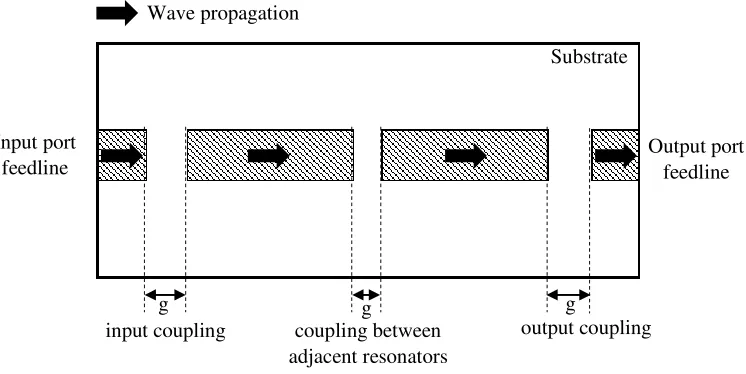
For a microstrip transmission lines, there are two types of coupling, input or
output coupling and coupling between adjacent resonators as illustrated in Figure
[image:33.612.139.512.408.595.2]2.11. Both characterize the excitation between the resonators.
Figure 2.11:Types of coupling between resonators
2.6.1 Input and Output Coupling
The input coupling characteristic depends on the spacing gap, g between the first
resonator and input feedline and output coupling depends on the spacing between last Wave propagation
Substrate
Input port feedline
Output port feedline
g g g
coupling between adjacent resonators
resonator and output feedline. From reflection coefficient transmission characteristic,
, we could calculate the input coupling by measuring its resonant frequency,
and bandwidth corresponding to 180 phase shift from resonant frequency. Then, the
input coupling is represented by external quality, factor given by:
f f Qe
∆
= 0 (2.6)
Since the performance of filter is referred to unloaded quality factor, ,
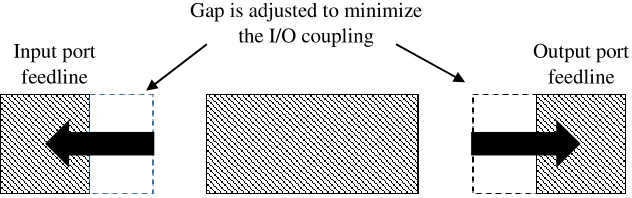
spacing gap between input or output feedlines can be manipulated. To eliminate the
effect of input and output coupling, the spacing between feedlines and resonators is
adjusted until attenuation, transmission characteristic at least 20dB from its
maximum value at resonant frequency as depicted in Figure 2.11. The 3dB bandwidth
is measured to calculate unloaded quality factor, by extrapolating external quality
factor, given by
) (
1 21 o
e f S Q Qu −
= (2.7)
Higher quality factor suggests more power is delivered between resonator lines due
[image:34.612.165.481.451.550.2]to strong coupling between resonators.
Figure 2.12:Method used to determine the unloaded quality factor.
2.6.2 Adjacent Resonator’s coupling
Coupling between adjacent resonators determine the maximum power transfer at
certain resonant frequency. A good filter resonate at designed resonant frequency.
Variation in spacing gap between resonator elements shift the resonant frequency.
When the spacing between resonators is shorter, the resonant frequency will be Output port
feedline Input port
feedline
decreases. These assumption has been used to optimize the modelled design in order
to achieve desired operating frequency of planar resonator.
As suggested by Y. Hongyu [9], the calculation methods of coupling
coefficient between resonators are presented. When two resonators are located in
close proximity, two modes of couplings are existed; electric coupling and magnetic
coupling. The electric coupling creates capacitance effect while the magnetic
coupling introduces inductance effect as showed in equation (1) in this paper. From
the general coupling coefficient equation, the researchers propose three methods in
order to calculate the coupling coefficient more accurately based on certain
conditions.
One of the methods is to add an electric and magnetic wall between coupled
resonators. This is done by adding a reference plane in the middle of RLC equivalent
circuit as illustrated in Figure 2.13.
Figure 2.13: Reference plane added to RLC equivalent circuit. [9]
In this method, the coupling coefficient is calculated in term of electrically or
magnetic coupling only. The electric coupling is calculated by short-circuiting the
reference plane (T-T’ plane) to create an electric wall while the magnetic wall is
created by open-circuiting the plane. Then the resonant frequency based on additional
of electric/magnetic wall is calculated respectively. Coupling coefficient for both
capacitance and inductance coupling can be found by knowing the value of resonant
frequency in both modes. Below equation summarize the method:
(i) Coupling coefficient for capacitance coupling (electric coupling),
2 2 2 2 e m e m m f f f f C C k + − =
= (2.8)
(ii) Coupling coefficient for inductance coupling (magnetic coupling), 2 2 2 2 m e m e m f f f f L L k + − =
= (2.9)
From this equation, we should expect that if coupling coefficient polarity is negative,
then we can conclude that the resonators are magnetically coupled and otherwise.
Coupling coefficient also can determined with S-parameter method
introduced by P. Jarry and J. Beneat [8]. This method require the gap adjustment
between input/output feedline and the resonators. To define the resonator coupling
coefficient, the input/output couplings need to be coupled weakly in order to prevent
any interference with coupling between resonators. Attenuation of at least 10dB
between two weakly coupled resonant frequencies and is assumed to make sure
[image:36.612.199.444.347.498.2]the interference do not occurred as depicted in Figure 2.14.
Figure 2.14: response with input/output are weakly coupled. [8]
Then, the coupling coefficient, k between resonators can be calculated by:
2 1 2 2 2 1 2 2 f f f f k + −
= (2.10)
This method applies to both electric and magnetic coupling. Farid Ghanem, Tayeb
A. Denidni and Renato-G Bosisio presented the same method to calculate the
coupling coefficient, k for planar cross-coupled resonator filters with electric or magnetic coupling and mixed coupling [13]. The result revealed that the dimension
exhibit desired response. They also explained the application of equation (2.10) in
comprehensive graphical representation.
2.7 Class of Coupling
For a periodic structure, the arrangement of planar resonator determines the class of
coupling either electrical or magnetic coupling. In electrical coupling, an electrical
field is concentrated inside coupling area or sometimes is referred as positive
coupling. In other hand, a magnetic coupling has its electrical field is concentrated
outside the coupling area. Hence, it is opposite with electrical coupling and known
as negative coupling. The term positive and negative can be seen in phase
characteristic as it is opposite to each other. We can observe that with same distance
of the gap between resonators but a different class of coupling, magnetic coupling
provide stronger coupling. The orientation of the resonators may introduce mixed
coupling too. This method can be used as a mechanism to control the bandwidth of
the filter (narrowband or wideband).
Depending on the application, transmission zero also sometimes is desirable
in filter design. Transmission zero often relates to the ability of the filter to reject the
unwanted frequency in the stop-band region. Interestingly, we can control the
occurrence of transmission zero by electrical or magnetic coupling. Electrical
coupling creates transmission zero at low pass section whereas magnetic coupling
influences transmission zero at high pass section. Besides that, it also helps to
attenuate or eliminate the spurious frequency and enhance band-stop rejection as well
Figure 2.15:Class of coupling between resonators. [8]
Figure 2.16:Transmission zero and selectivity
2.8 Review of Microwave Fractal Filter
There are many research on microwave filter based on fractal geometry. This section
will review some techniques and result. As fractal geometries have two common
properties, self-similarity and space-filling, the designer has an option to investigate
different fractal geometries.
Microstrip bandpass filter based on Hilbert fractal geometry of 2nd and 3rd
iteration are designed by Y.S. Mezaal [10]. The Hilbert fractal geometry is designed
from conventional half-wavelength resonator filter and considerable miniaturization
is achieved. Two structures of Hilbert fractal are coupled electrically to create a
[image:38.612.158.489.290.460.2]In term of performance, the filter produces transmission zero at both low and high
pass region at least -50dB ( response). The 3rd iteration of Hilbert fractal produce
better transmission response with symmetrical transmission zero around resonant
frequency. This result suggest better band-stop rejection and improve selectivity.
However, the width trace become smaller (w = 0.22mm) and need precision value
during fabrication. With smaller trace width, dissipation losses is higher and the
tradeoff between miniaturization rate and performance should be a concern. Hence,
this technique might not suitable to be used if fabrication is done in general printing
[image:39.612.155.491.266.455.2]circuit board (university) which is not specialized in microwave.
Figure 2.17:(a) 2nd iteration, (b) 3rd iteration of Hilbert filters and its transmission
response [10]
To further improve the miniaturization, P. Jarry, J. Beneat and E. Kerherve
implemented the pseudo-elliptic response [11]. For the same selectivity, this
approach allows further reduction in size and the construction will be simplified by
using lower order of the filter. Meandered line, Hilbert and dual-mode Minkowski
bandpass filter are designed and compared. 3rd order meandered line and Hilbert
fractal are fabricated and experimental results are presented. Interestingly, they also
re-arranged the structures to demonstrate magnetic and electrical coupling. From
both experimental results, it suggests that class of coupling will determine the
location of transmission zero either in left (electrical coupling) or right (magnetic
coupling). This information is useful for the designer to decide where they would
and selectivity. In this paper, all the input and output feedline is excited by mutual
[image:40.612.153.503.122.362.2]coupling.
Figure 2.18:3rd order meandered line with (a) magnetic coupling, (b)
electrical coupling and their transmission responses [11]
Figure 2.19:3rd order Hilbert filter with (a) magnetic coupling, (b) electrical
coupling and their transmission responses [11] (a)
(b)
[image:40.612.154.505.444.680.2]REFERENCES
1. Mandelbrot, B. B. (1983). The Fractal Geometry of Nature. New York: W.
H. Freeman.
2. Falconer, K. (2003). Fractal Geometry: Mathematical Foundations and Applications. West Sussex: John Wiley & Sons Ltd.
3. Krzysztofik, W. J. (2017). Fractals in Antennas and Metamaterials Applications, Fractal Analysis - Applications in Physics, Engineering and Technology, Dr. Fernando Brambila (Ed.), InTech,
4. Kolmakov, Y. A., Savino, A. M. & Vendik, I. B. (2004). Quasi-elliptic two
pole microstrip filter. 15th International Conference on Microwaves, Radar
and Wireless Communications (IEEE Cat. No.04EX824), pp. 159-161 Vol.1. 5. Liu, H., Ren, B., Hu, S., Guan, X., Wen, P., & Tang, J. (2017). High-Order
Dual-Band Superconducting Bandpass Filter With Controllable Bandwidths
and Multitransmission Zeros. IEEE Transactions on Microwave Theory and
Techniques, vol. 65, no. 10, pp. 3813-3823.
6. Hsieh, L. H. & Chang, K. (2003). Compact, low insertion-loss,
sharp-rejection, and wide-band microstrip bandpass filters. IEEE Transactions on Microwave Theory and Techniques, vol. 51, no. 4, pp. 1241-1246.
7. Behagi, A. A. (2015). RF and Microwave Circuit Design: A Design Approach Using (ADS).Ladera Ranch, California: Techno Search.
8. Jarry, P. & Beneat, J. (2009). Design and Realizations of Miniaturized Fractal Microwave and RF Filters. New Jersey: A John Wiley & Sons.
9. Hongyu, Y. (2012). The calculation methods of coupling coefficient between
resonators. 10th International Symposium on Antennas, Propagation & EM
Theory (ISAPE2012), Xian, pp. 741-743
10. Mezaal, Y. S. (2009). A New Microstrip Bandpass Filter Design Based on
Hilbert Fractal Geometry for Modern Wireless Communication Applications.
11. Jarry, P., Beneat, J. & Kerherve, E. (2010).Fractal microwave filters. 2010 IEEE 11th Annual Wireless and Microwave Technology Conference (WAMICON), Melbourne, FL, pp. 1-5.
12. Mezaal, Y. S., Ali, J. K. & Eyyuboglu, H. T. (2015). Miniaturised microstrip
bandpass filter based on Moore fractal geometry. International Journal of Electronics, Vol.102, No. 8, pp. 1306-1319.
13. Ghanem, F., Denidni, T. A. & Bosisio, R. G. (2003). Design of miniaturized
planar cross-coupled resonator filters. Microwave and Optical Technology
Letters, Vol. 36, No. 5, pp. 406-411.
14. Park, J. S., Kim, J. H., Lee, J. H., Kim, S. H. & Myung, S. H. (2002). A novel
equivalent circuit and modeling method for defected ground structure and its
application to optimization of a DGS lowpass filter. 2002 IEEE MTT-S International Microwave Symposium Digest (Cat. No.02CH37278), vol.1,
Seattle, WA, USA, pp. 417-420.
15. Khandelwal, M. K., Kanaujia, B. K. & Kumar, S. (2017). Defected Ground
Structure: Fundamentals, Analysis, and Applications in Modern Wireless
Trends. International Journal of Antennas and Propagation 2017, Article ID 2018527, 22 pages.
16. Ferh, A. E., & Jleed, H. (2014). Design, simulate and approximate parallel
coupled microstrip bandpass filter at 2.4 GHz. 2014 World Congress on
Computer Applications and Information Systems (WCCAIS), Hammamet, pp. 1-5.
17. Bhattacharjee, S., Poddar, D., Mukherjee, S., Saurabh, S. & Das, S. (2013).
Design of Microstrip Parallel Coupled Band Pass Filter for Global Positioning
System. Journal of Engineering, Computers & Applied Sciences (JEC&AS),
Vol.2, No.5, pp. 28-32.
18. Hanna, E., Jarry, P., Kerherve, E. & Pham, J. M. (2006). A novel compact
dual-mode bandpass filter using fractal shaped resonators. 2006 13th IEEE International Conference on Electronics, Circuits and Systems, Nice. pp. 343-346.
19. Chakravorty, P., Das, S., Mandal, D. & Lanjewar R. (2015). Feed Line
20. Ahn, D., Park, J. S. & Kim, C. S. (2001). A Design of the Low-Pass Filter
Using the Novel Microstrip Defected Ground Structure. IEEE Transactions on Microwave Theory and Techniques, vol. 49, no. 1, pp. 86-93.
21. Han-Jan Chen, H. J., Huang, T. H., Chang, C. S., Chen, L. S., Wang, N. F.,
Wang, Y. H. & Houng, M. P. (2006). A novel cross-shape DGS applied to
design ultra-wide stopband low-pass filters. IEEE Microwave and Wireless Components Letters, vol. 16, no. 5, pp. 252-254.
22. Barra, M., Collado, C., Mateu, J, & O'Callaghan, J. M. (2005).
Miniaturization of superconducting filters using Hilbert fractal curves. IEEE Transactions on Applied Superconductivity, vol. 15, no. 3, pp. 3841-3846.
23. Namsang, A., & Akkaraekthalin, P. (2008).Microstrip bandpass filters using
asymmetrical tapered-line resonators for improved stopband characteristics.
2008 International Conference on Microwave and Millimeter Wave Technology, Nanjing, 2008, pp. 2-5.
24. Mezaal, Y. S., Eyyuboglu, H. T. & Ali, J. K. (2014). New Microstrip
Bandpass Filter Designs Based on Stepped Impedance Hilbert Fractal
Resonators. IETE Journal of Research, Vol.60, No.3, pp. 257-264.
25. Lahmissi, A. & Challal, M. (2017). Microstrip dual-band bandpass filter
design using folded coupled lines. 2017 5th International Conference on
Electrical Engineering - Boumerdes (ICEE-B), Boumerdes, Algeria, pp. 1-4. 26. Pozar, D. M. (2012). Microwave Engineering 4th Edition. Danvers, MA: John
Wiley & Sons, Inc.
27. Hong, J. S. & Lancaster M. J. (2001). Microstrip Filters for RF/Microwave Applications. New York: John Wiley & Sons, Inc.
28. Swanson, D. & Macchiarella, G. (2007). Microwave filter design by synthesis

![Figure 2.5: Square dual-mode resonator with Minkowski’s iteration [8]](https://thumb-us.123doks.com/thumbv2/123dok_us/8751610.892026/30.612.136.510.416.545/figure-square-dual-mode-resonator-minkowski-s-iteration.webp)
![Figure 2.10: Transmission characteristics of Hilbert Resonator. [8]](https://thumb-us.123doks.com/thumbv2/123dok_us/8751610.892026/32.612.142.504.373.459/figure-transmission-characteristics-hilbert-resonator.webp)