Journal of Chemical and Pharmaceutical Research, 2016, 8(8):382-386
Research Article
CODEN(USA) : JCPRC5
ISSN : 0975-7384
382
Comparative analysis of trypsin inhibitor activity in common pulses
and its partial purification
Sabreena Manzoor, Imza Aslam
and Rattan Deep Singh*
School of Bioengineering and Biosciences, Lovely Professional University, Phagwara, Punjab, 144401, (India)
ABSTRACT
Five different pulses were taken and in all five pulses the protein content, carbohydrate content and phenolic content were estimated, all the pulses showed different result. All five pulses were treated with the Trypsin enzyme to check the activity of Trypsin inhibitor. The highest activity was shown in kidney bean 5.4 units/ml and then by the chickpea 7.5 units/ml, so the kidney bean was further purified though Dialysis and then SDS PAGE to analyze and to determine the Trypsin inhibitor activity and the molecular weight of Trypsin inhibitor by SDS PAGE .The Trypsin inhibitor is the enzyme which inhibits the activity of Trypsin in legumes. Further the effect of pH and temperature was done on common pulses to check the activity of inhibitor, and kidney bean showed the highest result. The molecular weight of partially purified Trypsin inhibitor was found to be in the range of 24-28kd.
Keywords: Trypsin inhibitor, Inhibitory activity, Dialysis, Pulses, Purification
INTRODUCTION
Pulses are rich in the supplementary protein which is the daily diets for a predominantly vegetarian population and also those who are not able to afford expensive protein diet. Pulses deliver energy, essential minerals vitamins, and other essential compounds required for good health. There cultivation enriches soil by adding nitrogen, and phosphorus and improves soil properties [1]. The presence of Trypsin inhibitor in soybean and navy bean has been reported [2]. The existence of a Trypsin inhibitor in Indian pulses and vegetables has also been reported by different workers. [3], in sweet potato and in field bean. Depending on their source the Trypsin inhibitor provides the major processes on seeds. For Example, in legumes (soybean and lima bean) the inhibitors which acts as the feeding deterrent for insects and disrupts the mid-gut proteases. This property of inhibitor is very important for the development of insect resistant transgenic plants e.g. the pancreatic hypertrophy in rats has been found by Soybean inhibitors, again providing a feeding deterrent. Several studies have shown carcinogen–induced transformation are suppressed by the action of the certain protease inhibitors of legume seeds concluded that “consumption of most vegetables and fruits is associated consistently with a reduced risk of cancer at most sites, and mostly with epithelial cancer of the alimentary and respiratory tracts. Since it has been found that Trypsin inhibitor is present in many pulses and out of them five pulses have been taken in the present study. Therefore the aim of present study is to evaluate the Trypsin inhibitor activity from all the five pulses and carried out its partial purification from a pulse showing higher values of Trypsin inhibitor activity.
EXPERIMENTAL SECTION
Collection of Seeds:
383
Table 1. List of samples
CODE Common Name Local Name Scientific Name KID Kidney bean Rajma Phaseolus vulgaris
LEN Lentil Masoor Lens culinaris
BEP Black eyed pea Lobia Vigna unguiculata
CP Chick pea Channa Cicer arietinium
PP Pigeon pea Arhar Cajanus cajan
Comparative analysis of Trypsin inhibitor activity in Pulses:
Preparation of Crude extract
Black and Glover [4] gave the method through which the crude extract for Trypsin inhibitor was prepared. The all five pulses were powdered by mortar and pestle. Then one and half gm of powder was homogenized with 10 ml of 0.15 M NaCl buffer (pH-7.6), Stirred for 20 minutes and centrifuged at 10000 g for 30 minutes at 40ºC. The supernatant was collected in micro centrifuge tube and stored in freeze at or below 4ºC for further use.
Estimation of Trypsin inhibitor activity
The activity of Trypsin inhibitor was determined by spectrophotometer method and is expressed in terms of units per mg protein. One inhibitor unit was defined as the amount inhibitor required for the complete inhibition of 1mg of Trypsin. Two test tubes were taken and in each test tube 0.8 ml of sample was added .Volume was made up to 1ml by diluting with distilled water. To each tube 1ml Trypsin solution was added. In one test tube one standard Trypsin was prepared by adding only Trypsin to distilled water; no sample was added in this case. A sample blank was prepared in which Trypsin solution was added after termination of reaction. These tubes were then placed in a water bath having a set temperature of 37ºC for 10 minutes. After the period of incubation 5ml of BAPNA solution was added to each tube, the contents were stirred with a vortex mixer .Tubes are again replaced in water bath. The reaction was terminated exactly after 10 minutes by adding 30% acetic acid with immediate vortexing and absorbance of each solution was determined at 410 nm against sample blank.
The values obtained in three aliquots were then averaged and subtracted from standard Trypsin absorbance. This value is then used for calculating Trypsin inhibitor activity in respect of Trypsin activity.
Trypsin activity is calculated by using the formula
Trypsin activity (Units/ml) = Astandard - Asample. X Dilution factor X 100
0.019 x sample weight (gm)x 1000 x sample volume (ml)
Heat Sensitivity of Trypsin inhibitor
Heat sensitivity of Trypsin inhibitor was done by incubating extract at elevated temperature such as 30, 50, 70 and 90°C for different time period with 15 minutes and 30 minutes. Test tubes containing 1ml of sample extract were incubated in water bath at different temperature. After definite time period tubes were taken out and cooled down. This extract was further assayed to determine effect of temperature on activity of Trypsin inhibitor.
Partial Purification of Trypsin inibitor
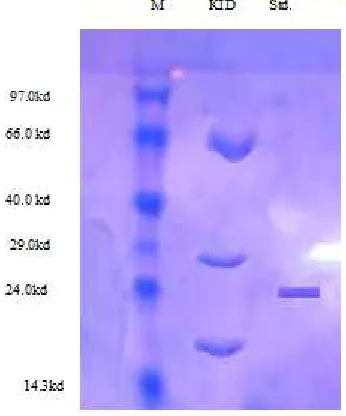
Ammonium sulphate precipitation (80-100% saturation) of the crude protein extract was performed at 4°C. The precipitate was dissolved in 10mM Tris-HCl and was dialyzed against buffer in batches. The dialyzed material was subjected to SDS PAGE (15%) under reduced conditions. The molecular weight of partially purified Trypsin inhibitor was compared with Standard bovine Trypsin inhibitor purchased from Sigma and with medium range protein marker (14.3- 97.4kd)
Statistical analysis
Each sample was analyzed in triplicates and the values were averaged. Data was assessed by ANOVA and mean comparison was done by using Duncan’s multiple range test.
RESULTS AND DISCUSSION
Comparative analysis of Trypsin inhibitor activity in Pulses:
384
Trypsin inhibitor activity in Pigeon pea (PP). Significant difference is found in all the pulses. However sample LEN and CP have not shown any significant difference (Fig-1).
Table 2. Trypsin Activity in Pulses
Pulses Trypsin activity (Units/ml)
KID 5.4a ±0.43
LEN 8.5b±0.35
BEP 7.5c±0.08
CP 8.8b ±0.47
PP 10d± 0.12
Means in a column with different letters are significantly different (p<0.05: n=3)
Fig 1 : Comparison of Trypsin activity in pulses
Heat Sensitivity of Trypsin inhibitor
Heat stability of Trypsin inhibitor was observed at varying temperatures. It was shown that when temperature was increased from 30ºC to 90ºC activity of Trypsin inhibitor decreases which was observed by increase in Trypsin activity. Trypsin activity was maximum at 90ºC (when Trypsin inhibitor activity was minimum) and minimum at 400C. However a significant decrease in activity was observed at 90ºC in all the Pulses.
385
Table 3. Trypsin activity
Trypsin Activity (units/ml)
KID LEN BEP CP PP
Time (Min) 15 30 15 30 15 30 15 30 15 30 30 Temperature (°C)
30 5.3 a± 0.34
5.1a± 0.23
8.30a± 0.4
8.34a± 0.3
7.5a± 0.56
7.23a± 0.03
8.34a± 0.32
8.24a± 0.04
10.34a± 0.24
10.20a± 0.03
10.20a± 0.03
40 5.24 a± 0.2
5.0a± 0.16
8.21a± 0.5
8.17b± 0.3
7.34a± 0.3
7.24a± 0.12
8.67b± 0.56
8.17b± 0.45
10.12a± 0.56
10.67b± 0.04
10.67b± 0.04
50 5.12 b± 0.5
4.98b± 0.7
8.05b± 0.8
7.98c± 0.5
7.12ba± 0.45
6.98b± 0.06
8.04c± 0.65
7.98c± 0.88
10.05a± 0.05
9.87c± 0.45
9.87c± 0.45
60 4.24 c± 0.4
4.12c± 0.2
7.23c± 0.2
7.34c± 0.8
6.34c± 0.68
6.12b± 0.12
7.23d± 0.05
7.67c± 0.74
9.67b± 0.35
9.57c± 0.06
9.57c± 0.06
70 4.01 c
± 0.7
3.78d± 0.8
5.21d± 0.1
5.12d± 0.6
5.12d± 0.22
5.67c± 0.87
6.56e± 0.67
6.12d± 0.10
8.23c± 0.15
8.35d± 0.45
8.35d± 0.45
80 3.56 d± 0.8
3.12d± 0.5
3.23e± 0.6
3.05e± 0.82
4.67e± 0.12
4.29d± 0.65
5.12f± 0.05
4.98e± 0.34
6.12d± 0.08
6.89e± 0.03
6.89e± 0.03
90 1.4 e± 0.16
1.10e± 0.9
1.24f± 0.87
1.23f± 0.67
3.05f± 0.14
2.45e± 0.09
4.23g± 0.35
3.45f± 0.45
4.23e± 0.04
4.19f± 0.05
4.19f± 0.05 Means in a column with different letters are significantly different (p<0.05: n=3)
Partial Purification of Trypsin inhibitor
The sample KID was subjected to Ammonium sulfate salt precipitation on the basis of maximum Trypsin inhibitory activity and heat stability profile. The saturation level was observed to be 60-70%. An increase in the Trypsin inhibitor activity was observed when extract was used after precipitation. It is expressed in terms of decrease in the activity of Trypsin. For further purification, the salt precipitated extract was subjected to dialysis and it was found that Trypsin activity decreases further and hence inhibitor activity increases. . This result is supported by [8], who report that an Ammonium sulfate saturation of 30%-65% was shown to be optimum range for Trypsin inhibitor recovery (Table 4).
Table 4. Partial purification of Trypsin Inhibitor from sample-KID
Purification step Trypsin Activity (U/ml)
Protein Concentration (mg/ml)
Specific Activity (U/mg)
Crude extract 5.8 4.4 1.31
Ammonium salt precipitated 4.23 3.8 1.11
Dialysis 2.05 2.95 0.95
SDS-PAGE Analysis:
SDS-PAGE was performed to see the presence and to determine molecular weight of Trypsin inhibitor. In one lane standard protein marker (14.7-97.6 kd) was loaded and in another lane, dialyzed extract was loaded. In the third lane purified Trypsin inhibitor was added and is used as a standard. The dialyzed extract was resolved into different bands. The molecular weight of Trypsin inhibitor was found to be in the range of 20-24 kd (Fig 2).
[image:4.595.218.391.537.745.2]386
CONCLUSIONAmong all the pulses studied, Phaseolus vulgaris was found to be good in activity of Trypsin inhibitor. The pulse can be cultivated on a large scale in order to increase resistance of the plants to the attack of pest. It can also be concluded that Trypsin inhibitor is heat stable and the effect is shown more by Phaseolus vulgaris. In future the Trypsin inhibitor could be fully purified and characterized further. Similarly the effect of heat stable inhibitor can be studies on Trypsin enzyme released by midgut or in larvae of pathogen. Moreover, other pulses should also be studied for presence of Trypsin inhibitor and should be cultivated on a large scale.
Acknowledgment
We would like to thank Lovely Professional University (LPU), Phagwara, for providing chemicals, laboratory facilities and financially support.
REFERENCES
[1] V Sardana and P Sharma; P Sheoran. Plant growth and crop production. 2004, 3, 141. [2] PR Duarte; D Bergeron; SS Nielsen, J. Agric. Food Chem., 1992, 40 (1), 32–42. [3] DN Roy and SP Rao, J. Agric. Food Chem., 1971, 19 (2), 257–259.
[4] LT Blac and JD Grover. Cereal Chemistry, 2004, 58, 42-45.
[5] C Vidal-Valverde C; J Frias ;A Hernandez; PJ Martin-Alvarez; I Sierra , C Rodriguez , I Blazquez ; G Vicente.
J Sci Food Agr., 2003, 83, 298–306.
[6] SA Godbole; TG Krishna; CR Bhatia. Journal of the Science of Food and Agriculture, 2000, 64 (3), 87–93. [7] MI Vasconcelos; J Tadeu; A Oliveira, Toxicon., 2004, 44, 385–403.